instrument cluster AUDI Q7 2011 Owner´s Manual
[x] Cancel search | Manufacturer: AUDI, Model Year: 2011, Model line: Q7, Model: AUDI Q7 2011Pages: 392, PDF Size: 93.29 MB
Page 181 of 392
____________________________________________ A_ d_a_ p ,_ t_iv _ e_ A _ i_ r _ S_ u_s_, p __ e_n _ s_ i _o_ n __ _
App lies to ve hicles : with A dap tive Air Su spen sion
Chassis controls
Five different driving modes can be set by the driver.
The automatic control processes are speed- and time-dependent. For
example, it is not possible to raise the suspension to a high level
above certain speeds.
When a speed of about 75 mph (120 km/h) is exceeded for more than
30 seconds, the vehicle is automatically lowered to
low level when in
comfort and automatic mode. Ground clearance is about 0.6 inch (15
mm) less, compared to the
normal level.
When a speed of about 100 mph (160 km/h) is exceeded for more
than 20 seconds, the vehicle is automatically lowered to
highway
level
when in automatic and dynamic mode . Ground clearance is
about 1.4 inches (35 mm) less, compared to the
normal level. Road
holding is optimized as a resu lt of the lower center of gravity, and fuel
consumption is reduced as a result of reduced wind resistance .
Level adjustment
high level 2
normal level
highway level
Ground clearance
about 9.4 inches (240 mm)
about 8 inches (205 mm)
about 7 inches (180 mm)
about 6.5 inches (165 mm)
about 5. 7 inches (145 mm)
The segment display @ in the MMI Display =>
page 180 or in the
instrument cluste r display =>
page 181 shows the current vehicle
level.
Automatic
Select the automatic mode if you prefer a balanced, comfortable
suspension setting. The damp ing characteristics are adjusted accord
ing ly .
Controls and equip
ment Safety first •
Automatic lowering: When a speed of about 75 mph (120 km/h)
is exceeded for more than 30 seconds, the veh icle is automatically
lowered by about 0 .6 inch (15 mm) to the
low level, which is more
suitable for highway speeds. Road holding is optimized as a result of
the lower center of gravity and fuel consumpt ion is reduced as a
result of reduced wind resistance . When a speed of about 100 mph
(160 km/h) is exceeded fo r more than 20 seconds, the vehicle is auto
matically lowered by an additional 0.8 inch (20 mm) to
highway level.
• Automatic raising: When the vehicle is at highway level and the
speed falls below about 80 mph (130 km/h) for more than 20
seconds, the vehicle is automat ically raised to
low level. The vehicle is
automatically raised again to
normal level if the speed falls below
about 44 mph (70 km/h) for a period of 2 minutes. The vehicle is
raised immediately when speed falls below about 22 mph (35 km/h).
Dynamic
Select the dynamic mode if you prefer a sporty suspension setting . In
this mode, the vehi cle is lowe red to
low level wh ile it is still stationary
and sporty damp ing characteristics a re selected . The warning light
c.:> in the instrument cluster wi ll come on for a few seconds just to
remind you of the reduced ground clearance.
If you switch off the engine whi le the vehicle is in the dynamic mode
and then switch on the ignition once again, the
c.:> warning light will
also come on again for a few seconds as a reminder .
• Automatic lowering : When a speed of about 100 mph (160 km/h)
is exceeded fo r more than 20 seconds, the vehicle is automatically
lowered by 0.8 inch (20 mm) to
highway level.
• Automatic raising: The vehicle is automatically raised to low level
again, if the speed falls below about 80 mph (1 30 km/h) for a per iod
of 20 seconds. The vehicle is raised immediately when speed falls
below about 22 mph (35 km/h).
Comfort
Select the comfort mode if you desire a suspension setting with a
special emphasis on comfort. Damping characteristics with a clear
emphasis on comfort are selected in this mode.
~
Vehicle care Technical data
Page 182 of 392
ffl..__A_ d_a_ p,__ t_iv _ e_ A_ i_r _ S_ u_s _, p'--- e_n _ s_ i_ o _ n ___________________________________________ _
• Automatic lowering: When a speed of about 75 mph ( 120 km/h)
is exceeded for more than 30 seconds, the vehicle is automatically
lowered by 0 .6 inch (15 mm) to
low level .
• Automatic raising: The vehicle is automatically raised to normal
level
again, if the speed falls below about 44 mph (70 km/h) for a
period of 2 minutes . The vehicle is raised immediately when speed
falls below about 22 mph (35 km/h) .
Offroad
Select the offroad mode when you have to travel over poor quality
sections of road (e.g. trails) . In this mode, the vehicle is raised to
high
level 1,
and damping characteristics for poor road stretches are
selected. When switching to offroad mode, the Adaptive Air Suspen
sion indicator appears automatically in the instrument cluster display
~page 181 .
The offroad mode can only be activated at speeds below 37 mph
(60 km/h). Offroad mode ends automatically and the automatic
mode is activated when a speed of approximately 50 mph (80 km/h)
is exceeded.
Lift
Select the lift mode when exceptionally high ground clearance is
needed at a reduced speed. In this mode, the vehicle is raised to
high
level
2 . When switching to lift mode , the Adaptive Air Suspension
indicator appears automatically in the instrument cluster display
~page 181 .
The lift mode can be activated only at speeds below 12 mph (20
km/h) . When a speed of about 25 mph (40 km/h) is exceeded, the
system automatically leaves
lift mode and the offroad mode is acti
vated . The instrument cluster display automatically switches the
display to Adaptive Air Suspension to indicate reduced ground
clearance. •
Appli es to veh icles : with Adapt ive Air Su spens ion
MMI se ttings
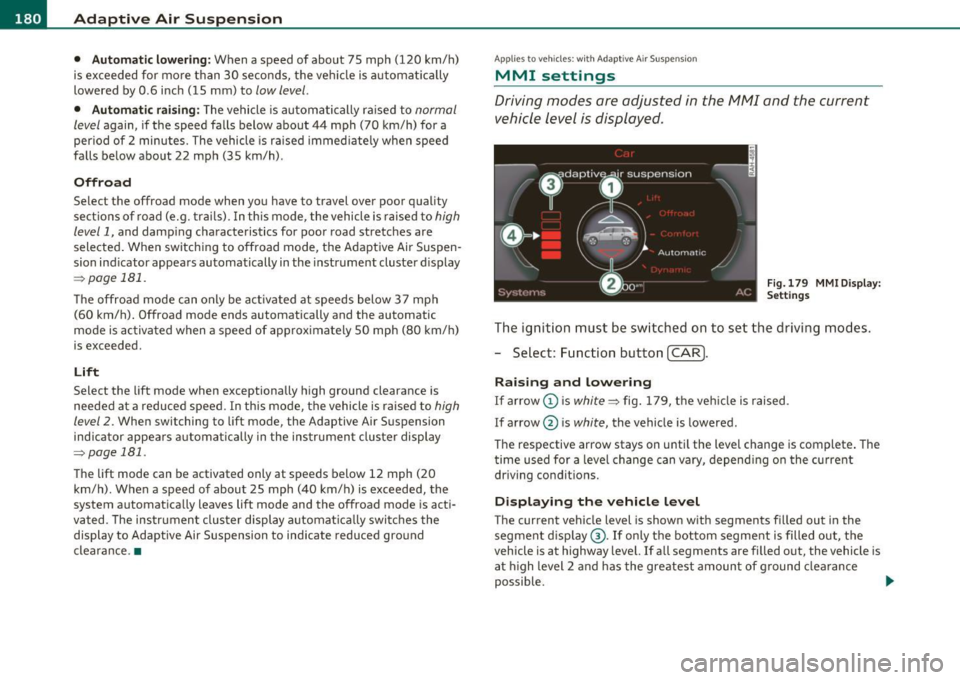
Driving modes are adjusted in the MMI and the current
vehicle level is displayed.
Fig.179 MMI Display:
Settings
The ignition must be switched on to set the driving modes.
- Select: Function button
(CAR].
Raising and lowering
If arrow (Dis white ~ fig. 179, the vehicle is raised.
If arrow @ is
white, the vehicle is lowered .
The respective arrow stays on until the level change is complete. The
time used for a level change can vary, depending on the current
driving conditions.
Displaying the vehicle level
The current vehicle level is shown with segments filled out in the
segment display ®·
If only the bottom segment is filled out, the
vehicle is at highway level. If all segments are filled out, the vehicle is
at high level 2 and has the greatest amount of ground clearance
possible. .,_
Page 183 of 392
____________________________________________ A_ d_a ..... p,__ t_iv _ e_ A_ i_r _ S_ u_s__, p_ e_n _ s_ i_ o _ n _ __.1111
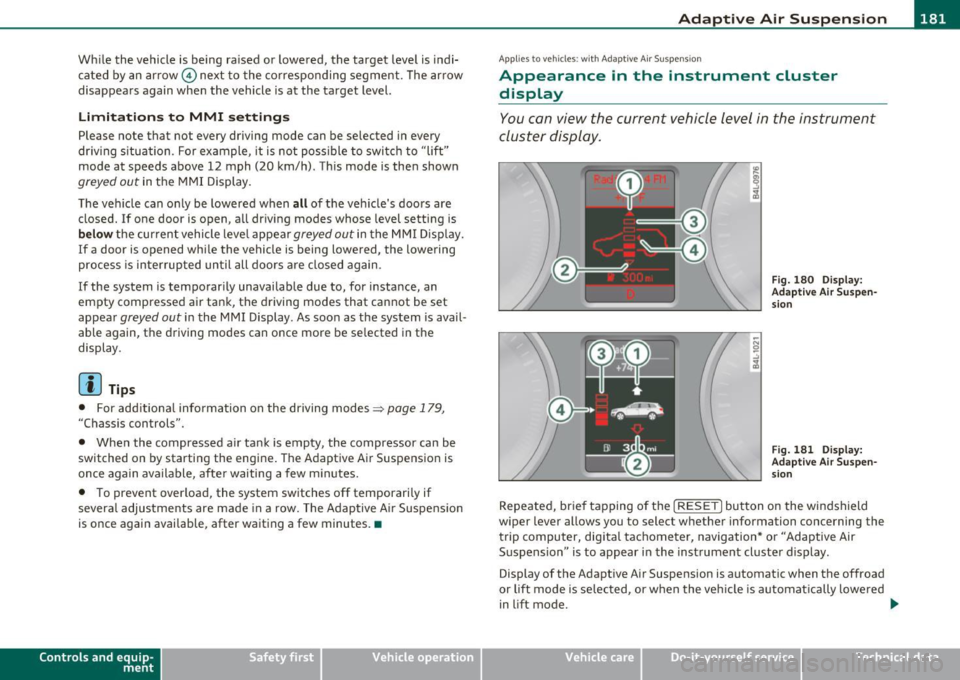
While the vehicle is being raised or lowered, the target level is indi
cated by an arrow © next to the corresponding segment. The arrow
disappears again when the vehicle is at the target level.
Limitations to MMI settings
Please note that not every driving mode can be selected in every
dr iving s ituation . For example , it is not poss ible to switch to "lift"
mode at speeds above 12 mph (20 km/h) . This mode is then shown
greyed out in the MMI Display .
The vehicle can on ly be lowered when
all of the veh icle's doors are
closed.
If one doo r is open, all driving modes whose level setting is
below the current vehicle level appear greyed out in the MMI Display.
If a door is opened whi le the vehicle is being lowered , the lowering
process is interrupted until all doo rs are closed again.
I f the system is temporarily unavailable due to, for instance, an
empty compressed air tank, the driving modes that cannot be set
appear
greyed out in the MMI Display . As soon as the system is avail
able aga in, the driv ing modes can once more be selected in the
display .
(I] Tips
• For additional information on the driving modes=> page 179,
"Chassis controls".
• When the compressed air tank is empty , the compressor can be
switched on by starting the engine. The Adaptive Air Suspension is
once again available, after waiting a few minutes.
• T o prevent overload, the system switches off temporarily if
severa l adjustments are made in a row. The Adaptive A ir Suspens ion
is once again available, afte r waiting a few minutes. •
Contro ls a nd e quip
m en t Vehicle
OP-eration
Applies to vehicles : w ith Adapt ive A ir Sus pens ion
Appearance in the instrument cluster
display
You can view the current vehicle level in the instrument
cluster display.
Fig. 180 Display:
Adaptive Air Suspen sion
Fig. 181 Display:
Adaptive Air Suspen
s ion
Repeated, br ief tapping of the [ RESET] button on the windshield
wiper lever allows you to selec t whether information concerning the
trip computer, digita l tachometer, navigation* or "Adaptive Air
Suspension " is to appear in the instrument cluster display .
Display of the Adaptive Air Suspension is automatic when the offroad
or lift mode is se lected, or when the vehicle is automat ically lowered
in lift mode.
~
Vehicle care Do-it-yourselt service iTechnical data
Page 203 of 392
_______________________________________________ S_ a_ f_ e_ t_ y_ b_ e_ lt_s __ _
Safety belts
General notes
Always wear safety belts!
Wearing safety belts correctly saves lives!
This chapter explains why safety belts are necessary, how
they work and how to adjust and wear them correctly.
- Read all the information that follows and heed all of the
instructions and WARNINGS.
& WARNING
Not wearing safety belts or wearing them improperly increases
the risk of serious personal injury and death.
• Safety belts are the single most effective means available to
reduce the risk of serious injury and death in automobile acci
dents. For your protection and that of your passengers, always
correctly wear safety belts when the vehicle is moving.
• Pregnant women, injured, or physically impaired persons must
also use safety belts. Like all vehicle occupants, they are more
likely to be seriously injured if they do not wear safety belts. The
best way to protect a fetus is to protect the mother - throughout
the entire pregnancy. •
Number of seats
Vehicles with five seats: Your vehicle has two front seats and three
rear seats. Each seating position has a safety belt.
Vehicles with six seats:* Your vehicle has two front seats, two seats
in the second row and two seats in the third row. Each seating posi
tion has a safety belt.
Controls and equip ment Safety first Vehicle operation Vehicles with
seven seats:* Your vehicles has two front seats, three
seats in the second row and two seats in the third row . Each seating
position has a safety belt.
& WARNING
Not wearing safety belts or wearing them improperly increases
the risk of serious personal injury and death.
• Never strap more than one person, including small children,
into any belt. It is especially dangerous to place a safety belt over
a child sitting on your lap.
• Never let more people ride in the vehicle than there are safety
belts available.
• Be sure everyone riding in the vehicle is properly restrained
with a separate safety belt or child restraint. •
Safety belt warning light l
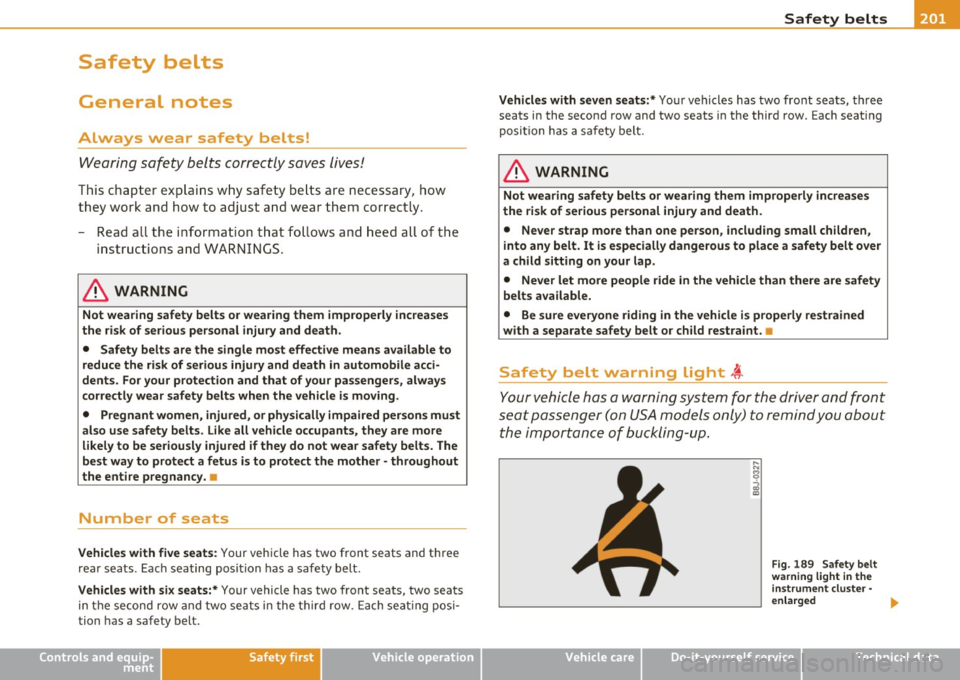
Your vehicle hos a warning system for the driver and front
seat passenger (on USA models only) to remind you about the importance of buckling-up.
Vehicle care
Fig. 189 Safety belt
warning light in the
instrument cluster·
enlarged ...
Do-it-yourself service Technical data
Page 204 of 392
... Safety belts PNM-- -=-------------------------------
Before driving off, always:
-Fasten your safety belt and mak e sure you are wea ring i t
p roperly .
- Make sure that your passengers also buckle up and prop
erly wear their safety be lts.
- Prot ect ch ildren w ith a child rest raint system appropriate
for the size and age.
T he warning light -if. in the instrument cluster lights up when the igni
tion is sw itched on as a reminder to fasten the safety belts. In addi
tion, you will hear a warning tone for a certa in period of time.
Fasten your safety belt and make s ure that your passenger s al so
properly put on their safety belts .
& WARNING
• Safety belts are the single most effective means available to
reduce the ri sk of serious injury and death in automobile a cci
dents. Fo r your protection and that of your passengers , always
c orrectly wear safety belts when the vehicle is moving.
• Failure to pay attention to the warning light that come on ,
could lead to personal injury. •
Why safety belts?
Frontal collisions and the law of physics
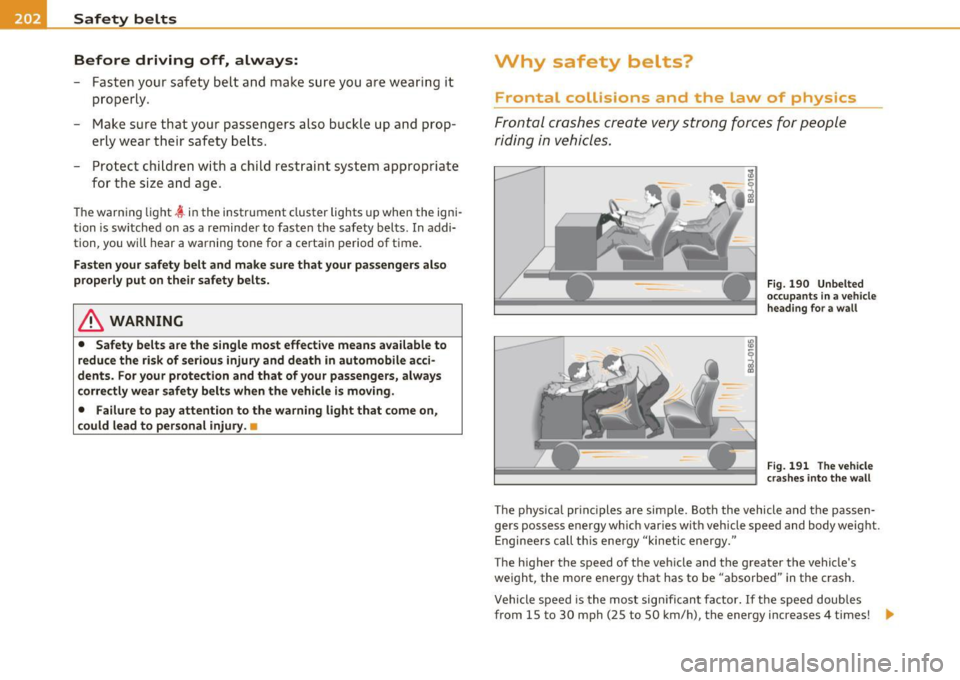
Frontal crashes cre ate very stron g forc es for people
ri din g i n vehi cles.
Fig . 19 0 Unbelted
o ccupa nts in a v ehicle
h eading f or a w all
Fig . 191 Th e vehicle
cr as hes into the wall
T he p hys ica l pr inc iples are simple. Both the vehicle and the passen
gers possess energy which var ies wit h veh icle speed and body weight.
E nginee rs ca ll t his ene rgy "kinetic energy."
The higher the speed of the veh icle and t he greater the vehicle's
we ight, the more energy that has to be "abso rbed" in the crash .
Vehicle speed is the most sig nifican t fa ctor. If t he speed doubles
from 15 to 30 mph (25 to 50 km/h), the energy increases 4 times! .,
Page 226 of 392

-L___:_A~ i r'....: b~ a ::::: gL:: s~y -=s ::..:t :.:e :..: m..:..:.. ______________________________________________ _
• make sure that thi ngs that may increase the weig ht o f the child
and ch ild safe ty se at are not be ing transported on t he front
passenger seat;
• make sure that the safety belt tens ion sensor is not blocked.
Shake the safety belt latch on the front passenger seatback and forth;
• If a strap or tether is being used to t ie the child safety seat to the
front passenger seat, make sure that it is not so tight that it causes
t he weight-sensing mat to meas ure more weight than is actua lly on
the seat .
If the PASSENGER AIR BAG OFF l ight still doe s not come on and
does not stay on cont inuously (when the ignition is switched on),
• take the child restraint off the f ront passenger seat and install it
properly at one of the rear seat positions . Have the airbag sys tem
inspected by your authori zed Audi dealer immediately .
• move the child to a rea r seat position and ma ke s ure that the child
is properly restrained in a ch ild restraint that is appropriate for its
size and age .
The
PA SSENG ER AIR BAG OFF light should NOT come on when the
ignition is on and an adult is sitting i n a proper seating position on the
front passenger seat . If the
PASSENGER AIR BAG OFF light comes on
and stays on or flashes for abo ut 5 seconds while driving, under these
circumstances, make sure that:
• the adult on the front passenger seat is properly seated on the
c en ter of the sea t cushion wi th his or her back up against the backrest
and the backrest is not reclined::::;,
page 192, "Proper occupant
seating positions",
• the adult is not taking weight off the seat by holding on to the
passenge r assis t handle above the fron t passenger door or
supporting their weight on the armrest,
• t he safety bel t is be ing properly wor n and that the re is not a lot of
slack in the safety belt webb ing,
• accessory seat cove rs or cushions o r othe r th ings that may ca use
an incor rect read ing or impress ion on the weight-sensing mat under the upholstery of the seat have bee
n removed from the front
p assenge r seat,
• a safety belt extender has not been left in the safety belt latch for
t he front passenge r se at.
In add it io n to the
PASSENGER AIR BAG OFF light in the center of the
instrument panel, the message
PASSENGER AIR BAG OFF or
PASSENGER AIR BAG ON will br iefly appear in the instrument cluster
display . This is to inform the driver of the current front passenger
airbag status .•
Important safety instructions on
monitoring the Advanced Airbag System
& WARNING
An a irbag syst em that is not fun ction ing properly cannot provide
supplemental protect ion in a frontal crash.
• If th e airbag indic ator light comes on , it means th at there may
be something wrong with the Advanc ed Airbag S ystem . It i s
poss ible that th e airbag will inflat e when it is not suppos ed to , or
will not inflate when it should.
• Have the a irb ag system inspected immediately by your autho
rized Audi dealer .
& WARNING
If the front airb ag inflate s, a child without a child restraint, or in
a rearwa rd -facing child safet y seat, o r in a fo rwa rd-facing child
re straint that h as not b een properl y install ed will be seriou sly
i njured and can b e killed.
• Even though your v ehicl e is equipped with an Advan ced Airbag
S y stem , ma ke certain that all children , especi ally 1 2 yea rs and
y ounger, alway s ride on the back seat properly restra ined for their
a ge and size . .,,_
Page 229 of 392

safety belt is being used but will inflate at the position where the
safety belt is not being used. It is impo rtant that nothing in terfere
with the safety belt buckles so that the sensors can send the correct information about safety belt use to the electronic control unit.
& WARNING
Changing the vehicle's suspension including use of unapproved
tire-rim combinations can change Advanced Airbag performance
and increase the risk of serious personal injury in a crash.
• Never install suspension components that do not have the
same performance characteristics as the components originally
installed on your vehicle.
• Never use tire-rim combinations that have not been approved
by Audi.
& WARNING
Items stored between the safety belt buckle and the center
console can cause the sensors in the buckle to send the wrong
information to the electronic control module and prevent the
Advanced Airbag System from working properly.
• Always make sure that nothing can interfere with the safety
belt buckles and that they are not obstructed .
W For the sake of the environment
Undeployed airbag modules and pretensioners might be classified as
Perchlorate Material -special handling may apply, see
www.dtsc.ca.gov/hazardouswas te/perchlorate . When the vehicle or
parts of the restraint system including airbag modules and safety
belts with pretensioners are scrapped, all applicable laws and regu la
tions mus t be observed. Your authorized Audi dealer is familiar w ith
these requirements and we recommend that you have your dealer
perform th is service for you .•
Safety first Vehicle OP-eration
Airbag system
Side airbags
Description of side airbags
The airbag system can provide supplemental protection
to properly restrained occupants.
Fig. 204 Side airbag
location in the driver's
seat
The side airbags are located in the sides of the front seat backrests
~ fig. 204 and the rear backrest* facing the doors . They are identi
fied by the word "AIRBAG" .
The side airbag system basically consists of:
• the electronic control module and external side impact se nsors
• the two side airbags located in the sides of the front backrests
• two rear side airbags (as an ordered
option)
• the airbag warning light in the instrument cluster.
Th e airbag system is monitored elect ronically to make certain that it
is functioning properly at all times. Each time you turn on the igni
tion, the airbag system indicator light will come on for a few seconds
(self d iagnostics).
The side airbag system supp lements the safety belts and can he lp to
reduce the risk of injury to the dr iver 's, front and rear* passenger 's
upper torso on the side of the vehicle that is struck in a side collision.
The airbag deploys on ly in s ide impacts and only when the vehicle
acceleration registered by the control unit is high enough. If this rate
~
Vehicle care Do-it-yourselt service iTechnical data
Page 266 of 392
Intelligent technology
'-------------------------------------------------
Take into consideration that when you unlock your vehicle, some
convenience functions, such as the remote key or power seat adjust
me nt, may not be available. The convenience functions will be avail
able again when you turn on the ignition and start the engine.
With the engine turned off
If you listen to the radio, for example, with the engine turned off or
use other MMI functions, the battery is being discharged.
If start ing capability is jeopardized due to energy consumption, the
following warning appears in the MMI display:
Please start engine, otherwise system will switch off in
3 minutes .
The warning indicates that the system will be turned off automati
cally after 3 minutes. If you wish to continue using the functions, you
have to start the engine.
With the engine running
Although electrical energy is generated when the vehicle is being
driven, the battery can become discharged. This happens mostly
when little energy is being generated and a great deal consumed and
the battery's state of charge is not optimal.
To bring the energy balance back into equilibr ium, consumers which
require especially large amounts of energy are temporarily cut back
or switched off. Heat ing systems in particular require a great deal of
energy. If you notice, for example, that the heated seats* or the
heated rear window are not heating, they have been temporarily cut
back or switched off. These systems will be available again as soon as
the energy balance has been restored .
You will also notice that engine idle speed has been increased
slightly. This is norma l and not a cause for concern. By increasing
engine idle speed the additional energy required is generated and the
battery is charged.
Driver notification in the instrument
cluster display
If battery power drops into the range where it can limit the ability of
the engine to start, this is shown in the instrument cluster display
with the following driver message:
i...-3 Low battery charge: battery will be charged while driving
This notification reminds you that the starting capability of the
engine may be limited. As soon as you start driving again, the battery
w ill be recharged and the notification will go out.
Driver notification appears and goes out again
If th is driver notification appears after the ignition is turned on or
whi le driving and it goes out again after a while, the battery has been
adequately recharged.
Driver notification appears and does not go out
again
If this driver notification appears after the ignition is turned on o r
wh ile driving and does not go out again, the battery's state of charge
is not in the optimal range. Starting ability is restricted. Have the
battery checked as soon as possible by an authorized Audi dealer or
qualified workshop. •
Page 299 of 392

If Ad Blu e usag e incr eas es due to ind iv id ual driving sty le, th e d river
must add Ad Blue be tween sche duled m ain te na nce in te rv al s
=>page 298.
& WARNING
Failure to heed Ad Blue refill information in the instrument cluster
c an prevent the vehicle from being started and driven . If the
vehicle cannot be driven and an emergency arises, personal injury
c an oc cur.
• Always have the Ad Blue tank refilled well before the tank runs
dry.
[ i J Tips
• If the A d Blue t ank is complete ly em pty, the engine w ill not s tar t
agai n after the igni tion is sw itched off. The instrument cluster d isp lay
ind ica tes t he distance remaining tha t can be driven =>
page 297 .
• Ad Blue is required by law to operate this vehicle.
• AdBlue ® is a regis tered tradem ark of the Regis tered Automob ile
Assoc iation (Verband der Automobilindustrie e . V. -VOA). •
Safety first
Fuel supply and filling your fuel tank
App lies to ve hicles : w ith d iese l eng ine
Indicator in the instrument cluster display
The display indicates if the Ad Blue level is low or if it was
filled incorrectly .
AdBlue level low
Fig. 228 In str ument
clu ste r: i ndi cator in the
di sp la y
Yo u will be informed if the Ad Blue in the ta nk drops be low a certain
level.
Ad Blue f) 1500 mi (2400 km ) Refill AdBlue. See owner 's
manual
Thi s indicator appea rs when there is only eno ugh Ad Blue left to drive
the distance indicated in the driver information system. You w ill hear
a warning signal. P lease add AdBl ue.
l " n _ 0 "' Refill Ad Blue! No restart in
600 miles (1000 km )! See owne r's manual
Thi s indi cato r appea rs w hen there is only eno ugh Ad Blue left to dr ive
the dis tance ind icated in the driver informat ion system. You will also
hear a wa rning signal. P lease add Ad Blue. Otherw ise the engine w ill
not start again if you stop it once the d istance ind icated has been
driven.
AdBlue f) 0 mi (0 km) Refill Ad Blu e! No re start! See own er' s
manual
Vehicle care Technical data
Page 301 of 392

- Remove the cap from the refill bott le.
- Position t he refill bott le on the filler tube a nd turn the
bottle clockwise u ntil it stops turning~
page 298,
fig. 230 © -
- Press lightly against the bottom of the bottle@to em pty
it. Contin ue pressing the bottom o f the bott le until it is
empty or until fluid stops flowing into the tank.
- Turn the bottle to the left without pressing on the
bottom .
Closing the filler tube
- Turn t he cap clockw ise on t he fi ller t ube with t he lug
wrench un til you hear it t ighte n comp letely.
- Then press on the le ft side of the filler fla p un til yo u hear
i t lock.
& WARNING
• Ad B lu e can irritat e the skin, eye s and respiratory sy stem. If
the re is contact with the fluid , flush immed iately with plenty of
water. Con sult a phy sician if ne ce ss ary .
• Do not allow Ad Blue to come into contact with clothing. If
there is contact with the fluid , flush immediate ly with plenty of
water.
0 Note
• Only use Ad Blue that conforms to the standard ISO 22241-1. Do
no t m ix any addit ives wi th the Ad Blue and do not dil ute it with water.
• Ad Blue is not a diesel add it ive. Do not add it to the diese l tank. If
Ad Blue is mixed w it h diesel f ue l, it can lead to damage to the engine
and the Ad Blue tank system. The L imited New Vehicle Warranty does
no t cover su ch damage.
Safety first
Fuel supply and filling your fuel tank
• Ad Blue attacks surfaces such as pai nted vehicle components,
plast ic and carpet. Remove the fluid as q uickly as poss ible wi th a
damp cloth and plenty of cold wate r. If the Ad Blue has already crys
tallized, use wa rm water and a sponge. Ad Bl ue residue that is not
removed will crystallize and can damage the affected s urface.
• Do not store the refi ll bott le in the veh icle. If it leaks, the esc aping
Ad Blue could damage the vehicle interior .
(I) Tips
• The fuel fil ler flap of your vehicle is not locked whe n you lock the
vehicle from the inside.
• The refill bottle ho lds approximate ly 0.5 gallon (1.9 liters) .
Always add two bottles of Ad Blue (1 gallon/3.8 liters) as soon as a
message appears in the instrument cluster display~
page 297. The
ignition must be switched off when filling the Ad B lue.
• The vehicle must be driven after the Ad Blue has been fi lled. The
system may take up to two minutes to detect when Ad B lue is added .
Whe n there is no more Ad Blue in the ta nk and
O mi (0 km) appears in
the instrument cluster display, switch the ignition on for approxi
mately 15 seco nds and then sta rt the eng ine.
• You can obtain refill bottles from any a uthorized Audi dealer or
other qualified workshop.
• F ollow t he Ad Blue manufacturer 's inst ru ct io ns for usage and
storage .•
Vehicle care Technical data