child seat AUDI Q7 2011 Owner´s Manual
[x] Cancel search | Manufacturer: AUDI, Model Year: 2011, Model line: Q7, Model: AUDI Q7 2011Pages: 392, PDF Size: 93.29 MB
Page 248 of 392
lffll.___C_ h_ il_d _ S_a _ f_ e _ t--= y '------------------------------------------------
& WA RNING (conti nued)
• Always bu ckle the child safety seat firmly in place even if a
child i s not sitting in it . A loo se child safety seat can fly around
during a sudden stop or in a crash.
• Always make sure the seat backre st to which the child restraint
is installed is in an up right position and securely latched into place
and cannot fold forward . Otherwise, the seatback with the child
safety seat attached to it could fly forward in the event of an acci ·
dent or other emergency situation.
• Alway s read and heed all WARNINGS wheneve r using a child
restrained in a vehicle is being used=>
page 233. Special precau
tions apply when installing a ch ild safety seat on the front
passenger seat =>
page 213, "Child restraints on the front seat -
some important things to know ".•
Deactivating the convertible Locking
retractor
The convertible l ocking retrac tor for child restraints will
be d eactivated automatically when the belt is wound all
the way back into the retractor.
- P ress t he red butto n on t he safety be lt buckle . T he belt
to ngue will pop out o f the buckle.
- G uid e the s afety belt all the way back in to its stowed posi-
t ion .
Always le t the safety be lt retract comple tely i nto i ts s towed position.
T he safety bel t can now be used as an ord inary safety belt without the
convertib le locking ret ractor for ch ild rest raints.
If th e convertible locking r etractor should be activated inadve rtently,
the safety be lt must be un fastened and guided comp letely back into
i t s s towe d position to de activa te th is fe ature. If th e convert ible locking retractor is
not deact ivated, the safety belt w ill gradua lly
become tigh ter and uncomfo rtable to we ar.
& WARNING
Improperly in stalled child safety seats increase the risk of serious
personal injury and death in a collision.
• Never unfasten the safety belt to deactivate the convertible
lo cking retractor for child restraints while the vehicle is moving.
You would not be restrained and could be seriou sly injured in an
a ccident .
• Always read and heed all WARNINGS whenever u sing a child
restrained in a vehicle is being used
=> page 233. Special precau·
tions apply when in stalling a child safety seat on the front
passenger seat =>
page 213, "Child restraints on the front seat -
s ome important things to know ".•
LATCH Lower anchorages and
tethers for children
Child Restraint System anchors and how
are they related to child safety
T o prov ide a s imp le r a nd more practic able way to a ttach the child
restraint on the vehicle seat, Federal regulat ions require special
lowe r anch orages in ve hicl es and devi ces on new ch ild rest rain ts to
attac h to the veh icle anchorages.
Th e combination of the tether anchorages and the lower anchorages
is now gene rally called the
LATCH sys tem fo r "Lowe r Anch orages and
T ethers for Children ."
Forw ard -fa cing child res train ts manuf actured aft e r September 1,
1999, are required by U.S. federa l regu lat ions to comp ly with new
c hild head moveme nt performan ce requirements. These new per for -
~
Page 249 of 392

mance requirements make a tether necessary on most new ch ild
seats.
Installing a child restra int that requires a top tether w ithout one can
seriously impair the performance of the chi ld restrai nt and its ability
to prote ct the child in a collision. Insta lling a child restraint tha t
requires a top tether without the top tether may be a violation of
state law.
Child restraint manufacturers offer LATCH lower anchorages on the ir
child seats with hook -on or push-on connectors attached to adjust
able straps .
In addition to the LATCH lower anchorages, these child restraint
systems usually require the use of tet he r straps to he lp keep the child
restra int firm ly in place.
& WARNING
Improper installation of child restraints will increase the risk of
injury and death in a crash.
• Always follow the instructions provided by the manufacturer
of the child restraint you intend to install in your vehicle.
• Never install a child restraint without a properly attached top
tether strap if the child restraint manufacturer 's instructions
require the top tether strap to be used.
• Improper use of child restraint LATCH lower anchorage points
can lead to injury in a collision . The LATCH lower anchorage points
are designed to withstand only those loads imposed by correctly
fitted child restraints .
• Never mount two child restraint systems on one LATCH lower
anchorage point .
• Never secure or attach any luggage or other item to the LATCH
lower anchorages .
Safety first Vehicle OP-eration
Child Safety
(I) Tips
• In Canada, the terms "top tether" with "lower universal anchor
ages" (or " lower universal anchorage bars") are used to describe the
system.
• In other countries, the term "ISO FIX" is used to descr ibe the lower
anchorages. •
Location
Fig. 212 Schematic
overview: LATCH
a nchorage point loca
tions
Th e illustrat io n shows the seat ing locat ions in your vehicle whic h are
equipped with the lower anchorages system. •
Vehicle care Do-it-yourselt service iTechnical data
Page 250 of 392
___ C_h _i_ld _ S_ a_ f_ e_ t_,, y'-----------------------------------------------
Description
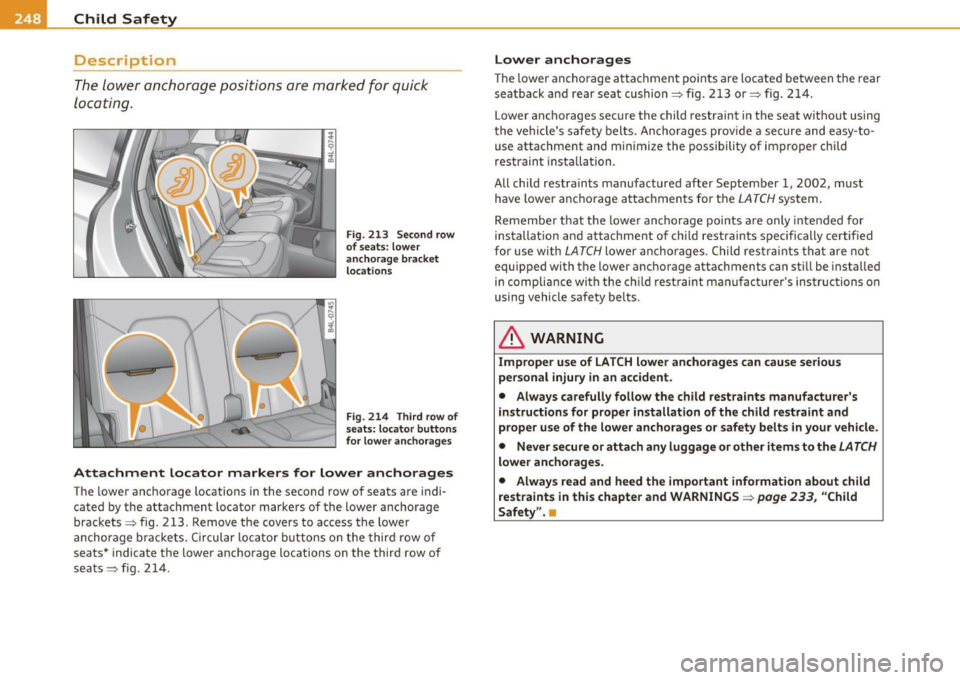
The lower anchorage positions are marked for quick
locating.
Fig . 213 Second row
of seats: lower
anchorage bracket
locations
Fig . 214 Third row of
seats: locator buttons
for lower anchorages
Attachment locator markers for lower anchorages
The lower anchorage locations in the second row of seats are indi
cated by the attachment locator marke rs of the lower a nchorage
brackets => fig . 213. Remove the covers to access the lower
anchorage brackets. Circular locator buttons on the third row of
seats * indicate the lower anchorage locations on the third row of
seats => fig. 214.
Lower anchorages
The lower anchorage attachment po ints are located between the rear
seatback and rear seat cushion=> fig. 213 or=> fig. 214 .
Lower anchorages secure the child restraint in the seat without using
the vehicle 's safety belts. Ancho rages prov ide a secure and easy -to
use attachment and minimize the possibility of improper child
restrain t insta lla tion .
All child restraints manufactured after September 1, 2002, must
have lower anchorage attachments for the
LATCH system.
Remembe r that the lower anchorage points are only intended for
installation and attachment of ch ild restraints spec ifically certif ied
for use with
LATCH lower anchorages . Child restraints that are not
equipped with the lower anchorage attachments can st ill be insta lled
in compliance with the child r estraint manu facturer's ins truc tions on
using vehicle safety belts .
& WARNING
Improper use of LATCH lower anchorages can cause serious
personal injury in an accident.
• Always carefully follow the child restraints manufacturer's
instructions for proper installation of the child restraint and
proper use of the lower anchorages or safety belts in your vehicle.
• Never secure or attach any luggage or other items to the
LATCH
lower anchorages.
• Always read and heed the important information about child
restraints in this chapter and WARNINGS =>
page 233, "Child
Safety". •
Page 251 of 392

Applies to veh icles : w ith th ird row seat ing
Guidance fixtures for Lower anchorages
Special guidance fixtures increase the convenience of the
lower anchorages and are available from your authorized
Audi dealer.
I I 0
0
I
Fig. 215 Third row of
seats: installing the
guidance fixtures
Fig. 216 Close-up :
fitting the guidance
fixture over the lower
anchorage bracket
The lower anchorage attachment points are located on the
third row of seats between the seatback and the seat
cushion. Special guidance fixtures increase the convenience
of the lower anchorages and help protect the seat material
from possible damage when installing child restraints .
Safety first Vehicle OP-eration
Child Safety
Installing the guidance fixtures
- Push down on the seat cushion so that the lower anchor
ages are visible.
- Hold the guidance fixture with the part number facing
downward and push it in the direction of the arrow onto
the anchorage~ fig. 216 .
- Make sure that each of the two guidance fixtures per seat
snaps into place.
Removing the guidance fixtures
- Remove the child restraint according the child restraint
manufacturer's instructions.
- Push down on the seat cushion so that the lower anchor
ages are visible.
- Pull off the guidance fixtures from the lower anchorages.
Always remove the guidance fixtures and keep them in a
safe place when not in use.
You may find it easier to install child restraints equipped with hooks
attached to straps without the guidance fixtures in place.
If this is the
case, remove the guidance fixtures by pulling them off the anchor
ages. However, the guidance fixtures can help you to locate the
LATCH anchorages.
& WARNING
Improper use of tether anchorages or lower anchorages can cause
serious personal injury in a crash.
• Always carefully follow the child restraint manufacturer's
instructions for proper installation and use of child restraint
systems.
II>
Vehicle care Do-it-yourselt service iTechnical data
Page 252 of 392
• .___C_ h_ il_d _ S_a _ f_ e _ t--= y '------------------------------------------------
& WA RNING (conti nued)
• Never u se the LATCH or tether anchorages to attach safety
belt s or other kinds of occupant re straints .
• Child restraint tether attachments and lower attachment s are
only designed to se cure a child restraint that has been equipped to
u se the se anchorages.
• Tether anchorages and lower anchorages are designed to with ·
stand only tho se loads imposed by correctly fitted child re straints.
Under no circumstances can they be used safely for adult or child
s afety belts or harnesses .
• Never mount more than one child restraint to a s ingle tether or
to a lower anchorage point. Attaching two child restraint s to a
single anchorage point can cause the anchorage to fail and cause
seriou s personal injury in a crash.
0 Note
• Remove the g uidance fixtures before folding the rear seatback to
preven t damaging the seat cushion .
• If you leave t he gui dance fix tures ins talled for severa l days, they
co uld leave a mark o n th e upholste ry on t he seat c ushi on and bac krest
in th e area t hat the guidance fixt ures w ere install ed. The upholstery
wou ld also be permane ntly stretc hed a round the gu idance fixtures .
Th is applies especially to leathe r seats. •
Installing a child restraint with LATCH
lower anchorages
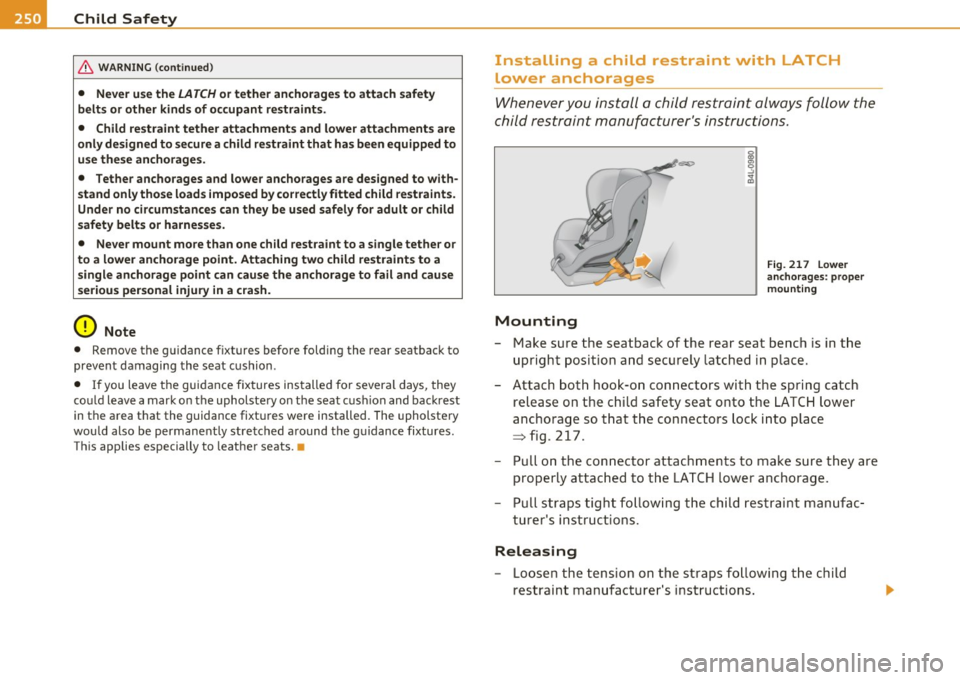
Whenev er you install a child restraint always f ollo w the
child restraint manufacturer's instructions.
Mounting
Fig. 217 Lower
anch ora ges : pr op er
mounting
- M ake sure the seatbac k of the rear seat be nch is in t he
u prigh t position a nd securely latche d in p lace .
- Att ach both hook-o n con nectors wi th th e spring catc h
release on t he ch ild sa fety se at o nto the LATC H lower
anchorage so t hat th e connectors lock i nto place
~ fig.21 7.
- Pull o n the con nec tor attac hmen ts to ma ke s ure they are
properly attac hed to t he LAT CH lower anchorage.
- Pull st ra ps t ig ht fo llow ing t he child r est raint manufa c
t u re r's instr uct io ns.
Releasing
- Loose n the tens ion on t he straps fo llowing t he child
restrain t man ufacture r's i nst ructions.
Page 253 of 392

-Depress the spring catches to release the anchorage hooks
from the lower anchorages.
Remember: Use tether straps to help keep the child restraint firmly
in place.
& WARNING
Improper use of the LATCH system can increase the risk of serious
personal injury and death in an accident.
• These anchors were developed only for child safety seats using
the "LATCH " system.
• Never attach other child safety seats, belts or other objects to
these anchors.
• Always make sure that you hear a click when latching the seat
in place. If you do not hear a click the seat is not secure and could
fly forward and hit the interior of the vehicle, or be ejected from
the vehicle.
& WARNING
Improper installation of child restraints will increase the risk of
injury in an accident.
• Always follow the child restraint system manufacturer's
instructions for proper installation of the child restraint system
and proper use of tether straps as well as the lower anchorages or
safety belts in your vehicle.
• Always read and heed the important information and WARN·
INGS about child safety and the installation of child restraint
systems
~ page 233, "Child Safety". •
Safety first Vehicle OP-eration
Child Safety
Tether anchors and tether straps
Fig. 218 Tether
an chors for second row
of seats: attachment
hook location s
Fig. 219 Tether
anchor s for third row
of seats : attachment
h ook locations
The tether anchors for the three rear seating pos itions in the second
row of seats are located underneath the seats in the back~ fig . 218.
For vehicles with th ird row seating*, the tether anchors for the two
seating positions in the third row of seats are stored underneath a
plast ic cover cap in the floor~ fig. 219 .
A tether is a straight or V-shaped strap that attaches the top part of
a child restra in t to special anchorage points in the vehicle.
The purpose of the tether is to reduce the forward movement of the
child restraint in a crash, in order to help reduce the risk of head injury
that could be caused by striking the vehicl e inter ior.
Forward fac ing child restraints manufactured after September 1,
1999, are required by U.S. federal regulati ons to comply wi th new •
Vehicle care Do-it-yourselt service iTechnical data
Page 254 of 392
-Child Safety Pfrt __ .,.___ ____________ _
child head movement performance req uirements. These new perfor
m anc e re qui re m en ts m ake a t eth er ne ces sary on m ost new chi ld
safety seats .
& WARNING
Improper installation of child restraints will increase the risk of
injury and death in a crash.
• Always follow the instructions provided by the manufacturer
of the child restraint you intend to install in your Audi.
• Improper use of child restraint anchors (including tether
anchors ) can lead to injury in a collision. The anchors are designed
to withstand only those loads imposed by correctly fitted child
re straint s.
• Never mount two child restraint systems on one LATCH lower
anchor point .
• Never attach two child restraint system s to one tether strap or
tether anchorage.
• Never atta ch a tether strap to a tie-down hook in the luggage
compartment.
• Never u se child restraint tether anchorages to secure safety
belts or other kinds of occupant restraints .
• Never secure or atta ch any luggage or other items to the LATCH
lower anchorages or to the tether anchors .
• If a tether or other strap is used to attach a child restraint to
the front passenger seat , make sure that it is not so tight , that it
c auses the weight-sensing mat to mea sure more weight than is
actually on the seat.
• The heavier weight registered can make the Advan ced Airbag
System work as though an adult were on the seat and deploy the
Advan ced Airbag when it mu st be suppre ssed causing serious or
even fatal injury to the child .
• If you must install a rearward facing child safety seat on the
front passenger seat because of e xceptional circumstances and
the PASSENGER AIR BAG OFF light does not come on and stay on,
& WARNING (co ntinued )
immediately install the rear-facing child safety seat in a rear
seating position and have the airbag system inspected by your
Audi dealer. •
Installing the upper tether strap on the
anchorage
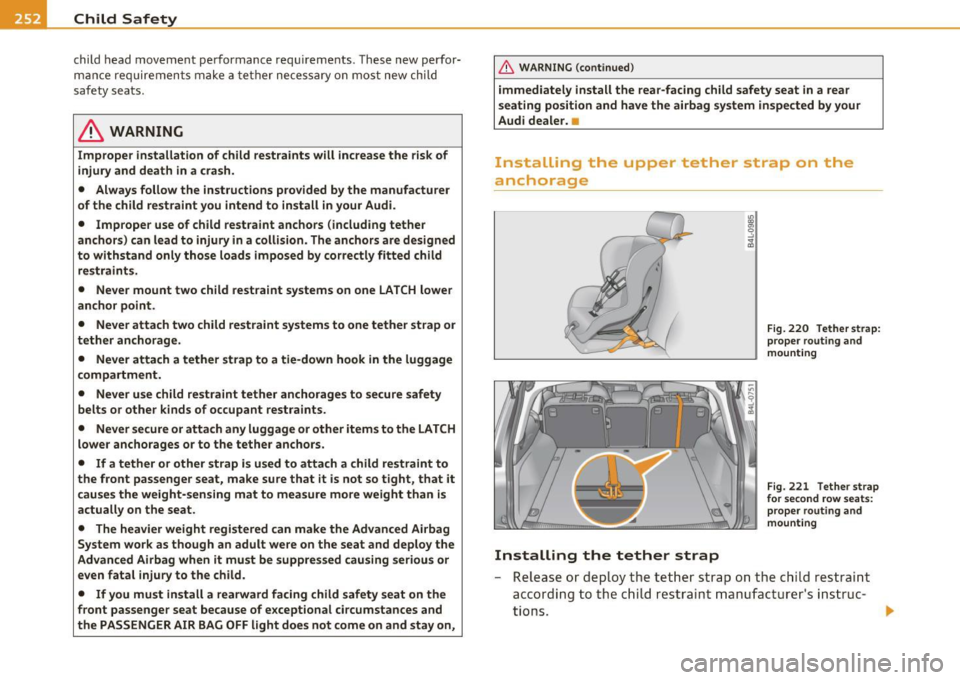
Installing the tether strap
Fig . 220 Tet her strap :
prope r routi ng and
mounting
Fig. 221 Tethe r stra p
for se cond row seats:
prope r ro uti ng and
mounting
- Release or deploy the tet her s trap on the ch ild restrai nt
according t o the child res tra in t m anufac ture r's instruc -
tions .
11'-
Page 255 of 392

Child Safety Ill
-------------------"'---
- Guide the upper tether strap under the rear head restraint
and into the rear cargo area (raise the head restraint if
necessary).
- For the second row of seats: Pull the flooring back, in
order to reach the anchor bracket=>
page 252, fig. 221.
-For the third row of seats:* Remove the plastic cover cap
with a screw driver, in order to reach the anchor bracket
=>
page 251, fig. 219.
- Slide the tether strap hook over the anchor bracket.
- Pull on the tether strap hook so that the spring catch of
the hook engages.
- Tighten the tether strap firmly following the child
restraint manufacturer's instructions.
- For the second row of seats: Push the flooring forward
into place again.
Releasing the tether strap
- Loosen the tension following the child restraint manufac
ture r's instructions.
- Depress the spring catch on the hook and release it from
the anchorage.
- For the second row of seats: Push the flooring forward
into place again.
-For the third row of seats:* Replace the plastic cover cap.
0 Note
If you leave the child restraint with the tether strap firmly installed
for several days, this could leave a mark on the upholstery on the seat
cushion and backrest in the area where the tether strap was installed.
Controls and equip
ment Safety first Vehicle operation
The upholstery would also be permanently stretched around the
tether strap. This
applies especially to leather seats.•
Using tether straps on rearward-facing
child restraints
Currently , few rear-facing child restraint systems come with a tether .
Please read and heed the child restraint system manufacturer's
instructions carefully to determine how to properly install the tether.
& WARNING
A child in a rearward-facing child safety seat installed on the front
passenger seat will be seriously injured and can be killed if the
front airbag inflates· even with an Advanced Airbag System.
• The inflating airbag will hit the child safety seat or infant
carrier with great force and will smash the child safety seat and
child against the backrest, center armrest, or door.
• A tight tether or other strap on a rearward-facing child
restraint attached to the front passenger seat can put too much
pressure on the weight-mat in the seat and register a heavier
weight in the Advanced Airbag System. The heavier weight regis
tered can make the system work as though an adult were on the seat and deploy the Advanced Airbag when it must be suppressed
causing serious or even fatal injury to the child.
• If you must install a rearward facing child safety seat on the
front passenger seat because of exceptional circumstances and
the PASSENGER AIR BAG OFF light does not come on and stay on,
immediately install the rear-facing child safety seat in a rear
seating position and have the airbag system inspected by your
Audi dealer. •
Vehicle care Do-it-yourself service Technical data
Page 256 of 392
ffl.___C_ h_ il_d _ S_a _ f_ e _ t--= y '------------------------------------------------
Additional Information
Sources of information about child
restraints and their use
There are a number of sources of additional information about child
res tra in t se lec tion , in st alla tion a nd use:
N HTSA adv ises that the best chi ld safety seat is the o ne t hat fits your
child and fits in your ve hicle, and that you will use co rrectly and
co nsist en tly .
Try before you buy !
U.S National Highway Traffic Safety Administration
Te l. : 1-888-327 -4236 (T TY : 1-800 -424-9 153)
www .n htsa .gov
National SAFE KIDS Campaign
Te l.: (202) 662-0600
www.s afe kids.o rg
Safety BeltSafe U .S. A
Tel. : (800) 7 45-SAFE ( Eng lish)
Te l.: (800) 747-SA NO (Span ish)
www .cars eat .org
Transport Canada Information Centre
Te l.: 1 (800) 333-0371 or call l (613) 998-8616 if you are in the
Ott awa area
www .tc .gc .ca/roadsafe ty
Audi Customer CARE
Te l.: (800) 822-2834 •
Page 289 of 392

____________________________________________ C_l_e _a_ n_ i n--= g=--- a_n_ d----' p,__ r_o _t_ e_ c_ t_ i _o_ n __ m
A ppli es to veh icles : with n atural leathe r
Natural leather
Audi makes great efforts to maintain the properties,
na tural look and feel of interior leather .
General
We offer many different types of leather on our vehicles . Most are
different types of nappa leather, which has a smooth s urface and
comes in various colors.
Th e intensity of the color determines the visual cha racter istics and
appearance .
If the surface of the leat her has a typical natural look,
then the leather is a nappa leather that has been left in a relatively
natura l condition. This leathe r offers pa rticu la rly good comfo rt and
breathes wel l. Fine veins, closed gra ins, insect b ites, sk in fo lds, and
s u btl e var iations in co lor remai n visible . These c harac ter istics demon
strate that the mater ial is natural.
N atural nappa leather is not covered by a color fin ish . It is the refore
more sensitive to soiling and wea r, which is something you need to
consider if children, animals or other factors might prove to be partic
ular ly hard on the leather .
By contrast, leather types that are covered by a colored fin ish layer
are more dur able. This h as a pos it ive e ffect on t he leather 's resist ance
to wear and so iling in daily use . On the other hand, the typical charac
t eris tics of na tura l leather are ba rely o r not app aren t. H oweve r, this
does not mean that the leather itself is of inferior quality.
Care and handling
Because of the exclusive nature of the types of leather that Audi uses
and the ir un ique properties (such as sensitivi ty to oils, gre ase, soiling,
etc.), you will need to be somewhat careful with these leathe rs, a nd
a ce rtain type of care is req uired. For example, dark clo thing mate
r ials can discolor leather seats (especially if such clothing is damp and
was not dyed cor rect ly). Dust and dirt particles in pores, folds, and
seams can have a n ab rasive effect and ca n damage the leathe r
surface as well as weaken seams.
Safety first
The leather should be cleaned regularly as needed . After having been
used for a rela tively long time, yo ur leat her seats w ill acq uire a rich
aged fi nish. This is a characteristic of natural leather and a s ign of
true quality .
I n orde r to maintain the va lue of this nat ural p rodu ct over t he life of
your vehicle, you should fo llow the recommendations be low:
0 Note
• To keep your leather from b leach ing out, do not allow it to be
exposed to b right s unl igh t fo r long pe riod s of time. If yo u have to
leave t he veh icle parked outside for long periods, cover the leather to
protect it from direct exposure to sunlight.
• Sharp objects on cloth ing, such as zippers, rivets or sharp pieces
on belts can le ave pe rm an ent sc ratches o r scrape mar ks on the
surface of the leather.
[I] Tips
• After each t ime you clean the leather and at regular intervals, use
a leathe r preservat ive creme that con tains UV -bloc ke rs and that
works into the leather. This creme will nourish and mo istur ize the
leather, helping it to b reathe and s tay supp le . It also he lps to build up
a p rotect ive coa ting on the surface .
• C lean the leather every 2 -3 months, a nd clean any areas that get
soiled .
• Remove fresh marks made by ballpoint pens, ink, lipstick, shoe
polish, etc . as soon as poss ible.
• P reserve t he colo r of t he lea ther as needed by us ing a specia l
co lored leather care creme to touch up areas of uneven color. •
Vehicle care Technical data