child seat AUDI Q7 2011 Owner´s Manual
[x] Cancel search | Manufacturer: AUDI, Model Year: 2011, Model line: Q7, Model: AUDI Q7 2011Pages: 392, PDF Size: 93.29 MB
Page 223 of 392
Airbag system -----------------=---=----
lower parts of the body. Front a irbags s upplement the t hree-poi nt
sa fety belts o nly in some fro ntal collis ions in which the vehicle decel
eration is high enough to dep loy the a irbags .
Front airbags will not deploy:
• if the ignition is switched off when a crash occ urs
• in s ide collis ions
• in rea r-end collisions
• in rollovers
• when the crash decelerat io n me asured by the a irbag system is less
than the min imum threshold needed for a irbag deployment as reg is
tered by the e lectron ic con trol un it
The front passenger airbag also will not deploy:
• when t he fron t passenger sea t is no t oc cupied
• when the weight on the front passenger seat as sensed by the
Advanced Ai rbag System in dicates that the front airbag o n the
passenger side has to be turned off by the e lectronic control unit (the
PASSENGER AIR BAG OFF li ght comes on and stays on)
& WARNING
Sitting in the wrong position can increase the ri sk of ser iou s injury
in crashes.
• To redu ce the risk of injury when the airbags inflate, the driver
and pas sengers mu st always sit in an upright position , mu st not
lean against or place any part of th eir body too close to the area
where the airbags are lo cated.
• Occupants who are unbelted, out of position or too close to the
airbag can be seriou sly injured by an airbag a s it unfolds with
great force in th e blink of an eye =>
page 213 .
Controls and equip ment Safety first Vehicle operation
& WARNING
A child in a rearward-facing child
safety se at installed on the front
pas senger seat will be seriously injured and can be killed if the
front airbag inflates - ev en with an Ad vanced Airbag System.
• The inflating airbag will hit the child safety seat or infant
c arrier with great force and will smash the child safety s eat and
c hild against the backre st, center armre st, d oor or roof .
• Always install rear -facing child safet y seats on the rear seat.
• If you must install a rearward-facing child safety seat on the
front passenger se at because of e xceptional circumstances and
the PASSENGER AIR BAG OFF light do es not come on and stay on ,
immediately install the rear -facing child s afety seat in a rear
s eating po sition and h ave the airbag system inspe cted by your
authoriz ed Audi d ealer.
& WARNING
Object s between you and the airbag will increase the r isk of inju ry
in a cra sh by int erfering with the way the airb ag unfold s or by
being pushed into you as the airbag inflates.
• Never hold things in your hand s or on your lap when the vehicle
i s in use.
• Never tran sport items on o r in the are a of the fr ont pa ssenger
seat. Obje ct s c ould move into the area of the front ai rbag s during
braking or other sudden maneu ver s and become dang erous
projectiles that can c au se se rious per sonal injury if the ai rbags
infl ate.
• Never pla ce o r attach accessories or othe r objects (such a s
cupholders, telephone brac kets, large , heavy or bulky object s) on
the doo rs, over o r near the are a marked
"AIRBAG " on the stee ring
wheel, in strum ent panel , se at ba ckre sts or between th ose area s
and yourself . These objects could cause injur y in a crash , especially
when the airbags infl ate .
9"'
Vehicle care Do-it-yourself service Technical data
Page 225 of 392

Airbag system -----------------=--=---
& WARNING (continued)
possible that the airbag will inflate when it is not supposed to, or
will not inflate when it should.
• Have the airbag system inspected immediately by your autho·
rized Audi dealer. •
PASSENGER AIR BAG OFF light
Fig. 203 Section from
the instrument panel:
PASSENGER AIR BAG
OFF light
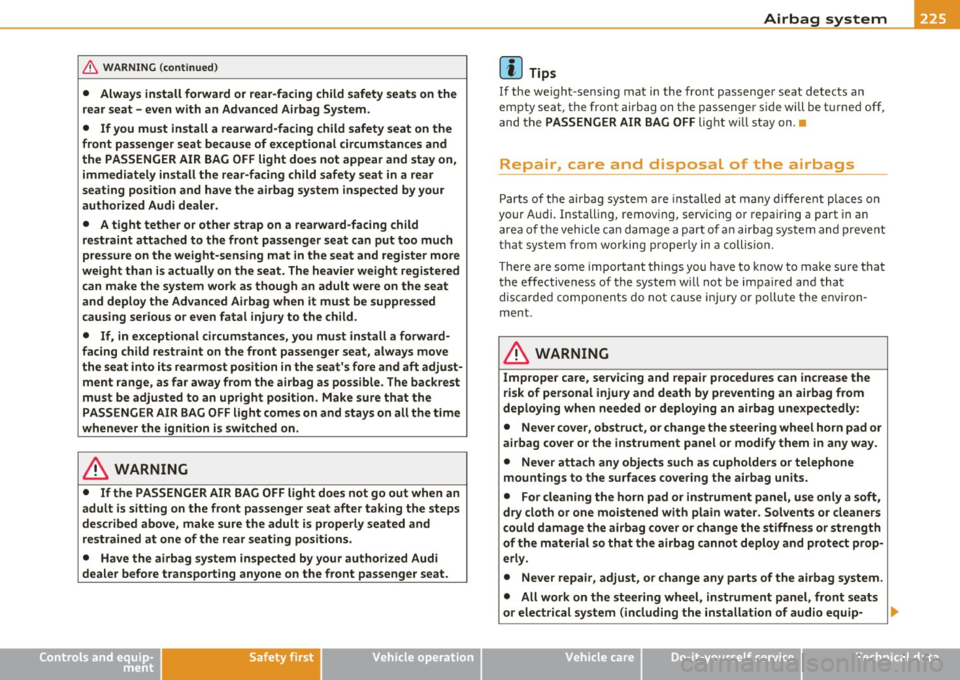
The PASSENGER AIR BAG OFF light is located in the center of the
instrument panel=> fig. 203.
The
PASSENGER AIR BAG OFF light will come on and stay on to tell
you when the front Advanced Airbag on the passenger side has been turned
off by the electronic control unit. Each time you turn on the
ignition, the
PASSENGER AIR BAG OFF light will flash for a few
seconds and:
• will stay on if the front passenger seat is not occupied
• will stay on if there is a small child or child restraint on the front
passenger seat
• will go out if the front passenger seat is occupied by an adult as
registered by the weight-sensing mat
The
PASSENGER AIR BAG OFF light must come on and stay on if the
ignition is on and
Controls and equip
ment Safety first
Vehicle operation
• a car bed has been installed on the front seat, or
• a rearward-facing child restraint has been installed on the front
passengerseat,or
• a forward-facing child restraint has been installed on the front
passengerseat,or
• the weight registered on the front passenger seat is equal to or
less than the combined weight of a typical 1 year-old restrained in
one of the rear-facing or forward-facing infant restraints listed in
Federal Motor Vehicle Safety Standard 208 with which the Advanced
Airbag System in your vehicle was certified.
If the front passenger seat is not occupied, the front airbag will not
deploy, and the
PASSENGER AIR BAG OFF light will stay on. Never
install a rearward -facing child restraint on the front passenger seat,
the safest place for a child in any kind of child restraint is at one of the
seating positions on the rear seat=>
page 213, "Child restraints on
the front seat -some important things to know" and=>
page 233,
"Child Safety ".
If the PASSENGER AIR BAG OFF light comes on when one of the
conditions listed above is met, be sure to check the light regularly to
make certain that the
PASSENGER AIR BAG OFF light stays on
continuously whenever the ignition is on. If the
PASSENGER AIR BAG
OFF
light does not appear on and does not stay on all the time, stop
as soon as it is safe to do so and
• reactivate the system by turning the ignition
off and then turning
it on again;
• remove and reinstall the child restraint . Make sure that the child
restraint is properly installed and that the safety belt for the front
passenger seat has been correctly routed through the child restraint
as described in the child restraint manufacturer 's instructions;
• make sure that the convertible locking feature on the safety belt
for the front passenger seat has been activated and that the safety
belt has been pulled tight. The belt must not be loose or have loops
of slack so that the sensor below the safety belt latch on the seat can
do its job=>
page 243. •
Vehicle care Do-it-yourself service Technical data
Page 226 of 392

-L___:_A~ i r'....: b~ a ::::: gL:: s~y -=s ::..:t :.:e :..: m..:..:.. ______________________________________________ _
• make sure that thi ngs that may increase the weig ht o f the child
and ch ild safe ty se at are not be ing transported on t he front
passenger seat;
• make sure that the safety belt tens ion sensor is not blocked.
Shake the safety belt latch on the front passenger seatback and forth;
• If a strap or tether is being used to t ie the child safety seat to the
front passenger seat, make sure that it is not so tight that it causes
t he weight-sensing mat to meas ure more weight than is actua lly on
the seat .
If the PASSENGER AIR BAG OFF l ight still doe s not come on and
does not stay on cont inuously (when the ignition is switched on),
• take the child restraint off the f ront passenger seat and install it
properly at one of the rear seat positions . Have the airbag sys tem
inspected by your authori zed Audi dealer immediately .
• move the child to a rea r seat position and ma ke s ure that the child
is properly restrained in a ch ild restraint that is appropriate for its
size and age .
The
PA SSENG ER AIR BAG OFF light should NOT come on when the
ignition is on and an adult is sitting i n a proper seating position on the
front passenger seat . If the
PASSENGER AIR BAG OFF light comes on
and stays on or flashes for abo ut 5 seconds while driving, under these
circumstances, make sure that:
• the adult on the front passenger seat is properly seated on the
c en ter of the sea t cushion wi th his or her back up against the backrest
and the backrest is not reclined::::;,
page 192, "Proper occupant
seating positions",
• the adult is not taking weight off the seat by holding on to the
passenge r assis t handle above the fron t passenger door or
supporting their weight on the armrest,
• t he safety bel t is be ing properly wor n and that the re is not a lot of
slack in the safety belt webb ing,
• accessory seat cove rs or cushions o r othe r th ings that may ca use
an incor rect read ing or impress ion on the weight-sensing mat under the upholstery of the seat have bee
n removed from the front
p assenge r seat,
• a safety belt extender has not been left in the safety belt latch for
t he front passenge r se at.
In add it io n to the
PASSENGER AIR BAG OFF light in the center of the
instrument panel, the message
PASSENGER AIR BAG OFF or
PASSENGER AIR BAG ON will br iefly appear in the instrument cluster
display . This is to inform the driver of the current front passenger
airbag status .•
Important safety instructions on
monitoring the Advanced Airbag System
& WARNING
An a irbag syst em that is not fun ction ing properly cannot provide
supplemental protect ion in a frontal crash.
• If th e airbag indic ator light comes on , it means th at there may
be something wrong with the Advanc ed Airbag S ystem . It i s
poss ible that th e airbag will inflat e when it is not suppos ed to , or
will not inflate when it should.
• Have the a irb ag system inspected immediately by your autho
rized Audi dealer .
& WARNING
If the front airb ag inflate s, a child without a child restraint, or in
a rearwa rd -facing child safet y seat, o r in a fo rwa rd-facing child
re straint that h as not b een properl y install ed will be seriou sly
i njured and can b e killed.
• Even though your v ehicl e is equipped with an Advan ced Airbag
S y stem , ma ke certain that all children , especi ally 1 2 yea rs and
y ounger, alway s ride on the back seat properly restra ined for their
a ge and size . .,,_
Page 227 of 392
Airbag system Ill
----------------=--=---
& WARNING (co ntinued )
• Always install forward or rear-facing child safety seats on the
rear seat - even with an Advanced Airbag System .
• If you must install a rearward-facing child safety seat on the
front passenger seat because of exceptional circum stances and
the PASSENGER AIR BAG OFF light does not appear and stay on ,
immediately install the rear-facing child safety seat in a rear
seating pos ition and have the airbag system inspected by your
authorized Audi dealer.
• A tight tether or other strap on a rearward-facing child
restraint attached to the front passenger seat can put too much
pressure on the weight-sensing mat in the seat and register more
weight than is actually on the seat. The heavier weight registered can make the system work as though an adult were on the seat
and deploy the Advan ced Airbag when it must be suppres sed
caus ing serious or e ven fatal injury to the child.
• If, in exceptional circumstances, you must install a forward
facing child restraint on the front passenger seat, always move
the seat into its rearmost position in the seat' s fore and aft adju st
ment range , as far away from the airbag as possible . The backrest
must be adjusted to an upright position. Make sure that the PASSENGER AIR BAG OFF light comes on and stays on all the time
whenever the ignition is switched on.
& WARNING
• If the PASSENGER AIR BAG OFF light doe s not go out when an
adult is sitting on the front passenger seat after taking the steps
described above, make sure the adult is properly seated and
restrained at one of the rear seating posit ions.
• Have the airbag system inspected by your authorized Audi
dealer before transporting anyone on the front passenger seat.
Controls and equip ment Safety first Vehicle operation
(I] Tips
If the we
ight-se nsin g mat in the fro nt passenge r seat detec ts a n
empty seat , the front airbag on the passenger s ide will be t urned off,
a nd the PASSENGER AIR BAG OFF light will sta y on .
a
Repair, care and disposal of the airbags
Parts of the ai rbag syste m are inst alled a t many diffe re nt pla ces on
your Audi. Installing, removing, serv ic ing o r repairing a part in a n
area of t he vehicle c an damage a par t of an a irbag sys tem and preve nt
that system from working proper ly in a coll is ion.
Th ere are some importa nt things you have to know to ma ke sure t hat
t he effectiv eness of the system will not be impai red and that
discarde d components do not cause injury or pollute t he env iron
m en t.
& WARNING
Improper care , servicing and repair procedures can increase the
risk of personal injury and death by preventing an airbag from
deploying when needed or deploying an airbag unexpectedly:
• Never cover, obstru ct, or change the steering wheel horn pad or
a irbag cover or the instrument panel or modify them in any way .
• Never atta ch any objects such as cupholders or telephone
mountings to the surfaces covering the airbag units .
• For cleaning the horn pad or instrument panel, use only a soft,
dry cloth or one moistened with plain wate r. Solvents or cleaners
c ould damage the airbag cover or change the stiffne ss or strength
of the mater ial so that the airbag cannot deploy and protect prop
erly.
• Never repair, adjust , or change any parts of the airbag system .
• All work on the steering wheel, instrument panel, front seats
or electrical system (including the installation of audio equip -
~
Vehicle care Do-it-yourself service Technical data
Page 231 of 392
_______________________________________________ A_ ir_ b_ a_,,,g '--- s.:.y _s _t_ e _ m ___ _
"AIRBAG" . It expands between the side tr im panel and the passenger.
I n order to he lp prov ide th is addi tion al pro te ct ion, the s ide a irbag
must inflate within a fract ion of a second at very high speed a nd with
great force . The supp lementa l sid e airbag co uld inju re you if your
seat ing position is not proper or upr ight or if items are located in the
area where the s upplementa l s ide a irbag expands . This applies espe
c ially to children=>
page 233, "Child Safety". S upplementa l side
airbags inflate between the occupant and the door panel on the side
o f the ve hicl e that is st ru ck in ce rtai n side co llision=> fig. 205 .
Although they are not a soft pillow, they can "cush ion" the impact
and in th is way they can help to reduce the risk of injury to the upper
part of the body.
A fine dust may develop when the airbag deploys. This is normal and
does not mean there is a fire in the vehicle. •
Important safety instructions on the side
airbag system
Airbags are only supplemental restrain ts. Always pr op
erly wear safe ty belts and ride in a proper seating posi
tion .
There is a lot that yo u and your passengers must know and act accord
ing ly to help the safety be lts and a irbags do the ir job to provide
supplementa l protection .
& WARNING
An inflating side ai rbag can cau se serious or fatal injury. Improp
e rl y wearing safety belts and improper seating pos itions increase
the risk of se rious pe rsonal injury a nd death whenever a vehicle is
being used .
• In order to reduce the ri sk of injury when the supplemental
s ide airbag inflates:
Controls and equip
ment Safety first Vehicle operation
& WA
RNING (continued )
-Alway s sit in an upr ight po sition and never lean again st the
area where the supplem ental side airbag is locat ed .
- Ne ver let a child or an yone el se rest their head against the
s ide trim panel in the area wh ere the supplemental side airbag
inflates.
- Alw ays make sure th at s afet y belts are worn correctly,
- Do not let anyone sitting in the front seat put their hand or
a ny other parts of their body out of the window.
• Alway s make sure that the side airbag can inflate without
interfe rence .
- N ever in stall seat covers or replac ement uphol stery over the
front seatbacks that have not been spe cifically appro ved by
Audi.
- Never use additional seat cu shion s that co ve r the area s
wher e the side airbags deploy.
- Damage to the original seat co ver s or to the seam in the area
of the side airbag mod ule must a lway s be repaired immedi
ately by an authorized Audi dealer.
• Obje ct s between you and the airbag can in crea se the risk of
injur y in an accident by inte rfer ing with the wa y the airbag unfold s
or by being pushed int o you as the a irbag inflates .
- Ne ver pla ce or attach a cce sso ries or other object s (such a s
c upholders, t elephon e brack ets, or even larg e, bulky objects )
on t he d oor s, over or near the area marked "AIRBAG " on the
s e at ba ckrests .
- Su ch obje ct s and a cc es sories can be come dangerou s proj ec
tiles and cause injury when th e supplemental side airbag
deplo ys.
- Nev er ca rry any objects or pets in the d eployment space
between them and the airbag s or allow childr en or other
pas seng ers to tra vel in this position .
Vehicle care Do-it-yourself service Technical data
Page 232 of 392

...,. Airbag system
P#RI-- --=------------------------------
& WARNING (continued)
• Always use the built-in coat hooks only for lightweight
clothing. Never leave any heavy or sharp-edged objects in the
pockets that may interfere with side airbag deployment and can
cause personal injury in an accident.
• Always prevent the side airbags from being damaged by heavy
objects knocking against or hitting the sides of the seatbacks.
• The airbag system can only be triggered once. If the airbag has
been triggered, the system must be replaced by an authorized
Audi dealership.
• Damage (cracks, deep scratches etc.) to the original seat covers
or to the seam in the area of the side airbag module must always
be repaired immediately by an authorized Audi dealer.
• If children are seated improperly, their risk of injury increases
in the case of an accident =:>
page 233, "Child Safety".
• Never attempt to modify any components of the airbag system
in any way.
• In a side collision, side airbags will not function properly if
sensors cannot correctly measure increasing air pressure inside
the doors when air escapes through larger, unclosed openings in
the door panel.
- Never drive with interior door trim panels removed.
- Never drive when parts have been removed from the inside
door panel and the openings they leave have not been properly
closed.
- Never drive when loudspeakers in the doors have been
removed unless the speaker holes have been properly closed.
- Always make certain that openings are covered or filled if
additional speakers or other equipment is installed in the
inside door panels.
- Always have work on the doors done by an authorized Audi
dealer or qualified workshop. •
Side curtain airbags
Description of side curtain airbags
The side curtain airbags can provide supplemental
protection to properly restrained occupants.
Fig . 206 Side curtain
airbags , driver 's side:
locati on
The side curtain airbags are located on both sides of the interio r
above the front and rear side windows =:> fig. 206 . They are identif ied
by the wo rd "AIRBAG" on the windshield frame and the cente r roof
pillar.
Th e side curtain airbag system supplements the safety belts and can
he lp to reduce the risk of injury for occupants' heads a nd upper torso
on the side of the vehicle th at is struck in a si de collis ion . The side
curtain airbag inflates in side impacts and only when t he veh icle
acceleration registered by the control u nit is high enoug h.
If this rate
is below the reference va lue programmed in to the control unit, the
side airbags wi ll not be triggered, even though the car may be badly
damaged as a result of the collision. It is not possible to define an
airbag triggering range that wi ll cover every possible angle of impact,
since the circumstances will vary consid erably between one collision
and another. Important factors include, for example, the nature
(h ard or soft) of the impacting object, the angle of impact, vehicle
speed, etc.=:>
page 231, "H ow s ide curta in a irbags wor k". .,_
Page 234 of 392
-Airbag system P:fM..,____--=----------------
curtain airbag cou ld injure you if your seating pos ition is not proper or
upr igh t or if items are located in the area where the s uppleme ntal
side curtain a irbag inflates . T hi s applies especially to children
=> page 233.
Although they a re not a soft pi llow, s ide cur tai n airbags can " cushion"
the impact and in this way they can help to reduce the risk of injury to
t he head and the u pper part of t he bo dy.
A fine d ust may develop when the airbag deploys . This is quite norma l
and does not mean the re is a fire in the vehicle .•
Important safety instructions on the side
curtain airbag system
Airbags are only supplemental r estraints. Always prop
erly wear safety belts and ride in a proper seating posi
ti on .
The re is a lot that yo u and your passe nge rs must know and do to help
the safety belts and airbags do their job to provide supp lemental
protec tion .
& WARNING
Improperly wearing safety belts and improper seating positions
increa se the risk of serious personal injury and death whenever a
vehicle is being used .
• Never le t oc cupant s place an y part s of their bodie s in the area
from which the side curtain airbags inflate.
• Always make sure that the side curtain airbag s can inflate
without interference. Unsuitable accessories fitted inside the
expansion range of a side curtain airbag can dangerously interfere
with its funct ion. A deploying head airbag develops enough force
to catapult any piece of add-on component out of it s path of infla
tion and into the passenger compartment. An occupant hit by
& WARNING (c on tinued )
such a projectile can suffer serious injury or death=> page 371,
"Te chnical Modifi cations ".
• Do not swivel the sun viso rs to the side if you have any objects
clipped onto them (for example pens) . If the airbag should
deploy, you could be injured by these objects.
• Use the built-in coat hooks only for lightweight clothing. Never
lea ve any heavy or sharp-edged objects in the pockets that may
interfere with airbag deployment and can cause per sonal injury in
an accident.
• Never use hanger s to hang clothing from the hook s.
• Only use factory-in stalled sun shade s or , in the case of shades
i nstalled after the vehicle leaves the factory, only Audi roll-up
sunscreen s ma y be used =>
page 370, "Additional accessories and
parts replacement ".
• Always sit in proper se ating position and wear safety belts
while traveling so that the side curtain airbags can help provide
protection .
• The airbag system can only be tr iggered once. If the ai rbag has
been trigge red , the system must be replaced by an authorized
Audi dealer or qualified workshop.
• Alway s have work involving the side curtain airbag system,
removal and installation of the airbag components, or other
repairs performed by an authorized Audi dealer or qualified work
shop. Otherwi se the airbag system may not work correctly.
• Never attempt to modify any components of the airbag system
i n any way. •
Page 235 of 392
Child Safety Ill
-------------------"'---
Child Safety
Important things to know
Introduction
The rear seat is generally the safest place in a collision.
The physical pr in ci ples o f wha t happens w hen yo ur vehicl e is in a crash
app ly a lso to children=>
page 203, "What happens to occupants not
wearing safety be lts?". But unlik e adu lts and teenagers, the ir
muscles and bones are not fully developed. In many respects c hildren
are at greate r risk of ser io us injury in cras hes than adults .
Because children 's bodies a re not f ully deve loped, they require
restraint systems especially designed fo r their size, weight, and body
st ruct ure. Many cou ntries and all states of t he Unite d States and
prov inces of Canada have laws req uiring the use of approved ch ild
restrain t sys tems for infan ts an d sm all ch ild ren .
I n a fronta l crash at a speed of 20 -35 mph (30-56 km/h) the forces
act ing o n a 13- pound (6 kg) infant w ill be more than 20 times the
we ight of the ch ild . This means the we ight of the child wo uld
suddenly be more than 260 po unds (120 kg). Unde r these conditions,
only a n app ropr iat e child restra int proper ly used can red uce the risk
of serious injury. Child restraints, like adult sa fety be lts, must be used
pro perl y to be effective. Use d imprope rly, they can i ncrease t he ris k
of serious injury in an accident.
C onsult the ch ild safety seat manufacturer's instr uctions in order to
be sure the seat is r ight for you r child's size=>
page 236, "Important
safety instructions fo r using child safety seats". P lease be s ure to
read and heed a ll of the important informa tion and WAR NINGS
about chi ld safety, Advanced Airbags, an d the installation of child
restra in ts in this chapte r.
There is a lot you need to know about the Advanced Airbags in your
vehicle and how t hey wo rk when inf ants and childre n in child
restra ints are on the front passenger seat. Beca use of t he large
Controls and equip
ment Safety first Vehicle operation
amou
nt of importa nt info rmation, we cannot repeat i t all he re. We
urge you to read the detailed information in th is owne r's man ua l
abou t airbags and t he Advanced A irbag Syste m in your vehicle and the
very important information abo ut transporting c hildren on the front
p assenger se at. P lea se be sure to heed the WARNIN GS - they a re
extremely important for your safety and the safety of your passe n
gers, especially infan ts and small ch il dre n.
& WARNING
• Accid ent statisti cs have shown that children are generally safer
in the rear seat area than in the front seating position. Always
re strain any child age 12 and under in the rear.
• All vehicle occupants and especially children must be
restrained properly when ever riding in a vehicle. An unre strained
or improperly restrained child could be injured by striking the
interior or by being ejected from the vehicle during a sudden
maneuver or impact. An unrestrained or improperly rest rained
child is also at greater risk of injury or death through contact with
an inflat ing airbag .
• A suitable child restraint properly installed and used at one of
the rear seating posi tions provides the highest degree of protec
tion for infants and small children in most accident situations.
& WARNING
Children on the front seat of any car even with Advanced Airbags
can be seriously injured or even killed when an airbag inflates. A
c hild in a rearward -facing child safety seat ins talled on the front
passenger seat will be seriously injured and can be killed if the
front airbag inflate s.
• The inflating airbag will hit the child safety seat or infant
c arrier with great force and will sma sh the child safety seat and
child aga inst the backrest, center armrest , or door . •
Vehicle care Do-it-yourself service Technical data
Page 236 of 392
-Child Safety ------ ~---------------------------------
& WA RNING (conti nued)
• Always install rear-facing child safet y seat s on the rear seat.
• If you must install a rearward facing child safety seat on the
front passenger seat in exceptional circumstances and the
PASSENGER AIR BAG OFF light do es not come on and stay on,
immediately in stall the rear-facing child safety seat in a rea r
seating position and have the airbag system inspected immedi
ately by you r Audi deale r.
& WARNING
If, in exceptional circumstances , you must in stall a forward-facing
child restraint on the front passenger' s seat:
• Always make sure the forward-facing seat has been designed
and certified by its manufacturer for use on a front seat with a
pa ssenger front and side airbag.
• Always follow the manufacturer 's instructions p rovided with
the child safety seat or carrier.
• Always move the passenger seat into its rearmost position in
the seat's fore and aft adjustment range, as far away from the
airbag as possible before install ing the child restra int . The back
re st must be adju sted to an upright position .
• Always make sure that the PASSENGER AIR BAG OFF light
c omes on and stays on all the time whenever the ignition i s
switched on .•
Advanced front airbag system and children
Your vehicle is equipped with an "Advanced Airbag System" in compli
ance wi th Uni ted St ates Federa l Mo to r Vehicle Safety St andar d
(FMVSS) 208 as applicable at the time your veh icle was manufac
tu red . The Advanced A
irbag system in yo ur vehicle has been certif ied to
mee t the "low -r is k" requiremen ts fo r 3-and 6-ye ar old ch ildre n on
t he passenger side and small adults on the dr iver side . The low risk
dep loyment criteria are inten ded to reduce the risk of injury through
interaction with the a irbag t hat can occur, for example, by being too
close to the stee ring wheel an d instr ument panel when the airbag
inflates. In addi tion, the sy stem has been certified to comp ly with t he
"suppression" requirements of the Safety Standa rd, to t urn off the
fron t air bag for infan ts u p to 1 2 months who a re res tra ined on the
front passenger seat in child restrai nts that are listed in the Stan
d ar d.
Even thoug h your vehicle is equipped with an Advanced Airbag
system , a ll ch ildren, especially those 12 years and yo unger, should
always r ide in t he back seat p roperly restrained for t heir ag e and si ze .
Th e ai rbag on the passenge r si de makes the front seat a potentia lly
dange rous p lace for a child to r ide. Th e front seat is not th e safest
place fo r a child in a forward- facing c hild safety seat. It can be a very
d an ge rous p lace for a n infan t or a large r chil d i n a re arwa rd-facing
seat. •
Advanced Airbags and the weight-sensing
mat in the front seat
Th e Advanced A irbag System i n your ve hicle de tects t he p resence o f
an infa nt o r ch ild in a child rest rai nt on the fro nt passenger sea t using
the we ight-sens ing mat in the seat cushion and the senso r be low the
saf ety belt la tch o n th e front passenge r seat tha t measur es t he
tension on the safety belt.
Th e weigh t-sens ing ma t me asures tot al we ight of the child and the
child safety seat and a child blanket on the fro nt passe nger seat . The
we ight on the fro nt passenger se at is re late d t o the desi gn of the
child res traint and i ts "footpri nt", the size and shape of t he bottom
of the ch ild restraint as it sits o n the seat . The weight of a child
restrain t an d its "foo tpr int" vary for differe nt kinds of child res tra ints .,_
Page 237 of 392

-----------------------------------------~C~ h~il ~d ~ S~a _!fe ~ t !;YL __
and for the different models of the same kind of child restraint
offered by child restraint manufacturers.
The weight ranges for the individual types, makes and models of ch ild
restraints that the NHTSA has specified in the Safety Standard
together with the weight ranges of typical infants and typical 1 year
old child have been stored in the control unit of the Advanced Airbag
System. When a child restraint is being used on the front passenger
seat with a typical 1 year-old chi ld, the Advanced Airbag System
compares the weight meas ured by the weight sensing mat with the
information stored in the electronic control unit .
The electronic contro l unit a lso registers the tension on the front
passenger safety belt. The tension on the safety belt for the front
passenger seat will be different for an adult who is properly using the
safety belt as compared to the tension on the belt when it is used to
attach a child restraint to the seat . The sensor below the latch for the
safety belt for the front seat passenger measures the tension on the
belt. The input from this sensor is then used with the weight to
"decide", whether there is a child restraint with a typical 1 year-old
child on the front passenger seat and whether or not the airbag must
be turned off .•
Child restraints and Advanced Airbags
Regardless of the child restraint that you use, ma ke sure that it has
been certified to meet United States Federal Motor Vehicle Safety
Standards and has been ce rtified by its manufacturer for use with an
airbag . Always be sure that the child restraint is properly installed at
one of the rear seating positions. If in exceptional circumstances you
must use it on the front passenger seat, carefully read all of the infor
mation on ch ild safety and Advanced Airbags and heed all of the
app licab le WARNINGS. Make certain that the child restra int is
correctly recognized by the weight-sensing mat inside the front
passenger seat, that the front passenger airbag is turned off and that
the airbag status is always correctly signaled by the
PASSENGER AIR
BAG OFF
light.
Controls and equip ment Safety first Vehicle operation
Many types and models of child restra
ints have been available over
t he years, new models are introduced reg ularly incorpo rating new
and improved designs and older models are taken out of product ion.
Chi ld restraints are not standardized. Child restraints of the same
type typ ically have d ifferent weights and sizes and differe nt 'foot
prints,' the size and shape of the bottom of the child restraint that
sits on the seat, when they are installed on a vehicle seat . These
differences make it virtually impossib le to certify compliance with
t he requirements for advanced airbags with each and every chil d
restra int that has ever been sold in the past or will be sold over the
course of the useful life of your vehicle.
For this reason, the United States Nationa l Highway Traffic Safety
Administration has published a list of specific type, makes and
mode ls of child restra ints that must be used to cert ify compliance of
the Advanced Airbag System in yo ur vehicle with the suppression
requirements of Federal Motor Veh icle Safety Standard 208. These
child restraints are:
A. Car beds, manufactured on or after September 1,
2004:
• Cosco Dream Ride 02-719
B. Rear facing child restraint systems,
manufactured on or after September 1, 2004:
(When the restraint system comes equipped with a removable base,
compliance has to be cert ified with or without the base) .
• Britax Handle with Care 191
• Century Assura 4553
• Century Smart Fit 4543
• Cosco Arriva 02727
• Evenflo Discovery Adjust Right 212
• Evenflo First Choice 204
• Graco Infant 8457
Vehicle care Do-it-yourself service Technical data