light AUDI Q7 2012 Owner´s Manual
[x] Cancel search | Manufacturer: AUDI, Model Year: 2012, Model line: Q7, Model: AUDI Q7 2012Pages: 342, PDF Size: 86.42 MB
Page 268 of 342
266 Check ing and filling
For year-round driving, antifreeze is added at
the factory for temperatures down to:
- -31°F(-35°C)USA
- - 40 °F ( - 40 °C) Canada.
_& WARNING
-
Before you check anything in the engine
compartment, always read and heed all
WARN INGS
¢ .&. in Working in the engine
compartment on page 258.
(D Note
- Befo re winter se ts in, have the coolant
checked to see if t he coolant addit ive in
your vehicle is sufficient to meet the cli
mate conditions. This is especially impor
tant if you live in a region where the win
ter is extremely co ld. If necessary, in
crease the proport ion of coolant additive
to 60%.
- When adding coolant additive to your
cooling system, remember:
- We recommend using only coolant ad ditive G12++ or G13 for your vehicle.
Th is coo lant add itive is available at au
thorized Audi dealers. Other types of
antifreeze can significantly reduce cor
rosion protection. The resulting corro
sion can cause a loss of coo lant and se
r ious engine damage.
- Do not add any type of radiator leak sea l
ant to your vehicle's engine coolant.
Adding rad iator repair fluid may adve rse
ly affect the function and performance of
your cooling system and could result in
damage not covered by your New Vehicle Limited Wa rranty.
Checking the engine coolant level
The engine coolant level can be checked with
a quick glance .
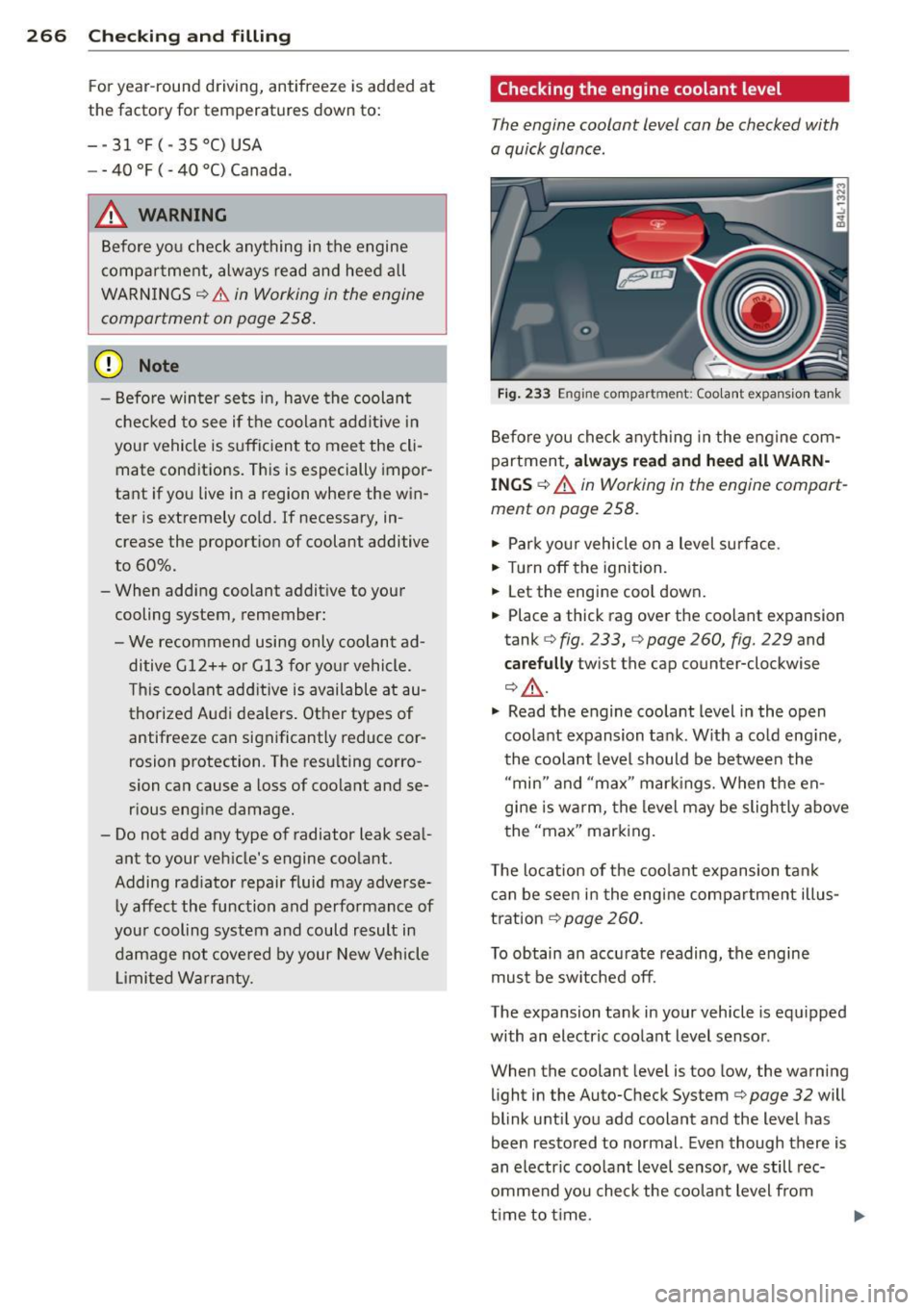
Fig . 233 Engine compartment : Coo lant expansio n ta nk
Before you check a nyth ing in the engine com
partment,
alw ays re ad and h eed all WARN
INGS ¢ A in Working in the engine compart
ment on page 258.
.,. Park yo ur vehicle on a level surface.
.,. Turn off the ignition.
.,. Let the engine cool down.
.,. Place a thick rag over the coolant expansion
tank ¢
fig. 233, c> page 260, fig. 229 and
care full y twist the cap counter-clockwise
¢,&. .
.,. Read the engine coolant level in the open
coolant expansion tank. W ith a cold eng ine,
the coolant level should be between the "min" and "max" markings. When the en
g ine is wa rm, the level may be slightly above
the "max" mark ing.
T he locat ion of the coolant expansion tank
can be seen in the engine compartment illus
tration
¢ page 260.
To obtain an accu rate reading, the engine
must be switched off.
The expansion tank in your vehicle is equipped
with an electric coolant level sensor.
When the coolant level is too low, the warning
light in the Auto-Check System¢
page 32 will
blink until you add coolant and the level has
been restored to normal. Even though there is
an electric coo lant level sensor, we still rec
ommend you check the coolant level from
time to t ime.
Page 269 of 342
Coolant loss
Coolant loss may indicate a leak in the cool ing
system . In the event of coolant loss, the cool
ing system should be inspected immediately
by your authorized Audi d ealer. It is not
enough merely to add coolant.
I n a
sea led system, losses can occur only if
the boiling point of the coolant is exceeded as
a result of overheating.
A WARNING
The cooling system is under pressure and can get very hot. Reduce the risk of scald
ing from hot coolant by following these
steps.
- Turn off the engine and allow it to coo l
down.
- Protect your face, hands and arms from
escaping fluid and steam by covering the
cap with a large, thick rag .
- Turn the cap slowly and very carefully in
a counter -clockwise direction wh ile ap
plying light, downward pressure on the
top of the cap .
- To avoid be ing burned, do not spill ant i
freeze or coolant on the exhaust system
o r hot eng ine parts. Under certai n condi
t ions, the ethy lene g lycol i n engine cool
an t ca n ca tch fire.
(D Note
Do not add any type of rad iator leak seal
ant to you r vehicle's eng ine coolant. Add
ing radiator repair f luid may adversely af
fec t the function and pe rformance of your
cooling system and could res ult in damage
not covered by your New Vehicle Limited
Warranty .
Adding coolant
Be very careful when adding engine coolant.
Before you check anything in the engi ne com
partment ,
alwa ys read and heed all WARN
INGS c:> A in Working in the engine compart
ment on page 258 .
Checking and fillin g 267
.. Turn off the engine .
.. Let the engine coo l down .
.. Place a thick rag over the coo lant expansion
tank
c:> page 266 , fig . 233 and carefully
twis t the cap coun ter-clockwise c:> &, .
.. Add coo lant .
.. Twist the cap on aga in
tightly.
Rep lacemen t engine coolant must conform to
exact spec ificat ions
c:> page 265, Coolant . We
recommend us ing on ly coo lant additive G12+
+, G 13 or in an eme rgency G12 +. Do
not use a
different additive. In an emergency use pla in
water until you can ge t the co rrect addi tive
and can restore the correc t ratio. This sho uld
be done as soon as possible.
If you have lost a cons iderab le amount of
coolant , the n you sho uld add cold ant ifree ze
and cold wate r on ly when the engine is cold.
Always use
n ew engine coolant when refilling .
Do not f ill coolant above the "MAX" mark. Ex
cess coola nt will be forced out through the
pressure relief valve in the cap when the en
gine becomes hot .
A WARNING
- The cooling system is under pressure and
can get ve ry hot. Reduce the risk of
scalding from hot coolan t by following
these steps.
- Turn off the engine and allow it to coo l
down .
- Protect your face, hands and arms from
escaping fluid and steam by covering
the cap w ith a large, th ick rag .
- Turn the cap s lowly and very carefully
i n a counter-clockwise direction while
applying light, downward pressure on
the top of the cap.
- To avoid being burned, do not spill a n
tifreeze o r coolant on the exhaust sys
tem or hot engi ne pa rts. Under certain
c ond it ions, the ethy lene glycol in en
gine coolant c an catch fire .
- Antifree ze is po isonous. Always s to re an
tifree ze in its o rigina l container and well
ou t of the rea ch of child ren. .,.
•
•
Page 270 of 342
268 Checking and filling
-If you drain the coolant, it must be
caught and safely stored in a proper con
tainer clearly marked "poison".
(D Note
- Coolant pollutes the environment and
could cause an engine fire . Excess cool-
ant will be forced out through the pres
sure relief valve in the cap when the en
gine becomes hot.
- If, in an emergency, only water can be
added , the correct ratio between water
and antifreeze
c:::> page 265 must be re
stored as soon as possible .
@ For the sake of the environment
Drained coolant should not be reused. Al
ways dispose of used coolant while observ ing all environmental regulations.
Radiator fan
The radiator fan switches on automatically by
itself
The radiator fan is driven by the engine via the
V-belt . The viscous clutch regulates the speed
of the fan accord ing to the temperature of the
coolant.
An auxiliary electric radiator fan* switches on
and off depending on coolant temperature
and other vehicle operating conditions.
After you switch the engine off, the aux iliary
fan can continue running for up to 10 minutes
- even with the ignition off. It can even switch
on again later by itself
c:::> &. , if
- the temperature of the engine coolant rises
due to the heat build-up from the engine in
t he engine compartment, or
- the engine compartment heats up because
the vehicle is parked in intense sunligh t.
_&. WARNING
- To reduce the risk of personal injury nev
er touch the radiator fan. -
The auxiliary electric fan is temperature
controlled and can switch on suddenly
even when the engine is not running.
- The auxiliary radiator fan switches on au
tomatically when the engine coolant reaches a certain temperature and will
continue to run until the coolant temper
ature drops.
Brake fluid
Checking brake fluid level
The brake fluid level can be checked with a
quick glance.
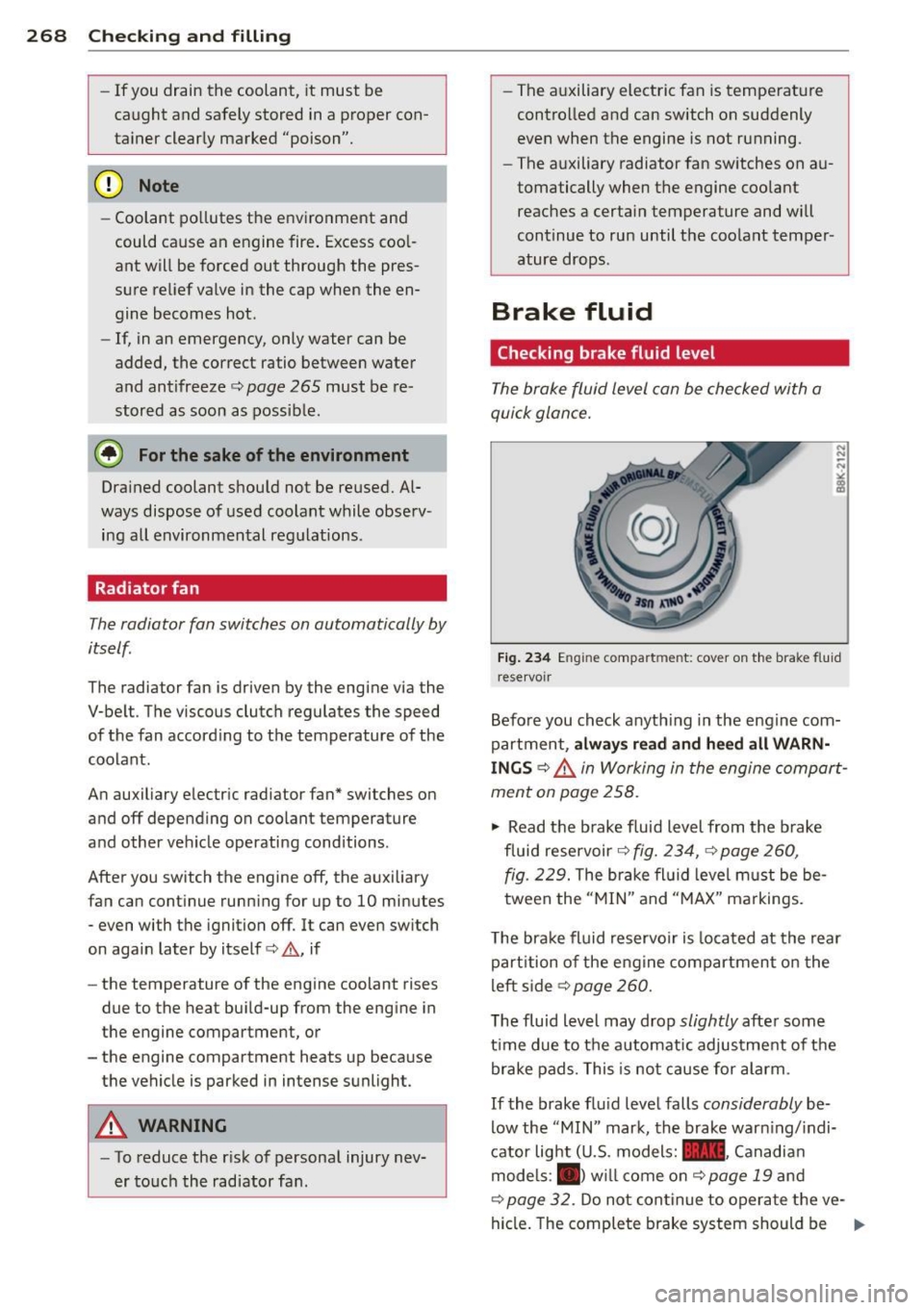
Fig. 234 E ngine compart men t: cove r on the brake fluid
reserv oir
Before you check anyth ing in the engine com
partment,
always read and heed all WARN
INGS c:::> _&. in Working in the engine compart
ment on page 258.
.,. Read the brake fluid level from the brake
fluid reservoir
c:::> fig. 234, c:::> page 260,
fig.
229. The brake fluid level m ust be be
tween the "MIN" and "MAX" markings.
The brake fluid reservoir is located at the rear
partition of the engine compartment on the
left side
c:::> page 260.
The fluid level may drop slightly after some
time due to the automatic adjustment of the
brake pads. This is not cause for alarm.
If the brake flu id level falls
considerably be
low the
"MIN " mark, the brake warning/indi
cator light ( U.S. models: -· Canadian
models :. ) w ill come on
c:::>page 19 and
c:::>page 32. Do not continue to operate the ve-
hicle. The compl ete brake system should be ..,.
Page 271 of 342
thoroughly checked by an authorized Audi
dealer or qualified workshop and the cause
corrected .
If the brake fluid level is too low ,
the brake warning/indicator light will i llum i
nate. Con tact an au thori zed Aud i dealer
im ·
mediately .
@ Tips
The brake fluid reservoir is located under
neath the cover.
Changing brake fluid
Have the brake fluid changed by an experi
enced technician .
Brake fluid absorbs moist ure from the a ir. If
the water content in the brake fluid is too
h igh, corrosion in the brake system may result
after a per iod of t ime . The bo iling po int of the
brake fluid w ill also decrease considerably and
decrease b raking performance .
Therefore, the brake flu id must be changed
every two years . Always use new brake fluid
which conforms to Federal Motor Vehicle
Standa rd "FMVSS 116 DOT 4".
The brake f lu id reservoir can be difficult to
reach, therefore, we recommend that yo u
have the brake f lu id changed by your author
i zed
Audi dea ler . Your deale r has the co rrect
too ls, the right b rake fluid and the know-how
to do this fo r you.
_& WARNING
- Br ake fluid is po isonous . It must be s to r
ed only in the closed orig inal con tainer
o ut of the reac h of c hildren!
- Br ake f ailure can resu lt from old or in ap
propr iate b ra ke fluid. Observe these pre
caut ions:
- Use on ly brake fluid that meets SAE
specif ication
J 1 703 and conforms to
Federal Motor V ehicle Sta ndard 116.
A lways check wi th you r auth o riz ed Audi
deale r to ma ke s ure you are using the
correct brake flu id . T he correc t type of
Checkin g and fillin g 269
brake f luid is also ind icated on t he
brake f luid rese rvoir.
- The bra ke fl uid must be new. Heavy use
of the brakes can cause a vapo r lock if
the brake fluid is left in the system too
l ong. This can seriously affect the effi
c iency of the brakes as well as your
safe ty. This co uld resu lt in an accide nt.
(1) Note
Brake fluid will damage the paint of your
vehicle.
@) For the sake of the environment
Because o f the prob lem of proper disposal
of brake fluid as well as the spec ial too ls
required and the necessary expertise, we
recomme nd that you have the brake flu id
changed by you r autho rized Aud i deale r.
Battery
General information
U nder normal operating cond itions, the bat
tery in your Audi does not need any ma inte
nance. With
high outside temperatures or
long da ily drives we recommend that you have
the e lectrolyte level chec ked by an au thorized
Audi dealer or qualified wo rkshop . The elec
t ro lyte level should also be che cked each time
t h e battery is cha rged
~ page 271.
Have the battery checked when you take your
vehicle in for se rv ice . You a re well advised to
replace a battery that is o lde r th an 5 years .
With certain types of airbag deployment, the ba tte ry is disconnected from the ve hicle elec
t rical sys tem for safety reasons
~ A in Re
pair, care and disposal of the airbags on
page 193.
Disconnecting the battery terminals
Some vehicle fu nctions (power window regu
lators, fo r example) are lost if the battery te r
mina ls are disconn ected . T hese functions have
to be relearned after the bat tery termina ls are
conne cte d ag ain. To p revent t his, the battery .,. •
•
Page 272 of 342
2 70 Chec king and filling
should only be disconnected from the vehicle
e lectrical system when absolutely necessary
for repairs.
Vehicles not driven for long periods
If you do not drive your vehicle over a pe riod
of several days or weeks, electrical compo
nents are gradually cut back or switched off.
This reduces energy consumption and main
tains starting capab ility over a longer period
c;, page225.
Take into consideration that when you un lock
your vehicle, some convenience functions, such as the interior lights or the power seat
adjustment, may not be available. The con
venience functions will be available again
when you turn on the ignition and start the
engine .
Winter operation
During the winter months, battery capacity
tends to decrease as temperatures drop . This
is because more power is also consumed while
starting, and the headlights, rear window de
fogger, etc., are used more often .
Avoid unnecessary power consumption, par
ticularly in city traffic or when traveling only
short d istances . Let your authorized Audi
dealer check the capacity of the vehicle bat
tery before w inte r sets in
¢ page 271. A well
cha rged battery w ill not only prevent starting
p rob lems when the weather is cold, but will
a lso last longer.
(D Tips
If your vehicle is left standing for several
weeks at extremely low temperatures, the
vehicle battery should be removed and
stored where it will not freeze . This wi ll
prevent it from being damaged and having
to be replaced.
Working on the battery
Be especially careful when working on or near
the battery.
The battery is located under the driver 's seat.
Before you check anyth ing under the driver 's
seat,
read and heed all WARNINGS c:;, _&.
Always heed the safety warnings, when work
ing on the vehicle battery or the vehicle elec
trical system to prevent injury.
The following WARNINGS are very
important when working on the battery:
Always heed the following WARNING SYM BOLS and safety precautions when working
on the battery.
@!) Always wear eye protection .
b.. Battery acid contains sulfuric acid . Al
~ ways wear gloves and eye protection.
~ No
\!:51 -sparks
- flames
- smoking.
A. When a battery is charged, it produces
~ hydrogen gas which is explosive and
could cause personal injury.
~ Always keep the battery well out of
~ reach of children.
,&. WARNING
Whenever working on the battery or on
the electrical system, there is the risk of
injury, accident and even fire . Read and
heed the following WARNINGS:
- Always wear eye protection. Do not let
battery ac id or any lead particles get on
your skin or clothing. Shield your eyes .
Exp losive gases can cause blindness or
other injury.
- Battery acid contains sulfuric acid. Sulfu
ric acid can cause blindness and severe
burns.
- Always wear g loves and eye protection.
-
Do not tilt the battery because acid ~
Page 273 of 342
could leak out of the ventilation open
ings.
- If you get battery acid in your eyes or
on your skin, immediately rinse with
cold water for several minutes and get
medical attention.
- If you should ingest any battery acid,
seek medical attention immediately.
- Do not expose the battery to an open
flame, electric sparks or an open light.
- Do not smoke.
- Do not interchange the positive and neg-
ative cables.
- When working on the battery, be sure
not to short-circuit the terminals with
tools or other metal objects. This would cause the battery to heat up very quickly,
which could lead to damage or explosion
and personal injury.
- When a battery is charged, it produces hydrogen gas which is explosive and
could cause personal injury.
- Always keep the battery well out of the
reach of children.
- Before work is done on the electrical sys tem, disconnect the negative ground ca
ble .
- Before performing any work on the elec
trical system, switch off the engine and
ignition as well as any electrical equip
ment . The negative cable on the battery
must be disconnected. If you are just go
ing to rep lace a light bulb, then it is
enough to switch off the lights.
- Before disconnecting the battery, switch
off the anti-theft alarm system! Other
wise you will set off the alarm.
- When disconnecting the battery, first
disconnect the negative cable and then
the positive cable.
- Before reconnecting the battery, make
sure all electrical consumers are switch
ed off. Reconnect the positive cable first
and then the negative cable. Never inter
change the cables -this could start a fire!
- Never charge a frozen or a thawed-out
battery. It could explode! If a battery has
frozen, then it must be replaced. A dis-
Checking and filling 2 71
charged battery can freeze over at 32 °F
(0 oc) .
-Make sure the vent hose is always attach
ed to the opening on the side of the bat
tery .
- Never use batteries which are damaged.
There is the danger of an explosion! Al
ways replace a damaged battery.
A WARNING
California Proposition 65 Warning:
- Battery posts, terminals and related ac
cessories contain lead and lead com pounds, chemicals known to the State of
California to cause cancer and reproduc
tive problems . Wash hands after han
dling.
(D Note
- Do not disconnect the vehicle battery
when the ignition is switched on or when the engine is running, otherwise, you will
damage electron ic components in the
electrical system.
- If your vehicle is going to stand for a
long period of time without being driven,
protect the battery from "freezing", oth
erwise it will be damaged and will then
have to be replaced.
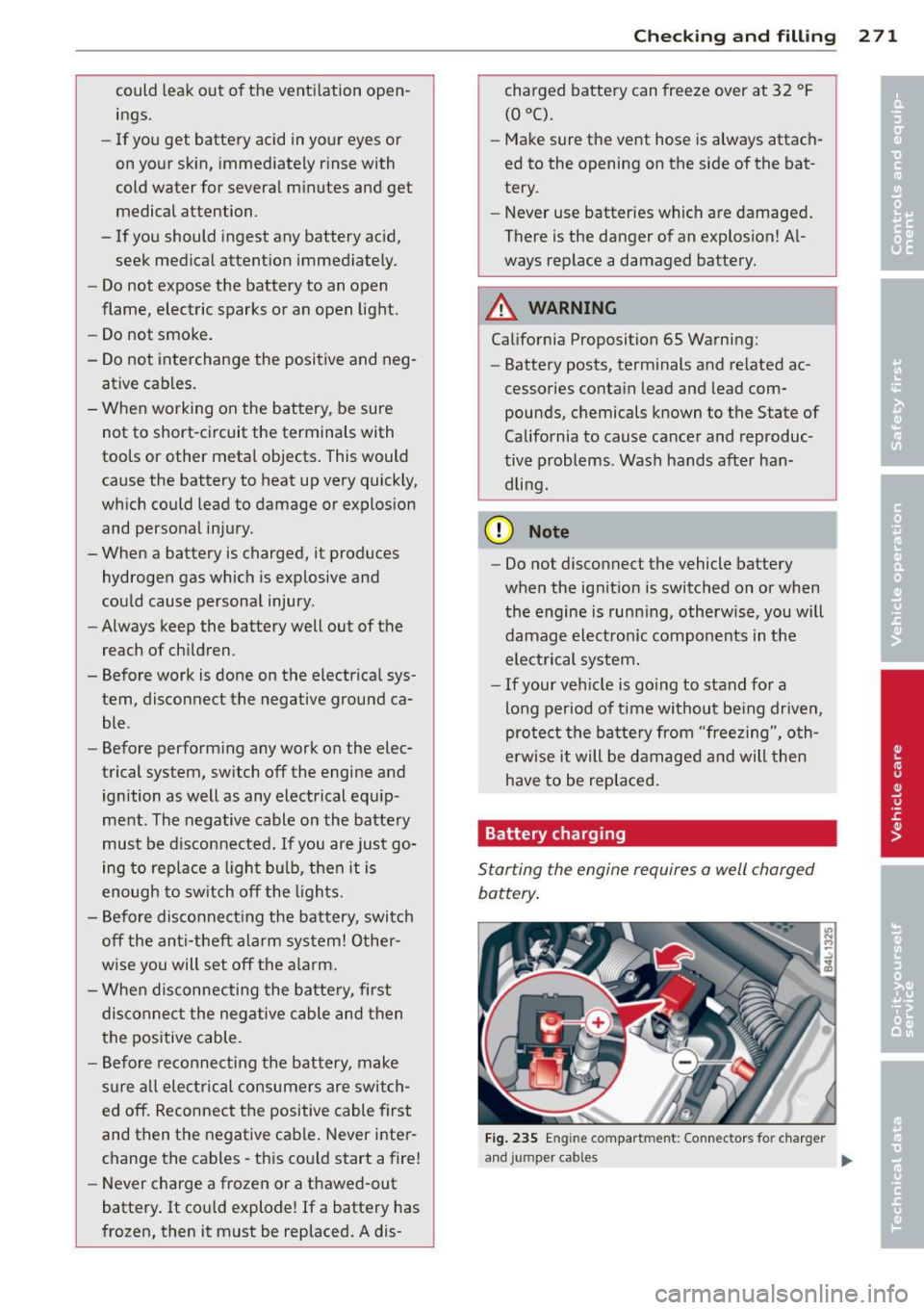
Battery charging
Starting the engine requires a well charged
battery.
Fig. 235 E n gin e compart men t: Co nnectors fo r charger
and j umper ca bles ..,_
Page 275 of 342
Battery replacement
The new battery must have th e sam e specifi
cations and dim ensions as the original equip
ment battery.
Intell igent energy management in your vehi
cle is respons ible for d istr ibuting the e lectr i
cal energy throughout your vehicle
¢
page 225. The intel ligent e nergy ma nage
men t system w ill keep the eng ine ba tte ry
ch arged be tte r th en vehicles w ithout t his sys
tem . To make sure the additional e lectrica l en
e rgy is available once again after you have
changed the battery, we recommend that you install batteries of the same type and man u
facture only (the same as those installed at
the time your vehicle was delivered). Specifi
cations a re listed on the battery hous ing . Your
author ized dealer must code the battery in
the energy manageme nt system to enable yo u
to use the energy managemen t fu nctions co r
rectly after rep lac ing the b attery .
If it is not poss ible to use a battery of this
type, the new battery must have the same ca
paci ty, voltage ( 12 volts) , a mpe rage , con
s truc tion and pl ug sea ling.
W hen insta lli ng the battery, make sure the ig
ni tion and all e lectr ical c ons umers a re turned
off.
CD Note
Ma ke s ure the venti lation hose on the s ide
of the bat tery is connected, ot he rwise
fumes or ba ttery a cid c an leak out.
@, For the sake of the environment
Because of the probl em of proper d isposa l
of a batte ry, we recommend your autho r
i z e d Au di d ealer change the batt ery f or
you. Batter ies co ntain s ulfu ric ac id and
lead and m ust always be dis posed of prop
erly i n complia nce w ith all environmenta l
reg ulations. D isposin g of vehicle batteries
improper ly is very dangerous to the envi
ronment.
Checkin g and fillin g 273
Windshield/headlight
washer container
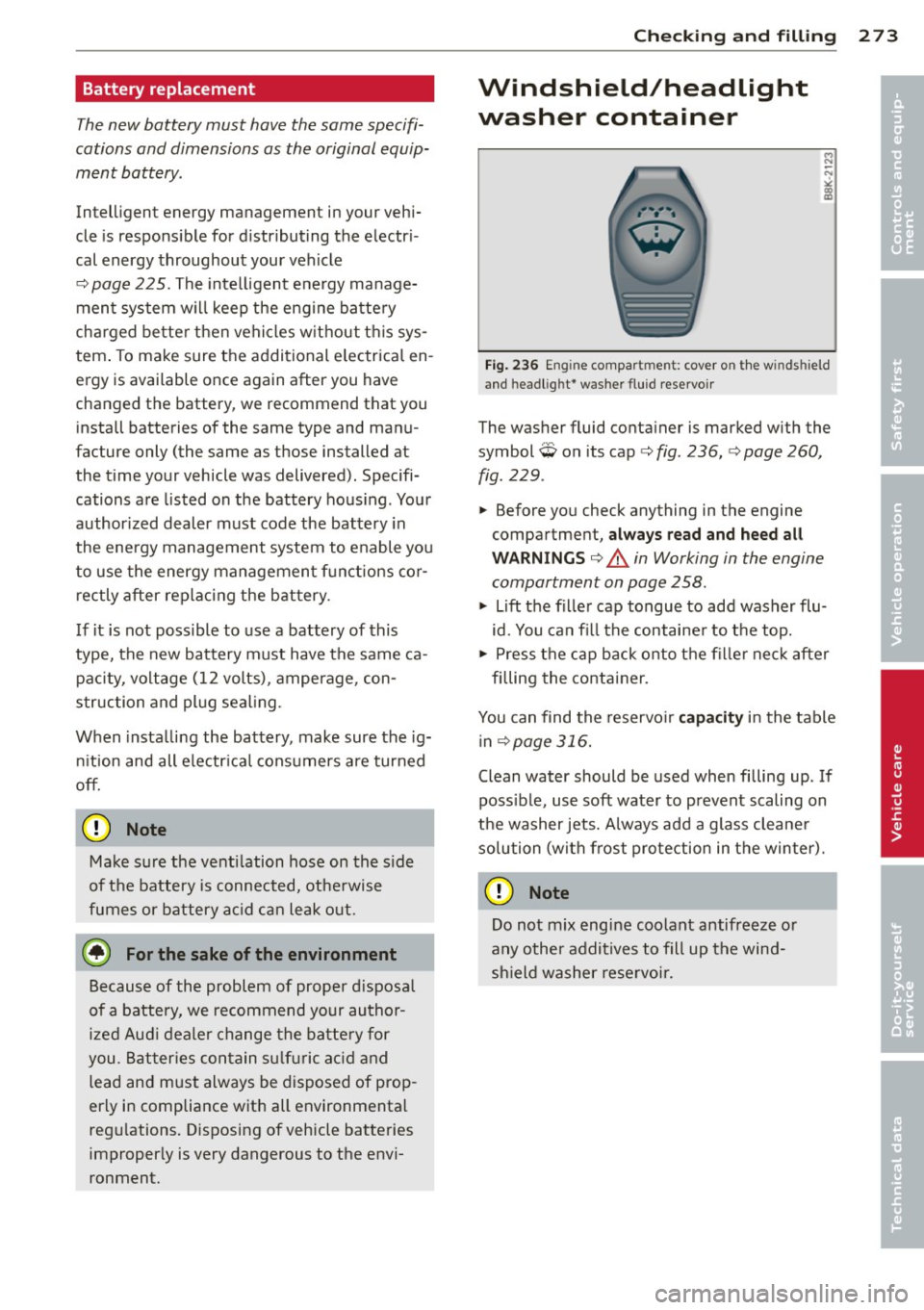
Fig. 2 36 En gin e compart ment: cover on t he w inds hield
a n d head lig ht* was her fl ui d reservo ir
The washer fluid conta iner is marked w ith the
symbol Won its cap ¢
fig. 236, ¢ page 260,
fig . 229 .
.. Before yo u check anything in the engine
compartment,
always read and heed all
WARNINGS ¢ &. in Working in the engine
compartment on page 258 .
.. Lift t he fi ller cap tongue to add washer flu
id. You can fi ll the containe r to t he top .
.. Press the cap back o nto the fi lle r ne ck afte r
filling the container.
You can find the reservo ir
capacity in t he table
in
¢ page 316.
Clean water should be used when filling up . If
poss ible , use soft water to prevent scaling on
the washer jets. A lways add a glass cleane r
solution (with frost pro te ction in t he winter).
CD Note
Do not mix engine coo lant antifreez e or
a ny other addit ives to f ill up t he win d
sh ield washer rese rvo ir.
•
•
Page 283 of 342
pressure label lists the recommended cold
tire i nflatio n pressures for the vehicle at its
maximum capacity we ight a nd the tires that
were on your vehicle at the time it was man
ufactured . For recommended t ire pressures
for normal load condit ions, please see chap
ter ~
page 2 78 .
-Turn the valve stem cap counter-clockwise
to remove it from the tire valve .
- Place the air pressure gauge on the valve.
- The tire pressures should only be checked
and adjusted when the tires are cold . The
s light ly raised pressures of warm tires must
not be reduced .
- Adjust the tire pressure to the load you are
carrying.
- Re insta ll the va lve stem cap on the valve .
When should I check the tire pressure ?
The correct tire pressure is especially impor
tant at high speeds . The pressure sho uld
therefo re be checked at least once a month
and a lways before start ing a journey. Do not
forget to check the tire pressure for the spare
wheel.
When should I adju st the tire pre ssures?
Ad just the tire pressure to the load you are
carrying. After changing a wheel
or replacing
wheels you have to adjust the tire pressures
on all wheels. In addition, you must then
store the new tire pressures i n the t ire pres
sure mon itor ing system
~ page 294.
A WARNING
Incorrect tire pressures and/or unde rinfla
tion ca n lead sudden tire failure, loss of
cont ro l, col lision, ser ious persona l inju ry
or even death.
- Whe n the wa rning symbo l
RI] appears in
the instrument cl uster, s top an d inspect
the tires.
- Incorre ct tire pressure and/or unde rinfla
t ion can cause inc reased t ire wear and
can affect the handling o f the veh icle and
stopp ing ability.
- Incorrect tire pressures and/or underin
flation can also lead to sud den tire fa il-
Tires an d wheel s 281
ure, including a blowout and sudden de
flation, ca using loss of veh icle contro l.
- The driver is responsib le for the correct
tire pressures for all tires on the veh icle.
The applicable pressure values are locat
ed on a sticker o n the dr iver's s ide B-pil
lar .
- Onl y when all tires on the vehicle are fil
led to the correct pressure, the t ire pres
sure mon itor ing system can work cor
rectly .
- The use of incorrect tire pressure va lues
can lead to acc idents or other damage .
Therefore it is ess ential that th e drive r
observe t he spec ified t ire p ress ure val ues
for the tires and the cor rect pressures for
the func tion of the t i re p ress ure moni to r
ing system.
- Always in flate tires to the recommen ded
a nd correct t ire p ress ure be fore dr iv ing
off .
- D riving with unde rinf lated tires bend
mo re, letting them get too hot resulting
in tread separation, s udden tire failure
and loss of control.
- Excessive speed and/overloading can
cause heat b uild- up, sudden tire failure
and loss of control.
- If the tire pressure is too low or too high,
the t ires will wear prematurely and the
veh icle w ill not handle well.
- If the tire is not flat and you do not have
to change a wheel immediately, d rive at
red uced speed to the nearest service sta
tion to check the t ire press ure and add
air as requ ired .
(D Note
Driving w ithout valve stem caps can cause
damage to the tire valves. To prevent this,
a lways make sure that factory installed
valve s tem caps o n all whee ls are sec urely
mounted o n the valve .
@ For the sake of the environment
Underinflated tires will also increase the
fuel consumpt ion.
•
•
Page 295 of 342

TPMS malfunction indicator is combined with
the low tire pressure tellta le . When the sys·
tern detects a malfunction, the telltale will
flash for approximately one minute and then
remain continuously illuminated. This se·
quence will continue upon subsequent vehicle
start-ups as long as the malfunction ex ists .
When the malfunc tion indicator is illuminat·
ed, the system may not be able to detect or
signal low tire pressure as intended. TPMS
malfunct ions may occur for a variety of rea·
sons, including the installation of replace·
mentor alternate tires or wheels on the vehi·
cle that prevent the TPMS from functioning
properly. Always check the TPMS malfunction
telltale after replacing one or more tires or
wheels on your vehicle to ensure that the re
p lacement or alternate tires and wheels allow
the TPMS to continue to function properly.
Tire pressure indicator appears
The tire pressure indicator in the instrument
cluster informs you if the tire pressure is too
low or if there is a system malfunction.
-
-
;g
Fig. 242 Display: underinflat io n warning
Fig. 243 Display: Syste m ma lfunct io n
Using the ABS sensors , the tire pressure moni·
toring system compares the tire tread circum·
Tires and wheels 293
ference and vibration characteristics of the in
dividual tires. If the pressure decreases in one
or more tires, this is indicated in the instru
ment cluster with a warning symbol
[I] and a
message
c;, fig. 242 . The driver message in the
display goes out after S seconds . The driver
message can be displayed again by pressing
the
ICHECKI button . If only one tire is affect·
ed, the disp lay wi ll indicate its posit ion.
The tire pressure monitoring must be reset via
MMI each time the pressures are adjusted (e.
g. when switching between part ial and fu ll
load pressu re) o r after changing or replacing a
tire on your vehicle
c;, page 294. You can find
the recommended tire pressures for your vehi ·
cle on the label on the driver's door pillar
c;,page 278.
Tire tread circumference and vibration charac·
teristics can change and cause a tire pressure
warning if:
- the tire pressure in one or more tires is too
low,
- the tir e has structural damage ,
- the tir e pressure was changed, wheels rotat-
ed or replaced but the TPMS was not reset
c;,page294 .
Warning symbols
[I] loss of pressure in at least one tire c;, .&, .
Check the tire or tires and replace or repair if
necessary . The indicator light
[I] in the instru·
ment cluster also illum inates
c;, page 14.
Check/correct the pressures of all four tires
and reset TPMS via MMI.
IIQ§S, (Tir e Pressure Monitoring System) Tire
pressure! System malfunction . If llQ§f:1 ap·
pears after switching the ignition on or while
driv ing
c;, fig. 243 and the indicator light [I] in
the instr ument cluster blinks for approxi
mately one minute and then stays on, there is
a system malfunction . See your authorized
Audi dealer as soon as possible.
Page 300 of 342
2 98 What do I do now?
The compressor must not be connected to
the c igarette lighter socket, as this socket
does not provide the required power.
Changing a wheel
Before changing a wheel
Observe the following precautions for your
own and your passenger's safety when chang
ing a wheel.
• After you experience a tire failure, pull the
car well away from moving traffic and try to
reach
level ground before you stop r::::> /.1. .
• All passengers should leave the car and
move to a safe location (for instance, behind
the guardrai l)
r::::> /.1. .
• Engage th e parking brake to prevent your
vehicle from rolling unintentionally
r::::> /.1. .
• Move selector lever to position P r::::> /.1..
• If you are towing a trailer: unhitch the trail
er from your vehicle .
• Block the diagonally opposite wheel with
the fo ld ing chocks or other objects .
• Take the
jack and the inflatable spare tire
out of the luggage compartment
r::::>page 295.
& WARNING
You or your passengers cou ld be injured
while changing a whee l if yo u do not fol
low these safety precautions :
- If you have a flat tire, move a safe dis
tance
off the road. Turn off the engine,
turn the emergency flashers on and use other warning devices to alert other mo
torists .
- Make sure that passengers wait in a safe
place away from the vehicle and well
away from the road and traff ic .
- To help prevent the vehicle from moving
suddenly and possibly slipping off the
jack, always fully set the parking brake
and block the whee l diagonally opposite
the whee l being changed with the fold
ing chocks or other objects. When one front wheel is lifted
off the ground, plac
ing the Automatic Transmission in "P"
(Park) will
not prevent the vehicle from
moving .
- Before you change a wheel, be sure the
ground is level and firm. If necessary,
use a sturdy board under the jack.
- After installing the inflatable spare tire,
make sure that you replace the flat tire/
wheel in its storage area properly and
tighten the knurled retaining screw se
curely.
Changing a wheel
When you change a wheel , follow these
quence described below step-by-step and in
exactly that order.
1. Activate the vehicle jack mode (only vehi
cles w ith Adaptive Air Suspens ion)
r::::> page 154.
2. Remove the decorative wheel cover*. For
more details see also
r::::> page 299, Deco
rative wheel covers or r::::> page 299,
Wheels with wheel bolt caps.
3. Loosen the wheel bolts r::::>page 299 .
4. Locate the proper mounting point for the jack and align the jack below that point
r::::>page 300.
S. Lift the car with the jack r::::> page 300.
6. Remove the wheel with the flat tire and
then insta ll the
inflatable spare tire
r::::>page 301.
7. Tighten all wheel bolts lightly.
8.
Lower the vehicle with the jack.
9. Use the wheel bolt wrench and
firmly
tighten all wheel bolts r::::> page 299.
10. Rep lace the decorative wheel cover*.
11. De activate the vehicle jack mode (only ve
hicles wi th Adaptive Air Suspension)
r::::> page 154.
& WARNING
Always read and follow all WARNINGS and
in format ion
c:::> &. in Raising the vehicle on
page 301
and c:::> page 302.