child seat AUDI Q7 2012 Owner´s Manual
[x] Cancel search | Manufacturer: AUDI, Model Year: 2012, Model line: Q7, Model: AUDI Q7 2012Pages: 342, PDF Size: 86.42 MB
Page 166 of 342
164 Driving Safel y
• Adjust the head restraints so the upper
edge is as even as possible with the top of
your head. If that is not possib le, try to ad
just the head restraint so that it is as close
to this position as possible
q fig. 183.
• If there are passengers in rear seat, fold the
head restraints up on the occupied seats or
s lide the center head restra int upward at
least to the next notch.
Adjusting head restraints
q page 76 .
A WARNING
-
Driv ing without head restraints or w ith
head restra ints that are not properly ad
justed increases the risk of serious o r fatal
neck injury dramatically. To help reduce
t he risk of injury:
- Always drive with the head restraints in
place and properly adjusted.
- E very pe rson in the veh icle must have a
properly ad justed head restra int.
- Always make su re each pe rson in the ve
hicle properly adjusts the ir head re
straint. Ad just the head restraints so the
upper edge is as even as possib le with
the top of your head. If that is not possi
ble, try to adjust the head restraint so
that it is as close to this position as pos
sible.
- Never attempt to adjust head restraint
wh ile driving. If you have driven
off and
must adjust the driver headrest for any
reason, first stop the vehicle safe ly be
fore attempting to adjust the head re
st rain t.
- Children must always be properly re
strained in a ch ild restraint that is appro
pr iate for their age a nd s ize
q page 200.
Examples of improper seating positions
The occupant restraint system can only re
duce the risk of injury if vehicle occupants are
properly seated.
Improper seating positions can cause serious
injury or death. Safety belts can only work
when they a re p roperly positioned on the body. Improper seating positions reduce the
effectiveness
of safety belts and will even in
c rease the risk o f injury and death by moving
the safety belt to crit ica l areas of the body.
Improper seating positions also increase the
risk of serious injury and death when an air
bag deploys and str ikes an occupant w ho is
not in the proper s eating position. A dr iver is
responsible for the safety of all veh icle o ccu
pants and espec ially for child ren. The re fo re:
• Never allow anyone to assume an incorrect
seating position when the vehicle is being
used
Q & .
The following bulletins list o nly some sample
pos itions tha t w ill increase the r isk of serious
i njury and dea th. O ur hope is that t hese exam
ples will ma ke yo u more aware o f seat ing po
s itions tha t a re dangerous.
Th erefore , whenever the vehicle is
moving:
- neve r sta nd up i n the vehicle
- neve r stand on the seats
- never kneel on the seats
- never ride wit h the seatback reclined
- never lie down on the rear seat
- never lean up against the instrument panel
- neve r sit on the e dge of the seat
- neve r sit sideways
- neve r lean out the window
- never put your feet out the window
- never put your feet on the instrument panel
- never rest your feet on the seat cushion or
back of the seat
- neve r ride in the footwell
- never ride in the cargo a rea
A WARNING
Imp roper seating positions increase the
risk of ser ious persona l injury and death
whenever a vehicle is being used.
- Always make sure that all vehicle occ u-
pants stay in a proper seating position
and are properly restrained whenever the
veh icle is being used.
Page 169 of 342
to reduce the risk of injury when the vehi
cle is not be ing used.
- After closing the rear lid, always make
sure that it is properly closed and locked.
- Never leave your vehicle unattended es
pecially with the rear lid left open . A
child could crawl into the vehicle through
the luggage compartment and close the
rear lid becoming trapped and unable to
get out . Be ing trapped in a vehicle can
lead to serious persona l injury .
- Never let children play in or around the vehicle .
- Never let passe ngers r ide in the luggage
compartment . Ve hicle occupants must
always be properly restrained in one of
the vehicle's seating positions.
(D Tips
- Air c irculation helps to reduce window
fogging . Sta le air escapes to the outside
th rough vents in the trim pane l. Be su re
to keep these slots free and open .
-The t ire pressure must correspond to the
load. The t ire pressur e is shown o n the
tire p ress ure label. The tire pressure la
bel is loc ated on the d river's s ide B-pi ll a r.
The t ire pressure label lists the recom
mended cold ti re inflat ion pressu res for
the vehicle at its maximum capacity
weig ht and the tires that were on you r
vehicle at the time it was man ufactured .
For recommended t ire pressures fo r nor
mal load conditions, please see chap ter
c:> page278 .
Tie-downs
The luggage compartment is equipped with
four tie-downs to secure luggage and other
items .
Use the tie-downs to secure your cargo prop
erly
c:> page 166, Loading the luggage com
partment.
In a coll is ion, the l aws of phys ics mean that
even smalle r items that are loose in the vehi
cle will become heavy missiles that can cause
Dr iving S afel y 167
serious injury. Items in the ve hicle possess en
ergy which vary with vehicle speed and th e
weight o f the item . Vehicle speed is the most
s ignificant factor.
Fo r example, in a fronta l collision at a speed
of 30 mph (48 km/h), the forces acting on a
10 -lb (4.5 kg) object are about 20 t imes the
no rmal weight of the item. This means t hat
the weigh t of the item would sudden ly be
about 200 lbs. (90 kg) . You can imag ine the
i njur ies that a 200 lbs . (90 kg) item fly ing
fr eely th ro ugh the passenger compar tme nt
c ould cause in a co lli sion like this.
A WARNING
We ak, dam aged or imprope r str aps used
to secure items to tie -downs can fail dur
ing hard braking or in a collision and cause
serio us personal injury .
-Always use s uita ble mount ing stra ps and
properly secu re items to the tie-downs in
the l uggage compa rtme nt to he lp pre
vent items from shift ing or f ly ing fo r
ward as dangerous missiles .
-When the rea r seat backrest is folded
down, a lways use suitable mounting
straps and properly secure items to the
tie-downs in the luggage compartment
to hel p prevent items from fly ing for
ward as da ngerous missiles into the pas
s enger compartment .
- Never attach a chi ld safety seat te th er
s trap to a t ie- down .
Reporting Safety
Defects
Applicable to U.S.A.
If you b elieve that your v ehi cle
has a d efe ct whi ch could cause
a crash or could cause injury or
d eath, you should imm ediately
inform the National Highway
Tr affic Safet y Admini stration ..,.
•
•
Page 172 of 342
1 70 Safety belts
Safety belts
General notes
Always wear safety belts!
Wearing safety belts correctly saves lives!
This chapter exp lains why safety be lts a re nec
essary, how they work and how to adjust and
wear them correctly .
.. Read a ll the informat ion that fo llows and
heed all of the instruct ions and WARNINGS.
A WARNING
Not wearing safety belts or wearing them
improperly increases the risk of ser ious
personal in jury and death .
- Safety belts are t he sing le most effective
means avai lab le to red uce the risk of se
r ious injury and dea th in a utomob ile acci
d ents . For your p rot ection and that of
yo ur passenge rs, alw ays co rrec tly wear
s afety belts when the vehicle is moving .
- P regnant wo men, injured, or physically
im paired perso ns mu st also use safe ty
bel ts. Lik e all veh icle occup ants, they are
more like ly to be ser iously injured if they
do not wea r safety be lts . The best way to
protect a fetus is to protect the mother -
throughout the entire pregnancy.
Number of seats
Vehicles with five seats : Your vehicle has two
front seats and three rear seats. Each seating
position has a safety belt .
Vehicles with six seats:* Your vehicle has two
front seats, two seats in the second row and
two seats i n the t hird row. Each seating posi
tion has a safety belt.
Vehicles with seven seats:* Your vehicles has
two front seats, three seats in the sec ond row
and two seats in the third row. Each seating
position has a safety belt .
A WARNING
Not wearing safety be lts or wear ing them
i mprope rly inc reases the r isk of serious
p ersonal injury and dea th.
- Never strap more than one person , in
cluding sma ll children, into a ny be lt . It is
esp ecia lly da nge ro us to p lace a safe ty
be lt ove r a ch ild sitt ing on your lap.
- Never let more p eopl e ride in th e vehicle
than there are safety belts availabl e .
- Be s ure everyone riding i n the vehicle is
p roperly rest rain ed w ith a separate sa fe
ty belt o r chi ld restr aint.
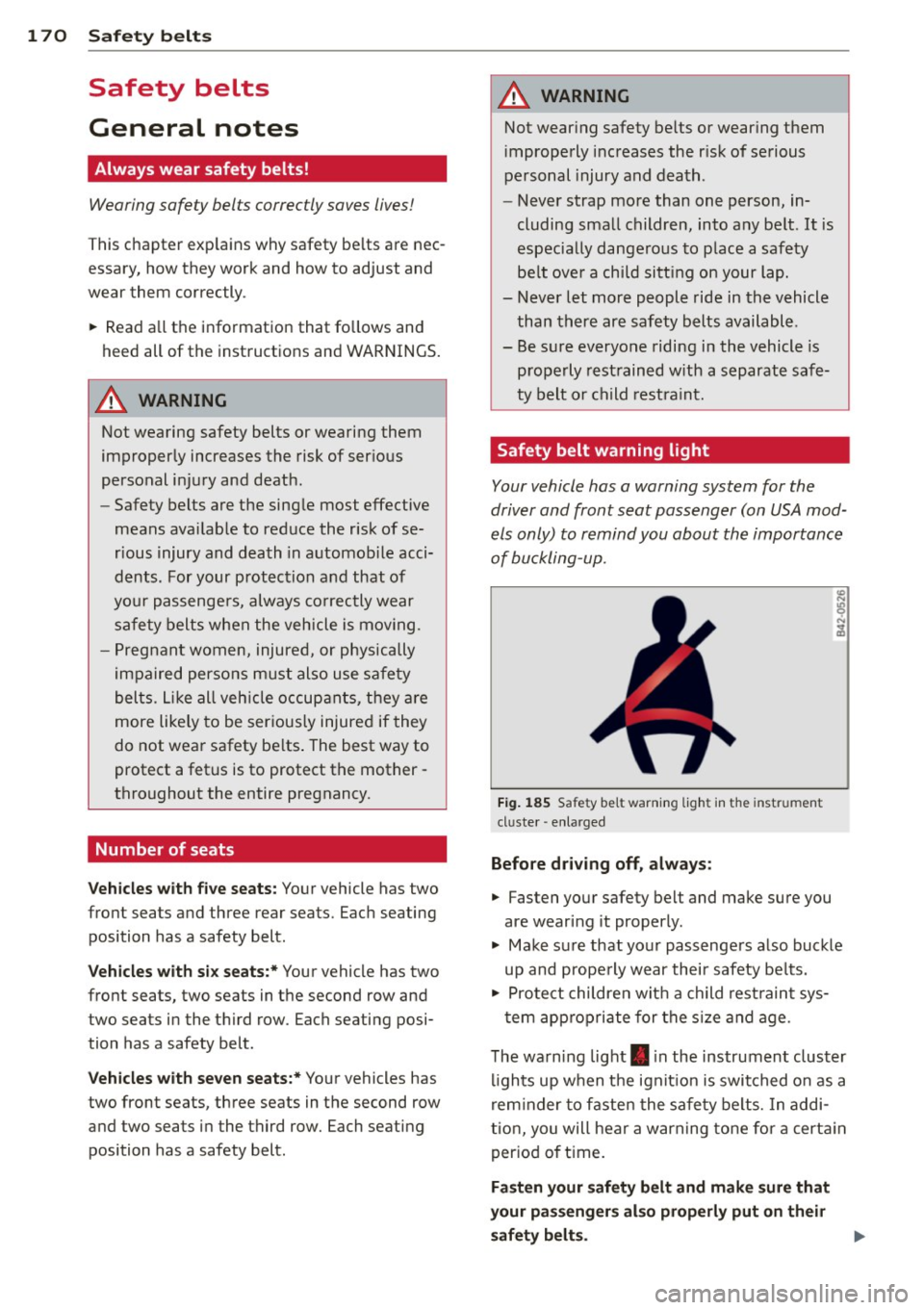
Safety belt warning light
Your vehicle has a warning system for the
driver and front seat passenger (on USA mod
els only) to remind you about the importanc e
of buckling-up.
Fi g. 1 85 Safety be lt warning lig ht in the instr ument
cl uste r -e nlar ged
Before driving off, always :
.. Fasten you r safety belt and make sure you
are wear ing it properly .
.. Mak e sur e that you r passenge rs also buck le
up and prope rly wear their safety be lts.
.. Prote ct childre n wit h a child res train t sys-
t em app ro pr ia te for the s ize and age .
T he wa rn ing lig ht . in the instrument cluster
li ghts up w hen t he ignit ion is switched on as a
rem inder to f asten the sa fe ty belts. In addi
t ion, you will hear a w arning to ne for a cert ain
per iod of t ime.
Fasten your safety belt and make sure that
your pa ssenger s also properly put on their
s afety belts .
Page 175 of 342
forces on the body more "tolerable" and less likely to cause injury.
Although these examples are based on a fron
tal collision , safety belts can also substantial
ly reduce the risk of injury in other kinds of
crashes. So, whether you're on a long trip or
just going to the corner store, always buckle
up and make sure others do, too. Accident sta
tistics show that vehicle occupants properly
wearing safety belts have a lower risk of being
injured and a much better chance of surviving
an accident . Properly using safety belts also
greatly increases the ability of the supplemen
tal airbags to do their job in a collision. For
this reason, wearing a safety belt is legally re
quired in most countries including much of
the United States and Canada.
Although your Audi is equipped with airbags ,
you still have to wear the safety belts provid
ed. Front airbags, for example, are activated
only in some frontal collisions. The front air
bags are not activated in all frontal collisions,
in side and rear collisions, in roll overs or in
cases where there is not enough deceleration
through impact to the front of the vehicle .
The same goes for the other airbag systems in
your Audi. So, always wear your safety belt
and make sure everybody in your vehicle is
properly restrained!
Important safety instructions about
safety belts
Safety belts must always be correctly posi
tioned across the strongest bones of your
body.
.,. Always wear safety belts as illustrated and
described in this chapter.
.,. Make sure that your safety belts are always
ready for use and are not damaged.
A WARNING
Not wearing safety belts or wearing them
improperly increases the risk of serious
personal injury and death. Safety belts can
work only when used correctly .
Safety belts 173
-Always fasten your safety belts correctly
before driving off and make sure all pas
sengers are correctly restrained.
- For maximum protection, safety belts
must always be positioned properly on
the body .
- Never strap more than one person, in cluding small children, into any belt .
- Never place a safety belt over a child sit
ting on your lap.
- Always keep feet in the footwell in front
of the seat while the vehicle is being driv
en.
- Never let any person ride with their feet
on the instrument panel or sticking out
the window or on the seat.
- Never remove a safety belt while the ve hicle is moving. Doing so will increase
your risk of being injured or killed .
- Never wear belts twisted.
- Never wear belts over rigid or breakable
objects in or on your clothing, such as
eye glasses, pens, keys, etc., as these
may cause injury.
- Never allow safety belts to become dam aged by being caught in door or seat
hardware .
- Do not wear the shoulder part of the belt
under your arm or otherwise out of posi
tion .
- Several layers of heavy clothing may in
terfere with correct positioning of belts
and reduce the overall effectiveness of
the system .
- Always keep belt buckles free of anything
that may prevent the buckle from latch
ing securely .
- Never use comfort clips or devices that
create slack in the shoulder belt. Howev
er, special clips may be required for the
proper use of some child restraint sys
tems .
- Torn or frayed safety belts can tear, and
damaged belt hardware can break in an
accident. Inspect belts regularly. If web-
bing, bindings, buckles, or retractors are .,..
L,_ _______________ _J
•
•
Page 177 of 342
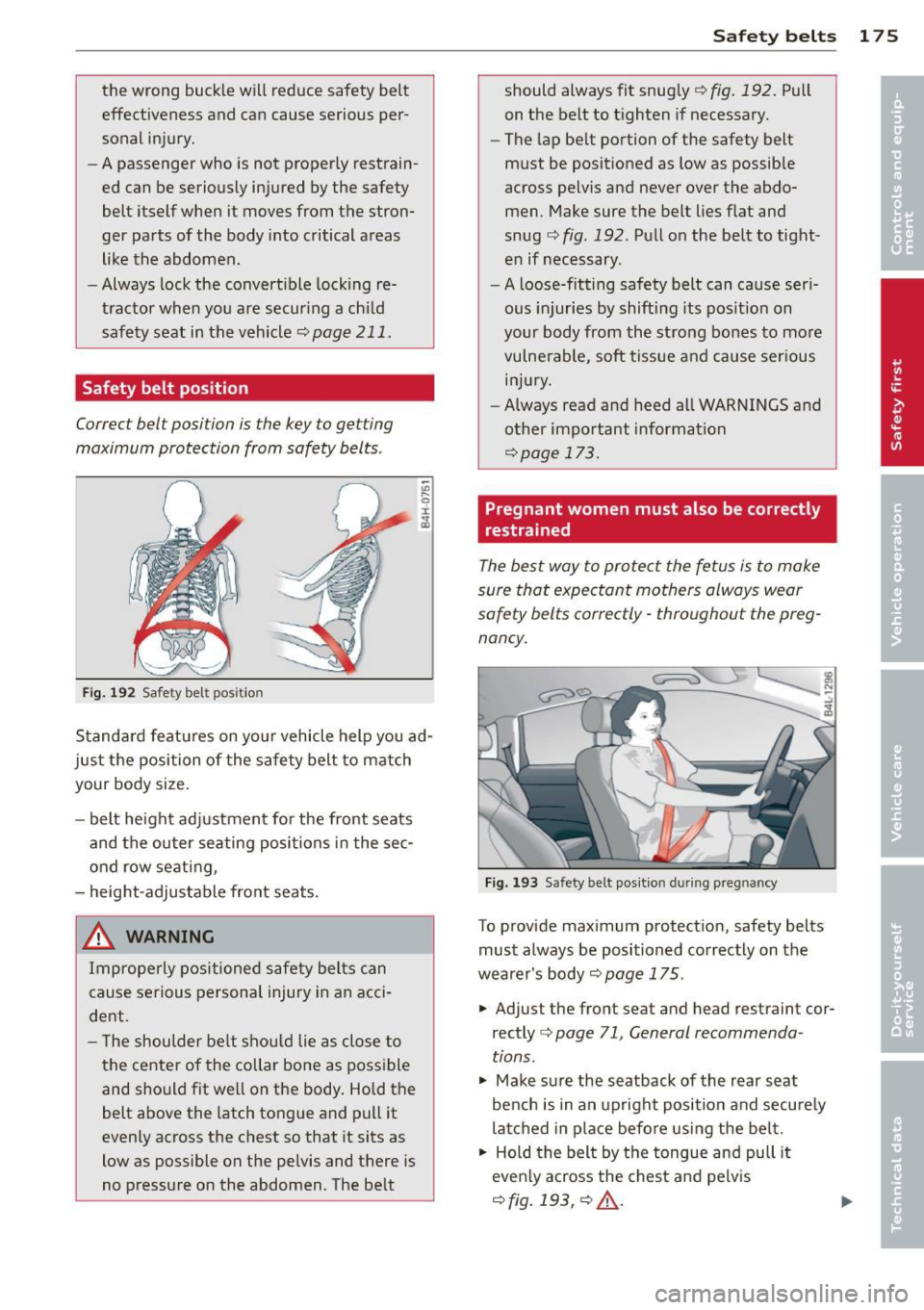
the wrong buckle will reduce safety belt
effectiveness and can cause serious per
sonal injury.
- A passenger who is not properly restrain
ed can be seriously injured by the safety
belt itself when it moves from the stron
ger parts of the body into critical areas
like the abdomen .
- Always lock the convertible locking re
tractor when you are secur ing a child
safety seat in the vehicle
~ page 211 .
Safety belt position
Correct bel t posi tion is the key to getting
maximum protection from safety belts .
Fig. 192 Safety be lt pos it io n
Standard features on your vehicle help you ad
just the position of the safety belt to match
your body size.
- belt height adjustment for the front seats
and the outer seating positions in the sec
ond row seating,
- height-adjustable front seats.
A WARNING
Improperly positioned safety belts can
cause serious personal injury in an acci
dent.
-
- The shoulder belt should lie as close to
the center of the collar bone as possible
and should fit well on the body. Hold the
belt above the latch tongue and pull it
evenly across the chest so that it sits as
low as possible on the pelvis and there is
no pressure on the abdomen . The belt
Safety belts 175
should always fit snugly¢ fig. 192. Pull
on the belt to tighten if necessary.
- The lap belt portion of the safety belt
must be positioned as low as possible
across pelvis and never over the abdo
men . Make sure the belt lies flat and
snug ¢
fig. 192 . Pull on the belt to tight
en if necessary .
- A loose-fitting safety belt can cause seri
ous injuries by shifting its pos ition on
your body from the strong bones to more
vulnerable, soft tissue and cause serious
injury.
- Always read and heed all WARNINGS and
other important information
¢ page 173.
Pregnant women must also be correctly
restrained
The best way to protect the fetus is to make
sure that expectant mothers always wear
safety belts correctly -throughout the preg
nancy.
Fig. 193 Safety belt pos ition du ring pregnan cy
To provide max imum protection, safety belts
must always be positioned correctly on the
wearer's body¢
page 175 .
.,. Adjust the front seat and head restraint cor
rectly ¢
page 71 , General recommenda
tions .
.,. Make sure the seatback of the rear seat
bench is in an upright position and securely
latched in place before using the belt.
... Hold the belt by the tongue and pull it
evenly across the chest and pelvis
¢fig. 193, ¢ A.
Page 181 of 342
Airbag system Important things to know
Importance of wearing safety belts and
sitting properly
Airbags are only supplemental restraints. For
airbags to do their job , occupants must al
ways properly wear their safety belts and be
in a proper seating position.
For your safety and the safety of your passen
gers, before driving off, always:
"" Adjust the dr iver's seat and steering wheel
properly ¢
page 161,
"" Adjust the front passenger's seat properly
¢page 72 ,
"" Wear safety be lts properly ¢
page 173,
"" Always properly use the proper child re-
straint to protect chi ldren ¢
page 200.
In a collision, airbags must inflate within the blink of an eye and with considerable force .
The supplemental airbags can cause injuries if
the driver or the front seat passenger is not
seated properly . T herefore in order to help the
a irbag to do its job, it is important, both as a
driver and as a passenge r to s it properly at all
times.
By keeping room between your body and the
steer ing wheel and the front of the passenger
compartment, the airbag can inflate fully and
comp letely and provide supplemental protec
tion in certain frontal collisions ¢
page 161,
Proper occupant seating positions.
F or detai ls
on the operation of the seat adjustment con
trols ¢
page 72.
It's especially important that children a re
properly restrained ¢
page 200.
There is a lot that the driver and the passen
gers can and must do to help the individual
safety features installed in your Aud i work to
gether as a system.
Proper seat ing pos ition is important so that
the front airbag on the driver s ide can do its
job. If yo u have a physical impa irment or con-
A irbag system 179
dition that prevents yo u from sitting properly
on the driver seat with the safety belt properly
fastened and reach ing the peda ls, or if you
have concerns with regard to the function or
operation of the Advanced Airbag System,
please contact your author ized Audi dealer or
qualified workshop, or call Audi Customer Re
l ations at 1-800-822-2834 for poss ible modi
ficat io ns to your veh icle.
When the airbag system dep loys, a gas gener
ator will fill the a irbags, break open the pad
ded covers, and inflate between the steer ing
whee l and the dr iver and between the instru
ment pane l and the front passenger. The a ir
bags will deflate immediately after dep loy
ment so that the front occupants can see
through the windshield again without inter
ruption .
All of th is takes place in the blink of an eye, so
fast that many people don't even realize that
the airbags have deployed. The airbags a lso
inflate with a great dea l of force and nothing
should be in their way when they deploy.
Front airbags in combination with properly
worn safety belts slow down and lim it the oc
cupant's forward movement . T ogether they
help to prevent the driver and front seat pas
senger from h itti ng pa rts of the inside of the
vehicle while reducing the forces acting on the
occupant during the crash . In this way they
help to reduce the risk of injury to the head
and upper body in the crash. Airbags do not
protect the arms or the lower parts of the
body.
Both front airbags will not inflate in all fronta l
collisions . The triggering of the airbag system
depends on the vehicle de ce leration rate
caused by the collision and regis te red by the
electron ic control unit. If th is rate is below
the reference value programmed into the con
trol unit, the airbags will not be trigge red ,
even though the car may be bad ly damaged as
a res ult of the co llision . Ve hicl e damage, re
pair costs or even the lack of veh icle damage
is not necessarily an indication of whether an
airbag should inflate or not . .,. •
•
Page 182 of 342
180 Airbag sys tem
Since the cir cumstances will vary considerab ly
between one collision and anot her, it is not
possib le to def ine a range of vehicle speeds
that will cover every possible k ind and angle
of impact t hat will always trigger the a irbags.
Important factors include, for example, the
nature (hard or soft) of the object which the
car h its, the ang le of impact, vehicle speed,
etc. The front airbags will also not inflate in
side or rea r collisions, or in ro ll-overs .
Always remember : Airbags will deploy only
once, and only in certa in k inds of co llisions.
Your safety belts are always there to offer pro
tection in those s ituations in which airbags
a re not supposed to deploy, or when they have
a lready deployed; for example, when your ve
hicle strikes or is struck by another vehicle af
ter the first co llision.
This is jus t one of the reasons why an a irbag is
a supplementary restra int and is not a substi
tute fo r a safety belt . The airbag system
works most effect ively when used with the
safety belts. Therefore, always properly wear
your safety belts¢
page 170.
A WARNING
Sitting too close to the steer ing whee l or
instrument panel will dec rease the effec
t iveness of the airbags and will increase
the risk of personal injury in a collision .
- Never sit closer than 10 inches (2S cm)
to the stee ring wheel or instrument pan
el.
- If you cannot sit more than 10 inches
( 2 5 cm) from the s teer ing whee l, investi
gate whethe r adap tive equipmen t may
be available to help you reach the pedals
and increase your seating distance from
the steering wheel.
- If you are unrestrained, lean ing fo rward,
sitting sideways or out of position in any
way, your risk of in jury is much higher.
- You will also receive serio us injuries and
cou ld even be killed if you are up against
the airbag or too close to it when it in
flates - even with an Advanced Airbag. -
To reduce the risk of injury when an a ir
bag inflates, always wear safety be lts
properly ¢
page 174, Safety belts.
-Always make certain that ch ildren age 12
or younger always ride in the rear seat. If
children are not properly restrained, they
may be severe ly injured or killed when an
ai rbag inflates.
- Never let children ride unrestrained or
improperly restrained in the vehicle. Ad
just the front seats prope rly .
- Never ride with the back rest reclined.
- Always sit as far as possible from the
steer ing whee l or the instrument pane l
¢page 161.
-Always sit upright with your back against
the backrest of your seat .
- Never p lace your feet on the instrument
panel or on the seat. Always keep both
feet on the floor in front of the seat to
help prevent serio us in ju ries to the legs
and h ips if the airbag inflates.
- Never recline the front passenger 's seat
to transport objects , Items can a lso
move into the a rea of the s ide airbag or
the front a irbag du ring bra king or in a
sudden maneuve r. Objects nea r the air
bags can become projectiles and cause
in jur y when an airbag inflates.
A WARNING ~
Airbags that have deployed in a crash must
be replaced.
- Use on ly orig ina l equipment airbags ap
proved by Aud i and installed by a trained
technician who has the necessary too ls
and d iagnost ic equipment to properly re
p lace any airbag in your vehicle and as
sure system effectiveness in a crash .
- Never permit salvaged or recycled air
bags to be installed in your vehicle.
Page 183 of 342
Child restraints on the front seat - some
important things to know
.. Be sure to read the important information
and heed the WARNINGS for important de
tails about chi ldren and Advanced Airbags
i=> page 200.
Even though your vehicle is equipped with an
Advanced Airbag System, make certain that
a ll chi ldren, especially those 12 years and
younger, always ride in the back seat properly restrained for their age and size. The airbag
on the passenger side makes the front seat a potentially dangerous place for a child to r ide .
The front seat is not the safest place fo r a
chi ld in a fo rward-facing chi ld safety seat. It
can be a very dangerous place for an infan t or
a child in a rea rward-facing seat.
The Advanced Airbag System i n your veh icle
has been cert ified to comp ly with the require
men ts of United States Federa l Mo to r Veh icle
Safety Standard 208 as applicable at the time
your vehicle was manufactured.
The Standard requires the front a irbag on the
passenger side to be t urned off ("sup
p ressed") if a chi ld up to about one year of
age restrained in one of the rear -facing or for
ward -facing infant restraints listed i n Federal
Motor Vehicle Safety Standard 208 with wh ich
the Advanced Airbag System in your vehicle
was certified has been installed o n the front
passenger seat . For a listing of the child re
straints that were used to certify compliance
with the US Safety Sta ndard
c> page 202.
The PASS ENG ER AIR BAG OFF light in the in
strument panel te lls you when the front Ad
vanced A irbag on the passenger side has been
turned off by the e lectronic control u nit.
Each t ime you turn on the ignition, the
PAS
SENGER AIR BAG OFF
light w ill come on for a
few seconds and:
- will stay on if the front passenger seat is not
occupied
- will stay on if there is a small child or child
restraint on the front passenger seat
A irbag sys tem 181
- w ill go off if the front passenger seat is oc
cupied by an adult as registered by the
weight -sensing mat
c> page 190, Monitor
ing the Advanced Airbag System.
T he PASSENGER AIR BAG OFF light comes on
whe n the contro l unit detects a tota l weight
on the front passenger seat that req uires the
front a irbag to be turned off.
If the total weight on the front passenger
seat is more than that of a typical 1 year-o ld
c h ild but less than the weight of a small
adult, the front airbag on the passenger side
can deploy (the
PASSENGER AIR BAG OFF
li ght does not come on). If the PASSENG ER
AIR BAG OFF
light does not come on, the
front a irbag on t he passenger side has not
been t urned off by the elect ronic con trol unit
and can deploy if the control unit senses an
impact that meets the cond itions stored in its
memory .
For exampl e, th e airb ag may deplo y if:
- a small ch ild that is heav ie r than a typical 1
year-old ch ild is o n the front passenger seat
(regard less of whether the child is in one of
the child safety seats listed
c> page 202), or
- a child who has outgrown child restraints is
on the front passenger seat.
If the front passenger airbag is turned off, the
PASSENGER AIR BAG OFF light comes on in
the instr ument cluster and stays on .
The front airbag on the passenger side may
not deploy (the PASSENGER AIR B AG OFF
light does not illum inate and stay lit) even if a
small ad ult or teenager, or a passenger who is
not sitti ng uprig ht w ith their back against a
non -recli ned back rest w it h thei r feet on the
vehicle floor in front of the sea t is on t he front
passenger seat
c> page 161, Proper seating
position for the driver.
If the fron t passenger ai rbag dep loy s, the
Federa l Standard req uires the airbag to meet
the "low risk" dep loyment criteria to reduce
the risk of injury t hro ugh interact ion w ith the
airbag. "Low risk" dep loyment occ urs in those
crashes that take place at lower dece lerat ions ..,. •
•
Page 184 of 342
182 Airbag sys tem
as def ined in the electronic control unit
Q page 190, PASSENGER AIR BAG OFF light.
A lways remember, a ch ild safety seat or infant
carrier insta lled on the front sea t may be
struck and knocked o ut o f position by the rap
id ly inflating passeng er's airbag in a frontal
coll is ion . T he airbag cou ld greatly reduce the
effec tiveness of the child restraint and even
serious ly injure the child during inflat ion.
F or this reason, and because the back seat is
the safest p lace for children - when properly
restra ined acco rd ing to their age and si ze - we
s trongly recommend that children always sit
in the back seat
Q page 200, Child Safety .
A WARNING
A child in a rearward-facing child safety
s e at insta lled on the front passenger seat
w ill be seriously injured and can be k illed if
t he fr ont a irbag inflates - even with an Ad
vanced Airbag System.
- T he i nflating a irbag will hit the child
safety seat or infant carrier wit h great
f orce and w ill smash the ch ild safety sea t
and child against the backrest , center
armrest, door or roof.
- Always insta ll rear -facing child sa fety
seats on the rear seat.
- If you mus t install a rearward facing
child safety seat on the front passenger
seat because of exceptional circ umstan
ces and the
PASSENG ER AIR BAG OFF
light does not come on and stay on , im
med iately install the rea r-facing child
safety seat in a rear seating position and
hav e the a irbag system inspected by you r
authori zed Aud i dealer.
- Forward-fac ing ch ild safety seats instal
led on the front passenger's seat may i n
terfere wi th the deployment of the air
b ag and cau se serious person al injury to
the ch ild .
A WARNING
If, in exceptional c ircumstances, you must
install a forward-facing child restra int on
the front passenger's seat: -
Always make sure the forward-facing
seat has been designed and certified by
its manufacturer for use on a front seat
with a passenger front and s ide a irbag .
- Never put the forward-facing child re
straint up against or very near the instru ment panel.
- Always move the passenger seat into its
rearmost pos ition in the seat's fore a nd
aft ad justment range, as fa r away from
the airbag as possible b efore installing
the forwa rd-fa cing ch ild restra int. The
b ackrest mus t be a djusted to a n up right
position.
- Make s ure that the
PASSENGER AIR BAG
OFF
li ght comes on and stays o n all the
t ime wheneve r the ignition is switched
on.
A WARNING -ra----
To reduce the risk of serious injury, make
sure that the
PASSENGER AIR BAG OFF
light will be displayed whenever a child re
straint is installed on the front passenger
seat and the ignition is sw itched on.
- If the
PASSENGER AIR BAG OFF light
does not stay on, perform the checks de
scribed
Q page 190, Monitoring the Ad
vanced Airbag System .
-Take t he chi ld restraint off the front pas
senger seat and install it prope rly at one
of the rear seat positions if t he
PASSEN
GER AIR BAG OFF
li ght does not stay on.
- Have the airbag system inspected by
your author ized Audi deal er immed iate
ly .
- Always carefu lly follow instr uctions from
chi ld restraint manufacture rs when in
st all ing c hild restra ints .
A WARNING
If, in exce ptiona l circumstances, you m ust
i nsta ll a forward or rearw ard-fa cing child
r estra int on the front passenger's seat :
- Imp roper ins tallation o f child restra ints
can reduce their effec tiveness or even
Page 185 of 342
prevent them from providing any
protection.
- An improperly insta lled child restraint
can interfere with the airbag as it de
ploys and seriously injure or even kill the
child -even with an Advanced Airbag
System .
- Always carefully follow the manufactur
er's instructions provided with the child
safety seat or carrier.
- Never place additional items on the seat
that can increase the total weight regis
tered by the weight-sensing mat and can
cause i njury in a c rash .
Front airbags
Description of front airbags
The airbag sys tem can provide supplemental
protection to properly restrained front seat
occupants.
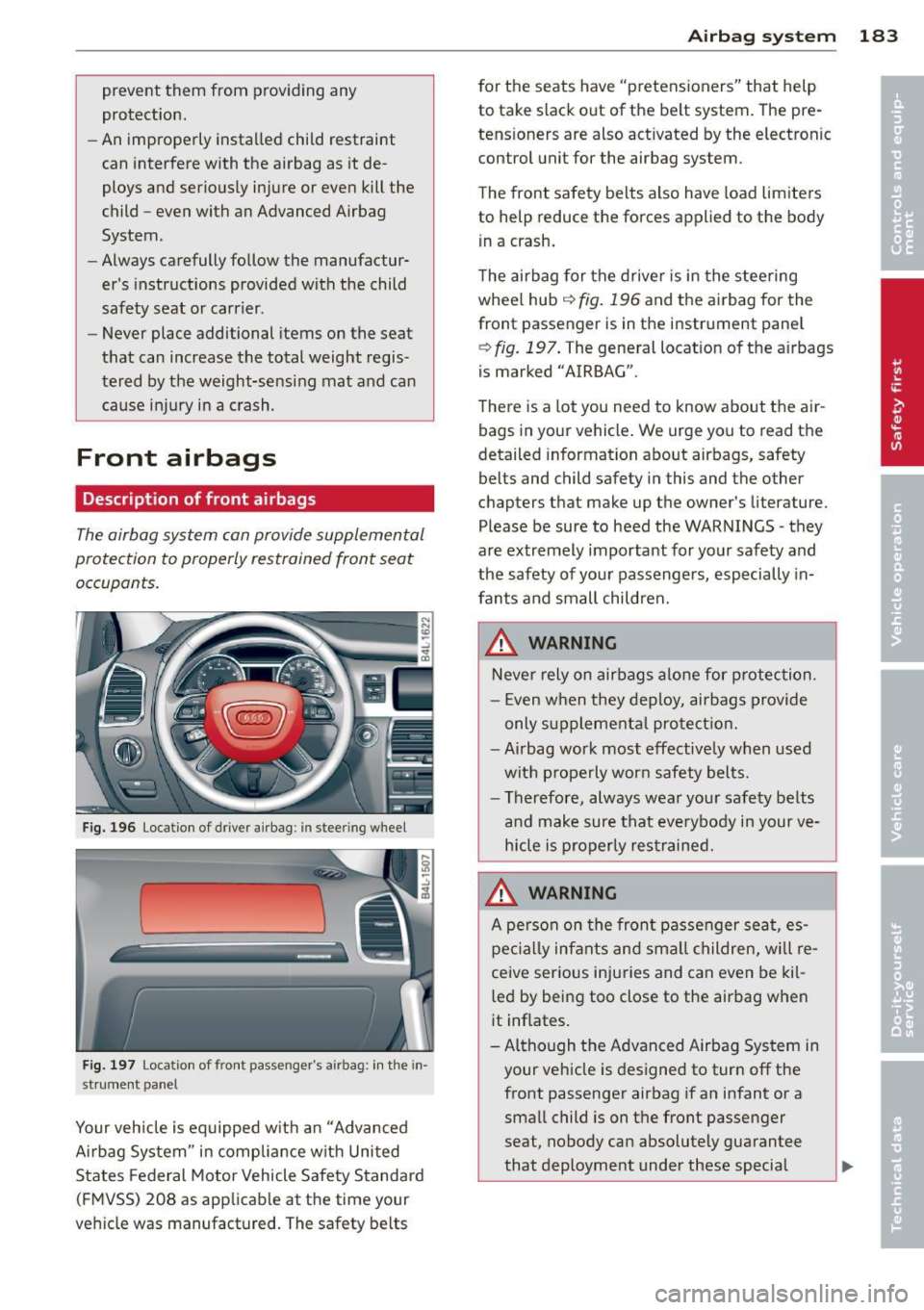
Fig. 196 Loca tion of driver ai rbag : in stee rin g whee l
Fig. 197 Locat io n of front passenger 's a irbag : in t he in
s trume nt panel
Your veh icle is eq uipped w it h an "Advanced
Ai rbag System " in compli ance w it h United
S tates Federal Motor Vehicle Safety Standard
(F MVSS) 208 as app licab le at the t ime your
ve hicle was manufactured. The safety be lts
A irba g sy stem 183
for the seats have "p retens ioners" that help
to take slack o ut of the be lt system. The pre
tens ioners are also act ivated by the electronic
control unit for the airbag system.
T he front sa fety belts also have load limite rs
to help reduce the forces applied to the body
in a crash .
T he airbag for the drive r is in the stee ring
whee l hub
q fig. 196 and the airbag for the
front passenger is in the instrument panel
~ fig. 197 . The general locat ion of the a irbags
is marked "AIRBAG" .
There is a lot you need to know about the ai r
bags in your vehicle . We urge you to read t he
detailed information about airbags, safety
belts and child safety i n this and the other
chapters that make up the owner's literature. Please be sure to heed the WARNINGS -they
a re extremely important for your safety and
the safety of yo ur passengers, especially in
fants and small children.
_&. WARNING
N eve r rely on airbags alone for protec tion.
- Even w hen they deploy, airbags provide
only s uppleme ntal pro tect ion .
- Airbag work most effective ly when used
wit h prope rly wor n safety belts .
- Therefore , always wea r you r safety belts
and make sure that eve rybody i n your ve
hicle is p rope rly res trained.
_&. WARNING
A pe rs o n on the fron t passe nger seat, es
pe cial ly inf ants and sm all children, will re
ceive serio us injuries and can even be kil
l e d by being too close to the airbag when
it inflates .
- Altho ugh the Advanced Airbag System in
your veh icle is designed to tur n off the
front passenge r airbag if an infant or a
small child is on the front passenger
seat, nobody can absolutely guarantee
that deployment under these specia l
11>-