tires AUDI Q7 2012 Owner´s Manual
[x] Cancel search | Manufacturer: AUDI, Model Year: 2012, Model line: Q7, Model: AUDI Q7 2012Pages: 342, PDF Size: 86.42 MB
Page 238 of 342
236 Trailer to wing
-The Gross Vehicle Weight Rating for yo ur
Audi Q7 would be exceeded if your vehi
cle is simultaneously equ ipped w ith Pan
oramic sl iding sunroof; th ird-row seat
ing; trailer towing equipment (factory or
dealer-installed), and running boards
(dea le r-installed) . UNDER NO C IRCUM
STANC ES MAY AL L SUC H ITE MS BE IN
STALLED ON THE SAM E VEH ICLE.
Operating instructions
MAX 6 .9 "
MAX175mm
E
"' E
"' .... a)
rt
Fig. 219 Permi tted ball p osit ion of the t ra iler hitc h
Traile r to wing we ight s
W it h a fac tor y-ins talled trailer hitch, the
maximum permissible trailer we ight is 6 ,615
lbs (3,000 kg) . The maximum permissible un
braked trailer weight is 1,650 lbs (750 kg) .
W ith an aft er mar ket trailer hitch, the maxi
m um permissible trailer we ight is 5,512 lbs
(2,500 kg) . These specifica tions apply when
driving on roads having an incline of less than
12%.
Perm issible tongue load
F or best vehicle handli ng u nder these
changed condit ions, adjust the trailer load so
that the tongue load is at the maxim um al
l owable or slightly lower. Yo u can get an ap
proximation of the tongu e load with a bath
room scale o r you c an measu re the load at a
trucking company or weighing s ta tion.
With a factory-in stalled trailer hitch, the
maximum permissib le load on the ball hitch
may not exceed 662 lbs (300 kg). With an af
termarket trailer hi tch, the maximum permis
sib le load on the ball h itch may not exceed 551
lbs (250 kg) . It is recommended to use
the maximum permissible load.
Trailer load distribution
Be sure the load in the t ra iler is held secure ly
in place to prevent it from shift ing forward,
backward or sideways.
Nev er allow a pas seng er t o rid e in a trai ler
¢&. in Driving instructions on page 23 7.
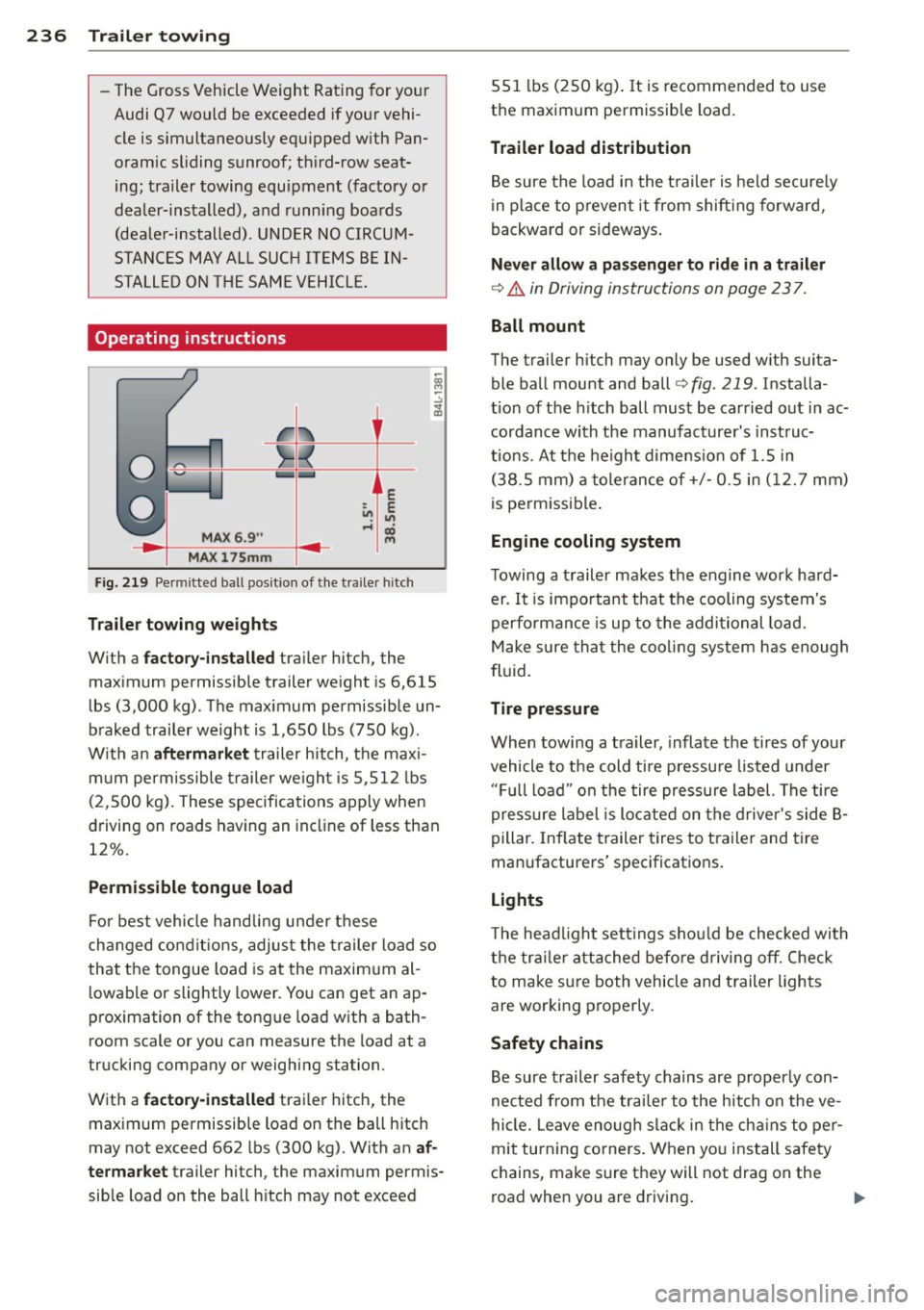
Ball m ount
The trailer hi tch may only be used w ith suita
ble ball mount and ball¢
fig. 219 . Installa
tion of the h itch ball must be carried out in ac
cordance with the manufacturer's inst ruc
tions . At the height dimens ion of 1.5 in
(38 .5 mm) a tolerance of+/- 0.5 in ( 12. 7 mm)
is permissible .
Engine cooling system
Towing a trailer makes the engine work hard er . It is impo rtant that the cooling system's
performance is up to the additional load.
Make sure that the cooling system has enough
fluid.
T ire pressur e
When towing a trailer, inflate the tires of your
vehicle to the cold ti re pressu re listed under
" F u ll load" on the tire pressure label. The tire
pressure label is located on the drive r's side B
pillar . Inflate trailer tires to t railer and tire
manufacturers' specifications.
Lights
T he headlight settings should be checked wi th
t h e trai ler attached before d riving
off. Check
to make s ure both vehicle and trailer lights
are worki ng properly.
Safety chains
Be sure trailer safety chains are properly con
nected from the trai le r to the hitch on the ve
hicle. Leave enough slack in the ch ains to pe r
mit turning corners. When you install safety
chains, make sure they will not drag on the
road when you are driving. ..,.
Page 243 of 342
directly at locks, or at door or hatch
openings -they can freeze shut.
- Never use sponges designed to remove
insects , or any kitchen scouring sponges
or similar products. They can damage
your paint finish .
- You should remove debris (such as in
sects) from the headlight lenses on a
regular basis, for example when refuel
ing your vehicle. Never use a dry cloth or
sponge to clean the headlights . Only use
wet cloths or sponges to prevent
scratches . It is best to use soapy water .
@) For the sake of the environment
In the interest of the environment, the ve
hicle should only be washed in special
wash bays .
Washing your vehicle with a power
washer
Cleaning the exterior of your car with a high
pressure power washer is safe as long as you observ e a few simple rules.
" Before using the power washer , make sure
you have read and understood the WARN INGS ~.&.
in General information on
page 239.
" Always follow the operating instructions for
the pow er wash er.
" Make su re that the jet on the spray hose
produces a "fan shaped spr ay" .
" Do
not hold the spray nozzle too close to
soft materials .
When cleaning the vehicle with a power wash
er
always follow the operating ins truc tions.
T his applies particularly to the
operating
pressure
and the spraying distance. Maintain
a sufficient distance to soft materials such as
rubber hoses and sound/vibration deadening
materials (particularly on the underside of the
engine hood). Do not use a jet which sprays
water in a
direct stream or one that has a ro
tating
jet.
Water temperature should not exceed 140 °F
(60 °().
Cleaning and protection 241
A WARNING
Never wash tires with a jet that sprays wa
ter in a direct stream . This could cause in
visible damage to the tires and weaken
them, even if the spray is from a relatively
long distance and for a short time . Dam
aged and weakened tires can fail and cause
accidents and personal injury.
(D Note
To avoid damaging your vehicle, always make sure that there is sufficient distance
between the spray head and soft materials
like rubber hoses, plastic parts and sound
deadening materials. Never aim the spray
head at the same point for a long time.
This also applies to cleaning headlights
and painted bumpers. Remember : the
closer the nozzle is to the surface of the
material, the greater the stress on the ma
terial.
Waxing and Polishing
Waxing
A good wax coating protects the vehicle paint
to a large extent against the environmental
factors listed under ~
page 239, Washing and
even against slight scratches.
You can use a liquid car wax to protect your
paint as soon as one week after your vehicle
has been delivered.
Even if you regularly use a
waxing process in
automatic car washes, we recommend that
you manually apply a coat of wax to give the paint extra protection, particularly if water no
longer beads on the clean paint .
Protect plastic body parts with car wax in the
same way as the vehicle body .
During warm weather dead insects tend to
collect on the front bumper and on the for
ward area of the hood. They are much easier
to remove from paint that is waxed
often . IJ,-
•
•
Page 276 of 342
274 T ire s and wheel s
Tires and wheels
Tires
General notes
Tires may be the least appreciated and most
abused parts of a motor vehicle .
Tires may be the least appreciated and most
abused parts of a motor vehicle . Tires are,
however, one of the most important parts of a
vehicle, particularly considering the compara
tive ly small patch of rubber on each tire that
assures that all -impo rtant contact between
you, your vehicle and the road.
Maintaining the correct tire pressure, mak ing
sure that your vehicle and its tires do not have
to carry mo re weight than they can safe ly han
d le, avoiding damage from road hazards and
reg ularly inspecting t ires for damage includ
ing cuts, slashes irregu la r wear and ove rall
condition are the most important things that
you can do to he lp avoid sudden tire failure in
cluding tread separation and blowouts.
A voidin g damage
I f you have to drive over a curb or similar ob
stacle, drive very s low ly and as close as possi
b le at a right angle to the curb.
A lways keep chem ica ls includ ing grease, o il,
gasoline and b rake fluid off the ti res.
Inspect the t ires regularly for damage (cuts,
cracks or b listers, etc.). Remove any fo reign
bod ies embedded in the treads.
St oring tires
Mark tires when you remove them to indicate
the direction of rotation . Th is ensures you to
be ab le to mount them correctly when you re
install t hem.
When removed, the wheels or t ires should be
stored in a cool, dry and preferably dark place .
Store tires in a vertical pos ition if they are not
mounted on rims, in a horizontal pos it ion if
they are mounted on rims. New tire
s
New t ires have to be broken in¢&,. .
The tread depth of new t ires may vary, accord
ing to the type a nd make of t ire and the tread
pa tte rn .
Hidden damage
Damage to tires and r ims is often not readily
vis ible . If you notice unusual v ibrat ion or the
vehicle p ulls to one side, th is may ind icate
that one of the t ires has been damaged . Th e
t ir es m ust be checked immed iate ly by an au
tho rized Aud i dea le r or q uali fied wor kshop.
Unidirectional t ires
A un idirectional tire can be identified by ar
rows on the sidewa ll, that po int in the direc
t ion the t ire is designed to rotate. You must
fol low the specified d irection of rotation . This
is necessary so that these tires can develop
their optimum characteristics regarding grip, road no ise, wear and hydrop laning resistance.
For more information
¢page 302.
A WARNING
-New tires or tires that are old, worn or
damaged cannot provide maximum con
trol and braking ability .
-
-New tires tend to be slippery and must
be broken in . To reduce the risk of losing
control, a co llision and ser ious personal
in jur ies, d rive w ith special ca re fo r the
fi rst 350 m iles (560 km).
- Driving with worn or damaged tires can
lead to loss of control, sudden tire fail
ure, including a blowou t and sudden de
fl ation, c rashes and seriou s personal in
juries . Have wo rn or damaged t ires re
p laced immediate ly .
- T ires age even if they are not being used
and can fai l sudden ly, especially at high
speeds. Tires that are more than 6 years
old can only be used in an emergency
and then w ith specia l care and at low
speed.
Page 277 of 342
-Never mount used tires on yo ur vehicle if
you are not sure of their "previous histo
ry." Old used tires may have been dam
aged even though the damage cannot be
seen that can lead to sudden tire failure
and loss of vehicle control.
Glossary of tire and loading terminology
Accessory weight
means the comb ined weight (in excess of
those standard items wh ich may be rep laced)
of automa tic tra nsmission, power steering,
power br akes, power w indows, power sea ts,
radio, and heater, to the ex tent that these
items are avai lab le as factory -installed equip
ment (whether installed or not).
Aspect ratio
means the rat io of the height to the w idt h of
the tire in percent. Numbers of 55 or lower in
d icate a low sidewall fo r improved s teer ing re
sponse and better overall handling on dry
pavement.
Bead
means the pa rt of the t ire t hat is made o f
s teel wires, wrapped o r rein force d by ply cor ds
and that is shaped to fit the r im.
Bead separation
means a b reakdown of the bond between
components in the bead.
Cord
means the strands forming the plies in the
tire.
Cold tire infl ation pressure
means t he tire pressure recommended by the
vehicle manufacturer for a t ire of a designated
size that has not been dr iven for more than a
couple of miles (kilometers) at low speeds in
the three hour period before the tire pressure
i s measu red or adjusted.
Tire s an d wheel s 275
-If you notice un usua l vibration or if the
veh icle pulls to one side when driv ing, a l
ways stop as soon as it is safe to do so and check the wheels and tires for dam
age.
Curb weight
mea ns the we ight of a motor ve hicle w it h
standard equipment in cl ud ing t he maximum
capa city of fuel, o il, and coolant, ai r cond i
tion ing a nd addi tional weig ht o f optiona l
equipment .
Extra load tire
means a t ire design to operate at h igher loads
and at higher inflation pressures than the cor
respondi ng s tanda rd tire. Extra load tires may
be identified as "X L", "xl", "EXTRA LOA D", or
"R F" on the sidewall .
Gross Axle Weight Rating ("GAWR ")
mea ns the load-carry ing capac ity of a s ingle
axle system, measured at the tire-ground in
te rfaces.
Gross Vehicle Weight Rating ( "GVWR ")
means the maximum total loaded we ight of
t h e ve hicle.
Groove
means the space between two adjacent tread
ribs.
Load rating (code )
means the maximum load tha t a t ire is rated
to carry for a given inflation pressure. Yo u
may not find this information on all tires be
ca use it is not required by law.
Maximum load rating
me ans the loa d ra ti ng f or a t ire at the maxi
mum pe rm issi ble inflat ion pressure for that
ti re .
•
•
...
Page 278 of 342
2 76 Tires and wheels
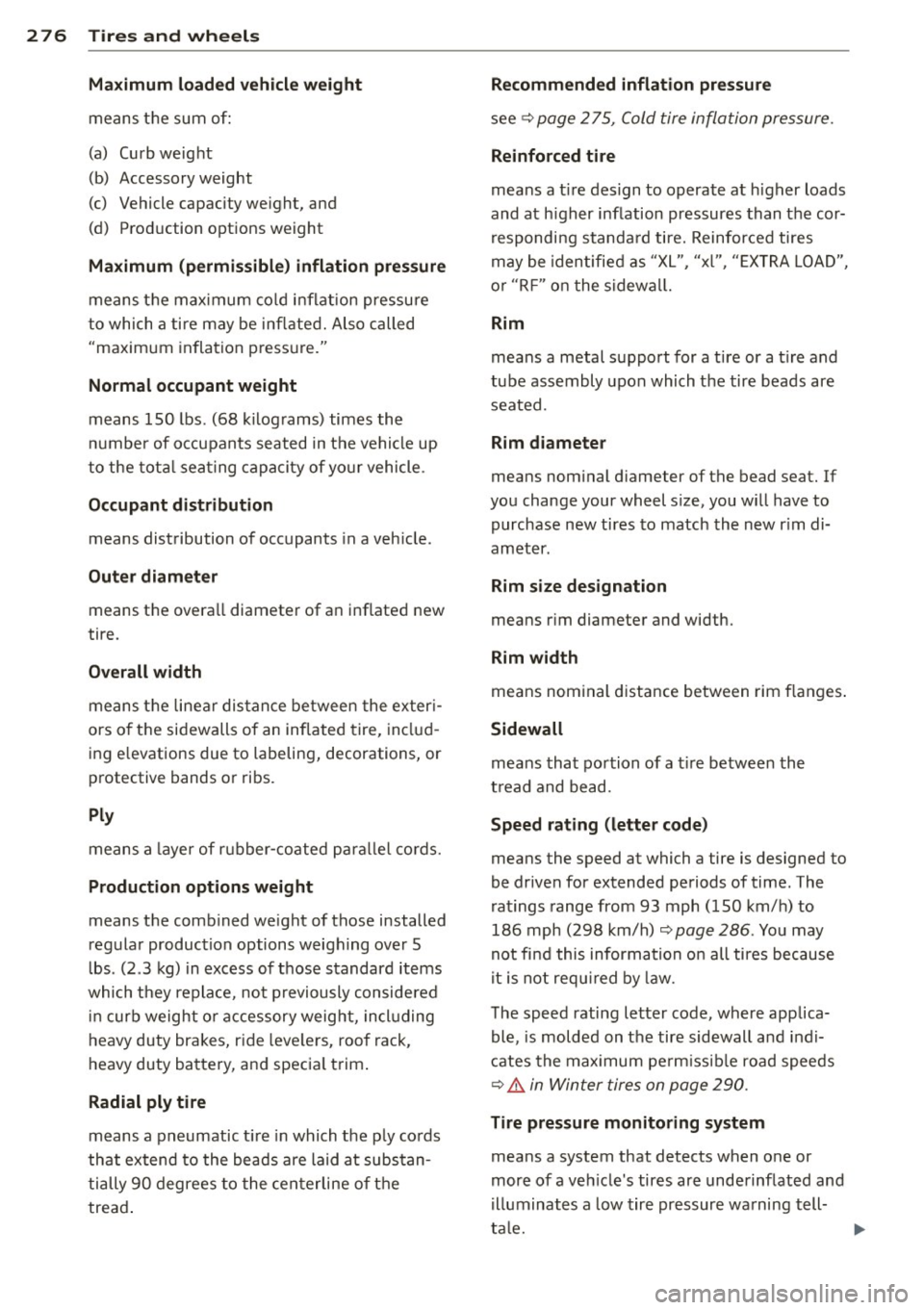
M aximum loaded vehicle weight
means t he sum of:
(a) Curb weight
(b) Accessory weight
( c ) Vehicle capacity we ight, and
(d) P rod uction options weight
Maximum (permissible) inflation pressure
means t he max imum co ld inflation pressu re
to which a tire may be in flate d. Also called
"maxim um inflation p ress ure."
Normal occupant weight
means 150 lbs. (68 kilog rams) times the
nu mbe r of o ccupants seated in t he vehicle up
to the tota l sea ting capaci ty of yo ur vehicle .
Occupant distribution means dist ribution of occupants in a veh icle .
Outer diameter means t he overa ll diameter of a n inf lated new
tire.
Overall width
means t he linear dis tan ce between the ex ter i
ors o f th e sidewalls of an inflated tire, in cl ud
ing e levations due to labeling, decorations, or
p rotective bands o r ribs.
Ply
mea ns a laye r of r ubber-coate d parall el c ords.
Production options weight
means t he comb ined we ight of those installed
regular produc tion options weigh ing ove r 5
l bs . (2 .3 kg) in excess of t hose standard items
which they repla ce, no t previously considered
in cur b weight o r acc essory weig ht, incl uding
h eavy duty brakes, r ide leve le rs, roof ra ck,
h eavy duty ba ttery, a nd specia l trim .
Radial ply tire
means a pneumatic t ire in which the p ly co rds
that ex tend to the beads are laid a t sub stan
ti ally 9 0 degrees to the ce nt erline o f the
tread . Recommended inflation pressure
see
~
page 2 75, C old tire infla tion pressure.
Reinforced tire
means a t ire design to operate at h igher loads
and at h igher inflation pressures than t he cor
r espondi ng stan da rd tire. Reinforced tires
may be identifie d as "X L", "xl" , "EX TRA LOAD",
o r "RF " on t he sidewal l.
Rim
means a metal su ppo rt for a tire or a t ire and
tube assembly upon which the tire beads are
seated.
Rim diameter
means nom inal d iameter of the bead seat.
If
you change your wheel s ize, you wi ll have to
purchase new tires to match th e new r im di
ameter .
Rim size designation
means r im diameter and width.
Rim width
means nom inal d ista nce between rim flanges .
Sidewall
means tha t po rtion of a t ire betw ee n t he
t read and bead.
Speed rating (letter code)
means the speed at which a tire is designed to
be driven for extended periods of time. The
r a ti ngs range from 93 mph ( 150 km/h) to
186 mph (298 km/h)
~ page 286 . You may
not fi nd this information o n all ti res because
it is no t re quir ed by law.
T he speed rating letter code, wh ere applica
ble , is molde d on the tire sidewall a nd indi
c ates the max imum pe rmissibl e road speeds
~ A in Winter tire s on page 290 .
Tire pressure monitoring system
mea ns a system that detects when o ne or
more of a ve hicle 's tires are unde rinf lated an d
i lluminat es a low tir e pr essure wa rning t ell-
tal e. ..,_
Page 279 of 342
Tires and wheels 2 77
Tread
means that portion of a tire that comes into
contact with the road.
Tread separation
means pull ing away of the tread from the tire
carcass .
Treadwear indicators (TWI)
means the projections within the principal
grooves designed to give a visual indication of
the degrees of wear of the tread. See
c:> page 284, Tread Wear Indicator (TWI) for
more informat ion on measuring tir e wear.
Uniform Tire Quality Grading
is a tire information system developed by the
United States National Highway Traffic Safety
Administration (NHTSA) that is designed to help buyers make relative comparisons among
tires. The UTQG is not a safety rating and not a
guaran tee that a tire will last for a prescribed
number of miles (kilometers) or perform in a
certain way.
It simply gives tire buyers addi
tional information to combine with other con
siderat ions, such as pr ice, brand loya lty and
dealer recommendations. Under UTQG, tires
are graded by the tire manufacturers in three
areas: treadwear, traction, and temperature
res istance . The UTQG information on the tires,
mo lded into the sid ewa lls.
U.S . DOT Tire Identification Number (TIN)
This is the t ire's "serial number" It begins
with the letters "DOT" and indicates that the tire
meets all federal standards. The next two
numbers or letters indicate the plant where it
was man ufactured, and the last four numbers
represent the week and year of man ufacture.
For example,
DOT . .. 2211 ...
means tha t the tire was produced in the 22nd
week of 2011. The other numbers are market
ing codes that may or may not be used by the
tire manufacturer . This information is used to
contact consumers if a tire defect requires a
recall.
Vehicle capacity weight
means the rated cargo and luggage load plus
150 lbs. (68 k ilograms) times the vehicle's to
ta l seating capacity as listed on the label lo
cated on the driver's side B-pillar.
Vehicle maximum load on the tire
means that load on an individu al tire that is
determined by distributing to each axle its
share of the maximum loaded vehicle weight
and dividing by two.
Vehicle normal load on the tire
means that loa d on an individua l tire that is
determined by distributing to each axle its
share of the curb weight, accessory weight,
and normal occupant weight (distributed in
accordance with tab le be low
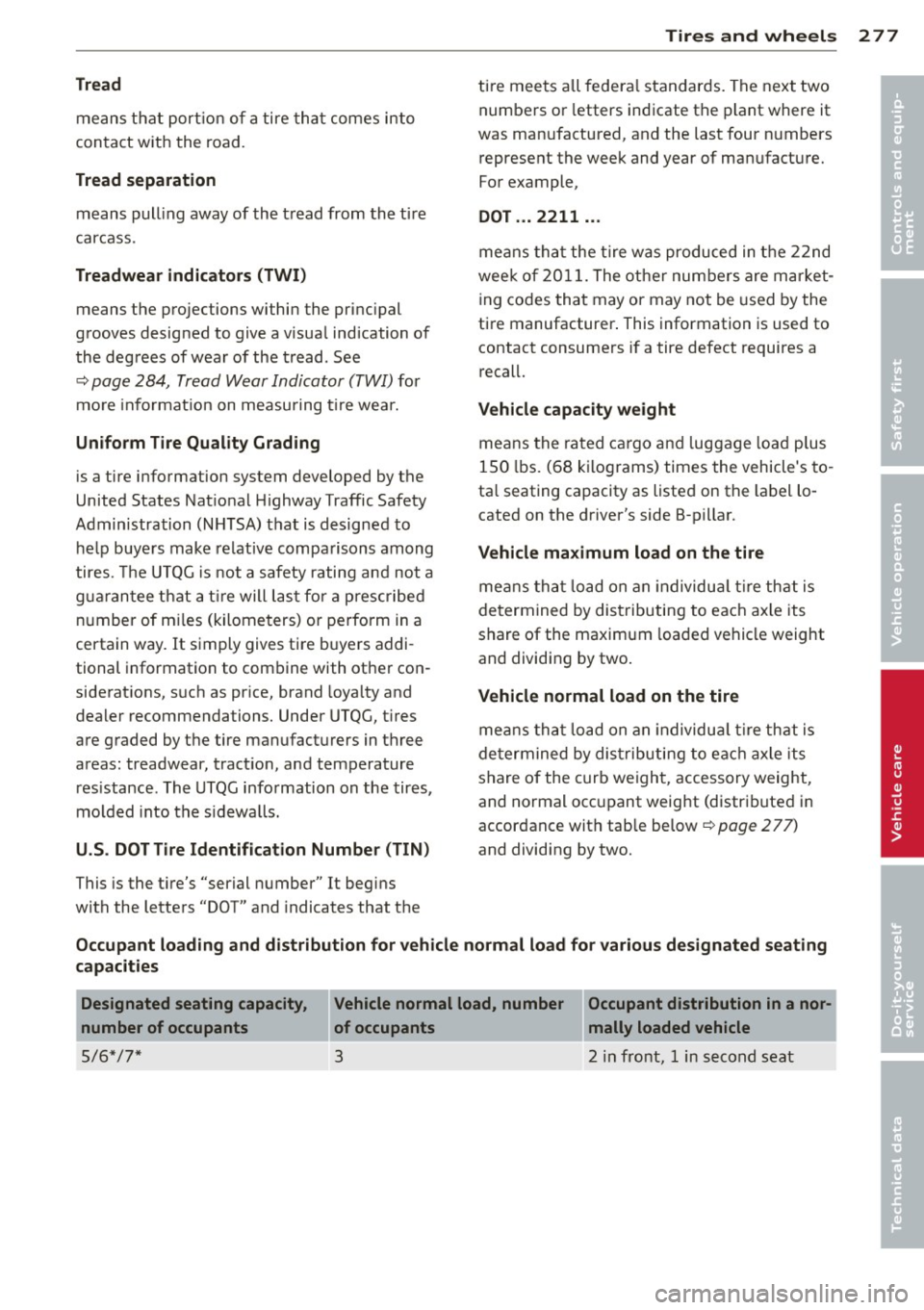
c:> page 2 77)
and dividing by two.
Occupant loading and distribution for vehicle normal load for various designated seating
capacities
Designated seating capacity,
number of occupants 5/6*/7* Vehicle normal load, number Occupant distribution in a nor-
of occupants
_____ mally loaded vehicle
3 2 in front, 1 in second seat
•
•
Page 280 of 342
278 Tires and wheels
Cold tire inflation pressure
Tire pressure affects the overall handling, performance and safety of a vehicle.
I
4
t>
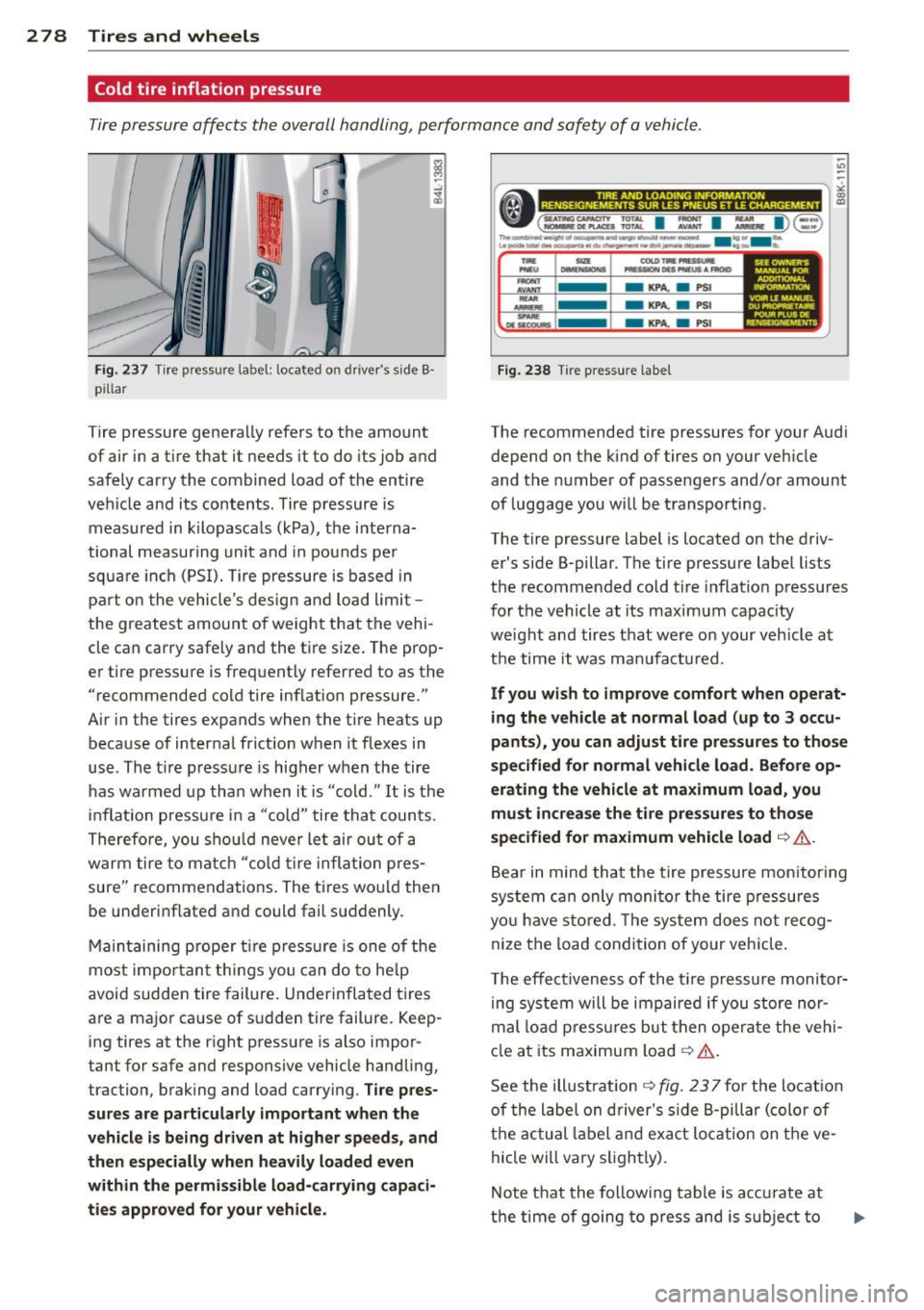
Fig. 2 37 T ire pressure label: located on driver's side B·
pillar
Tire pressure genera lly refers to the amount
of air i n a tire that it needs it to do its job and
safely carry the combined load of the entire
vehicle and its contents. Tire pressure is measured in kilopasca ls (kPa), the inte rna·
tional measuring unit and in pounds pe r
squa re inch ( PSI). Tire pressure is based in
pa rt o n the vehicle's desig n an d load limit
the greatest amount of weight that the vehi ·
cle can car ry safe ly and the tir e size . The prop·
er tire pressure is freq uent ly referred to as the
"recommended cold tire inflation pressure."
A ir in the tires expands when the tire heats up
because of internal frict ion when it flexes in
use . The t ire p ress ure is higher when the tire
h as warmed up than when i t is "cold ." It is the
in flat io n pressu re i n a "cold" tire that coun ts.
Th erefore, you sho uld neve r let air ou t of a
warm tire to match " co ld tir e infla tion pres
sure" recommendations . The ti res wo uld then
be un derinflated and could fail su ddenly.
M ain taining p roper t ire pr es su re is one o f the
most impo rtan t thi ngs you can do to he lp
avoid sudden tire failure. Underinfla ted ti res
a re a major ca use of s udden tire failure. Keep
ing tires at the right pressure is also impor
tant for safe and responsive vehicle handling,
traction, braking and load carrying .
Tire pres
sures are particularly important when th e
vehicle is being driven at higher speeds , and
then especially when heavily loaded even
within the permissible load -carrying capaci
tie s approved for your vehicle .
------------------..,;
•(=~: I : I :,.. I)@ ~
The~-----~---w-o- ....... -e.....i -·· - u ........ -.-..,.0, ... -....,.,...tot~---....... ._.,. -..
....
-..... ...........
- KPA. a PSI
- KPA.
a PSI
-KPA. a PSI
Fig. 2 38 Tire pressure la bel
SU OWNER'S MANUAl FOR AD0"10NAL l10N VOl!ILEMANU£1. DU _,...,
POUR Pl.US DE
REHSEKi.\'IEME NTS
The recommended tire pressures for your Audi
depend on the kind of tires on your ve hicle
and the numbe r of passengers and/or amount
of luggage you w il l be transporting .
The tire pressure label is located on the driv
er's si de B-pillar . T he tire pressure label lists
t h e recommended cold tir e inflat io n pressu res
for the vehicle at its maxim um capac ity
we ight and tires that were on your veh icle at
t h e time it was man ufa ctu red.
If you wish to improve comfort when operat
ing the vehicle at normal load (up to 3 occu
pants), you can adjust tire pre ssure s to tho se
specified for normal vehicle lo ad. Before op
erating the vehicle at maximum load, you
mu st increase the tire pres sures to those
specified for maximum vehicle load
c::> .&, .
Bear in mind that the tire pressure mon itor ing
system can only moni to r th e tire pressures
yo u have s to red. The sys tem does not recog
nize the load condition of your vehicle.
T he effectivene ss of the t ire p ress ure monitor
ing system will be impaire d if you store nor
m al loa d press ures b ut t hen o pe ra t e the ve hi
cl e a t its ma ximum load
c::> .&. .
See the ill ustration c::> fig. 23 7 fo r the lo cat ion
of the label o n driver's s ide B-pill ar (color o f
t h e actu al lab el and exa ct lo cat ion on the ve
hicle will vary sligh tly).
Note t hat the f ollowing ta ble is ac curate at
th e time of goi ng to press and i s sub ject to
Page 281 of 342
Tires an d wheel s 2 79
change. In the event of discrepancies, the tire
pressure label located on the driver's side 8-
p ill ar a lways takes precedence.
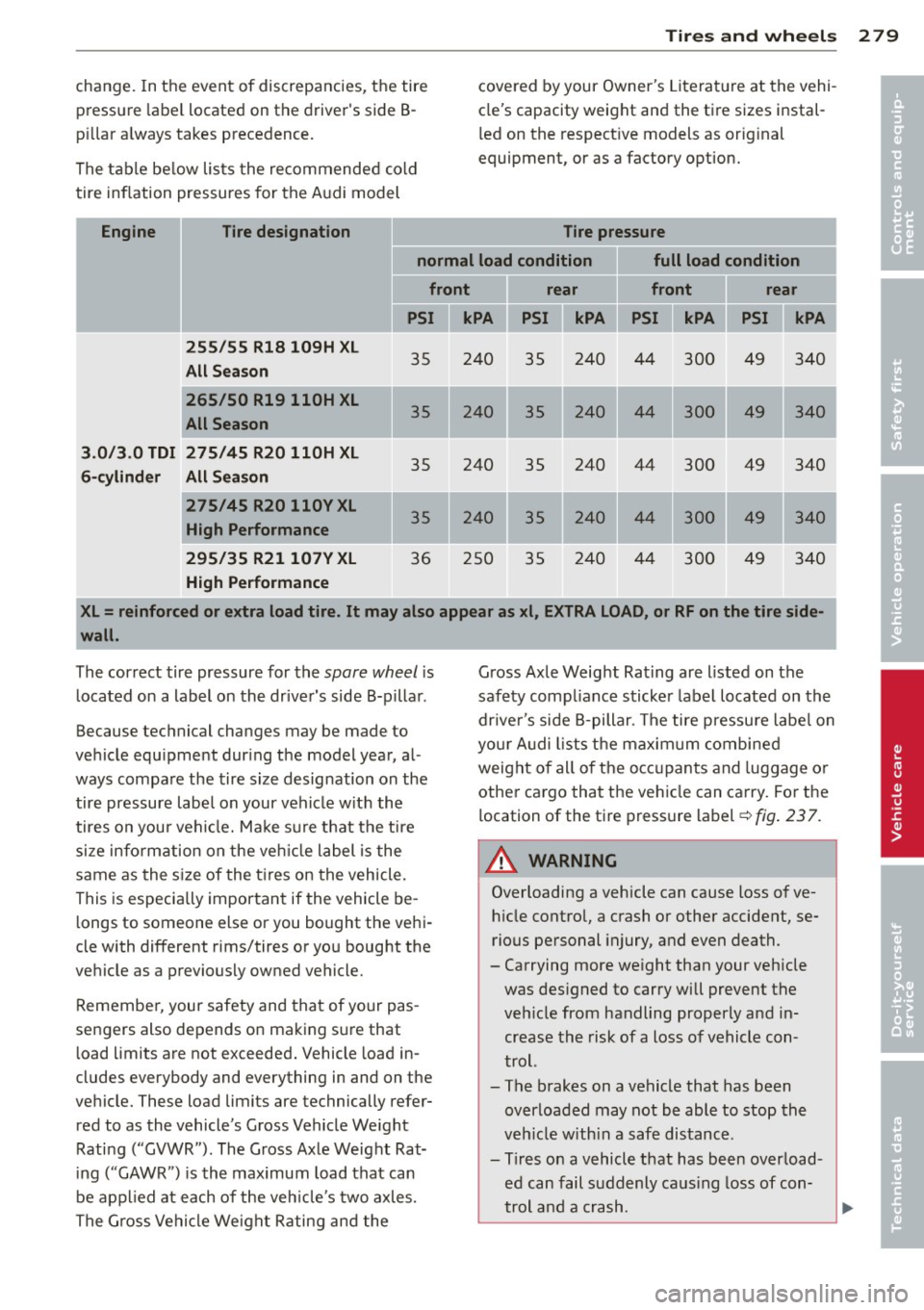
The table be low lists the recommended cold
tire inf lation pressures for the A udi model
I Engine Tire designation
covered by your Owner 's Literat ure at the vehi
cle's capacity weight and the tire sizes instal
l ed on the respect ive models as orig inal
equipment, or as a factory option.
Tire pressure
normal load condition full load condition front rear front rear
I
PSI II kPA PSI kPA PSI j[ kPA PSI kPA
2 55/5 5 Rl8 109H XL
All Sea son
265 /50 Rl9 ll0H XL
All Sea son
3.0 /3 .0 TDI 275 /45 R20 ll0H XL
6 -cy lind er All S ea son
275 /45 R20 110V XL
High Performance
295 /35 R21 107V XL
High Performance
35 240 35
35 240 35
35 240 35
35 240 35
36 250 35 240
44
300 49 340
240 44 300 49 340
240 44 300 49 340
•
240 44 300 49 340
I
240 44 300 49 340
XL= reinforced or extra load tire. It may also appear as xl, EXTRA LOAD, or RF on the tire side
wall.
The correct tire pressure for the spare wheel i s
l ocated on a label on the driver's side 8-pilla r.
Because technical changes may be made to
vehicle equ ipment dur ing the model year , al
ways compare the tire size designation on the
tire pressure label on your vehicle w ith the
tires on you r vehicle. Ma ke su re that the tire
si ze information on the ve hicle label is the
same as the s ize of the t ires on the vehicle.
This is especially important if the vehicle be l ongs to someone else or you bought the vehi
cle with different rims/tires or you bought the
ve hicle as a previously owned vehicle.
Remember, your safety and that of your pas
sengers also depends on making sure that
l oad limits are not exceeded. Vehicle load in
cludes everybody and everything in and on the
vehicle. These load limits are technically refer red to as the vehicle's Gross Vehicle We ight
Rating ("GVWR") . The Gross Axle Weight Rat
i ng ( "GAWR") is the maximum load that can
be appl ied at each of the veh icle's two axles.
The G ross Vehicle Weight Rating and the Gross Axle Weig
ht Rating are listed on the
safety comp liance sticker label located on the
drive r's side 8-pillar . The tire pressure labe l on
yo ur A udi lists t he maxim um combined
weight of all o f the occ upants and luggage or
othe r cargo that t he vehicle can carry. Fo r the
location of the tire press ure label ¢
fig. 23 7.
A WARNING
Overloading a vehicle can cause loss of ve
h icle control, a crash or other accident, se
rious personal injury, and even death.
- Carrying more we ight than your veh icle
was des igned to carry will prevent the
veh icle from handling properly and in
crease the risk of a loss of vehicle con
trol.
- The brakes on a vehicle that has been overloaded may not be able to stop the
veh icle w ith in a safe distance.
- T ires on a vehicle that has been overload
ed can fail suddenly ca using loss of con-
trol and a crash . ..,.
•
•
Page 282 of 342
28 0 T ire s and wheel s
-Always make su re that t he tota l load be
ing t ransp orted -includ ing the we ight of
a tra ile r hitch a nd the tongue weight of a
loaded trailer -does not make the veh i
cle heav ier than the veh icle's Gross Vehi
cl e Weight Rating.
A WARNING
- Incorrect tire pressures and/or underin
flation can lead to a serious or fatal acci
dent .
- Incorrect tire pressures and/o r underin
flation cause increased tire wear and can affect the handling of the vehicle.
- Incor rect tire pressures and/or underin
fla tion can also lead to sudden tire fa il
ure, incl uding a b lowo ut and sudden de
flation, causing loss of vehicle control.
Checking tire pressure
The correct tire pressure for the tires original
ly installed on your vehicle is listed on the tire
pressure label loc;ated on driver's side 8-pil
lar.
The recommended t ire p ress ures are o n the
tire pressure label and in the tab le
¢ page 278, Cold tire inflation pressure.This
means that the pressure must be checked and
ad justed when the tire has not been driven for
more than a couple of m iles (kilometers) at
l ow speeds during the previous three hours.
A ir in the tires expands when the tire heats up
as a result of internal fr iction as it flexes in
use . The t ire pressure is higher when the tire
has wa rmed up than when it is "cold ."
It is the inflat ion pressure in a "cold" tire that
counts. Therefore, you should never let air out
of a warm t ire to match "Cold tire inflation
p ressu re" recommendations ¢
page 2 78. The
tires would then be under inflated and cou ld
fa il suddenly .
The t ire pressure label on you r Audi lists the
r ecommended cold t ire inflat io n pressu res at
maximum capacity fo r the new, o rigi na l
eq uipment t ires that were on your vehicle at the time
it was man ufactu red. Fo r the loca
tion of the labe l
~page 278, fig . 237.
Most tires lose air natur ally over t ime. They
can a lso lose some air if yo u drive over a pot
hole or hit a curb while park ing.
It is usually
not possible to see whether the radial tires
u sed today are underinflated just by looking
at them.
The re fore, be sure to check ti re p ress ures at
least once a mo nth and a lways before going
on a long trip . Make s ure to take the n umber
of peop le and the amount of luggage into ac
count when adjust ing tire pressure for a trip -
even one that you wou ld not consider to be
"long. " See
~ page 2 82, Tires and vehicle
load limits
for mo re important information .
Always use an accurate tire pressure gauge
when checking and adjusting inflat ion pres
s ur es. Check all of the tires and be sure not to
forget the spare tire .
If the pressure in any t ire
i s too high when the t ire is "cold," let air out
of the t ire s low ly w ith the edge of the tire
gauge and keep checking the pressure until
yo u reach the pressure that is correct for the
l oad (passengers and l uggage) and kind of
driv ing you plan to do.
If the pressure in any ti re is too low, note the
difference between the pressure in the co ld
tire and the pressure you need and add the air
that you need to reach the correct pressure for
the vehicle load (passengers and luggage) for
the tires on your vehicle as listed on the on
your vehicle and in this ma nual and the kind
of d riving you plan to do.
Ne ver e xceed the ma ximum infl ation pres
sure listed on the ti re sidewall for an y rea
son .
Remember that the vehicle manufacturer, not
the tire manufact urer, determines the correct
t ire press ure for the tires on your vehicle.
It is important to check the ti re pressure whe n
the tires are co ld.
- Read the required tire pressure from the t ire
pressure labe l. The tire pressure label is lo -
cated o n the driver's side B-pillar . T he tire
liJJ>
Page 283 of 342
pressure label lists the recommended cold
tire i nflatio n pressures for the vehicle at its
maximum capacity we ight a nd the tires that
were on your vehicle at the time it was man
ufactured . For recommended t ire pressures
for normal load condit ions, please see chap
ter ~
page 2 78 .
-Turn the valve stem cap counter-clockwise
to remove it from the tire valve .
- Place the air pressure gauge on the valve.
- The tire pressures should only be checked
and adjusted when the tires are cold . The
s light ly raised pressures of warm tires must
not be reduced .
- Adjust the tire pressure to the load you are
carrying.
- Re insta ll the va lve stem cap on the valve .
When should I check the tire pressure ?
The correct tire pressure is especially impor
tant at high speeds . The pressure sho uld
therefo re be checked at least once a month
and a lways before start ing a journey. Do not
forget to check the tire pressure for the spare
wheel.
When should I adju st the tire pre ssures?
Ad just the tire pressure to the load you are
carrying. After changing a wheel
or replacing
wheels you have to adjust the tire pressures
on all wheels. In addition, you must then
store the new tire pressures i n the t ire pres
sure mon itor ing system
~ page 294.
A WARNING
Incorrect tire pressures and/or unde rinfla
tion ca n lead sudden tire failure, loss of
cont ro l, col lision, ser ious persona l inju ry
or even death.
- Whe n the wa rning symbo l
RI] appears in
the instrument cl uster, s top an d inspect
the tires.
- Incorre ct tire pressure and/or unde rinfla
t ion can cause inc reased t ire wear and
can affect the handling o f the veh icle and
stopp ing ability.
- Incorrect tire pressures and/or underin
flation can also lead to sud den tire fa il-
Tires an d wheel s 281
ure, including a blowout and sudden de
flation, ca using loss of veh icle contro l.
- The driver is responsib le for the correct
tire pressures for all tires on the veh icle.
The applicable pressure values are locat
ed on a sticker o n the dr iver's s ide B-pil
lar .
- Onl y when all tires on the vehicle are fil
led to the correct pressure, the t ire pres
sure mon itor ing system can work cor
rectly .
- The use of incorrect tire pressure va lues
can lead to acc idents or other damage .
Therefore it is ess ential that th e drive r
observe t he spec ified t ire p ress ure val ues
for the tires and the cor rect pressures for
the func tion of the t i re p ress ure moni to r
ing system.
- Always in flate tires to the recommen ded
a nd correct t ire p ress ure be fore dr iv ing
off .
- D riving with unde rinf lated tires bend
mo re, letting them get too hot resulting
in tread separation, s udden tire failure
and loss of control.
- Excessive speed and/overloading can
cause heat b uild- up, sudden tire failure
and loss of control.
- If the tire pressure is too low or too high,
the t ires will wear prematurely and the
veh icle w ill not handle well.
- If the tire is not flat and you do not have
to change a wheel immediately, d rive at
red uced speed to the nearest service sta
tion to check the t ire press ure and add
air as requ ired .
(D Note
Driving w ithout valve stem caps can cause
damage to the tire valves. To prevent this,
a lways make sure that factory installed
valve s tem caps o n all whee ls are sec urely
mounted o n the valve .
@ For the sake of the environment
Underinflated tires will also increase the
fuel consumpt ion.
•
•