ECU AUDI Q7 2012 Owner´s Manual
[x] Cancel search | Manufacturer: AUDI, Model Year: 2012, Model line: Q7, Model: AUDI Q7 2012Pages: 342, PDF Size: 86.42 MB
Page 178 of 342
176 Safety belts
• Insert the tongue into the correct buckle of
your seat until you hear it latch securely
¢page 174, fig. 191.
• Pull on the belt to make sure that it is se
curely latched in the buckle.
A WARNING
Improperly positioned safety belts can
cause serious personal injury in an acci
dent.
- Expectant mothers must always wear the
lap portion of the safety belt as low as
possible across the pelv is and be low the
rounding of the abdomen.
- Always read and heed all WARNINGS and
other important information¢ .&.
in Fas
tening safety belts on page 174.
Unfastening safety belt s
Unbuckle the safety belt with the red release
button only after the vehicle has stopped.
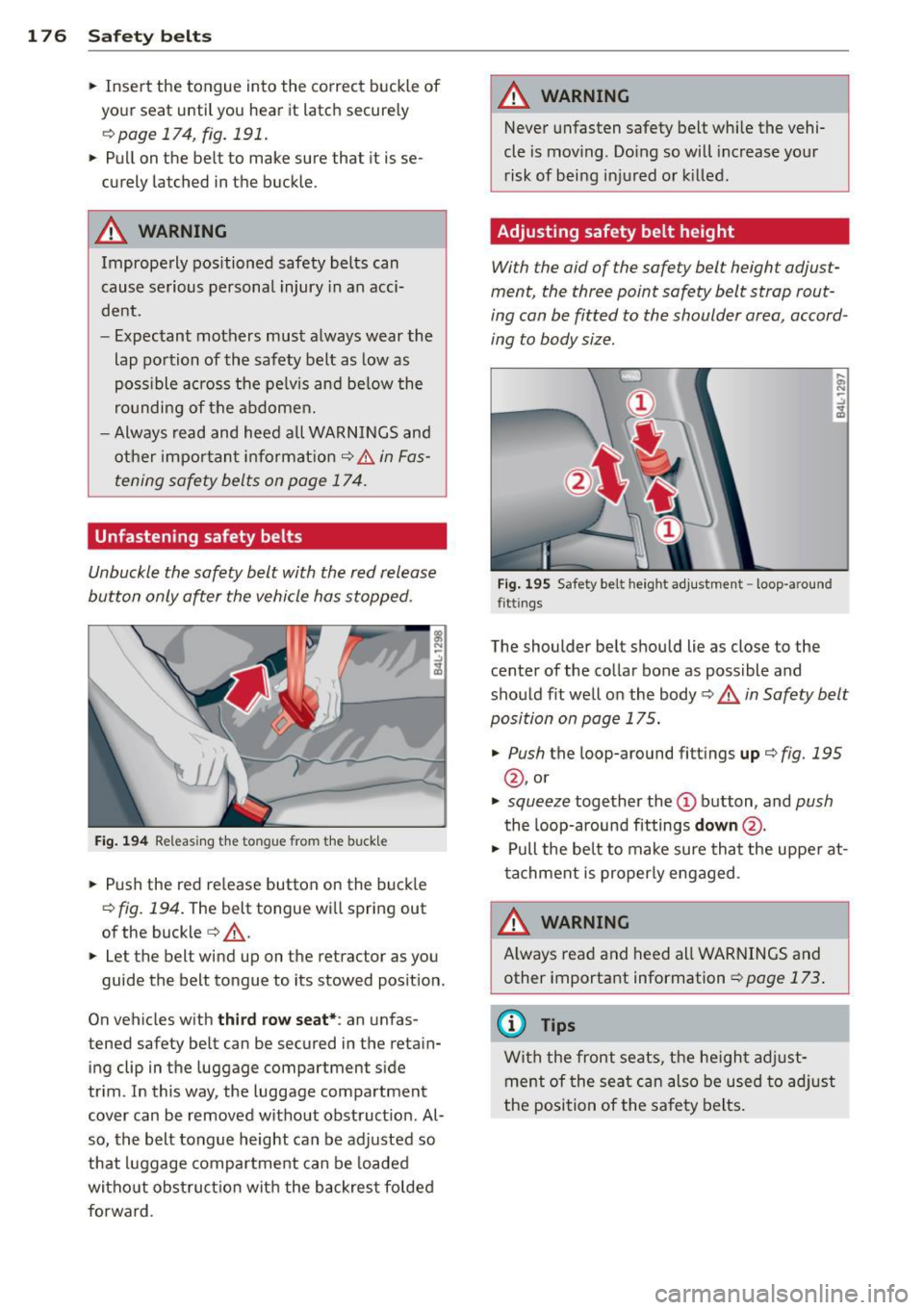
Fig. 194 Releasing the tongue from the buckle
• Push the red release button on the buckle
¢
fig. 194. The belt tongue will spring out
of the buckle
c:> &_ .
• Let the belt wind up on the retractor as you
guide the belt tongue to its stowed position.
On vehicles with
third row seat* : an unfas
tened safety belt can be secured in the retain
ing clip in the luggage compartment side
tr im. In this way, the luggage compartment
cover can be removed without obstruction. Al
so, the belt tongue height can be adjusted so
that luggage compartment can be loaded
without obstruction with the backrest folded
forward.
A WARNING
-Never unfasten safety belt while the vehi-
cle is mov ing. Do ing so will increase your
risk of being injured or killed.
Adjusting safety belt height
With the aid of the safety belt height adjust
ment, the three point safety belt strap rout
ing can be fitted to the shoulder area, accord
ing to body size.
Fig. 195 Safety belt heigh t adj ustment- loop -around
f ittings
The shoulder belt should lie as close to the
center of the collar bone as possible and
should fit well on the body¢&.
in Safety belt
position on page 175.
• Push
the loop- around fittings up c:> fig. 195
@,or
• squeeze together the CD button, and push
the loop-around fittings down@.
• Pull the be lt to make sure that the upper at
tachment is properly engaged.
A WARNING
Always read and heed all WARNINGS and
other important information
¢page 173.
(D Tips
With the front seats, the height adjust
ment of the seat can also be used to adjust
the position of the safety belts.
Page 211 of 342
because of exceptional circumstances, be
properly restrained and as far away from the
airbag as poss ib le . By keep ing room between
the child's body and the front of the passen
ger compartment, the airbag can inflate com
p letely and provide supplemental protection
i n certa in frontal collis ions .
A WARNING
Not using a booster seat, us ing the boos
ter seat imprope rly, i ncorrect ly ins tall ing a
booste r seat or using the vehicle safety
bel t improperly increases the risk of seri
ous personal injury and death in a collision
or other emergency s ituation. To help re
duce the risk of ser ious persona l injury
and/or death:
- The shoulder be lt must lie as close to the
center of the child's co llar bone as possi
ble and must lie flat and snug on the up
per body. It must never lie across the
throat or neck. The lap belt must lie
across the pelvis and never across the
stoma ch or abdomen. Make su re the bel t
lies flat and snug. P ull on the be lt to
t igh ten i f ne cessary.
- Failure to properly route safety belts
over a ch ild' s body will cause severe inju
ries in an a cciden t or o ther emergency
situation ¢
page 170.
-The rea r side of the child s afety se at
sho uld be positioned as close as possible
to the back rest on the ve hicle seat. A d
just or remove the rear seat head re
straint if it is difficult to install t he child
seat with the head restrai nt in place
¢
page 77. Install the head restra int
agai n immed iate ly once the child sea t is
removed. Driving w ithout head rest raints
o r with head res traints tha t are no t prop
e rl y adju sted incre ases the risk of ser ious
o r f atal neck injury dramat ica lly.
- Children on the front seat of any car,
even with Advanced A irb ags, can be seri
o usly inju red or even killed when an a ir
bag inf lates .
- Never le t a child st and or knee l on any
sea t, for examp le the front seat.
-
Child Sa fet y 209
-Never let a chi ld r ide in the cargo area of
your veh icle.
- Always remember t hat a c hild leaning
forward, sitting sideways or out of posi
tion in any way d uring an accident can be
struck by a dep loying a irbag. This will re
sult in ser ious personal inju ry or death .
- If you must install a booster seat on the
front passenger seat because of excep
tional ci rcumstances the
PASSENGER
AIR BAG OFF
li ght m ust come o n and
s tay on, w henever the ign ition is switc h
ed on.
- If the
PASSENGER AIR BAG OFF li ght
does not come on and stay on, pe rform
the c heck s descr ibed¢
page 190, Moni
toring the Advanced Airbag System .
- Take the chi ld restraint off the fron t pas
senger sea t and inst all it prope rly at one
of the rear sea t positions if the
PASSEN
GER AIR BAG OFF
li ght does not stay on
whenever the ignit ion is switched on .
-A lways read an d heed a ll WAR NIN GS
wheneve r using a chi ld restrained in ave
hicle is being used
¢ page 170, Safety
belts,
¢ page 179, Airbag system and
¢ page 200, Important things to know.
Installing a child safety
seat
Securing a child safety seat using a
safety belt
Safety belts for the rear seats and the front
passenger con be locked with the convertible locking retractor to properly secure child
safety seats.
The safety belts emergency locking retractors
for the rear seats safety belts and for the
front passenger's seat safety be lt have a co n
vertib le locking retractor for child rest raints.
T he safety belt must be locked so that be lt
webb ing cannot unreel. The retractor can be
activated to lo ck the safe ty belt and prevent
t h e safety be lt webbing from looseni ng up
during norma l dr iving . A chi ld safety seat can
o nl y be properly installed when the safety belt.,.. •
•
Page 212 of 342
210 Child Saf ety
is locked so that the child and child safety
seat will stay in place .
A lways remember: Even though your veh icle is
equipped w ith an Advanced A irbag system, all
children, especially those 12 years and young
er, should always ride in the back seat proper
ly restrained fo r their age and s ize.
.&_ WARNING
Improperly installed child safety seats in
crease the risk of ser ious personal injury
and death in a collision.
- Always make sure that the safety belt re
tractor is locked when installing a child
safety seat . An unlocked safety belt re
tractor cannot hold the child safety seat in place during normal driving or in a
crash .
- Always buck le the child safety seat firmly
in place even if a child is not sitting in it.
A loose ch ild safety seat can fly around
dur ing a sudden stop or in a col lision .
- Always make su re that the rear seat
backrest to which the center rear safety
belt is attached is sec urely latched when
ever the rear center safety be lt is being
used to sec ure a child restraint.
- If the backrest is not securely latched,
the chi ld and the child restraint will be
thrown forward together with the back
rest and will strike parts of the veh icle
inter ior. The child can be serious ly in
jured or killed.
- Never install rear-facing chi ld safety
seats or infant carriers on the front pas
senger seat . A ch ild will be ser iously in
jured and can be k illed when the passen
ger ai rbag inflates.
- T he inflating a irbag will hit the child
safety seat or infant carri er w ith great
force and w ill smash the ch ild safety sea t
and child against the backrest, center armrest, door or roo f.
- Always install rear-facing child safety
sea ts or infant carriers on the rear seat.
- Forward-fa cing ch ild safety seats or in
f ant ca rr iers installed on the front pas- senger's seat may interfere with the de
ployment of the a irbag and cause serious
injury to the child.
- It is safer to install a forward-facing
child safety seat on the rear seat.
- Always read and heed all WARNINGS
whenever using a child restrained in ave
hicle is being used ¢
page 200. Special
precautions apply when insta lling a child
safety seat on the front passenger seat
¢ page 181, Child restraints on the front
seat -some important things to know .
.&_ WARNING
Always take specia l precautions if you
must install a forw ard or rearward-fa cing
chi ld restraint on the front p assenge r's
seat in exceptional situations:
- W henever a forw ard or rearward-facing
child restraint is installed on the front
passenger seat , the
PASSENGER AIR
BAG OFF
light must come on and stay on
whenever the ignit ion is switched on.
- If the
PASSENGER AIR BAG OFF light
does not come on and stay on, perform
the checks described¢
page 190, Moni
toring the Advanced Airbag System.
- Take the chi ld restraint off the front pas
senger seat and install it properly at one
of the rear seat positions if the
PASSEN
GER AIR BAG OFF
light does not s tay on
wheneve r the ignit ion is switched on.
- Imprope r installation of ch ild restra ints
can reduce their effectiveness or even
p revent them from providing any protec
tion .
- An improperly installed ch ild restra int
can int erfere with the airbag as it de
p loys and se riously injure o r even k ill the
child.
- Always carefu lly follow the manufact ur
er's ins tructions p rov ided with t he chi ld
safety sea t or carrier.
- Neve r place add itiona l it ems on the seat
that c an in crease the tot al weight reg is
tered by the weight-sensing mat and can
cause injury in a crash.
~
Page 214 of 342
212 Child Saf ety
_& WARNING
Using the wrong child restraint or an im
properly insta lled child restraint can cause
ser ious persona l injury or death in a crash .
- Always make sure that the safety be lt re-
tractor is locked when installing a child
safety seat. An unlocked safety belt re
tractor cannot hold the child safety seat in place during normal driving or in a
crash .
- Always buck le the child safety seat firmly
in place even if a child is not s itting in it.
A loose ch ild safety seat can fly around
dur ing a sudden stop or in a crash .
-Always make sure the seat backrest to wh ich the child restraint is installed is in
an upr ight position and securely latched
into p lace and cannot fo ld forwa rd. Oth
erwise, the seatbac k w ith the child safety
sea t attached to it could fly forward in
the event of an accident or other emer gency situation .
- Always read and heed all WARNINGS whenever using a child restrained in ave
hicle is being used ¢
page 200. Special
precautions apply when installing a ch ild
safety seat on the front passenger seat
¢ page 181, Child restraints on the front
seat -some important things to know .
Deactivating the convertible locking
retractor
The convertible locking retractor for child re
straints will be deactivated automatically when the belt is wound all the way back into the retractor.
.. Press the red button on the safety be lt
buc kle. The belt tongue wi ll pop out of the
b uck le .
.. Gui de t he safety belt all the way back in to
its s towed posit ion .
A lways le t the safety bel t retract complete ly
in to i ts stowed posit ion. The safety belt can
now be used as an ordinary sa fe ty belt with
out the convert ib le lock ing retractor for chi ld
restraints.
-
If the convertib le locking retractor should be
activated inadvertent ly, the safety be lt must
be unfastened and guided complete ly back in
to its stowed posit ion to deactivate this fea
ture. If the convert ible locking retractor is not
deact ivated, the safety belt w ill gradually be
come tighte r and uncomfortable to wear .
_& WARNING
=
Improperly installed ch ild safety seats in-
crease the risk of serious pe rsonal injury
and death in a co llision.
- Never u nfasten the safety belt to deacti
vate the conve rtible locking retrac to r f or
child res traints while the vehicle is mov
ing . You would not be restrained and
could be se riously injured in an accident .
- Always rea d and heed a ll WAR NIN GS
whenever using a chi ld restrained in ave
hicle is being used¢
page 200 . Special
preca utions apply when insta lling a child
safety seat on the front passenger seat
¢ page 181, Child restraints on the front
seat -some important things to know .
LATCH Lower
anchorages and tethers
for children
Child Restraint System anchors and how
are they related to child safety
T o p rov ide a simple r and more practicable way
to attach the child restraint on the vehicle
seat, Federal regulat ions req uire spec ial lower
anchorages in vehicles and devices on new
child restra ints to attach to the veh icle ancho
rages .
The combination of t he tether anchorages and
the lower anchorages is now generally ca lled
the
L ATCH system for " Lower Anchorages and
T ethers for C hildren ."
Forward-facing chi ld restraints man ufactured
after September 1, 1999, are required by U.S.
federa l reg ulations to comply with new child
head movement performance requirements . .,._
Page 215 of 342
These new performance requirements make a
tether necessary on most new chi ld seats.
I ns tal ling a child restraint that req uires a top
tether witho ut one can serio usly impair the
performance of the child restraint and its abil
ity to protect the child i n a co llision . Installing
a child restraint that requires a top tether
without the top tether may be a vio lation of
state law.
Child restraint manufacturers offer LATCH lower anchorages on their ch ild seats with
hook-on or push-on connectors attached to
adjustable straps.
In addition to the LATCH lower anchorages,
these child restraint systems usually require
the use of tether straps to help keep the child
restraint firmly in place.
A WARNING
Improper installation of child restraints
w ill increase the risk of injury and death in
a crash .
- Always follow the instructions prov ided
by the manufacturer of the ch ild re
st raint you intend to install in your veh i
cle.
- Never install a child restraint witho ut a
properly attached top tether s trap if the
child restrain t manufacturer's instruc
t ions requ ire the top tether strap to be
used.
- Improper use of c hild restra int LA TCH
lower anchorage points can lead to injury
in a collision . The LA TCH lower anchorage
points are des igned to w ithstand only
those loads imposed by correctly fitted
child restraints.
- Never mount two chi ld restraint systems
on one LATCH lower anc horage point.
- Never secure o r attach any l uggage or
other item to the LATCH lower anchorag
es.
(D Tips
- In Canada, the terms "top tether" with
"lower universa l anchorages" (or "lower
-
Child S afety 213
universal anchorage bars") a re used to
describe the system .
- In o ther coun tries, the term " ISOFIX" is
used to describe the lower anchorages .
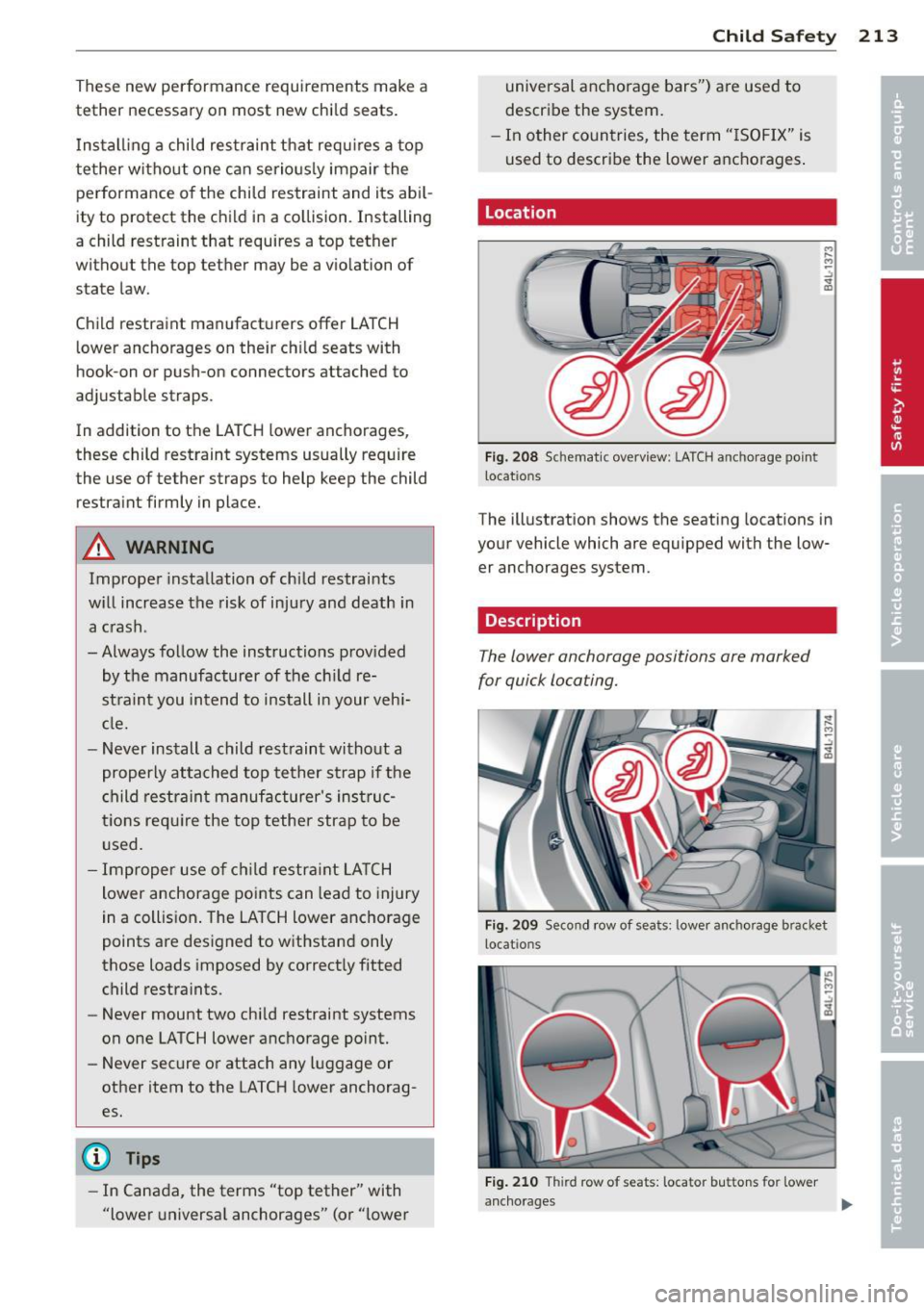
Location
Fig. 208 Schemat ic overv iew : LA TCH anchorage po in t
l ocations
The illustration shows the seating locations in
your vehicle which are equipped with the low
er anchorages system.
Description
The lower anchorage positions are marked
for quick locating.
Fig. 209 Second row of seats: lower ancho rage bracket
l ocat io ns
Fi g. 210 Thi rd row of seats: locator buttons for lower
anc horages
II-
Page 216 of 342

214 Child Safety
Attachment locator markers for lower
anchorages
The lower anchorage locations in the second
row of seats are indic ated by the attachment
locator marke rs of the lower anchorage brack
ets
¢ fig. 209. Remove the covers to access
the lower anchorage brackets . C ircular locator
buttons on the th ird row of seats* ind icate the
l ower anchorage locations on the third row of
seats¢
fig . 210.
Lower anchorages
The lower anchorage attachment points are
located between the rear seatback and rear
seat cushion ¢
fig. 209 or¢ fig. 210 .
Lower anchorages secure the child restraint in
the seat without using the vehicle's safety
belts. Anchorages prov ide a secure and easy
to-use attachment and m inimize the possibili
ty of improper chi ld restraint installation.
All child restra ints manufactured after Sep
tember 1,
2002, must have lower anchorage
attachments for the
LATCH system.
Remember that the lower anchorage points
are only intended for installation and attach
ment of child restraints specifically certified
for use w ith
LATCH lower anchorages . Child
restraints that are not equipped with the low
e r anchorage attachments can still be instal
l ed in compliance w ith the child restraint
manufacturer's instructions on using vehicle
safety belts.
_&. WARNING
Improper use of LATCH lower anchorages
can cause serious personal injury in an ac
cident.
- Always carefully fo llow the child re
straints manufacturer's instruct ions for
proper installation of the child restraint
and proper use of the lower anchorages
or safety belts in your vehicle.
- Never secure o r attach any luggage or
other items to the
LATCH lower ancho
rages . -
Always read and heed the important in·
formation about child restraints in this
chapter and WARNINGS ¢
page 200,
Child Safety.
Guidance fixtures for lower anchorages
App lies to vehicles: wit h third row seating
Special guidance fixtures increase the conven
ience of the lower anchorages and are availa
ble from your authori zed Audi dealer.
Fig . 211 Thir d row of seat s: in sta lling the guidance fix·
t u res
Fig. 212 Close-up : fitting the guida nce f ixture over t he
lowe r anchorage b racket
T he lower anchorage attachment poi nts are
located on the third row of seats between the
seatback and the seat cushion. Special guid
ance fixtures increase the conven ience of the
lower anchorages and help protect the seat
material from possible damage when insta l
ling child restraints.
Installing the guidance fixtures
" Push down on the seat cushion so that the
lower anchorages are visible.
" Hold the guidance fixture with the part
number facing downward and push it in the
direction of the arrow onto the anchorage
¢ fig. 212 .
Page 217 of 342
.. Make sure that each of the two guidance fix
tures per seat snaps into p lace.
Rem oving the guidance fi xture s
.. Remove the child restrai nt according the
child restra int manufacturer's instruct ions .
.. Push down on the seat cushion so that the
lower anchorages are visib le .
.. Pull
off the guida nee fix t u res from the low
er anchorages.
.,. Always remove the guidance fixtures and
keep them in a safe place when not in use.
You may find it easier to install child re
straints equipped with hooks attached to
straps without the guidance f ixtures in place.
If this is the case, remove the guidance fix
tures by pull ing them
off the anchorages .
H owever, the guidance fixtures can he lp you
to locate the
LATCH anchorages.
_& WARNING
Improper use of tether anchorages or low
er anchorages can cause serious personal
injury in a crash .
- Always carefully follow the ch ild re
straint manufacturer 's instruct ions for
proper installation and use of child re
straint systems.
- Never use the
LATCH or tether anchorag
es to attach safety belts o r other kinds of
occupant restraints .
- Child restraint tether attachments and
lower attachments are only designed to
secure a child restraint that has been equipped to use these anchorages.
- Tether anchorages and lower anchorages
are designed to withstand only those
loads imposed by correctly fitted chi ld
restraints. Under no circumsta nces can
they be used safely for adu lt or chi ld
safety belts o r harnesses .
- Never mount more than one ch ild re
st raint to a sing le tether or to a lower an
cho rage point. Attach ing two ch ild re
st raints to a single anchorage point can
ca use the anchorage to fail and cause se
rious persona l injury in a crash .
Child Safety 215
(D Note
-Remove the g uidance fixtures before
folding the rear seatback to prevent damaging the seat cushion .
- If you leave the guidance f ixtures instal
led for several days , they could leave a
mark on the upholstery on the seat cush
ion and backrest in the area that the
guidance fixtures were installed . The up
holstery would also be permanently
st retched a round the guidance fixtures.
T hi s app lies especia lly to leather seats.
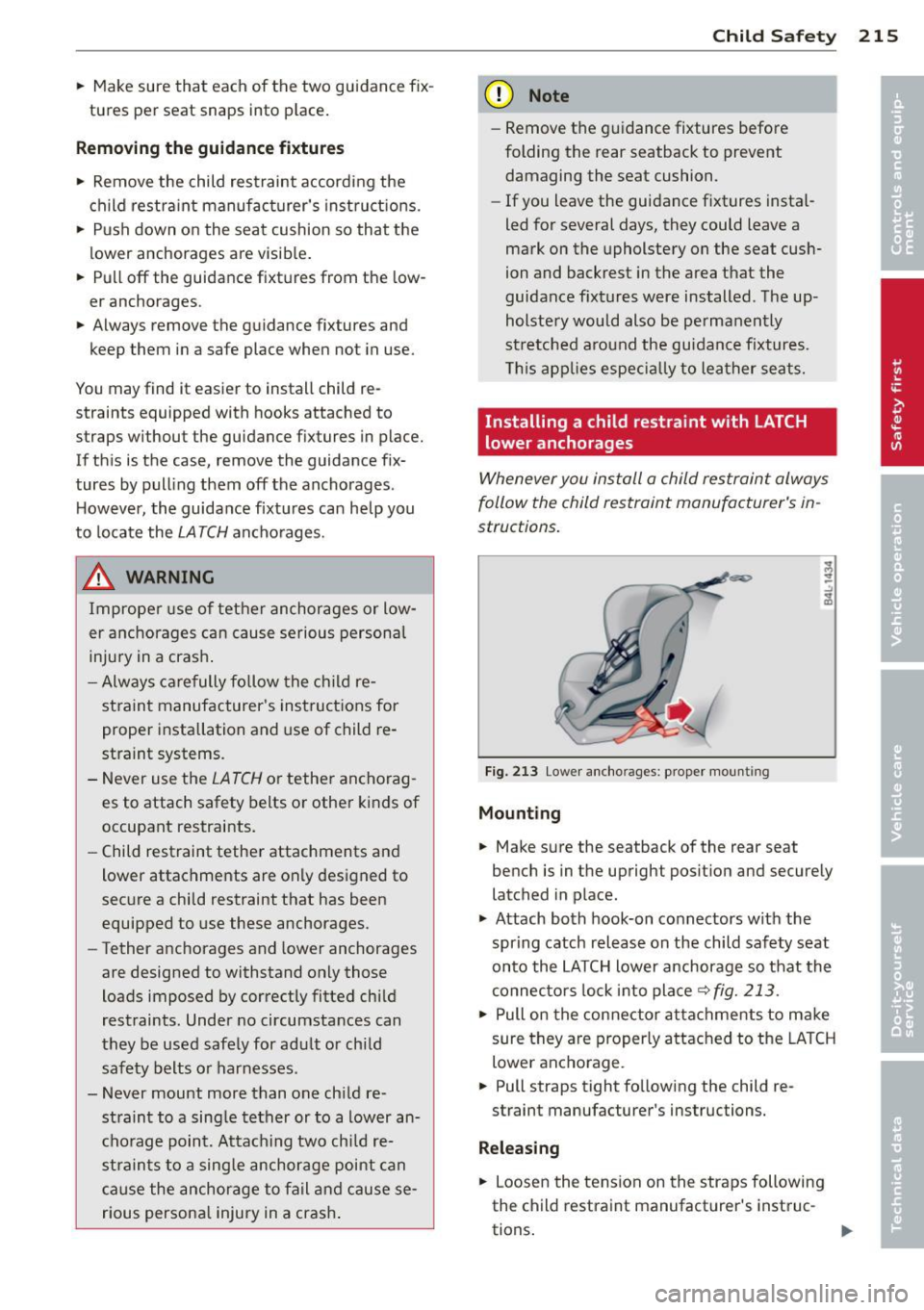
Installing a child restraint with LATCH
lower anchorages
Whenever you install a child restraint always
follow the child restraint manufacturer's in
structions.
F ig. 213 Lowe r anc horages : prope r mount ing
Mountin g
.. Make sure the seatback of the rear seat
bench is in t he upright position and securely
latched in place .
.. Attach both hook-on co nnectors with the
spring catch release on the child safety seat
onto the LATCH lower anchorage so that the
connecto rs lock into place
~ fig. 213.
.. Pull on the connector attachments to make
sure they are properly attached to the LATCH
lower ancho rage .
.. Pull straps tight fo llowing the child re
straint manufacturer's instructions.
Relea sing
.. Loosen the tension on the straps following
the child restraint manufact urer's instruc
tions .
Page 218 of 342
216 Child Safety
• Depress the spring catches to re lease the
anchorage hooks from the lower anchorag
es.
Remember: Use tether straps to help keep the
child restraint firmly in place.
A WARNING
Improper use of the LATCH system can in
crease the risk of ser ious personal injury
and death in an accident.
- These anchors were developed only for
child safety seats using the "LATCH" sys
tem.
- Never attach other child safety seats,
belts or other objects to these anchors.
- Always make sure that you hear a click
when latching the seat in place. If you do
not hear a click the seat is not secure and
could fly forward and hit the interior of
the vehicle, or be ejected from the vehi
cle.
A WARNING
Improper insta llation of chi ld restraints
w ill increase the risk of injury in an acci
dent.
- Always follow the child restraint system
man ufactur er's instr uctions for proper
installation of the child restraint system
and proper use of tether straps as we ll as
the lower anchorages or safety belts in
your vehicle.
-Always read and heed the important in
format ion and WARNINGS about child
safety and the installation of child re
straint systems¢
page 200, Child Safe
ty.
-
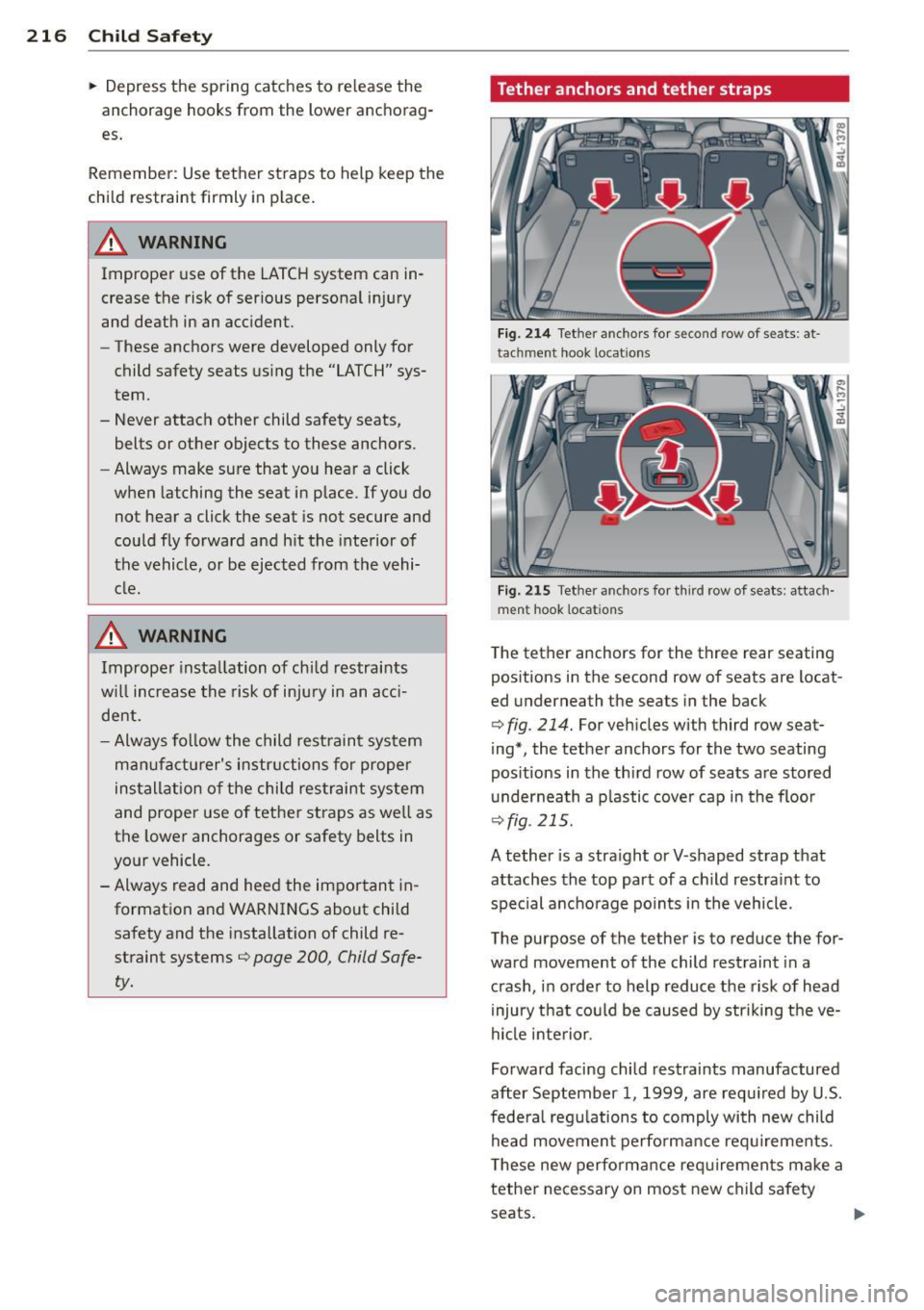
Tether anchors and tether straps
Fig. 214 T ether ancho rs for second row of seats: at
tachment hook locations
Fig. 21S Tether anchors fo r th ird row of seats: attach
m ent hook lo cations
T he tether anchors for the three rear seating
positions in the second row of seats are locat
ed underneath the seats in the back
<=? fig. 214. For vehicles with third row seat
ing*, the tether anchors for the two seating
pos itions in the third row of seats are stored
underneath a plastic cover cap in the floor
<=?fig. 215.
A tether is a stra ight or V-shaped strap that
attaches the top part of a ch ild restra int to
special anchorage po ints in the vehicle.
The purpose of the tether is to reduce the for
ward movement of the child restraint in a
crash, in order to help reduce the risk of head
injury that could be caused by striking the ve
hicle interior.
Forward facing child restraints manufactured
after September 1, 1999, are required by U.S.
federal regulations to comply with new child
head movement performance requirements.
T hese new performance requirements make a
tether necessary on most new child safety
seats.
Page 219 of 342
_& WARNING
Improper installation of child restraints
w ill increase the risk of injury and death in
a crash .
- Always follow the instructions prov ided
by the manufacturer of the ch ild re
st raint you intend to install in your Audi.
- Improper use of ch ild restraint anchors
(including tether anchors) can lead to in
jury in a co llision. The anchors are de
signed to withstand only those loads im
posed by correct ly fi tted ch ild restraints.
- Never mount two child restrai nt systems
on one LA TCH lowe r ancho r po int.
- Never attach two child restraint systems
to one tethe r strap or te ther anchorage.
- Never attach a tether st rap to a tie-down
hook in the luggage compartment.
- Never use ch ild restra int tether ancho
rages to secur e safety belts o r other
k inds of o ccupant rest ra ints.
- Never secure o r attach any l uggage or
other items to the LATCH lowe r ancho
rages or to t he tethe r ancho rs.
- If a tether o r othe r strap is used to at
ta ch a child rest raint to the front passen
ger seat, make sure that it is not so
t ight, th at it c auses the weigh t-sensing
mat to measure mo re weig ht than is ac
t u ally on the seat.
- T he heav ier we ig ht reg iste red can make
the Advanced Airbag System work as
though an ad ult were on the seat and de
ploy the Advanced Airbag w hen it must
be suppressed causing serious or even
fatal injury to the child .
- If you must install a rearward facing child safety seat on the front passenger
seat beca use of exceptional circ umstan
ces and the
PASSENGER AIR BAG OFF
light does not come on and stay on, im
med iate ly install the rear -facing child
sa fety seat in a rear seating posi tion and
have the a irbag sys tem inspec ted by you r
Audi dealer .
Child Safety 21 7
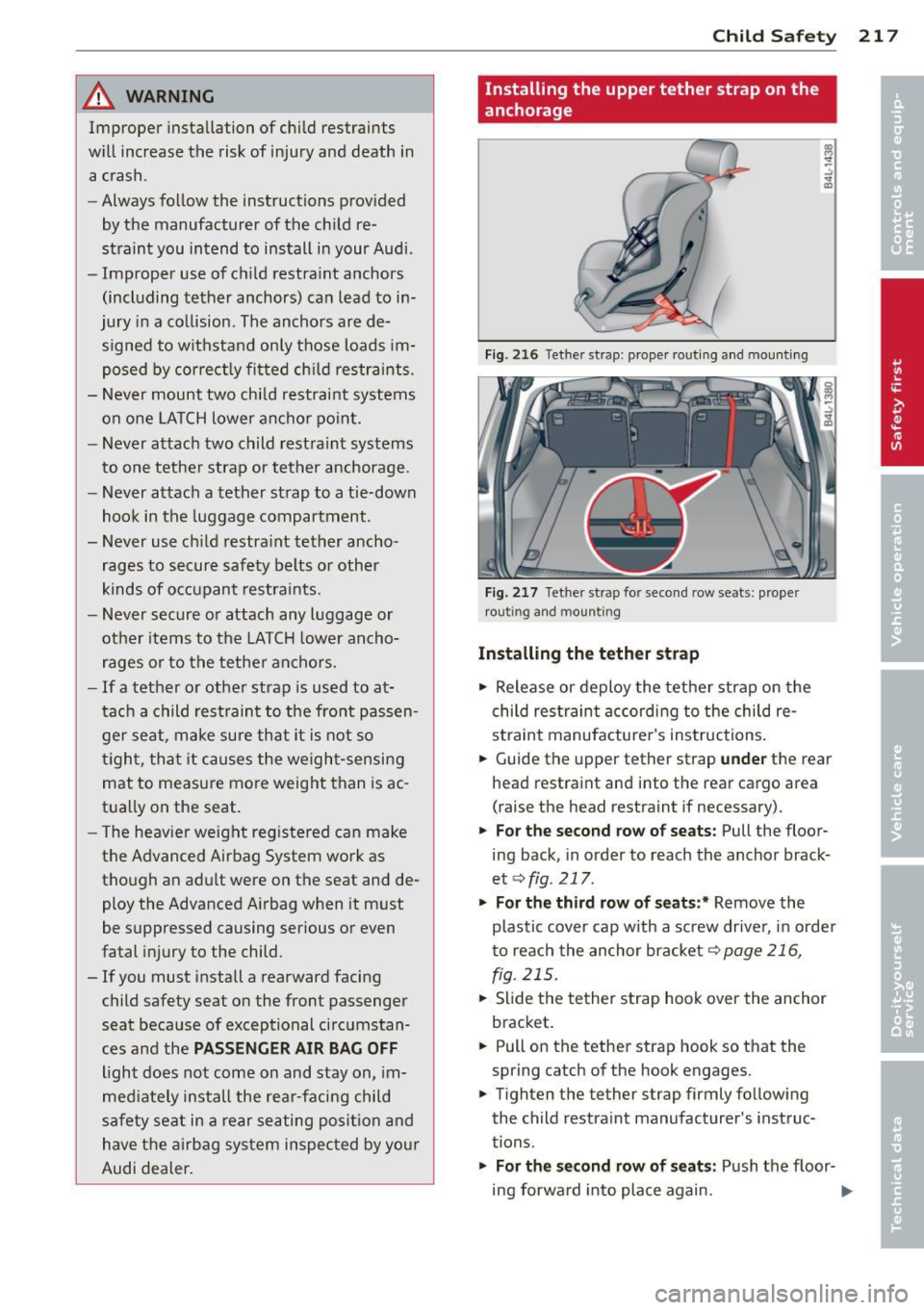
Installing the upper tether strap on the
anchorage
Fig . 21 6 Tet her s trap: prope r rout ing a nd m ounti ng
Fi g. 217 Tet her st rap fo r seco nd row se ats: prope r
rou ting and moun tin g
Installing the tether strap
... Release or deploy the tether strap on the
child res traint accord ing to the child re
st raint manufacture r's ins tructions .
... Guide the upper tether strap
und er the rear
head restraint and into the rear ca rgo area
(raise the head restraint if necessary) .
... Fo r the second row o f seats: Pull the floor
ing back, in order to reach the anchor brack
et
c:::> fig. 217 .
... For the third row of seats :* Remove the
plastic cover cap with a screw drive r, in orde r
t o reach the anchor bracket
c:::> page 216,
fig . 215.
... Slide the tether s trap hoo k over the anchor
bracket .
... Pull on the tether strap hook so that the
spring catch of the hook engages .
.,. Tighten the tether strap firmly fo llow ing
the child restra int manufacturer's instruc
tions.
.,. For the second row of seats: Push the floor
ing forward into place again.
Page 234 of 342

232 Driving o ff road
Driving off road
Driving in difficult road
conditions and offroad
General information
The operation of the E lectronic Stability Con
trol (ESC) is expanded for operation away
from paved roads. In situations where slip or a
d ifferential locking function is required, the
ESC offroad mode can be act ivated
c::;, page 219 . Hill descent control is also availa
ble in the ESC offroad mode, which automati
cally b rakes the vehicle and thereby keeps
speed constant when diffe rent wheel speeds
a re detected when descending a hill
c::;, page 220. Your Audi also has permanent
a ll-whee l drive in addition.
H oweve r, your Aud i is not a pure off road vehi
cle .
It was no t built for d riving unde r extreme
conditions, e .g. fo r trips that are in the natu re
of an expedit ion .
Dri ve only on road s and offroad section s
which match the de sign of y our vehicl e and
y ou r abilitie s as a dri ver. Never take risks!
Before driving offroad
- Check the eng ine oil level, ti re p ressu re ,
coolant level , and the fluid level in the w ind
shield washe r reservo ir.
- Stow luggage items and o ther objects in the
luggage compartment, and secure t hem
against s liding aro und .
After driving offroad
- After trips offroad, remove any twigs and
othe r foreign objects from the grill, the un
derbody and the wheels. Pay spec ia l atten
t ion to fo re ign objects (stones) which have
be come lodged in the tire tread.
- Clean t he body a nd the veh icle unders ide,
and in spec t the veh icle for poss ible damage.
- Clean dirty w indows , headlamp lenses , rear
l ights, and li cense plates .
- Perfo rm a brake check (part icularly after
t ravel ling th rough water) .
A WARNING
-Drive especially attentively and plan
a head in d iff icu lt road conditions and
when off road. Excessive speed o r inco r
rect maneuvers can cause injuries and
damage to the vehicle.
-
- Always adapt your speed and driving
style to road, offroad, t raff ic, and weat h
er cond itions. Drive e specially slowly off
ro ad when you r view is res tricted.
- Please be awa re that in ESC off road
mo de, particularly on a smoo th and s lip
pe ry road, the wheels may have an in
crease d tendency to sp in and the vehicle
may b reak away - danger of skidding!
- Stabili ty is limited in the ESC off roa d
mode .
@) For the sake of the environment
Avoid damage to t he environmen t an d re
s pect na tu re .
(D Tips
Only d rive w here it is permitte d and stay
on marked road s and pat hs.
Explanation of some technical terms
The following data refe r to ideal cond itions.
Depend ing on veh icle load and gro und condi
tions and the environment, the numbers may
vary. It is the driver's responsibility to decide
whether a vehicle can overcome a specific s it
uat io n
c::;, ,&. .
Gradient angle
The number of meters in alt itude ga ined over
a distance of 109.4 yards or 100 meters
(grade) are given as a percentage or degrees.
Information about the gradient the vehicle
can climb under its own power (depends in
part on the road surface and engine power) .
Max imum pe rm itt ed grade : 3 1
°
Later al angle (slope of vehicle )
Indicates the angle up to which the vehicle
can be driven diagonally or across the fall line ..,.