oil AUDI Q7 2012 Owner´s Manual
[x] Cancel search | Manufacturer: AUDI, Model Year: 2012, Model line: Q7, Model: AUDI Q7 2012Pages: 342, PDF Size: 86.42 MB
Page 266 of 342
264 Check ing and filling
per 2,000 km). Cons umption may be higher
within the first 3,000 mi les (5,000 km).
Adding engine oil "1:::7':
0 N ;:;
"' "' a:>
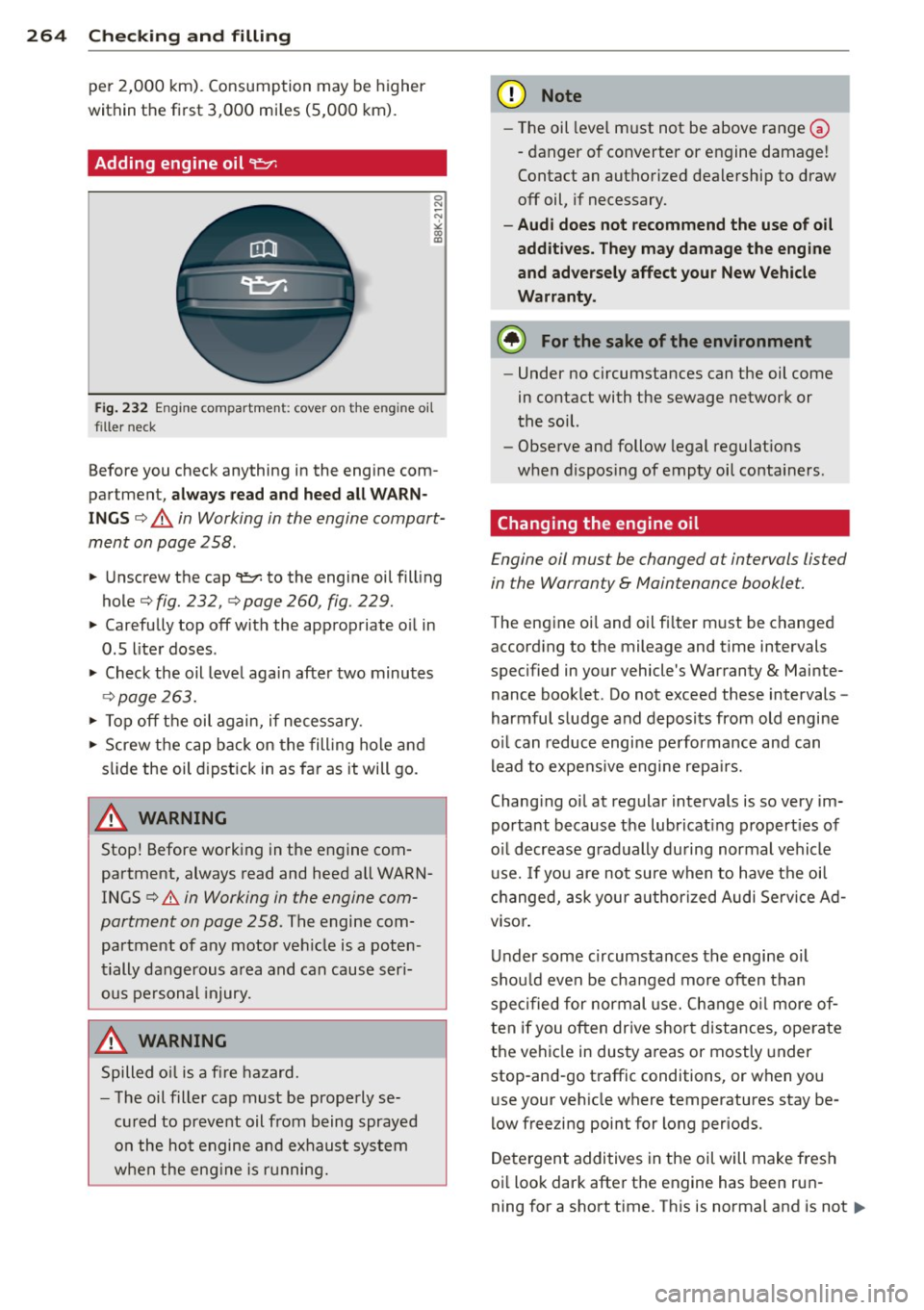
F ig . 232 Eng ine com part men t: cove r on the eng ine o il
filler neck
Before you check anything in the engine com
partment,
alway s read and h eed all WARN
INGS
¢ .&. in Working in the engine compart
ment on page 258 .
.. Unscrew the cap 't::r. to the engine oil fill ing
hole¢
fig. 232, ¢ page 260, fig . 229.
.. Carefully top off with the appropriate o il in
0 .5 lite r doses .
.. Check the oil leve l aga in afte r two minutes
¢ page 263.
.. Top off th e oil again, if necessary.
.. Screw t he cap back on the filling hole and
s li de the oil d ipst ick in as far as it will go.
& WARNING
Stop! Before working in the engine com
partment, always read and heed a ll WARN
INGS
¢ .& in Working in the engine com
partment on page 258 .
The engine com
partment of any motor ve hicle is a poten
tially dangerous a rea and can cause ser i
ous pe rsonal injury.
& WARNING
Spilled o il is a fi re hazard.
- The oil fille r cap must be prope rly se
c u red to prevent oil from being sprayed
on the ho t engine and exhaust system
w hen the eng ine is r unni ng.
-
(D Note
- The oil leve l m ust not be above range 0
- danger of converter or engine damage !
Contact an authorized dea lership to draw
off oil, if necessary.
- Audi does not recommend the use of oil
additives. They may damage the engine
and adversely affect your New Vehicle
Warranty .
~ For the sake of the environment
-Under no circumstances can the oil come
in contact with the sewage network or
the so il.
- Observe and follow legal regulat ions
when dispos ing of empty oil containers.
Changing the engine oil
Engine oil mus t be changed at intervals listed
in the Warranty
& Maintenance booklet.
The eng ine oi l and oil fi lter m ust be changed
accord ing to the mileage and time intervals
specified in your vehicle's Warranty
& Mainte
nance booklet . Do not exceed these intervals -
harmful s ludge and depos its from old engine
o il can reduce engi ne pe rformance and can
lead to expens ive engine repa irs.
Chang ing oi l at regula r intervals is so very im
po rtant because t he lubricat ing propert ies of
o il decrease gradually du ring normal vehicle
u se.
If you are not sure when to have the oi l
c h anged, ask your a uthori zed Audi Se rvi ce A d
visor .
U nder some c ircumstances the engine oil
sho uld even be cha nged more often than
spec ified for normal use. Change o il more of
ten if you often dr ive short distances, ope rate
t h e ve hicle in dusty a reas or mostly under
stop-and-go t raff ic conditions, or when you
u se your vehicle where temperatures stay be
low free zing point for long periods.
Detergent additives in the oil will make fresh
oi l loo k dark after the engine has been run-
ning for a short time . T hi s is normal and is not
IJ,,
Page 267 of 342
a reason to change the oil more often than recommended.
A WARNING
Stop! Before working in the engine com
partme nt, always read and heed all WARN
INGS
q & in Working in the engine com
partment on page 258.
The engine com
partme nt of any motor veh icle is a poten
tially dangerous a rea and can cause ser i
ous pe rsonal injury.
A WARNING
If you must change t he engine o il i n your
vehicle:
- Always wea r eye p rotection.
- To reduce the r isk of burns from hot en-
gine oil let the engine cool down to the
t ouch.
- When removing the oil drain plug with
yo ur finge rs, stay as far away as possible.
Always kee p your forea rm pa ra llel to the
ground to he lp prevent ho t oi l from r un
ning down your arm.
- Drain the o il into a co nt ainer designed
f or this p urpose, one large enough to
hold at least the total amount of oil in
yo ur engine .
- T o reduce the r is k of po ison ing, never use
empty food or beverage containers that
might mis lead someone into dr inking
from them.
- Engine oil is poisono us. Keep it well out
of the reach of chi ldren.
- Cont in u ous contact with used engi ne oil
is harmful to your skin. Always protect
yo ur sk in by washing tho ro ughly with
soap and water.
(D Note
Never mix oi l ad dit ives with your engine
oil. These additives can damage your en
gine and adverse ly affect your Audi Limit
ed New Vehicle Warranty.
-
Checkin g and fillin g 265
@) For the sake of the environment
-Before changing the oil, first make sure
you know where you can prope rly dispose
of the old o il.
- Always dispose of used oil p ro perly. Nev
er dump it on garden soil, in wooded
areas, into streams or down sewage
dra ins.
- Recycle used o il by tak ing it to a used en
gine oil collection facility in your area, or
contact a service station.
- We strongly recommend that yo u have
your oil cha nged by an authorized Audi
dealer or a qualified wo rkshop with the
special tools a nd expert ise required, and
proper m eans of disposa l.
Engine cooling system
Coolant
The engine coolant performs two functions: it
keeps the engine from overheating and it pro tects the engine from freezing in the winter.
T he cooling sys tem is sealed and genera lly re
quires little attention.
T he cooli ng system has bee n filled a t the fac
t ory with a permanent coolant which does not
need to be c hanged . The coo lant cons ists of a
mixture of water and the manufacturer's gly
col-based coo lant additive G l3 antifreeze
with anticorrosion additives (50% for USA
models; 60% for Canadian mode ls). This m ix
ture both assures the necessary frost protec
tion and protects meta l compone nts in t he
engine's cool ing system from corros io n and
sca ling.
It also raises the boiling point of the
c oolant.
Do not reduce the concentration of the cool
ant in the s ummer by adding p lai n water .
The
proportion of coolant additive must be at
lea st 50 % but not more than 60 %
to main
tai n antifree ze pro te ct io n a nd coo ling eff icien
cy .
If the coo lant fros t protection is too low,
the coo lant co uld freeze and damage the vehi-
cle heating and engine cooling system. .,..
•
•
Page 269 of 342
Coolant loss
Coolant loss may indicate a leak in the cool ing
system . In the event of coolant loss, the cool
ing system should be inspected immediately
by your authorized Audi d ealer. It is not
enough merely to add coolant.
I n a
sea led system, losses can occur only if
the boiling point of the coolant is exceeded as
a result of overheating.
A WARNING
The cooling system is under pressure and can get very hot. Reduce the risk of scald
ing from hot coolant by following these
steps.
- Turn off the engine and allow it to coo l
down.
- Protect your face, hands and arms from
escaping fluid and steam by covering the
cap with a large, thick rag .
- Turn the cap slowly and very carefully in
a counter -clockwise direction wh ile ap
plying light, downward pressure on the
top of the cap .
- To avoid be ing burned, do not spill ant i
freeze or coolant on the exhaust system
o r hot eng ine parts. Under certai n condi
t ions, the ethy lene g lycol i n engine cool
an t ca n ca tch fire.
(D Note
Do not add any type of rad iator leak seal
ant to you r vehicle's eng ine coolant. Add
ing radiator repair f luid may adversely af
fec t the function and pe rformance of your
cooling system and could res ult in damage
not covered by your New Vehicle Limited
Warranty .
Adding coolant
Be very careful when adding engine coolant.
Before you check anything in the engi ne com
partment ,
alwa ys read and heed all WARN
INGS c:> A in Working in the engine compart
ment on page 258 .
Checking and fillin g 267
.. Turn off the engine .
.. Let the engine coo l down .
.. Place a thick rag over the coo lant expansion
tank
c:> page 266 , fig . 233 and carefully
twis t the cap coun ter-clockwise c:> &, .
.. Add coo lant .
.. Twist the cap on aga in
tightly.
Rep lacemen t engine coolant must conform to
exact spec ificat ions
c:> page 265, Coolant . We
recommend us ing on ly coo lant additive G12+
+, G 13 or in an eme rgency G12 +. Do
not use a
different additive. In an emergency use pla in
water until you can ge t the co rrect addi tive
and can restore the correc t ratio. This sho uld
be done as soon as possible.
If you have lost a cons iderab le amount of
coolant , the n you sho uld add cold ant ifree ze
and cold wate r on ly when the engine is cold.
Always use
n ew engine coolant when refilling .
Do not f ill coolant above the "MAX" mark. Ex
cess coola nt will be forced out through the
pressure relief valve in the cap when the en
gine becomes hot .
A WARNING
- The cooling system is under pressure and
can get ve ry hot. Reduce the risk of
scalding from hot coolan t by following
these steps.
- Turn off the engine and allow it to coo l
down .
- Protect your face, hands and arms from
escaping fluid and steam by covering
the cap w ith a large, th ick rag .
- Turn the cap s lowly and very carefully
i n a counter-clockwise direction while
applying light, downward pressure on
the top of the cap.
- To avoid being burned, do not spill a n
tifreeze o r coolant on the exhaust sys
tem or hot engi ne pa rts. Under certain
c ond it ions, the ethy lene glycol in en
gine coolant c an catch fire .
- Antifree ze is po isonous. Always s to re an
tifree ze in its o rigina l container and well
ou t of the rea ch of child ren. .,.
•
•
Page 287 of 342
A WARNING
Sudden tire failure can lead to loss of con
trol, a crash and serious personal injury!
- Never drive a vehicle when the tread on
any tire is worn down to the wear indica
tors.
- Worn tires are a safety hazard, they do
not grip well on wet roads and increase
your risk of "hydroplaning" and loss of
control.
- Always keep chemicals that can cause
tire damage, such as grease, oil, gasoline
and brake fluid away from t ires.
- Tires age even if they are not be ing used
and can fail suddenly, especially at high
speeds . Tir es that are more than 6 years
old can only be used in an emergency
and then with special care and at lower
speeds.
- Never mount used tires on your vehicle if
you are not sure of their" previous histo
ry ." Old used tires may have been dam
aged even though the damage cannot be
seen that can lead to sudden tire failure
and loss of vehicle control.
Tires and wheels 285
New tires and replacing tires and wheels
New tires and wheels have to be broken in .
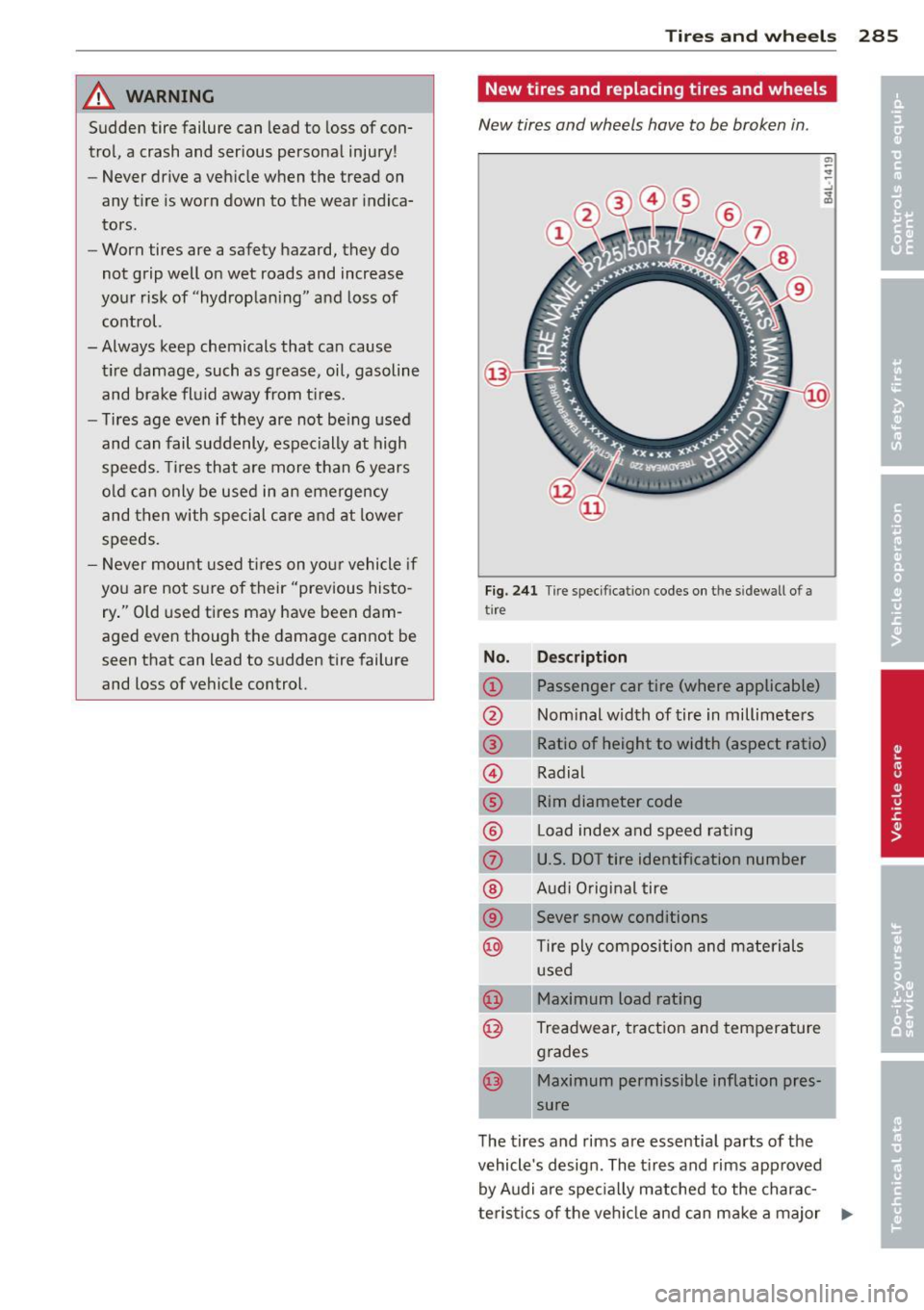
Fig. 241 Tir e specificat ion codes on t he s idewall o f a
tire
No. Description
CD Passenger car tire (where applicable)
@ Nominal width of tire in millimeters
® Ratio of height to width (aspect ratio)
© Radial
® Rim diameter code
® Load index and speed rat ing
(f) U.S. DOT tire identification number
® Audi Original tire
® Sever snow conditions
@ Tire ply composition and materials
used
@ Maximum load rating
@ Treadwear, traction and temperature
grades
@ Maximum permissible inflation pres-
sure
The tires and rims are essential parts of the
vehicle's design . The tires and rims approved
by Audi are specially matched to the charac
teristics of the vehicle and can make a major .,.
•
Page 293 of 342
driving a few yards and correct if neces
sary . Follow the instructions from the
snow cha in manufacturer when doing so.
- If the Adaptive Air Suspension* should
malfunction, do not mount or use snow
chains beca use the vehicle will be ex
tremely low. If you do drive with snow
chains on while the vehicle is at this lev el, the snow chains might severe ly dam
age the wheelhouse and other parts of
the veh icle.
(0 Tips
W here snow cha ins are mandatory oncer
tain roads, this normally also applies to ve
hicles with all-wheel drive.
Wheel bolts
Wheel bolts must always be tightened to the
correct torque .
The design of whee l bolts is matched to the
factory installed r ims. If different rims are fit
ted, the cor rect wheel bolts wit h the right
lengt h and correctly s haped bolt heads must
be used. This ens ures t hat w heels a re fitted
secure ly an d that the brake system f unctions
correctly.
I n ce rtain circumstances, you may not use
wheel bo lts from a d ifferent vehicle -even if it
is the s ame mode l~
page 3 21.
& WARNING
Improperly tig htened or maintained whee l
bolts can become loose ca using loss of
cont ro l, a co llision and serious persona l in
jury.
- Always keep the w heel bolts and the
threads in the wheel hubs clean so the
wheel bolts can turn easily and be prop erly t ightened.
- Never grease or oil the wheel bolts and the threads in the wheel hubs. They can
become loose w hile driving if greased or
o iled, even if tig hte ned to the specified
torq ue.
Tire s an d wheel s 2 91
-On ly use whee l bolts that be long to the
rim being installed.
- Never use different wheels bolts on yo ur
veh icle.
- Always maintain the correct t ightening
torque for the whee l bolts to reduce t he
risk o f a wheel loss. If the tightening tor
que of t he wheel bolts is too low, they
can loosen and come out when t he vehi
cle is mov ing.
If the tig hte ning torque is
too high, the wheel bolts and threads can be damaged and the whee l can be
come loose.
(D Note
The specified torque for the whee l bolts is
120
ft l b ( 160 Nm) with a to le rance of
± 7, 4
ft lb( ± 10 Nm). Torque w heel bo lts
d iagon ally . After changi ng a w heel, the
torque m ust be chec ke d as soon as poss i
b le with a to rque wrench -preferab ly by an
a uthorized Audi dea ler or q ua lified work
shop .
Low aspect ratio tires
Your Audi is factory-equ ipped with tow aspect
ratio tires. These tires have been thoroughly
tested and been se lected specifically for your
model for their superb perfo rmance, road feel
and handli ng under a var iety of drivi ng condi
tions. As k your au thori zed A udi dealer for
more de tails.
The low asp ect ratio of these tires is ind icated
by a nu mera l of
55 or l ess in the tire's s ize
designation. The n ume ra l rep resen ts the ra tio
of the tire's sidew all height in rel ation to its
tread width exp ressed in percentage . Conven
tiona l tires have a he ight/width ratio of 60 or
more.
The performance of low-aspect-ratio tire s is
particularly sensitive to improper inflation
pre ssure. It is therefore important th at low
aspect ratio tires are inflated to the specified pressure and that the inflation pressure is
regularly checked and mainta ined. Tire pres-
sures should be checked at least once a .,..
•
•
Page 315 of 342

fall f rom a lift if the re is a change in ve
h icle we ight d istr ibut ion and balance.
This might happen, for examp le, when
heavy components such as the engi ne
b lock or transmiss io n are removed .
- Whe n removing heavy components like
these, ancho r vehicle to ho ist o r add cor
respond ing weig hts to ma inta in the cen
te r of g ravity . Othe rwise, the vehicl e
m ig ht tilt o r slip off th e hois t, causi ng
s erious perso nal inju ry.
(D Note
- Be awa re of the fo llowing po in ts befo re
li fting t he vehi cle:
- The vehicle should never be lifted or
jacked up from underneath the engine oil pan, the transmission housing, the
front or rear axle or the body side
members. This could lead to serious
damage .
- To avoid damage to the underbody or
chassis frame, a rubber pad must be
inserted between the floor jack and
the lift points.
- Before driving over a workshop hoist,
check that the vehicle weight does not
exceed the permissible lifting capacity
of the hoist.
- Before driving over a workshop hoist,
ensure that there is sufficient clear ance between the hoist and low parts
of the vehicle .
Emergency situations 313
•
•
Page 318 of 342
316 Data
Data
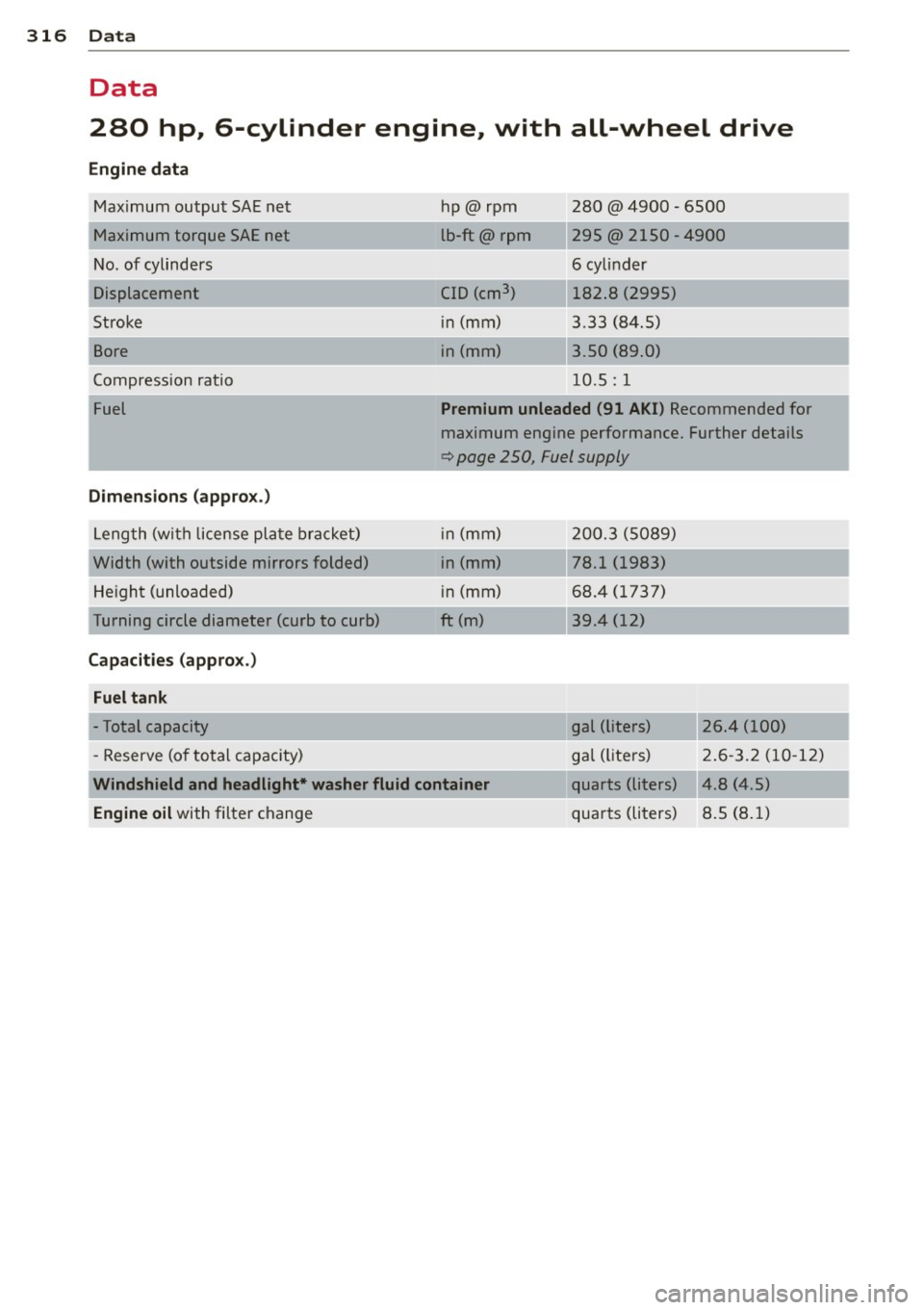
280 hp, 6-cylinder engine, with all-wheel drive
Engine data Maximum output SAE net
Maximum torque SAE net
No . of cylinders
Displacement
Stroke
Bore
Compression ratio
Fuel
Dimensions (approx .)
Length (with license plate bracket)
Width (with outside mirrors folded) Height (unloaded)
Turning circle diameter (curb to curb)
Capacities (approx .)
Fuel tank
- Total capacity
- Reserve (of total capacity) hp@ rpm
lb-ft@ rpm
CID (cm
3 )
in (mm)
in (mm) 280@ 4900
-6500
-·--295@ 2150 -4900
6 cylinder
-·~-182 .8 (2995)
3.33 (84 .5)
3 .50 (89 .0)
--· 10.5 : 1
Premium unleaded (91 AKI) Recommended for
maximum engine performance. Further details
¢page 250, Fuel supply
in (mm) 200.3 (5089)
in (mm) 78.1 (1983)
in (mm) 68.4 (1737)
ft (m) 39 .4 (12)
gal (liters) 26.4 (100)
gal (liters) 2.6-3.2 (10 -12)
Windshield and headlight* washer fluid container quarts (liters) 4.8 (4 .5)
Engine oil with filter change quarts (liters) 8.5 (8.1)
Page 319 of 342
Data
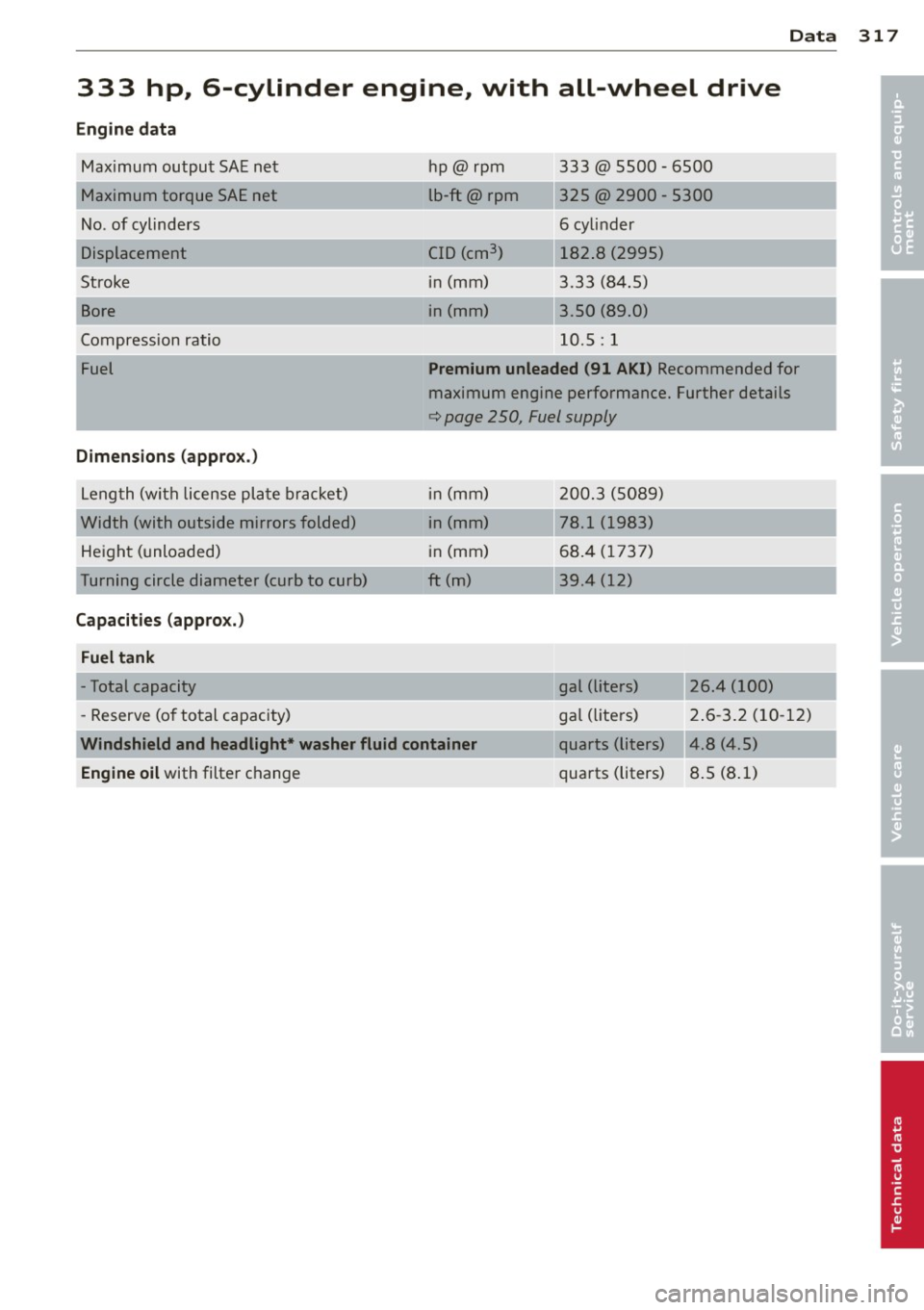
333 hp, 6-cylinder engine, with all-wheel drive
Engine data
Maximum output SAE net
Maximum torque SAE net
No. of cylinders
Displacement
Stroke
Bore
Compression ratio
Fuel
Dim ension s (appro x.)
Leng th (with license pla te bracket)
Width (with outside mirrors folded) He igh t (unloaded)
T urning circle diameter (curb to curb)
Capacit ies (appro x.)
Fuel tank
- Total capacity
- Reserve (o f total capacity) 333@ 5500 - 6500
hp@rpm
lb-ft@ rpm
-~~-
CID (cm3
)
in (mm)
in (mm)
--·
325 @ 2900 - 5300
6 cylinder
182 .8 (2995)
3 .33 (84.5)
3 .50 (89.0)
10.5 : 1
Premium unleaded (91 AKI) Recommended for
maximum engine performance. Further details
<=> page 250, Fuel supply
in (mm) 200.3 (5089)
in (mm) 78.1 (1983)
in (mm) 68.4 (1737)
ft (m) 39 .4 (12)
gal (liters) 26.4 (100)
gal (lite rs) 2 .6 -3.2 (10 -12)
Windshield and headlight* washer fluid container quarts (liters) 4 .8 (4 .5)
Engine oil with filter change quarts (liters) 8
.5 (8 .1)
317
•
•
Page 320 of 342
318 Data
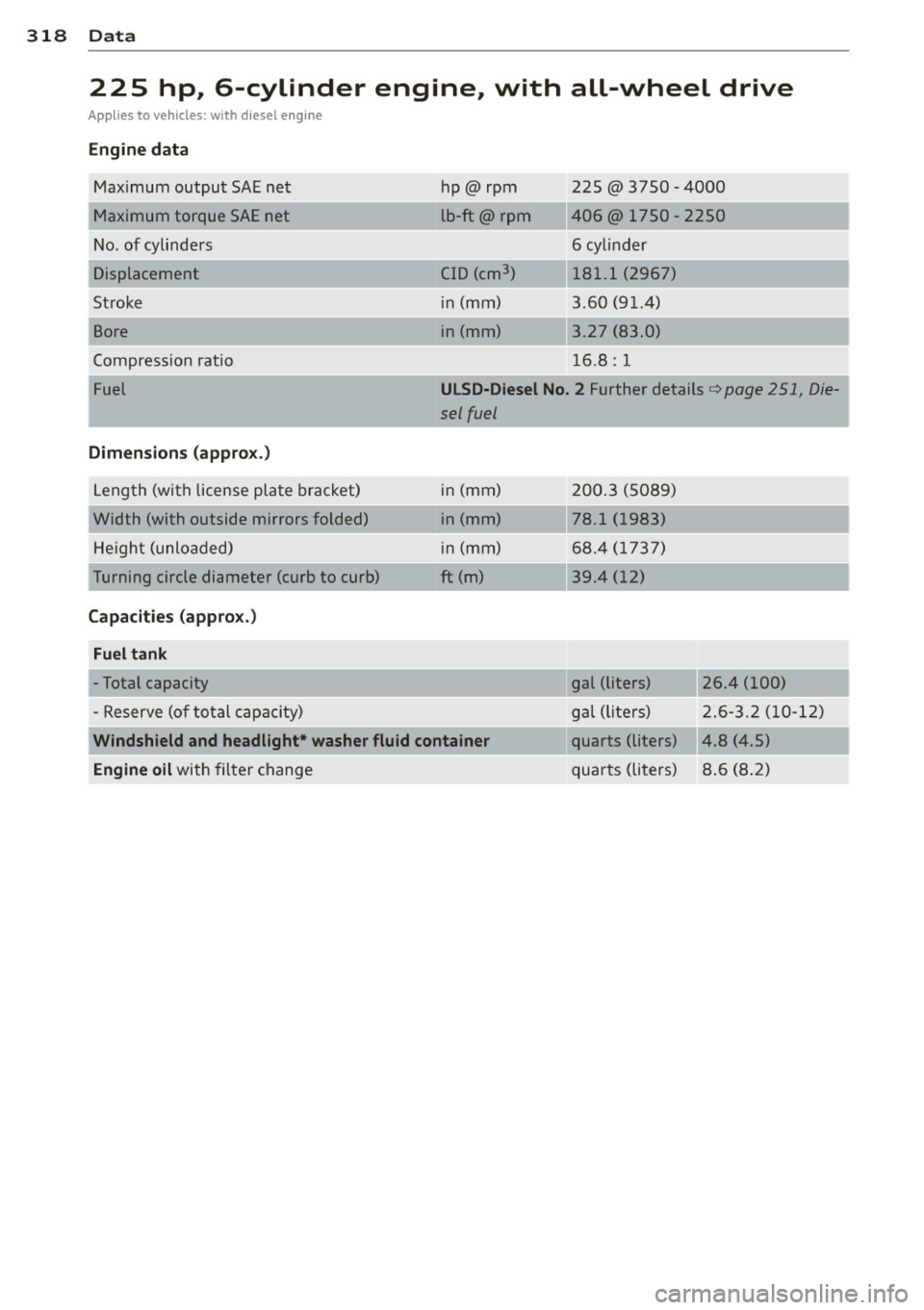
225 hp, 6-cylinder engine, with all-wheel drive
Applies to vehicles: with diesel engine
Engine data
Maximum output SAE net
Maximum torque SAE net
No . of cylinders
Stroke
Bore
Compression ratio
Fuel
Dimen sions (app rox.)
Length (with license plate bracket)
Width (with outside mirrors folded)
He ight (unloaded)
Turning circle diameter (curb to curb)
Capacities (approx.)
Fuel tank
- Total capacity
- Reserve (of total capacity) hp@ rpm
lb-ft@ rpm
CID (cm
3 )
in (mm)
in (mm) 225@ 3750 - 4000
-·--406@ 1750 - 2250
6 cylinder
-•--
181.1 (2967)
3 .60 (91.4)
3.27 (83 .0)
~-· 16.8: 1
ULSD-Diesel No. 2 Further details
c:> page 251, Die
sel fuel
in (mm) 200.3 (5089)
in (mm) 78.1 (1983)
in (mm) 68.4 (1737)
ft (m) 39.4 (12)
gal (liters) 26.4 (100)
gal (l iters) 2.6-3.2 (10-12)
Windshield and headlight* washer fluid container quarts (liters)
4.8 (4.5)
Engine oil with filter change quarts
(liters) 8.6 (8.2)
Page 321 of 342

Consumer Information
Warranty coverages
Your Audi is covered by the following war
ranties:
- New Vehicle Limited Warranty
- Limited Warranty Against Corrosion Perfo-
ration
- Emissions Control System Warranty
- Emissions Performance Warranty
- California Emissions Con trol Warranty (USA
vehicles only)
- California Emissions Performance Warranty
(USA vehicles only)
Detailed information regarding your warran
ties can be found in your
Warranty & Mainte
nance booklet .
Operating your vehicle
outside the U.S.A. or
Canada
Government regulations in the United States
and Canada require that automobiles meet
specific emission regulations and safety
standards. Therefore, veh icles built for the
U.S.A. and Canada differ from vehicles sold in
other countries .
If you p lan to take your vehicle outside the
continental limits of the United States or Can
ada, there is the possibility that
- unleaded fuels for vehicles with cata lytic
converter may not be available;
- fuel may have a considerably lower octane
rating . Improper fuel may cause engine
damage ;
- service may be inadequate due to lack of
proper service facilities, tools or testing
equipment ;
- replacement parts may not be readily availa
ble.
- Navigation systems for vehicles built for the
U.S.A. and Canada will not necessari ly work
in Europe, and may not work in other coun
tries outside North America .
Consumer Information 319
@ Note
Audi cannot be responsible for mechanical
damage that could result from inadequate
fuel, service or parts availability.
Audi Service Repair Manuals and Literature
Audi Offic ial Factory Service Manuals and Lit
erature are published as soon as possible after
model introduction. Service Manuals and liter
atu re are availabl e to order from the Audi
T echnical Literature Ordering Center at:
www.audi.techliterature.com
Maintenance
' General
Your vehicle has been designed to help keep
maintenance requirements to a minimum.
However, a certain amount of regular mainte
nance is still necessary to assure your vehicle's
safety, economy and reliability . For detailed
vehicle maintenance consult your Warranty
&
Maintenance booklet.
Under difficult operating conditions, for ex
ample at extremely low outside temperatures ,
in very dusty regions, when towing a tra iler
very frequently, etc., some serv ice work
shou ld be performed between the intervals
specified. This applies particularly to:
- oil changes, and
- cleaning or replacing the air filter .
® For the sake of the environment
By regularly maintaining your vehicle, you
help make sure that emission standards
are maintained, thus min imizi ng adverse
effects on the environment .
Important considerations for you and
your vehicle
The increasing use of electronics , sophisticat
ed fuel injection and emission control sys-
tems, and the generally increasing technica l ..,_
•
•