oil AUDI Q7 2012 Owner´s Manual
[x] Cancel search | Manufacturer: AUDI, Model Year: 2012, Model line: Q7, Model: AUDI Q7 2012Pages: 342, PDF Size: 86.42 MB
Page 247 of 342
The MMI control console should be cleaned
with a brush first so that no dirt is trapped be
tween the buttons and the housing . We rec
ommend giv ing the MMI control console a fi
nal w ipe with a cloth mo istened with water
and d ish washing detergent.
Q;) Note
To prevent damage, make sure that no flu
id ever gets into the MMI control console .
Aluminum trim
Use only neutr al- pH products to remove spots
and depos its from alum inum surfaces.
C hr ome ca re products and alkaline cleaners
will attack alum in um s urfaces and can dam
age them ove r time.
& WARNING
Always read and heed a ll WARNINGS and
other information
¢ page 239 .
Fabrics and fabric coverings
Fabrics and fabric coverings (e .g. seats, door
trim panels, etc.) should be cleaned at regu lar
intervals with a vacuum cleaner . Th is removes
surface dirt particles which could become em bedded in the fabr ic through use. Steam
cleaners should not be used, because the
steam tends to push the dirt deeper into the
fabric and lock it there.
Norm al cleaning
Generally, we recommend using a soft sponge
or a lint-free microfiber cloth to the clean fab
ric. Brushes should only be used for carpets
a nd floor mats, since other fabric surfaces
could be harmed by b rushes.
Normal surface sta ins can be cleaned using a
commercia lly available foam cleaner . Spread
the foam on the surface of the fab ric with a
soft sponge and work it in gently. Do not sat u
r ate the fabric. Then pat the foam dry using
absorbent, dry cloths (e .g. microfiber cloth)
and vacuum it after it has dried comp lete ly.
Cleaning and protec tion 245
Cl ean ing sta in s
Stains caused by beverages (e.g . coffee, fruit
juice, etc.) can be treated with a mild deter
gent solution. Apply the detergent sol ution
with a sponge. In the case of stubborn stains, a detergent paste can be applied directly to
the s tain and worked into the fabric . After
wards, use copious amounts of clean water to
remove the rema ining detergent . Apply the
water with a damp cloth or sponge and pat
the fabric dry with an abso rbent, dry cloth.
Stains from chocolate or makeup should have detergent paste (e .g . ox -gall soap) rubbed in
to them . Afterwards, remove the soap with
water (damp sponge).
Alcohol can be used to treat stains from
grease, o il, lipstick or a ballpoint pen . Melted
grease or dye must be patted off using ab
sorbent mater ial. It may be necessa ry to re
treat the areas with detergent paste and wa
te r.
In the case of general soiling of the uphols
tery and cover material, we recommend hir ing
a specia list that has the eq uipment to clean
the seat cove rs and othe r fabr ic surfaces by
shampooing and spray extraction.
A WARNING
A lways read and heed all WARNINGS and
the information
¢ page 239.
(D Tips
Open Ve lcro fas teners on yo ur cl othing can
damage the seat cover . Please make sure
that Ve lcro fasteners are closed .
Plastic parts and instrument panel
Always use a clean cloth moistened in clear
water to clean these areas. For persistent d irt
use an Aud i approved
s olvent-fre e plastic
clea ner/protectant . .,.. •
•
Page 248 of 342
24 6 Cl eaning and protec tio n
8_ WARNING
So lvents can change the properties of
some plastics and make it harder for the
airbag to deploy .
-
-Never clean the instrument panel or the
surface of airbag modules with cleaning
products that contain solvents .
- Products containing solvents w ill make
the surface of th is part porous.
- Serious injur ies can result if plastic parts
come loose when the airbag is deployed.
- Always read and heed all WARNINGS and
other information
¢ page 239.
(D Note
Cleaning agents containing solvents will
attack the mater ial and can change the
way it behaves.
Natural leather
App lies to vehicles: with natura l leather
Audi makes great efforts to maintain the
properties, natural look and feel of interior
leather.
Gen eral
We offer many different types of leather on
our vehicles. Most are different types of nappa
leather, which has a smooth surface and
comes in various colors.
The intensity of the color determines the visu al characteristics and appearance . If the sur
face of the leather has a typical natural look,
then the leather is a nappa leather that has
been left in a relatively natural condition. This
leather offers particularly good comfort and
breathes well. F ine veins, closed grains, insect
b ites, ski n folds , and subtle var iations in color
remain visible. These characte ristics demon
strate that the mater ial is natural.
Natural nappa leather is not covered by a col
or finish.
It is therefore more sensitive to soil
ing and wear, which is something you need to
consider if chi ld ren, anima ls or othe r factors
might prove to be particular ly hard on the
leather. By cont
rast, leather types that are covered by
a colored finish layer are more durable . This
has a positive effect on the leather's resist
ance to wear and soiling in dai ly use. On the
other hand, the typical characteristics of natu
ral leather are barely or not apparent . Howev
er, th is does not mean that the leathe r itself
is of inferior quality .
Care and h andling
Because of the exclusive nature of the types of
leather that Aud i uses and their unique prop
erties (such as sensit ivity to oils, grease, soil
ing, etc.), you will need to be somewhat care
ful with these leathers, and a ce rtain type of
ca re is requ ired . For example , dark clothing
mater ials can disco lor leathe r seats (especia l
ly if such clothing is damp and was not dyed
correct ly). Dust and dirt particles in pores,
folds, and seams can have an abrasive effect and can damage the leather surface as we ll as
weaken seams.
The leather should be cleaned regularly as
needed . After having been used for a relatively
l ong time, your leather seats will acqu ire a
rich aged fin ish. This is a characteristic of nat
ural leather and a sign of true quality.
In order to maintain the value of this natural
product over the life of your vehicle, you
should follow the recommendat ions below:
(D Note
- To keep your leather from b leaching out,
do not allow it to be exposed to bright
sunlight for long periods of time. If you
have to leave the veh icle parked outside
for long per iods, cover the leather to
protect it from direct exposure to sun
light.
- Sharp objects on cloth ing, such as zip
pers, rivets or sharp pieces on belts can
leave permanent s cratches or s crape
ma rks on the su rface of the leather.
(D Tips
- After each time you clean the leather and
at regular intervals, use a leathe r
1111>
Page 249 of 342
preservative creme that contains UV
blockers and that works into the leather .
This creme w ill nourish and mo istur ize
the leather, he lp ing it to breathe and
stay supple. It also helps to build up a
protective coating on the surface.
- Clean the leather every 2 - 3 months,
and clean any areas that get soiled.
- Remove fresh marks made by ballpoint pens, ink, lipst ick, shoe polish, etc. as
soon as possib le.
- Preserve the color of the leather as need
ed by using a special colored leather care
creme to touch up areas of uneven color .
Cleaning and caring for leather
upholstery and trim
Applies to vehicles: with natural leather
Natural leather requires special care and at
tention.
Norm al cleaning
.,. Clean soiled areas w ith a slightly mo istened
cotton or woolen cloth.
Mor e stub born dir t
.,. More stubborn dirt can be removed using a
cloth saturated with a m ild soap so lution (2
tablespoons m ild liquid soap) .
.,. Never allow the soap solution to saturate
the leather, and make certa in that no water
soaks into the seams .
.,. Wipe off the soap solut ion with a soft, dry
cl oth.
Cleaning spots
.,. Remove fresh water -b ased spots (such as
coffee, tea, ju ices, blood) w ith an absorbent
cloth or paper towel.
.,. Remove fresh
gr eas e or oil -ba sed spot s
(such as b utter, mayon naise , chocolate) wi th
an absorbe nt cloth or paper towe l, or use
the cleaner from the leat her ca re kit i f the
spot has not yet penetrated into the s urface
of the leather .
.,. Use an oil/grease disso lv ing spray, if
oil /
grease spots h ave d ried on.
Cleaning and protec tion 247
.,. Remove specific k inds of spots (ba llpoint
pe n, fe lt marker, fingernai l polish, water
based pa int, shoe po lish, etc .) with a spot
remover specifically formu lated for leather.
L e ather care
.,. Every half year use an approved leather care
product (available from your authorized Au
di dea ler) to care for the leather .
.,. App ly the product very sparingly.
.,. Wipe it off with a damp cloth.
If you have any q uestions about cleaning and
caring for the leather in yo ur vehicle, it is best
to contact your a uthorized Audi dea ler, who
will be g lad to help you and tell you about our
full range of leather care products, such as :
- Leather cleaning and care kit
- Creams to ca re fo r colored leather
- Spot removers for ballpoin t pens, shoe pol-
ish, etc.
- Oil/grease d issolving spr ay
- New and upcom ing products .
.&_ WARNING
Always read and heed all WARN INGS and
other in formation
r::!)page 239 .
(D Note
- Never use chem ica l so lvents (e .g . lighte r
fluid, tu rpe nti ne), waxes, s hoe polish o r
simi la r prod ucts on the lea ther surfaces
i n yo ur Audi .
- T o avoid damage, have stubbo rn sta ins
remove d by a comme rci al clean ing spe
c ialist .
Cleaning Alcantara ® (synthetic suede)
Applies to vehicles: with Alcantara upholstery
Removing du st and dirt
.,. Mois ten a cloth, squeeze out excess water
and wipe down the seat surfaces .
Removing stains
.,. Moisten a cloth with lukewa rm wate r o r
w ith di luted
ethyl (rubbing ) alc ohol.
•
•
Page 250 of 342

248 Clea ning and protec tio n
• Dab at the stain . Start at the outside and
work inwards .
• Once the stain is no longer visible, use a
soft dry cloth or t issue to soak up the mois
ture.
Do not use leather cleaning products on Al
cantara.
You may use a suitable shampoo for removing
dust and dirt .
Dust and gr it in the pores and seams can
scratch and damage the surface. If the car is
l eft standing in the sun for long periods, the
A lcantara should be protected against direct
sunlight to prevent it from fading. Slight color
variations will deve lop in normal use and are
not an indication of material deterioration .
- Never use chemical solvents (e.g . lighter
fluid, turpentine), waxes, shoe polish or
s imilar products on Alcantara ® surfaces .
- To avoid damage, have stubborn stains
removed by a commerc ial cleaning spe
cia list.
- Do not use br ushes, stiff sponges or sim
i larly abrasive cleaning aids.
Safety belts
Only well-maintained safety belts work relia
bly when needed.
• Keep be lts clean.
• For cleaning, use a mild soap and water sol
ution. Let be lts dry thoroughly and away
from direct sunlight.
• Do not allow inertia reel safety belts to re
tract before they are completely dry.
• Check the condition of your safety belts
reg
ularly.
Heavily soiled safety belts may not retract
properly .
A WARNING
Damaged safety belts can b reak in a crash . -
Anything that might damage your safety
be lts could mean that you and your pas
sengers would not be adequately pro
tected in an accident.
- Safety belt performance depends on cor
rect insta llation. Never remove be lts
from the veh icle to clean them .
- Do not use chemical clean ing agents,
bleach or dyes. They have corrosive prop
erties which weaken the webb ing.
- When clean ing your safety belts, inspect
them for damage . If you discover dam
age, see your authorized Audi dealer .
- Always read and heed all WARNINGS and
other information ¢
page 239.
' Engine compartment
Be especially careful when cleaning the en
gine comportment.
Alwa ys switch off the ign ition before clean
i ng the engine¢ .&, .
Plenum panel
Remove leaves from the plenum panel in front
of the windshield under the engine hood . This
prevents the water drain holes from becoming
blocked, and it prevents debris from enter ing
the vehicle interior through the heating and
ventilat ion ducts.
Cor rosion protection
The engine compartment and transmission
have been corrosion -protected at the factory .
Good anti- corrosion treatment is very impor
tant, particu larly in the w inter.
If the vehicle
is frequently driven on salt treated roads, the
entire engine compartment and plenum panel
shou ld be thoroughly cleaned at the end of
winter and retreated to prevent salt damage.
At the same time, the underside of the vehicle
should be washed as well. ..,_
Page 254 of 342

252 Fuel supply and filling your fuel tank
Winter operation
At temperatures below 20° F (-7° C), Diesel
fuel No.
2 loses its fluidity due to wax separa
tion, which may clog the fuel filter or tank fil
ter and keep the engine from running .
To help the filter from being clogged by wax,
the fue l filter in your vehicle is automatically
preheated. Preheating the fuel filter makes
operation of your vehicle possible with Diesel
fuel No. 2 down to -10° F (-24° C).
If you expect temperatures below
5° F
(-15° C)
ask your fuel dealer whether their
Diese l fuel No.
2 is sufficiently winterized for
the prevailing and expected temperatures.
If not winterized or insufficiently winterized
Diesel fuel has already thickened to the extent
that the engine will not start, warm the vehi
cle up by leaving it in a heated garage.
It is normal that the engine noise leve l (die
seling) is louder during the warm-up period in
winter. It is also norma l when whitish-blue
smoke comes out of the tailpipe after starting
and during warm-up . The amount of smoke
depends on the outs ide temperature.
Do not let your Diese l engine idle unnecessari
ly after a cold start. Driving off slowly will
shorten the warm-up period.
A WARNING
- Never use "starting assist fluids." They
may be potent ially explosive or cause a
"run-away" engine condition. This could
result in ser ious engine damage and per
sonal injur y.
- Never use fuel line anti-freeze offered for
gasoline engines.
(D Note
- Your Diesel engine has been specifically designed to operate only on Ultra Low
Sulfur Diesel fuel. Therefore, never use
home heating oil or regular gasoline. The
properties of these fuels may cause seri
ous damage to the fuel injection system
and to the engine. Using these fuels can
-
cause expensive engine repairs and will
also adversely affect your New Vehicle
Limited Warranty.
- If Diesel fuel sho uld get on any rubber
hose, it must be wiped off immediately.
Then wash the contaminated hose por
tion with soap and warm water. Do not allow D iesel fuel to remain on connect
ing hoses . They may develop leaks and
cause serious damage.
Fuel tank
Fuel filler neck
The fuel filler neck is located on the right rear
side panel behind the fuel filler flap.
If the power locking system shou ld fail, you
can still open the flap manua lly -for detailed
instructions see
¢page 255.
You can find the fuel tank capacity of your ve
hicle in
Technical Data ¢page 316 .
The label on the inside of the fuel filler flap
te lls you the correct fuel for your vehicle. For
more information about fuel specifications,
see ¢
page 250.
Your vehicle fuel tank has an on-board refuel
ling vapo r recovery system. This feature helps
to prevent fue l vapors from escaping from the
tank and polluting the environment while you refuel your vehicle. In order to fi ll the tank
proper ly while protecting the environment,
please fo llow this refueling procedure careful
ly.
A WARNING
-Under normal operating conditions, never
carry addit ional fuel conta iners in your car .
Gas canisters and other conta iners used to
transport fuel can be dangerous. Such con
tainers, full or empty, may leak and could
cause a fire in a collision .
If you must
transport fuel to use for your lawn mower,
snow b lower, etc., be very careful and al
ways observe loca l and state laws regard
ing the use, transportation and storage of
such fuel containers. Make certain the ..,.
Page 261 of 342
-Apply the parking brake.
- Move selector lever to "P" (Park).
- Always let the engine cool down. Hot
components will burn skin on contact.
- To reduce the risk of being burned, never
open the hood if you see or hear steam
or coolant escaping from the engine
compartment. Wa it until no steam or
coolant can be seen or heard before care
fully opening the hood.
- Keep children away from the engine com
partment .
- Never spill fluids on hot engine compo
nents. They can cause a fire.
- Never touch the radiator fan. The auxili
ary electric fan is temperature controlled
and can switch on suddenly.
- Never open the coolant reservoir cap
when the engine is still warm. The cool
ant system is pressurized and hot cool
ant could spray out .
- Protect your face, hands and arm from
steam or hot engine coolant by placing a
thick rag over the cap when you open the
coolant reservoir .
- If work on the fuel system or the electri
cal system is necessary:
- Always disconnect the battery.
- Never smoke or work near heaters or
open flames. Fluids in the engine com
partment could start a fire.
- Keep an approved fire extinguisher im
mediately available.
- To avoid electrical shock and personal in
jury while the engine is running or being
started, never touch:
- Ignition cables
- Other components of the high voltage
electronic ignition system.
-If you must perform a check or repair
with the engine running:
- First, fully apply the parking brake,
move selector lever to "P" (Park).
Checking and filling 259
-Always use extreme caution to prevent
clothing, jewelry, or long hair from get
ting caught in the radiator fan, V-belts
or other moving parts, or from contact ing hot parts . Tie back hair before
starting, and do not wear clothing that
will hang or droop into the engine.
- Minimize exposure to emission and
chemical hazards
9 .&, .
&_ WARNING
California Proposition 65 Warning:
- Engine exhaust, some of its constituents,
and certain vehicle components contain
or emit chemicals known to the State of
California to cause cancer and birth de
fects and reproductive harm. In addition,
certain fluids contained in vehicles and
certain products of component wear con
tain or emit chemicals known to the
State of California to cause cancer and birth defects or other reproductive harm.
- Battery posts, terminals and related ac
cessories contain lead and lead com
pounds, chemicals known to the State of
California to cause cancer and reproduc
tive harms. Wash hands after handling .
(D Note
When adding fluids, always make sure that
they are poured into the proper container
or filler opening, otherwise serious dam
age to vehicle systems will occur.
@ For the sake of the environment
To detect leaks in time, inspect the vehicle
floor pan from underneath regularly. If
you see spots from oil or other vehicle flu
ids, have your vehicle inspected by an au
thorized Audi dealer. •
•
Page 262 of 342
260 Checking and filling
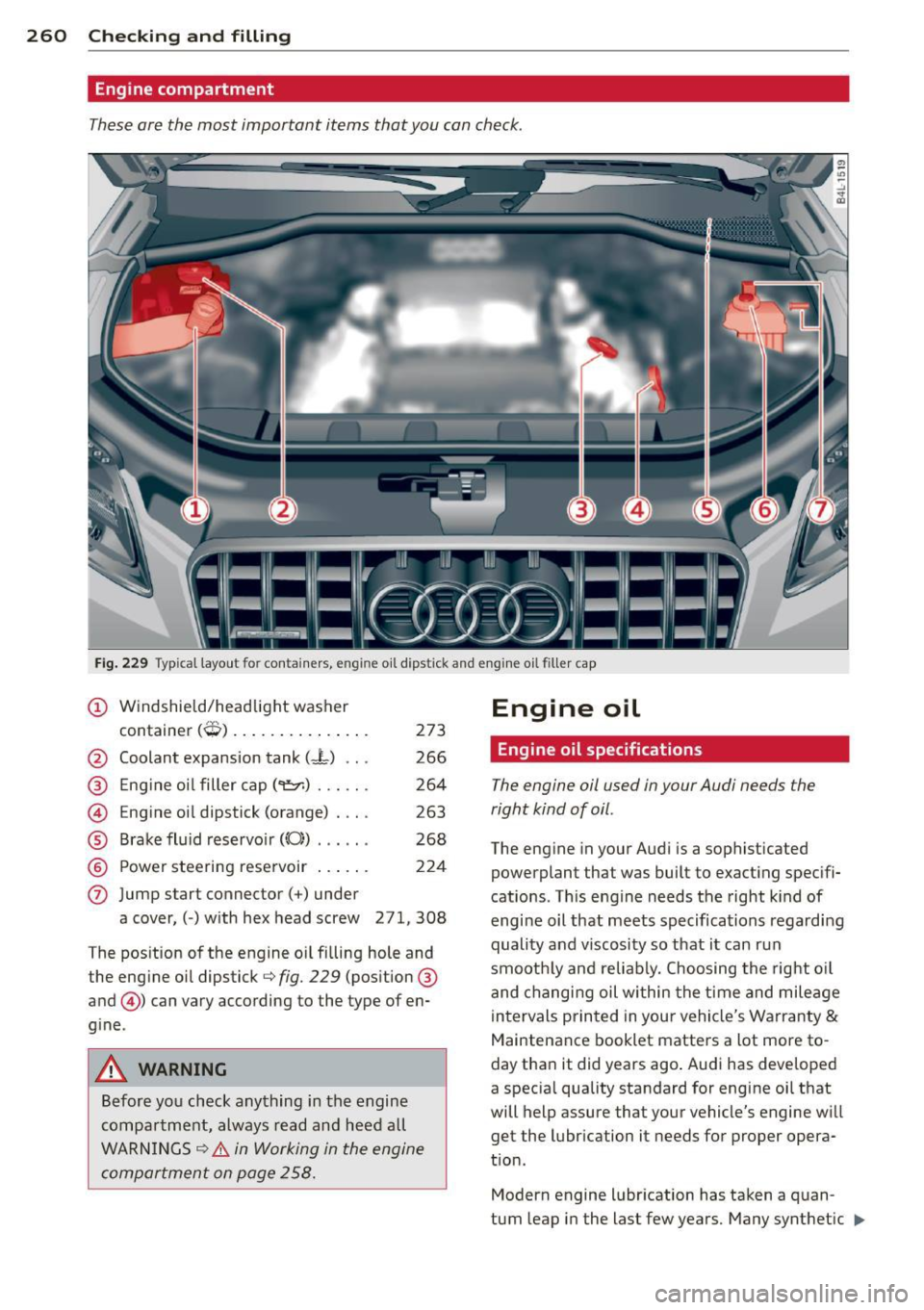
Engine compartment
These are the most important items that you can check .
Fig. 229 Typical layout for containers, engine oil di pstick and engin e oil fille r cap
(D W indshield/head light washer
t . (
;R ) con ainer ,.... .............. .
@ Coolant expansion tank (-L) .. .
@ Engin e oi l filler cap ('t".:r.) . .. .. .
©
®
®
(j)
Eng ine oil dipstick (orange) . .. .
Brake fluid reservoir
((0)) ..... .
Power steering reservoir ... .. .
Jump start connector( +) under 273
266
264
263
268
224
a cover,( ·) with hex head screw 271,308
The pos ition of the engine o il fi lling hole and
the engine oil dipstick
r=;, fig. 229 (position ®
and @) can vary according to the type of en
gine .
_&. WARNING
Before you check anything in the engine
compartment, always read and heed all
WARNINGS ¢.&.
in Working in the engine
c omportment on page 258.
-
Engine oil
Engine oil specifications
The engine oil used in your Audi needs the
right kind of oil.
The engine in your Audi is a sophist icated
powerplant that was built to exacting specifi
cations. Th is engine needs the right kind of
engi ne oil that meets specifications regard ing
quality and v iscosity so that it can run
smooth ly and reliab ly. Choosing the right oil
and changing oil within the time and mileage
intervals printed in your vehicle's Warranty
&
Maintenance booklet matters a lot more to
day tha n it did years ago . Audi has developed
a spec ia l quality standard for eng ine oil that
will help assure that your vehicle's engine w ill
get the lubr ication it needs for proper opera
t ion .
Modern engine lubr ication has taken a quan
tum leap in the last few years. Many synthetic "'
Page 263 of 342
oils available today provide better engine lu
brication that can outlast traditional petrole
um-based oils, making them a smart choice
for use throughout the life of your Audi.
Whether you use synthetic or petroleumbased engine oil, the oil that you use must
conform to Audi's oil quality standard
VW 502 00 (vehicles with gasoline engine) or VW 507 00 (vehicles with diesel engine) to
help keep your vehicle's engine running
smoothly and help prevent the formation of harmful deposits , sometimes called "sludge,"
that over time can lead to expensive repairs.
At the time of printing, engine oils available in
the U .S . and Canada that meet the exacting
specifications of Audi oil standard VW 502 00 (vehicles with gasoline engine) or VW 507 00
(vehicles with diesel engine) are synthetic en
gine oils. This does not mean, however, that
every synthetic engine oil will meet Audi oil
standard VW 502 00 (vehicles with gasoline
engine) or VW 507 00 (vehicles with diesel
engine). So always be sure that you use an ap
proved oil.
To help prevent the formation of harmful de posits use only oil with the following specifi
cations printed on the oil container :
-Audi oil standard VW 502 00 (gasoline en
gine)
- Audi oil standard VW 507 00 (diesel en-
gine)
Oil container labels may carry the specifica
tion singly or in combination with other desig
nations and oil quality standards.
Viscosity
Engine oils are graded according to their vis
cosity . The proper viscosity grade oil for your
engine depends on climactic or seasonal con
ditions where you drive. You can use oil with a
viscosity grade of SAE SW40 ac ross all tem
perature ranges for normal driving conditions.
However, if engine oil viscosity grade SAE
SW40 is not available, you can also use viscos
ity grade SAE SW-30 or SAE OW-40 as long as
it meets Audi oil quality standard VW 502 00
Checking and filling 261
(vehicles with gasoline engine) or VW 507 00
(vehicles with diesel engine) specifications.
Because engine oil that meets the Audi oil
standard may not be available everywhere
when you need it, we strongly recommend
that you always carry with you an extra quart (liter) of oil that expressly conforms to the
VW 502 00 (vehicles with gasoline engine) or
VW 507 00 (vehicles with diesel engine) spec
ification, in case you have to top
off the oil
while on the road.
Applies to vehicles with gasoline engine on
ly: Only if the level of the oil is at or below the
minimum mark on the oil dipstick -and no oil
that expressly conforms to Audi oil standard
VW 502 00 specificat ions is available - may
you top
off with a high quality engine oil, pref
erably synthetic-based, that meets ACEA A3
or API SM specifications, but even then, only in viscosity grades SAE SW-40, SAE SW-30, or
SAE OW-40 . However, during the entire time
between oil change intervals, never top off
with more than a total of 0.5 qt/liter engine
oil that does not conform to Audi oil specifica
tion VW 502 00.
Applies to vehicles with diesel engine only:
Only if the level of the oil is at or below the
minimum mark on the oil dipstick - and no oil
that expressly conforms to Audi oil standard
VW 507 00 spec ifications is available - may
you top
off with a high quality engine oil, that
meets ACEA C3 or API CF specifications, but
even then, only in viscosity grades SAE
5W-40, SAE 5W-30, or SAE OW-40. However,
during the entire time between oil change in
tervals, never top off with more than a total
of 0 .5 qt/liter engine oil that does not con
form to Audi oil specification VW S07 00.
For more information about engine oil that
has been approved for your vehicle, please
contact either your authori zed Audi dealer or
Audi Customer Relations at 1 (800) 822-2834
or visit our web si te at www.audiusa .com or
www .audicanada .ca. Here you will also find a
current list of oils (manufacturers, brand
names etc.) that conform to Audi oil standard
lilJJ,,
•
•
Page 264 of 342
262 Checking and filling
VW 502 00 (vehicles with gasoline engine) or
VW 507 00 (vehicles with diese l engine).
C hanging the engine oil
The engine oil and o il fil te r must be changed
according to the m ileage (ki lomete rs) and
time inte rva ls spe cified in your vehicle 's War
ra nty
& Main ten ance booklet. Do not ex ceed
these in tervals - harmful depos its from ol d
engine o il can reduce engine performance an d
can lead to expensive engi ne re pairs.
C hanging the o il at th e recommen ded i nte r
v al s is so very impor tant because t he lub ric at
ing p roperties o f oi l decrease gra dually du ring
norma l vehicle use . If you are not sure when
you have yo ur oil changed, ask yo ur aut ho r
i z ed A udi Service Advisor.
Unde r some ci rc u ms tances the engine o il
should even be change d mo re frequently .
C hange o il more often if you drive mostly
short d istances, ope rate the vehicle in d usty
areas or mostly under stop-and-go traffic con
d it ions, or when you use your veh icle w he re
tem peratures stay below freez ing poin t fo r
l ong periods .
Detergent addit ives i n the o il w ill make fresh
oil look dark after the eng ine has been run
ni ng fo r a shor t time . This is no rma l and is not
a reason to change the o il mo re often tha n
r e co m men ded.
Damage or malfunctions due to lack of
maintenance
It is essential that yo u change your oil at the
recommended interva ls using only engine o il
that complies with Audi oi l standard
VW 502 00 (vehicles wi th gasoli ne e ngine) or
VW 507 00 (ve hicles with diese l engi ne) . Yo ur
Li m ite d N ew Vehicle Warranty does no t cove r
d am age or m alfu ncti ons due to f ailure to fol
l ow recommended main tenance and use re
q uir ements as set forth in the A udi Owne r's
M anual a nd Warra nty
& M aintenance book let.
Your dea ler will have to deny war ranty cover
age un less yo u present to the dea le r proof in
the f orm of Service or Repa ir Orders that a ll scheduled mai
ntenance was perfo rme d in a
t imely man ne r.
Engine oil consumption
To prov ide effective l ubr ication and cooling for
i nter na l eng ine parts, a ll interna l combustion
engi nes use some o il. Oil consumption va ries
from eng ine to engi ne and may cha nge over
t h e life of the engine. Engines tend to use
more o il du ring t he b reak-in pe riod tha n they
do afterwa rd, w hen oil c onsum ption ha s sta
b ilized. Dependi ng on the w ay the vehicle is
driven and the operati ng conditions, oil con
s u mption can be up to 1 q uart per 1, 200
miles (1 liter per 2,000 km) . Consumption
may be higher within the first 3,000 m iles
(5,000 km) .
Un der normal con ditions , the rate o f oi l con
s u mption depen ds on o il quality as well as vis
cosity, engine spee d (rpm), outs ide tempera
ture, road conditions, the amount of oil dil u
t io n caused by condensed water or fue l resi
du e, and ox ida tion of the o il. Oil co nsu mp tion
may incr eas e with eng ine w ear ov er time, un
t il repl acemen t of w orn en gine p arts may be
co me ne ce ssar y.
B eca use of all thes e var iables , there is no
sta nda rd o r "n orma l" ra te of o il cons umption .
We urge you to check the engine oil level at
regular intervals, preferably every time you
fill the fuel tank, and always before a long
trip.
The oil pressure warning light. i s not an
indicator of low engine oil level. If the warn
ing light does not go out after starting, or
flashes while driving (above 1500 rpm), a
buzzer will sound. It indicates that the oil
pressure is too low . Stop the engine immedi·
ately, check the engine oil level and add oil if
necessary. If the engine oil level is normal,
but the light continues to flash, do not keep
driving or let the engine idle, as damage may
occur .
II-
Page 265 of 342
If you be lieve your engine uses too much oil,
w e recommend that you consult your author
ized Audi dealer so that the cause of your con
cern can be properly diagnosed . Keep in mind
that accurate measurement of oil consump
tion requires great care and may take some
time . Your Aud i dealer has instruct ions for
how to measure oil consumption accurately .
_& WARNING
Stop! Before work ing in the engine com
pa rtment, always read and heed all WARN
INGS
¢ .& in Working in the engine com
partment on page 258.
The engine com
partment of any motor ve hicle is
a poten
tially dangerous area and can cause ser i
ous pe rsonal injury.
(D Note
- The eng ine depends on oi l to lubr icate
and cool a ll of its moving parts . The en
gine o il m ust be checked regu larly and
kept at the required leve l.
- Make it a habit to have the engine oil lev
el checked every time you fill the fuel
tank.
- Too little engine oil may ca use severe en
gine damage.
Checking the engine oil level
The dipstick indicates the engine oil level.
Fig. 230 Ill ust rat io n of principle 1: Markers on o il dip
s tick
Checkin g and fillin g 263
Fig . 231 Il lust rati on of p rin ciple 2: Ma rke rs o n oil d ip
stick
Before you check anyt hing in the engine com
partment,
alway s read a nd heed all WARN
INGS ¢ A in Working in the engine compart
ment on page 258 .
Determining oil level
.,. Park yo ur vehicle so that it is horizonta lly
level.
.,. While at operating state tempe rature,
briefly let the engine run at idle and then
shut it off.
.,. Wait approx. two minutes.
.,. Pull out the oil dipstick . W ipe off the oil
d ipstick with a clean cloth, and sl ide it back
in as far as it w ill go.
.,. Pull it back out and read off the o il level
r=> fig. 230 or r=> fig. 231. Top off the eng ine
oil, if applicable ¢
page 264 .
Oil level within range (v
.,. Do not add oil.
Oil le ve l within range@
.,. You can add oil. Afterwards, the oil leve l
sh ould be within range@.
Oil le vel within rang e 0
.,. Yo u must add oil. Afterwards, the oil leve l
should be within range @.
T he oil leve l needs to be checke d at regu lar in
terva ls. The best t imes to do this are whenev -
er you refuel and prior to long trips.
Depend ing o n the way the vehicle is dr iven
and the ope rat ing cond it ions, o il co nsumption
can be up to 1 q uart per 1,200 mi les ( 1 liter
Ill>