brake AUDI Q7 2012 Owner´s Manual
[x] Cancel search | Manufacturer: AUDI, Model Year: 2012, Model line: Q7, Model: AUDI Q7 2012Pages: 342, PDF Size: 86.42 MB
Page 234 of 342

232 Driving o ff road
Driving off road
Driving in difficult road
conditions and offroad
General information
The operation of the E lectronic Stability Con
trol (ESC) is expanded for operation away
from paved roads. In situations where slip or a
d ifferential locking function is required, the
ESC offroad mode can be act ivated
c::;, page 219 . Hill descent control is also availa
ble in the ESC offroad mode, which automati
cally b rakes the vehicle and thereby keeps
speed constant when diffe rent wheel speeds
a re detected when descending a hill
c::;, page 220. Your Audi also has permanent
a ll-whee l drive in addition.
H oweve r, your Aud i is not a pure off road vehi
cle .
It was no t built for d riving unde r extreme
conditions, e .g. fo r trips that are in the natu re
of an expedit ion .
Dri ve only on road s and offroad section s
which match the de sign of y our vehicl e and
y ou r abilitie s as a dri ver. Never take risks!
Before driving offroad
- Check the eng ine oil level, ti re p ressu re ,
coolant level , and the fluid level in the w ind
shield washe r reservo ir.
- Stow luggage items and o ther objects in the
luggage compartment, and secure t hem
against s liding aro und .
After driving offroad
- After trips offroad, remove any twigs and
othe r foreign objects from the grill, the un
derbody and the wheels. Pay spec ia l atten
t ion to fo re ign objects (stones) which have
be come lodged in the tire tread.
- Clean t he body a nd the veh icle unders ide,
and in spec t the veh icle for poss ible damage.
- Clean dirty w indows , headlamp lenses , rear
l ights, and li cense plates .
- Perfo rm a brake check (part icularly after
t ravel ling th rough water) .
A WARNING
-Drive especially attentively and plan
a head in d iff icu lt road conditions and
when off road. Excessive speed o r inco r
rect maneuvers can cause injuries and
damage to the vehicle.
-
- Always adapt your speed and driving
style to road, offroad, t raff ic, and weat h
er cond itions. Drive e specially slowly off
ro ad when you r view is res tricted.
- Please be awa re that in ESC off road
mo de, particularly on a smoo th and s lip
pe ry road, the wheels may have an in
crease d tendency to sp in and the vehicle
may b reak away - danger of skidding!
- Stabili ty is limited in the ESC off roa d
mode .
@) For the sake of the environment
Avoid damage to t he environmen t an d re
s pect na tu re .
(D Tips
Only d rive w here it is permitte d and stay
on marked road s and pat hs.
Explanation of some technical terms
The following data refe r to ideal cond itions.
Depend ing on veh icle load and gro und condi
tions and the environment, the numbers may
vary. It is the driver's responsibility to decide
whether a vehicle can overcome a specific s it
uat io n
c::;, ,&. .
Gradient angle
The number of meters in alt itude ga ined over
a distance of 109.4 yards or 100 meters
(grade) are given as a percentage or degrees.
Information about the gradient the vehicle
can climb under its own power (depends in
part on the road surface and engine power) .
Max imum pe rm itt ed grade : 3 1
°
Later al angle (slope of vehicle )
Indicates the angle up to which the vehicle
can be driven diagonally or across the fall line ..,.
Page 236 of 342
234 Driving off road
If the vehicle threatens to tip over when
driving across a slope, you must immediate
ly steer downhill in the di rection of the
slope.
D o not par k your veh icle on steep slopes or
g rades .
T o reduce t he risk of tippi ng over, dr ive o n
slopes in the d irection o f the downwa rd slope
(fa ll line) -
not cros swise .
A WARNING
After drivin g through wate r, m ud, slush ,
etc ., the brakes may be slow to take effect
because of wet brake roto rs and pads. Dry
the brakes f irst by braking carefully to re
sto re the full braking effect.
-
(D Note
Vehicle components s uch as the engine,
transmiss io n, suspension or elect rical sys
tem can be severely damaged by drivi ng
thr ough wat er.
(1) Tips
- Check the depth of the wate r before dr iv
i ng th rough it.
- Do not stop the veh icle, dr ive in reverse
or switc h the engine off whe n driving
t hr ough water .
- Keep in mind that oncoming vehicles may create waves that raise t he water
l eve l a nd make it t oo deep fo r yo ur vehi
cle to dr ive th rough safely.
- Avoid dr iving thro ugh salt water because
i t can ca use corrosion.
Page 237 of 342

Trailer towing Driving with a trailer
General information
Your Audi was designed primarily for passen
ger transportation .
If you plan to tow a trailer, p lease remember
that the additional load will affect durability,
economy and performance .
Trailer towing not on ly places more stress on
the vehicle, it also calls for more concentra
tion from the driver.
F or this reason, always fo llow the operating
and driving instructions provided and use
common sense.
(D Note
If you are going to tow a trai ler, you must
activate the trailer operation mode
q page 154, Towing a trailer.
Technical requirements
Traile r hitch
Use a weight-carrying hitch conforming to the
gross trailer weight. The hitch must be suita ble for your vehicle and trailer and must be
mounted securely on the vehicle's chassis at a
technically sound location. Use only a trailer
hitch with a removable ball mount. A lways
check with the trai ler hitch manufacturer to
make sure that you are using the correct
hitch.
Do not use a bumper hitch.
The hitch must be installed in such a way that
it does not interfere with the impact-absorb
i ng bumper system. No mod ifications should
be made to the vehicle exhaust and brake sys
tems . From time to time, check that all hitch
mounting bo lts remain securely fastened.
When you are not towing a trailer, remove the
trai ler hitch ball mount. This prevents the
hitch from causing damage should your veh i
cle be struck from behind~.&.
Trailer towing 235
Trailer brakes
If your trailer is equipped with a brak ing sys
tem, check to be sure that it conforms to all
regulations.
T he trailer hydraulic bra ke system must not be
directly connected to the vehicle's hydraulic
brake system
q .& .
Safety chains
Always use safety chains between your veh icle
and the trai le r.
Trailer lights
Trailer lights must meet all regulations. Be
sure to check with your authorized Audi dealer
for correct wiring, sw itches, and relays.
M irr ors
If you are unable to see the traffic behind you
using the regular outside mirrors, then you
must install extended mirrors.
It is important
that you always have clear v is ion to the rear.
_&. WARNING
- If a trailer has electrical brakes please
note that these brakes are not activated
by the factory-fitted control unit -risk of
accident!
- After removing the trailer hitch, do not
store it in you r vehicle. In case of sudden
brak ing, the hitch could fly forward and
injure you or your passengers.
- The Gross Vehicle Weight Rating for your
Audi Q7 vehicle, found on the safety
compliance labe l on the driver's side 8 -
pillar, must never be exceeded under any
circumstances. Exceeding the Gross Vehi
cle Weight Rating of your vehicle is likely
to damage your veh icle, and such dam
age will not be covered by your Limited New Vehicle Warranty. Exceeding the
Gross Vehicle Weight Rat ing will a lso
change the performance and handling
characteristics of your vehicle, which
could cause a crash resulting in serious
injury or death.
-
•
•
Page 238 of 342
236 Trailer to wing
-The Gross Vehicle Weight Rating for yo ur
Audi Q7 would be exceeded if your vehi
cle is simultaneously equ ipped w ith Pan
oramic sl iding sunroof; th ird-row seat
ing; trailer towing equipment (factory or
dealer-installed), and running boards
(dea le r-installed) . UNDER NO C IRCUM
STANC ES MAY AL L SUC H ITE MS BE IN
STALLED ON THE SAM E VEH ICLE.
Operating instructions
MAX 6 .9 "
MAX175mm
E
"' E
"' .... a)
rt
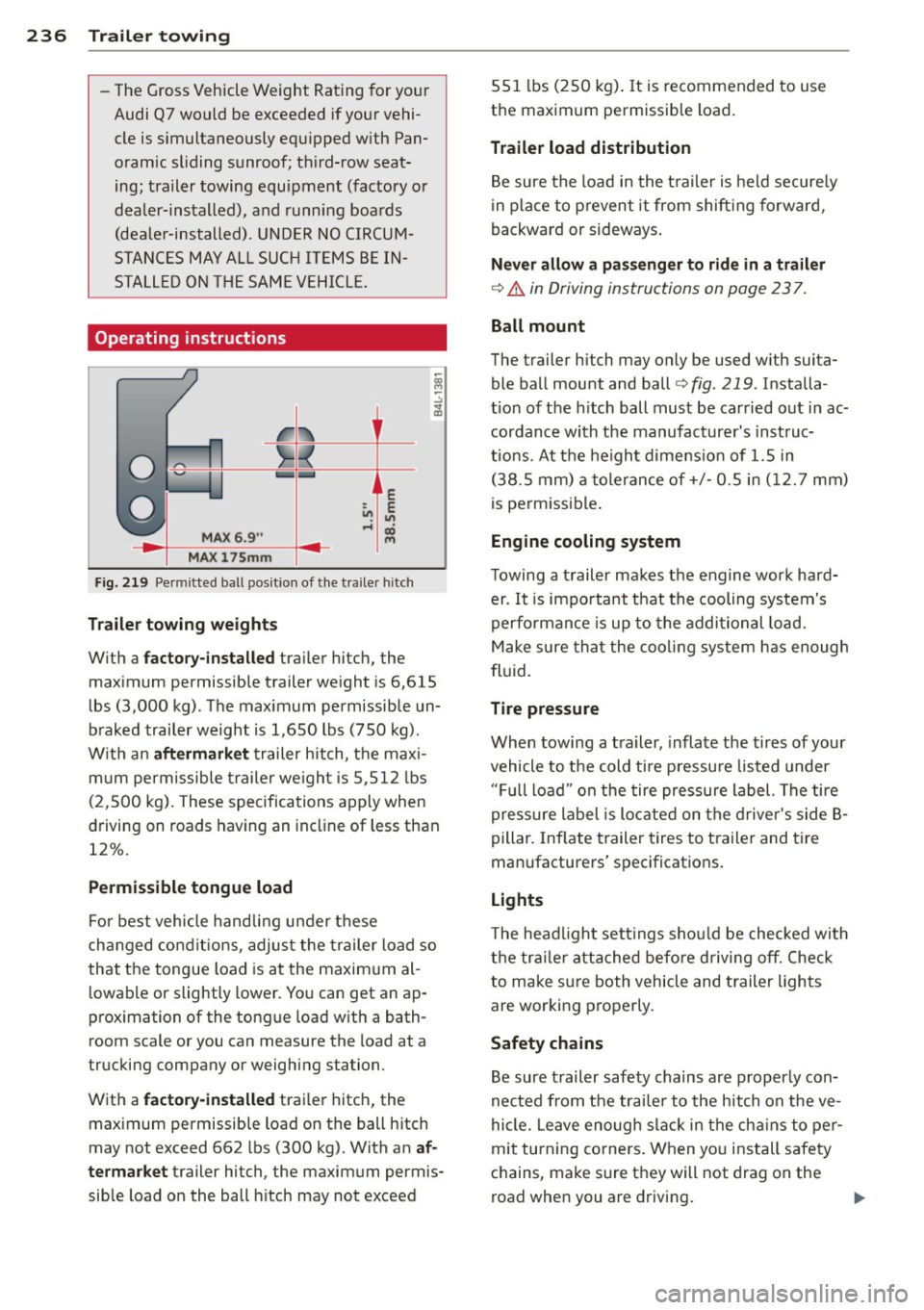
Fig. 219 Permi tted ball p osit ion of the t ra iler hitc h
Traile r to wing we ight s
W it h a fac tor y-ins talled trailer hitch, the
maximum permissible trailer we ight is 6 ,615
lbs (3,000 kg) . The maximum permissible un
braked trailer weight is 1,650 lbs (750 kg) .
W ith an aft er mar ket trailer hitch, the maxi
m um permissible trailer we ight is 5,512 lbs
(2,500 kg) . These specifica tions apply when
driving on roads having an incline of less than
12%.
Perm issible tongue load
F or best vehicle handli ng u nder these
changed condit ions, adjust the trailer load so
that the tongue load is at the maxim um al
l owable or slightly lower. Yo u can get an ap
proximation of the tongu e load with a bath
room scale o r you c an measu re the load at a
trucking company or weighing s ta tion.
With a factory-in stalled trailer hitch, the
maximum permissib le load on the ball hitch
may not exceed 662 lbs (300 kg). With an af
termarket trailer hi tch, the maximum permis
sib le load on the ball h itch may not exceed 551
lbs (250 kg) . It is recommended to use
the maximum permissible load.
Trailer load distribution
Be sure the load in the t ra iler is held secure ly
in place to prevent it from shift ing forward,
backward or sideways.
Nev er allow a pas seng er t o rid e in a trai ler
¢&. in Driving instructions on page 23 7.
Ball m ount
The trailer hi tch may only be used w ith suita
ble ball mount and ball¢
fig. 219 . Installa
tion of the h itch ball must be carried out in ac
cordance with the manufacturer's inst ruc
tions . At the height dimens ion of 1.5 in
(38 .5 mm) a tolerance of+/- 0.5 in ( 12. 7 mm)
is permissible .
Engine cooling system
Towing a trailer makes the engine work hard er . It is impo rtant that the cooling system's
performance is up to the additional load.
Make sure that the cooling system has enough
fluid.
T ire pressur e
When towing a trailer, inflate the tires of your
vehicle to the cold ti re pressu re listed under
" F u ll load" on the tire pressure label. The tire
pressure label is located on the drive r's side B
pillar . Inflate trailer tires to t railer and tire
manufacturers' specifications.
Lights
T he headlight settings should be checked wi th
t h e trai ler attached before d riving
off. Check
to make s ure both vehicle and trailer lights
are worki ng properly.
Safety chains
Be sure trailer safety chains are properly con
nected from the trai le r to the hitch on the ve
hicle. Leave enough slack in the ch ains to pe r
mit turning corners. When you install safety
chains, make sure they will not drag on the
road when you are driving. ..,.
Page 239 of 342
The chains should cross under the trai ler
tongue to prevent it from dropping in case of
separation from the hitch.
([) Note
If you are going to tow a trai le r, you must
activate the trailer operation mode
¢ page 154, Towing a trailer.
Driving instructions
Driving with a trailer always requires extra
care and consideration .
To obtain the best poss ible handling o f vehicle
and trai ler, p lease note the following:
~ Do not tow a loaded trailer whe n your car it
self is not loaded.
~ Be especially careful when passing other ve
hicles.
~ Observe speed limits .
~ Do not drive at the maximum permissible
speed .
~ Always apply brakes early.
~ Monitor the temperature gauge .
Weight distribution
Towing a loaded trai ler with an empty car re
sults in a highly unstable distribution of
weight . If this cannot be avoided, drive at very
low speeds only to avoid the risk of losing
steering control.
A "balanced" rig is easier to operate and con
trol. This means that the tow vehicle should be loaded to the extent possible and permissi
ble, wh ile keeping the trailer as light as poss i
ble under the circumstances . Whenever possi
b le, transfer some cargo to the luggage com
partment of the tow vehicle wh ile observing
tongue load requirements and vehicle loading
considerations.
Speed
The higher the speed, the more difficult it be
comes for the drive r to control the rig. Do not
drive at the maximum permissible speed. Re
duce your speed even more if load, weather or
Trailer towing 237
wind conditions are unfavorable -pa rticularly
when going downhill.
Reduce veh icle speed
immediately if the trail
er shows the slightest s ign of sway ing .
Do not
try to stop the swaying by accelerating.
Observe speed limits. In some a reas, speeds
for vehicles tow ing tra ilers are lower than for
regular veh icles .
Always apply brakes early. When driving
down hill, shift into a lower gear to use the en
gine braking effect to s low the vehicle . Use of
the brakes alone can cause them to overheat
and fail.
Coolant temperature
The coolant temperature gauge¢ page 10
must be observed carefully. If the need le
moves close to the upper end of the scale, re
duce speed immediately and/or turn off the
air conditioner.
If the coolant temperature warning light in
the instrument cluster starts flashing ., pull
off the road, stop and let the engine
idle for
about two minutes to prevent heat build -up .
A WARNING ~
Anyone not properly restrained in a mov-
ing vehicle is at a much greater risk in an
accident. Never let anyone ride in your car
who is not properly wearing the restraints
prov ided by Audi.
Trailer towing tips
Important to know
Your vehicle handles differently when towing
-
a trailer because of the additional weight and
different weight distr ibution . Safety, perform
ance and economy will great ly depend on how
carefully you load your trailer and operate
your rig .
Before you actua lly tow your tra iler, practice
turning, stopping and backing up in an area away from traffic. Keep practicing until you
have become completely familiar w ith the way.,.
•
•
Page 240 of 342
238 Trailer towing
your vehicle-trai ler combination behaves and
responds.
Backing up is difficult and requires practice.
Backing up with a trailer genera lly requi res
steering action opposite to that when backing
up your vehicle without a trailer .
Maintain a greater distance between your ve
hicle and the one in front of you. You will need
mo re room to stop. To compensate for the
trai ler, you will need a larger than norma l
turning radius.
When passing, remember that you cannot ac
celerate as fast as you normally would be
cause of the added load. Make sure you have
enough room to pass. After passing, allow
plenty of room for your trai ler before chang
ing lanes again.
Avoid jerky starts, sharp turns or rapid lane
changes.
(D Tips
- Do not tow a trailer during the break-in
period of your vehicle.
- If you tow a trailer, you r A ud i may re
quire more frequent maintenance due to
the extra load
~page 319.
Parking on a slope
Do not pork on a slope with a trailer. If it can
not be avoided , do so only ofter doing the fol
lowing:
When parking:
.. Apply the foot brake .
.. Have someone place chocks under both the
vehicle and the trai ler wheels .
.. With chocks in p lace, slowly re lease the
brakes until the whee l chocks absorb the
load .
.. Turn the wheels towards the curb .
.. Apply the parking brake .
.. Move the selector lever to
P.
When restarting after parking:
.. Apply the foot brake .
.. Start the engine. ..
Move the selector lever to
D.
.. Release the parking brake and s low ly pull
out and away from the wheel chocks .
.. Stop and have someone retrieve the wheel
chocks .
(D Tips
If you move the selector lever of the auto
matic transmission to
P before applying
the parking brake and before blocking the
wheels, you may have to use more force later to move the lever out of the
P posi
tion.
Page 241 of 342
Cleaning and protect ion
General information
Regular core preserves vehicle value.
Any automobile is exposed to industrial
fumes , corrosive road salt, etc. A well cared
for Audi can look like new many years after purchase . Regu lar and correct care w ill con
tr ibute to maintaining the beauty and value of
your Aud i.
F u rth ermor e, good c are may be a conditi on
for subs tantiati ng a w arrant y claim sho uld
c orrosion d amag e or paint d efects oc cur.
Your authorized Audi dealer has a variety of
dedic ated veh icle-car e products and can ad
vise which ones to use for cleaning the exter i
or and interior of your vehicle.
Whether you use products recommended by
Aud i or other commercially available clean ing
agents, please make sure you apply them cor
rectly .
.&, WARNING
-Cleaning agents may be poisonous. Keep
them out of the reach of children.
- Heed all caut ion labels.
- Always read directions on the container
before using any product. Follow the di
rect ions carefu lly.
- Most chemical cleaners are concentrated
and have to be diluted .
- Use spot removing fluids only in well
ventilated areas.
- Do not use gasoline, kerosene, d iesel
fuel, nail polish remover or other volatile
fluids. They may be toxic, flammab le or
haza rdous in other ways. Do not wash,
wax or dry the vehicle with the ign it ion
on or the engine running.
- Do not clean the undersides of chassis,
fenders, wheel covers, e tc. w ithout pro
tecting your hands and arms. You may c u t yourself on sharp -edged metal parts .
Cleaning and protec tion 239
- Moisture and ice on brakes may impair
brak ing effic iency¢
page 222, General
information.
Test the brakes carefully
each time you wash the vehicle.
@) For the sake of the environment
Select on ly environmentally friend ly clean
i ng products . Leftover cleaning products
should not d isposed of in the household
waste.
Care of exterior
Washing
Frequent washing protects the vehicle .
The best protection against environmental i n
fluences is
frequent washing and waxing . How
often t his is required depends on:
- How much the veh icle is used
- Where the veh icle is parked (garage, in the
open under trees, etc.)
- The seasonal and weather conditions
- Environmental infl uences
T he longer b ird droppings, insects, tree resin,
road and indus tria l gr ime, ta r, soot, road salt
and other materials remain on the vehicle body, the more lasting their destructive ef
fects wi ll be . High temperatures caused by ex
posure to intense sun light intens ify the corro
s ive effect, particularly when humid ity is high
as well.
Under certain circumstances,
weekl y washing
may be necessary. Under other cond itions, a
monthly washing and waxing may be ade
quate .
After the winter, the underside of the vehicle
should be thoroughly washed, preferab ly in a
professional car wash .
.&, WARNING ,_
A lways read and heed all WARNINGS and
other information ¢
page 239.
•
•
Page 245 of 342
& WARNING
Always read an d heed a ll WARNINGS and
other information ¢
page 239.
Windows
Clear vision to all sides.
Clean all windows regularly to remove road
film and ca rwash wax bu ildup.
.,. Remove snow from windows using a brush .
.,. Use a plast ic ice scraper to remove ice from
windows and mirrors .
.,. Remove other res idue on the wi ndows with
a spray-on glass cleaner .
.,. Wipe the windows dry with a cle an p iece of
cloth o r kitchen paper towel.
The best way to remove snow from w indows
and mir rors is to use a b rush . U se a non -abra
sive
pla stic ice scra per -better still, a spray
deicer -to remove
ice from windows and mir
rors.
The window s m ust no t be cleaned wi th insect
r emover or wax s ince these can interfere wi th
the function of the windshield wipe r blades
(chatter) .
O il, g rease , or silicone residue can be removed
with
gla ss cleaner or silicone r emover. How
ever, wax residue req uires the use of a specia l
l y form ulated solvent. P lease contact yo ur au
thorized Audi dealer for adv ice on safe prod
ucts for wax removal.
Windows sho uld a lso be cleaned on the inside
at regular interva ls .
Never dry w indows w ith the same chamois
that you use to dry pain ted s urfaces. Wax resi
d ue on the chamois can impair vision thro ugh
the windows .
& WARNING
- Always read and heed all WARNINGS and
other information
¢ page 239.
-The windshie ld m ust not be treated with
water-repellent materials. They can in
crease glare under poor visib ility condi-
Cleaning and protec tion 243
tions such as wetness, darkness, or when
the sun is low on the hor izon. In addi
tion, they can cause the windshield wip
ers to chatter.
@ Note
- Never use warm or hot water to remove
snow and ice from windows and mirrors.
Th is could cause the glass to crack.
- To prevent damage to the wires of the
rear defogger, do not place any adhesive
st ickers on the ins ide of the rear w indow
over the wires.
- To help prevent dirt from scratching the
window, always scrape in a forward di
rection -pushing the sc raper away from
you -never back and forth.
Cast (light) alloy wheels
Cast (light) alloy wheels require special care .
.,. Wash the wheels with a sponge or hose
brush every other week.
.,. For deep cleaning afterwards, use only a
ded icated
acid-fre e cast alloy wheel cleaner .
.,. Rub a coat of
liquid wa x onto the rims every
three month. Be su re to rea ch and treat all
pa rts of the rim.
T o preserve the decorative appea rance of the
cast alloy wheels, some special care is neces sa ry. In addi tion to road d irt and salt, brake
dust is a lso co rrosive . If left on fo r too long,
brake d ust can cause pitting.
U se only spec ia l
acid-free cleaners formulated
for alloy r ims. Safe produc ts a re ava ilab le at
your aut ho rized Aud i dea le r. Neve r leave the
cleaner on the rims longer than specified on
the labe l. If not rinsed off promptly, the acid
contained in some cleaners can attack the
threads on the wheel bolts.
Never use abrasive o r metal po lish ing clean
ing agents . If the protective coating has been
c hi pped, e .g . by kicked up road dirt, to uch it
u p as soon as possible .
•
•
Page 246 of 342
24 4 Cl eaning and protec tio n
8_ WARNING
- Moisture and ice on brakes may affect
braking efficiency¢
page 222, Gen eral
information.
Test the brakes carefu lly
e ach time you wash the veh icle .
- Always read and heed all WARNINGS and
-
other information ¢ page 239.
Body cavity sealing
The body cavity sealing does not need to be
checked .
All body cavities wh ich could be affected by
corrosion have been thoroughly protected at
the factory.
This sealing does not require any inspection or
additional treatment. If any wax should seep
out of the cavity when the ambient tempera
ture is high, it can be removed with a plastic
scraper and a suitable solvent.
8_ WARNING , ~
Solvents can be dangerous .
- Benzine is flammable and toxic . If you
use benzine for removing the wax, keep
sparks, flame and lighted c igarettes
away. Never dump benzine on the
ground, into open streams or down sew
age drains.
- Be sure to observe all safety and env iron
menta l regulations. Follow all instruc
tions on the con tainer .
- Always read and heed all WARN INGS and
other information
¢ page 239 .
Chassis
Have the undercoating checked for damage
from time to time.
The lower body shell of your Audi is also thor
oughly protected against corrosion .
Any damage to the undercoating caused by road hazards should be repa ired promptly .
8_ WARNING
Too much undercoating in the wrong p la
ces can cause a fire.
- Do not apply additional undercoating or
rustp roofing on or near the exhaust
manifold, exhaust pipes, catalytic con
verter or heat shields. While driving, the substance used fo r undercoating could
overheat and cause a fire.
- Always read and heed all WARNINGS and
other info rmation ¢
page 239.
Exhaust tail pipes
Road salt and o ther co rrosive materials w ill
damage the material in the exhaus t tail pipes
i f they a re not cleaned regular ly . Do not clean
the tail pipes with wheel cleaner, paint polish, chrome polish or other abras ive cleaners .
Clean the tail pipes with car care products
that are suitable for sta inless steel.
Your a uthorized Audi dea ler can provide clean
ing products that have been tested and ap
proved for your vehicle .
Care of interior
MMI display
.,. Clean the MM I display wi th a soft clean
cloth and an LC D cleaner .
T he M MI display can be cleaned wit h a profes
s io nal ly availab le " LCD cleane r". The cloth
sho uld be slightly dampened with t he clean
ing fluid to clean the disp lay.
CIT) Note
To avoid sc ratching the M MI display, you
shou ld never clean it dry.
MMI control console
.,. First clean the MMI contro l conso le with a
brush to remove dust from the housing .
.,. Then wipe the MMI control console with a
clean, soft, slightly damp cloth. .,..
Page 261 of 342
-Apply the parking brake.
- Move selector lever to "P" (Park).
- Always let the engine cool down. Hot
components will burn skin on contact.
- To reduce the risk of being burned, never
open the hood if you see or hear steam
or coolant escaping from the engine
compartment. Wa it until no steam or
coolant can be seen or heard before care
fully opening the hood.
- Keep children away from the engine com
partment .
- Never spill fluids on hot engine compo
nents. They can cause a fire.
- Never touch the radiator fan. The auxili
ary electric fan is temperature controlled
and can switch on suddenly.
- Never open the coolant reservoir cap
when the engine is still warm. The cool
ant system is pressurized and hot cool
ant could spray out .
- Protect your face, hands and arm from
steam or hot engine coolant by placing a
thick rag over the cap when you open the
coolant reservoir .
- If work on the fuel system or the electri
cal system is necessary:
- Always disconnect the battery.
- Never smoke or work near heaters or
open flames. Fluids in the engine com
partment could start a fire.
- Keep an approved fire extinguisher im
mediately available.
- To avoid electrical shock and personal in
jury while the engine is running or being
started, never touch:
- Ignition cables
- Other components of the high voltage
electronic ignition system.
-If you must perform a check or repair
with the engine running:
- First, fully apply the parking brake,
move selector lever to "P" (Park).
Checking and filling 259
-Always use extreme caution to prevent
clothing, jewelry, or long hair from get
ting caught in the radiator fan, V-belts
or other moving parts, or from contact ing hot parts . Tie back hair before
starting, and do not wear clothing that
will hang or droop into the engine.
- Minimize exposure to emission and
chemical hazards
9 .&, .
&_ WARNING
California Proposition 65 Warning:
- Engine exhaust, some of its constituents,
and certain vehicle components contain
or emit chemicals known to the State of
California to cause cancer and birth de
fects and reproductive harm. In addition,
certain fluids contained in vehicles and
certain products of component wear con
tain or emit chemicals known to the
State of California to cause cancer and birth defects or other reproductive harm.
- Battery posts, terminals and related ac
cessories contain lead and lead com
pounds, chemicals known to the State of
California to cause cancer and reproduc
tive harms. Wash hands after handling .
(D Note
When adding fluids, always make sure that
they are poured into the proper container
or filler opening, otherwise serious dam
age to vehicle systems will occur.
@ For the sake of the environment
To detect leaks in time, inspect the vehicle
floor pan from underneath regularly. If
you see spots from oil or other vehicle flu
ids, have your vehicle inspected by an au
thorized Audi dealer. •
•