lock AUDI Q7 2013 Owner´s Manual
[x] Cancel search | Manufacturer: AUDI, Model Year: 2013, Model line: Q7, Model: AUDI Q7 2013Pages: 348, PDF Size: 87.72 MB
Page 304 of 348
302 What do I do now ?
plate. If this happens, the vehicle may
start to move while a wheel is being changed.
- Never use the folding chocks if they are
damaged or if they have not been assem
bled correctly.
A WARNING
Improper use of the vehicle jack can cause
ser ious persona l injuries.
- Never use the jack supplied with your
Audi on anothe r vehicle, particularly on a
heavier one. The jack is only suitable for
use on the vehicle it came w ith.
- Us ing a bumper jack to raise the vehicle
will damage the bump er system. The
jack may slip, causing in jury.
- Never support your veh icle on cinder
blocks, b ricks or other objec ts. These
may no t be ab le to suppor t the load and
c ou ld cau se injury whe n they fail.
- Never start o r run the engine while the
vehicle is supported by the j ack.
- If you must wo rk under the vehicle, al
ways use safety stands specifically de
signed for this purpose.
- Always make su re the inf latable spare
ti re and even a flat tire a re se cu red in
pla ce and not loose, otherwise t hey
c ou ld f ly forward, causing personal in jury
to passengers in the veh icle in an acc i
dent o r sudden mane uver.
Removing bass box
Applies to vehicles: with bass box
Before the inflatable spare tire can be taken
out, the bass box must be removed .
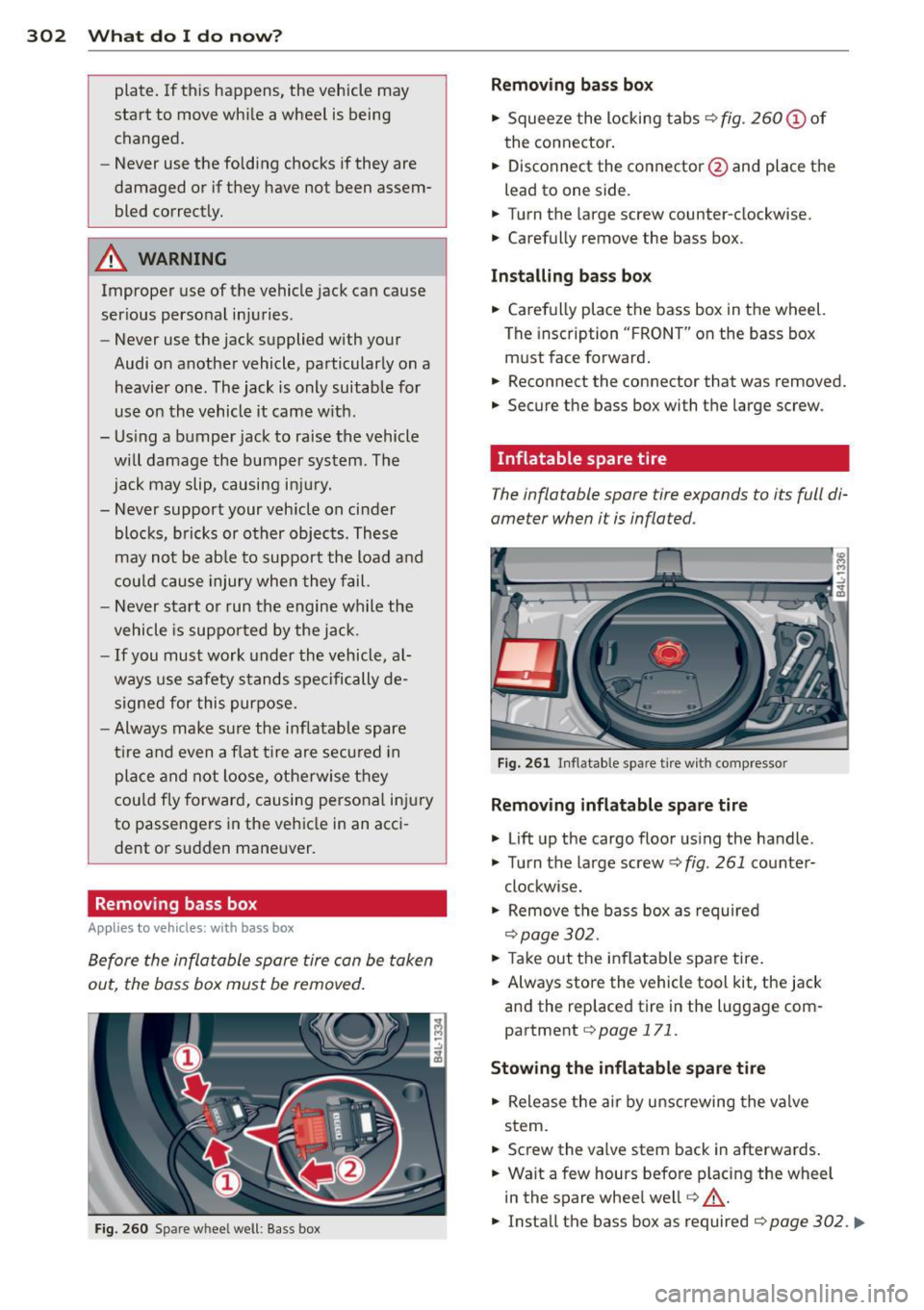
Fig. 260 Spare wheel well: Bass box
Removing bass box
" Squee ze the locking tabs ¢ fig. 260 (!) of
the connector .
" Disconnect the connector @and place the
lead to one side.
" Turn t he large screw counter-clockwise.
" Carefully
remove the bass box.
Installing bass bo x
" Carefully place t he bass box in the wheel.
The insc ription "FRO NT" on the bass box
m ust face forward .
" Reconnect the connector that was removed.
" Secure the bass box with t he large screw.
· Inflatable spare tire
The inflatable spare tire expands to its full di
ameter when it is inflated.
Fi g. 2 61 In flatable spare t ire w ith compressor
Removing inflatable spare tire
" Lift up the cargo floor us ing the handle .
" Tu rn the large screw¢
fig. 261 co unter-
clockwise.
" Remove the bass box as required
¢page 302.
" Take out the inflatable spare tire .
" Always sto re the vehicle tool kit, the jack
and the replaced tire in the luggage com
partment
¢page 171.
Stowing the inflatable spar e tire
" Release the air by unscrewing the valve
stem.
" Screw the valve stem back in afterwards .
" Wait a few hours befo re p lacing the wheel
in the spare whee l we ll
r=:, _.&.
" Install the bass box as required r=:, page 302 . ..,.
Page 306 of 348
304 What do I do now?
Changing a wheel
Before changing a wheel
Observe the following precautions for your
own and your passenger's safety when chang
ing a wheel .
• After you experience a tire failure, pull the
car well away from moving traffic and try to
reach
level ground before you stop ¢,& .
• All passengers should
leave the car and
move to a safe location (for instance, behind
the guardrail) ¢
A-
.. Engage the parking brake to prevent your
vehicle from rolling unintentionally ¢,& .
• Move
selector lever to position P <=> ,&.
• If you are towing a trailer: unhitch the trail
er from your vehicle.
• Block the diagonally opposite wheel wi th
the folding chocks or other objects.
• Take the
jack and the inflatable spare tire
out of the luggage compartment
¢page 301.
11. WARNING
=
You or your passengers could be injured
while changing a whee l if you do not fol
low these safety precautions :
- If you have a f lat tire,
move a safe dis
tance off the road . Turn off the engine,
turn the emergency flashers on and use
other warning devices to alert other mo
torists .
- Make sure that passengers wait in a safe
place away from the vehicle and well
away from the road and traff ic.
- To help prevent the vehicle from moving
suddenly and possibly slipping off the
jack, always fully set the parking brake
and block the wheel diagonally opposite
the wheel being changed with the fold
ing chocks or other objects. When one
front whee l is lifted off the ground, plac
ing the Auto mat ic Transmission in "P"
(Park) will
not prevent the vehicle from
moving .
-
-Before you change a wheel, be sure the
ground is level and firm. If necessary,
use a sturdy board under the jack.
- After installing the inflatable spare tire,
make sure that you replace the flat tire/
wheel in its storage area properly and
tighten the knurled retaining screw se
curely .
' Changing a wheel
When you change a wheel , follow the se
quence described below step-by-step and in
exactly that order .
l. Activate the vehicle jack mode (only
vehicles with Adaptive Air Suspension)
¢ page 159.
2. Remove the decorative wheel cover* . For
more details see also ¢
page 305, Deco
rative wheel covers
or ¢ page 305,
Wheels with wheel bolt caps.
3. Loosen the wheel bolts¢ page 305.
4. Locate the proper mounting point for the
jack and align the jack be low that point
¢ page 306.
5. Lift the car with the jack¢ page 306.
6. Remove the wheel with the flat tire and
then install the
inflatable spare tire
¢page 307 .
7. Tighten all whee l bolts lightly.
8.
Lower the vehicle with the jack .
9. Use the wheel bolt wrench and
firmly
tighten all wheel bolts¢ page 305.
10. Rep lace the decorative wheel cover*.
11. Deactivate the vehicle jack mode (only
vehicles with Adaptive Air Suspension)
¢page 159.
A WARNING
Always read and follow all WARNINGS and
inf ormat ion¢ .&.
in Raising the vehicle on
page
307 and ¢page 308.
Page 308 of 348
306 What do I do now?
Loosening
.,. Install the wheel bolt wrench over the
wheel bolt and push it down as far as it will
go .
.,. Take tight hold of the
end of the wrench
handle and turn the wheel bolts
counter
clockwise
about one single turn in the direc
tion of arrow
c:> fig. 264.
Tightening
.,. Install the wheel bolt wrench over the
wheel bolt and push it down as far as it will
go .
.,. Take tight hold of the
end of the wrench
handle and turn each wheel bolt
clockwise
until it is seated .
A WARNING
- Do not use force or hurry when changing
a wheel - you can cause the vehicle to slip
off the jack and cause serious personal
injuries.
- Do not loosen the wheel bolts more than
one turn
before you raise the vehicle with
the jack. - You risk an injury.
@ Tips
If a wheel bolt is very tight, you may find it
easier to loosen by carefully pushing down
on the end of the wheel bolt wrench with
one foot only. As you do so, hold on to the
car to keep your balance and take care not
to slip.
Raising the vehicle
The vehicle must be lifted with the jack first
before the wheel can be removed.
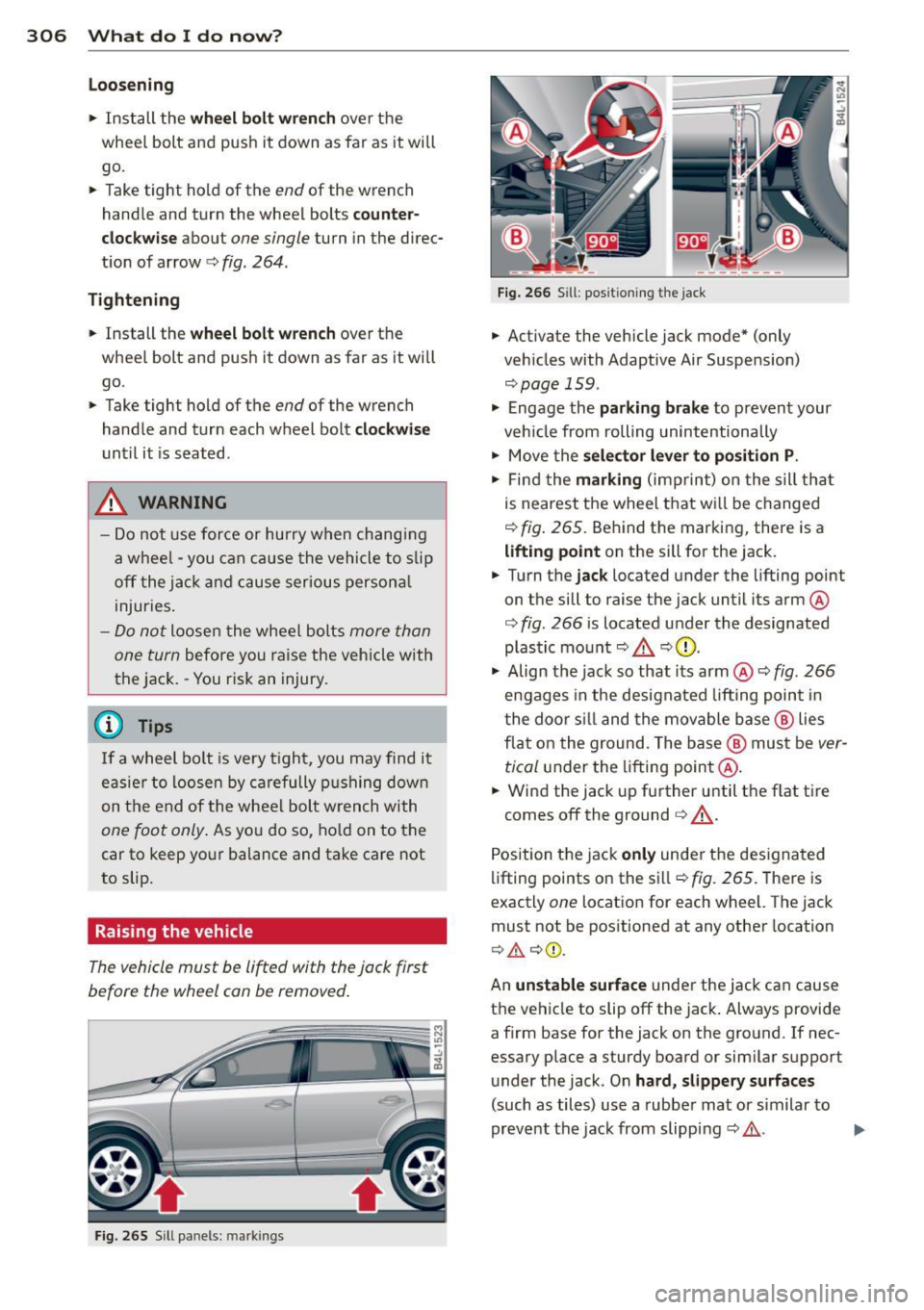
Fig. 265 Sill pane ls: mar kings
Fig. 266 Sill: posit ioning the jack
.,. Activate the vehicle jack mode* (only
vehicles with Adaptive Air Suspension)
<::> page 159 .
.,. Engage the parking brake to prevent your
vehicle from rolling unintentionally
.,. Move the
selector lever to position P .
.,. Find the marking (imprint) on the sill that
is nearest the wheel that will be changed
<=>
fig. 265. Behind the marking, there is a
lifting point on the sill for the jack.
.,. Turn the
jack located under the lifting point
on the sill to raise the jack until its arm@
<=>
fig . 266 is located under the designated
plastic mount<=>
& c::>(D .
.,. Align the jack so that its arm @ c::> fig. 266
engages in the designated lifting point in
the door sill and the movable base® lies
flat on the ground. The base @ must be
ver
tical
under the lifting point@.
.,. Wind the jack up further until the flat tire
comes off the ground
c:> ,& .
Position the jack only under the designated
lifting points on the sill
<=>fig . 265. There is
exactly
one location for each wheel. The jack
must not be positioned at any other location
<=>
.&. <=> CD .
An unstable surface under the jack can cause
the vehicle to slip off the jack. Always provide
a firm base for the jack on the ground. If nec
essary place a sturdy board or similar support
under the jack . On
hard, slippery surfaces
(such as tiles) use a rubber mat or similar to
prevent the jack from slipping
c:> ,&.. liJI,
Page 309 of 348

_& WARNING
-You or your passengers could be injured
while changing a wheel if you do not
follow these safety precautions:
- Position the jack only at the designated
lifting points and align the jack. Other
wise, the jack could slip and cause an
injury if it does not have sufficient hold
on the vehicle.
- A soft or unstable surface under the
jack may cause the vehicle to slip off the jack. Always provide a firm base for
the jack on the ground. If necessary,
use a sturdy board under the jack.
- On hard, slippery surface (such as tiles)
use a rubber mat or similar to prevent
the jack from slipping .
- To help prevent injury to yourself and
your passengers:
- Do not raise the vehicle until you are
sure the jack is securely engaged.
- Passengers must not remain in the ve
hicle when it is jacked up.
- Make sure that passengers wait in a
safe place away from the vehicle and
well away from the road and traffic.
- Make sure jack position is correct, ad
just as necessary and then continue to
raise the jack.
(D Note
Do not lift the vehicle by the sill. Position
the jack only at the designated lifting
points on the sill. Otherwise, your vehicle
will be damaged.
What do I do now? 307
Taking the wheel off/installing the inflatable spare tire
Follow these instructions step-by-step for
changing the wheel
Fig. 267 Chan gin g a w hee l: alignment p in inside the
to p ho le
After you have loosened all wheel bolts and
raised the vehicle off the ground, remove and
replace the wheel as follows :
Removing the wheel
.. Remove the topmost wheel bolt completely
and set it aside on a
clean surface.
.. Screw the threaded end of the
alignment
pin from the tool kit hand-tight into the
empty bolt hole
~ fig . 267.
.. Th en remove the other wheel bolts as de
scribed above.
.. Take off the wheel leaving the alignment
pin in the bolt hole
~ 0.
Putting on the inflatable spare tire
.. Inflate the inflatable spare tire ~ page 303
and push the wheel over the alignment pin.
.,. Screw in and tighten all wheel bolts
slight
ly.
.. Remove the alignment pin and insert and
tighten the remaining wheel bolt slightly
like the rest .
.. Turn the jack handle counter-clockwise to
lower the vehicle until the jack is fully re
leased .
.,. Use the wheel bolt wrench to tighten all
wheel bolts firmly ~
page 305. Tighten
them
crosswise, from one bolt to the (ap
proximately) opposite one, to keep the
wheel centered.
Page 312 of 348
310 Fuses and bulb s
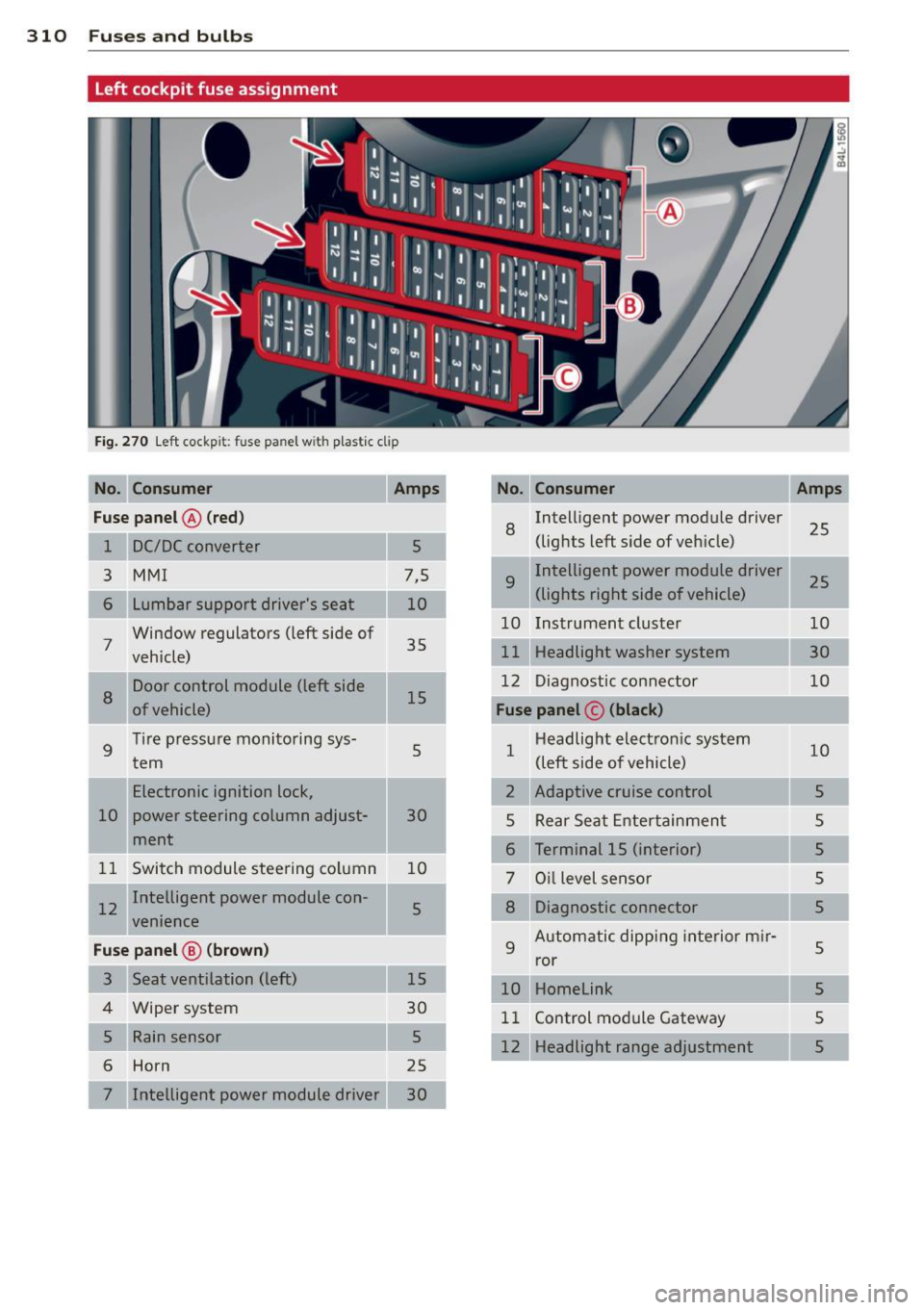
Left cockpit fuse assignment
Fig. 270 Left cockpit: fuse panel w ith p lastic clip
No. Consumer
Fu se pa nel @ (red )
8 Intelligent power modu le driver
25
1 5 (lights left s
ide of veh icle)
3
MMI 7,5 9 Intelligent power module driver 25
6 Lumbar support driver's seat
(lights right side of vehicle)
Window regulators (left side of 10 Instrument cluster
10
7 vehicle) 35
11 Headlight
washer system
Door control module (left side 12 Diagnostic connector
10
8 of vehicle) 15 Fu
se panel © (black )
9 Tire pressure monitoring sys-
5 1 Headlight electron
ic system
10
tern (left side of vehicle)
.
Electronic ignition lock,
2 Adaptive cruise control
5
10 power steering column adjust-
30
5 Rear Seat Ente rtainment
s
I ment 6 Terminal 15 (interior)
5
11 Switch module steering co lumn 10
7 Oil level sensor 5
I 12 Intelligent power module con-5 8 Diagnostic connector
5
venience
F u se pa nel @ (b ro wn) 9 Automatic dipping
interior m ir-5 ror
3 10 Homelink
5
4 Wiper system 11 Control module Gateway 5
5 5
12 Headlight range adjustment 5
6 Horn
25
7 Intelligent power module driver 30
Page 318 of 348
316 Emergency sit uat ions
-Jumper cables must be long enough so
that the vehicles do not touch.
- When connecting jumper cables, make
sure that they cannot get caught in any
moving parts in the engine compart
ment.
- Before you check anything in the engine compartment, always read and heed all
WARNINGS c>
page 255, Engine com
partment.
({D Note
Improper hook-up of jumper cables can r u
in the generator.
- Always connect POSITIVE( +) to POSI
TIVE(+), and NEGATIVE( -) to NEGATIVE
( - ) ground post of the battery manager
control unit.
- Check that all screw plugs on the battery
cells are screwed in firmly. If not, tighten
plugs prior to connecting clamp on nega
tive battery terminal.
- Please note that the procedure for con
nec:t i ng a jumper cable as described
above applies spec ifically to the case of
you r vehicle being jump started. When
you are giving a jump star t to anothe r ve
hicle, do
not connect the negat ive (-) ca
ble to the negat ive (-) terminal on the
discharged battery@c>
fig. 2 74. In
stead, securely connect the negative(-)
cable to e ither a solid metal component
that is firmly bolted to the engine block
or to the engine block itse lf. If the bat
te ry that is being charged does not vent
to t he outside, escaping batte ry gas
could ignite and explode!
Emergency towing
with commercial tow
truck
General hints
Your Audi requires special handling for tow
ing.
T he following information is to be used by
commercial tow truck operators who know
how to operate their equipment safely.
- Nev er tow your Audi , towing will cau se
damage to the engine and tr an smi ssion .
- Ne ver wrap th e safety chain s or winch ca
ble s around the brak e lines.
- To pre vent unne ce ss ary damage, your Audi
mus t be tr an sp o rt ed with a flat bed tru ck.
- To load th e vehi cle on to th e flat b ed, use
the towing l oop found in the ve hicle to ols
an d att ach to th e front or rea r a ncho rage
i=> page 317 and c> page 317 .
& WARNING
--==
A vehicle being towed is not safe for pas-
sengers. Never allow anyone to ride in a
vehicle be ing towed, for any reason.
-
Page 321 of 348
fall f rom a lift if the re is a change in ve
h icle we ight d istr ibut ion and balance.
This might happen, for examp le, when
heavy components such as the engi ne
b lock or transmiss io n are removed .
- Whe n removing heavy components like
these, ancho r vehicle to ho ist o r add cor
r e spond ing w eig hts to ma intai n the cen
te r of g ravity . Othe rwise, the vehicl e
mi ght til t or slip off th e hoi st, causi ng
s er ious perso nal inju ry.
(D Note
- Be awa re of th e f ollowing po in ts b efore
li fting t he vehi cle:
- The vehicle should never be lifted or
jacked up from underneath the engine oil pan, the transmission housing, the
front or rear axle or the body side
members. This could lead to serious
damage .
- To avoid damage to the underbody or
chassis frame, a rubber pad must be
inserted between the floor jack and
the lift points.
- Before driving over a workshop hoist,
check that the vehicle weight does not
exceed the permissible lifting capacity
of the hoist.
- Before driving over a workshop hoist,
ensure that there is sufficient clear ance between the hoist and low parts
of the vehicle .
Emergency situations 319
•
•
Page 322 of 348
320 General information
General information Explanation of
technical data
Some of the technical data listed in this man
ual requires further explanation .
The technical data for your vehicle is listed in
the charts starting on
r:::>page 322. This sec
tion provides general information, notes and
restrictions which apply to this data .
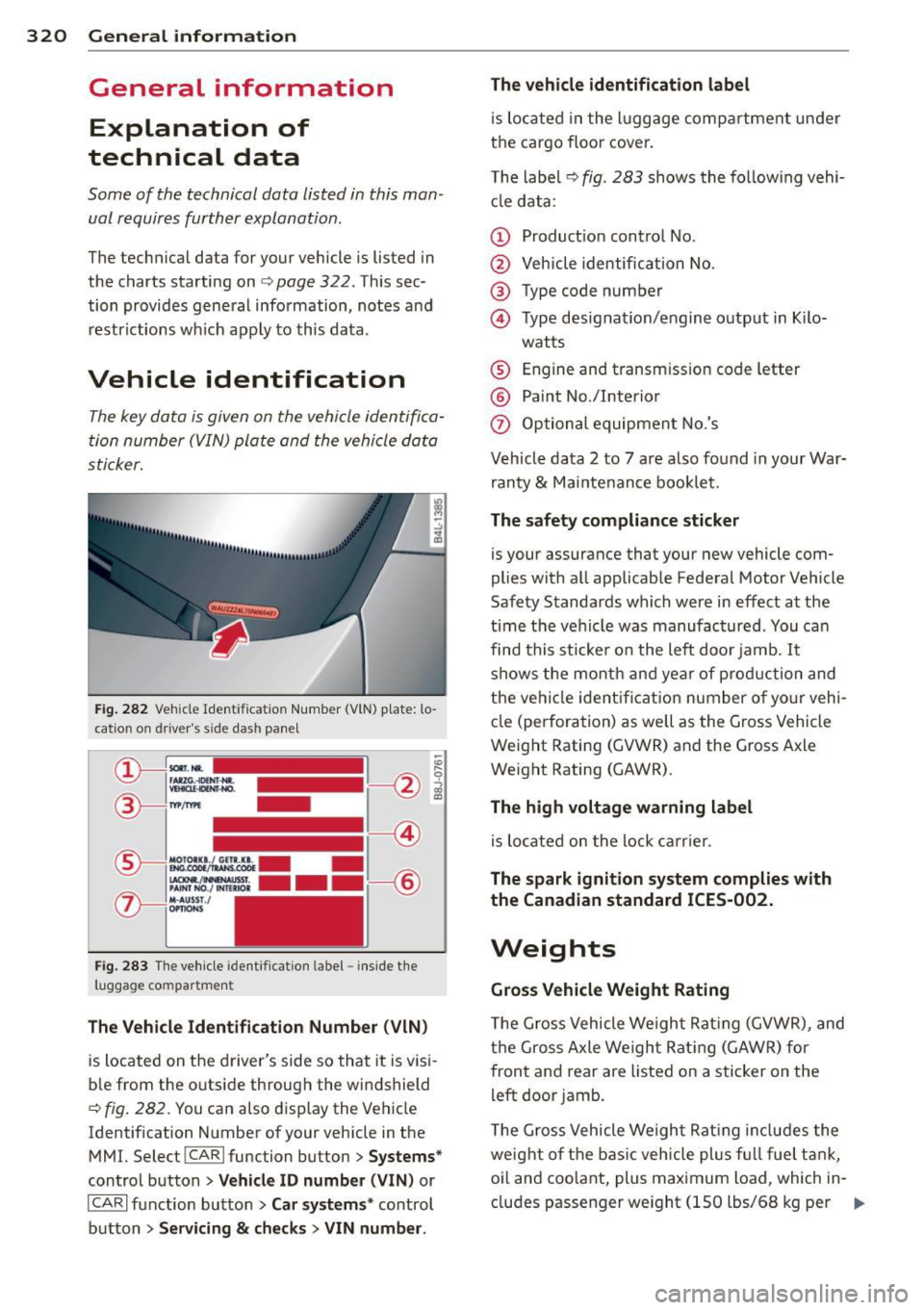
Vehicle identification
The key data is given on the vehicle identifica
tion number (VIN) plate and the vehicle data
sticker.
Fig. 282 Veh icle Ide ntific atio n Number (VlN) p late: lo
cation on driver 's sid e das h panel
Fig. 283 The vehicle identi fication label -inside the
luggage co mpa rtmen t
The Vehicle Identification Number (VIN)
is located on the driver's side so that it is visi
b le from the outside through the windshield
r:::> fig . 282 . You can also display the Vehicle
Identification Number of your vehicle in the
MMI. Select !CAR lfunc tion button>
Systems*
control button > Vehicle ID number (V IN) or
ICARI function button >
Car systems * control
button >
Servicing & checks > VIN number . The
vehicle identification label
is located in the luggage compartment under
the cargo floor cover.
The label¢
fig. 283 shows the following vehi
cle data :
(D Production control No .
@ Vehicle identification No.
® Type code number
@ Type designation/engine output in Kilo-
watts
® Engine and transmission code letter
@ Paint No./Interior
(f) Optional equipment No.'s
Vehicle data 2 to 7 are also found in your War
ranty
& Maintenance booklet.
The safety compliance sticker
is you r assurance that your new vehicle com
plies with all applicable Federal Motor Vehicle
Safety Standards which were in effect at the
time the vehicle was manufactured . You can
find this sticker on the left door jamb.
It
shows the month and year of production and
the ve hicle ident ification number of your vehi
cle (perforation) as well as the Gross Vehicle
Weight Rating (GVWR) and the Gross Axle
Weight Rating (GAWR) .
The high voltage warning label
is located on the lock carr ier .
The spark ignition system complies with
the Canadian standard ICES-002.
Weights
Gross Vehicle Weight Rating
The Gross Vehicle Weight Rating (GVWR), and
the Gross Axle Weight Rating (GAWR) for
front and rear are Listed on a sticker on the
left door jamb.
The Gross Vehicle Weight Rating includes the
weight of the basic vehicle plus full fuel tank,
oi l and coolant, plus maximum load, wh ich in
cludes passenger weight (lSO lbs/68 kg per
Ill>
Page 328 of 348
326 Consumer Inf ormation
comp lexity of today's automobi les, have
steadi ly reduced the scope of maintenance
and repairs which can be carried out by vehicle
owners.
Also, s afety an d e nvir onm ent al con
cerns place very strict limits on the nature of repairs and adjustments to engine and trans
miss ion pa rts which an owner can perform .
Maintenance, adjustments and repa irs usua lly
require special tools, testing devices and oth
er equipment avai lab le to specially trained
workshop personnel in order to assure proper
performance, reliab ility and safety of the vehi
cle and its many systems .
Improper ma intenance, adjustments and re
pa irs can impair the operation and reliab ility
of your vehicle and even void your vehicle war ranty. Therefo re , proof of servici ng in accord
ance w it h the ma intenance sched ule may be a
condition for upholding a poss ible warranty
claim made within the warran ty period.
Above all, operational safety can be adve rsely
affected, c reating unnecessary risks for you
and your passengers.
If in doubt about any serv icing, have it done
by your author ized Audi dealer or any other
p roperly equipped and qualified workshop .
We strong ly urge you to give your authorized
Audi dealer the opportunity to perform all
schedu led maintenance and necessary repairs .
Your dea ler has the facilities, or iginal parts
and tra ined spec ialists to keep your vehicle
running properly .
Performing lim it e d m aint en anc e y ourself
The fo llowing pages describe a limited num
ber of procedures which can be performed on
you r vehicle with ordinary too ls, shou ld the
need arise and trained personnel be unavaila
ble. Before performing any of these proce
dures, always thoroughly read all of the app li
cable text and ca refully follow the instruc
tions given. Always rigorously obse rve the
WARNINGS p rovided .
Before you ch eck anything in th e engin e
compartme nt, alway s read an d heed all WARNINGS
¢ & a
nd ¢ & in Working in the
engine comportment on page 264 .
A WARNING
--Serious personal in jury may occur as a re-
sult of improperly performed mainte nance, adjustments or repa irs.
- Always be extremely careful when work
ing on the vehicle. Always follow com
monly accepted safety pract ices and gen
eral common sense. Never r isk personal
in jur y.
- Do not attempt any of the maintenance,
checks or repairs descr ibed o n the fol
lowing pages if you are not fu lly fam iliar
with these or other procedures with re spect to the ve hicl e, or are uncerta in how
to proceed .
- Do not do any work withou t the proper
too ls and equipment . Have the necessary
work done by your authorized A udi deal
er or anothe r properly equipped and
qualified workshop.
- The engine compar tment o f any motor
vehicle is a potentially hazardous area. Never reach into the area around or
touch the rad iator fan. It is temperature
control led and can sw itch on suddenly -
even when the engine is off and the igni
tion key has been removed. The rad iator
fan switches on automatically when the coo lant reaches a certai n tempera ture
and will cont inue to run until the coo lant
temperature drops .
- Always remove the ign ition key befo re
a nyone gets under the veh icle.
- Always suppor t your veh icle with safety
s tands if it is necessary to work under
neath the vehicle. The jack s upplied with
the vehicle is not adequate for this pur
pose and co uld co llapse causing serio us
personal injury.
- If you must work unde rneath the vehicle
wit h the wheels on the ground, a lways
make sure the vehicle is on leve l ground,
that the wheels are always secure ly
blocked and that the engine cannot be
started.
Page 333 of 348
All-wheel drive ..... .... ... .. .. .. ... 231
Winter tires . ... .. .... ... .. .. .. ... 295
Alloy whee ls . ............. .... .. ... 2 50
Alternator Malfunct io n . . . . . . . . . . . . . . . . . . . . . . . 31
Ambience lighting Lighting p rof iles ... .... ... .. .. .. .... 62
Anti-freeze
refer to Engine coo la nt system .. .. .. . 27 1
Anti -lock brake system
H ow the ABS system wo rks . .. .. .. .. . 229
War ning/ indicato r lights ...... .... ... 18
Anti-Slip Regulation System (ASR) How the system works ..... .. .. .. .. . 227
Anti -theft systems
Anti-theft alarm system . . . . . . . . . . . . . SO
Elect ronic immobilizer .. ... .. .. .. .. .. 40
Approa ch/departu re angle ... .. .. .. .. . 238
Ash tray . .. .. ................. .. .. .. 86
ASR How t he Anti -Slip Regulation System
works ... .. .. ............. .. .. ... 22 7
Aster is k
What does it mean when someth ing is
marked with an asterisk? . . . . . . . . . . . . . . 6
Aud i b rak ing guard ............ .. .... 127
E rro r messages .......... .... .. .. . 128
Sett ings . .. .. ........... .. .. .. ... 128
S tat us messages ......... .. .. .. .. . 128
Switching on and
off ...... .. .. .. .. . 128
Aud i Service Repa ir Manuals and Lite ra-
ture .. .. .. .. .... ............. .. .. . 325
Auto-Check Control . . . . . . . . . . . . . . . . . . 30
Automatic belt retrac to r . . . . . . . . . . . . . 179
Automatic ca r wash
refer to Wash ing ............ .. .... 246
Aut omatic mode
Four- zone automatic comfort a ir cond i-
tioning .. ..... ........... ... ... ... 98
Automatic S hift Lock (ASL) . ... .. .. .. . 139
Automatic t ransmission ..... .. .. .. .. . 137
Automatic S hift Lock (ASL) . .. .. .. .. . 139
D riving .. .. ............. .... .. .. . 13 7
D ynamic shift program . ... .. .. .. .. . 1 40
Emergency mode . ..... ... .. .. .. .. . 14 1
Emergency release for selector lever . . 142
Ignition key safety lock .... .. .. .. .. . 105
Inde x 331
Kick -down . . . . . . . . . . . . . . . . . . . . . . . . 14 0
Manua l shift program ... .... ... .. .. 140
Se lector lever . . . . . . . . . . . . . . . . . . . . . 138
Sh ift buttons .. .. ................. 141
Steering wheel with tiptronic ®
A UTO mode
141
AC climate contro ls .. .. ..... ... .. .. . 94
Auto Safety Hot lin e ............. .. .. 172
Average speed . . . . . . . . . . . . . . . . . . . . . . . 24
Avoid damaging the vehicle .... ... .. .. 236
B
Bass box . . . . . . . . . . . . . . . . . . . . . . . . . . 302
Battery ...... .. .. .... ............. 275
Battery location .................. . 276
Charg ing .. .. .. .. .. . .. .... .... .. .. 277
Impo rtant warnings when working on
the battery .. .. .. .. . .............. 276
Jump star ting .. .. .... ........... .. 31 4
L ow . ... .. .. .... .. . .. .. ..... ... .. 231
Rep lacing the battery .. ..... ... .. .. 279
State of charge . . . . . . . . . . . . . . . . . . . . 231
Voltage ... .. .. .. ................. . 36
Winter operation . ................. 275
Working on the battery ...... ... .. .. 276
Befo re driving ... .... . ... ...... ... .. 165
B lended gasoline .................. . 256
Body cavity sealing . ................. 250
Boos ter sea ts . . . . . . . . . . . . . . . . . . . . . . 213
B rake assistant .. .. .. ............... 230
Brake booster ..... .. . .. .. ..... ... .. 229
B ra ke fluid
Changi ng the bra ke fluid ........ .. .. 275
Checking the brake fluid level . ... .. .. 274
Rese rvoir ... .... .. . .. .. ..... ... .. 274
What is the correct brake fluid level? . . 274
What should I do if the brake fluid warn-
ing light comes on? ............ .. .. 274
Brake light De fective . . . . . . . . . . . . . . . . . . . . . . . . . 23
B rake system .. .. .... .......... ..... 274
Ant i- lock b rake system . . . . . . . . . . . . . . 18
Br ake fluid .. .. .. .... ............. 27 4
Br ake fluid specifica tions fo r refill and re-
placement . ..... ... .. .. ..... ... .. 275
B rake pads . ..... .. . .. .. ..... ... .. 234
General information ........... .. .. 228
•
•