heating AUDI Q7 2013 Owner´s Manual
[x] Cancel search | Manufacturer: AUDI, Model Year: 2013, Model line: Q7, Model: AUDI Q7 2013Pages: 348, PDF Size: 87.72 MB
Page 104 of 348
102 Warm and cold
A nearly constant temperature is maintained
when the steering wheel heating is switched
on.
The last setting selec ted for the stee ring
wheel heating (on or off) is automatically
saved when the vehicle is shut off and is as
signed to the remote key.
Page 107 of 348
Ignition lock and ignition switch
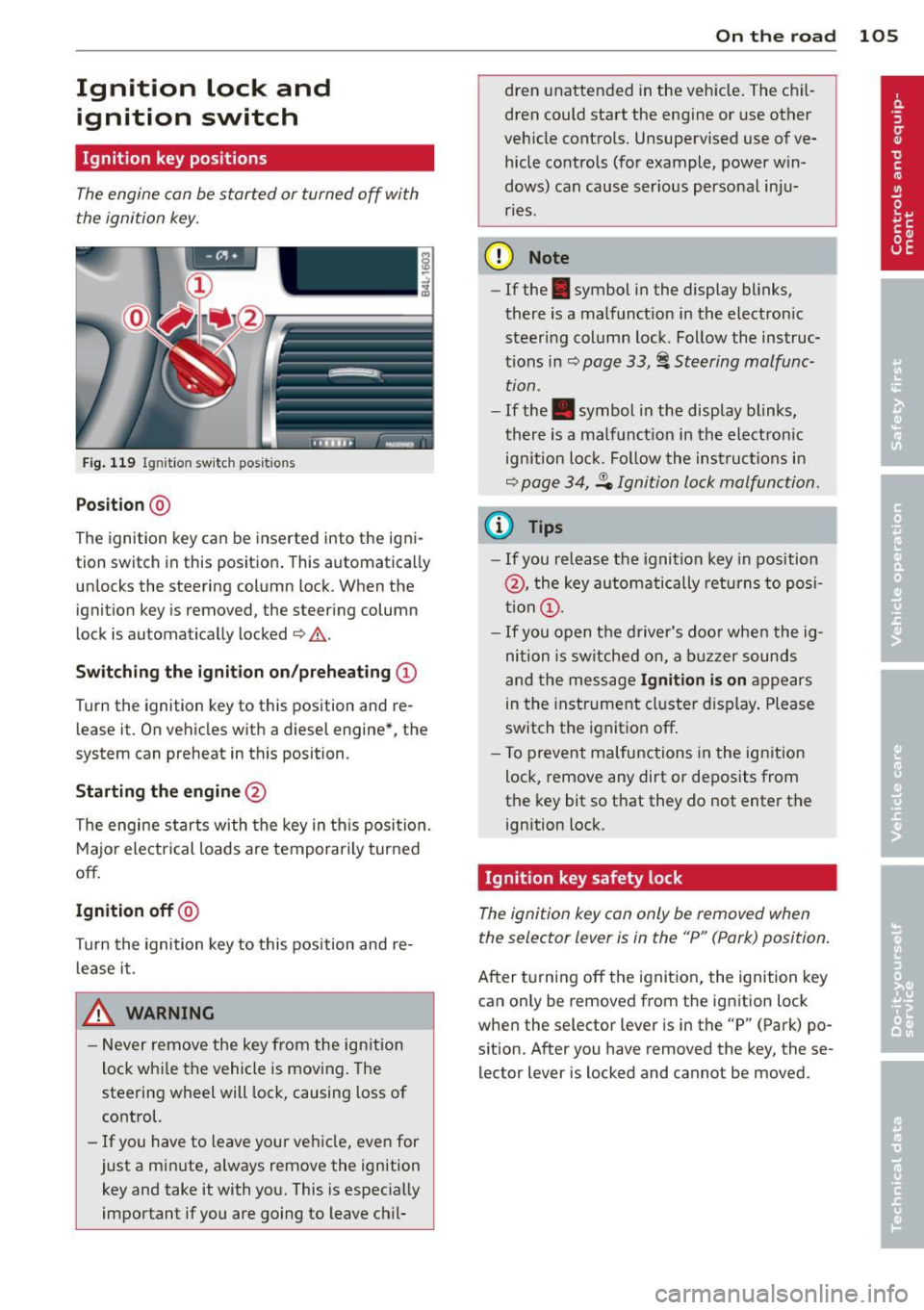
Ignition key positions
The engine con be started or turned off with
the ignition key.
Fig. 119 Igni tion switch pos it io n s
Position @
The ignition key can be inserted into the igni
tion switch in this position . This automatically
unlocks the steering column lock . When the
ignition key is removed, the steering column
lock is automatically locked
Q .&. .
Switching the ignition on/preheating (D
Turn the ignition key to this position and re
lease it. On vehicles with a d iesel engine*, the
system can preheat in this position .
Starting the engine@
The engine starts with the key in this position.
Major electrical loads are temporarily turned
off.
Ignition off@
Turn the ignition key to this position and re
lease it.
A WARNING ,~ ~
- Never remove the key from the ign ition
lock whi le the vehicle is moving. The
steering wheel will lock, causing loss of
control.
- If you have to leave your vehicle, even for
just a minute, always remove the ignition key and take it with you. This is especially
important if you are going to leave chil-
On the road 105
dren unattended in the vehicle. The chil
dren could start the engine or use other
vehicle controls. Unsupervised use of ve
hicle controls (for example, power win
dows) can cause ser ious personal inju
ries.
(D Note
- If the . symbol in the display blinks,
there is a malfunction in the electronic
steering column lock . Follow the instruc
tions in
Q page 33, i Steering malfunc
tion .
-If the . symbol in the display blinks,
there is a malfunction in the electronic
ignition lock . Fol low the instructions in
Q page 34, .P. Ignition lock malfunction.
a) Tips
-If you release the ignition key in position
@, the key automatically returns to posi
tion (!).
- If you open the driver's door when the ig
nition is sw itched on, a buzzer sounds
and the message
Ignition is on appears
in the instrument cluster display. Please
switch the ignition off.
- T o prevent malfunctions in the ign ition
lock, remove any dirt or deposits from
the key bit so that they do not enter the
ignition lock.
Ignition key safety lock
The ignition key con only be removed when
the selector lever is in the "P" (Pork) position.
After turning off the ignition, the ignition key
can only be removed from the ignition lock
when the selector lever is in the "P" (Park) po
sition. After you have removed the key, these lector lever is locked and cannot be moved.
Page 108 of 348
106 On the road
Starting and stopping
the engine
Starting the engine
The engine can only be started with your orig
inal Audi key.
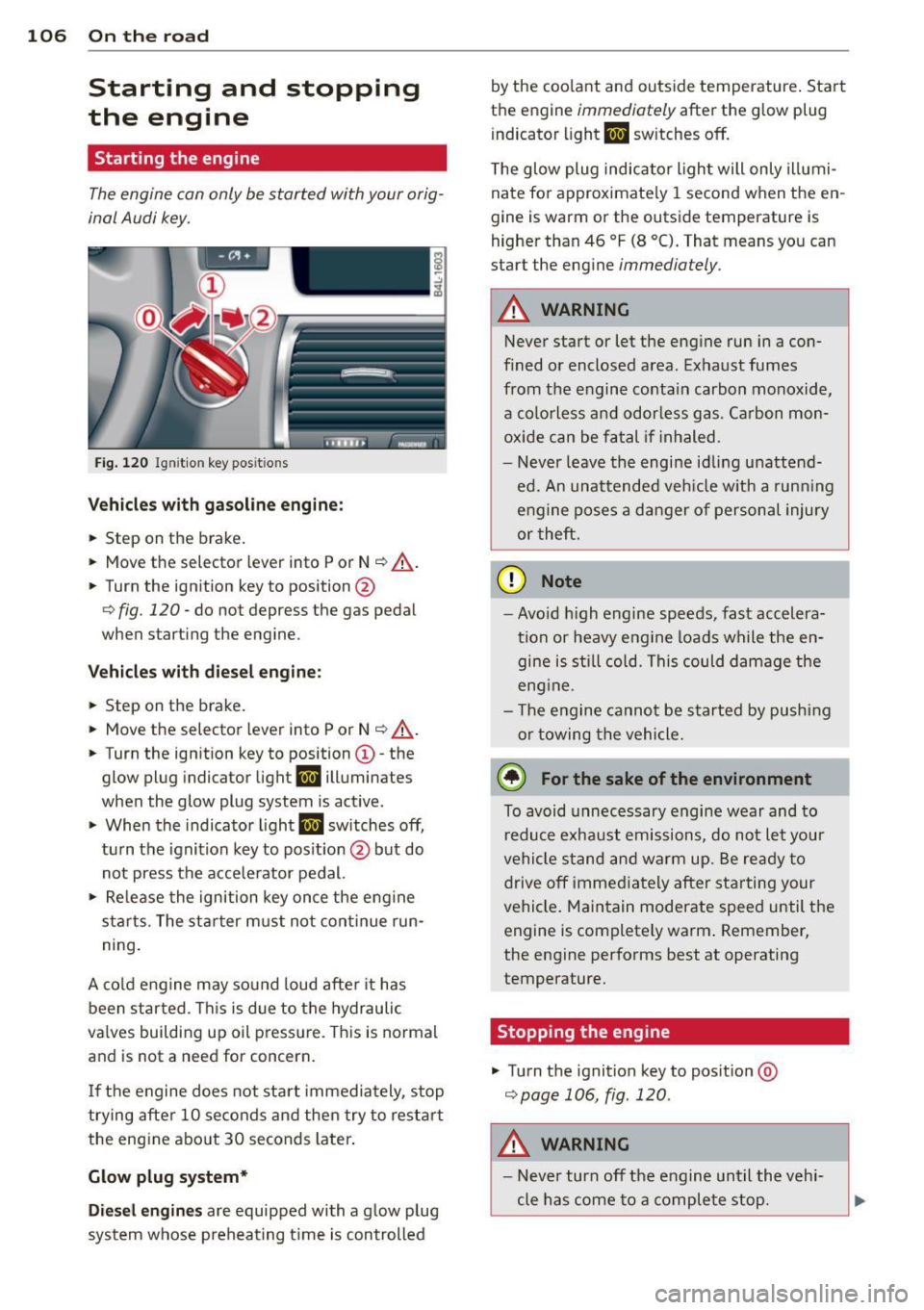
Fig. 120 I gni tion key positio ns
Vehicles with gasoline engine:
.. Step on the brake .
.. Move the selector lever into P or N
¢ A.
.. Tu rn the ignition key to position @
9 fig. 120 -do not depress the gas pedal
when starting the engine.
Vehicles with diesel engine:
.. Step on the brake.
.. Move the selector lever into P or N
¢ &.
.. Turn the ignition key to position ©- the
glow plug indicator light
m illuminates
when the glow plug system is act ive .
.,. When the indicator light
I.I switches off,
turn the ignition key to pos it ion @ but do
not press the accelerator pedal.
.. Re lease the ignition key once the engine
sta rts. The starter must not continue run
ning.
A cold engine may sound loud after it has
been started . This is due to the hydraulic
va lves building up oil pressure. This is normal
and is not a need for concern.
If the engine does not start immediately, stop
trying after 10 seconds and then try to restart
the engine about 30 seconds Later.
Glow plug system*
Diesel engines are equipped with a glow plug
system whose preheating t ime is controlled by the coo
lant and outs ide temperature . Start
the engine
immediately after the glow plug
indicator light
m sw itches off.
The glow plug indicator light will only illumi
nate for approximate ly 1 second when the en
gine is warm or the outside temperature is
higher than 46 °F (8 °C). That means you can
start the engine
immediately .
A WARNING
-Never start or let the engine run in a con-
fined or enclosed area. Exhaust fumes
from the engine contain carbon monoxide,
a colorless and odorless gas . Carbon mon
oxide can be fatal if inhaled.
- Never leave the engine idling unattend
ed. An unattended veh icle w ith a runn ing
engine poses a danger of personal injury
or theft .
(D Note
- Avo id high engine speeds, fast accelera
tion or heavy engine loads while the en gine is still cold. This could damage the
eng ine .
- Th e engine cannot be started by pushing
or towing the vehicle .
@ For the sake of the environment
To avoid unnecessary engine wear and to
reduce exhaust emissions, do not let your
vehicle stand and warm up. Be ready to
drive
off immediately after starting your
vehicle. Maintain moderate speed until the
engine is completely warm . Remember,
the engine performs best at operating
temperature.
· Stopping the engine
.,. Turn the ignition key to position @
¢page 106, fig . 120 .
A WARNING
-
-Never turn off the engine until the vehi-
cle has come to a complete stop.
Page 109 of 348
-The brake booster and servotronic only
work when the engine is running. With
the ignition turned off, you have to apply
more force when steering or braking .
S ince you cannot steer and stop normal
ly, this can lead to accidents and ser ious
injuries.
- The rad iator fan can continue to run for
up to 10 min utes even after you have
turned off the engine and removed the ign ition key. The radiator fan can also
turn on again if the engine coolant heats
up because of intense sunlight or heat
build -up in the engine compartment.
«I) Note
Do not stop the engine immed iate ly after
hard or extended dr iving. Keep the engine
running for approximately two minutes to
prevent excessive heat build-up .
Starting and stopping
the engine with
Convenience key
Starting the engine with the~
button
App lies to vehicles: with Convenie nce key
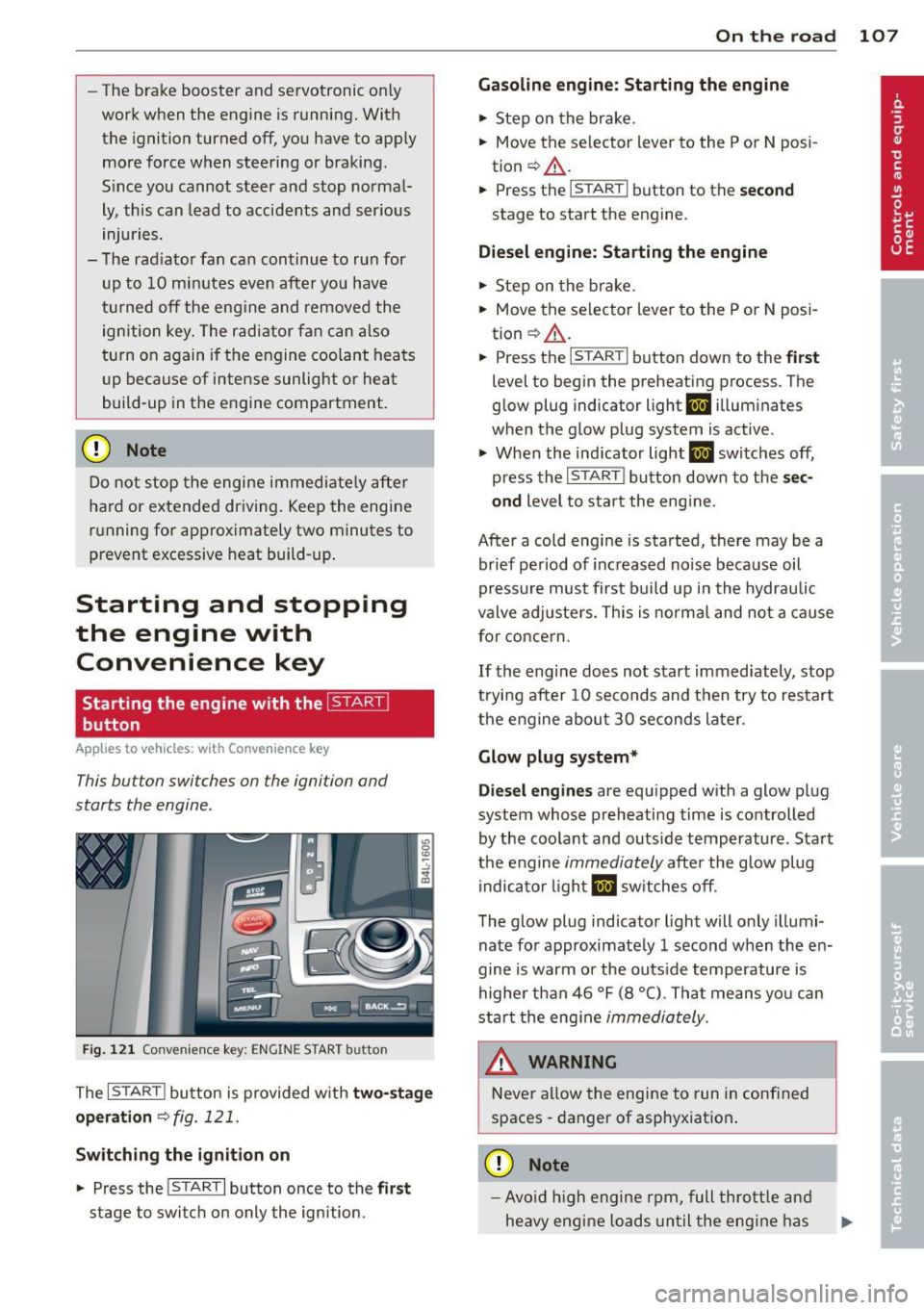
This bu tton swi tches on the ign ition and
starts the engine .
Fig. 121 Co nvenie nce k ey: ENG INE START b utton
The I S TAR T! button is provided w ith two -sta ge
o p era tion
¢ fig. 121.
Switching the ignition on
.. Press the !START I button once to the fir st
stage to switch on only the ign ition .
On th e road 107
Gasoline eng in e: St arting th e engine
.. Step on the brake.
.. Move the se lector lever to the P or N posi
tion ¢,&. .
.. Press the
r::1s=Tc:- A=RT =I button to th e seco nd
stage to start the engine .
Diesel en gine : Starting the engine
.. Step on the brake.
.. Mov e the selector lever to the P or N posi
tion ¢,&. .
.. Press the
r::1s=TAc:-=R T=I button down to the fi rst
level to begin the preheating process . The
glow plug indica tor light
II illumina tes
when t he glow plug system is active .
.. When the indicator light
II switches off,
press the
I ST ART ! button down to the se c
ond
level to star t the eng ine .
After a cold engine is started, there may be a br ief period of increased no ise because oil
pressure must first build up in the hydraulic
valve adjuste rs. This is norma l and not a cause
for concern .
If the engine does not start immediately, stop
trying after 10 seconds and then try to restart
the engine abou t 30 seconds later .
Glow plug system *
Di ese l engine s
are equ ipped with a glow plug
system whose preheating time is controlled
by the coolant and outs ide temperature . Start
the engine
immediately afte r the glow plug
indicator light
II sw itches off .
The glow plug indicator light will only illumi
nate fo r approximate ly 1 second when the en
gine is warm or the outs ide temperature is
highe r than 46 °F (8 °C) . That means yo u can
start the eng ine
immediately .
WARNING
Never allow the engine to run in confined
spaces -danger of asphyxiation .
(D Note
-Avo id h igh engine rpm, full thrott le and
heavy engine loads until the eng ine has
Page 229 of 348
-Stability is limited in the ESC offroad
mode.
Electronic differential lock (EDL)
The electronic differential lock monitors the
rotational speed of the drive wheels .
General notes
The electronic differentia l lock (EDL) helps the
car to start movi ng, accelerate and climb a
gradient on surfaces providing poor or almost
no grip. Without EDL, this would be difficult,
if not impossible.
H ow the system works
The ED L opera tes automatically. It monitors
the rotat iona l speed of wheels w ith the help
of the ABS sensors¢
page 229. If a noticea
b le
slip is detected at the wheels (e .g. on slip
pery ground
on one side), the spinning whee ls
are braked and power is transferred to the
other wheels. This is done up to a speed of
about
60 mph (100 km/h) . Noises from the
brake system s ignal that wheel sp in is being
controlled.
Dri ving off
When driving off, always be sure to keep road
conditions in mind as you accelerate. If one
drive wheel spins because it is on a surface
w ith less gr ip, apply
plenty of throttle until
the car starts to move.
O verheating of br akes
To prevent the disc brake of the braked wheel
from overheating if subjected to excessive
loads on this wheel, the EDL cuts out tempo
rarily . T he vehicle remains operational and be
haves in the same way as a veh icle w ithout
E DL.
As soon as the brake has cooled down, EDL
switches on again automatically .
A WARNING
-When accelerating on slippery surfaces,
such as on ice or snow, always be carefu l
when depressing the acce le rator pedal.
Int ellig ent technolog y 22 7
Even with the EDL working, the drive
wheels can spin and red uce your ab ility
to control your car. Risk of crash!
- The increased safety afforded by EDL
does not mean that you can take safety
risks. Always adapt your driving style to
the road condit ions and traffic situation .
(D Tips
If a fault occurs in the ABS, the EDL is also
not functioning. This is ind icated by the
ABS warning light¢
page 18.
Anti-Slip Regulation System (ASR )
The Anti-Slip Regulation System prevents the
driven wheels from spinning when the car is
accelerating .
General note s
The Anti-Slip Regu lation System (ASR) is inte
grated in the Electronic Stabilization Control
(ESC). When the vehicle starts up and acceler
ates, the wheels are prevented from spinning
by adjust ing the engine power to match the
amount of grip available from the road sur
face .
How the sy stem works
ASR performs automat ically, i.e. without the
driver's intervention. With the aid of the ABS
sensors ¢
page 229, ASR monito rs the speed
of the dr iven wheels .
If the wheels start to
spin, engine torque is red uced automat ically
unt il the t ires find enough grip to lock onto
the ro ad surface. The system is active across
the entire speed range.
T he ASR works in conjunction with the ABS. If
a malfunc tion s hou ld occu r in the ABS, the
ASR wi ll also be out of act io n.
A WARNING ~
The increased safety affo rded by ASR does
not mean that you can take safety risks.
A lways adapt your driving sty le to the road
conditions and traffic situation.
Ill--
•
•
Page 235 of 348
With the engine running
Although electrical energy is generated when
the vehicle is being driven, the battery can be
come discharged. This happens most ly when
litt le energy is being generated and a great
deal consumed and the battery's state of
charge is not optimal.
To bring the energy balance back into equili
brium, consumers which require especia lly
large amounts of energy are temporarily cut
back or switched off. Heating systems in par
ticular requ ire a great deal of energy. If you
notice, for example, that the heated seats* or
the heated rear window are not heating, they h ave been temporar ily cut back or switched
off. These systems will be available again as
soon as the energy ba lance has been restored.
You will also notice that engine idle speed has
been increased slightly. This is normal and not
a cause for concern . By increasing engine idle
speed the additional energy required is gener
ated and the battery is charged .
Driver notification in the instrument
cluster display
If battery power drops into the range where it
can limit the ab ility of the engine to start, th is
is shown in the instrument cluster display
with the following driver message:
(•) Low battery charge: battery will be
charged while driving
This notification reminds you that the starting
capability of the engine may be limited. As
soon as you start driving again, the battery
will be recharged and the notification will go
out.
Driver notification appears and goes out
again
If th is driver notification appears after the ig
nition is turned on or while driving and it goes
out again after a wh ile, the battery has been
adequately recharged.
Intelligent technology 233
Driver notification appears and does not
go out again
If this driver notification appears after the ig
nition is turned on or whi le driving and does
not go out again, the battery's state of charge
is not in the optimal range. Starting ab ility is
restricted . Have the battery checked as soon
as possible by an authorized Aud i dealer or
qualified workshop.
•
•
Page 237 of 348
Catalytic converter
Applies to vehicles: with gasoline engine
It is very important that your emission control system (catalytic converter) is function
ing properly to ensure that your vehicle is run
ning in an environmentally sound manner .
... Always use lead-free gasoline¢ page 256,
Gasoline .
... Never run the tank down all the way to
empty .
... Never put too much motor oil in your en-
gine
¢ page 270, Adding engine oil~-
.,. Never try to push- or tow-start your veh icle.
The catalytic converter is an eff icient "clean
up" device built into the exhaust system of
the vehicle. The catalytic converter burns
many of the poll utants in the exhaust gas be
fore they are released into the atmosphe re.
The exclusive use of unleaded fuel is cr it ically
i mportant for the life of the cata lytic convert
e r and proper fu nctioning of the engine.
A WARNING ,~
- Do not park or operate the veh icle in
areas where the hot exhaust system may
come in contact with dry grass, brush,
fuel spill or other material which can
cause a fire.
- Do not apply additional undercoating or
rustproofing on or near the exhaust
man ifold, exhaust p ipes, catalytic con
verter or heat shie lds . During driving, the
substance used for undercoating could
overheat and cause a fire.
{[) Note
-Be aware that just one tank fi lling with
le aded fuel will already seriously de
grade the performance of the catalytic
conve rter .
- Do not exceed the correct engine oil level
¢ page 270.
-Do not drive until the fuel tank becomes
completely empty. The eng ine could mis
fire . U nburned fuel could a lso get into
Dri vin g and en vironm ent 235
the exhaust system and this cou ld cause
the catalytic converter to overheat .
- Do not turn off the igni tion while the ve
hicle is moving.
- Do not con tinue to ope rate your veh icle
unde r these conditions, as othe rwise fuel
can reach the catalytic converter. This
co uld result in overheating o f the con
verter, requir ing its replacement.
- To assure efficient operation of the Emis
sion Control System:
- H ave your vehicle maintained prope rly
and in accordance w ith the se rv ice rec
ommendat ions in you r Warranty &
M aintenance boo klet.
- L ack of prope r maintenance as we ll as
improper use of the vehi cle w il l impair
the function of the em ission contro l
system and could lead to damage .
@ For the sake of the environment
Even when the Emiss ion Control System is
operat ing properly, the exha ust gas can
have a sul fur -li ke exhaust gas smell under
some operating states . This depends on
the sulfur content of the fuel being used .
Using a different brand of fue l may help,
or f illing the tank with lead-free super
grade gasoline .
Diesel particulate filter
Applies to vehicles : with diese l eng ine
The diesel part iculate filter filters nearly all of
the soot particles out of the exhaust . The fil
ter cleans itself automat ica lly under normal
driv ing cond itions . If the filter ca nnot clean it
self (for example, because you a re o nly dr iving
short distances), the fi lter becomes clogged
with soot and the
II symbo l for the diesel
particu late filter ill uminates ¢
page 3 7.
A WARNING
- Do not park your vehicle over flammab le
materia ls such as grass or leaves because
the high temperature of the diesel par-
ticulate f ilter could start a fire. ..,. •
•
Page 239 of 348
It takes a long time for the engine to warm up
fu lly when it is running at idle. However , wear
and nox ious em issions are especially high
when the engine is warming up. So you should drive away as soon as you start the engine and
avoid running at high rpms while the engine is
still warming up .
(D Note
Do not leave engine idling unattended af
ter starting . If warning lights should come
on to indicate improper operation, they
wou ld go unheeded. Extended idling also
p roduces heat, which cou ld resu lt i n over
heating or other damage to the vehicle or
other property.
Regular maintenance
A badly tuned engine unnecessarily wastes a lot of fuel.
"' Have your vehicle serv iced at regular inter-
vals.
By having your vehicle regularly serviced by an
author ized Audi dealer helps to ensure that it
r uns p roper ly and economically. The condition
of your vehicle not only affects its safety and
ab ility to hold its value, it also affects
fuel
c on sumption.
Ch eck your oil each time you fill your tank .
The amount of oil used is related to engine
load and speed .
It is normal for the oil consumption of a new
engine to reach its lowest v alue after a certain
mileage has been dr iven .
You must drive your vehicle about 3,000 miles (5,000 ki lometers) before you can properly
assess o il consumption .
This a lso applies to fuel consumption and en
gin e output.
0 Note
- Have yo ur vehicle maintained properly
and in accordance wit h the service rec
ommendations in your War ranty
& Main-
Dri vin g and en vironm ent 237
tenance book let. Lack of p roper mainte
nance as well as improper use of the ve
hicle will impair the function of the
em ission contro l system and could lead
to damage.
- Do not alter or remove any component of the Emission Control System unless approved by the manufacturer.
- Do not alter or remove any device, such as heat shie lds, switches, ign ition w ires,
valves, which are designed to protect
your vehicle's Emission Control System and other impo rtant vehicle compo
nents.
Fewer short trips
Fuel consumption will always be relatively
high on short trips .
"' Try to avoid driv ing short distances w ith a
cold engine .
The eng ine and cataly tic converter have to
reach their opt imal
operat ing temperature t o
reduce fuel consumpt ion and nox ious em is
s ions effect ively .
Just after starting, a co ld eng ine in a mid-s iz e
car only achieves a fuel economy of 6-8 mi les
per gallon (30 -40 l/l00km). After about a
half a mile , fuel economy cl imbs to 12 mpg
(20 l/100 km) . After about
2.5 miles (4 km),
t he engine is at i ts p rope r opera ting tempe ra
tu re and f uel economy has reached a normal
l evel. So you can see that yo u should avo id
short trips whenever possible.
T he
out sid e t emperature is also cr itica l in th is
regard. Your car consumes more fue l in the
winter than in the s ummer.
•
•
Page 257 of 348
Engine compartment
Be especially careful when cleaning the en
gine compartment.
Al ways s witch off the ign ition befor e clean
ing the eng in e
c:> & .
Plenum panel
Remove leaves from the plenum pane l in front
of the windshield under the engine hood. This
prevents the water drain holes from becoming
blocked, and it prevents debris from entering
the vehicle interior through the heating and
ventilation ducts .
Corrosion protecti on
The engine compartment and transmission
have been corrosion-protected at the factory.
Good anti-corrosion treatment is very impor
tant, particular ly in the winter . If the vehicle
is frequent ly driven on salt treated roads, the
entire engine compartment and plenum panel
should be thoroughly cleaned at the end of
winter and retreated to prevent sa lt damage.
At the same time, the underside of the vehicle
should be washed as we ll.
If the engine compartment is cleaned at any
time with grease removing solut ions
1>, or if
you have the engine washed, the anti-corro
sion treatment is a lmost always removed as
well.
It is therefore essential to have a long
lasting co rrosion protection reapp lied to a ll
surfaces, seams, joints and components in the
engine compartment.
A WARNING
Be aware: The engine compa rtment of any
motor vehicle is a potentially hazardous
area.
- Before working in the engine compart
ment, be s ure to read the in format ion
c:> page 264.
- Before reaching into the front plenum
pane l, always remove the ignition key.
l) Use only the correct cleaning sol utions. Never use gas
oline or diesel fuel.
Cleaning and protec tion 255
Otherwise, the windshield wiper system
could un intentionally be switched on,
possibly caus ing personal injury from the
mov ing wiper linkage.
- Never reach into the area around or
touch the radiator fan. The aux iliary fan
is temperature controlled and can sw itch
on suddenly - even when the ignition is
off.
- Do not wash, wax or dry the eng ine with
the engine running. Moving or hot parts could injure you.
- Do not clean the underside of the chas
sis, fenders, wheel covers, or other ha rd
to reach pa rts without protect ing your
hands and arms. You may cut yourself on
sharp-edged metal parts .
- Always read and heed all WARNINGS and
o ther info rmation
c:> page 245.
•
•
Page 260 of 348
258 Fuel supply and filling your fuel tank
Winter operation
At temperatures below 20° F (-7° C), Diesel
fuel No.
2 loses its fluidity due to wax separa
tion, which may clog the fuel filter or tank fil
ter and keep the engine from running .
To help the filter from being clogged by wax,
the fue l filter in your vehicle is automatically
preheated. Preheating the fuel filter makes
operation of your vehicle possible with Diesel
fuel No. 2 down to -10° F (-24° C).
If you expect temperatures below
5° F
(-15° C)
ask your fuel dealer whether their
Diese l fuel No.
2 is sufficiently winterized for
the prevailing and expected temperatures.
If not winterized or insufficiently winterized
Diesel fuel has already thickened to the extent
that the engine will not start, warm the vehi
cle up by leaving it in a heated garage.
It is normal that the engine noise leve l (die
seling) is louder during the warm-up period in
winter. It is also norma l when whitish-blue
smoke comes out of the tailpipe after starting
and during warm-up . The amount of smoke
depends on the outs ide temperature.
Do not let your Diese l engine idle unnecessari
ly after a cold start. Driving off slowly will
shorten the warm-up period.
A WARNING
- Never use "starting assist fluids." They
may be potent ially explosive or cause a
"run-away" engine condition. This could
result in ser ious engine damage and per
sonal injur y.
- Never use fuel line anti-freeze offered for
gasoline engines.
(D Note
- Your Diesel engine has been specifically designed to operate only on Ultra Low
Sulfur Diesel fuel. Therefore, never use
home heating oil or regular gasoline. The
properties of these fuels may cause seri
ous damage to the fuel injection system
and to the engine. Using these fuels can
-
cause expensive engine repairs and will
also adversely affect your New Vehicle
Limited Warranty.
- If Diesel fuel sho uld get on any rubber
hose, it must be wiped off immediately.
Then wash the contaminated hose por
tion with soap and warm water. Do not allow D iesel fuel to remain on connect
ing hoses . They may develop leaks and
cause serious damage.
Fuel tank
Fuel filler neck
The fuel filler neck is located on the right rear
side panel behind the fuel filler flap.
If the power locking system shou ld fail, you
can still open the flap manua lly -for detailed
instructions see ¢
page 261.
You can find the fuel tank capacity of your ve
hicle in
Technical Data ¢page 322 .
The label on the inside of the fuel filler flap
te lls you the correct fuel for your vehicle. For
more information about fuel specifications,
see ¢
page 256.
Your vehicle fuel tank has an on-board refuel
ling vapo r recovery system. This feature helps
to prevent fue l vapors from escaping from the
tank and polluting the environment while you refuel your vehicle. In order to fi ll the tank
proper ly while protecting the environment,
please fo llow this refueling procedure careful
ly.
A WARNING
-Under normal operating conditions, never
carry addit ional fuel conta iners in your car .
Gas canisters and other conta iners used to
transport fuel can be dangerous. Such con
tainers, full or empty, may leak and could
cause a fire in a collision.
If you must
transport fuel to use for your lawn mower,
snow blower, etc., be very careful and al
ways observe loca l and state laws regard
ing the use, transportation and storage of
such fuel containers. Make certain the ..,.