heating AUDI Q7 2013 Owner´s Manual
[x] Cancel search | Manufacturer: AUDI, Model Year: 2013, Model line: Q7, Model: AUDI Q7 2013Pages: 348, PDF Size: 87.72 MB
Page 273 of 348
a reason to change the oil more often than recommended.
A WARNING
Stop! Before working in the engine com
partme nt, always read and heed all WARN
INGS
q & in Working in the engine com
partment on page 264.
The engine com
partme nt of any motor veh icle is a poten
tially dangerous a rea and can cause ser i
ous pe rsonal injury.
A WARNING
If you must change the engine o il i n your
vehicle:
- Always wea r eye p rotection.
- To reduce the r isk of burns from hot en-
gine oil let the engine cool down to the
t ouch.
- When removing the oil drain plug with
yo ur finge rs, stay as far away as possible.
Always kee p your forea rm pa ra llel to the
ground to he lp prevent ho t oi l from r un
ning down your arm.
- Drain the o il into a co nt ainer designed
f or this p urpose, one large enough to
hold at least the total amount of oil in
yo ur engine .
- T o reduce the r is k of po ison ing, never use
empty food or beverage containers that
might mis lead someone into drinking
from them.
- Engine oil is poisono us. Keep it well out
of the reach of chi ldren.
- Cont in u ous contact with used engi ne oil
is harmful to your skin. Always protect
yo ur sk in by washing tho ro ughly with
soap and water.
(D Note
Never mix oi l addit ives with your engine
oil. These additives can damage your en
gine and adverse ly affect your Audi Limit
ed New Vehicle Warranty.
-
Checkin g and fillin g 2 71
@) For the sake of the environment
-Before changing the oil, first make sure
you know where you can prope rly dispose
of the old o il.
- Always dispose of used oil p ro perly. Nev
er dump it on garden soil, in wooded
areas, into streams or down sewage
dra ins.
- Recycle used o il by tak ing it to a used en
gine oil collection facility in your area, or
contact a service station.
- We strongly recommend that yo u have
your oil cha nged by an authorized Audi
dealer or a qualified wo rkshop with the
special tools a nd expert ise required, and
proper m eans of disposa l.
Engine cooling system
Coolant
The engine coolant performs two functions: it
keeps the engine from overheating and it pro tects the engine from freezing in the winter.
T he cooling sys tem is sealed and genera lly re
quires little attention.
T he cooli ng system has bee n filled a t the fac
t ory with a permanent coolant which does not
need to be c hanged . The coo lant cons ists of a
mixture of water and the manufacturer's gly
col-based coo lant additive G l3 antifreeze
with anticorrosion additives (50% for USA
models; 60% for Canadian mode ls). This m ix
ture both assures the necessary frost protec
tion and protects meta l compone nts in t he
engine's cool ing system from corros io n and
sca ling.
It also raises the boiling point of the
c oolant.
Do not reduce the concentration of the cool
ant in the s ummer by adding p lai n water .
The
proportion of coolant additive must be at
lea st 50 % but not more than 60 %
to main
tai n antifree ze pro te ct io n a nd coo ling eff icien
cy .
If the coo lant fros t protection is too low,
the coo lant co uld freeze and damage the vehi-
cle heating and engine cooling system. .,..
•
•
Page 275 of 348
Coolant loss
Coolant loss may indicate a leak in the cooling
system . In the event of coolant loss, the cool
ing system should be inspected immediately
by your authorized Audi dealer. It is not
enough merely to add coolant.
In a
sealed system, losses can occur only if
the boiling point of the coolant is exceeded as
a result of overheating.
A WARNING
The cooling system is under pressure and
can get very hot. Reduce the risk of scald
ing from hot coolant by following these
steps.
- Turn off the engine and allow it to cool
down.
- Protect your face, hands and arms from
escaping fluid and steam by covering the
cap with a large, thick rag.
- Turn the cap slowly and very carefully in
a counter-clockwise direction while ap
plying light, downward pressure on the
top of the cap.
- To avoid being burned, do not spill anti freeze or coolant on the exhaust system
or hot engine parts. Under certain condi
tions, the ethylene glycol in engine cool
ant can catch fire.
(D Note
Do not add any type of radiator leak seal
ant to your vehicle's engine coolant. Add
ing radiator repair fluid may adversely af
fect the function and performance of your
cooling system and could result in damage
not covered by your New Vehicle Limited
Warranty.
Adding coolant
Be very careful when adding engine coolant.
Before you check anything in the engine com
partment,
always read and heed all WARN
INGS c:;, A in Working in the engine compart
ment on page 264.
Checking and filling 273
.. Turn off the engine .
.. Let the engine cool down.
.. Place a thick rag over the coolant expansion
tank
c:;, page 2 72, fig. 247 and carefully
twist the cap counter-clockwise c:;, &, .
.. Add coolant .
.. Twist the cap on again
tightly.
Replacement engine coolant must conform to
exact specificat ions
c:;, page 2 71, Coolant. We
recommend using only coolant additive G12+
+, G13 or in an emergency G12 +. Do
not use a
different additive. In an emergency use plain
water until you can get the correct additive
and can restore the correct ratio. This should
be done as soon as possible.
If you have lost a considerable amount of
coolant, then you should add cold antifreeze
and cold water only when the engine is cold.
Always use
new engine coolant when refilling .
Do not fill coolant above the "MAX" mark. Ex
cess coolant will be forced out through the
pressure relief valve in the cap when the en
gine becomes hot.
A WARNING
- The cooling system is under pressure and
can get very hot. Reduce the risk of
scalding from hot coolant by following
these steps.
- Turn off the engine and allow it to cool
down.
- Protect your face, hands and arms from
escaping fluid and steam by covering
the cap with a large, thick rag.
- Turn the cap slowly and very carefully
in a counter-clockwise direction while
applying light, downward pressure on
the top of the cap.
- To avoid being burned, do not spill an
tifreeze or coolant on the exhaust sys
tem or hot engine parts. Under certain
conditions, the ethylene glycol in en
gine coolant can catch fire.
- Antifreeze is poisonous. Always store an
tifreeze in its original container and well
out of the reach of children. .,.
•
•
Page 305 of 348
• Secure the wheel with the large screw.
• Fold the cargo floor back down.
After using the inflatable spare wheel
The inflatable spare tire can be re-used as
long as it is not damaged and is not worn
down to the tread wear indicators~.&. .
When you let the air out of the inflatable
spare tire, it does not assume its folded shape
again for several hours. Until then, it cannot
be placed back in the spare wheel well and
stowed securely.
A WARNING
- Never use the spare tire if it is damaged
or if it is worn down to the tread wear in
dicators.
- If the inflatable spare tire is more than 6
years old, use it only in an emergency
and with extreme caution and careful
driving .
- The inflatable spare tire is intended only
for temporary and short-term use .
It
should be replaced as soon as possible
with the normal wheel and tire.
- The tire pressure value for the inflatable
spare tire is located on the driver's side
B-pillar ~page284,
fig . 252.
-Maximum permissible speed is 50 mph
(80 km/h).
- Avoid full-throttle acceleration, heavy
braking, and fast cornering.
- When the air is let out of the inflatable
spare wheel, it does not assume its fold
ed shape for several hours . Until then, it
cannot be placed back in the spare wheel
well and stowed securely.
- Never drive with more than one inflata
ble spare tire.
- For technical reasons, the use of tire
chains on the inflatable spare tire is not
permitted. If it is necessary to drive with
tire chains, the inflatable spare wheel
must be mounted on the front axle in the
event of a flat in a rear tire. The newly
available front wheel must then be in
stalled in place of the rear wheel with
What do I do now? 303
the flat tire. Installing the tire chain be
fore mounting the wheel and tire is rec
ommended.
- Loose items in the passenger compart
ment can cause serious personal injury
during hard braking or in an accident.
Never store the inflatable spare tire or
jack and tools in the passenger compart
ment.
(D Note
- The inflatable spare tire has been devel
oped specifically for this vehicle model.
It must not be exchanged or used for
other vehicle models. Similarly, inflata
ble tires from other vehicle models must
not be used.
- Normal summer or winter tires must not
be installed on the inflatable tire rim.
Inflating inflatable spare tire
• Remove the compressor from the luggage
compartment ~
page 302, fig. 261.
• Unscrew the valve stem from the spare tire.
• Screw the tire filler hose from the compres
sor firmly onto the valve of the spare tire.
• Insert the plug from the compressor into an
outlet of the vehicle~
page 87.
• Switch the compressor on .
• Let the compressor run until the value
specified on the tire pressure label is
reached
~ page 284, fig. 252. Switch the
compressor off after running for 12 minutes
at the most -danger of overheating!
A WARNING
-
The compressor and the tire filler hose can
become extremely hot while they are run
ning -danger of burns!
(D Note
Switch the compressor off after running
for 12 minutes at the most -danger of
overheating! Allow the compressor to cool
down for a few minutes before you use it
again .
•
•
Page 337 of 348
Engine coolant system ............... 271
Adding coolant .............. ... ... 273
Checking coolant level ........ ... .. . 272
Checking the engine coolant level .. .. . 272
Malfunction ............. .... .. .... 32
Radiator fan ................ ... ... 274
Engine coolant temperature Temperature gauge .......... ... .. .. 10
Engine data .. .. ........... .. .. .. ... 322
Engine hood Closing .. ............ ...... .... .. 264
How to release the hood ...... .... .. 264
Engine oil . .. ............. .... .. ... 266
Adding .. .. .. ........... .. .. .. ... 270
Additives . .. ............. .... .. .. . 270
Changing .. ................ ... ... 270
Checking the engine oil level .. .. ... .. 269
Consumption . .. .. .... ... .. .. .. .. . 268
Indications and conditions requiring ex-
tra checking ............. .... .. .. . 269
Oil grades . ................. ... ... 266
Recommended oil check intervals . ... . 269
Specification and viscosity ... ... .. .. . 266
Engine oil level .................. .... 36
Engine oil pressure Malfunction ................ .... ... 33
Engine oil sensor defective ... ... .. .... 36
Engine speed limitation ....... .. .. .. .. 36
Entry assist Rear seats . . . . . . . . . . . . . . . . . . . . . . . . . 7 5
Environment Break-in period .............. ... ... 234
Catalytic converter ........ .. .. .. .. . 235
Diesel particulate filter .... .. .. .. .. . 235
Disposing of your vehicle battery .. .. . 279
Driving at high speeds .......... .... 236
Driving to minimize pollution and no ise 236
Fuel ... .. .. .. .. ........... .. .. ... 259
Fuel economy ............ .... .. ... 236
L eaks under your vehicle ... .. .. .. .. . 264
Letting the vehicle stand and warm up. 236
Proper disposal of drained brake fluid . 275
Proper disposal of drained engine cool-
ant . .... .. .. ............. .. .. ... 273
Proper disposal of drained engine oil . . 270
Recycling used engine oil ....... ... .. 270
Unleaded fuel ............... ... ... 256
What should I do with an old battery? . 279
Index 335
EPC
refer to Electronic power control . . . . . . 15
ESC
refer to Electronic Stabilization Control
(ESC) ..... .. .. .. ................. . 16
Event Data Recorder (EDR) . .......... . 225
Exhaust tail pipes Cleaning .. .. .. .. .... ............. 250
Expansion tank .. .. .... ........... .. 272
Explanation of some technical terms ... 238
Exterior lighting in the mirror housing 59
Exterior mirrors
Adjusting . . . . . . . . . . . . . . . . . . . . . . . . . 68
Dimming .. .... .. .. . ............... 69
Heating ..... .... .. ................ 68
Eyeglasses compartment .............. 89
F
Fall line
Fan
Four-zone automatic comfort air condi- 238
tioning ... .... .. .. . ............... 98
Radiator .... .. .... ............... 274
Fastening Booster seats .................... . 213
Convertible child safety seats ....... . 212
Infant seats 211
Flat tire
Changing ........................ 304
Floor mats . . . . . . . . . . . . . . . . . . . . . . . . . 170
Fog lights ... ... .. .. ................ 58
Folding chocks .. .. .... ......... .... 301
Folding master key with remote control . . 38
Foot pedals ......... ............... 170
For the sake of the environment Gasoline fumes and the environment .. 259
Letting your engine warm up ...... .. 106
Reducing engine noise by early upshift-
ing ........ ..... .. . ............... 10
Refueling ........................ 259
Saving fuel by early upshifting ..... .. . 10
Using the rear window defogger .. .. .. . 95
Four-zone automatic comfort air condi-
tioning ....... .. .... ................ 97
Automatic mode in rear ............ .. 98
Heated rear seats . . . . . . . . . . . . . . . . . . 101
•
•
Page 343 of 348
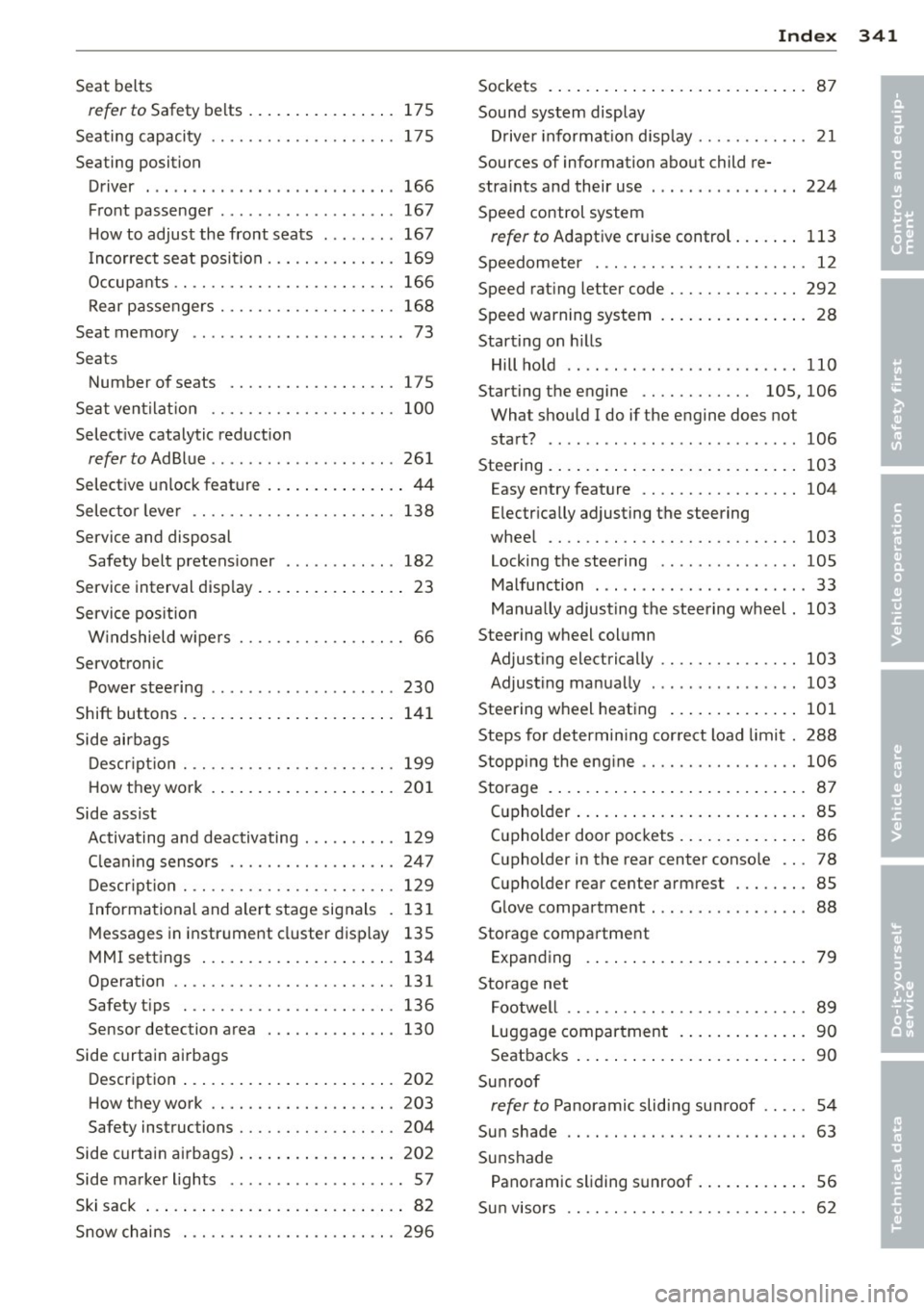
Seat belts
re fer to Safety belts . . . . . . . . . . . . . . . . 17 5
Seating capacity
Seating position
175
Driver . .. .. .. .. .. .. .... ... .. .. .. . 166
Front passenger . ............. ... .. 167
How to adjust the front seats . .. . ... . 167
Incorrect seat position ..... .. .. .. .. . 169
Occupants .. .. ........... .. .. .. ... 166
Rear passengers .......... .. .. .. .. . 168
Seat memory . . . . . . . . . . . . . . . . . . . . . . . 73
Seats
Number of seats ......... .. .. .. .. .
175
Seat ventilation . . . . . . . . . . . . . . . . . . . . 100
Selective catalytic reduction
refer to Ad Blue ... .. ...... .. .. .. .. . 261
Selective unlock feature ........ ... .. .. 44
Selector lever ............. .... .. .. . 138
Service and disposal
Safety belt pretensioner . . . . . . . . . . . .
182
Service interval display . . . . . . . . . . . . . . . . 23
Service position
Windshield wipers ........ .. .. .. .. ..
66
Servotronic
Power steering ............ ... ... ..
230
Shift buttons . . . . . . . . . . . . . . . . . . . . . . . 141
Side airbags
Description .............. .... .. .. .
199
How they work .............. ... ... 201
Side assist
Activating and deactivating . .. .. .. .. .
129
C leaning sensors ......... .. .. .. .. . 247
Description .............. .... .. .. . 129
Informational and alert stage signals . 131
Messages in instrument cluster display 135
MMI settings .................. ... 134
Operation . . . . . . . . . . . . . . . . . . . . . . . . 131
Safety tips . ............. .... .. ... 136
Sensor detection area ..... .. .. .. .. . 130
Side curtain airbags
Description ................. ... ...
202
How they work ........... .... .. .. . 203
Safety instructions ........ .. .. .. .. . 204
Side curtain airbags) ................. 202
Side marker lights ............ .... ... 57
Ski sack ............................ 82
Snow chains . ............. .... .. ... 296
Index 341
Sockets ..... ..... .................. 87
Sound system display
Driver information display ........... .
21
Sources of information about child re-
straints and their use . .... .... ... .. ..
224
Speed control system
refer to Adaptive cruise control ....... 113
Speedometer . . . . . . . . . . . . . . . . . . . . . . . 12
Speed rating letter code .............. 292
Speed warning system . . . . . . . . . . . . . . . . 28
Starting on hills
Hill hold . . . . . . . . . . . . . . . . . . . . . . . . .
110
Starting the engine . . . . . . . . . . . . 105, 106
What should I do if the engine does not
start? ....... ... .. ..... ..........
106
Steering ..... ..... .. ............... 103
Easy entry feature ................. 104
Electrically adjusting the steering
wheel .... .. .. .. ... ............ ..
103
Locking the steering ............... 105
Malfunction ... .... .. .. ...... ...... 33
Manually adjusting the steering wheel . 103
Steering wheel column
Adjusting electrically ............... 103
Adjusting manually ................
103
Steering wheel heating .............. 101
Steps for determining correct load limit . 288
Stopping the engine .. ........... .... 106
Storage .......... .................. 87
(upholder ......................... 85
(upholder door pockets ............ .. 86
(upholder in the rear center console .. . 78
(upholder rear center armrest ....... . 85
Glove compartment . ... ..... ... .. .. . 88
Storage compartment
Expanding . ... .... ................
79
Storage net
Footwell . . . . . . . . . . . . . . . . . . . . . . . . . .
89
Luggage compartment ............ .. 90
Seatbacks . . . . . . . . . . . . . . . . . . . . . . . . . 90
Sunroof
refer to Panoramic sliding sunroof .. .. . 54
Sun shade .. .. .. .. .. ............... . 63
Sunshade
Panoramic sliding sunroof . . . . . . . . . . . .
56
Sun visors .... .. ...... ........... .. . 62
•
•
Page 346 of 348
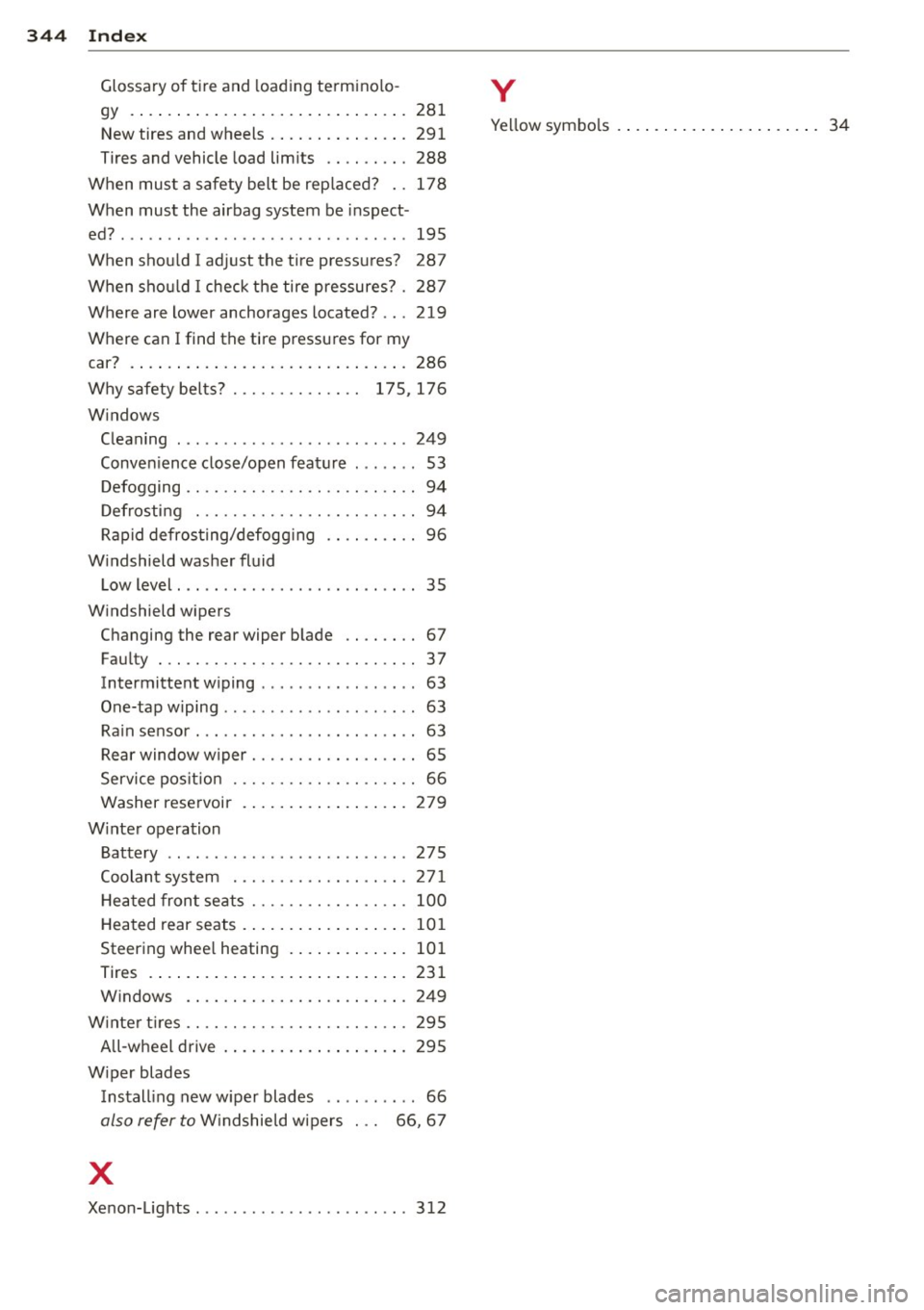
344 Index
Glossary of tire and loading termino lo-
gy . ... .... ... ............ .. .... . 281
New tires and wheels ...... .. .. .... . 291
Tires and vehicle load limits .. .. ..... 288
When mus t a safety belt be rep laced? . . 178
When must the airbag system be inspect-
ed? .... ... .. ................ ... ... 195
When shou ld I adjust the tire pressures? 28 7
When shou ld I check the tire pressures? . 287
Where are lower anchorage s located? ... 219
Where can I find the tire pressures for my
car? . ... .. .. ............... .. .... . 286
Why safety belts? . . . . . . . . . . . . . . 175 , 176
Windows Cleaning . .. ................ ... .. . 249
Conven ience close/open feature . .. .... 53
Defogging . . . . . . . . . . . . . . . . . . . . . . . . . 94
Defrosting . . . . . . . . . . . . . . . . . . . . . . . . 94
Rapid defros ting/defogg ing .. .. .... .. 96
Windshield washer fluid Low level ............. ........ ... .. 35
W indshield w ipers
Changing the rear wipe r blade . . . . . . . . 67
Faulty . .. .......... ....... .. .. .. ..
37
Intermittent wiping ........... .. .... 63
One-tap w iping .... .... ..... .. .. .. .. 63
Ra in sensor . ..... ..... .... ... .. .. .. 63
Rear window w iper . ....... .. .. .. .. .. 65
Service pos it ion . . . . . . . . . . . . . . . . . . . . 66
Washer reservoir .......... ... .... . 279
W inter operation
Battery .. .. ................ ... ... 275
Coolant system ..... ..... .... .. .. . 271
H eated front seats . ....... .. .. .. .. . 100
H eated rear seats .......... ... .... . 101
Steering whee l heating ..... .... ... . 101
Tires . ................... ... .... . 231
W indows .. .... .. ... .. .. .. .. .. ... 249
W inter tires .. ... ..... ..... .. .. .. .. . 295
A ll-wheel drive ............ ... .... . 295
W iper blades
I nstalling new w iper blades ...... .... 66
also refer to Windshie ld wipers . . . 66, 67
X
Xenon-Lights . ................ ... .. . 312
y
Yellow symbo ls . . . . . . . . . . . . . . . . . . . . . . 34