service AUDI Q7 2013 Owner´s Manual
[x] Cancel search | Manufacturer: AUDI, Model Year: 2013, Model line: Q7, Model: AUDI Q7 2013Pages: 348, PDF Size: 87.72 MB
Page 69 of 348
.. Lift the wiper blade off in the direction of
the arrow @.
Install ing wipe r blade
.. Place the new wiper b lade in the retainer on
the wiper a rm ©
r::!>fig. 68.
.. Swing the wipe r blade in the direction of
the arrow @against the wiper arm .
.. Squeeze the corrugation on the wiper until
you hear the bracket click in the wiper arm .
.,. Place the wiper arm back against the wind-
shield.
Clean your wiper blades regularly with a wind
shie ld washer solution to prevent streaking. If
the blades are very dirty, for example with in
sects, carefully clean the blades with a sponge
or a soft brush .
If the wiper blades begin to streak the wind
shie ld, this could be caused by residue left on
the windshield by automatic car washes .
Fi ll the windshield washer container with a
specia l solution available at your authorized
Aud i dealer to remove the residue.
A WARNING
Be sure to inspect the condit ion of yo ur
w iper blades regularly. See yo ur author
ized Aud i dea le r for r eplacement b lades .
(D Note
-The windshield wiper blades must only
be replaced whe n in the service position
r::!> page 66! Otherwise, yo u risk da mag-
i ng the pa int on the hood or the wind
s h ield wiper motor.
- To he lp prevent damage to the wiper sys
tem, a lways loosen blades which are fro
z en to the windsh iel d befo re ope rat ing
wipe rs.
- To he lp prevent damage to w iper b lades,
do no t use g asoline, ke rose ne, pa int
t hi nner, or othe r so lven ts on or nea r th e
wipe r blades .
- To he lp prevent dam age to the wiper
arms or other components, do not at
tempt to move the w ipers by hand .
Clear vision 6 7
@ Tips
Commercia l hot wa xes applied by auto
matic car washes affect the cleana bility of
the windshield .
Changing the rear wiper blade
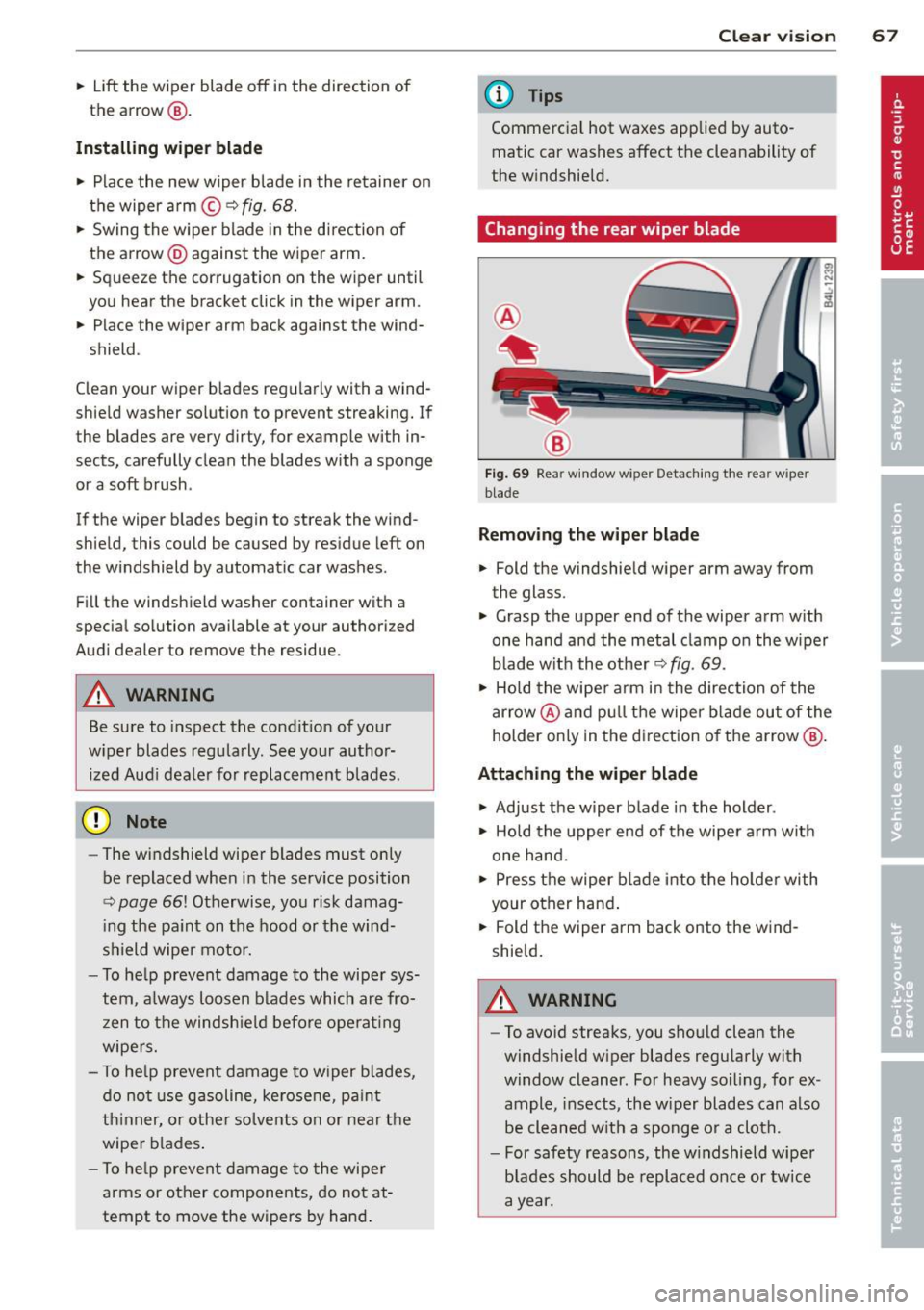
F ig . 6 9 Rear w indow w iper Detac hing the rear wiper
b lade
Removing the wiper bl ade
.. Fold the windshie ld w iper arm away from
the glass.
.. Grasp the upper end of the wiper a rm with
one hand and the metal clamp o n the wiper
b lade w it h the other
Q fig . 69.
.. Ho ld the wipe r arm in the direction of the
arrow @and pu ll th e wiper b lade out of the
holder on ly in the d irection of the arrow @.
Attaching the w iper blade
.,. Ad just the wiper b lade in the holder .
.. Ho ld the upper end of the wipe r arm wit h
one hand.
.. Press t he wiper b lade i nto the ho lder wi th
your other hand .
.. Fold the w iper arm back onto the wind
shield.
A WARNING
- To avoid streaks, you should clean the
windshie ld w iper blades regu larly with
w indow cleaner. For heavy soiling, for ex
ample, insects, the w iper blades can also
be cleaned w ith a sponge or a cloth.
- For safety reasons, the w indshield wipe r
blades should be replaced once or tw ice
a year.
Page 184 of 348
182 Safety belts
Improperly worn safety belts
Incorrectly positioned safety belts can cause
severe injuries .
Wearing safety belts improperly can cause se
rious injury or death. Safety belts can only
work when they are correctly positioned on
the body . Improper seating positions reduce
the effect iveness of safety belts and will even
i ncrease the r isk of injury and death by mov
ing the safety belt to critical areas of the
body . Improper seating positions also in
crease the risk of serio us inj ury and death
when an airbag deploys and strikes an occu pant who is not in the correct seating posi
tion . A driver is responsible for the safety of
all vehicle occupants and especially for ch il
dren . Therefore:
.. Never permit anyone to ass ume an incorrect
sitting position in the vehicle wh ile traveling
¢ _& .
A WARNING
Imprope rly worn safety belts increase the
r isk of se rious personal injury and death
whenever a veh icle is being used.
- Always make sure that al l vehicle occu-
pants are correctly restrained and stay in
a correct seating position wheneve r the
vehicle is be ing used.
- Always read and heed all WARNINGS and
other important info rmat ion
¢page 178.
Safety belt preten
sioners
How safety belt pretensioners work
In front, side and rear -end collisions above a
particular severity and in a rollover , safety
belts are tensioned automatically.
The safety belts are equipped with safety belt
pretensioners . The system is activated by sen
sors in front, side and rear-end collisions of
g reat seve rity and in a rollove r. T his tightens
the belt and takes up be lt slack ¢.&.
in Service and disposal of safety belt pretensioner on
page 183.
Taking up the slack helps to reduce
forward occupant movement dur ing a coll i
s ion.
(D Note
Never let the belt remain over a rear seat
back that has been fo lded forward.
(D Tips
The safety belt pretensioner can only be
activated once.
- In minor frontal and s ide collisions, in
rear-end collisions and in accidents in
volving very little impact force, the safe
ty be lt pretensioner are not activated.
- When the safety belt pretensioners are
activated, a fine dust is re leased. This is
normal and is not caused by a fire in the
vehicle.
- The re levant safety requ irements must
be observed when the vehicle or compo
nents of the system are scrapped. An au
thorized Audi dealer or qualified work
shop is familiar with these regulations
and w ill be pleased to pass on the infor
mation to you .
- Be sure to observe all safety, env iron
mental and other regu lations if th e ve hi
cle or individual parts of the system, par
t ic ular ly the safety belt or airbag, are to
be disposed. We recommend you have
your authorized Audi dealer perform this
service for you .
Service and disposal of safety belt
pretensioner
The safety belt pretens ioners are parts of the
safety belts on your Aud i. Insta lling, remov
ing, servic ing or repairing of belt pretension
ers can damage the safety belt system and
prevent it from working correctly in a co lli
s ion .
T he re a re some important t hings you have to
know to make su re that the effectiveness of ..,.
Page 200 of 348
198 Airbag system
(D Tips
If the weight-sensing mat in the front pas
senger seat detects an empty seat, the
front airbag on the passenger side will be turned off, and the
PASSENGER AIR BAG
OFF
light will stay on.
Repair, care and disposal of the airbags
Parts of the airbag system are installed at
many different places on your Audi . Installing,
removing, servicing or repairing a part in an
area of the vehicle can damage a part of an
airbag system and prevent that system from
working p roperly in a collision.
There are some important things you have to know to make sure that the effectiveness of
the system will not be impaired and that dis
carded components do not cause injury or pol
lute the environment.
A WARNING
Improper care, servicing and repair proce
dures can increase the risk of personal in
jury and death by preventing an airbag from deploying when needed or deploying
an airbag unexpectedly:
- Never cover, obstruct, or change the steering wheel horn pad or airbag cover
or the instrument panel or modify them
in any way .
- Never attach any objects such as cu
pholders or telephone mountings to the
surfaces covering the airbag units.
- For cleaning the horn pad or instrument
panel, use only a soft, dry cloth or one
moistened with plain water. Solvents or
cleaners could damage the airbag cover
or change the stiffness or strength of the material so that the airbag cannot de
ploy and protect properly.
- Never repair , adjust, or change any parts
of the airbag system.
- All work on the steering wheel, instru
ment panel, front seats or electrical sys
tem (including the installation of audio
equipment, cellular telephones and CB radios, etc.) must be performed by a
qualified technician who has the training
and special equipment necessary.
- For any work on the airbag system, we
strongly recommend that you see your
authorized Audi dealer or qualified work
shop.
- Never modify the front bumper or parts
of the vehicle body.
- Always make sure that the side airbag
can inflate without interference:
- Never install seat covers or replace
ment upholstery over the front seat
backs that have not been specifically
approved by Audi.
- Never use additional seat cushions that
cover the areas where the side airbags
inflate.
- Damage to the original seat covers or
to the seam in the area of the side air
bag module must always be repaired
immediately by an authorized Audi
dealer. - The airbag system can be activated only
once. After an airbag has inflated, it
must be replaced by an authorized Audi
dealer or qualified technician who has
the technical information, training and
special equipment necessary.
- The airbag system can be deployed only once . After an airbag has been deployed,
it must be replaced with new replace
ment parts designed and approved espe
cially for your Audi model version . Re
placement of complete airbag systems
or airbag components must be per
formed by qualified workshops only. Make sure that any airbag service action
is entered in your Audi Warranty
& Main
tenance booklet under
AIRBAG REPLACE
MENT RECORD .
-For safety reasons in severe accidents,
the alternator and starter are separated
from the vehicle battery with a pyrotech
nic circuit interrupter.
- Work on the pyrotechnic circuit inter
rupter must only be performed by a
qualified dealer - risk of an accident!
Page 201 of 348
-If the ve hicle or the circuit interrupter
is scrapped, all applicable safety pre
cautions must be followed.
@ For the sake of the environment
Undep loyed airbag modu les and preten
sioners might be classified as Perchlorate
Material -special handling may app ly, see
www.dtsc.ca.gov/hazardouswaste/per chlorate . When the vehicle or parts of the
restraint system including airbag modules
and safety bel ts w ith pretens ioners are
scrapped, a ll applicable laws and regula
tions must be observed . Your authorized
Aud i dea le r i s familiar w it h these require
ments and we recommend that you have
your dea le r perform this service for you.
Other things that can affect Advanced
Airbag performance
Changing the vehicle's suspension system can
change the way that the Advanced A irbag Sys
tem pe rforms in a crash. For example, us ing
tire -r im combinations not approved by Aud i,
l owering the vehicle , changing the stiffness o f
the s uspension, incl uding the springs, s uspen
sion struts, shoc k absorbers etc. can change
the forces that are measured by the airbag
sensors and sent to the electronic control
un it. Some suspension changes can, for exam
p le, increase the force levels measured by the
sensors and make the airbag system deploy in
crashes in wh ich it would not dep loy if the
changes had not been made. Ot he r kinds of
changes may redu ce the force levels meas
ured by the sensors and prevent the a irbag
from deploying when it sho uld .
The senso rs in the safety belt buckle fo r th e
dr iver and front passenger sea t tell the elec
tronic control module if the safety belt is
l a tched o r not.
If the safety belt is being used,
the front airbag will deploy at a slightly high
er rate of vehicle deceleration than if the safe
ty belt is not being used. Therefore, in a par
ticular collision, it is poss ible that an airbag
will not deploy at a seati ng position where the
safety belt is being used but will inflate at the
A irba g sy stem 199
position where t he safety be lt is not be ing
u sed. It is important that nothing interfere
with the safety be lt b uckles so that the sen
sors can send the correct information about
safety belt use to the electronic control un it.
A WARNING
C hanging the vehicle's suspension includ
ing use of unapprove d tire-r im combina
tions can cha nge Advanc ed Airbag per
fo rman ce an d in crease the r isk of se rious
person al injury in a crash.
- Never install suspension components
tha t do no t have the same pe rforman ce
characteris tics a s the co m ponen ts origi
na lly installed on yo ur vehicle.
- N ever use tire-rim combin ations tha t
have not been approved by Audi.
A WARNING
-
Items stored between the safety be lt
b uckle and the cente r console can cause
the sensors in t he b uckle to send the
wrong information to the e lectronic con
trol module and prevent the Advanced Air bag System from working properly.
-A lways make su re that nothing can inter-
fere with the safety belt buckles and that
they are not obstructed .
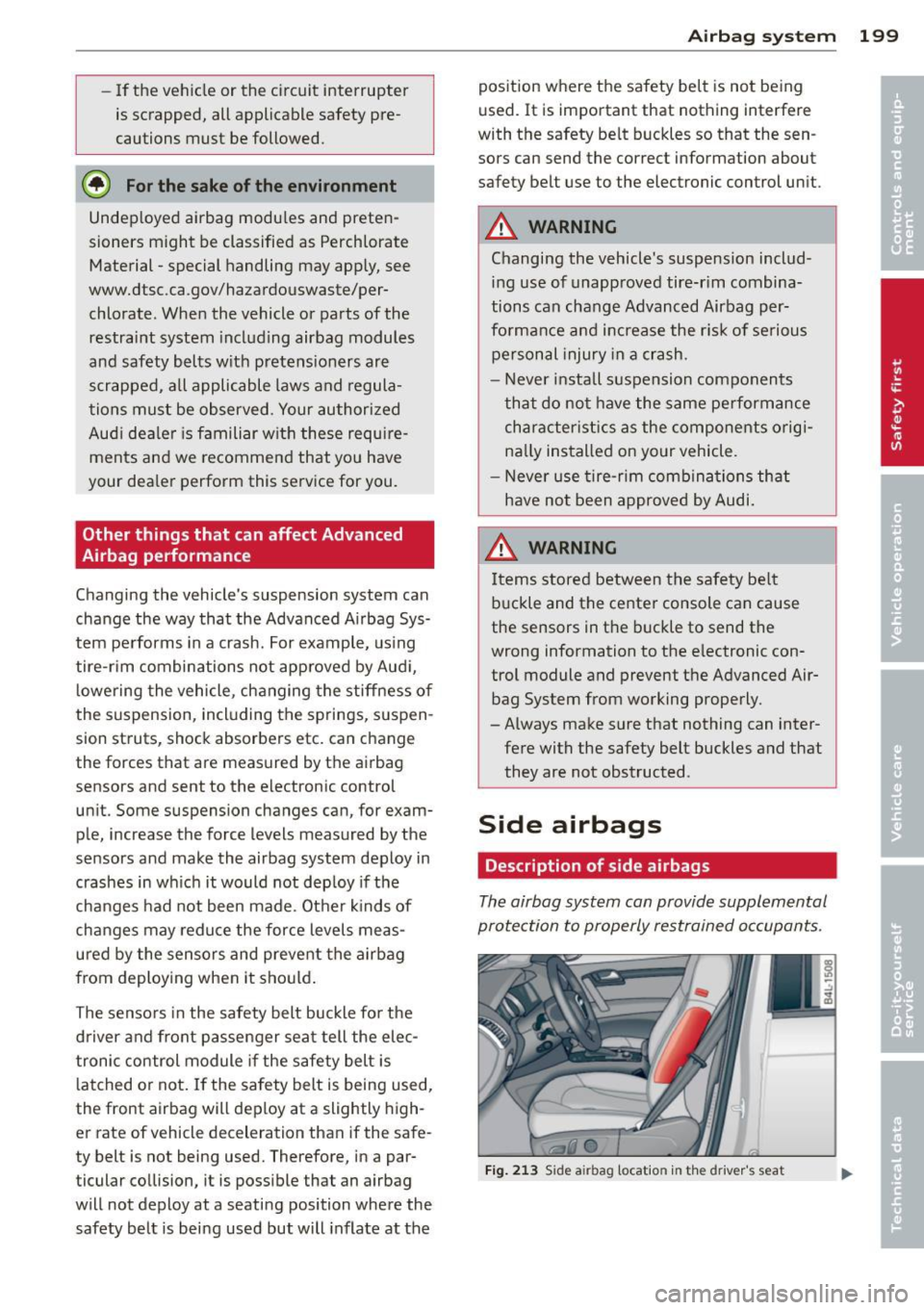
Side airbags
Description of side airbags
The airbag system can provide supplemental
protection to properly restrained occupants .
Fig. 2 13 Side a irbag locat io n in t he driver's seat
Page 232 of 348
230 Intellig ent technol ogy
8_ WARNING
Although the ABS is very effective, always
remember that bra king capability is limit
ed by t ire traction . Always adjust your dr iv
ing spee d according to the road and t raffic
co nditions. Do no t let t he extra sa fety af
forded by the ABS tempt you into ta king
extra risks. The ABS cannot overcome the
laws of physics.
@ Tips
- If ABS is not functioning prope rly, a
warning light will come on. See
¢page 18 .
-If a fault occurs in the ABS, the EDL is al
so not functioning. This is indicated by
the ABS warning light .
Brake assistant
The brake assistant is designed to achieve the
optimum braking effect .
The brake assistant helps to increase the ef
fective b rak ing power and thus to achieve a
shorter stopp ing distance. If the driver
presses the brake pedal very quickly, the brake
assistant automatica lly boosts the braking
force to the maximum level, up to the point where the anti-lock brake function (ABS) inter
venes to stop the wheels from locking. You
should then keep the brake pedal pressed un
til the veh icle has braked to the required
speed . The brake assistant sw itches itself off
as soo n as you re lease the brake pedal.
Automatic full braking a ssist
This funct ion allows full brak ing in spite of
h igh brake pedal forces (e .g . when the brakes
a re severely stressed because the vehicle is
fully loaded) . The driver notices th is function
throug h a reduction of pedal force and in
creased pedal trave l. When the brake peda l is
r e leased, fu ll braking assis t switc hes off again
automatically.
I f the re is an ABS fa il ur e, the brake ass ista nt
and automatic full b rak ing ass ist are not avai l
ab le . The brake assistant wi
ll not be operative if
there is a ma lfunction in the ABS .
8_ WARNING
-Please remember that the accident risk a l-
ways increases if you drive too fast, espe
cially in corners or on a slippery road, or if
you follow the veh icle ahead of you too
closely. Increased r isk of an accident can
not be compensated for even by the brake
assistant, so always maintain a safe speed.
Servotronic ® -
advanced power
steering system
The power steering systems uses the power of
the running engine to allow precise steering
with little effort.
The advanced Servotronic ® power steering
system senses the road speed and electron i
cally adjusts power assistance to provide com
fortab le and safe steering response exact ly
matched to the vehicle speed .
Power steer ing will not work if the engine is
off . As a result, the steering wheel will be hard
to turn .
The power steering fluid level is checked dur
ing the scheduled maintenance services .
d) Note
If there is an electronic malfunction, ser
votronic
will still function like a conven
tiona l powe r steering system, providing a
constant steering support force that is no
l onger proportionate to the vehicle speed .
This is most not iceable when turning the
stee ring wheel at low speeds (fo r example
when pa rking), - more effort w ill be re
q uired than us ua l.
- Be aware o f the different than usual
steering response and adjust your steer
ing force accordingly.
- Have the problem checked and set r ight
by an Audi dealer as soon as possible .
Page 239 of 348
It takes a long time for the engine to warm up
fu lly when it is running at idle. However , wear
and nox ious em issions are especially high
when the engine is warming up. So you should drive away as soon as you start the engine and
avoid running at high rpms while the engine is
still warming up .
(D Note
Do not leave engine idling unattended af
ter starting . If warning lights should come
on to indicate improper operation, they
wou ld go unheeded. Extended idling also
p roduces heat, which cou ld resu lt i n over
heating or other damage to the vehicle or
other property.
Regular maintenance
A badly tuned engine unnecessarily wastes a lot of fuel.
"' Have your vehicle serv iced at regular inter-
vals.
By having your vehicle regularly serviced by an
author ized Audi dealer helps to ensure that it
r uns p roper ly and economically. The condition
of your vehicle not only affects its safety and
ab ility to hold its value, it also affects
fuel
c on sumption.
Ch eck your oil each time you fill your tank .
The amount of oil used is related to engine
load and speed .
It is normal for the oil consumption of a new
engine to reach its lowest v alue after a certain
mileage has been dr iven .
You must drive your vehicle about 3,000 miles (5,000 ki lometers) before you can properly
assess o il consumption .
This a lso applies to fuel consumption and en
gin e output.
0 Note
- Have yo ur vehicle maintained properly
and in accordance wit h the service rec
ommendations in your War ranty
& Main-
Dri vin g and en vironm ent 237
tenance book let. Lack of p roper mainte
nance as well as improper use of the ve
hicle will impair the function of the
em ission contro l system and could lead
to damage.
- Do not alter or remove any component of the Emission Control System unless approved by the manufacturer.
- Do not alter or remove any device, such as heat shie lds, switches, ign ition w ires,
valves, which are designed to protect
your vehicle's Emission Control System and other impo rtant vehicle compo
nents.
Fewer short trips
Fuel consumption will always be relatively
high on short trips .
"' Try to avoid driv ing short distances w ith a
cold engine .
The eng ine and cataly tic converter have to
reach their opt imal
operat ing temperature t o
reduce fuel consumpt ion and nox ious em is
s ions effect ively .
Just after starting, a co ld eng ine in a mid-s iz e
car only achieves a fuel economy of 6-8 mi les
per gallon (30 -40 l/l00km). After about a
half a mile , fuel economy cl imbs to 12 mpg
(20 l/100 km) . After about
2.5 miles (4 km),
t he engine is at i ts p rope r opera ting tempe ra
tu re and f uel economy has reached a normal
l evel. So you can see that yo u should avo id
short trips whenever possible.
T he
out sid e t emperature is also cr itica l in th is
regard. Your car consumes more fue l in the
winter than in the s ummer.
•
•
Page 259 of 348
-Blend must contain not more than 1S%
MTBE.
Seasonally adjusted gasoline
Many gasoline grades are blended to perform
espec ially we ll for winter or summer driving.
During seasonal change-over, we suggest that
you fill up at busy gas stat ions where the sea
sonal adjustment is more likely to be made in
time .
(D Note
-Methanol fuels which do not meet these
requirements may cause corrosion and
damage to plastic and rubber compo
nents in the fuel system.
- Do not use fue ls that fail to meet the
specified criter ia in this chapter.
- If you are unable to determine whether
or not a particular fue l blend meets the
specifications, ask your service station or
its fuel supp lier.
- Do not use fuel for which the contents
cannot be identified.
- Fuel system damage and performance
problems resulting from the use of fuels
different from those specified are not
the responsibility of Audi and are not
covered under the New Vehicle or the Emission Control System Warranties.
- If you experience a loss of fuel economy
or driveability and performance prob l ems due to the use of one of these fuel
blends, we recommend that you switch
to unblended fuel.
Gasoline additives
Applies to vehicles : wit h gasoli ne e ng in e
A majo r concern among many auto manufac
ture rs is carbon deposit build-up caused by
the type of gasoline you use.
Although gasoline grades differ from one manufacturer to another , they have certain
things in common. All gasoline g rades contain
substances that can cause deposits to collect
on vital engine parts, such as fuel injectors
and intake valves. Although most gasoline
Fuel supply and filling your fuel tank 257
brands include additives to keep engine and
fuel systems clean, they are not equally effec
tive .
Audi recommends using TOP TIER Detergent
Gasoline . For more information on TOP TIER
Detergent Gasoline, please go to the official
webs ite (www.toptiergas.com).
After an extended per iod of using inadeq uate
fuels, carbon deposit build-ups can rob your
engine of peak performance.
(D Note
Damage or malf unct ion due to poor fuel
quality is not covered by the Audi New Ve
hicle Limited Warranty.
Diesel fuel
Applies to veh icles: w ith diesel engine
Always use ULSD (Ultra Low Sulfur Diesel) sul
fur content 15 ppm or less.
The ULSD (U ltra Low Sulfur Diesel) meets the
ASTM-D-97S (grade 2).
Die sel fuel with a higher concentration than
ULSD-Die sel No. 2 ASTM D975 and Bio-die
sel with a higher concentration than 5
% like
Bl 1 , B20 or B100 are strictly prohibited.
Service station fue l pumps are labeled with
the correct fuel information for easy recogni
tion by the user. If the diesel fuel pump is not
labeled ask the station operator what fuel is
being dispensed before filling up your vehicle.
Serv ice stations offering Diesel fuel are gener
ally located on truck routes or major high
ways . Directories of Diesel fuel stations are
usually available at Diese l fuel stations.
Some states in the USA require permits to
purchase Diesel fuel. Check with your State
Motor Vehicle Department .
Diesel fuel may not be available outside the
USA and Canada. Be sure to check before trav-
eling to other countries .
Ill-
•
•
Page 270 of 348
268 Checking and filling
VW 502 00 (vehicles with gasoline engine) or
VW 507 00 (vehicles with diesel engine).
Changing the engine oil
The engine oil and oil filter must be changed
according to the m ileage (ki lometers) and
time intervals specified in your vehicle 's War
ranty
& Maintenance booklet. Do not exceed
these intervals -harmful deposits from old
engine oil can reduce engine performance and
can lead to expensive engine repairs.
Changing the oil at the recommended inter
va ls is so very important because the lubricat
ing properties o f oi l decrease gradually during
normal vehicle use. If you are not sure when
you have your o il changed, ask your author
i z ed Audi Service Advisor.
Under some ci rcumstances the engine oi l
should even be changed more frequently .
Change oi l more often if you drive mostly
short distances, operate the vehicle in dusty
areas or mostly under stop-and-go traffic con
d itions, or when you use your vehicle w here
temperatures stay below freez ing point for
l ong periods .
Detergent additives in the o il w ill make fresh
oil look dark after the engine has been run
ni ng for a short time . This is normal and is not
a reason to change the oil more often than
recommended.
Damage or malfunctions due to lack of
maintenance
It is essential that you change your oil at the recommended intervals using only engine oil
that complies with Audi oi l standard
VW 502 00 (vehicles with gasoli ne engine) or
VW 507 00 (veh icles with diese l engine) . Your
Limited New Vehicle Warranty does not cover
damage or malf unctio ns due to failure to fol
lo w recommended maintenance and use re
quirements as set forth in the A udi Owner's
Manual and Warranty
& Maintenance booklet.
Your dea ler will have to deny warranty cover
age unless you present to the dealer proof in
the form of Service or Repa ir Orders that all scheduled maintenance was
performed in a
timely manner.
Engine oil consumption
To provide effective lubrication and cooling for
internal engine parts, all internal combustion
engines use some o il. Oil consumption varies
from engine to engine and may change over
the life of the engine. Engines tend to use
more o il during the break-in period tha n they
do afterward, when oil consumption has sta
bilized. Depending on the way the vehicle is
driven and the operating conditions, oil con
s u mption can be up to 1 quart per 1,200
miles (1 liter per 2,000 km) . Consumption
may be higher within the first 3,000 m iles
(5,000 km) .
Under normal conditions, the rate of oil con
sumption depends on oil quality as well as vis
cosity, engine speed (rpm), outs ide tempera
ture, road conditions, the amount of oil dilu
t ion caused by condensed water or fue l resi
due, and ox idat ion of the oil. Oil co nsumption
may increase with engine wear over time, un
t il replacement of worn engine pa rts may be
come necessary.
Because of all these variables, there is no
standard or "norma l" rate of oil consumption .
We urge you to check the engine oil level at
regular intervals, preferably every time you
fill the fuel tank, and always before a long
trip.
The oil pressure warning light. is not an
indicator of low engine oil level. If the warn
ing light does not go out after starting, or
flashes while driving (above 1500 rpm), a
buzzer will sound. It indicates that the oil
pressure is too low . Stop the engine immedi·
ately, check the engine oil level and add oil if
necessary. If the engine oil level is normal,
but the light continues to flash, do not keep
driving or let the engine idle, as damage may
occur .
II-
Page 273 of 348
a reason to change the oil more often than recommended.
A WARNING
Stop! Before working in the engine com
partme nt, always read and heed all WARN
INGS
q & in Working in the engine com
partment on page 264.
The engine com
partme nt of any motor veh icle is a poten
tially dangerous a rea and can cause ser i
ous pe rsonal injury.
A WARNING
If you must change the engine o il i n your
vehicle:
- Always wea r eye p rotection.
- To reduce the r isk of burns from hot en-
gine oil let the engine cool down to the
t ouch.
- When removing the oil drain plug with
yo ur finge rs, stay as far away as possible.
Always kee p your forea rm pa ra llel to the
ground to he lp prevent ho t oi l from r un
ning down your arm.
- Drain the o il into a co nt ainer designed
f or this p urpose, one large enough to
hold at least the total amount of oil in
yo ur engine .
- T o reduce the r is k of po ison ing, never use
empty food or beverage containers that
might mis lead someone into drinking
from them.
- Engine oil is poisono us. Keep it well out
of the reach of chi ldren.
- Cont in u ous contact with used engi ne oil
is harmful to your skin. Always protect
yo ur sk in by washing tho ro ughly with
soap and water.
(D Note
Never mix oi l addit ives with your engine
oil. These additives can damage your en
gine and adverse ly affect your Audi Limit
ed New Vehicle Warranty.
-
Checkin g and fillin g 2 71
@) For the sake of the environment
-Before changing the oil, first make sure
you know where you can prope rly dispose
of the old o il.
- Always dispose of used oil p ro perly. Nev
er dump it on garden soil, in wooded
areas, into streams or down sewage
dra ins.
- Recycle used o il by tak ing it to a used en
gine oil collection facility in your area, or
contact a service station.
- We strongly recommend that yo u have
your oil cha nged by an authorized Audi
dealer or a qualified wo rkshop with the
special tools a nd expert ise required, and
proper m eans of disposa l.
Engine cooling system
Coolant
The engine coolant performs two functions: it
keeps the engine from overheating and it pro tects the engine from freezing in the winter.
T he cooling sys tem is sealed and genera lly re
quires little attention.
T he cooli ng system has bee n filled a t the fac
t ory with a permanent coolant which does not
need to be c hanged . The coo lant cons ists of a
mixture of water and the manufacturer's gly
col-based coo lant additive G l3 antifreeze
with anticorrosion additives (50% for USA
models; 60% for Canadian mode ls). This m ix
ture both assures the necessary frost protec
tion and protects meta l compone nts in t he
engine's cool ing system from corros io n and
sca ling.
It also raises the boiling point of the
c oolant.
Do not reduce the concentration of the cool
ant in the s ummer by adding p lai n water .
The
proportion of coolant additive must be at
lea st 50 % but not more than 60 %
to main
tai n antifree ze pro te ct io n a nd coo ling eff icien
cy .
If the coo lant fros t protection is too low,
the coo lant co uld freeze and damage the vehi-
cle heating and engine cooling system. .,..
•
•
Page 289 of 348
pressure label lists the recommended cold
tire inflatio n pressures for the vehicle at its
maximum capacity we ight a nd the tires that
were on your vehicle at the time it was man
ufactured . For recommended t ire pressures
for normal load condit ions, please see chap
ter ~
page 284 .
-Turn the valve stem cap counter-clockwise
to remove it from the tire valve .
- Place the air pressure gauge on the valve.
- The tire pressures should only be checked
and adjusted when the tires are cold . The
s light ly raised pressures of warm tires must
not be reduced .
- Adjust the tire pressure to the load you are
carrying.
- Re insta ll the va lve stem cap on the valve .
When should I check the tire pressure ?
The correct tire pressure is especially impor
tant at high speeds . The pressure sho uld
therefo re be checked at least once a month
and a lways before start ing a journey. Do not
forget to check the tire pressure for the spare
wheel.
When should I adju st the tire pre ssures?
Ad just the tire pressure to the load you are
carrying. After changing a wheel
or replacing
wheels you have to adjust the tire pressures
on all wheels. In addition, you must then
store the new tire pressures i n the t ire pres
sure mon itor ing system
~ page 300.
A WARNING
Incorrect tire pressures and/or unde rinfla
tion ca n lead sudden tire failure, loss of
cont ro l, col lision, ser ious persona l inju ry
or even death.
- Whe n the wa rning symbo l
[ti] appears in
the instrume nt cl uster, s top and inspect
the tires.
- Incorrect tire pressure and/or underinfl a
t ion can ca use inc reased t ire wear and
can affect the handling o f the veh icle and
stopp ing ability .
- Incorrect tire pressures and/or underin
flation ca n also lead to sud den tire fa il-
Tires an d wheel s 287
ure, including a blowout and sudden de
flation, ca using loss of veh icle contro l.
- The driver is responsi ble for the co rrect
tire pressures for all tires on the veh icle.
The applicable pressure values are locat
ed on a sticker o n the dr iver's s ide B-pil
lar .
- Onl y when all tires on the vehicle are fil
led to the correct pressure, the t ire pres
sure mon itor ing system can work cor
rectly .
- The use of incorrect tire pressure va lues
can lead to acc idents or other damage .
Therefore it is ess ential that th e drive r
observe t he spec ified t ire p ress ure val ues
for the tires and the cor rect pressures for
the func tion of the t i re p ress ure moni to r
ing system.
- Always in flate tires to the recommen ded
a nd correct t ire p ress ure be fore dr iv ing
off .
- D riving with unde rinf lated tires bend
mo re, letting them get too hot resulting
in tread separation, s udden tire failure
and loss of control.
- Excessive speed and/overloading can
cause heat b uild- up, sudden tire failure
and loss of control.
- If the tire pressure is too low or too high,
the t ires will wear premat urely and the
veh icle w ill not handle well.
- If the tire is not flat and you do not have
to change a wheel immediately, d rive at
red uced speed to the nearest service sta
tion to check the t ire press ure and add
air as requ ired .
(D Note
Driving w ithout valve stem caps can cause
damage to the tire valves. To prevent this,
a lways make sure that factory installed
valve s tem caps o n all whee ls are sec urely
mounted o n the valve .
@ For the sake of the environment
Underinflated tires will also increase the
fuel consumpt ion.
•
•