warning AUDI Q7 2013 Owner´s Manual
[x] Cancel search | Manufacturer: AUDI, Model Year: 2013, Model line: Q7, Model: AUDI Q7 2013Pages: 348, PDF Size: 87.72 MB
Page 298 of 348
29 6 T ire s and whee ls
was manufactured . Please see q page 292,
Speed roting (letter code) for a listing of the
speed rating letter codes and the maximum
speed at which the tires can be driven.
The speed rating letter code( ¢
page 282) is
on the side wall of the tire
c::> page 291.
A WARNING
Winter tires have maximum speed limits
that may be lower than your vehicle's max
imum speed. Always know the maximum
speed before driving off . Never drive faster
than the speed permitted for your specific
w inter t ires. This will cause damage to the
tires leading to an accident and serious
personal inj ury to you and your passen
gers.
A WARNING
=
Driving faster than the maximum speed
for which the winter tires on your vehicle
were designed can cause tire failure in cluding a blowout and sudden deflation,
loss of control, crashes and serious per
sonal injuries. Have worn or damaged tires
replaced immed iately .
- Winter tires have maximum speed rat ing
that may be lower than your veh icle's
maximum speed .
- Never drive faster than the speed for
which the winter or other tires installed on your vehicle are rated.
A WARNING
Always adjust your driving to the road and
traffic conditions. Never let the good ac
celeration of the winter tires and all-wheel
drive tempt you into taking extra r is ks. A l
ways remember:
- When brak ing, an a ll-wheel d rive vehicle
hand les in the same way as
a front drive
vehicle.
- Drive caref ully and reduce your speed on
icy and slippery roads, even winter tires
cannot he lp under black ice conditions.
{® Fo r the s ake of the en vironment
Use summer tires when weather condi
tions permit. They are quieter, do not wear
as quickly and reduce fuel consumption.
Snow chains
Snow cha ins may be f itted only to the rear
wheels, and only to certain tire sizes . Ask your
authorized Aud i dealer on which tire sizes
snow chains can be used.
The snow chains must have low-prof ile links
and must not be th icker than 0.53 inch
(13 .5 mm), includ ing the lock .
Remove wheel center covers and trim discs
before putt ing snow chains on your vehicle
c::>@ . For safety reasons cover caps must then
be fitted over the wheel bolts. These are avail
able from authorized Aud i dealers.
A WARNING
Using the wrong snow chai ns for your veh i
cle or instal ling them incorrect ly can in
crease the risk of loss of cont ro l leading to
serious personal injury.
- Snow chains are available in different
sizes. Always make sure to follow the in
structions provided by the snow chain manufacturer.
- When driving with snow chains never
drive faster than the speed permitted for
your specif ic snow chains.
- Always observe local regulations .
(D Note
-Remove snow chains before dr iv ing on
roads not covered with snow to avoid
damaging tires and wearing the snow
chains down unnecessarily.
- Snow chains, which come into direct con
tact with the whee l rim, can scratch or
damage it . Therefore, make sure that the
snow chains are s uitably covered. Check
the pos ition of the snow chains after
Page 299 of 348
driving a few yards and correct if neces
sary . Follow the instructions from the
snow cha in manufacturer when doing so.
- If the Adaptive Air Suspension* should
malfunction, do not mount or use snow
chains beca use the vehicle will be ex
tremely low. If you do drive with snow
chains on while the vehicle is at this lev el, the snow chains might severe ly dam
age the wheelhouse and other parts of
the veh icle.
(0 Tips
W here snow cha ins are mandatory oncer
tain roads, this normally also applies to
veh icles w ith all-whee l dr ive.
Wheel bolts
Wheel bolts must always be tightened to the
correct torque .
The design of whee l bolts is matched to the
factory insta lled r ims. If different rims are fit
t e d, the cor rect wheel bolts wit h the right
lengt h and correctly s haped bolt heads must
be used. This ens ures t hat w heels a re fitted
secure ly an d that the brake system f unctions
correctly.
I n ce rtain circumstances, you may not use
wheel bo lts from a d ifferent vehicle -even if it
is the s ame mode l
~page 32 7.
& WARNING
Improperly tig htened or maintained whee l
bolts can become loose ca using loss of
cont ro l, a co llision and serious persona l in
jury.
- Always keep the w heel bolts and the
threads in the wheel hubs clean so the
wheel bolts can turn easily and be prop erly t ightened.
- Never grease or oil the wheel bolts and the threads in the wheel hubs. They can
become loose w hile driving if greased or
o iled, even if tig hte ned to the specified
torq ue.
Tire s an d wheel s 297
-On ly use whee l bolts that be long to the
rim being installed.
- Never use different wheels bolts on yo ur
veh icle.
- Always maintain the correct t ightening
torque for the whee l bolts to reduce t he
risk o f a wheel loss. If the tightening tor
que of t he wheel bolts is too low, they
can loosen and come out when t he vehi
cle is mov ing.
If the tig hte ning torque is
too high, the wheel bolts and threads can be damaged and the whee l can be
come loose.
(D Note
The specified torque for the whee l bolts is
120
ft l b ( 160 Nm) with a to le rance of
± 7, 4
ft lb( ± 10 Nm). Torque w heel bo lts
d iagon ally . After changi ng a w heel, the
torque m ust be chec ke d as soon as poss i
b le with a to rque wrench -preferab ly by an
a uthorized Audi dea ler or q ua lified work
shop .
Low aspect ratio tires
Your Audi is factory-equ ipped with tow aspect
ratio tires. These tires have been thoroughly
tested and been se lected specifically for your
model for their superb perfo rmance, road feel
and handli ng under a var iety of drivi ng condi
tions. As k your au thori zed A udi dealer for
more de tails.
The low asp ect ratio of these tires is ind icated
by a nu mera l of
55 or l ess in the tire's s ize
designation. The n ume ra l rep resen ts the ra tio
of the tire's sidew all height in rel ation to its
tread width exp ressed in percentage . Conven
tiona l tires have a he ight/width ratio of 60 or
more.
The performance of low-aspect-ratio tire s is
particularly sensitive to improper inflation
pre ssure. It is therefore important that low
aspect ratio tires are inflated to the specified pressure and that the inflation pressure is
regularly checked and mainta ined. Tire pres-
sures should be checked at least once a .,..
•
•
Page 301 of 348
TPMS malfunction indicator is combined with
the low tire pressure tellta le . When the sys
tem detects a malf unct ion, the te lltale will
flash for approximately one minute and then remain cont inuously illuminated. This se
quence will continue upon subsequent vehicle
start-ups as long as the malfunction ex ists .
When the malfunct ion indicator is illuminat
ed, the system may not be able to detect or
sig nal low t ire pressure as intended . TPMS
malfunct ions may occur for a variety of rea
sons, including the installat ion of rep lace
ment or alternate tires o r whee ls on the veh i
cle that prevent the TPMS from funct io ni ng
p roperly. Always check the TPM S malfunct ion
tellta le after replacing one or more tires or
wheels on your vehicle to ensure that the re p lacement or a lternate tires and wheels allow
the TPMS to continue to function properly.
Tire pressure indicator appears
The tire pressure indicator in the instrument
cluster informs you if the tire pressure is too
low or if there is a system malfunction.
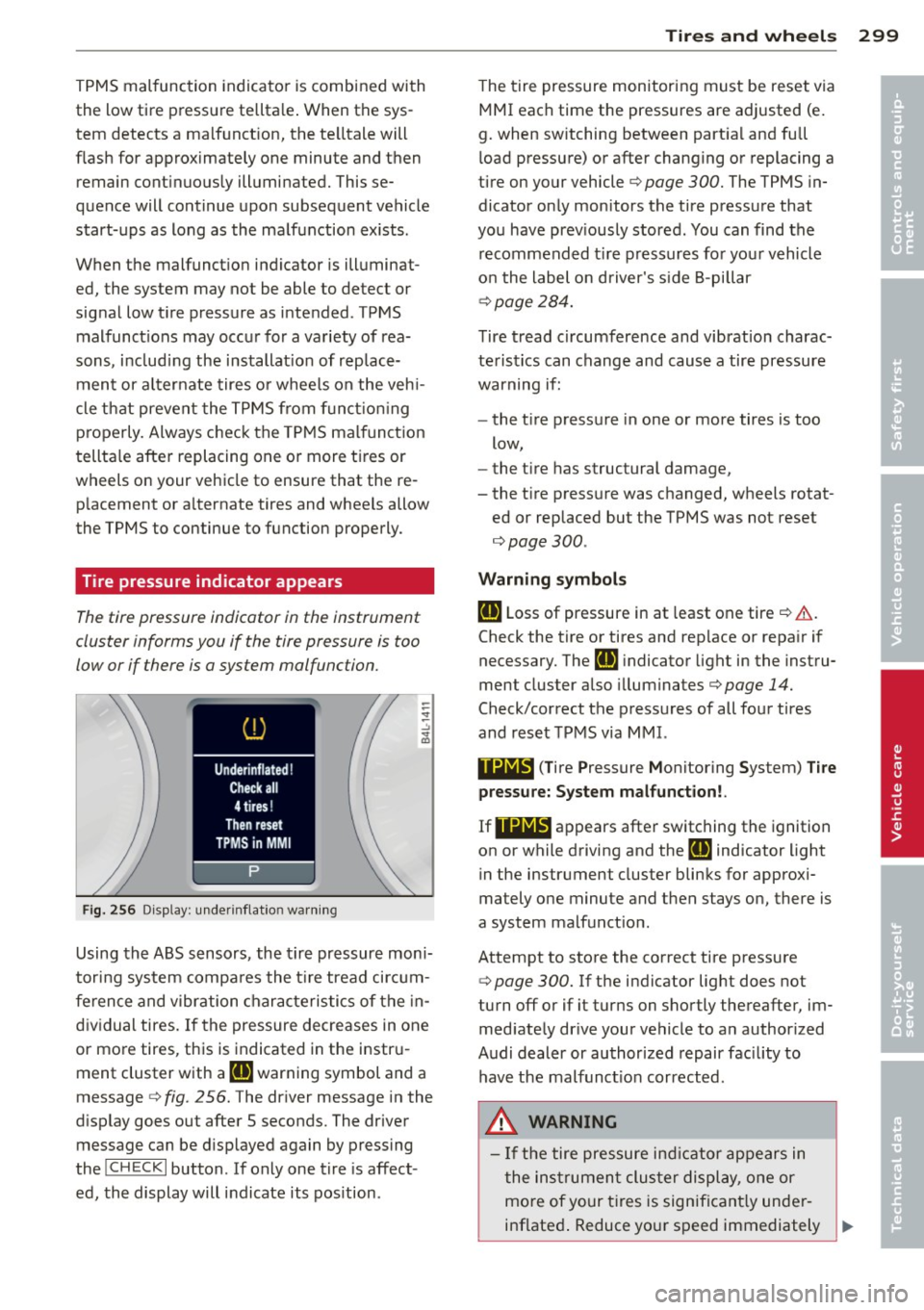
Fi g. 25 6 Display: under inflat io n warn ing
Using the ABS sensors, the tire pressure mon i
tori ng system compa res the t ire tread ci rcum
fe rence and vibration characteristics of the in
dividual tires. If the pressure decreases in one
or more tires, this is indicated in the instr u
ment cluster with a
IE warning symbol and a
message
c:> fig . 256. The driver message in the
d isplay goes out after 5 seconds. The driver
message can be d isplayed again by pressing
the
! CHECK I button . If only one tire is affect
ed, the display will indicate its pos ition .
Tire s an d wheel s 2 99
The t ire pressure monitoring must be reset via
MMI each time the pressures are adjusted (e.
g. when switching between part ia l and full
l oad pressure) or after changing or replacing a
tire on your vehicle
c:> page 300. The TPMS in
dicator on ly monitors the tire pressure that
you have prev iously stored . You can find the
recommended t ire pressures for you r vehicle
o n the label on driver's s ide 8-pillar
¢ page 284.
Tire tread circumference and vibration charac
teristics can change and cause a tire pressure
warning if:
- the t ire pressure in one or more tires is too
low,
- the t ire has structural damage,
- the t ire press ure was changed, wheels rotat-
ed or replaced but the TPMS was not reset
¢page 300.
Warni ng symbo ls
IE Loss of pressure in at least one tire ¢ &..
Check the tire or tires and rep lace or repa ir if
necessary. The
Rt] i ndicator light in the instru
ment cluster also illuminates¢
page 14.
Check/correct the p ressures of all four tires
and reset TPMS via MMI.
••NIB (T ire Pressure Monitoring System) Tir e
pressure: System malfunct ion!.
If llilW appears
after switching the ignition
on or while driving and the
IE indicator light
in the instrument cluster blinks for approxi
mately one minute and then stays on, there is
a system malfunct ion.
Attempt to store the correct tire pressure
¢
page 300. If the indicator light does not
turn off or if it turns on shortly thereafter, im med iate ly dr ive your vehicle to an author ized
Audi dealer or authorized repair fac ility to
have the malfunct ion corrected.
_&, WARNING
- If the tire pressure ind icator appears in
the ins trument cluster display, one or
mo re of your t ires is significant ly under
inflated . Reduce your speed immediately ..,
•
•
Page 303 of 348
What do I do now?
Jack, tools and
inflatable spare tire
Tools
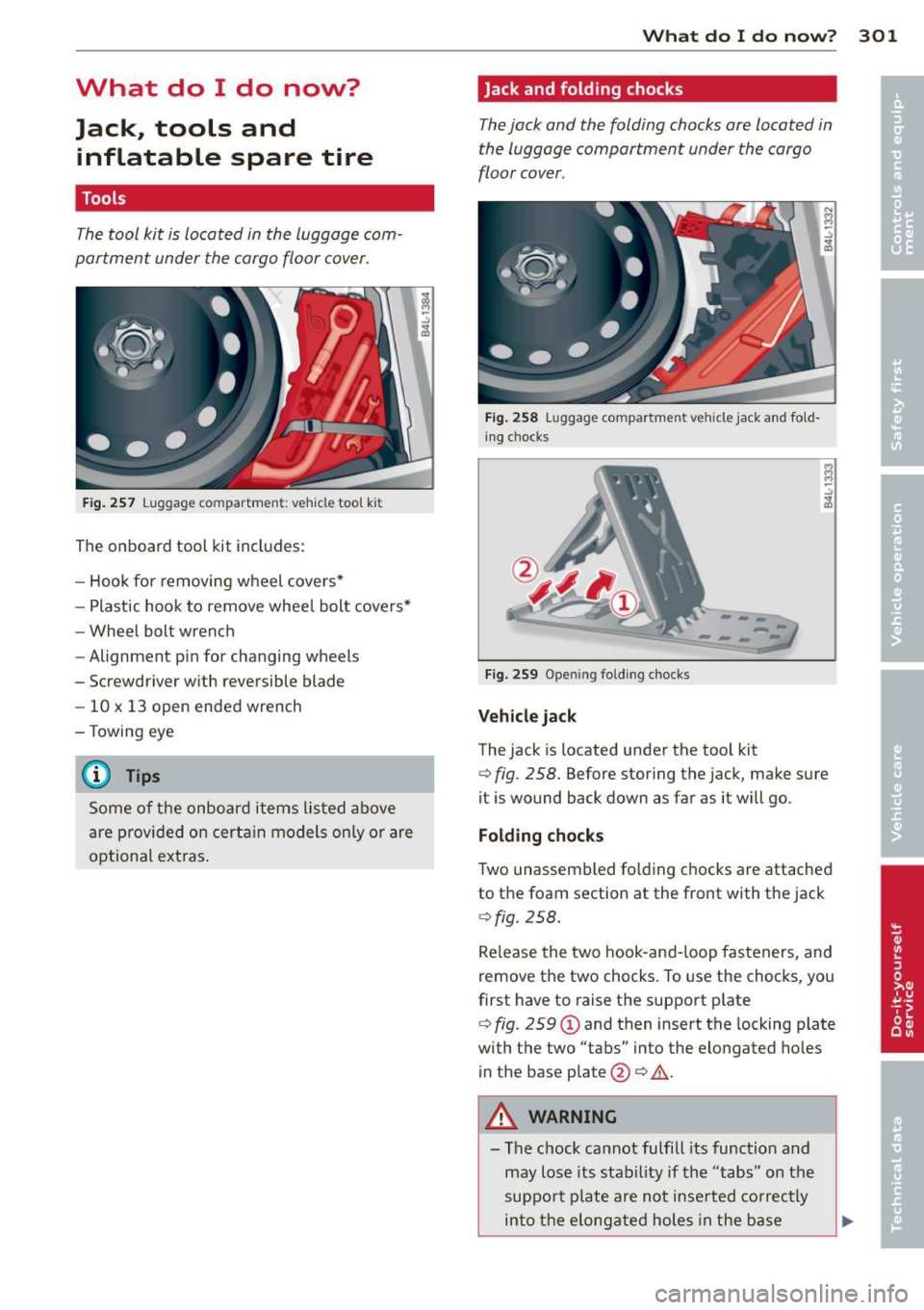
The tool kit is located in the luggage com
partment under the cargo floor cover.
F ig . 257 Luggage compa rtme nt: ve hicle tool ki t
The on board tool kit includes:
- Hook for removing wheel covers*
- Plastic hook to remove wheel bolt cove rs*
- Wheel bolt wrench
- Alignment pin for changing wheels
- Screwdriver with reversible blade
- 10 x 13 open ended wrench
- Towing eye
@ Tips
Some of the onboard items listed above
are prov ided on certa in models only or are
optional extras .
What do I d o now ? 301
Jack and folding chocks
The jack and the folding chocks are located in
the luggage compartment under the cargo
floor cover.
F ig . 258 Luggage compar tme nt ve hicle jack and fold ·
i ng chocks
--------
F ig. 259 Opening fo ldi ng chocks
Vehi cle jack
The jack is located under the tool kit
¢ fig . 258. Before storing the jack, make sure
it is wound back down as far as it will go.
Folding chocks
Two unassembled fo lding c hocks are attached
to the foam section at the front with the jack
¢fig . 258.
Re lease the two hook-and-loop fasteners, and
remove the two chocks. To use the chocks, you
first have to raise the support plate
¢ fig . 259 (D and then insert the locking plate
with the two "tabs" into the elongated ho les
in the base plate @¢.&. .
A WARNING
-The chock cannot fulfill its function and
may lose its stability if the "tabs" on the
support p late are not inse rted co rrectly
into the elong ated holes in the base
Page 304 of 348
302 What do I do now ?
plate. If this happens, the vehicle may
start to move while a wheel is being changed.
- Never use the folding chocks if they are
damaged or if they have not been assem
bled correctly.
A WARNING
Improper use of the vehicle jack can cause
ser ious persona l injuries.
- Never use the jack supplied with your
Audi on anothe r vehicle, particularly on a
heavier one. The jack is only suitable for
use on the vehicle it came w ith.
- Us ing a bumper jack to raise the vehicle
will damage the bump er system. The
jack may slip, causing in jury.
- Never support your veh icle on cinder
blocks, b ricks or other objec ts. These
may no t be ab le to suppor t the load and
c ou ld cau se injury whe n they fail.
- Never start o r run the engine while the
vehicle is supported by the j ack.
- If you must wo rk under the vehicle, al
ways use safety stands specifically de
signed for this purpose.
- Always make su re the inf latable spare
ti re and even a flat tire a re se cu red in
pla ce and not loose, otherwise t hey
c ou ld f ly forward, causing personal in jury
to passengers in the veh icle in an acc i
dent o r sudden mane uver.
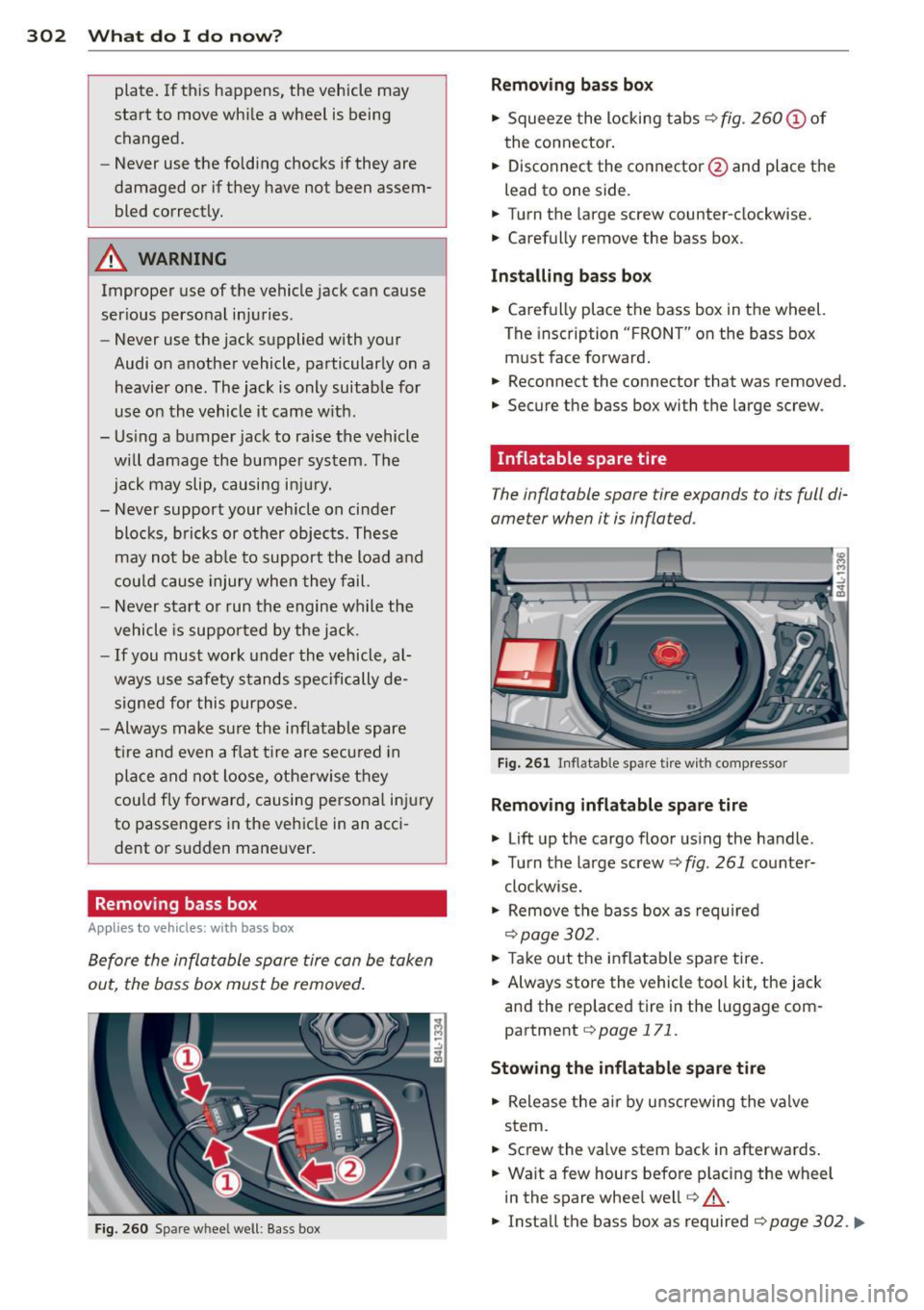
Removing bass box
Applies to vehicles: with bass box
Before the inflatable spare tire can be taken
out, the bass box must be removed .
Fig. 260 Spare wheel well: Bass box
Removing bass box
" Squee ze the locking tabs ¢ fig. 260 (!) of
the connector .
" Disconnect the connector @and place the
lead to one side.
" Turn t he large screw counter-clockwise.
" Carefully
remove the bass box.
Installing bass bo x
" Carefully place t he bass box in the wheel.
The insc ription "FRO NT" on the bass box
m ust face forward .
" Reconnect the connector that was removed.
" Secure the bass box with t he large screw.
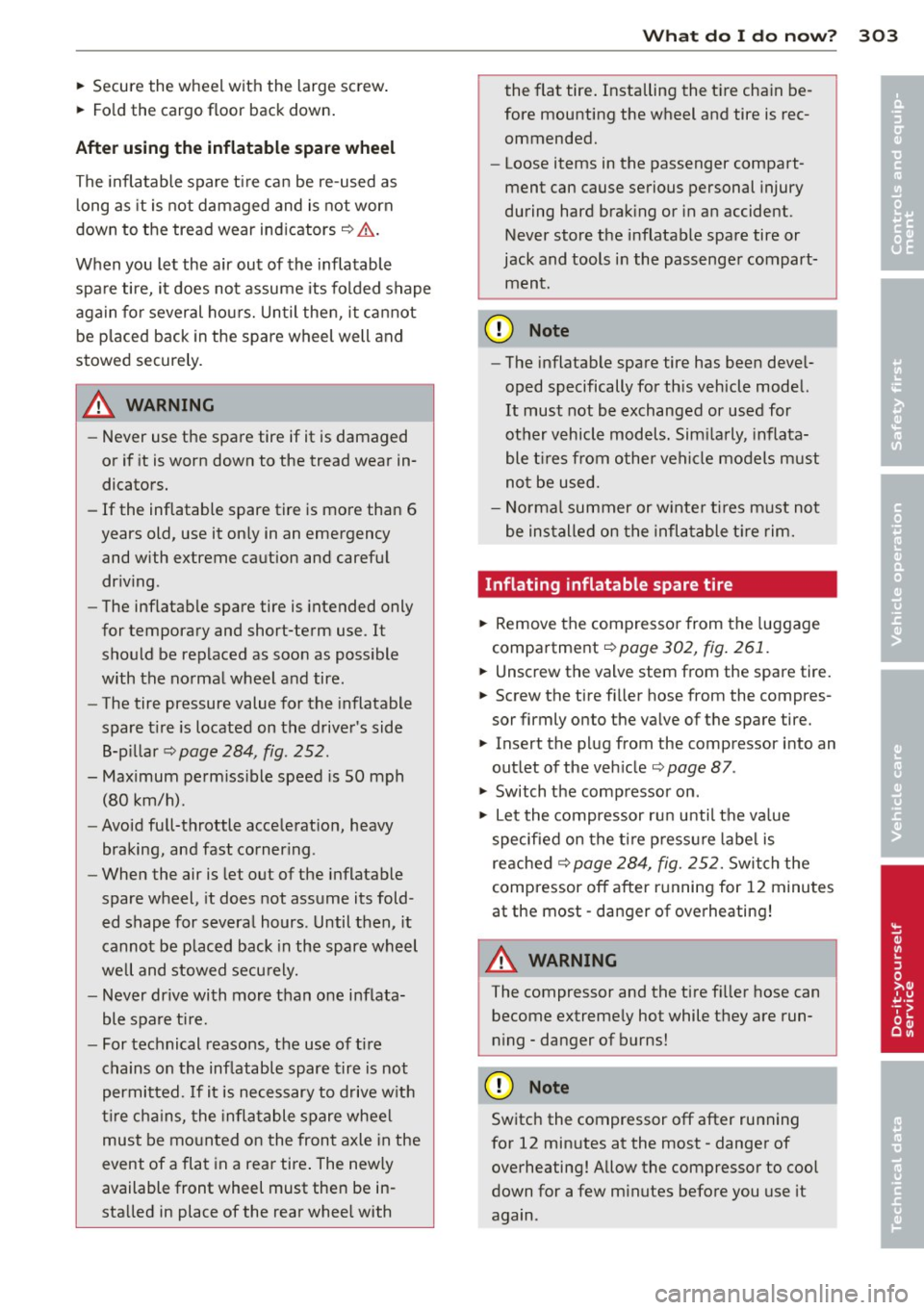
· Inflatable spare tire
The inflatable spare tire expands to its full di
ameter when it is inflated.
Fi g. 2 61 In flatable spare t ire w ith compressor
Removing inflatable spare tire
" Lift up the cargo floor us ing the handle .
" Tu rn the large screw¢
fig. 261 co unter-
clockwise.
" Remove the bass box as required
¢page 302.
" Take out the inflatable spare tire .
" Always sto re the vehicle tool kit, the jack
and the replaced tire in the luggage com
partment
¢page 171.
Stowing the inflatable spar e tire
" Release the air by unscrewing the valve
stem.
" Screw the valve stem back in afterwards .
" Wait a few hours befo re p lacing the wheel
in the spare whee l we ll
r=:, _.&.
" Install the bass box as required r=:, page 302 . ..,.
Page 305 of 348
• Secure the wheel with the large screw.
• Fold the cargo floor back down.
After using the inflatable spare wheel
The inflatable spare tire can be re-used as
long as it is not damaged and is not worn
down to the tread wear indicators~.&. .
When you let the air out of the inflatable
spare tire, it does not assume its folded shape
again for several hours. Until then, it cannot
be placed back in the spare wheel well and
stowed securely.
A WARNING
- Never use the spare tire if it is damaged
or if it is worn down to the tread wear in
dicators.
- If the inflatable spare tire is more than 6
years old, use it only in an emergency
and with extreme caution and careful
driving .
- The inflatable spare tire is intended only
for temporary and short-term use .
It
should be replaced as soon as possible
with the normal wheel and tire.
- The tire pressure value for the inflatable
spare tire is located on the driver's side
B-pillar ~page284,
fig . 252.
-Maximum permissible speed is 50 mph
(80 km/h).
- Avoid full-throttle acceleration, heavy
braking, and fast cornering.
- When the air is let out of the inflatable
spare wheel, it does not assume its fold
ed shape for several hours . Until then, it
cannot be placed back in the spare wheel
well and stowed securely.
- Never drive with more than one inflata
ble spare tire.
- For technical reasons, the use of tire
chains on the inflatable spare tire is not
permitted. If it is necessary to drive with
tire chains, the inflatable spare wheel
must be mounted on the front axle in the
event of a flat in a rear tire. The newly
available front wheel must then be in
stalled in place of the rear wheel with
What do I do now? 303
the flat tire. Installing the tire chain be
fore mounting the wheel and tire is rec
ommended.
- Loose items in the passenger compart
ment can cause serious personal injury
during hard braking or in an accident.
Never store the inflatable spare tire or
jack and tools in the passenger compart
ment.
(D Note
- The inflatable spare tire has been devel
oped specifically for this vehicle model.
It must not be exchanged or used for
other vehicle models. Similarly, inflata
ble tires from other vehicle models must
not be used.
- Normal summer or winter tires must not
be installed on the inflatable tire rim.
Inflating inflatable spare tire
• Remove the compressor from the luggage
compartment ~
page 302, fig. 261.
• Unscrew the valve stem from the spare tire.
• Screw the tire filler hose from the compres
sor firmly onto the valve of the spare tire.
• Insert the plug from the compressor into an
outlet of the vehicle~
page 87.
• Switch the compressor on .
• Let the compressor run until the value
specified on the tire pressure label is
reached
~ page 284, fig. 252. Switch the
compressor off after running for 12 minutes
at the most -danger of overheating!
A WARNING
-
The compressor and the tire filler hose can
become extremely hot while they are run
ning -danger of burns!
(D Note
Switch the compressor off after running
for 12 minutes at the most -danger of
overheating! Allow the compressor to cool
down for a few minutes before you use it
again .
•
•
Page 306 of 348
304 What do I do now?
Changing a wheel
Before changing a wheel
Observe the following precautions for your
own and your passenger's safety when chang
ing a wheel .
• After you experience a tire failure, pull the
car well away from moving traffic and try to
reach
level ground before you stop ¢,& .
• All passengers should
leave the car and
move to a safe location (for instance, behind
the guardrail) ¢
A-
.. Engage the parking brake to prevent your
vehicle from rolling unintentionally ¢,& .
• Move
selector lever to position P <=> ,&.
• If you are towing a trailer: unhitch the trail
er from your vehicle.
• Block the diagonally opposite wheel wi th
the folding chocks or other objects.
• Take the
jack and the inflatable spare tire
out of the luggage compartment
¢page 301.
11. WARNING
=
You or your passengers could be injured
while changing a whee l if you do not fol
low these safety precautions :
- If you have a f lat tire,
move a safe dis
tance off the road . Turn off the engine,
turn the emergency flashers on and use
other warning devices to alert other mo
torists .
- Make sure that passengers wait in a safe
place away from the vehicle and well
away from the road and traff ic.
- To help prevent the vehicle from moving
suddenly and possibly slipping off the
jack, always fully set the parking brake
and block the wheel diagonally opposite
the wheel being changed with the fold
ing chocks or other objects. When one
front whee l is lifted off the ground, plac
ing the Auto mat ic Transmission in "P"
(Park) will
not prevent the vehicle from
moving .
-
-Before you change a wheel, be sure the
ground is level and firm. If necessary,
use a sturdy board under the jack.
- After installing the inflatable spare tire,
make sure that you replace the flat tire/
wheel in its storage area properly and
tighten the knurled retaining screw se
curely .
' Changing a wheel
When you change a wheel , follow the se
quence described below step-by-step and in
exactly that order .
l. Activate the vehicle jack mode (only
vehicles with Adaptive Air Suspension)
¢ page 159.
2. Remove the decorative wheel cover* . For
more details see also ¢
page 305, Deco
rative wheel covers
or ¢ page 305,
Wheels with wheel bolt caps.
3. Loosen the wheel bolts¢ page 305.
4. Locate the proper mounting point for the
jack and align the jack be low that point
¢ page 306.
5. Lift the car with the jack¢ page 306.
6. Remove the wheel with the flat tire and
then install the
inflatable spare tire
¢page 307 .
7. Tighten all whee l bolts lightly.
8.
Lower the vehicle with the jack .
9. Use the wheel bolt wrench and
firmly
tighten all wheel bolts¢ page 305.
10. Rep lace the decorative wheel cover*.
11. Deactivate the vehicle jack mode (only
vehicles with Adaptive Air Suspension)
¢page 159.
A WARNING
Always read and follow all WARNINGS and
inf ormat ion¢ .&.
in Raising the vehicle on
page
307 and ¢page 308.
Page 308 of 348
306 What do I do now?
Loosening
.,. Install the wheel bolt wrench over the
wheel bolt and push it down as far as it will
go .
.,. Take tight hold of the
end of the wrench
handle and turn the wheel bolts
counter
clockwise
about one single turn in the direc
tion of arrow
c:> fig. 264.
Tightening
.,. Install the wheel bolt wrench over the
wheel bolt and push it down as far as it will
go .
.,. Take tight hold of the
end of the wrench
handle and turn each wheel bolt
clockwise
until it is seated .
A WARNING
- Do not use force or hurry when changing
a wheel - you can cause the vehicle to slip
off the jack and cause serious personal
injuries.
- Do not loosen the wheel bolts more than
one turn
before you raise the vehicle with
the jack. - You risk an injury.
@ Tips
If a wheel bolt is very tight, you may find it
easier to loosen by carefully pushing down
on the end of the wheel bolt wrench with
one foot only. As you do so, hold on to the
car to keep your balance and take care not
to slip.
Raising the vehicle
The vehicle must be lifted with the jack first
before the wheel can be removed.
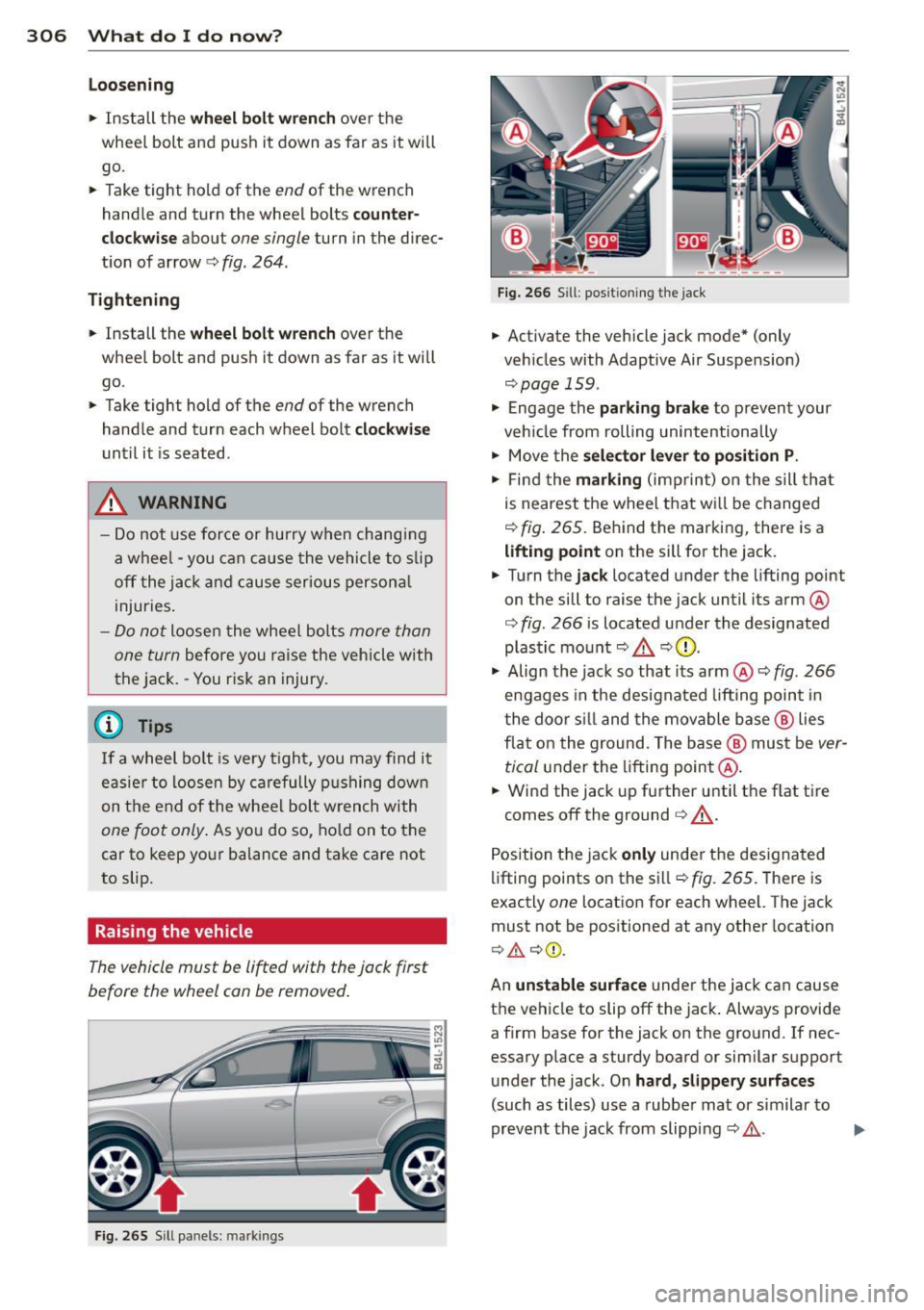
Fig. 265 Sill pane ls: mar kings
Fig. 266 Sill: posit ioning the jack
.,. Activate the vehicle jack mode* (only
vehicles with Adaptive Air Suspension)
<::> page 159 .
.,. Engage the parking brake to prevent your
vehicle from rolling unintentionally
.,. Move the
selector lever to position P .
.,. Find the marking (imprint) on the sill that
is nearest the wheel that will be changed
<=>
fig. 265. Behind the marking, there is a
lifting point on the sill for the jack.
.,. Turn the
jack located under the lifting point
on the sill to raise the jack until its arm@
<=>
fig . 266 is located under the designated
plastic mount<=>
& c::>(D .
.,. Align the jack so that its arm @ c::> fig. 266
engages in the designated lifting point in
the door sill and the movable base® lies
flat on the ground. The base @ must be
ver
tical
under the lifting point@.
.,. Wind the jack up further until the flat tire
comes off the ground
c:> ,& .
Position the jack only under the designated
lifting points on the sill
<=>fig . 265. There is
exactly
one location for each wheel. The jack
must not be positioned at any other location
<=>
.&. <=> CD .
An unstable surface under the jack can cause
the vehicle to slip off the jack. Always provide
a firm base for the jack on the ground. If nec
essary place a sturdy board or similar support
under the jack . On
hard, slippery surfaces
(such as tiles) use a rubber mat or similar to
prevent the jack from slipping
c:> ,&.. liJI,
Page 309 of 348

_& WARNING
-You or your passengers could be injured
while changing a wheel if you do not
follow these safety precautions:
- Position the jack only at the designated
lifting points and align the jack. Other
wise, the jack could slip and cause an
injury if it does not have sufficient hold
on the vehicle.
- A soft or unstable surface under the
jack may cause the vehicle to slip off the jack. Always provide a firm base for
the jack on the ground. If necessary,
use a sturdy board under the jack.
- On hard, slippery surface (such as tiles)
use a rubber mat or similar to prevent
the jack from slipping .
- To help prevent injury to yourself and
your passengers:
- Do not raise the vehicle until you are
sure the jack is securely engaged.
- Passengers must not remain in the ve
hicle when it is jacked up.
- Make sure that passengers wait in a
safe place away from the vehicle and
well away from the road and traffic.
- Make sure jack position is correct, ad
just as necessary and then continue to
raise the jack.
(D Note
Do not lift the vehicle by the sill. Position
the jack only at the designated lifting
points on the sill. Otherwise, your vehicle
will be damaged.
What do I do now? 307
Taking the wheel off/installing the inflatable spare tire
Follow these instructions step-by-step for
changing the wheel
Fig. 267 Chan gin g a w hee l: alignment p in inside the
to p ho le
After you have loosened all wheel bolts and
raised the vehicle off the ground, remove and
replace the wheel as follows :
Removing the wheel
.. Remove the topmost wheel bolt completely
and set it aside on a
clean surface.
.. Screw the threaded end of the
alignment
pin from the tool kit hand-tight into the
empty bolt hole
~ fig . 267.
.. Th en remove the other wheel bolts as de
scribed above.
.. Take off the wheel leaving the alignment
pin in the bolt hole
~ 0.
Putting on the inflatable spare tire
.. Inflate the inflatable spare tire ~ page 303
and push the wheel over the alignment pin.
.,. Screw in and tighten all wheel bolts
slight
ly.
.. Remove the alignment pin and insert and
tighten the remaining wheel bolt slightly
like the rest .
.. Turn the jack handle counter-clockwise to
lower the vehicle until the jack is fully re
leased .
.,. Use the wheel bolt wrench to tighten all
wheel bolts firmly ~
page 305. Tighten
them
crosswise, from one bolt to the (ap
proximately) opposite one, to keep the
wheel centered.
Page 310 of 348
308 What do I do no w?
When removing or installing the wheel,
the rim could hit the brake rotor and dam
age the rotor. Work carefully and have a
second person help you.
- When mounting tires with
unid irection al
tread design
make sure the tread pat
tern is pointed the right way
¢ page 308 .
-The wheel bolts should be clean and easy
to turn. Check for d irt and corrosion on
the mat ing surfaces of both the wheel
and the hub . Remove all dirt from these
su rfaces before remount ing the wheel.
Tires with unidirectional tread design
Tires with unidirectional tread design must be
mounted with their tread pattern pointed in
the right direction.
Using a spare t ire w ith a tread pattern
int ended fo r use in a specific direct ion
When us ing a spa re tire w ith a t read patte rn
i n te nded for use in a specific direction, p lease
note the fo llowing:
- The direction of rotation is marked by an ar
row on the side of the tire .
- If the spare t ire has to be in stalled in the in
correct d irection, use the spare tire only
temporarily since the t ire will not be able to
a chieve its optimum perfo rmance character
ist ics w ith reg ard to aquapl ani ng, noise and
wea r.
- We recommend tha t you pay pa rticular at
tent ion to this fact du ring wet weather and
that you adjust your speed to ma tch road
conditions .
- Replace the fla t tire w ith a new one and
have it installed on your veh icle as soon as
poss ible to restore the handling advantages
of a unid irect iona l tire .
Notes on wheel changing
Please read t he i nfo rmat ion Q page 291 , New
tires and replacing tires and wheels
if yo u are
go ing to use a spa re tire which is different
from the tires on yo ur vehicle.
After you change a tire:
- Check the tire pressure on the spar e imm e
diately after installation .
- Ha ve the wheel bolt tightening torque
ch ecked with a torque wr ench as soon a s
po ssible by your authorized Audi deal er or
a qua lifi ed workshop.
- With steel and alloy wheel rim s, the wheel
bolt s are corre ctly tightened at a torque of
120 ft lb (160 Nm) .
- If you notice that the wheel bolts ar e cor
roded and difficult to turn while changing
a tir e, they should be repla ced before y ou
c h eck the tightening torque .
- Re pla ce the flat tire wi th a new on e and
have it in stalled on y our vehi cle a s soon a s
po ssible. Remount the wheel cover.
Until th en , dr iv e with extra car e and at re
duc ed sp eed s.
&_ WARNING
-
- If you a re going to eq uip your vehi cle
with tires or rims which differ from those
which were factory installed, then be
sure to read the information
Q page 291,
New tires and replacing tires and
wheels.
- Always make s ure the damaged wheel o r
even a flat tire and the jack and tool kit
are property secured in the luggage com
partment and are not loose in the pas
senger compartment .
- In an accident or sudden maneuver they
could fly forwa rd, injuring anyone in the
ve hicle .
- Always store damaged wheel, jack and
too ls securely in the luggage compa rt
ment. Othe rwise, in a n accident o r sud
den maneuve r they could f ly forwa rd ,
causing inj ury to passengers in the ve hi
cle .