child lock AUDI Q7 2013 Owner´s Manual
[x] Cancel search | Manufacturer: AUDI, Model Year: 2013, Model line: Q7, Model: AUDI Q7 2013Pages: 348, PDF Size: 87.72 MB
Page 214 of 348
212 Child Safety
Convertible child safety seats
Properly used convertible child safety seats
can help protect toddlers and children over
age one who weigh between
20 and 40 lbs. (9
and 18 kg) in a crash.
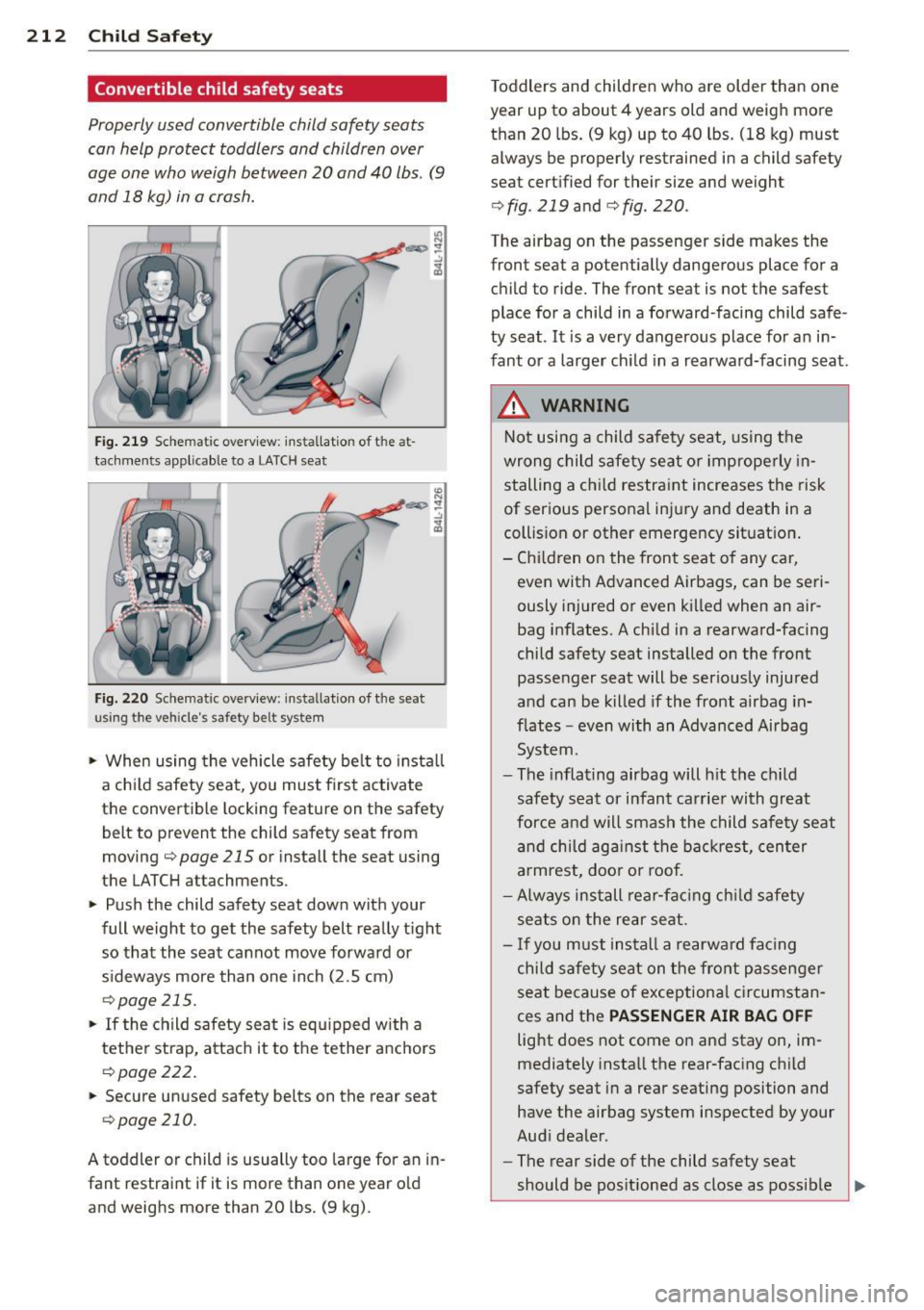
Fig. 219 Schematic overv iew : ins tallat ion of t he at
ta chments applicable to a LATCH seat
Fig. 220 Sche matic overview: insta llation of th e sea t
us ing t he veh icle's safety be lt system
.. When using the vehicle safety belt to install
a chi ld safety seat, you must f irst activate
the convertible locking feature on the safety
belt to prevent the child safety seat from
moving ¢
page 215 or install the seat using
the LATCH attachments .
.. Push the child safety seat down with your
full weight to get the safety belt really t ight
so that the seat cannot move forward or sideways more than one inch (2.5 cm)
¢page 215.
.. If the child safety seat is equ ipped with a
tether strap, attach it to the tether anchors
¢page 222.
.. Secure unused safety belts on the rear seat
¢page 210.
A toddler or child is usually too large for an in
fant restra int if it is more than one year o ld
and weighs more than 20 lbs. (9 kg). T
oddlers and children who are older than one
year up to about 4 years old and weigh more
than 20 lbs. (9 kg) up to 40 lbs. (18 kg) must
always be properly restrained in a child safety
seat certified for their size and weight
¢ fig . 219 and ¢ fig. 220 .
The airbag on the passenger side makes the
front seat a potentia lly dangerous place for a
child to ride. The front seat is not the safest
place for a child in a forward-facing child safe
ty seat . It is a very dangerous place for an in
fant or a larger child in a rearward-facing seat.
_&. WARNING
Not using a child safety seat, using the
wrong child safety seat or improp erly in
stalling a chi ld restraint increases the risk
of serious personal injury and death in a
collision or other emergency situation .
- Children on the front seat of any car,
-
even with Advanced Airbags, can be seri
ously injured or even killed when an air bag inflates . A chi ld in a rearward-facing
child safety seat installed on the front passenger seat will be serious ly injured
and can be killed if the front airbag in
f la tes -even with an Advanced Airbag
System .
- The inflating airbag will hit the child
safety seat or infant carrier with great
force and will smash the child safety seat
and child against the backrest, center
armrest, door or roof.
- Always install rear-facing child safety
seats on the rear seat .
- If you must install a rearward facing
child safety seat on the front passenger
seat because of exceptiona l circumstan
ces and the
PASSENGER AIR BAG OFF
light does not come on and stay on, im
mediately insta ll the rear-facing child
safety seat in a rear seating position and
have the airbag system inspected by your
Aud i dealer.
- The rear side of the child safety seat
should be pos itioned as close as possible ..,.
Page 215 of 348
to the backrest on the vehicle seat. Ad
just or remove the rear seat head restraint if it is diff icult to install the
child seat w ith the head restraint in place
¢ page 77. Install the head restraint
again immed iate ly once the child seat is
removed. Driving without head rest raints
o r with he ad restraints that are not prop
erly adjusted increases the risk of serious
or fatal neck injury dramatically.
- Always read and heed all WARNINGS
whenever using a child rest rained in ave
hicle is being used
¢page 175, Safety
belts,¢ page 184, Airbag system
and
¢ page 205, Important things to know.
A WARNING
If except ional circumstances requ ire the
use of a forward-facing child restra int on
the front passenger's seat, the ch ild's safe
ty and well-being require that the follow
ing special precautions be taken:
- Make sure the forward-fac ing seat has
been designed and certified by its manu
factur er for use on a front seat with a
passenge r fron t and side airbag.
- Always follow the manufacturer's in
st ruct ions provided with the child sa fety
sea t or infan t carrier.
- Always mov e the front passenge r seat in
to the rearmost posit ion of the passen
ger seat's fore and aft ad justment r ange,
and as far away from the airbag as possi
ble before instal ling the child restraint.
- Always m ake sure that noth ing prevents
the front passenger's seat from bei ng
moved to the rearmost position in its
fore and aft adjustment range .
- Always make sure the backrest is in an upright position.
- Make su re that the
PASSENGER AIR BAG
OFF
light comes on and stays on all the
time whenever the ignition is switched
on.
- If the light does not stay on, perform the
checks¢
page 195, Monitoring the Ad
vanced Airbag System.
-
Child S afety 213
-Take the chi ld restraint off the front pas
senger seat and install it properly at one
of the rear seat positions if the
PASSEN
GER AIR BA G OF F
light does not stay on
whenever the ignit ion is switched on.
Booster seats and safety belts
Properly used booster seats con help protect
children weighing between about 40 lbs. and
80 lbs . (18 kg and 36 kg) who are less than 4
ft. 9 in . (57 inches/1 .45 meters) tall.
In .... N 0 ±
~
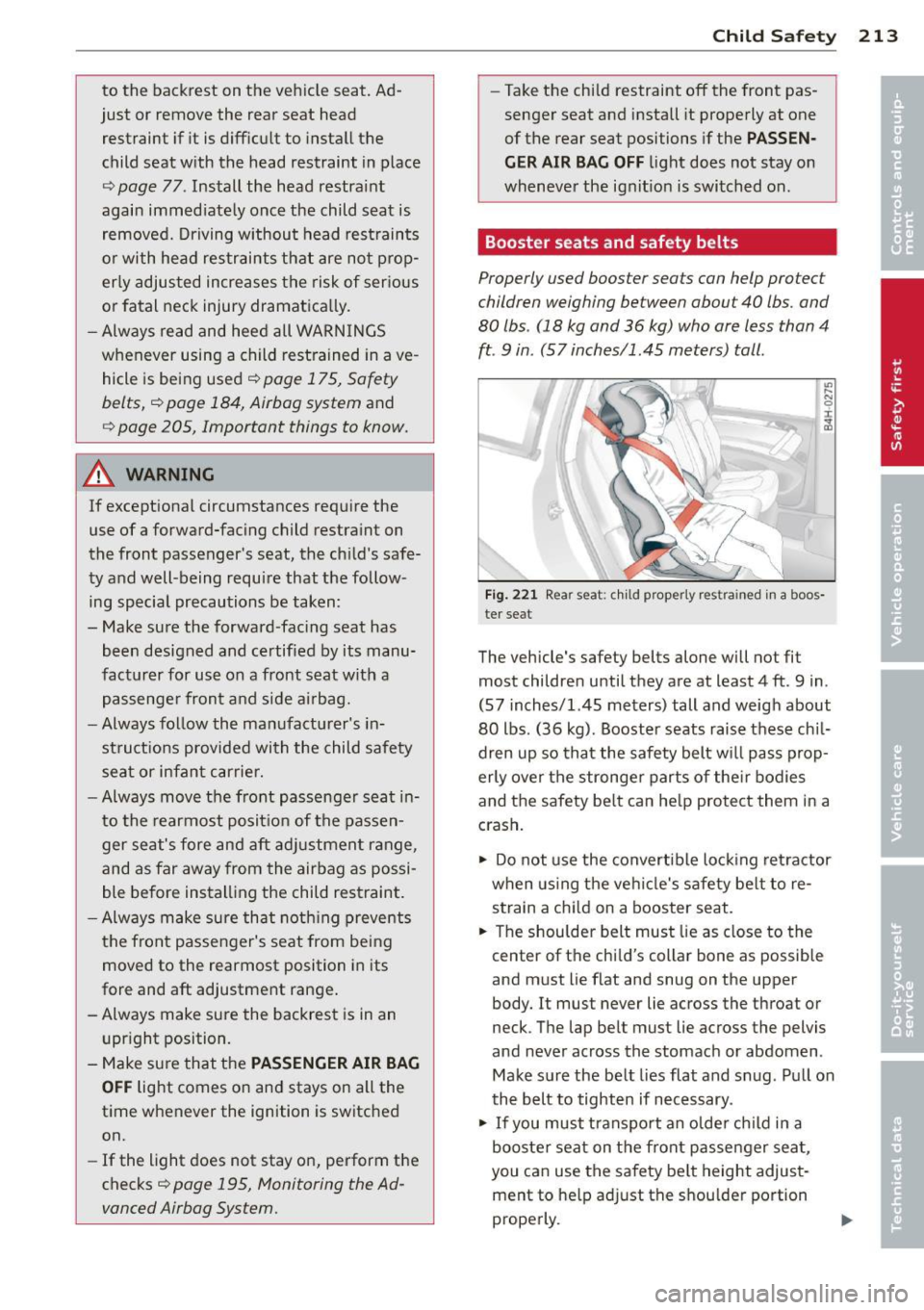
Fig . 221 Rear seat: ch ild properly res trained in a boos
ter seat
The vehicle's safety belts alone will not fit most children until they are at least 4
ft. 9 in .
(57 inches/1.45 me ters) tall and weigh about
80 lbs . (36 kg) . Booster seats raise these chi l
dren up so tha t the safety belt w ill pass p rop
erly over the stronger parts of the ir bodies
and the safety be lt can he lp protect them in a
crash.
.,. Do not use the conver tible locking ret ra ctor
when using the ve hicl e's s afety be lt to re
s train a ch ild on a booster seat.
... The shoulder belt must lie as close to the
center of the ch ild's collar bone as possible
and must lie flat and snug on the upper
body. It must never lie across the throat or
neck . The lap belt must lie across the pelvis
and never across the stomach or abdomen .
Make s ure the belt lies flat and snug. Pull on
th e belt to tighten if necessary.
.,. If you must transport an o lder ch ild in a
booster seat on the front passenger sea t,
you can use the safety be lt height adjust
ment to he lp ad just the shou lder portion
properly.
Page 217 of 348
-Children on the front seat of any car,
even with Advanced A irbags, can be seri
ous ly injured or even killed when an a ir
bag inflates.
- Never let a child stand or kneel on any
seat, for examp le the front seat.
- Never let a child ride in the cargo area of
your vehicle .
- Always remember that a ch ild lean ing
forward, sitt ing sideways or out of posi
t ion in any way during an acc ident can be
struck by a deploying airbag . This will re
sult in se rious personal injury or death .
- If you must install a booster seat on the
front passenger seat because of excep
t ional circumstances the
PASSENGER
AIR BAG OFF
light must come on and
stay on, whenever the ignition is switch
ed on.
- If the
PASSENGER AIR BAG OFF light
does not come on and stay on, perform
the checks described¢
page 195, Moni
toring the Advanced Airbag System.
- Ta ke the child restrain t off the front pas
senger seat and install it properly at one
of the rear seat positions if the
PASSEN
GER AIR BAG OFF
light does not stay on
whenever the ignition is switched on.
- Always read and heed all WARNINGS
whenever using a child restrained in ave
hicle is being used¢
page 175, Safety
belts,¢ page 184, Airbag system
and
c:> page 205, Important things to know.
Installing a child safety
seat
Securing a child safety seat using a
safety belt
Safety belts for the rear sea ts and the fron t
passenger can be locked wi th the convertible
locking retractor to properly secure child
safety seats .
The safety belts emergency lock ing retractors
for the rear seats safety belts and for the
front passenger's seat safety belt have a con
ve rtible locking retractor for child restraints.
Child Sa fet y 215
The safety belt must be locked so that be lt
webbing cannot unree l. The retractor can be
activated to lock the safety belt and prevent
the safety belt webbing from loosening up
during normal dr iving . A child safety seat can
only be properly installed when the safety belt
i s locked so that the chi ld and child safety
seat w ill stay in place .
Always remember: Even though your vehicle is equipped with an Advanced Airbag system, all
ch ildren, especially those 12 years and young
er, shou ld always r ide in the back seat proper
ly restrai ned fo r the ir age and size.
A WARNING
Improperly installed chi ld safety seats in
crease the risk of serious personal injury
and death in a collision.
- Always ma ke sure that the safety belt re
tracto r is loc ked when installing a child
safety seat . An unlocked safety belt re
tractor cannot hold the child safety seat
in place during normal dr iving or in a
crash.
- Always buckle the child safety seat firmly
in place even if a ch ild is not sitt ing in it.
A loose child safety seat can fly around during a sudden stop or in a collision .
- Always make sure that the rear seat
backrest to which the center rear safety
be lt is attached is securely latched when
eve r the rea r center safety belt is being
used to secure a ch ild restra int.
- If the backrest is not securely latched,
the child and the child restraint will be
thrown forward together with the back rest and will strike parts of the vehicle
interior. The child can be seriously in
jured or killed.
- Never install rear-fa cing child safety
seats or infant carrie rs on the front pas
senger seat . A child will be serio usly in
jured and can be killed when the passen ger airbag inflates.
- The inflating airbag will h it the ch ild
safety seat or infant carrier with great
force and will smash the child safety seat
~
•
•
Page 219 of 348
-A tight tether strap on a rearward-facing
child restraint attached to the front pas
senger seat can put too much pressure on the weight-mat in the seat and regis
ter a heavier weight in the Advanced Air
bag System . The heavier weight regis
tered can make the system work as
though an adult were on the seat and de
ploy the Advanced Airbag when it must
be suppressed causing serious or even
fatal injury to the child .
- Make sure that the
PASSENGER AIR BAG
OFF
light comes on and stays on all the
time whenever the ignition is switched
on.
- If the
PASSENGER AIR BAG OFF light
does not come on and stay on, immedi
ately install the rear-facing child safety
seat in a rear seating position and have
the airbag system inspected by your Audi dealer.
Activating the convertible locking
retractor
Use the convertible locking retractor to se
cure a child restraint.
Always heed the child safety seat manufactur
er's instructions when installing a child re
straint in your vehicle . To activate the conver
tible locking retractor :
.. Place the child restraint on a seat, prefera
bly on the rear seat.
.. Slowly pull the belt
all the way out .
.. Route it around or through the child re
straint belt path~&_ .
.. Push the child safety seat down with your
full weight to get the safety belt really tight.
.. Insert the belt tongue into the buckle for
that seating position .
.. Guide the safety belt back into the retractor
until the belt lies flat and snug on the child
safety seat .
.. You should hear a "clicking " noise as the
belt winds back into the inertia reel. Test the
convertible locking retractor by pulling on
the belt . You should no longer be able to
Child Safety 21 7
pull the belt out of the retractor. The con
vertible locking retractor is now activated.
.. Make sure that the red release button is fac
ing away from the child restraint so that it
can be unbuckled quickly.
.. Pull on the belt to make sure the safety belt
is properly tight and fastened so that the
seat cannot move forward or sideways more
than one inch (2.5 cm).
_&. WARNING
Using the wrong child restraint or an im
properly installed child restraint can cause
serious personal injury or death in a crash.
- Always make sure that the safety belt re-
tractor is locked when installing a child
safety seat. An unlocked safety belt re
tractor cannot hold the child safety seat
in place during normal driving or in a
crash.
-Always buckle the child safety seat firmly in place even if a child is not sitting in it.
A loose child safety seat can fly around
during a sudden stop or in a crash.
- Always make sure the seat backrest to
which the child restraint is installed is in
an upright position and securely latched
into place and cannot fold forward . Oth
erwise, the seatback with the child safety
seat attached to it could fly forward in
the event of an accident or other emer
gency situation .
- Always read and heed all WARNINGS
whenever using a child restrained in ave
hicle is being used¢
page 205. Special
precautions apply when installing a child
safety seat on the front passenger seat
¢ page 186, Child restraints on the front
seat -some important things to know .
-
•
•
Page 220 of 348
218 Child Saf ety
Deactivating the convertible locking
retractor
The convertible locking retractor for child re
straints will be deactivated automatically when the belt is wound all the way back into the retractor.
.,. Press the red button on the safety be lt
buck le. The belt tongue wi ll pop out of the
buck le .
.. Guide the safety belt all the way back into
its stowed position .
A lways le t the safety belt retract complete ly
into its stowed position . The safety belt can
now be used as an ordinary safety belt with
out the convertib le locking r etractor for chi ld
restra ints .
I f the convertible locking retractor shou ld be
activated inadvertently, the safety belt m ust
be unfastened and guided completely back in
to its stowed pos ition to deactivate th is fea
ture. If the convertible locking retractor is not
deactivated, the safety belt will gradually be
come tighter and u ncomfortable to wear .
A WARNING
Improperly insta lled child safety seats in
crease the risk of ser ious personal inju ry
and death in a collision .
- Never unfaste n the safety belt to deacti
vate the convert ible lock ing ret ractor for
c hild rest rain ts while the veh icle is mov
ing. You would not be restrained and
cou ld be seriously injured in an accident.
- Always read and heed all WARN INGS
whenever using a child restrained in ave
hicle is being used
c::> page 205. Special
precautions apply when installing a ch ild
safety seat on the front passenger seat
<=> page 186, Child restraints on the front
seat -some important things to know .
LATCH Lower
anchorages and tethers
for children
Child Restraint System anchors and how
are they related to child safety
To p rov ide a simpler and more practicable way
to a ttach the child restra int on the vehi cle
seat, Federal regulat ions req uire spec ia l lowe r
anchorages in vehicles and devices on new
child restraints to attach to the vehicle ancho
rages.
T he combination of the tether anc horages and
the lowe r anchorages is now genera lly ca lled
t h e
LATCH system fo r "Lower Anchorages and
T ethers for Child ren."
F o rward-facing chi ld restrai nts ma nufactured
after September 1, 1999, are requ ired by U .S .
f edera l regu lations to comply with new child
head movement performance req uirements.
These new performance req uirements make a
tether necessary on most new child seats.
Installing a child restraint that requires a top
tether without one can seriously impair the performance of the c hild restra int and its abil
ity to protect the child in a coll is ion. Insta lling
a chi ld restraint that requires a top tether
without the top tether may be a violat ion of
state law.
Child restraint manufacturers offer LATCH
lower anchorages on their child seats w ith
hook -on or push-on connectors attached to
adjustable straps .
In add ition to the LATCH lower anchorages,
these chi ld restraint systems usually require
the use of tether straps to he lp keep the chi ld
rest raint firmly in place.
A WARNING
-Imp roper installat ion of ch ild restra ints
will i ncrease the r is k of injury a nd death i n
a crash.
-
Page 223 of 348
_& WARNING
Improper use of tether anchorages or low
er anchorages can cause serious personal
injury in a crash.
- Always carefully follow the child re
straint manufacturer's instructions for
proper installation and use of child re
straint systems.
- Never use the
LATCH or tether anchorag
es to attach safety belts or other kinds of
occupant restraints.
- Child restraint tether attachments and
lower attachments are only designed to
secure a child restraint that has been
equipped to use these anchorages.
- Tether anchorages and lower anchorages
are designed to withstand only those
loads imposed by correctly fitted child
restraints. Under no circumstances can
they be used safely for adult or child
safety belts or harnesses.
- Never mount more than one child re
straint to a single tether or to a lower an
chorage point. Attaching two child re
straints to a single anchorage point can
cause the anchorage to fail and cause se
rious personal injury in a crash.
(D Note
-Remove the guidance fixtures before
folding the rear seatback to prevent
damaging the seat cushion.
- If you leave the guidance fixtures instal
led for several days, they could leave a
mark on the upholstery on the seat cush
ion and backrest in the area that the
guidance fixtures were installed. The up
holstery would also be permanently
stretched around the guidance fixtures.
This applies especially to leather seats.
Child Safety 221
Installing a child restra int with LATCH
lower anchorages
Whenever you install a child restraint always
follow the child restraint manufacturer's in
structions.
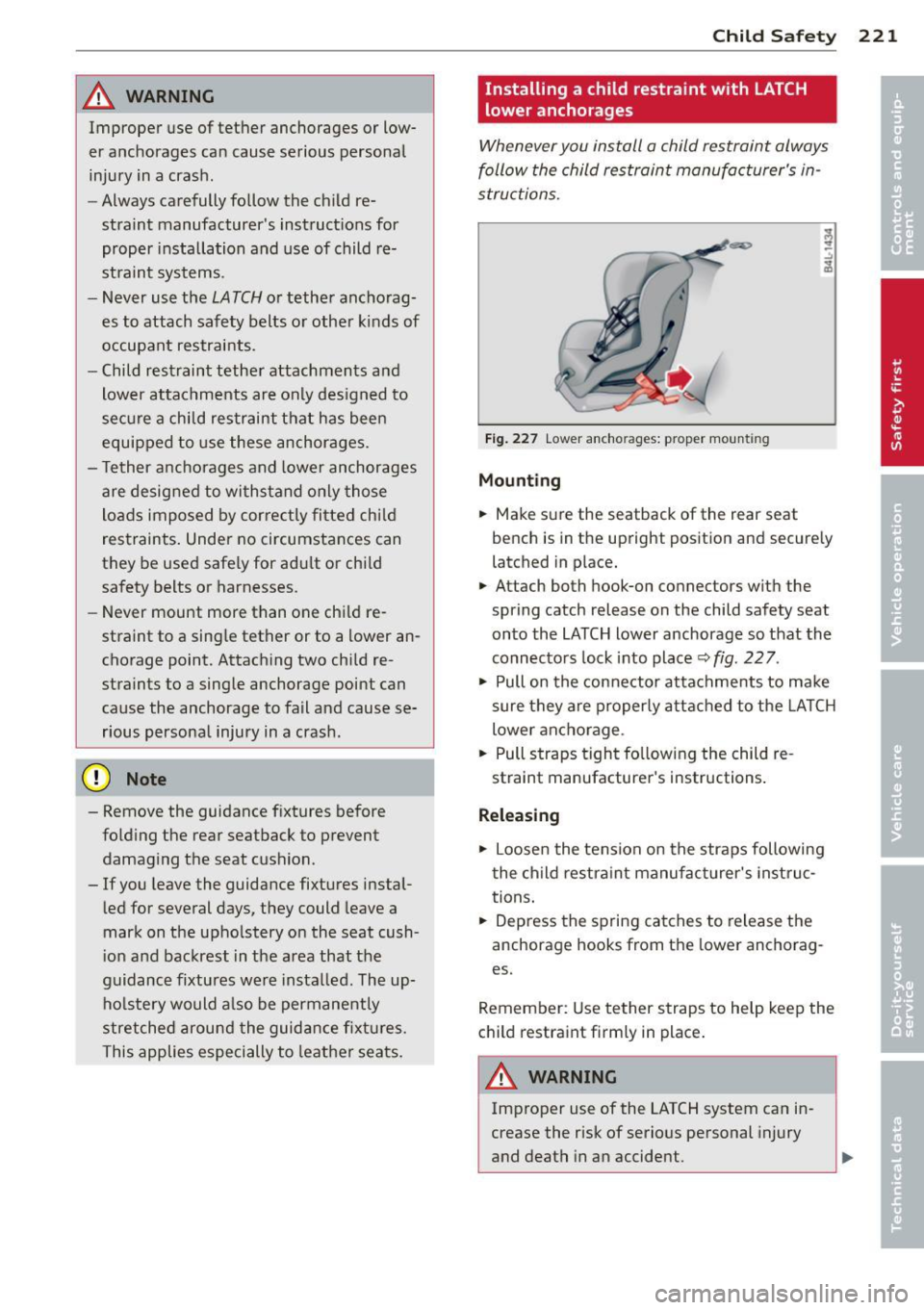
Fig. 227 Lower anchorages: proper mounting
Mounting
.. Make sure the seatback of the rear seat
bench is in the upright position and securely
latched in place.
.. Attach both hook-on connectors with the
spring catch release on the child safety seat
onto the LATCH lower anchorage so that the
connectors lock into place
¢fig. 227.
.. Pull on the connector attachments to make
sure they are properly attached to the LATCH
lower anchorage .
.. Pull straps tight following the child re
straint manufacturer's instructions.
Releasing
.. loosen the tension on the straps following
the child restraint manufacturer's instruc
tions.
.. Depress the spring catches to release the
anchorage hooks from the lower anchorag
es.
Remember: Use tether straps to help keep the
child restraint firmly in place.
A WARNING '-
Improper use of the LATCH system can in-
crease the risk of serious personal injury
and death in an accident.
Page 275 of 348
Coolant loss
Coolant loss may indicate a leak in the cooling
system . In the event of coolant loss, the cool
ing system should be inspected immediately
by your authorized Audi dealer. It is not
enough merely to add coolant.
In a
sealed system, losses can occur only if
the boiling point of the coolant is exceeded as
a result of overheating.
A WARNING
The cooling system is under pressure and
can get very hot. Reduce the risk of scald
ing from hot coolant by following these
steps.
- Turn off the engine and allow it to cool
down.
- Protect your face, hands and arms from
escaping fluid and steam by covering the
cap with a large, thick rag.
- Turn the cap slowly and very carefully in
a counter-clockwise direction while ap
plying light, downward pressure on the
top of the cap.
- To avoid being burned, do not spill anti freeze or coolant on the exhaust system
or hot engine parts. Under certain condi
tions, the ethylene glycol in engine cool
ant can catch fire.
(D Note
Do not add any type of radiator leak seal
ant to your vehicle's engine coolant. Add
ing radiator repair fluid may adversely af
fect the function and performance of your
cooling system and could result in damage
not covered by your New Vehicle Limited
Warranty.
Adding coolant
Be very careful when adding engine coolant.
Before you check anything in the engine com
partment,
always read and heed all WARN
INGS c:;, A in Working in the engine compart
ment on page 264.
Checking and filling 273
.. Turn off the engine .
.. Let the engine cool down.
.. Place a thick rag over the coolant expansion
tank
c:;, page 2 72, fig. 247 and carefully
twist the cap counter-clockwise c:;, &, .
.. Add coolant .
.. Twist the cap on again
tightly.
Replacement engine coolant must conform to
exact specificat ions
c:;, page 2 71, Coolant. We
recommend using only coolant additive G12+
+, G13 or in an emergency G12 +. Do
not use a
different additive. In an emergency use plain
water until you can get the correct additive
and can restore the correct ratio. This should
be done as soon as possible.
If you have lost a considerable amount of
coolant, then you should add cold antifreeze
and cold water only when the engine is cold.
Always use
new engine coolant when refilling .
Do not fill coolant above the "MAX" mark. Ex
cess coolant will be forced out through the
pressure relief valve in the cap when the en
gine becomes hot.
A WARNING
- The cooling system is under pressure and
can get very hot. Reduce the risk of
scalding from hot coolant by following
these steps.
- Turn off the engine and allow it to cool
down.
- Protect your face, hands and arms from
escaping fluid and steam by covering
the cap with a large, thick rag.
- Turn the cap slowly and very carefully
in a counter-clockwise direction while
applying light, downward pressure on
the top of the cap.
- To avoid being burned, do not spill an
tifreeze or coolant on the exhaust sys
tem or hot engine parts. Under certain
conditions, the ethylene glycol in en
gine coolant can catch fire.
- Antifreeze is poisonous. Always store an
tifreeze in its original container and well
out of the reach of children. .,.
•
•
Page 278 of 348
2 76 Chec king and filling
should only be disconnected from the vehicle
e lectrical system when absolutely necessary
for repairs.
Vehicles not driven for long periods
If you do not drive your vehicle over a pe riod
of several days or weeks, electrical compo
nents are gradually cut back or switched off.
This reduces energy consumption and main
tains starting capab ility over a longer period
<=> page 231.
Take into consideration that when you un lock
your vehicle, some convenience functions, such as the interior lights or the power seat
adjustment, may not be available. The con
venience functions will be available again
when you turn on the ignition and start the
engine .
Winter operation
During the winter months, battery capacity
tends to decrease as temperatures drop . This
is because more power is also consumed while
starting, and the headlights, rear window de
fogger, etc., are used more often .
Avoid unnecessary power consumption, par
ticularly in city traffic or when traveling only
short d istances . Let your authorized Audi
dealer check the capacity of the vehicle bat
tery before w inte r sets in
<=> page 277. A well
cha rged battery w ill not only prevent starting
p rob lems when the weather is cold, but will
a lso last longer.
(D Tips
If your vehicle is left standing for several
weeks at extremely low temperatures, the
vehicle battery should be removed and
stored where it will not freeze . This wi ll
prevent it from being damaged and having
to be replaced.
Working on the battery
Be especially careful when working on or near
the battery.
The battery is located under the driver 's seat.
Before you check anyth ing under the driver 's
seat,
read and heed all WARNINGS c:> _&.
Always heed the safety warnings, when work
ing on the vehicle battery or the vehicle elec
trical system to prevent injury.
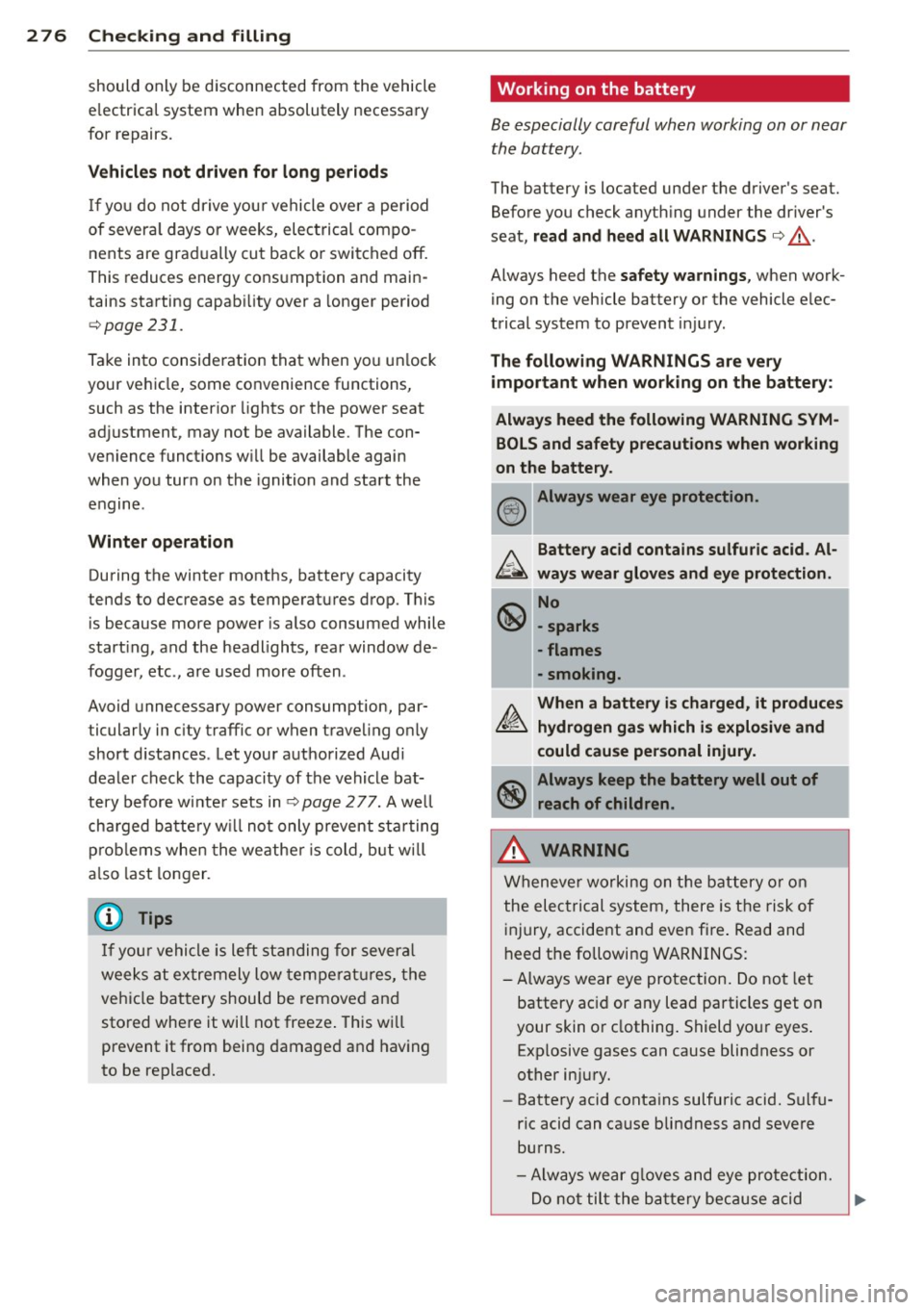
The following WARNINGS are very
important when working on the battery:
Always heed the following WARNING SYM BOLS and safety precautions when working
on the battery.
® Always wear eye protection .
b.. Battery acid contains sulfuric acid . Al
~ ways wear gloves and eye protection.
~ No
\!:!Y -sparks
- flames
- smoking.
A When a battery is charged, it produces
~ hydrogen gas which is explosive and
could cause personal injury.
Always keep the battery well out of reach of children.
,&. WARNING
Whenever working on the battery or on
the electrical system, there is the risk of
injury, accident and even fire . Read and
heed the following WARNINGS:
- Always wear eye protection. Do not let
battery ac id or any lead particles get on
your skin or clothing. Shield your eyes .
Exp losive gases can cause blindness or
other injury.
- Battery acid contains sulfuric acid. Sulfu
ric acid can cause blindness and severe
burns.
- Always wear g loves and eye protection.
-
Do not tilt the battery because acid ~
Page 334 of 348
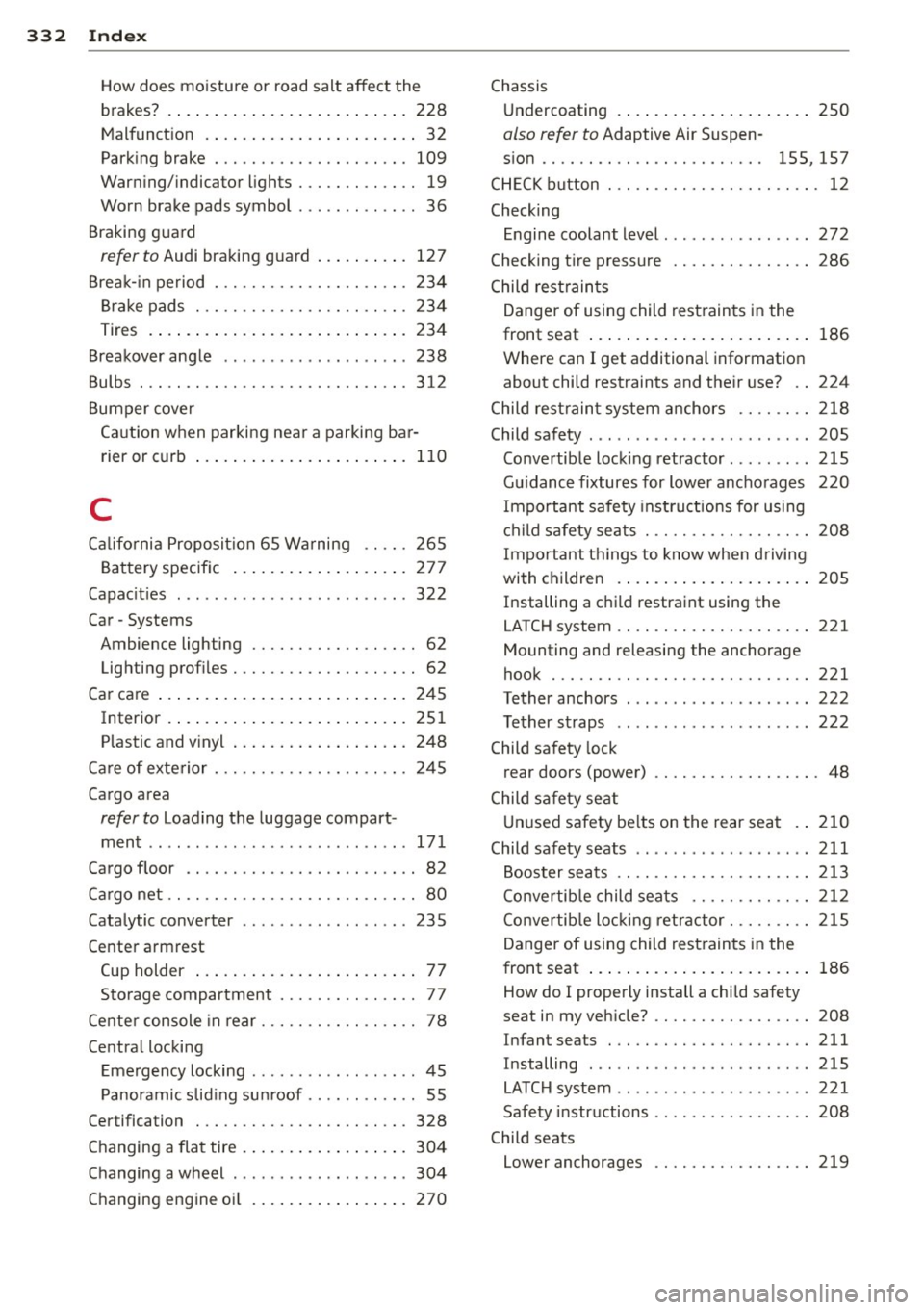
332 Index
How does moisture or road salt affect the
brakes? .................... ..... . 228
Malfunction .............. ... .... .. 32
Parking brake ............ .. .. .... . 109
Warning/indicator lights ... .. .. .... .. 19
Worn brake pads symbol ....... .. .... 36
Braking guard
refer to Audi braking guard .......... 127
Break-in period ............ .. .. .... . 234
Brake pads ............ .. .... .. .. . 234
Tires .... .. ................ ..... . 234
Breakover angle .. .. ........ ... .. .. . 238
Bulbs ... .. .. ..................... . 312
Bumper cover Caution when parking near a parking bar-rier or curb ............... ... .... . 110
C
California Proposition 65 Warning .. .. . 265
Battery specific .............. .... . 277
Capacities ... ... .... ...... .. .. .. .. . 322
Car -Systems
Ambience lighting . . . . . . . . . . . . . . . . . . 62
Lighting profiles ............ .. .... .. 62
Car care ..... ................ ..... . 245
Interior . . . . . . . . . . . . . . . . . . . . . . . . . . 251
Plastic and vinyl ................ .. . 248
Care of exterior ............ .. .. .. .. . 245
Cargo area
refer to Loading the luggage compart-
ment .. .. .. ... .... ...... .. .. .. .. . 171
Cargo floor .. ............. .. .. .. .. .. 82
Cargo net .... ... .......... .. .. .. .. .. 80
Catalytic converter ... ...... .. .. .. .. . 235
Center armrest Cup holder . . . . . . . . . . . . . . . . . . . . . . . . 77
Storage compartment . . . . . . . . . . . . . . . 77
Center console in rear ..... .. .. .. .. .. . . 78
Central locking Emergency locking .. ...... .. .. .. .. . . 45
Panoramic slid ing sunroof .. .. .. .. .. . . 55
Certification .............. .. .. .. .. . 328
Changing a flat tire .......... ... .... . 304
Changing a wheel .............. .. ... 304
Changing engine oil ......... .... ... . 270 Chassis
Undercoating
also refer to Adaptive Air Suspen- 250
sion . . . . . . . . . . . . . . . . . . . . . . . . 155, 157
CHECK button ..... ................. . 12
Checking Engine coolant level . ............ ... 272
Checking tire pressure ........... .... 286
Child restraints
Danger of using child restraints in the
front seat . . . . . . . . . . . . . . . . . . . . . . . . 186
Where can I get additional information
about child restraints and their use? .. 224
Child restraint system anchors .... .. .. 218
Child safety ..... .. .......... ... .. .. 205
Convertible locking retractor ... .. .. .. 215
Guidance fixtures for lower anchorages 220
Important safety instructions for using
child safety seats . ............. .. .. 208
Important things to know when driving
with children .... ................ . 205
Installing a child restraint using the
LATCH system .. .. ............. .. .. 221
Mounting and releasing the anchorage
hook . .... .... ................... 221
Tether anchors . .. .......... ... .. .. 222
Tether straps . ... ....... ...... .. .. 222
Child safety lock
rear doors (power) .. ........... .... . 48
Child safety seat Unused safety belts on the rear seat . . 210
Child safety seats .. ..... ..... ... .. .. 211
Booster seats ................. .... 213
Convertib le child seats ............. 212
Convertible locking retractor ......... 215
Danger of using child restraints in the
front seat ..... .. ................ . 186
How do I properly install a child safety
seat in my vehicle? ............... .. 208
Infant seats .................. .... 211
Installing ... .. .. ....... ...... .. .. 215
LATCH system .. .. ... ......... ... .. 221
Safety instructions ... .. ..... ... .. .. 208
Child seats Lower anchorages ............. .... 219
Page 335 of 348
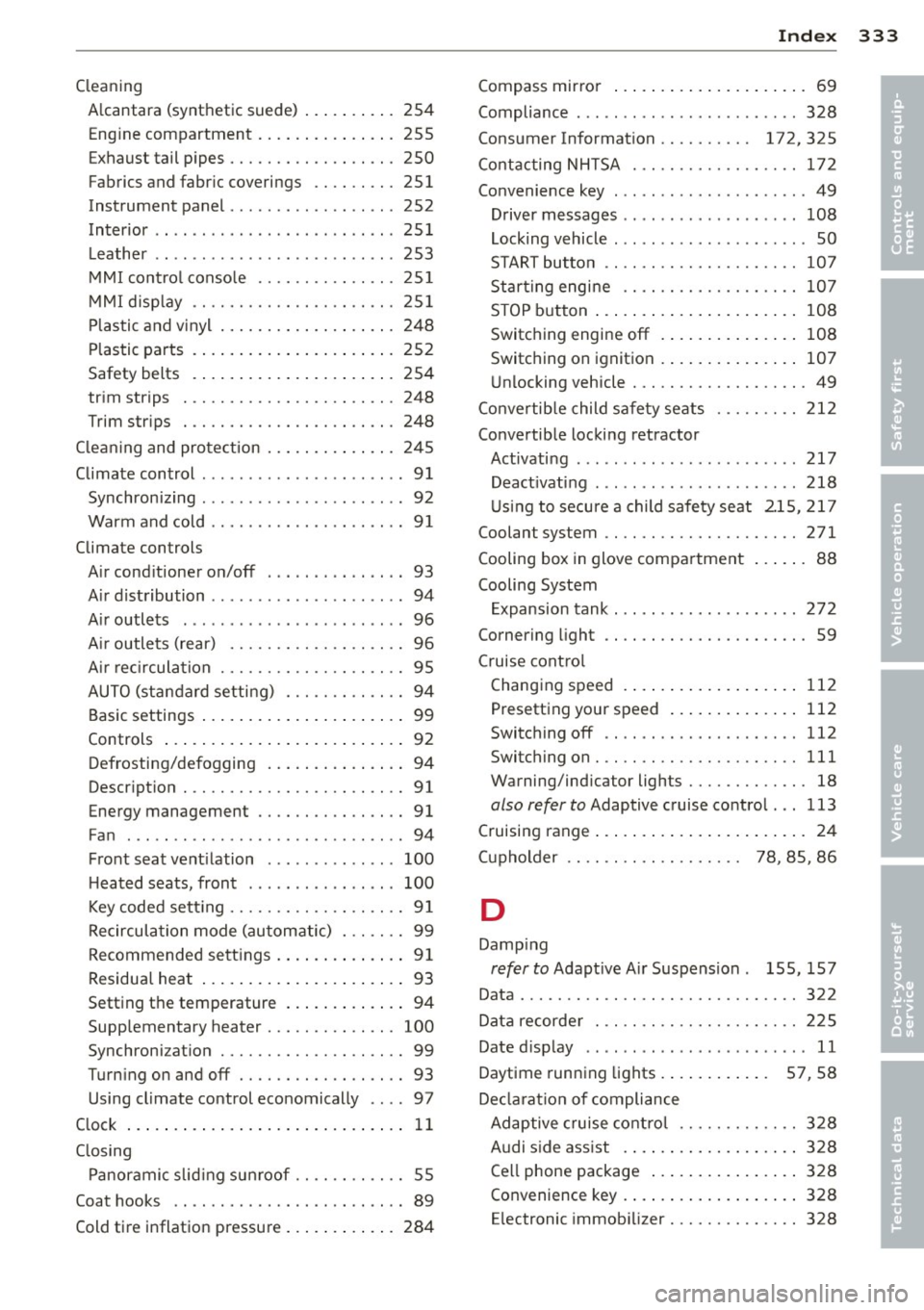
_______________________________ ___:I~n ~d ~e:.::x 333
Cleaning
A lcantara (synthetic suede) ... .. .. .. . 254
Eng ine compartment ... ... .. .. .. .. . 255
Exhaust tail p ipes ......... .. .. .. .. . 250
Fabrics and fabr ic coverings .. .. .. .. . 251
Instrument panel .............. .... 252
Inter ior . . . . . . . . . . . . . . . . . . . . . . . . . . 2 5 1
L eather .. ............ ...... .... .. 253
M MI con tro l conso le ...... .. .. .. .. . 251
M MI d isp lay ............. .... .. ... 2 51
Pl asti c and v inyl ....... ... .. .. .. ... 248
P lastic parts . ..... .... ... .. .. .. ... 252
Safety belts . ... .. .... ... .. .. .. ... 254
tr im strips . .. ........... .. .. .. ... 248
Trim str ips . ............. .... .. ... 248
C lean ing and pro tect ion .. ... .. .. .. .. . 2 45
Climate control . . . . . . . . . . . . . . . . . . . . . . 91
Synchron izing ............... ... ... . 92
Warm and cold ........... .... .. .. .. 9 1
Climate controls Air cond itioner o n/off ..... .. .. .. .. .. 93
A ir distribution .............. .... ... 94
A ir outlets ................. .... ... 96
A ir outlets (rear) ......... .. .. .. .. .. 96
A ir r eci rcula tion .......... .... .. .. .. 95
AUTO (st and ard setti ng) ... .. .. .. .. .. 94
B asic settings . . . . . . . . . . . . . . . . . . . . . . 99
Controls . . . . . . . . . . . . . . . . . . . . . . . . . . 92
Defrosting/defogging .. ... .. .. .... .. 94
Descr ipt ion . ............. .... .. .... 91
Energy management ...... .. .. .. .. .. 91
Fa n ... .. .. .. ........ ... .. ... ... .. 94
Front seat vent ilation ........ .... .. 100
H eated seats, front .............. .. 100
K ey coded sett ing ......... .. .. .. .. .. 9 1
Recirculation mode (autom atic) . . . . . . . 99
Recommended se tt ings . ... .. .. .... .. 91
Residua l heat ... .. .... ... .. .. .. .... 93
Sett ing t he temperature ... .. .. .. .. .. 94
Supp lementary heater ..... .. .. .. .. . 100
Synchroni zat ion . . . . . . . . . . . . . . . . . . . . 99
Turn ing on and off ........ .. .. .. .. .. 93
Using climate control economically . . . . 97
C lock ..... .. .. ... .. ..... ... .. .. .... 11
Closing Panor ami c slid ing su nroof .. .. .. .. .. .. S5
Coat hooks . . . . . . . . . . . . . . . . . . . . . . . . . 89
Cold tire inflat ion pressure ... .. .. .. .. . 284 Compass mir
ro r . . . . . . . . . . . . . . . . . . . . . 69
Compliance ....... .. ............... 328
Consume r Information . . . . . . . . . . 172, 325
Contacting N HTSA . . . . . . . . . . . . . . . . . . 172
Convenience key ... .. ................ 49
D river messages .. .. .......... .... . 108
Locking vehicl e . . . . . . . . . . . . . . . . . . . . . 50
START bu tton .. .. ................. 10 7
Star ting engi ne .. ............. .. .. 10 7
S TOP b utton ..... ... .. .. ..... ... .. 108
Switching engine off . .. ..... ... .. .. 108
Switching on ignition . .. ..... ... .. .. 107
Un locking vehicle . ................. . 49
Co nvertib le child sa fety se ats 212
Convertib le locking retractor
Act ivati ng ... .. .. .. . .. ... ... .. .. .. 217
Deact ivat ing . .. .. .. ............... 218
U si ng to secure a child safety seat 2.15, 217
Coolant system .. .. ................. 271
Cooling box in glove compa rtment ... .. . 88
Cooling System Expansion tank . .. .. . ... ...... ... .. 272
Cornering light . . . . . . . . . . . . . . . . . . . . . . 59
Cruise cont ro l
Changing speed .. .. . ... .... ... .. .. 112
Presetting your spe ed .. ..... ... .. .. 112
Switching off .. .. .. ............... 112
Switching on . .. .. .... .... ....... .. 111
Warning/ind ica tor lights .......... .. . 18
also refer to Adaptive cruise control ... 113
C ruising range . . . . . . . . . . . . . . . . . . . . . . . 24
(upholder . . . . . . . . . . . . . . . . . . . 78 , 85 , 86
D
Damp ing
r e fer to Adapt ive A ir Suspension . 155, 157
Data ......... .. .. .. . ... ....... .... 322
Dat a recorder . .. .. .. .. .... .... ..... 225
Date d isp lay . . . . . . . . . . . . . . . . . . . . . . . . 11
Daytime running lights. .. ..... ... . 57 , 58
De clara ti on of compliance
Adaptive cruise cont rol .. ....... .. .. 32 8
Audi s ide ass ist .... . .. ..... ... .. .. 328
Ce ll phone package .. ... .... ... .. .. 328
Convenience key .... . .. ..... ... .. .. 328
E lectronic immob ilizer ... .. ......... 328
•
•