unlock AUDI Q7 2013 Owner´s Manual
[x] Cancel search | Manufacturer: AUDI, Model Year: 2013, Model line: Q7, Model: AUDI Q7 2013Pages: 348, PDF Size: 87.72 MB
Page 90 of 348
88 Seats and storage
-Any articles of clothing that you have
hung up must not interfere with the driv
er's view. The coat hooks are designed
only for lightweight clothing. Never hang any clothing with hard, pointed or heavy
objects in the pockets on the coat hooks .
Dur ing sudden braking or in an a ccident -
especi ally if the airbag is deployed -
these objects could injure a ny passe n
gers inside the vehicle.
Glove compartment
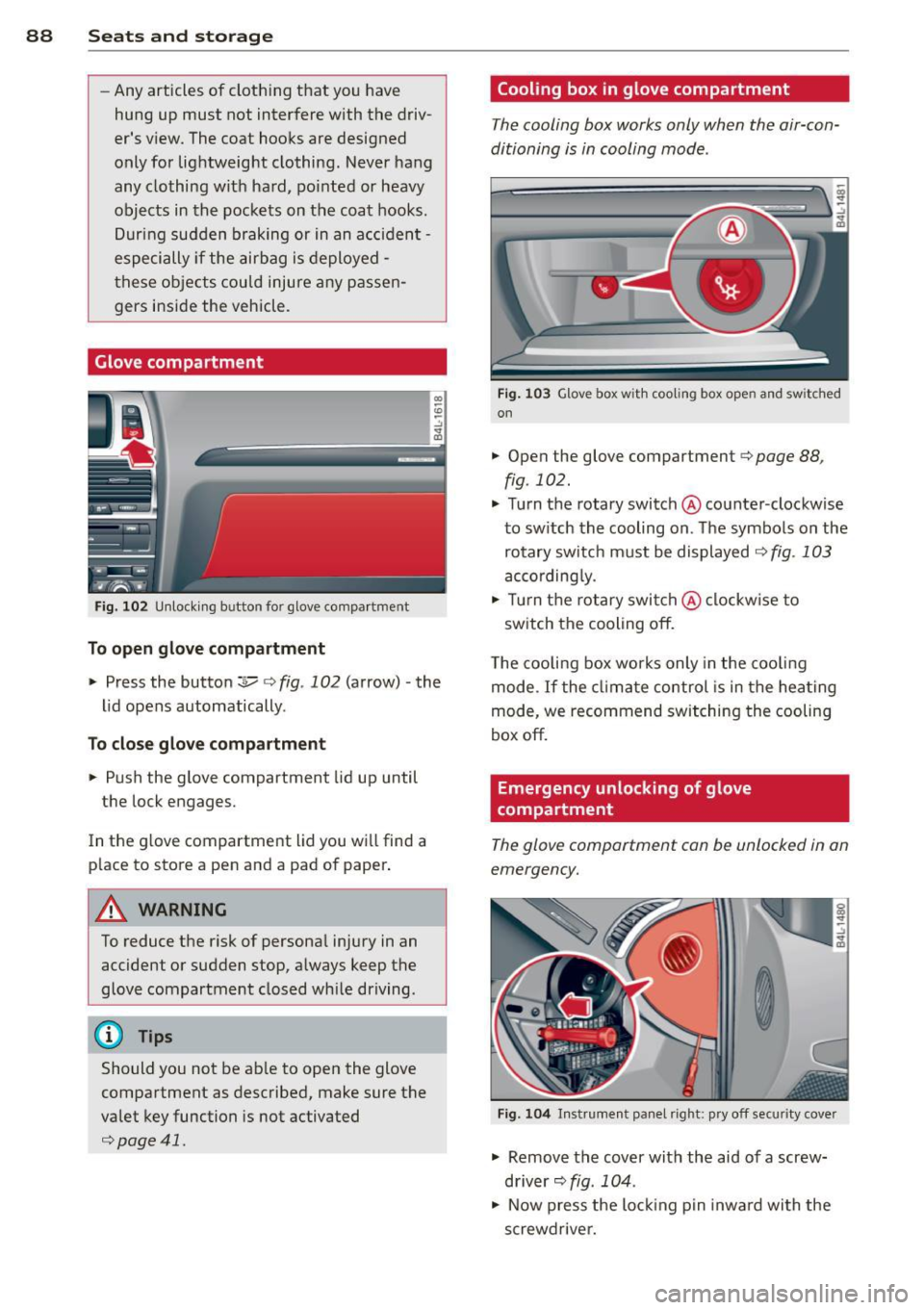
F ig . 102 U nlocki ng button for glove compa rtment
To open glove compartment
• Press the button :::!l.....-¢ fig . 102 (arrow) -the
lid opens automatically .
To close glove compartment
• Push the glove compartment lid up until
the lock engages.
In the g love compartment lid you wi ll find a
p lace to store a pen and a pad of paper .
A WARNING
To reduce the risk of personal injury in an
accident or sudden stop, a lways keep the
glove compartment closed wh ile driving.
@ Tips
Should you not be ab le to open the glove
compartment as described, make sure the
valet key function is not activated
¢page 41.
Cooling box in glove compartment
The cooling box works only when the air-con
ditioning is in cooling mode.
F ig . 1 03 Glove box with coo ling box open and sw itched
on
• Open the glove compartment¢ page 88,
fig. 102.
• Turn the rotary switch @counter-clockwise
to sw itch the cooling on. The symbo ls on the
rotary switch must be displayed
¢ fig . 103
according ly.
• Tur n the rotary swi tch@ clockw ise to
switch the cooling off.
T he cooling box wor ks only in the coo ling
mode. If the cl imate control is in the hea ting
mode, we recommend switching the cooling
box off.
Emergency unlocking of glove
compartment
The glove compartment can be unlocked in an
emergency.
F ig. 10 4 In strument panel right: pry off secur it y cover
• Remove the cover with the aid of a screw
driver~
fig . 104 .
• Now press the lo cking p in inwa rd with the
screwdrive r.
Page 107 of 348
Ignition lock and ignition switch
Ignition key positions
The engine con be started or turned off with
the ignition key.
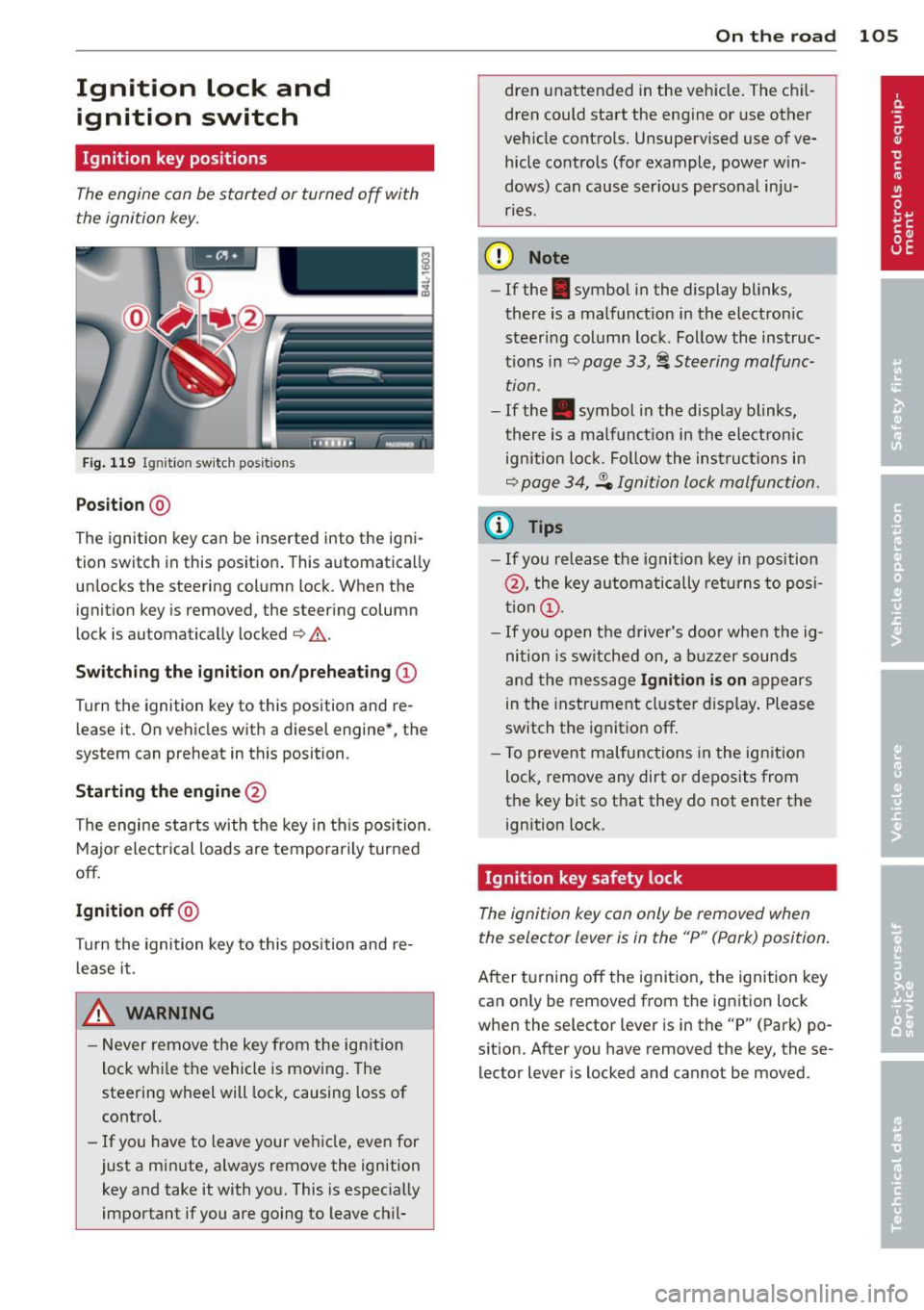
Fig. 119 Igni tion switch pos it io n s
Position @
The ignition key can be inserted into the igni
tion switch in this position . This automatically
unlocks the steering column lock . When the
ignition key is removed, the steering column
lock is automatically locked
Q .&. .
Switching the ignition on/preheating (D
Turn the ignition key to this position and re
lease it. On vehicles with a d iesel engine*, the
system can preheat in this position .
Starting the engine@
The engine starts with the key in this position.
Major electrical loads are temporarily turned
off.
Ignition off@
Turn the ignition key to this position and re
lease it.
A WARNING ,~ ~
- Never remove the key from the ign ition
lock whi le the vehicle is moving. The
steering wheel will lock, causing loss of
control.
- If you have to leave your vehicle, even for
just a minute, always remove the ignition key and take it with you. This is especially
important if you are going to leave chil-
On the road 105
dren unattended in the vehicle. The chil
dren could start the engine or use other
vehicle controls. Unsupervised use of ve
hicle controls (for example, power win
dows) can cause ser ious personal inju
ries.
(D Note
- If the . symbol in the display blinks,
there is a malfunction in the electronic
steering column lock . Follow the instruc
tions in
Q page 33, i Steering malfunc
tion .
-If the . symbol in the display blinks,
there is a malfunction in the electronic
ignition lock . Fol low the instructions in
Q page 34, .P. Ignition lock malfunction.
a) Tips
-If you release the ignition key in position
@, the key automatically returns to posi
tion (!).
- If you open the driver's door when the ig
nition is sw itched on, a buzzer sounds
and the message
Ignition is on appears
in the instrument cluster display. Please
switch the ignition off.
- T o prevent malfunctions in the ign ition
lock, remove any dirt or deposits from
the key bit so that they do not enter the
ignition lock.
Ignition key safety lock
The ignition key con only be removed when
the selector lever is in the "P" (Pork) position.
After turning off the ignition, the ignition key
can only be removed from the ignition lock
when the selector lever is in the "P" (Park) po
sition. After you have removed the key, these lector lever is locked and cannot be moved.
Page 217 of 348
-Children on the front seat of any car,
even with Advanced A irbags, can be seri
ous ly injured or even killed when an a ir
bag inflates.
- Never let a child stand or kneel on any
seat, for examp le the front seat.
- Never let a child ride in the cargo area of
your vehicle .
- Always remember that a ch ild lean ing
forward, sitt ing sideways or out of posi
t ion in any way during an acc ident can be
struck by a deploying airbag . This will re
sult in se rious personal injury or death .
- If you must install a booster seat on the
front passenger seat because of excep
t ional circumstances the
PASSENGER
AIR BAG OFF
light must come on and
stay on, whenever the ignition is switch
ed on.
- If the
PASSENGER AIR BAG OFF light
does not come on and stay on, perform
the checks described¢
page 195, Moni
toring the Advanced Airbag System.
- Ta ke the child restrain t off the front pas
senger seat and install it properly at one
of the rear seat positions if the
PASSEN
GER AIR BAG OFF
light does not stay on
whenever the ignition is switched on.
- Always read and heed all WARNINGS
whenever using a child restrained in ave
hicle is being used¢
page 175, Safety
belts,¢ page 184, Airbag system
and
c:> page 205, Important things to know.
Installing a child safety
seat
Securing a child safety seat using a
safety belt
Safety belts for the rear sea ts and the fron t
passenger can be locked wi th the convertible
locking retractor to properly secure child
safety seats .
The safety belts emergency lock ing retractors
for the rear seats safety belts and for the
front passenger's seat safety belt have a con
ve rtible locking retractor for child restraints.
Child Sa fet y 215
The safety belt must be locked so that be lt
webbing cannot unree l. The retractor can be
activated to lock the safety belt and prevent
the safety belt webbing from loosening up
during normal dr iving . A child safety seat can
only be properly installed when the safety belt
i s locked so that the chi ld and child safety
seat w ill stay in place .
Always remember: Even though your vehicle is equipped with an Advanced Airbag system, all
ch ildren, especially those 12 years and young
er, shou ld always r ide in the back seat proper
ly restrai ned fo r the ir age and size.
A WARNING
Improperly installed chi ld safety seats in
crease the risk of serious personal injury
and death in a collision.
- Always ma ke sure that the safety belt re
tracto r is loc ked when installing a child
safety seat . An unlocked safety belt re
tractor cannot hold the child safety seat
in place during normal dr iving or in a
crash.
- Always buckle the child safety seat firmly
in place even if a ch ild is not sitt ing in it.
A loose child safety seat can fly around during a sudden stop or in a collision .
- Always make sure that the rear seat
backrest to which the center rear safety
be lt is attached is securely latched when
eve r the rea r center safety belt is being
used to secure a ch ild restra int.
- If the backrest is not securely latched,
the child and the child restraint will be
thrown forward together with the back rest and will strike parts of the vehicle
interior. The child can be seriously in
jured or killed.
- Never install rear-fa cing child safety
seats or infant carrie rs on the front pas
senger seat . A child will be serio usly in
jured and can be killed when the passen ger airbag inflates.
- The inflating airbag will h it the ch ild
safety seat or infant carrier with great
force and will smash the child safety seat
~
•
•
Page 219 of 348
-A tight tether strap on a rearward-facing
child restraint attached to the front pas
senger seat can put too much pressure on the weight-mat in the seat and regis
ter a heavier weight in the Advanced Air
bag System . The heavier weight regis
tered can make the system work as
though an adult were on the seat and de
ploy the Advanced Airbag when it must
be suppressed causing serious or even
fatal injury to the child .
- Make sure that the
PASSENGER AIR BAG
OFF
light comes on and stays on all the
time whenever the ignition is switched
on.
- If the
PASSENGER AIR BAG OFF light
does not come on and stay on, immedi
ately install the rear-facing child safety
seat in a rear seating position and have
the airbag system inspected by your Audi dealer.
Activating the convertible locking
retractor
Use the convertible locking retractor to se
cure a child restraint.
Always heed the child safety seat manufactur
er's instructions when installing a child re
straint in your vehicle . To activate the conver
tible locking retractor :
.. Place the child restraint on a seat, prefera
bly on the rear seat.
.. Slowly pull the belt
all the way out .
.. Route it around or through the child re
straint belt path~&_ .
.. Push the child safety seat down with your
full weight to get the safety belt really tight.
.. Insert the belt tongue into the buckle for
that seating position .
.. Guide the safety belt back into the retractor
until the belt lies flat and snug on the child
safety seat .
.. You should hear a "clicking " noise as the
belt winds back into the inertia reel. Test the
convertible locking retractor by pulling on
the belt . You should no longer be able to
Child Safety 21 7
pull the belt out of the retractor. The con
vertible locking retractor is now activated.
.. Make sure that the red release button is fac
ing away from the child restraint so that it
can be unbuckled quickly.
.. Pull on the belt to make sure the safety belt
is properly tight and fastened so that the
seat cannot move forward or sideways more
than one inch (2.5 cm).
_&. WARNING
Using the wrong child restraint or an im
properly installed child restraint can cause
serious personal injury or death in a crash.
- Always make sure that the safety belt re-
tractor is locked when installing a child
safety seat. An unlocked safety belt re
tractor cannot hold the child safety seat
in place during normal driving or in a
crash.
-Always buckle the child safety seat firmly in place even if a child is not sitting in it.
A loose child safety seat can fly around
during a sudden stop or in a crash.
- Always make sure the seat backrest to
which the child restraint is installed is in
an upright position and securely latched
into place and cannot fold forward . Oth
erwise, the seatback with the child safety
seat attached to it could fly forward in
the event of an accident or other emer
gency situation .
- Always read and heed all WARNINGS
whenever using a child restrained in ave
hicle is being used¢
page 205. Special
precautions apply when installing a child
safety seat on the front passenger seat
¢ page 186, Child restraints on the front
seat -some important things to know .
-
•
•
Page 234 of 348
232 Intelligent technology
can result in there being insufficient energy
avai lab le to start the engine .
I ntell igent energy management in your vehi
cle handles the distribution of electrical ener
gy . Starting abi lity is markedly improved and
the life of the battery is extended .
Basically , energy management consists of
battery diagnosis , idling current manage
ment
and dynamic energy management.
Battery diagnosis
Battery diagnosis continuously determines
the state of the battery. Sensors determine
battery volta ge, battery current and battery
temperature. This determines the current
state of charge and the power of the battery.
Idling current management
Idling current management reduces energy
consumption while the vehicle is stand ing.
With the ignition switched off, it contro ls the
energy supply to the various e lectrica l compo
nents. Data from battery diagnosis is consid
ered.
Depending on the battery's state of charge,
individua l consumers are gradually turned off
to prevent excessive discharge of the battery
and thus maintain starting capability.
Dynamic energy management
While the vehicle is being dr iven , dynamic en
e rg y management distributes the energy gen
erated according to the needs of the individu
a l components. It regulates consumption, so
that more ele ctrical energy is not being used
than is being generated and ensures an opti mal state of cha rge for the battery.
{D) Tips
- But even energy management cannot
negate the limits of physics. Consider
that the power and life of a battery are
limited .
- If starting ab ility is threatened, you are
i nformed by a warn ing
c> page 233,
Driver notification in the instrument
cluster display .
What you should know
The highest priority is given to maintaining
starting capability .
The battery is seve rely taxed in shor t-distance
driving, in city tra ffic and dur ing the cold time
of year . Abundant electrical energy is re
quired, but only a little is generated . It is also
critical if the engine is not running and e lectri
ca l components are turned on . In this in
stance energy is being consumed but none is
being generated.
It i s in precisely these situations that you will
notice energy management actively regulat
ing the distribution of energy.
Vehicle stands for an extended period
If you do not drive your vehicle over a period
of several days or weeks , e lectr ica l compo
nents are gradually cut back or sw itched off.
T his reduces energy consumption and main
ta ins start ing capability over a longer period .
Take into consideration that when you unlock
your vehicle , some conven ience functions ,
s uc h as the inte rior lights or the power seat
adjustment, may not be available. The con
venience functions will be available again
when you turn on the ignition and start the e ngine .
With the engine turned off
If you listen to the radio, for example, w ith
the engine turned off or use other MMI func
tions, the battery is being discharged .
If starting capability is jeopardized due to en
ergy consumption , the following warning ap
pears in the MMI display:
Please start engine, otherwise system will
switch off in 3 minutes .
The warning indicates that the system will be
turned off automatically after 3 minutes . If
you w ish to continue using the funct ions, you
have to sta rt the eng ine.
1111>
Page 261 of 348
container meets industry standards (ANSI/
ASTM F852 -86).
(D Note
Never drive yo ur vehicle unt il the fuel tank
is complete ly empty. The irregular supply
of fuel can cause misfiring . Gasoline could
enter the exhaust system and damage the
catalyt ic converter.
Refuelling
F ig. 234 Righ t rear vehicle side: Opening th e fue l fill er
flap
F ig. 235 Fu el cap hooked on the opened fuel filler flap
When adding fuel, the ignition and any cellu
lar phones in the vehicle must be sw itched
off. When activating the central locking, the
fuel filler flap is automatica lly unlocked or
locked. Refuel the ve hicle w ith the ignition
turned
off.
Tak ing th e fu el cap off
• To open the fuel filler flap, press on the left
s ide of the flap¢
fig. 234 -arrow- .
• Unscrew fuel fil ler cap counter-clockwise
and hang it on the fuel fille r flap ¢
fig. 235.
• Check the label on the inside o f the f uel fill
er flap to determine if the vehicle must be
fueled with gasoline or diesel fuel.
Fuel suppl y and filli ng your fuel t ank 259
Refuelling p ro cedur e
• Insert the fuel nozz le from the gasoline
pump into the fuel fi ller neck as far as it wi ll
go .
• Select a medi um refue lling rate so that the
nozz le switches off automatically when the
tank is full.
Pu tting th e fuel cap bac k on
• After fi lling your tank, twist the fuel filler
cap clockwise as far as it wi ll go.
• Close the fue l filler flap.
T o avoid fuel spill ing or evaporating from the
fuel tank always close fuel filler cap proper ly
and completely. An improperly closed fuel fill
er cap may also cause the MIL lamp¢
page 2 7
to come on (only vehicles with gasoline en
gine).
A WARNING
Improper refueling or handling of fuel can
cause fire, explosion and severe burns.
- Fuel is highly flammable and can cause
severe burns and other injur ies.
- Failure to shut the engine off wh ile refu
eling and/or to insert the pump nozzle
fully into the fuel filler neck could cause
fue l to spray out of filler neck or to over
f low. Fue l spray and overflowing fue l can
cause a fi re.
- Never use a cel lu lar telephone while re
fueling. The electromagnetic rad iation
can cause sparks that can ignite f uel va
pors and cause a fire.
- Never get back into your vehicle whi le re
fueling. If in exceptional circumstances
you must get back in your vehicle while
refueling, make certain that you close
the door and touch metal to discharge
stat ic electricity before touching the fill
er nozzle again. Static e lectricity can
cause sparks that can ignite fuel vapors re leased du ring refuel ing .
- Never smoke or have an open flame any
where in or near your veh icle when refu-
eling or filling a portab le fue l conta iner.
ll>
Page 263 of 348
Unlocking the fuel filler flap by hand
You can open the fuel filler flap by hand if the
power locking system should fail.
•
•
Fig . 236 Luggage compartment: Prying cover open
Fi g. 237 Luggage compartment: Emergency opening
of fuel filler flap
.. Remove the right-side trim panel with the
aid of a screwdriver ¢
fig. 236.
.. Pull the loop down in the direction of the ar
row to unlock the fuel f iller flap ¢
fig. 237.
Selective catalytic
reduction
General information
App lies to vehicles : with diesel engine
On vehicles w ith select ive catalytic reduction,
an urea solut ion (Ad Blue ®) is injected into the
exhaust system befo re a nitrogen oxide cata
lytic converter to reduce nitrogen em iss ions.
The AdBlue is stored in a separate tank in the
veh icle. The AdBlue usage accounts for ap
p rox imately 0.5% to 1.2% of the diese l fuel
that is used. The Ad Blue tank capaci ty is ap
pr ox ima tely 6 gallons (23 liters).
You must refill the Ad Blue or have it refilled
by your authorized A udi dealer or qualified
wo rkshop as soon as the Ad Bl ue refill mes-
Fu el suppl y and filli ng your fuel t ank 261
sage appears in the instrument cluster
¢ page 262.
A WARNING
Failure to heed AdBlue refill info rmation in
the instrument cluster can prevent the ve hi cle from be ing started and dr iven. If the
vehicle cannot be driven and a n emerge ncy
a rises, pe rsonal injury can occur.
- Always have the AdBlue tank refilled well
befo re the tank runs dry .
(D Tips
- The instrument cluster d isp lay ind icates
the distance remain ing that can be driv
en ¢
page 261. If the Ad B lue tank is
completely empty, the engine will not
start again afte r the ignit ion is switched
off.
- Ad Blue is req uired by law to operate th is
veh icl e.
- Ad Blue ® is a registered trademark of the
Registe red Automobile Association (Ve r
band de r Automob ilindustrie e.
V. -
VOA) .
Indicator in the instrument cluster
display
Appl ies to vehicles: wit h diesel eng ine
The display indica tes if the Ad Blue level is low
or if it was filled incorrectly.
Fi g. 2 38 Instr ument cluste r: indicator in t he d isplay
AdBlue level low
You w ill be informed if t he AdB lue in the tank
drops below a certain level.
Ad Blue /9 1500 mi (2400 km) R efill
AdBlue. See owner 's manual
Page 338 of 348
336 Index
Rear air distribution .... ... .. .. .... .. 99
Rear controls . . . . . . . . . . . . . . . . . . . . . . 97
Rear fan ... ... ... .... ... .. .. .... .. 98
Rear operat ion ........... .... ..... 100
Rear temperature . . . . . . . . . . . . . . . . . . . 98
Synchron izat ion ........... ... .. ... 100
Turn ing o n/off ..... ...... .. .. .. .. .. 98
Front airbags Descr ipt ion ... ........... .. .. .... . 188
H ow they work . . . . . . . . . . . . . . . . . . . . 193
Fr onta l co llisions and the laws of physics 17 6
F ront fog l ights . . . . . . . . . . . . . . . . . . . . . . 58
Front seats .. ..................... .. 71
Ad justing ........................ 167
C hi ld restra ints in the front seat . ..... 186
Fu el
Additives ... ... . ...... ... .. .. .... . 256
Blended gasoline .................. 256
Consumpt ion . . . . . . . . . . . . . . . . . . . . . . 24
F ill er neck ............... ........ . 258
Fue l gauge . .............. ... .. .... 12
Gasoline ... ... .... ...... .. .. .. .. . 256
Gasoline additives . ........ ... .. .. . 257
L ow fue l level . . . . . . . . . . . . . . . . . . 12 , 35
Octane r ating . ......... .. .. .. .. .. . 256
Recommendation . ..... ... .. .. .... . 25 6
Refue lling . .. .. .. ..... ... .. .. .... . 259
Reserve .... ... . ...... ... .. .. .... .. 12
Tank capacity .............. .. .... . 322
Unlock ing the fuel filler flap by hand .. 261
Fu el economy messages (eff iciency pro -
gram) ... .... ... . ...... ... .. .. .... .. 27
Fuse ar rangement .......... ... .. ... 309
G
Garage door opener (HomeL ink ®) 161
Gas discharge lamps ... ... .. .. .. .. .. . 3 12
Gauges Eng ine coolan t temperature .. .. ...... 10
Fu el gauge .............. .. .. .. .. .. 12
Speedometer .. .. ..... ... .. .. .... .. 12
Tac hometer . . . . . . . . . . . . . . . . . . . . . . . 11
Trip odometer ........... .. .. .... .. 12
Ge ne ral illus tra tion
I ns trumen ts an d con trols . . . . . . . . . . . . . 8 G
eneral rules and dr iv ing t ips ... ... . .. 238
Befo re dr iving offroad .. ..... ... .. .. 238
Driving offroad ... ... .. ..... ... .. .. 238
G lossary of tire and loading term inology 281
G love compartment .................. 88
Cooling box . . . . . . . . . . . . . . . . . . . . . . . . 88
Valet key funct io n ................ .. 41
G love compartment -emergency unlock-
i ng ................................ 88
G low p lug system
Indicator light ... .. .... .... ... .. .. . 15
G radient angle .. ............ ....... 238
Gross Vehicle Weight Rating (GVWR) . .. 320
G ro u nd cle arance 238
H
Head lights . .. .. .. ... .......... .. .. . 57
Ad aptive ligh t . . . . . . . . . . . . . . . . . . . . . . 59
D efec tive . .. ................. .. .. . 23
Front fog lights . . . . . . . . . . . . . . . . . . . . 58
Hea dlight range control ..... ... .. .. . 36
Switching off ...................... 57
Switching on . . . . . . . . . . . . . . . . . . . . . . . 57
Washer system . . . . . . . . . . . . . . . . . . . . . 66
Xenon headlights . . . . . . . . . . . . . . . . . . . 57
Head light washer reservoir .. ... .. .. .. 279
Head restrai nts ..................... 168
Adjus ting . .. .. .. ................. 168
F ron t se ats . . . . . . . . . . . . . . . . . . . . . . . . 76
Rear seats . . . . . . . . . . . . . . . . . . . . . . . . . 77
Heated Exte rior m irrors ............... .. ... 68
F ron t seats ....................... 100
Rea r sea ts . .. .. .. ... .......... .... 101
Rea r seats (four -zone a utomat ic comfort
air conditioning) .. ... .. ..... ... .. .. 101
Steering w heel ... .. ... ..... ... .. .. 101
Washer jets . . . . . . . . . . . . . . . . . . . . . . . 63
He ating
C limate controls . .... .. ..... ... .. .. . 91
Heavy clothi ng a nd safety be lts ....... . 178
Highbeam .. ................... . 57,60
Warning/ind icator lights ........ ..... 18
Hig h voltage warning label ........... 320
Hill descent con trol ................ . 225
Page 341 of 348
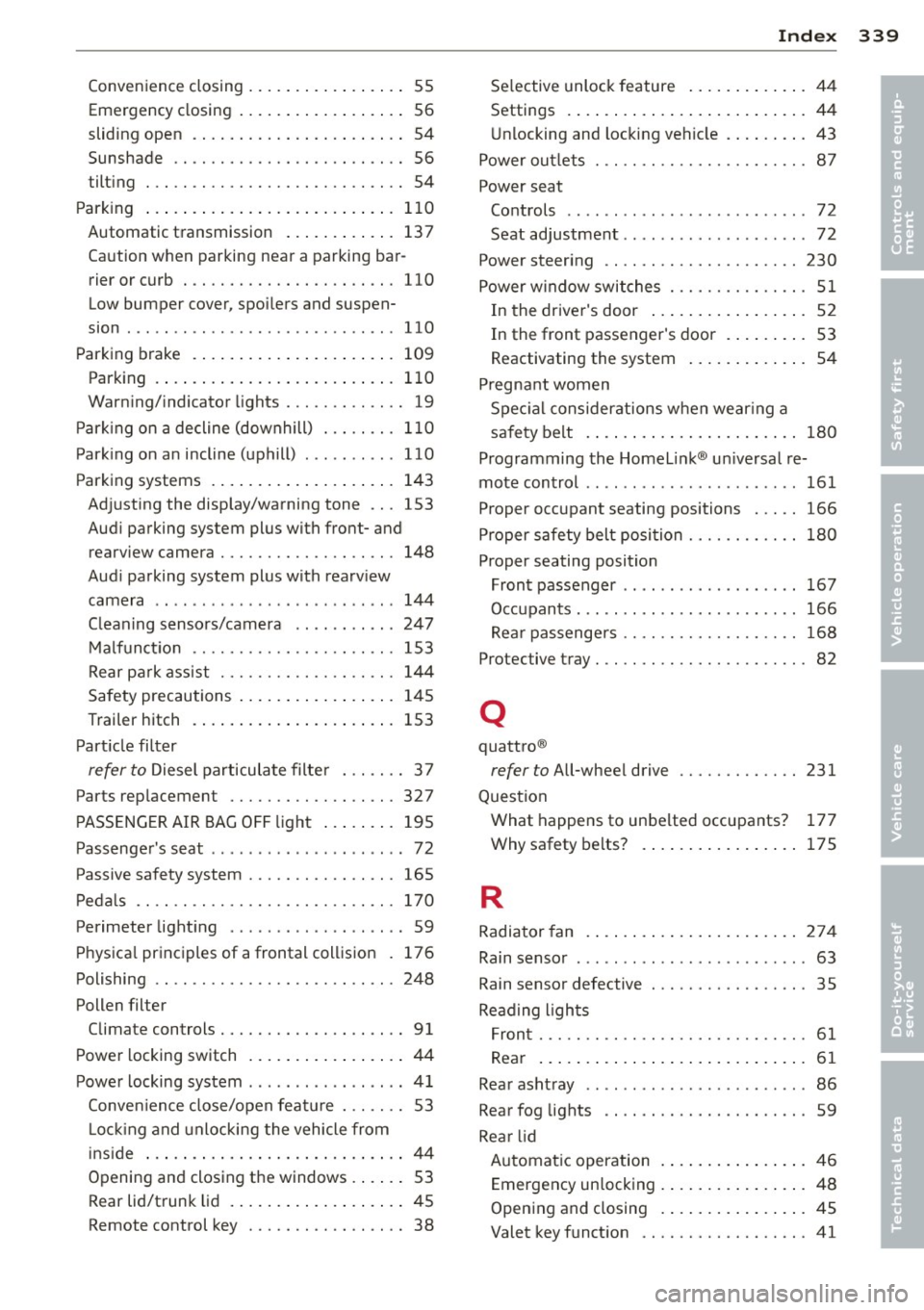
Convenience closing ......... .. .. .. .. 55
Emergency closing . . . . . . . . . . . . . . . . . . 56
sliding open . . . . . . . . . . . . . . . . . . . . . . . 54
Sunshade . . . . . . . . . . . . . . . . . . . . . . . . . 56
tilt ing ... .. ................. .. .... 54
P ark ing ..... .. .. .. .. .... ... .. .. ... 110
Automatic transmission ... .. .. .. .. . 137
Caution when parking near a parking bar- rier or curb . ............. .... .. ... 110
Low bumper cover, spoi lers and suspen-
sion ..... ... ...... ............. .. 110
Parking brake . .... ..... ... .. .. .. ... 109
Parking .... .. .... .... ... .. .. .. ... 110
Warn ing/ indicator lights ... .. .. .. .. .. 19
P ar king on a decline (downhill) . .. .. .. . 110
Park ing on an incline (uphill) ..... . ... . 110
Parking systems . ... .... ... .. .. .. ... 143
Ad justing the disp lay/warning tone .. . 153
Aud i parking system plus with front- and
rearv iew camera . . . . . . . . . . . . . . . . . . . 148
Aud i pa rking system plus with rearv iew
camera . ... ... .. .. ...... .. .. .. .. . 144
C lean ing senso rs/camera .. .. .. .. .. . 247
M alfunc tion ................ ... .. . 153
Rear p ark assist .......... .... .. .. . 14 4
Safety precautions . . . . . . . . . . . . . . . . . 14 5
T railer hitch . ..... .... ... .. .. .. ... 153
P art icle filter
refer to Diesel particula te filter . . . . . . . 3 7
Parts rep lacement ......... .. .. .. .. . 327
P ASSENGER AIR BAG O FF light ... .. .. . 195
P assenge r's seat . . . . . . . . . . . . . . . . . . . . . 72
Passive safety system ....... .. .. .. .. . 165
P ed als .... .. ................. ..... 170
Perimeter light ing ...... .... ... ... ... 59
Physica l princ iples of a frontal coll is ion . 176
P olishing .. .. ............. .... .. ... 2 48
Pollen filter Climate controls . . . . . . . . . . . . . . . . . . . . 91
P owe r locking switch . . . . . . . . . . . . . . . . . 4 4
P owe r locking system ....... ... .. .... . 41
Conve nien ce close/open feat ure . .. .... 53
L o cki ng and unlocking the vehicle from
ins ide ..... .. ... .. ..... ... .. .. .... 4 4
Opening and clos ing the windows . ... .. 53
Rear lid/trunk lid . ..... ... .. .. .. .. .. 45
Remote control key . . . . . . . . . . . . . . . . . 38
Inde x 339
Selective unlock feature ..... ... .. .. . 44
Settings . . . . . . . . . . . . . . . . . . . . . . . . . . 44
U nlocking and locking vehicle . ... .. .. . 43
Power out lets . . . . . . . . . . . . . . . . . . . . . . . 87
Power seat Controls . . . . . . . . . . . . . . . . . . . . . . . . . . 72
Seat adjustment . . . . . . . . . . . . . . . . . . . . 72
Power steering .. ................... 230
Power w indow switches .......... .... . 51
In the driver's door . . . . . . . . . . . . . . . . . 52
In the front passenger's door . . . . . . . . . 53
Reactivating the system . . . . . . . . . . . . . 54
Pregnan t women
Spe cial consider ations w hen wear ing a
sa fe ty belt . . . . . . . . . . . . . . . . . . . . . . . 180
Programming the HomeL ink® u niversa l re-
mote control ...... .. . .. ... .... .. ... 161
Proper occupant seating positions ... .. 166
P roper safety belt posi tion ............ 18 0
Proper seating position Front passenger .. .. .. .. ...... ... .. 167
Occupants . .. .. .. .... ........... .. 166
Rea r passenger s ................... 168
Protective tray . . . . . . . . . . . . . . . . . . . . . . .
82
Q
quattro ®
refer to All-wheel drive
231
Ques tion
What happens to unbelted occupants? 177
Why safety be lts? . .. .. .. ..... ... .. 175
R
Radiator fan . ..... .. . .. .. ..... ... .. 274
Rain senso r . . . . . . . . . . . . . . . . . . . . . . . . . 63
Rain sensor defective . . . . . . . . . . . . . . . . . 35
Re ading ligh ts
F ron t ....... .. .. .................. 61
Rear ... .. .. .... .. . .. .. ..... ... .. . 61
Rea r asht ray .. .. .. .. . .. .... .... .. .. . 86
Rear fog lights .. ................... . 59
Re ar li d
Au tomat ic operation . .. ..... ... .. .. . 46
Emergency unlocking . .. ..... ... .. .. . 48
Opening and closing . .. ..... ... .. .. . 45
Valet key funct ion ................. . 41
•
•
Page 343 of 348
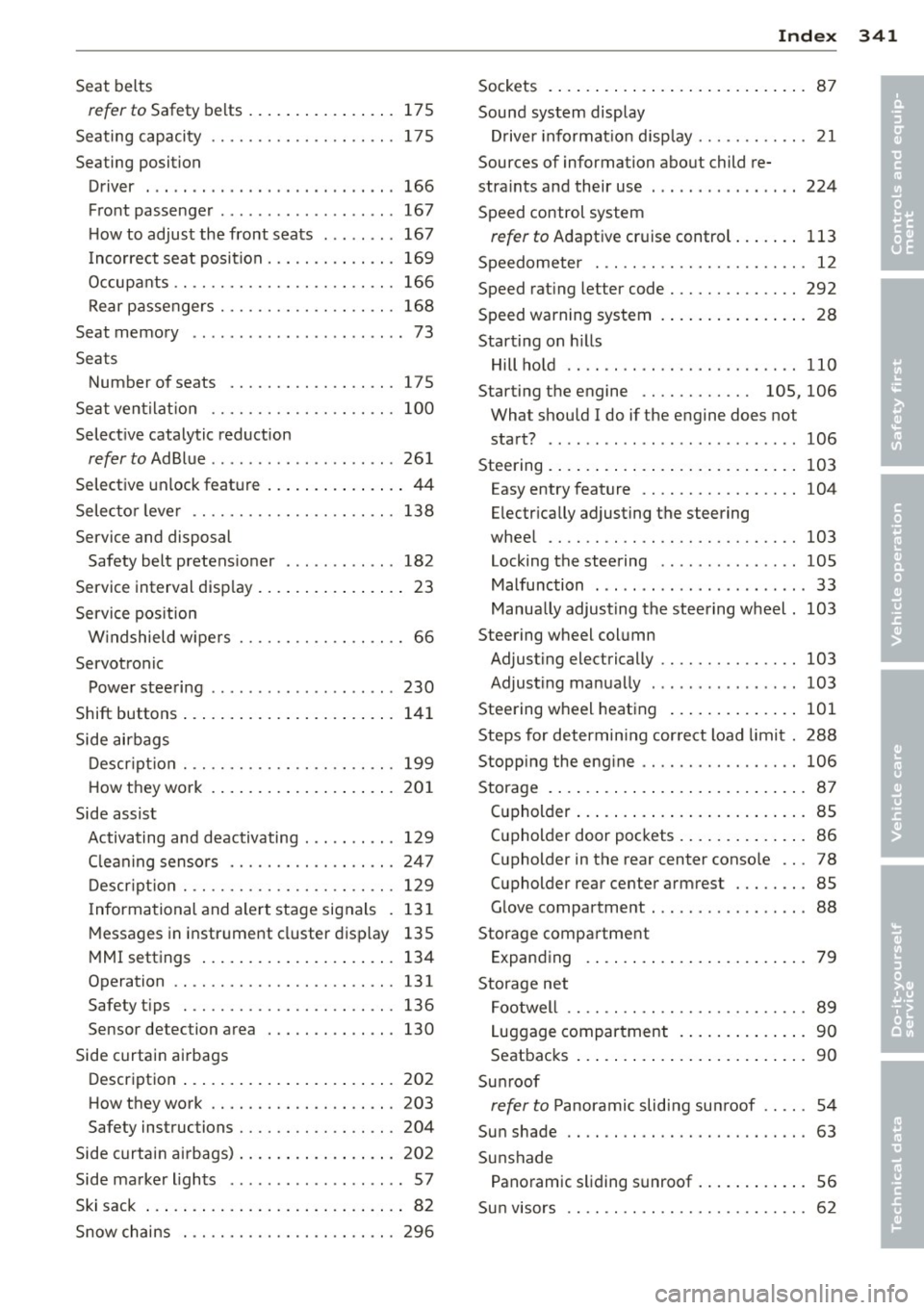
Seat belts
re fer to Safety belts . . . . . . . . . . . . . . . . 17 5
Seating capacity
Seating position
175
Driver . .. .. .. .. .. .. .... ... .. .. .. . 166
Front passenger . ............. ... .. 167
How to adjust the front seats . .. . ... . 167
Incorrect seat position ..... .. .. .. .. . 169
Occupants .. .. ........... .. .. .. ... 166
Rear passengers .......... .. .. .. .. . 168
Seat memory . . . . . . . . . . . . . . . . . . . . . . . 73
Seats
Number of seats ......... .. .. .. .. .
175
Seat ventilation . . . . . . . . . . . . . . . . . . . . 100
Selective catalytic reduction
refer to Ad Blue ... .. ...... .. .. .. .. . 261
Selective unlock feature ........ ... .. .. 44
Selector lever ............. .... .. .. . 138
Service and disposal
Safety belt pretensioner . . . . . . . . . . . .
182
Service interval display . . . . . . . . . . . . . . . . 23
Service position
Windshield wipers ........ .. .. .. .. ..
66
Servotronic
Power steering ............ ... ... ..
230
Shift buttons . . . . . . . . . . . . . . . . . . . . . . . 141
Side airbags
Description .............. .... .. .. .
199
How they work .............. ... ... 201
Side assist
Activating and deactivating . .. .. .. .. .
129
C leaning sensors ......... .. .. .. .. . 247
Description .............. .... .. .. . 129
Informational and alert stage signals . 131
Messages in instrument cluster display 135
MMI settings .................. ... 134
Operation . . . . . . . . . . . . . . . . . . . . . . . . 131
Safety tips . ............. .... .. ... 136
Sensor detection area ..... .. .. .. .. . 130
Side curtain airbags
Description ................. ... ...
202
How they work ........... .... .. .. . 203
Safety instructions ........ .. .. .. .. . 204
Side curtain airbags) ................. 202
Side marker lights ............ .... ... 57
Ski sack ............................ 82
Snow chains . ............. .... .. ... 296
Index 341
Sockets ..... ..... .................. 87
Sound system display
Driver information display ........... .
21
Sources of information about child re-
straints and their use . .... .... ... .. ..
224
Speed control system
refer to Adaptive cruise control ....... 113
Speedometer . . . . . . . . . . . . . . . . . . . . . . . 12
Speed rating letter code .............. 292
Speed warning system . . . . . . . . . . . . . . . . 28
Starting on hills
Hill hold . . . . . . . . . . . . . . . . . . . . . . . . .
110
Starting the engine . . . . . . . . . . . . 105, 106
What should I do if the engine does not
start? ....... ... .. ..... ..........
106
Steering ..... ..... .. ............... 103
Easy entry feature ................. 104
Electrically adjusting the steering
wheel .... .. .. .. ... ............ ..
103
Locking the steering ............... 105
Malfunction ... .... .. .. ...... ...... 33
Manually adjusting the steering wheel . 103
Steering wheel column
Adjusting electrically ............... 103
Adjusting manually ................
103
Steering wheel heating .............. 101
Steps for determining correct load limit . 288
Stopping the engine .. ........... .... 106
Storage .......... .................. 87
(upholder ......................... 85
(upholder door pockets ............ .. 86
(upholder in the rear center console .. . 78
(upholder rear center armrest ....... . 85
Glove compartment . ... ..... ... .. .. . 88
Storage compartment
Expanding . ... .... ................
79
Storage net
Footwell . . . . . . . . . . . . . . . . . . . . . . . . . .
89
Luggage compartment ............ .. 90
Seatbacks . . . . . . . . . . . . . . . . . . . . . . . . . 90
Sunroof
refer to Panoramic sliding sunroof .. .. . 54
Sun shade .. .. .. .. .. ............... . 63
Sunshade
Panoramic sliding sunroof . . . . . . . . . . . .
56
Sun visors .... .. ...... ........... .. . 62
•
•