window AUDI Q7 2013 Owner´s Manual
[x] Cancel search | Manufacturer: AUDI, Model Year: 2013, Model line: Q7, Model: AUDI Q7 2013Pages: 348, PDF Size: 87.72 MB
Page 98 of 348
96 Warm and cold
Air outlets
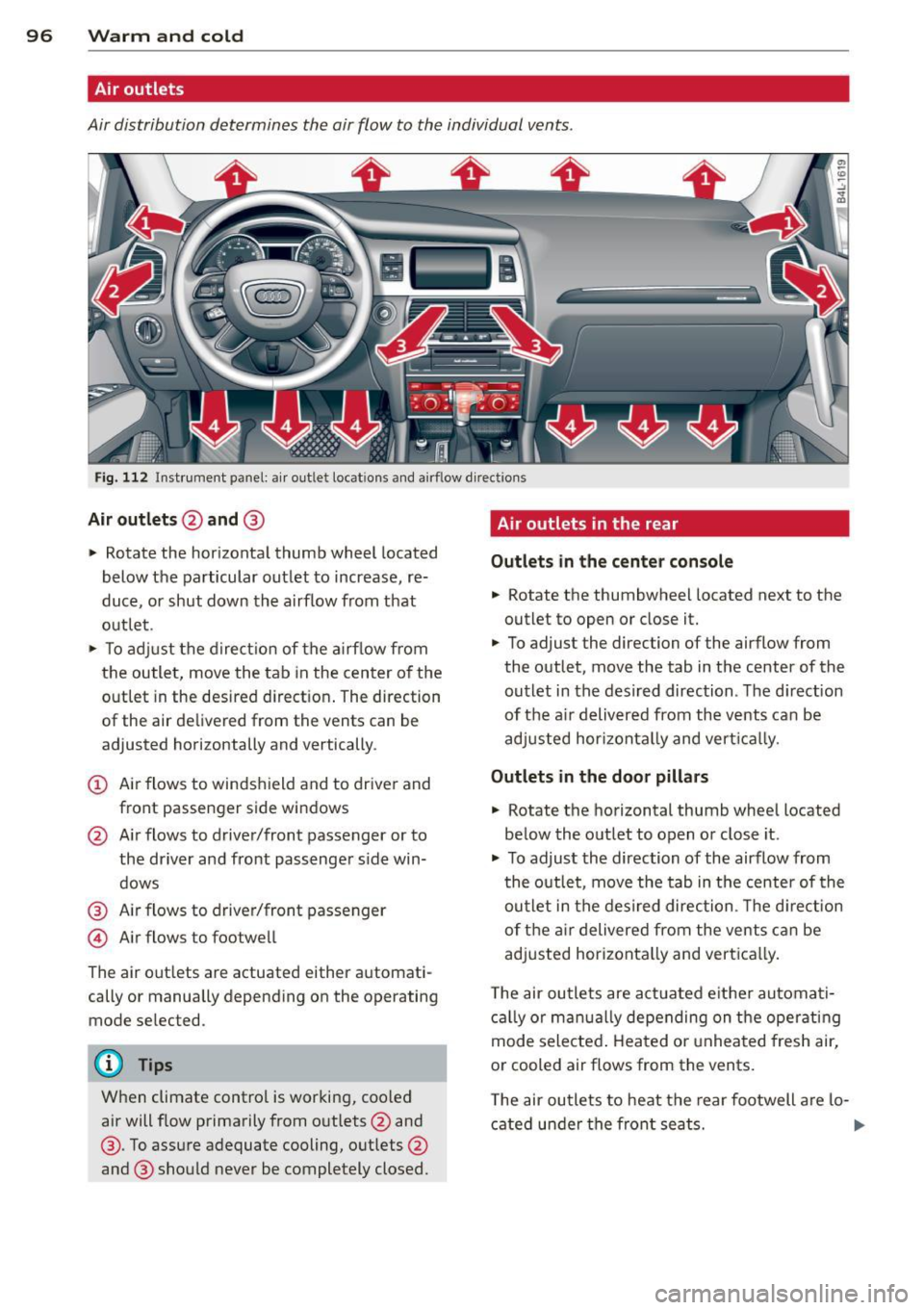
Air distribution determines the air flow to the individual vents .
Fig. 112 Instrument panel: a ir outlet locat ions and airf low d irections
Air outlets @and @
" Rotate the horizontal thumb wheel located
below the particular outlet to increase, re
duce, or shut down the a irflow from that
out let .
" To ad just the direc tion of the a irf low from
the outle t, move the tab in the center o f the
outlet in the desired d irect ion . The direction
of the air de livered from the vents can be
adjusted horizontally and vertically .
(D Air flows to windshield and to drive r and
front passenger side windows
@ Air flows to driver/front passenger or to
the driver and front passenger s ide win
dows
@ Air flows to driver/front passenger
© Air flows to footwell
The air out lets are actuated either automati
cally or manually depending on the operating
mode selected .
@ Tips
When climate control is working, coo led
air will f low primarily from outlets @and
@ . To assure adequate cooling, outlets @
and @ should never be completely closed.
Air outlets in the rear
Outlet s in the center con sol e
.. Rotate the thumbwheel located next to the
outlet to open or close it.
" To adjust the direction of the airflow from
the outlet, move the tab in the center of the
outlet in the desired direction . The d irection
of the a ir deliv ered from the vents can be
adj usted hor izontal ly and vert ica lly.
Outlets in the door pill ars
" Rotate the horizontal thumb wheel located
be low the outlet to open o r close it .
.. To adjust the direction of the airflow from
t he outlet, move the tab in the center of the
outlet in the desired direction . Th e d irect ion
of t he ai r delivered from the vents can be
adjusted horizonta lly and vert ica lly.
T he air ou tle ts are act uated e ither automati
c a lly or man ua lly depending on the operating
mode selected . Heated o r unheated fresh air,
or cooled air flows from the vents.
T he air ou tle ts to heat the rear footwell a re lo-
cated under the front seats.
1J11>
Page 99 of 348
@ Tips
If the climate control system is operating
in cooling mode, a ir flows primarily from
the outlets in the center conso le and in the
door pillars. To achieve adequate cooling,
you should never close the outlets com
pletely .
Using climate control economically
Using the climate controls prudently can help
save fuel.
When you use the air conditioner, engine pow
er is reduced and fuel consumption increases.
To save fuel, you should use the air condition
e r only when necessary. Also please note the
following points :
.,. To save fuel, turn off cooling mode by press
ing the
I AC ! button (indicator light goes
out) .
.,. In add ition, if you open the window or the
Panoramic sliding sunroof* while driving,
turn off cooling mode by p ress ing the
IACI
button (indicator light goes out).
.,. If the vehicle is extremely hot due to the
heat of the sun, briefly open doors and win
dows.
@ For the sake of the environment
By reducing the amount of fue l you use,
you also reduce the amount of poll utants
emitted into the air. W
arm and cold 9 7
Rear Air Conditioning
Rear air conditioning - controls
Applies to vehicles: with four-zone automatic comfort air
conditio nin g
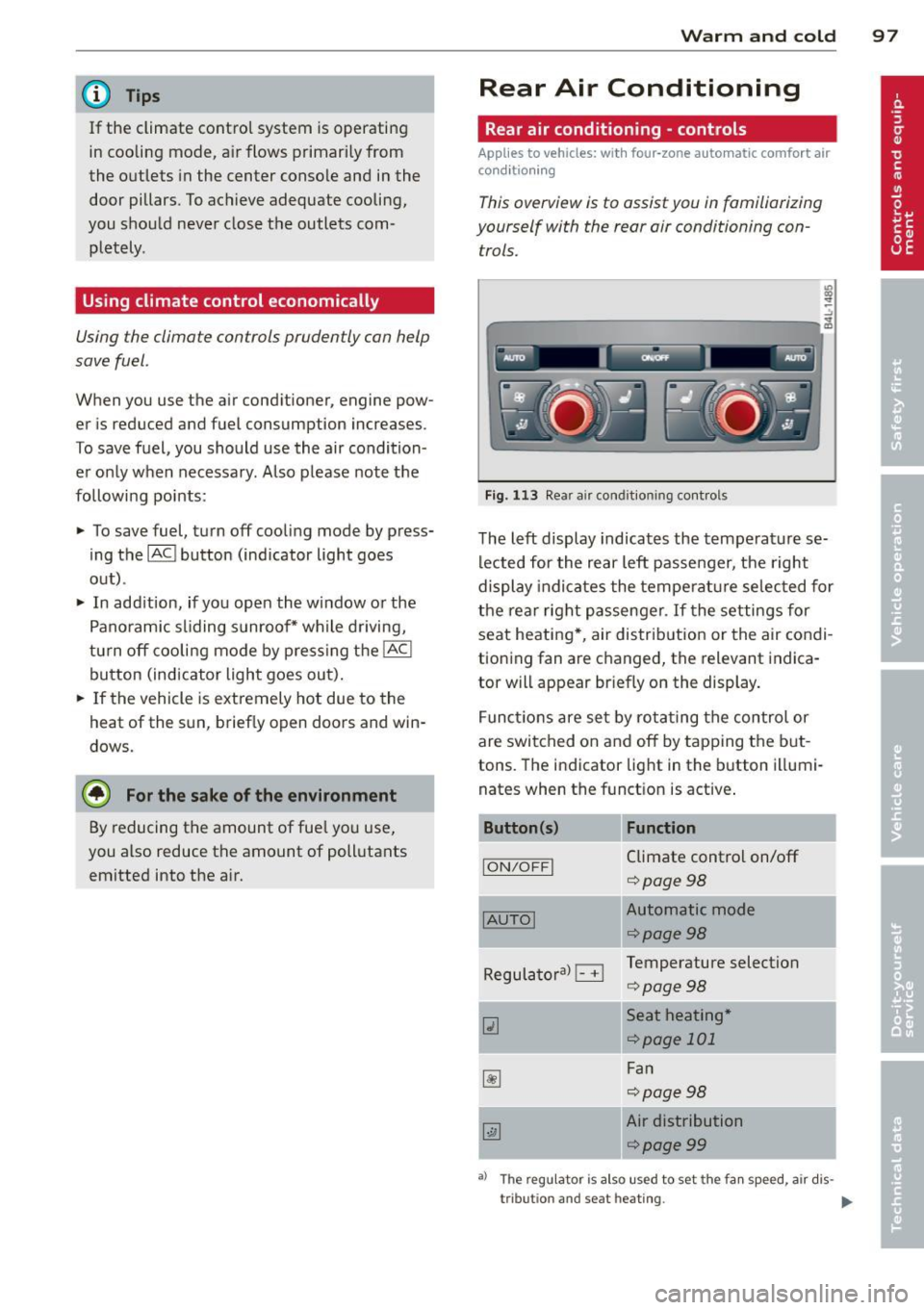
This overview is to assist you in familiarizing
yourself with the rear air conditioning con
trols.
lll ... :;
- --- ------------....... ~
Fig . 113 Rea r air conditioning controls
The left display indicates the temperature se
lected for the rear left passenger, the right
display indicates the temperature selected for
the rear right passenger . If the settings for
seat heating *, air distribution or the air condi
tioning fan are changed, the relevant indica
tor will appear br iefly on the display .
Funct io ns are set by ro tating the control or
are switched on and off by tapping the but
tons. The indicator light in the button illumi
nates when the function is active.
Button (s) Function
ION/OFFI Climate control on/off
¢ page98
-
IAUTOI Automatic mode
¢page98
Regulatoral El Temperature selection
¢page98
Qi Seat heating *
¢page 101
~
Fan
¢page98
~
Air distribution
¢page99
a) The regu lator is also u sed to set the fan sp ee d, air dis-
tribut ion and seat heating .
IIJ,
Page 101 of 348
Rear air distribution ~
Applies to vehicles: with four-zone automatic comfort air
conditioning
The automatically controlled air distribution
con be changed manually.
.. Press the Gil button.
.. Rotate the regu lator to the desired setting .
You can adj ust the air circulation so that air
flows from specific vents .
- In position
:J, all air flows from the vents in
the center console and the outlets to the
door pilla rs.
- In position
:0, air flows from the outlets in
the door p illars.
- In position
!,8, air flows from the outlets un-
der the front seats.
There are additional combinations available to
adjust air d istr ibut io n as needed.
To regulate air distribution automatically,
sw itch to
IAU TO I.
Basic settings
General
The basic climate control settings con be ad
justed in the MMI.
.,. Select: I CARI funct ion button > AC control
button . Or
.,. Se lect:
I CARI funct io n button > Car sys-
tem s*
control bu tton > A C.
The follow ing funct ions can be selected :
- Auto recirculation
c> page 99
- Synchronization c> page 99
-Supplementary heater * ¢page 100
-Rear oper ation* c> page 100
Warm and c old 99
Automatic recirculation mode
An air quality sensor detects increased con
centrations of pollutants in the outside air
and automatically switches to recirculation
mode .
We recommend that you always keep auto
matic a ir recirculation ON to p revent polluted
outside air from enteri ng the veh icle inter ior.
If the
a ir qu ality sensor l ocated in the air con
ditioning system detects polluted outs ide a ir,
the sensor dec ides whether the air pollut ion
can be reduced by the facto ry-installed pollu
ta nt fi lter or whethe r it is necessary to switc h
to air recirc ulation. With heavy conce ntra ti ons
of pollu tants, the a ir condit ion ing system is
switched automatica lly to recirc ulation mode
and the supp ly of outside air is blocked . As
soon as the concentration of pollutants in the
outside air drops, fresh air is supplied to the
vehicle interior aga in.
In the event that the windows fog up during
automat ic air rec irculat ion, you must press
the® button immediately.
Under certa in ope rating cond itions, a utomatic
air recirculation is switched off automatica lly.
With outside temperatures be low about 50 °F
(+10
°(), automatic air rec irculat ion is limited
to 30 seconds. W it h outside temperatures be
low about 30 °F ( -1 °C) a nd with the air condi
tione r switched off, the a utomatic air recircu
l ation is limited to 15 seconds.
Synchronization
One climate control setting for the driver and
front passenger seats .
With synchro nization active, the driver's set
tings a re adopted for the passenger o r vice
versa . All the othe r setti ngs that were made
are t ransferred to t he other seat . This in
cl udes all the cl ima te co ntro l settings, excep t
for the se at heating/ven tilat ion* .
If a different setting is selected at a
"synchron ized seat ", synchronization is can
c e lled.
Page 167 of 348
Driving Safely
General notes
Safe driving habits
Please remember -safety first!
This chapter contains important information,
tips, instructions and warnings that you need
to read and observe for your own safety, the
safety of your passengers and others . We have
summarized here what you need to know
about safety belts, airbags, ch ild restra ints as
well as child safety. You r safety is for us
priori
ty number 1.
Always observe t he information
a nd warn ings in th is se ct ion - for yo ur own
safety as well as that of your passengers .
The information in this se ction applies to all
model ve rsion s of your veh icle . Some of the
feat ures descr ibed in th is sec tions may be
standa rd equipment on some models, or may
be optional equipment on others . If you are
not sure, ask yo ur authorized Aud i dea ler.
A WARNING
- Always make sure that you follow the in
st ruct ions and heed the WARNINGS i n
this manual. It is in your interest and in
the inte rest of you r passengers.
- Always keep all of the Owner's Literature
man uals in your Audi when you lend o r
sell your vehicle so that this im po rtant
information will a lways be availab le to
the driver and passengers.
- Always keep the Owner's Literature han
dy so that you can find it easily if yo u
have ques tion s.
Safety equipment
The safety features are part of the occupant
restraint syst em and work togeth er to help
redu ce the risk of injury in a wide variety of
accident situations .
Your safety and the safety of your passenge rs
should not be left to chance. Advances in
t echnology have made a var iety o f fea tures
avai lable to he lp red uce the risk of i njury in an
Dr iving Safel y 165
accident . The following is a list of just a few of
the safety features in yo ur Audi :
- sophis ticated s afety be lts fo r drive r and a ll
passenger sea ting posit ions,
- be lt tens ione rs fo r the fro nt seats and the
outer sea ting pos it ions in the second row
seating,
- be lt h eight adjustment fo r th e front seats
a nd the o ute r seat ing positions in the sec
ond row sea ting,
- he ad restra ints for e ach sea ting pos it ion,
- front airbags,
- side airbags in the fro nt seats a nd the outer
seating posit ions i n the second row seat
ing*,
- side curta in airbags,
- special LATCH anchorages for child re-
straints,
- adjustab le steeri ng column.
T hese individual safety features, can work to
gether as a system to he lp protect you and
your passengers in a wide range of accide nts.
These features cannot work as a system if
they are not always correctly adjusted and cor
rect ly used .
Safety is everybody's responsibil ity!
Important things to do before driving
Safety is everybody 's job! Vehicle and occu
pant safety always depends on the informed
and careful driver.
Fo r yo ur safety and the safety of your passen
gers,
before driving always:
.. Make s ure that all lights and signals are op
erating correctly .
.. Ma ke s ure that the tire pressu re is co rrect .
.. Make s ure that all windows are clean and
afford good v is ibility to the o utside.
.. Secure a ll luggage a nd other items carefu lly
¢ page 87.
.. Make s ure th at noth ing can inte rfe re with
the peda ls.
.. Adjust fron t seat, head re straint and mi r
rors co rrec tly for you r heigh t.
•
•
Page 171 of 348
~ Adjust the head restraints so the upper
edge is as even as possible with the top of
your head. If that is not possib le, try to ad
j ust the head restraint so that it is as close
to this position as possible ¢
fig. 196.
~ If there are passengers in rear seat, fo ld the
head restraints up on the occupied seats or
s li de the center head restra int upward at
least to the next notc h.
Adjust ing head restraints ¢
page 76.
A WARNING
All seats are equipped with head re
st raints. Dr iv ing without head restra ints or
w it h head restra ints that a re not properly
adjusted incre ases the risk of ser ious or fa
t al neck injury dramat ica lly. To help reduce
the risk of injury:
- Always drive wit h the head restraints in
place and properly adjusted.
- E very person in the veh icle must have a
properly ad justed head restra int .
- Alw ays make sure e ach pe rson in the ve
hicle properly adjus ts the ir head re
st raint . Adj ust the head rest rain ts so the
upper edge is as even as possib le wit h
the top of your head. If that is not possi
ble, try to adjust the head restra int so
that it is as close to this position as pos
sible .
- Never attempt to adjust head restraint
wh ile driving. If you have driven off and
must adjust the dr iver headrest for any
reason, first stop the vehicle safe ly be
fore attempting to adjust the head re
st ra in t.
- Children must always be properly re
strained in a ch ild restrai nt that is app ro
pr iate for their age and s ize
c> page 205.
Examples of improper seating posit ions
The occupant restraint system can only re
duce the risk of injury if vehicle occupants are
properly seated.
Improper seat ing posit ions can cause serious
inju ry or death . Saf ety belts can on ly work
Dr iving S afel y 169
when they are properly positioned on the
body. Improper seating positions red uce the
effectiveness of safety belts and will even in
crease the r isk of injury and death by moving
the safety belt to crit ica l areas of the body.
Improper seating positions a lso increase t he
risk of serious in ju ry and death when an a ir
bag deploys and str ikes an occupant who is
not in the p roper sea ting posit ion. A dr iver is
responsible for the s afe ty of all ve hicle occu
pan ts and espec ially for children . There fore:
~ Never allow anyone to assume an incorrect
seating posi tion when the vehicle is being
used¢ &.
The following bullet ins list o nly some samp le
pos itions t hat will i ncrease the risk of se rio us
injury and dea th. O ur hope is that t hese exam
ples will make yo u more aware o f seating po
s itions tha t are dangerous .
Therefore, whenever the vehicle is
moving:
- neve r stan d up in the vehicle
- neve r stand on the seats
- neve r kneel on the seats
- neve r ride w it h the seatback reclined
- never lie down on the rear seat
- neve r lean up against the instrument panel
- never sit on the edge of the seat
- neve r sit sideways
- neve r lean out the window
- neve r put your feet out the window
- never put your feet on the instrument panel
- neve r rest your feet on the seat cush ion or
back of the seat
- never ride in the footwell
- never ride in the cargo area
A WARNING
Imp roper seating posit ions increase the
risk of serious persona l injury and death
whenever a vehicle is being used.
-Always make sure that all vehicle occ u-
pants stay in a proper seating position
a nd are p roperly rest rained whenever the
veh icle is being used .
-
•
•
Page 173 of 348
Stowing luggage
Loading the luggage compartment
All luggage and other objects must be prop
erly stowed and secured in the luggage com
partment.
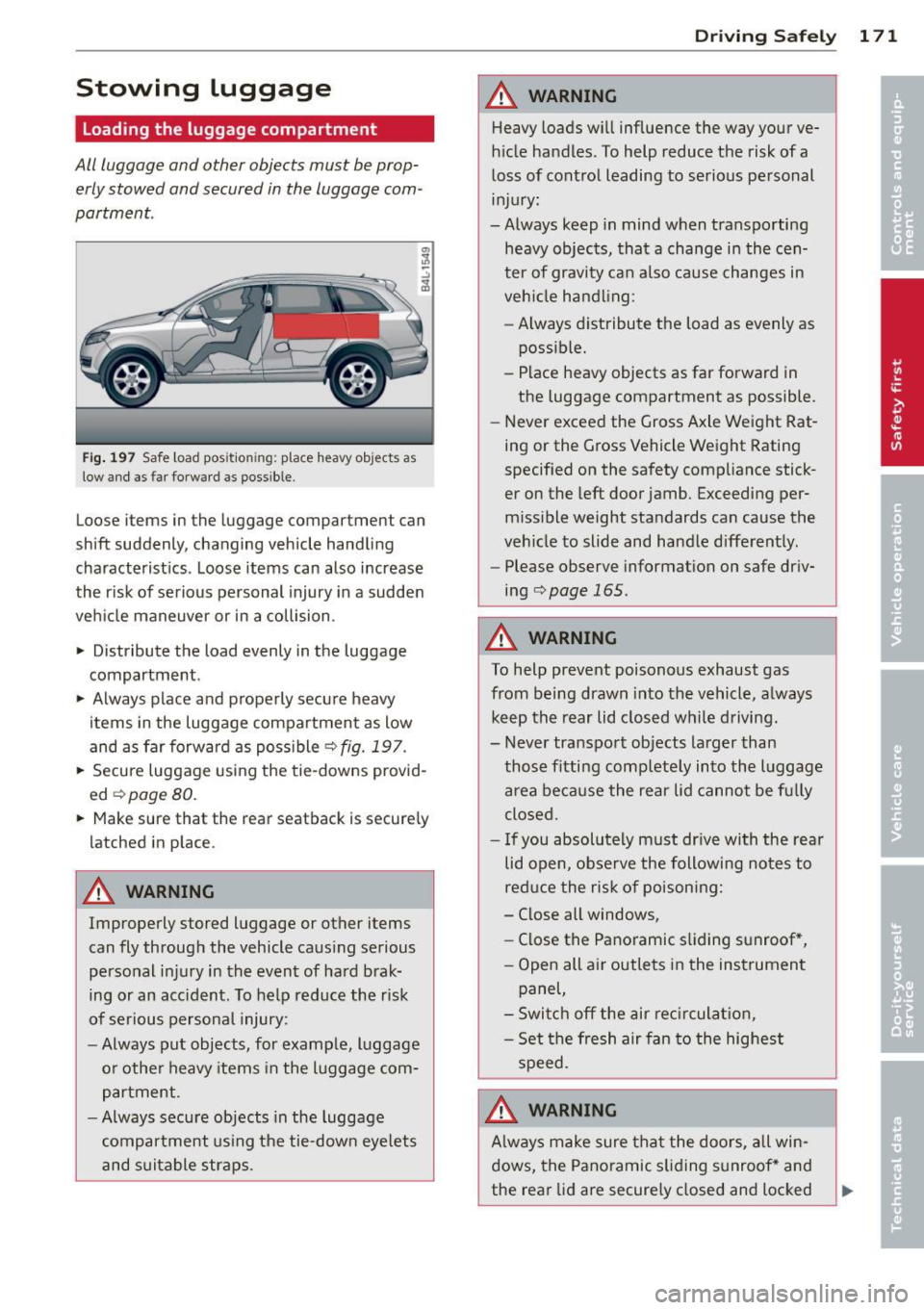
Fig . 197 Safe load pos ition ing: place heavy objects as
low and as far forward as possible.
Loose items in the luggage compartment can
shift suddenly, changing vehicle handling
characteristics . Loose items can also increase
the risk of serious personal injury in a sudden
veh icle maneuver or in a collision .
.. Distribute the load evenly in the luggage
compartment.
.. Always place and properly secure heavy
items in the luggage compartment as low
and as far forward as possible
<=>fig. 197.
.. Secure luggage using the tie-downs provid
ed
¢ page 80.
.. Make sure that the rear seatback is secure ly
latched in place.
A WARNING
Improperly stored luggage or other items
can fly through the vehicle causing serious
personal injury in the event of hard brak
ing or an acc ident. To help reduce the risk
of serious personal injury:
- Always put objects, for example, luggage
or other heavy items in the luggage com
partment.
- Always secure objects in the luggage
compartment us ing the tie-down eye lets
and suitable straps .
Drivin g Sa fely 1 71
A WARNING
Heavy loads will influence the way your ve
hicle handles. To help reduce the risk of a
loss of control leading to serious personal
injury:
-Always keep in mind when transporting heavy objects, that a change in the cen
ter of gravity can also cause changes in
veh icle handling:
- Always distribute the load as evenly as
possible.
- Place heavy objects as far forward in
the luggage compartment as possible.
- Never exceed the Gross Axle Weight Rat
ing or the Gross Vehicle Weight Rating
specified on the safety compliance stick
er on the left door jamb. Exceeding per
missible weight standards can cause the
veh icle to slide and handle differently.
- Please observe information on safe driv
ing
<=>page 165 .
A WARNING
To help prevent poisonous exhaust gas
from being drawn into the vehicle, a lways
keep the rear lid closed while driving.
- Never transport objects larger than
-
those fitting comp letely into the luggage
area because the rear lid cannot be fu lly
closed .
- If you absolutely must dr ive with the rear
lid open, observe the following notes to
reduce the risk of poisoning:
- Close all windows,
- Close the Panoramic sliding sunroof *,
- Open all air outlets in the instrument panel,
- Switch off the air rec irculat ion,
- Set the fresh a ir fan to the highest
speed.
A WARNING
A lways make sure that the doors, all win
dows, the Pano ramic s liding sunroof* and
the rear lid are securely closed and locked
Page 174 of 348
172 Driving Safel y
to reduce the risk of inj ury when the vehi
cle is not be ing used.
- After closing the rear lid, always make
sure that it is properly closed and locked.
- Never leave your vehicle unattended es
pecially with the rear lid left open . A
child could crawl into the vehicle through
the luggage compartment and close the
rear lid becoming trapped and unable to
get out . Be ing trapped in a vehicle can
lead to serious persona l injury.
- Never let children p lay in or around the
vehicle .
- Never let passengers r ide in the luggage
compartment . Veh icle occupan ts must
always be proper ly restrained in one of
the vehicle's seating positions.
(D Tips
- Air circulation helps to reduce window
fogging . Sta le air escapes to the o utside
th rough vents in the trim pane l. Be su re
to keep these slots free and open.
- The tire pressure must correspond to the
load . The t ire pr essure is shown on the
tire p ressu re label. The tire pressure la
bel is loc ate d on the driver's s ide B-pi lla r.
The tire pressure label lists the recom
men ded cold t ire inflat ion pressu res for
the veh icle at its maximum capacity
weight and the tires that were on your
vehicle at the time it was manufact ured.
For recommended t ire pressures for nor
mal load conditions, please see chapter
Q page284.
Tie-downs
The luggage compartment is equipped with
four tie-downs to secure luggage and other
items .
Use the tie-downs to secure your cargo prop
erly ¢ page 171 , Loading the luggage com
partment .
In a coll is ion, the laws of phys ics mean that
even smaller items that are loose in the vehi
cle will become heavy missiles that can cause se
rious injury. Items in t he vehi cle possess en
ergy which vary with vehicle speed and the
weight of t he item . Vehicle speed is the most
s ignificant factor.
F or example, in a frontal collision at a speed
of 30 mph (48 km/h), the forces acting on a 10 -lb (5 kg) object a re abo ut 20 times the
normal weight of the item. This means that
the weight of the item would sudden ly be
about 200 lbs . (90 kg) . You can imag ine the
injur ies that a 200 lbs . (90 kg) item fly ing
fr ee ly t hro ugh the passenger compa rtment
cou ld cause in a col lision like this.
_& WARNING
We ak, damaged or imprope r straps used
to secure items to tie-downs can fail dur
i ng hard braking or in a collision and cause
se rious pe rsonal injury.
-Always use s uita ble mo unt ing straps an d
p roperly secu re items to the tie-downs in
the l uggage compa rtment to he lp pre
vent items from shift ing or fly ing fo r
ward as dangerous missiles.
- When the rea r seat backrest is folded
down, a lways use suitable mounting
straps and properly secure items to the
tie-downs in the luggage compartment
to hel p prevent items from fly ing for
ward as dangerous missiles into the pas
senger compartment.
- Never attach a chi ld safety seat t ether
s trap to a t ie-down .
Reporting Safety
Defects
Applicable to U.S.A.
If yo u b eli eve that your vehi cle
has a def ect whi ch could cau se
a crash or could cau se injury or
death, you should immediately
inform the National Highway
Traffic Safet y Administration ""
Page 180 of 348
178 Safety belts
forces on the body more "tolerable" and less likely to cause injury.
Although these examples are based on a fron
tal collision , safety belts can also substantial
ly reduce the risk of injury in other kinds of
crashes . So, whether you're on a long trip or
just going to the corner store, always buckle
up and make sure others do, too. Accident sta
tistics show that vehicle occupants properly
wearing safety belts have a lower risk of being injured and a much better chance of surviving
an accident . Properly using safety belts also
greatly increases the ability of the supplemen
tal airbags to do their job in a collision. For
this reason, wearing a safety belt is legally re
quired in most countries including much of
the United States and Canada.
Although your Audi is equipped with airbags ,
you still have to wear the safety belts provid
ed. Front airbags, for example, are activated
only in some frontal collisions . The front air
bags are not activated in all frontal collisions,
in side and rear collisions, in roll overs or in
cases where there is not enough deceleration
through impact to the front of the vehicle .
The same goes for the other airbag systems in
your Audi. So, always wear your safety belt
and make sure everybody in your vehicle is
properly restrained!
Important safety instructions about
safety belts
Safety belts must always be correctly posi tioned across the strongest bones of your
body.
.. Always wear safety belts as illustrated and
described in this chapter.
.. Make sure that your safety belts are always
ready for use and are not damaged.
A WARNING
Not wearing safety belts or wearing them
improperly increases the risk of serious
personal injury and death. Safety belts can
work only when used correctly . -
Always fasten your safety belts correctly
before driving off and make sure all pas
sengers are correctly restrained.
- For maximum protection, safety belts
must always be positioned properly on
the body.
- Never strap more than one person, in
cluding small children, into any belt .
- Never place a safety belt over a child sit
ting on your lap.
- Always keep feet in the footwell in front
of the seat while the vehicle is being driv
en.
- Never let any person ride with their feet
on the instrument panel or sticking out
the window or on the seat.
- Never remove a safety belt while the ve
hicle is moving. Doing so will increase
your risk of being injured or killed .
- Never wear belts twisted.
- Never wear belts over rigid or breakable
objects in or on your clothing, such as
eye glasses, pens, keys, etc., as these
may cause injury .
-Never allow safety belts to become dam
aged by being caught in door or seat
hardware.
- Do not wear the shoulder part of the belt
under your arm or otherwise out of posi
tion .
- Several layers of heavy clothing may in
terfere with correct positioning of belts
and reduce the overall effectiveness of
the system.
- Always keep belt buckles free of anything that may prevent the buckle from latch
ing securely .
- Never use comfort clips or devices that create slack in the shoulder belt . Howev
er, special clips may be required for the
proper use of some child restraint sys
tems .
- Torn or frayed safety belts can tear, and
damaged belt hardware can break in an
accident. Inspect belts regularly. If web-
bing , bindings, buckles, or retractors are .,,.
Page 197 of 348
away by getting out of the vehicle or
opening windows or doors.
-If you are in a collision in which airbags
deploy, wash your hands and face with
mild soap and water before eating.
- Be careful not to get the dust into you r
eyes, or into any cuts or scratches.
- If the residue should get into your eyes,
flush them with water.
Monitoring the
Advanced Airbag
System
Airbag monitoring indicator light
Two separate indicators monitor the function
of the Advanced Airbag System: the airbag
monitoring indicator light and the
PA SSEN ·
GER AIR BAG OFF
light.
The Advanced Airbag System (including the
e lectronic control unit, sensor circuits and sys
tem wiring) is monitored cont inuously to
make sure that it is functioning properly
whenever the ignit ion is on . Each t ime you
turn on the ignition, the airbag monitoring in
d icator light
I will come on for a few seconds
(sel f diagnos tics) .
The system must be inspected when the
indicato r light
I:
- does not come on when the ignit ion is
switched on
- does not go out a few seconds after you
have swi tched o n the ignition, o r
- comes on w hile driving
If an airbag system malfunct ion is detected,
the indicator light will first start flashing to
catch the driver's attention and then stay on
continuously to serve as a constant reminde r
to have the system inspected immediately.
If a malfunction occurs that tur ns the front
a irbag on the passenger side off, the
PAS SEN
GER AIR BAG OFF
light w ill come on and stay
on w henever the ignition is on.
A irbag system 195
A WARNING
An airbag system that is not functioning
p roperly cannot provide supplemental pro
tection in a frontal crash.
- If the airbag ind icator light comes on, it
means that there may be something
wrong with the Advanced Airbag System .
I t is poss ible that the ai rbag w ill inflate
when it is not supposed to, or will not in
fla te when it sho uld.
- Have the airbag system inspe cted imme
diate ly by yo ur aut ho rized Aud i dea ler.
PASSENGER AIR BAG OFF light
Fi g. 212 Sec tion fro m th e in str um ent pa nel: PASSEN
GER AIR BAG O FF light
-
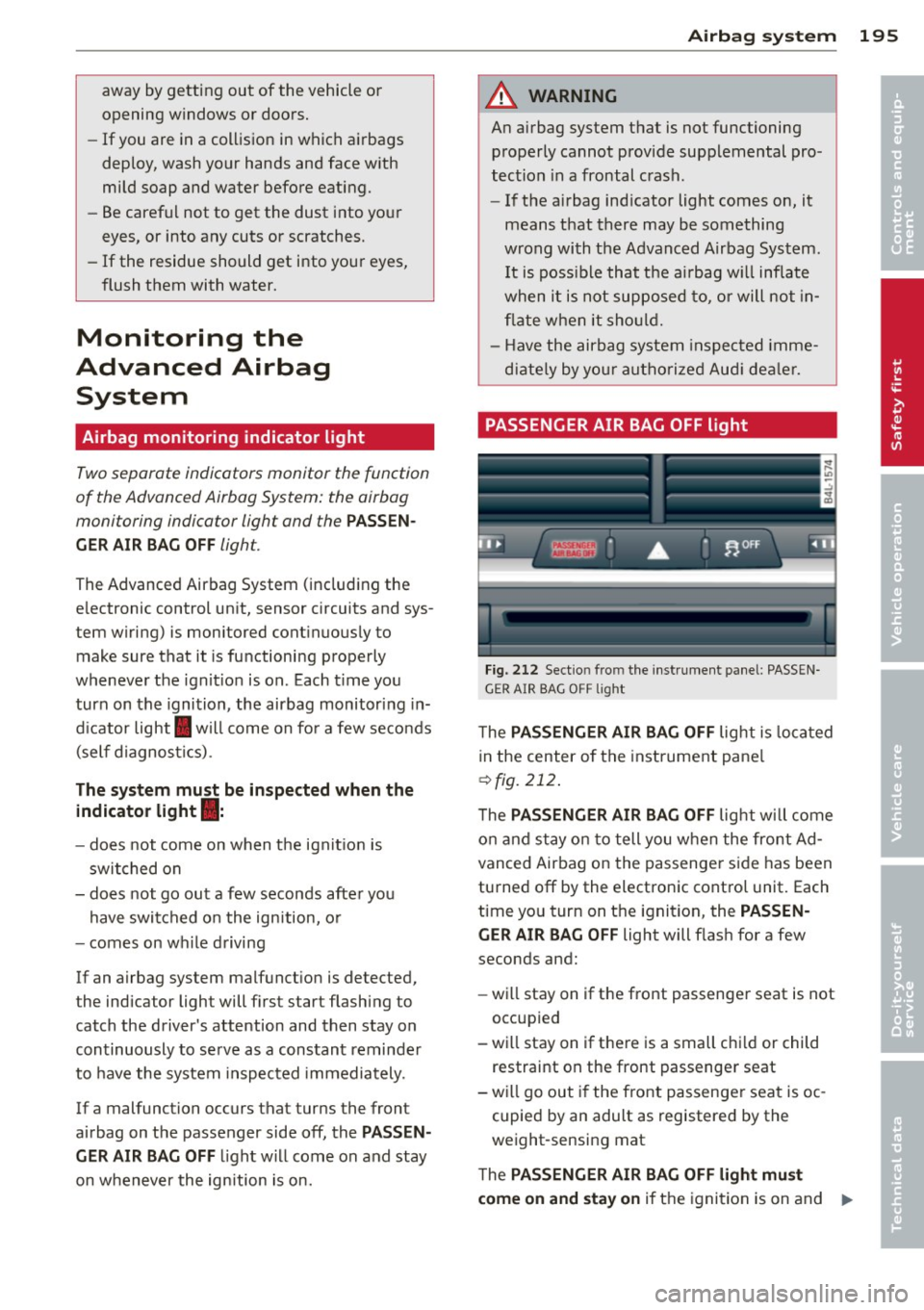
T he PASSENGER AIR BAG OFF light is loca ted
i n the center of the instrument pa ne l
¢ fig. 212 .
The PAS SENGER AIR BAG OFF lig ht will come
o n and stay on to tell you when the front Ad
vanced Airbag on the passenger side has been
turned off by the electronic control unit. Each
t ime yo u turn on the ignition, the
PASSEN·
GER AIR BAG OFF
light will flash for a few
seconds and:
- w ill stay on if the front passenger seat is not
occupied
- w ill stay on if there is a small chi ld or child
restraint on the front passenger seat
- w ill go out if the front passenger seat is oc
cupied by an adult as registered by the
weight-sensing mat
T he
PASSENGER AIR BAG OFF light must
come on and sta y on
if the ignition is on and ..,.
•
•
Page 203 of 348
not work properly when the vehicle
acceleration in a side collision is high
enough to activate the airbag.
How supplemental side airbags work
Side airbags deploy instantly and can help re duce the risk of upper torso injuries for occu
pants who are properly restrained.
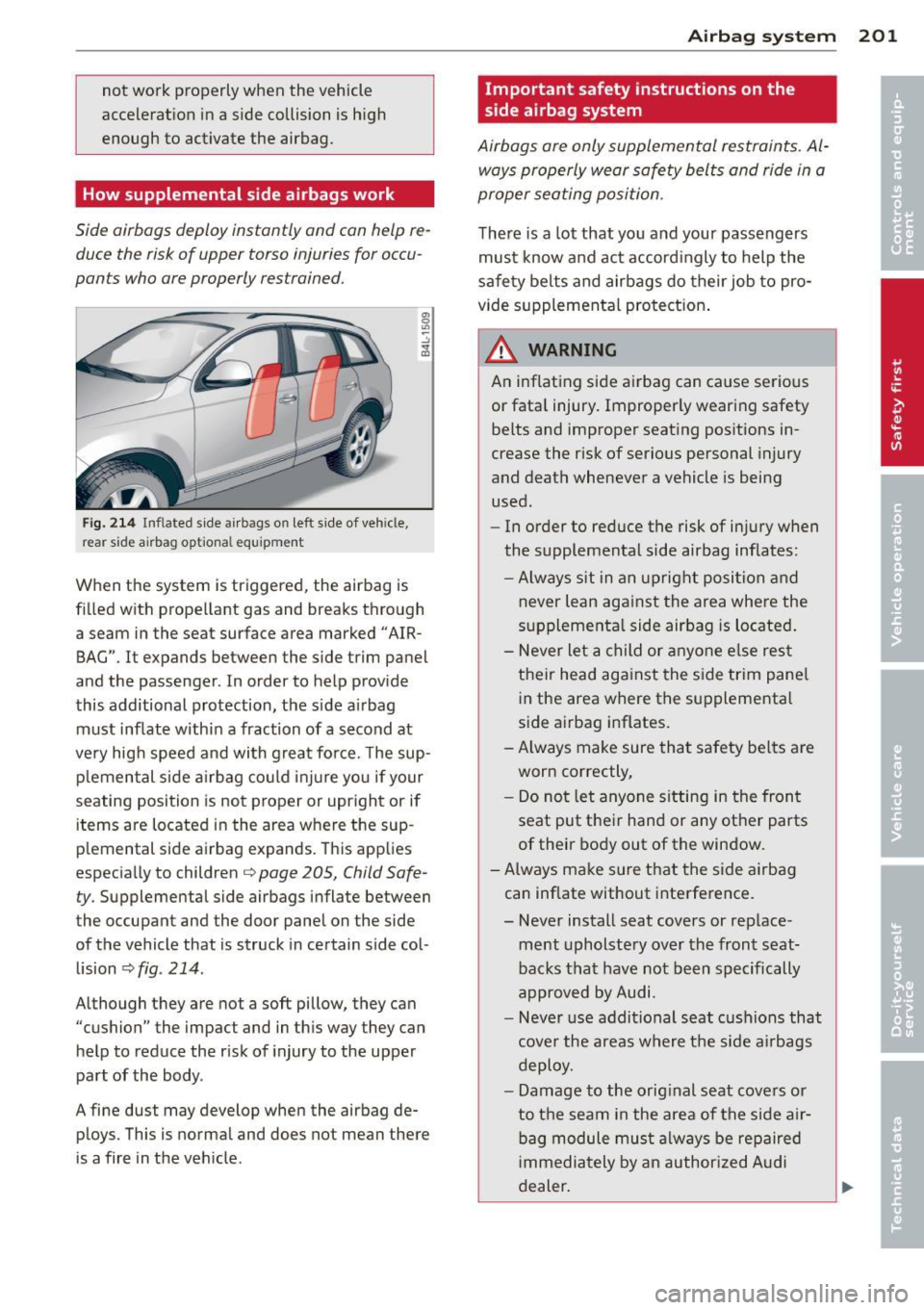
Fig. 214 Inflated side airbags on left side of veh icle,
rear side airbag optional equipment
When the system is triggered, the airbag is
filled with propellant gas and breaks through a seam in the seat surface area marked "AIR
BAG". It expands between the side trim panel
and the passenger . In order to help provide
this additional protection, the side airbag must inflate within a fraction of a second at
very high speed and with great force. The sup
plemental side airbag could injure you if your
seating position is not proper or upright or if
items are located in the area where the sup
plemental side airbag expands. This applies
especially to children
¢ page 205, Child Safe
ty.
Supplemental side airbags inflate between
the occupant and the door panel on the side
of the vehicle that is struck in certain side col
lision
~ fig . 214.
Although they are not a soft pillow, they can
"cushion" the impact and in this way they can
help to reduce the risk of injury to the upper
part of the body .
A fine dust may develop when the airbag de ploys. This is normal and does not mean there
is a fire in the vehicle.
Airbag system 201
Important safety instructions on the
side airbag system
Airbags are only supplemental restraints. Al
ways properly wear safety belts and ride in a
proper seating position.
There is a lot that you and your passengers
must know and act accordingly to help the
safety belts and airbags do their job to pro
vide supplemental protection.
A WARNING
An inflating side airbag can cause serious
or fatal injury. Improperly wearing safety
belts and improper seating positions in
crease the risk of serious personal injury
and death whenever a vehicle is being
used.
- In order to reduce the risk of injury when
the supplemental side airbag inflates:
- Always sit in an upright position and
never lean against the area where the
supplemental side airbag is located.
- Never let a child or anyone else rest
their head against the side trim panel
in the area where the supplemental
side airbag inflates.
- Always make sure that safety belts are
worn correctly,
- Do not let anyone sitting in the front
seat put their hand or any other parts
of their body out of the window.
-Always make sure that the side airbag can inflate without interference.
- Never install seat covers or replace
ment upholstery over the front seat
backs that have not been specifically
approved by Audi.
- Never use additional seat cushions that
cover the areas where the side airbags deploy.
- Damage to the original seat covers or
to the seam in the area of the side air
bag module must always be repaired
immediately by an authorized Audi
dealer.