airbag AUDI Q7 2013 Owner´s Manual
[x] Cancel search | Manufacturer: AUDI, Model Year: 2013, Model line: Q7, Model: AUDI Q7 2013Pages: 348, PDF Size: 87.72 MB
Page 216 of 348
214 Child Saf ety
• Secure unused safety be lts on the rear seat
9 page 210.
Ch ildren up to at least 8 years old (over 40
l bs. or 18 kg) are best protected in chi ld safe
ty seats designed for their age and weight. Ex perts say that the ske leta l structure, particu
larly the pelvis, of these chi ldren is not fully
developed, and they must not use the vehicle
safety belts w ithout a su itable child restraint .
It is us ually best to put these children in ap
propriate booster seats. Be sure the booster
seat meets all applicab le safety standards.
Booster seats raise the seating position of the
child and reposition both the lap and shoulder
parts of the safety belt so that they pass
across the child's body in the right places. The
routing of the belt over the child's body is very
important for the ch ild's protection, whether
or not a booster seat is used . Children age 12
and under must always ride in the rear seat.
Ch ildren who are at least 4
ft . 9 in. (57 in
ches/1.4S meters) tall can generally use the
vehicle's three po int lap and shoulder belts .
Neve r use the lap belt portion of the veh icle's
safety belt a lone to restrain any child, regard
l ess of how b ig the child is. Always remembe r
that c hildren do not have the pronounced pe l
vic structure required for the proper function
of lap belt portion of the vehicle's three point
lap and shoulder be lts. The child's safety ab
solutely requires that a lap be lt portion of the
safety belt be fastened snugly and as low as
possible around the pelvis . Never let the lap
be lt portion of the safety belt pass over the
chi ld's stomach or abdomen.
In a crash, airbags must inflate within a blink
of an eye and with cons iderable force . In order
to do its job, the airbag needs room to inflate
so that it will be there to protect the occupant
as the occupant moves forward into the air bag.
A vehicle occupant who is out of position and
too close to the airbag gets in the way of an
i n flat ing airb ag. When an occupant is too
close, he or she wi ll be struck violen tly and will
receive serious or possib ly even fatal in
jury .
In orde r fo r the ai rbag to offer protect ion, i t is
i mportant that a ll vehicle occupants, espe cial
ly any children, who m ust be in the front seat
because of exceptiona l circumstances , be
proper ly restrained and as far away from the
airbag as possible . By keeping room between
the child's body and the front of the passen
ger compartment, the airbag can inflate com
pletely and prov ide supplemental protection
in certain frontal collisions .
.&, WARNING
Not using a booste r seat, using the boos
ter seat improperly, inco rrectly installing a
booster seat or using the vehicle sa fety
belt improperly increases the risk of seri
ous persona l injury and death in a collision
or other emergency situat ion. To he lp re
duce the risk of serious personal injury
and/or death:
- The shou lder belt must lie as close to the
center of the ch ild's collar bone as possi
b le and must lie flat and snug on the up
per body . It must neve r lie across the
throat or neck. The lap belt must lie
across the pe lvis and neve r ac ross t he
stomach o r abdomen. Make sure the belt
liesflat andsnug.Pullon thebelt to
tighten if necessary.
- Failure to p roperly ro ute s afe ty belts
over a child's body wi ll ca use seve re inj u
ries in an accident o r other emergency
situation
¢ page 175 .
- The rear side o f the child sa fety seat
should be pos itioned as close as possib le
to the backrest on the vehicle seat. Ad
just or remove the rear seat head re straint if it is difficu lt to install the ch ild
seat with the head restraint in p lace
c::> page 77 . Install the head restraint
aga in immediately once the ch ild seat is
removed. D riving without head restraints
or w ith head restra ints that a re not prop
erly ad justed increases the risk of serious
.
or fatal neck in jury dramatically . ""
Page 217 of 348
-Children on the front seat of any car,
even with Advanced A irbags, can be seri
ous ly injured or even killed when an a ir
bag inflates.
- Never let a child stand or kneel on any
seat, for examp le the front seat.
- Never let a child ride in the cargo area of
your vehicle .
- Always remember that a ch ild lean ing
forward, sitt ing sideways or out of posi
t ion in any way during an acc ident can be
struck by a deploying airbag . This will re
sult in se rious personal injury or death .
- If you must install a booster seat on the
front passenger seat because of excep
t ional circumstances the
PASSENGER
AIR BAG OFF
light must come on and
stay on, whenever the ignition is switch
ed on.
- If the
PASSENGER AIR BAG OFF light
does not come on and stay on, perform
the checks described¢
page 195, Moni
toring the Advanced Airbag System.
- Ta ke the child restrain t off the front pas
senger seat and install it properly at one
of the rear seat positions if the
PASSEN
GER AIR BAG OFF
light does not stay on
whenever the ignition is switched on.
- Always read and heed all WARNINGS
whenever using a child restrained in ave
hicle is being used¢
page 175, Safety
belts,¢ page 184, Airbag system
and
c:> page 205, Important things to know.
Installing a child safety
seat
Securing a child safety seat using a
safety belt
Safety belts for the rear sea ts and the fron t
passenger can be locked wi th the convertible
locking retractor to properly secure child
safety seats .
The safety belts emergency lock ing retractors
for the rear seats safety belts and for the
front passenger's seat safety belt have a con
ve rtible locking retractor for child restraints.
Child Sa fet y 215
The safety belt must be locked so that be lt
webbing cannot unree l. The retractor can be
activated to lock the safety belt and prevent
the safety belt webbing from loosening up
during normal dr iving . A child safety seat can
only be properly installed when the safety belt
i s locked so that the chi ld and child safety
seat w ill stay in place .
Always remember: Even though your vehicle is equipped with an Advanced Airbag system, all
ch ildren, especially those 12 years and young
er, shou ld always r ide in the back seat proper
ly restrai ned fo r the ir age and size.
A WARNING
Improperly installed chi ld safety seats in
crease the risk of serious personal injury
and death in a collision.
- Always ma ke sure that the safety belt re
tracto r is loc ked when installing a child
safety seat . An unlocked safety belt re
tractor cannot hold the child safety seat
in place during normal dr iving or in a
crash.
- Always buckle the child safety seat firmly
in place even if a ch ild is not sitt ing in it.
A loose child safety seat can fly around during a sudden stop or in a collision .
- Always make sure that the rear seat
backrest to which the center rear safety
be lt is attached is securely latched when
eve r the rea r center safety belt is being
used to secure a ch ild restra int.
- If the backrest is not securely latched,
the child and the child restraint will be
thrown forward together with the back rest and will strike parts of the vehicle
interior. The child can be seriously in
jured or killed.
- Never install rear-fa cing child safety
seats or infant carrie rs on the front pas
senger seat . A child will be serio usly in
jured and can be killed when the passen ger airbag inflates.
- The inflating airbag will h it the ch ild
safety seat or infant carrier with great
force and will smash the child safety seat
~
•
•
Page 218 of 348
216 Child Safety
and child against the backrest, center
armrest, door or roof.
- Always install rear-facing child safety
seats or infant carriers on the rear seat.
- Forward-facing child safety seats or in
fant carriers installed on the front pas
senger's seat may interfere with the de
ployment of the airbag and cause serious
injury to the child.
- It is safer to install a forward-facing
child safety seat on the rear seat.
- Always read and heed all WARNINGS whenever using a child restrained in ave
hicle is being used
c::> page 205 . Special
precautions apply when installing a child
safety seat on the front passenger seat
c::> page 186, Child restraints on the front
seat -some important things to know.
A WARNING
Always take special precautions if you
must install a forward or rearward-facing
child restraint on the front passenger's
seat in exceptional situations:
- Whenever a forward or rearward-facing
child restraint is installed on the front
passenger seat, the
PASSENGER AIR
BAG OFF
light must come on and stay on
whenever the ignition is switched on.
- If the
PASSENGER AIR BAG OFF light
does not come on and stay on, perform
the checks described
<=:> page 195, Moni
toring the Advanced Airbag System.
- Take the child restraint off the front pas
senger seat and install it properly at one
of the rear seat positions if the
PASSEN
GER AIR BAG OFF
light does not stay on
whenever the ignition is switched on.
- Improper installation of child restraints
can reduce their effectiveness or even
prevent them from providing any protec
tion.
- An improperly installed child restraint
can interfere with the airbag as it de
ploys and seriously injure or even kill the
child. -
Always carefully follow the manufactur
er's instructions provided with the child
safety seat or carrier.
- Never place additional items on the seat
that can increase the total weight regis
tered by the weight-sensing mat and can
cause injury in a crash .
A WARNING
-Forward-facing child restraints:
- Always make sure the forward-facing
seat has been designed and certified by its manufacturer for use on a front seat
with a passenger front and side airbag .
- Never put the forward-facing child re straint up, against or very near the in
strument panel.
- Always move the passenger seat into its
rearmost position in the seat's fore and
aft adjustment range, as far away from
the airbag as possible before installing
the forward-facing child restraint. The
backrest must be adjusted to an upright
position.
- Make sure that the PASSENGER AIR BAG
OFF
light comes on and stays on all the
time whenever the ignition is switched
on .
A WARNING
Rearward-facing child restraints:
- A child in a rearward-facing child safety
seat installed on the front passenger
seat will be seriously injured and can be killed if the front airbag inflates -even
with an Advanced Airbag System .
- The inflating airbag will hit the child
safety seat or infant carrier with great
force and will smash the child safety seat
and child against the backrest, center
armrest, door or roof.
- Always be especially careful if you must
install a rearward facing child safety seat
on the front passenger seat in exception-
al circumstances.
~
Page 219 of 348
-A tight tether strap on a rearward-facing
child restraint attached to the front pas
senger seat can put too much pressure on the weight-mat in the seat and regis
ter a heavier weight in the Advanced Air
bag System . The heavier weight regis
tered can make the system work as
though an adult were on the seat and de
ploy the Advanced Airbag when it must
be suppressed causing serious or even
fatal injury to the child .
- Make sure that the
PASSENGER AIR BAG
OFF
light comes on and stays on all the
time whenever the ignition is switched
on.
- If the
PASSENGER AIR BAG OFF light
does not come on and stay on, immedi
ately install the rear-facing child safety
seat in a rear seating position and have
the airbag system inspected by your Audi dealer.
Activating the convertible locking
retractor
Use the convertible locking retractor to se
cure a child restraint.
Always heed the child safety seat manufactur
er's instructions when installing a child re
straint in your vehicle . To activate the conver
tible locking retractor :
.. Place the child restraint on a seat, prefera
bly on the rear seat.
.. Slowly pull the belt
all the way out .
.. Route it around or through the child re
straint belt path~&_ .
.. Push the child safety seat down with your
full weight to get the safety belt really tight.
.. Insert the belt tongue into the buckle for
that seating position .
.. Guide the safety belt back into the retractor
until the belt lies flat and snug on the child
safety seat .
.. You should hear a "clicking " noise as the
belt winds back into the inertia reel. Test the
convertible locking retractor by pulling on
the belt . You should no longer be able to
Child Safety 21 7
pull the belt out of the retractor. The con
vertible locking retractor is now activated.
.. Make sure that the red release button is fac
ing away from the child restraint so that it
can be unbuckled quickly.
.. Pull on the belt to make sure the safety belt
is properly tight and fastened so that the
seat cannot move forward or sideways more
than one inch (2.5 cm).
_&. WARNING
Using the wrong child restraint or an im
properly installed child restraint can cause
serious personal injury or death in a crash.
- Always make sure that the safety belt re-
tractor is locked when installing a child
safety seat. An unlocked safety belt re
tractor cannot hold the child safety seat
in place during normal driving or in a
crash.
-Always buckle the child safety seat firmly in place even if a child is not sitting in it.
A loose child safety seat can fly around
during a sudden stop or in a crash.
- Always make sure the seat backrest to
which the child restraint is installed is in
an upright position and securely latched
into place and cannot fold forward . Oth
erwise, the seatback with the child safety
seat attached to it could fly forward in
the event of an accident or other emer
gency situation .
- Always read and heed all WARNINGS
whenever using a child restrained in ave
hicle is being used¢
page 205. Special
precautions apply when installing a child
safety seat on the front passenger seat
¢ page 186, Child restraints on the front
seat -some important things to know .
-
•
•
Page 225 of 348
-Improper use of child restra int anchors
(incl uding tether anchors) can lead to in
jury in a co llision. The anchors are de
signed to withstand only those loads im
posed by correctly fitted ch ild restraints .
- Never mount two child restraint systems
on one LATCH lower anchor po int.
- Never attach two child restraint systems
to one tether strap or tether anchorage.
- Never attach a tether strap to a tie-down
hook in the luggage compartment.
- Never use ch ild restra int tether ancho
rages to secure safety belts or other
kinds of occupant restra ints.
- Never secure or attach any luggage or
other items to t he LATCH lower ancho
rages or to the tether anchors.
- If a tether or other strap is used to at
tac h a child restraint to the fro nt passen
ger seat, make sure that it is not so
t ight, that it causes the we ight-sensing
mat to measu re mo re weight than is ac
t ual ly on the seat.
- T he heav ier we ight reg iste red can make
the Advanced Airbag System wo rk as
though an adult were on the seat and de ploy the Adva nced Ai rbag when it must
be s uppressed causing serious or even
fatal injury to the child.
- If you must install a rearward facing
child safety seat on the front passenger
seat because of exceptional circ umstan
ces and the
PASSENGER AIR BAG OFF
light does not come on and stay on, im
med iately install the rear-facing child
safety seat in a rear seating posi tion and
have the a irbag system inspected by you r
Audi dealer.
Child S afety 223
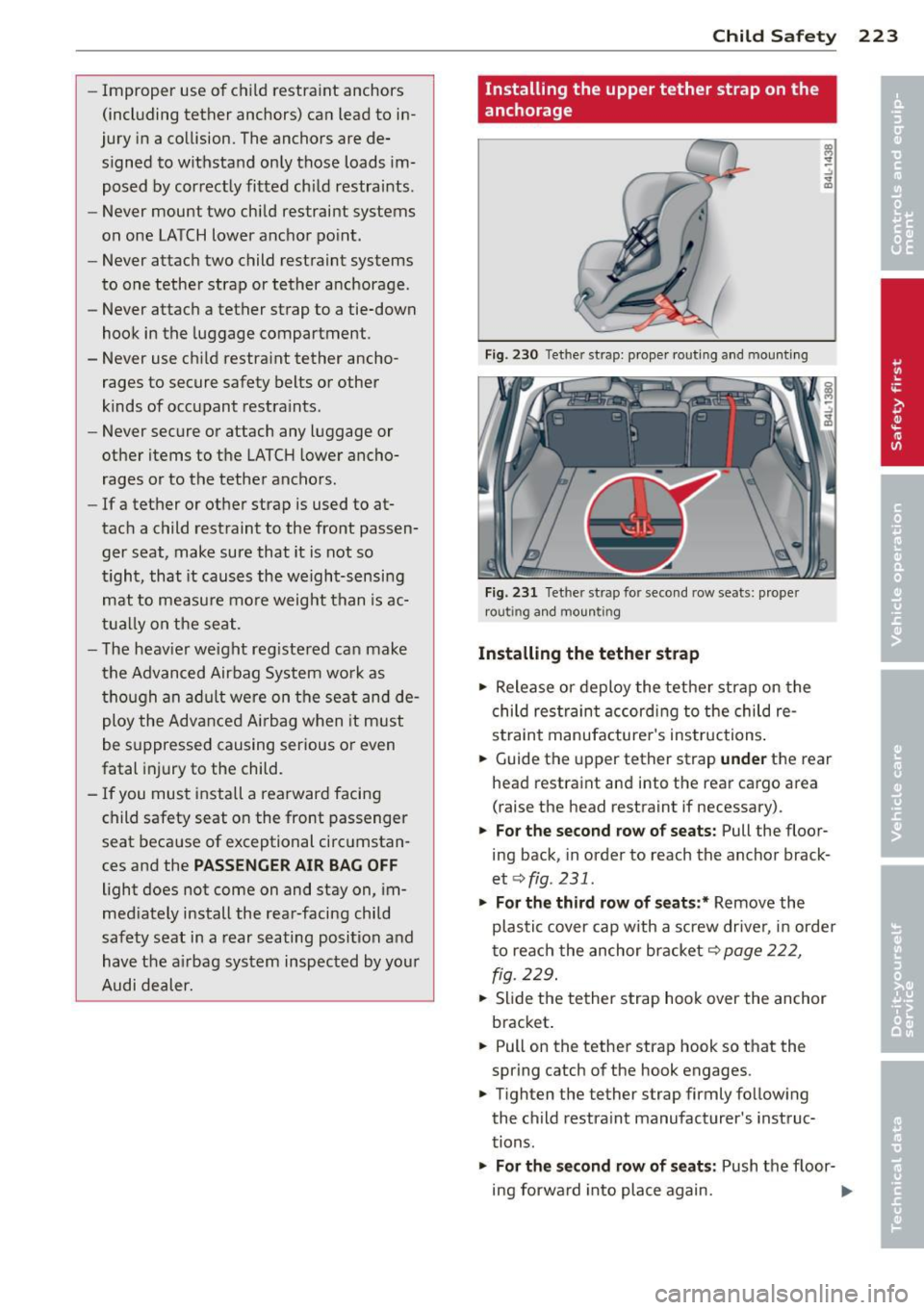
Installing the upper tether strap on the
anchorage
Fig . 230 Tet her st rap: prope r rout ing a nd mounti ng
Fi g. 23 1 Tet her st rap fo r seco nd row sea ts: prope r
rou ting and moun tin g
Installing the tether strap
... Release or deploy the tether strap on the
child res traint accord ing to the child re
st raint manufacture r's ins tructions .
... Guide the upper tether strap
und er the rear
head restraint and into the rear ca rgo area
(raise the head restraint if necessary).
... Fo r the second row o f seats: Pull the floor
ing back, in order to reach the anchor brack
et
c:::> fig. 231 .
... Fo r the third row of seat s:* Remove the
plastic cover cap with a screw drive r, in orde r
to reach the anchor bracket
c:::> page 222,
fig . 229.
.,. Slide the tether strap hoo k over the anchor
bracket .
... Pull on the tether strap hook so that the
spring catch of the hook engages .
.,. Tighten the tether strap firmly follow ing
the child restra int manufacturer's instruc
tions .
.,. For the second r ow of s eats : Push the floor-
ing forward into place again.
11-
Page 226 of 348
224 Child Saf ety
Re leas ing th e te th er str ap
.. Loosen the tension following the child re
stra int manufacturer's instructions.
.. Depress the spring catch on the hook and
release it from the anchorage .
.. Fo r t he seco nd ro w of se ats: Push the floor
ing forward into place again.
.. For the th ird r ow of seats :* Replace the
plast ic cover cap .
(D Note
If you leave the child restraint with the
tether strap firmly installed for several
days, this could leave a mark on the up
holstery on the seat cushion and backrest
in the area whe re the tether strap was in
stalled. The uphols tery would a lso be per
manently stretched around the tether
strap . This applies especially to leather
seats .
Using tether straps on rearward-facing
child restraints
Currently , few rear -facing child restraint sys
tems come with a tether . P lease read and
heed the child restraint system manufactur
e r's instructions caref ully to determine how to
p roperly insta ll the tethe r.
& WARNING
A child in a rearward -facing child safety
seat insta lled on the front passenger seat
w ill be seriously injured and can be ki lled if
the front a irbag inflates - even with an Ad
vanced Airbag System.
- The inflating airbag will hit the child safety seat or infant carrier with great
force and w ill smash the ch ild safety seat
and child against the backrest, center
armrest, or door .
- A tight tether or other strap on a rear
ward-facing child restra int attached to
the front passenger seat can put too much pressure on the weight-mat in the
seat and register a heavier weigh t in the
Advanced Airbag System. The heav ier weight registered can make the system
work as though an adult were on the seat
and deploy the Advanced Airbag when it must be suppressed causing ser ious or
even fatal injury to the ch ild.
- If you must install a rearward fac ing
child safety seat on the front passenger
seat because of exceptional c ircumstan
ces and the
PASSENGER AIR BAG OFF
light does not come on and stay on, im
mediately insta ll the rear-fac ing ch ild
safety seat in a rear seating position and have the airbag system inspected by your
Audi dea ler.
Additional Information
Sources of information about child
restraints and their use
T here are a number of sou rces of add itiona l
information about child restraint se lection, in
sta llation and use:
N HT SA advises that the best chi ld safety seat
is the one that fits your ch ild and fits in you r
vehicle, and that yo u will use correct ly and
consistently.
T ry before yo u buy!
U. S Nat ional Highw ay Traffi c Safety Admin
i s trat ion
Tel.: 1-888-327-4 236 (TIY: 1-800-424-9153)
http://www.nhtsa.gov
N ati onal SAFE KID S Camp aign
Tel.: (202) 662-0600
http://www.safekids .o rg
S af ety Belt Saf e U. S.A
T el.: (800) 7 45 -SAFE (Eng Lish)
Tel.: (800) 747-SANO (Span ish)
http://www.ca rseat.org
T ranspo rt Ca nad a Info rmation Centre
Tel.: 1-800 -333-0371 or call
1-613-998-8616 if you are in the Ottawa area
http://www.tc.gc.ca/eng/ roadsafety/
menu.htm
Aud i Cu stom er R elation s
Tel.: (800) 822-2834
Page 227 of 348
Intelligent technology Notice about data
recorded by vehicle
control modules
Your vehicle is not equipped with an Event Da
ta Recorder (EDR), installed by some manu
facturers for the express purpose of capturing
data for retrieval after an accident or crash
event. EDRs are sometimes called "crash re
corders".
Some state laws restrict the retr ieval or down
loading of data stored by EDRs that were in
stalled in a vehicle for the express purpose of
retrieving data after an accident or crash
event without the owner's consent.
Although your vehicle is not equipped with an
EDR, it is equipped with a number of electron
ic control modules for various vehicle systems
such as, for example, engine function, emis
sion control, as well as for the airbags and
safety belts.
These electronic control modules also record
vehicle-related data during norma l vehicle op
eration for diagnostic and repair purposes.
The recording capacity of the electronic con
trol modules is limited to data (no sound is re
corded) and only a small amount of data is ac
tually recorded over a very limited period of
time and stored when a system fault or other
condition is sensed by a control unit. Some of
the data then stored may relate to vehicle
speed, direction, braking as we ll as restraint
system use and performance in the event of a
crash or other condition. Stored data can only be read and downloaded with special equip
ment.
Intelligent technology 225
Electronic Stabilization
Control (ESC)
General information
The ESC improves the vehicle stability.
. ..---------..
------- -
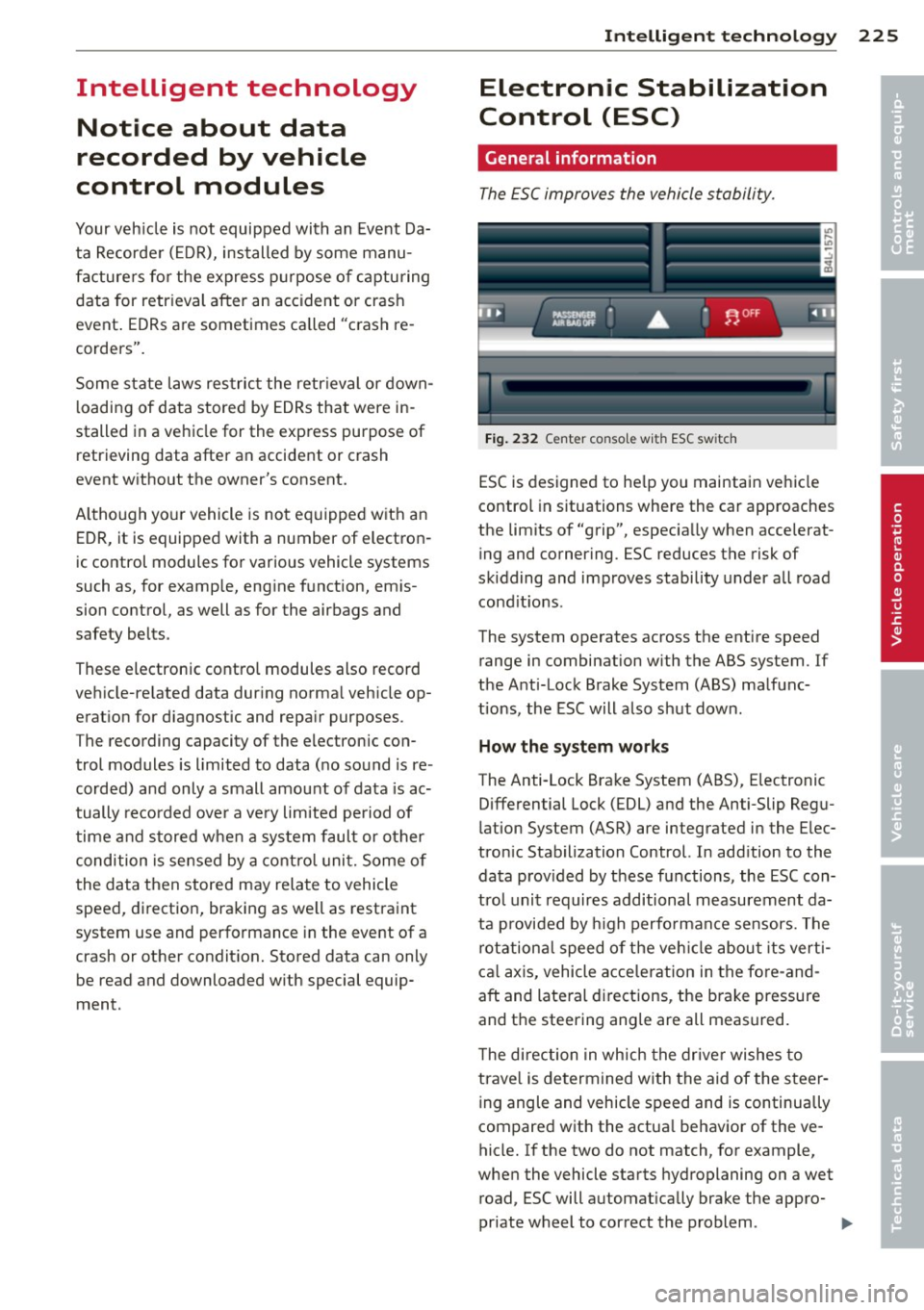
Fig. 232 Center console with ESC sw itch
ESC is designed to help you maintain vehicle
control in situations where the car approaches
the limits of "grip", especially when accelerat
ing and cornering. ESC reduces the risk of
skidding and improves stability under all road
condit ions .
The system operates across the entire speed range in combination with the ABS system. If
the Anti-Lock Brake System (ABS) malfunc
tions, the ESC will also shut down.
How the system works
The Anti-Lock Brake System (ABS), Electronic
Differential Lock (EDL) and the Anti-Slip Regu
lation System (ASR) are integrated in the Elec
tronic Stabilization Control. In addition to the
data prov ided by these functions, the ESC con
trol unit requires additional measurement da
ta provided by high performance sensors. The
rotational speed of the vehicle about its verti
cal axis, vehicle acceleration in the fore-and
aft and lateral directions, the brake pressure and the steering angle are all measured.
T he direction in wh ich the driver wishes to
travel is determined with the aid of the steer
ing angle and vehicle speed and is continually
compared with the actual behavior of the ve
hicle. If the two do not match, for example,
when the vehicle starts hydroplaning on a wet
road, ESC will automatically brake the appro-
priate wheel to correct the problem. ..,_
•
•
Page 254 of 348
252 Cleaning and protec tio n
In the case of genera l soi ling of the uphols
tery and cover material, we re commend hiring
a specialist that has the equ ipment to clean
the seat cove rs an d other fa bric surfaces by
shampooing and spray ex traction.
.&_ WARNING
Always r ead and heed all WARNINGS and
the information
~ page 245.
(D Tips
Open Velcro fasteners on your clothing can
damage the seat cover. Please make sure
that Velcro fasteners are closed.
Plastic parts and instrument panel
Always use a clean cloth mo istened in clear
wate r to clean these areas. For pers istent dirt
use an Audi approved
s olvent -fr ee plas tic
cleane r/pro tectan t.
.&_ WARNING
So lvents can change the propert ies of
some plastics and make it harder for the
airbag to dep loy.
-
- Never clean the instr ument pane l or the
s u rface of air bag modules with cleaning
products that contain solvents .
- Products conta ining solvents wi ll make
the surface o f th is part porous.
- Serious injuries can result if plastic pa rts
come loose when the airbag is deployed .
- Always read and heed all WARN INGS and
other information ~
page 245.
(D Note
Cleaning agents con taini ng solvents will
at tac k t he mater ial and can change the
way it behaves .
Natural leather
Applies to vehicles: wit h natural leather
Audi makes great efforts to maintain the
properties, natural look and feel of interior
leather .
General
We offer many d ifferent types of leather on
o u r vehicles. Most are d ifferent types of nappa
leather, which has a smooth surface and
comes in various colo rs .
The intensity of the co lo r determines the visu
al characterist ics and appearance .
If the sur
face of the leather has a typ ica l natural look,
then the leather is a nappa leather that has
been left in a relat ive ly natura l condit ion. This
l eat her offe rs part icular ly good comfort and
breathes we ll. Fine veins, closed grai ns, insect
bi tes, sk in fo lds, and s ubtl e va ria tions in color
remain visible . These characteristics demon
strate that the material is natura l.
Natu ra l na ppa le athe r is not covere d by a co l
o r finish. It is therefore mo re sensit ive to soil
ing and wea r, which is something you need to
consider if children, animals or other factors
mig ht prove to be part icu larly hard on the
leat her.
By cont rast, leather types that are covered by
a colo red finish layer are more durable . This
has a positive effect on the leather's resist
ance to wear and soiling in dai ly use. On the
other hand, the typica l characteristics of natu
ral leather a re barely or not apparent . Howev
er, th is does not mean that the leathe r itse lf
i s of infe rior quality .
Care and handling
Because of the exclusive nature of the types of
leather that Aud i uses and their unique prop
erties (such as sens it ivity to oils, grease, soil
i ng, etc.), you will need to be somewhat ca re
ful with these leathers, and a ce rtai n type of
ca re is req uired. Fo r example, dark clothing
ma ter ials can dis co lor le athe r seats (especi al
ly if such clothing is damp and was not dyed
correct ly). Dust and dirt particles in pores ,
fo lds, and seams can have an abrasive effect .,..
Page 277 of 348
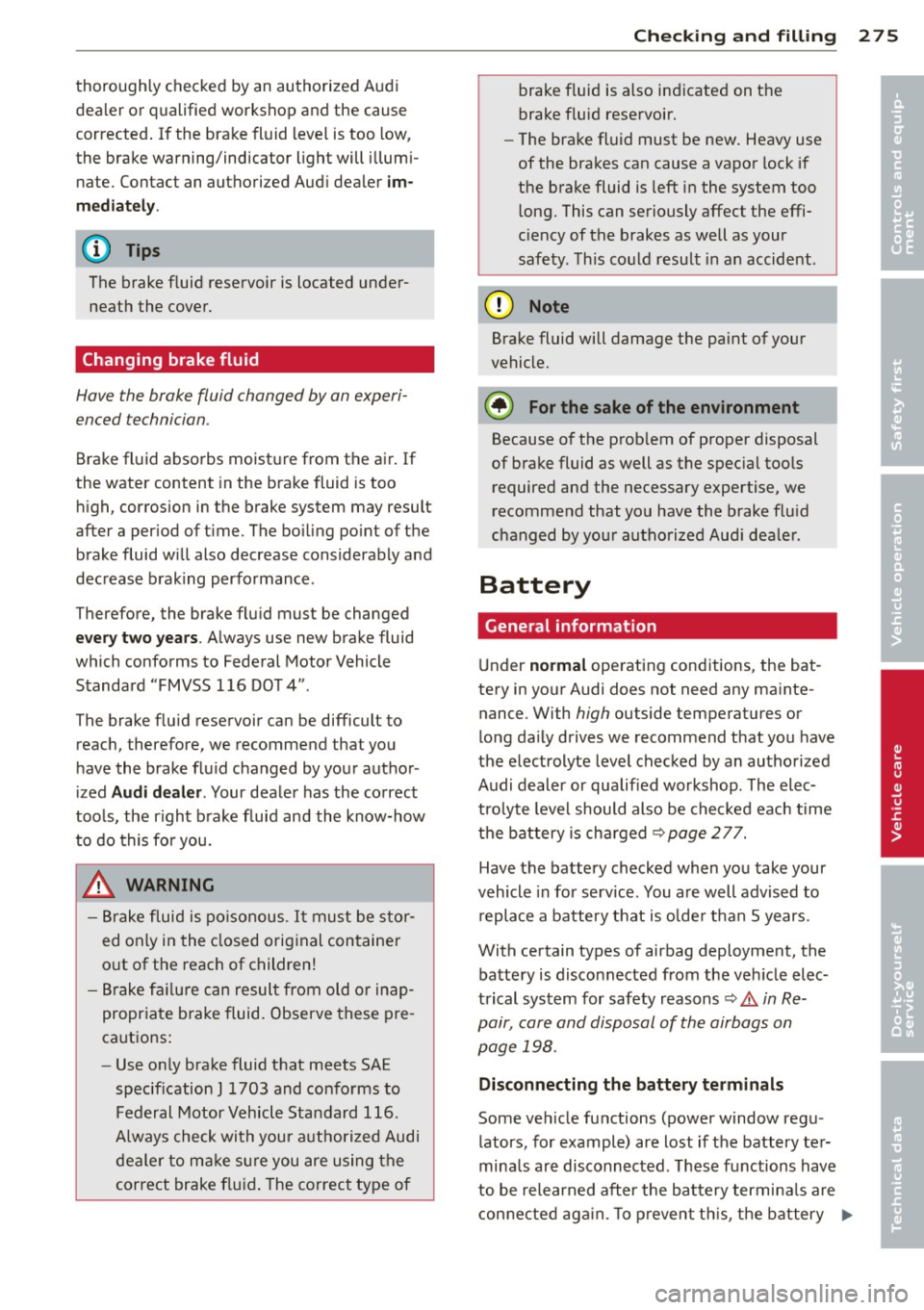
thoroughly checked by an authorized Audi
dealer or qualified workshop and the cause
corrected .
If the brake fluid level is too low ,
the brake warning/indicator light will i llum i
nate. Con tact an au thori zed Aud i dealer
im ·
mediately .
@ Tips
The brake fluid reservoir is located under
neath the cover.
Changing brake fluid
Have the brake fluid changed by an experi
enced technician .
Brake fluid absorbs moist ure from the a ir. If
the water content in the brake fluid is too
h igh, corrosion in the brake system may result
after a per iod of t ime . The bo iling po int of the
brake fluid w ill also decrease considerably and
decrease b raking performance .
Therefore, the brake flu id must be changed
every two years . Always use new brake fluid
which conforms to Federal Motor Vehicle
Standa rd "FMVSS 116 DOT 4".
The brake f lu id reservoir can be difficult to
reach, therefore, we recommend that yo u
have the brake f lu id changed by your author
i zed
Audi dea ler . Your deale r has the co rrect
too ls, the right b rake fluid and the know-how
to do this fo r you.
_& WARNING
- Br ake fluid is po isonous . It must be s to r
ed only in the closed orig inal con tainer
o ut of the reac h of c hildren!
- Br ake f ailure can resu lt from old or in ap
propr iate b ra ke fluid. Observe these pre
caut ions:
- Use on ly brake fluid that meets SAE
specif ication
J 1 703 and conforms to
Federal Motor V ehicle Sta ndard 116.
A lways check wi th you r auth o riz ed Audi
deale r to ma ke s ure you are using the
correct brake flu id . T he correc t type of
Checkin g and fillin g 275
brake f luid is also ind icated on t he
brake f luid rese rvoir.
- The bra ke fl uid must be new. Heavy use
of the brakes can cause a vapo r lock if
the brake fluid is left in the system too
l ong. This can seriously affect the effi
c iency of the brakes as well as your
safe ty. This co uld resu lt in an accide nt.
(1) Note
Brake fluid will damage the paint of your
vehicle.
@) For the sake of the environment
Because o f the prob lem of proper disposal
of brake fluid as well as the spec ial too ls
required and the necessary expertise, we
recomme nd that you have the brake flu id
changed by you r autho rized Aud i deale r.
Battery
General information
U nder normal operating cond itions, the bat
tery in your Audi does not need any ma inte
nance. With
high outside temperatures or
long da ily drives we recommend that you have
the e lectrolyte level chec ked by an au thorized
Audi dealer or qualified wo rkshop . The elec
t ro lyte level should also be che cked each time
t h e battery is cha rged
~ page 2 77.
Have the battery checked when you take your
vehicle in for se rv ice . You a re well advised to
replace a battery that is o lde r th an 5 years .
With certain types of airbag deployment, the ba tte ry is disconnected from the ve hicle elec
t rical sys tem for safety reasons
~ A in Re
pair, care and disposal of the airbags on
page 198.
Disconnecting the battery terminals
Some vehicle fu nctions (power window regu
lators, fo r example) are lost if the battery te r
mina ls are disconn ected . T hese functions have
to be relearned after the bat tery termina ls are
conne cte d ag ain. To p revent t his, the battery .,.
•
•
Page 313 of 348
Fuse s and bulb s 311
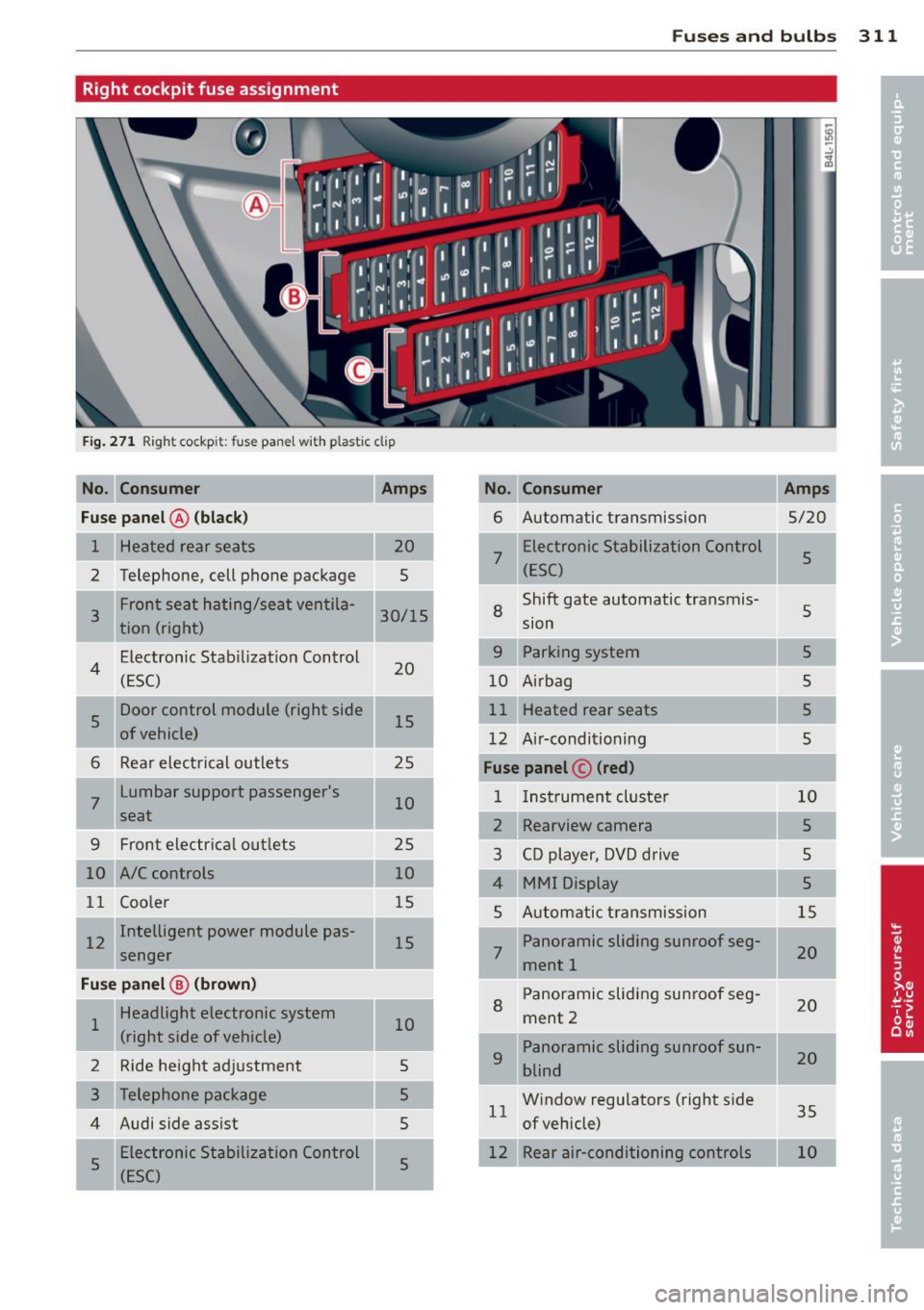
Right cockpit fuse assignment
Fig . 27 1 Righ t cockp it: f use pane l w ith pla stic clip
No. Con sumer Amps No. Consumer Amps
Fu se pa nel@ (bla ck )
6 Automatic transmission
5/20
1 Heated rear seats
7
Electronic Stabilization Control 5
2 Telephone, cell phone package (ESC)
--Shift gate automatic transmis-
Front seat hating/seat ventila-
8 s 3 30/15
tion (right) sion
Electron ic Stab ilizat ion Control
9 Parking system 5
4 (ESC) 20
10 Airbag s
s
Door control module (right side 15 Heated rear seats
5
of vehicle) 12 Ai r·conditioning 5
6 Rear electrical outlets 25 Fuse panel © (red )
7
Lumbar support passenger's
10 1
Instrument cluste r 10
seat 2 Rearview camera 5
9 Front electrical outlets 25
3 CD player, DVD drive s
10 A/C controls 10
MMI Display 5
11 Coo ler 15
5 Automatic transmission 15
I 12 Intelligent power module pas-
15 Panoramic sliding sunroof seg-
senger 7 ment 1 20
Fu
se p anel@ (b rown ) Panoramic sliding sunroof seg-
Headlight electronic system
8 ment 2 20
1 10
(right side of vehicle) Panoramic sliding sunroof sun-
2 Ride height adjustment 5
9 blind 20
5 Window regulators (right side
1 1 35
4 Audi side assist
5 of vehicle)
5 Electronic Stabili
zation Control
5 12 Rear air-conditioning controls
(ESC)