page 27 AUDI Q7 2014 Owner´s Manual
[x] Cancel search | Manufacturer: AUDI, Model Year: 2014, Model line: Q7, Model: AUDI Q7 2014Pages: 340, PDF Size: 85.02 MB
Page 265 of 340
per 2,000 km). Consumption may be higher
within the first 3 ,000 mi les (S,000 km).
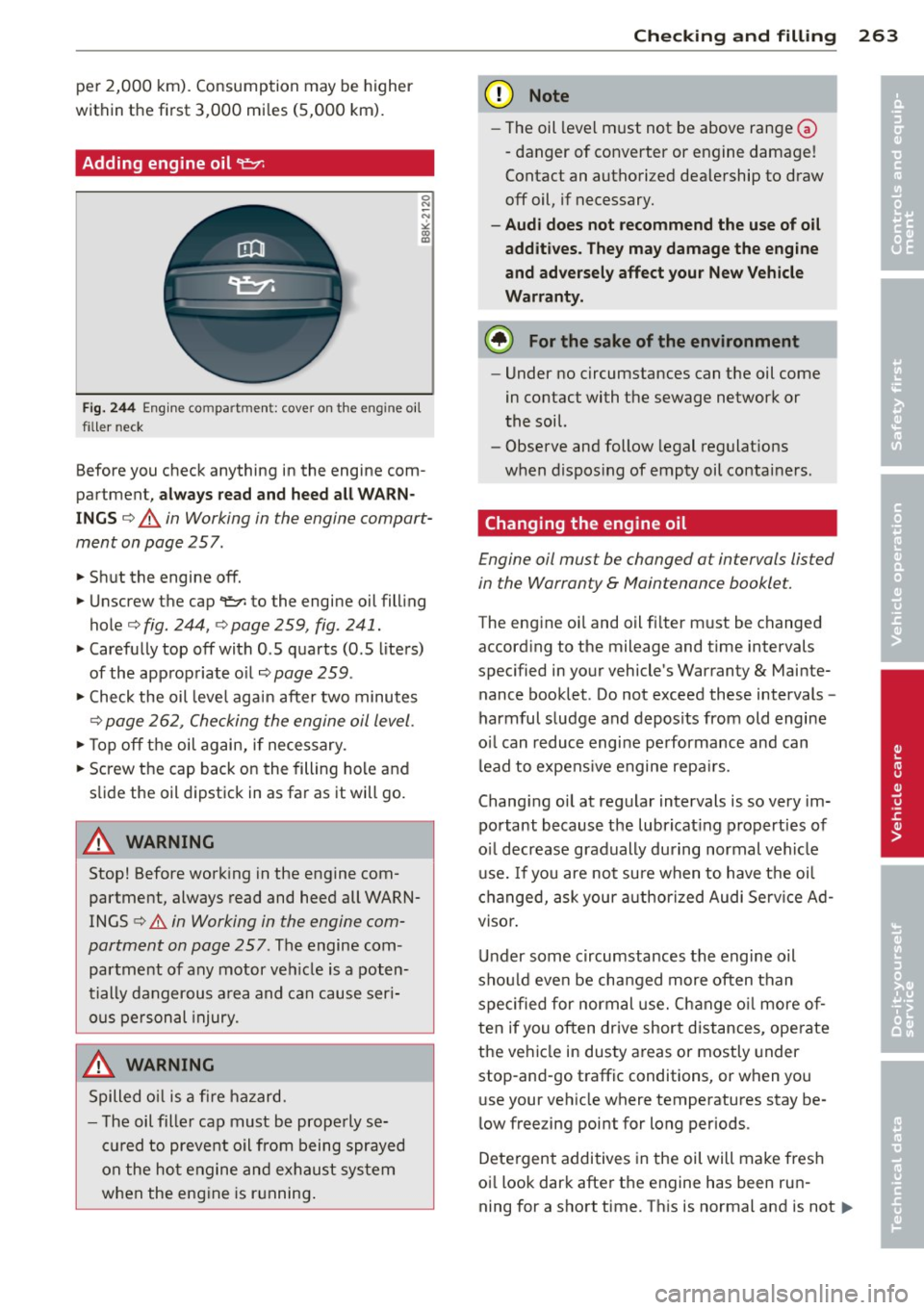
Adding engine oil "1:::1:
0 N ~ N
" "' "'
F ig . 2 44 Eng in e c omp art m ent: co ver on the eng ine o il
fi ller nec k
Befo re you check anything in the engine com
partment,
al way s read and heed all WARN ·
INGS ¢&. in Working in the engine compart
ment on page 257 .
... Sh ut the engine off.
.,. Unscrew the cap~ to the engine oil fill ing
hole ¢
fig. 244, ¢ page 259 , fig . 241.
... Carefully top off with 0 .5 quarts (0 .5 lite rs)
of the appropriate o il ¢ page 259.
.,. Check the oil leve l aga in afte r two minutes
¢ page 262, Checking the engine oil level.
.,. Top off the oil again, if necessary.
... Screw the cap back on the filling hole and
sli de the oil dipst ick in as far as it will go.
A WARNING
Stop! Before work ing in the engine com
partment, always read and heed all WARN
INGS
c> .& in Working in the engine com
partment on page 257 .
The engine com
partment of any motor veh icle is a poten
tially dangerous a rea and can cause ser i
ous pe rsonal injury.
.&, WARNING
Spilled o il is a fi re ha zard.
- The oil filler cap must be prope rly se
cur ed to preve nt oil from being sprayed
on the ho t engine and exhaust sys tem
when the eng ine is r unning .
-
Checkin g and fillin g 263
@ Note
-The oil leve l m ust not be above range (v
- danger of converter or engine damage!
Contact an authori zed dealership to draw
off oil, if necessary.
- Audi does not recommend the use of oil
additives. They may damage the engine
and adverse ly affect your New Vehicle
Warranty.
® For the sake of the environment
- Under no circumstances can the oil come
in contact with the sewage network or
the soil.
- Observe and follow legal regulat ions
when dispos ing of empty oil containers.
Changing the engine oil
E ngine oil mus t be changed a t in tervals lis ted
in the Warranty
& Maintenance bookle t.
The engin e oi l and oil f ilter m ust be changed
acco rd ing to the mileage and time intervals
specified in yo ur vehicle's Warranty & Mainte·
nance booklet . Do not exceed these intervals -
harmful s ludge and deposits from old engine
o il can reduce engi ne pe rformance and can
l ead to expens ive engine repa irs .
Chang ing oil at regular interval s is so very im
po rtant because the lubricat ing p roperties of
o il decrease gradually du ring normal veh icle
use. If you are no t su re when to have t he oi l
c h anged, ask your a uthori zed Audi Serv ice Ad
visor .
U nder some circumstances the engine oil
shou ld eve n be cha nged more often than
spec ified for normal use. Ch ange o il more of
ten if you often drive short distances , operate
the ve hicle in dusty areas or mostly under
stop -and -go t raffic conditions, or when you
u se you r veh icle where temperatures stay be
low free zing point for long periods .
Dete rgent additives in the oil will make fres h
oi l look dark afte r the engine has been run-
ning for a short time . Th is is normal and is not
Ill>
•
•
Page 266 of 340
264 Check ing and filling
a reason to change the oil more often than
recommended.
A WARNING
Stop! Before working in the engine com
partment, a lways read and heed all WARN
INGS
c> .&. in Working in the engine com
partment on page 257. The engine com
partment of any motor veh icle is a poten
tially dangerous a rea and can cause ser i
ous personal injury.
A WARNING
If you must change the engine oil in your
vehicle:
- Always wea r eye p rotection.
- T o reduce the r isk of burns from hot en-
gine oil let the engine cool down to the
touch.
- When removing the oil drai n plug with
yo ur finge rs, stay as far away as possible.
Always keep your forea rm pa ra ll el t o the
ground to he lp prevent hot oil from run
ning down your arm.
- Dr ain the o il into a container designed
for this p urpose, one large enough to
hold at least the total amount of oil in
yo ur engine .
- T o reduce the r is k of po ison ing, never use
empty food or beverage containers that
might mis lead someone into drinking
from them.
- Engine oil is poisono us. Keep it well out
of the reach of children.
- Cont inuo us contact with used engine oil
is harmful to your skin . Always protect
yo ur sk in by washing thoro ughly with
soap and water.
@ Note
Never mix oil ad ditives with your engine
oil. These additives can damage your en
gine and adverse ly affect your Audi Limit
ed New Vehicle Warranty.
(® For the sake of the environment
- Before changing the oil, first make sure
you know where you can prope rly dispose
of the old o il.
- Always dispose of used oil p roperly. Nev
er dump it on garden soil, in wooded
areas, into streams or down sewage
dra ins.
- Recycle used o il by tak ing it to a used en
gine oil collection facility in your area, or
contact a se rvice station.
- We strongly recommend that yo u have
your oil cha nged by an authorized Audi
dealer or a qualified workshop with the
special tools a nd expert ise required, and
prope r m eans of disposal.
Engine cooling system
Coolant
The engine coolant performs two functions: it
keeps the engine from overheating and it pro
tects the engine from freezing in the winter.
T he cooling sys tem is sealed and genera lly re
quires little attention.
T he coo lin g sys tem has been fi lled a t the fac
tory with a permanent coolan t which does not
need to be changed . The coo lant cons ists of a
mixture of specially conditioned water and the
manufacture r's g lycol-basedcoo lant add i-
t ive
Gl3 antifreeze with anticorrosion addi
t ives (SO% for USA models; 60% for Canadian
models). This mixture both assures the neces
sa ry frost protection and protects metal com
ponents in the eng ine's cooling system from
corros io n and scaling.
It also ra ises the bo il
i ng po in t of the coolan t.
Do not reduce the concentration of the cool
ant in the summer by addi ng p lain water .
The
proportion of coolant additiv e must be at
lea st 50 % but not more than 60°/o
to main
t ai n ant ifree ze pro te ct io n and cooling eff ic ien
cy .
If the coo lant fros t protec tion is too low '
t h e coo lant co uld freeze and damage the vehi-
cle heating and engine cooling system. ..,.
Page 267 of 340

For year-round driv ing, antifreeze is added at
the factory for temperatures down to:
- - 31 °F (- 35 °C) USA
- - 40 °F ( - 40 °C) Canada .
If you mus t add coolant, use a mixture of wa
ter and coolant additive. Mixing the coolant
additive with distilled water is recommended .
A WARNING
-
Before you check anything in the engine
compartment, always read and heed all
WARNINGS ¢
A in Working in the engine
compartment on page 257.
(D Note
-Before winter sets in, have the coolant
checked to see if the coolant additive in
your vehicle is sufficient to meet the cli
mate conditions. This is especially impor
tant if you live in a region where the win
ter is extremely cold.
If necessary, in
crease the proportion of coolant additive
to 60%.
- When adding coolant additive to your
cooling system, remember:
- We recommend using only coolant ad
ditive Gl2++ or G13 for your vehicle.
This coolant additive is available at au
thorized Audi dealers. Other types of
antifreeze can significantly reduce cor
rosion protection . The resulting corro
sion can cause a loss of coolant and se
rious engine damage.
- Do not add any type of radiator leak seal
ant to your vehicle's engine coolant.
Adding radiator repair fluid may adverse
ly affect the function and performance of
your cooling system and could result in damage not covered by your New Vehicle
Limited Warranty.
Checking and filling 265
Checking the engine coolant level
T he engine coolant level can be checked with
a quick glance.
Fig. 245 En gin e compar tment: Coolant expansion tank
Before you check anything in the engine com
partment,
always read and heed all WARN
INGS ¢ A in Working in the engine comport
ment on page 257 .
.,. Park your vehicle on a level surface.
.,. Turn
off the ignition .
.,. Let the engine cool down.
.,. Place a thick rag over the coolant expans ion
tank ¢
fig. 245, c> page 259, fig. 241 and
carefully twist the cap counter-clockwise
¢,&. .
.,. Read the engine coolant level in the open
coolant expansion tank. With a cold engine,
the coolant level should be between the
"min " and "max" markings. When the en
gine is warm, the level may be slightly
above
the "max" marking.
The location of the coolant expansion tank
can be seen in the engine compartment illus
tration
¢ page 259 .
To obtain an accurate reading, the engine
must be switched
off.
The expansion tank in your vehicle is equipped
with an electric coolant level sensor .
When the coolant level is too low, the warning
light in the Auto-Check System¢
page 32 will
blink until you add coolant and the level has
been restored to normal. Even though there is
an electric coolant level sensor, we still rec ommend you check the coolant level from
time to time .
Page 268 of 340
26 6 Ch eck ing and filling
Coolant lo ss
Coolant loss may indicate a l ea k in t he cooling
system. In the event of coolant loss, the cool
ing system should be inspected immediately
by your authorized Audi dealer. It is not
enough merely to add coolant.
I n a
se ale d system, losses can occur only if
the boiling point of the coolant is exceeded as
a result of overheating.
A WARNING
The cooling system is under pressure and
can get very hot. Reduce the risk of scald
ing from hot coolant by following these
steps .
- Turn off the engine and allow it to cool
down.
- Protect your face, hands and arms from
escaping fluid and steam by covering the
cap with a large, thick rag .
- Turn the cap slowly and very carefully in
a counter -clockwise direction wh ile ap
plying light, downward pressure on the
top of the cap .
- To avoid being burned, do not spill ant i
freeze or coolant on the exhaust system
or hot eng ine parts. Under certain condi
t ions, the ethy lene g lycol in engine cool
an t can ca tch f ire.
0 Note
Do not add any type of radiator leak seal
ant to your vehicle's eng ine coolant. Add
ing radiato r repair fluid may adve rsely af
fect the function and performance of your
cooling system and could res ult in damage
not covered by your New Vehicle Limited
Warranty .
Adding coolant
Be very careful when adding engine coolant.
Before you check anything i n the engine com
pa rtmen t,
a lwa ys rea d and h eed all WARN
INGS c:::> A in Working in the engine compart
ment on page 257.
.. Tu rn off the engine .
.. Let the engine cool down.
.. Place a thick rag over the coo lant expansion
tank
c> page 265 , fig. 245 and car efully
twist the cap counter-clockwise c> ,&. .
.. Add coo lant m ixed in the correct rat io
c:::> page 264, Coolant.
.. Twist the cap on again tightly.
Replacement engine coolant must conform to
exact spec ificat ions
c> page 264, Coolant.
We recommend using only coo lant additive
G12 ++, G13 or in an emergency G12 +. Do
not
use a different add itive. In an emergency use
plain water until you can get the correct addi
t ive and can restore the correct ratio . This
shou ld be done as soon as poss ib le.
If you have lost a considerable amount of
coolant, then you should add cold ant ifreeze
and co ld water only when the eng ine is cold .
Always use
new engine coolant when refilling.
Do not fi ll coolant above the "MAX" mark. Ex
cess coolant will be forc ed out through the
pressure relief valve in the cap when the en
gine becomes hot.
A WARNING
- The cooling system is under pressure and
can get very hot. Reduce the risk of
scalding from hot coolant by following
these steps.
- Turn off the engine and allow it to coo l
down.
- Protect your face, hands and arms from
escaping fluid and steam by covering
the cap with a large, th ick rag.
- Turn the cap s low ly and very carefully
in a counter-clockwise direction while
applying light, downward pressure on
the top of the cap.
- To avoid being burned, do not spill an
tifreeze or coolant on the exhaust sys
tem or hot engine parts. Under certain
cond it ions, the ethylene g lycol in en
gine coolant can catch fire .
Page 269 of 340
-Antifreeze is poisonous . Always store an
t ifreeze in its or iginal container and well
out of the reach of children.
- If you drain the coolant, it must be
caught and safely stored in a proper con
tainer clearly marked "poison".
(D Note
- Coolant pollutes the environment and
could cause an engine fire. Excess coo l
ant will be forced out through the pres
sure re lief va lve in the cap when the en
gine becomes hot.
- If, in an emergency, only water can be
added, the correct ratio between water
and antifreeze ¢
page 264 must be re
stored as soon as possib le.
@ For the sake of the environment
Drained coolant should not be reused. Al
ways dispose of used coolant while observ ing all environmental regulations .
Radiator fan
The radiator fan switches on automatically by
itself
The radiator fan is driven by the engine via the
V-belt . The viscous clutch regulates the speed
of the fan accord ing to the temperature of the
coolant .
An auxiliary electric radiator fan* switches on
and off depending on coolant temperature
and other vehicle operating conditions .
After you switch the engine off, the auxilia ry
fan can continue running for up to 10 minutes
- even with the ignition off. It can even switch
on again later by itself¢& , if
- the temperature of the engine coolant rises due to the heat build-up from the engine in
the engine compartment, or
- the engine compartment hea ts up because
the vehicle is parked in intense sunlight .
Checking and fillin g 267
A WARNING
-To reduce the risk of personal injury nev
er touch the rad iator fan.
- The auxiliary electric fan is temperature
controlled and can switch on suddenly
even when the engine is not running .
- The auxiliary radiator fan switches on au
tomatically when the engine coolant reaches a certain temperature and will
continue to run until the coo lant temper
ature drops.
Brake fluid
Checking brake fluid level
The brak e fluid lev el can be check ed with a
quick glance.
N
N
-N ,.
:8
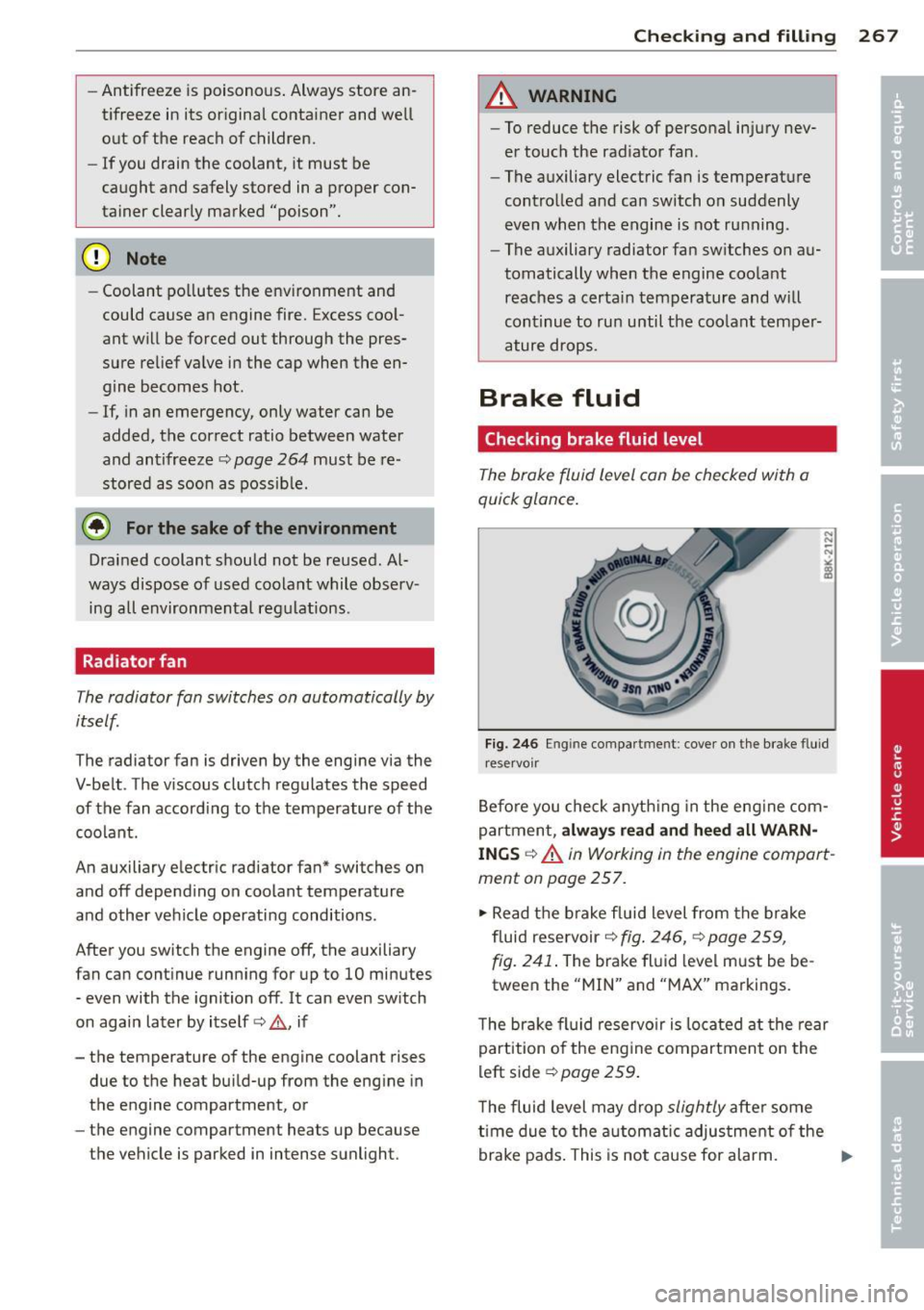
Fi g. 246 En gin e compa rtm en t: cover o n the bra ke fluid
reservoir
Before you check anything in the eng ine com
partment ,
always read and heed all WARN
INGS ¢ A in Working in the engine compart
ment on page 257.
.,. Read the brake fluid level from the brake
fluid reservoir ¢
fig. 246, ¢ page 259,
fig. 241.
The brake fluid level must be be
tween the "MIN" and "MAX" markings .
The brake fluid reservoir is located at the rear
partition of the eng ine compartment on the
left side ¢
page 259.
The fluid level may drop slightly after some
time due to the automatic adjustment of the
brake pads. This is not cause for alarm. ..,_
Page 270 of 340
268 Check ing and filling
If the brake fluid level falls considerably be
low the "MIN" mark, the brake warning/indi
cator light (U .S . mode ls:
1111 , Canadian
models: .) will come on
<::> page 19 and
<::> page 32. Do not continue to operate the ve
h icle . The complete brake system should be
thoroughly checked by an authorized Aud i
dea ler or qualified workshop and the cause
corrected. If the brake fluid level is too low,
the brake warning/indicator light will illum i
nate . Contact an authorized Aud i dealer
im
m ediatel y.
@ Tips
The brake fluid rese rvoir is located unde r
neath the cove r.
Changing brake fluid
Hove the broke fluid changed by on experi
enced technician.
Brake fluid absorbs moisture from the a ir . If
the water content in the brake fluid is too
h igh , corrosion in the brake system may result
after a per iod of t ime. The bo iling po int of the
brake fluid wi ll also decrease considerably and
decrease braking performance.
Therefore, the brake flu id must be changed
e ver y tw o year s. Always use new b rake fluid
which conforms to Federal Motor Vehicle
Standard "FMVSS 1 16 DO T 4".
The brake flu id reservo ir can be difficult to
reach, therefore, we recommend that yo u
have the brake f luid changed by you r author
ized
Audi dea ler. Your dea ler has the correct
too ls, the right brake fluid and the know -how
to do this for you.
A WARNING
- Brake fluid is poisonous . It must be stor
ed only i n the closed orig inal container
o ut of the reach of children!
- Brake fa ilure can result from old or inap
propriate b rake fluid. Observe these pre
caut ions: -
Use only brake fluid that meets SAE
specification
J 1703 and conforms to
Federa l Motor Vehicle Standard 116.
Always check with your authorized Audi
dealer to make sure you are using the
correct brake fluid . The correct type of
brake f lu id is also ind icated on the
brake flu id reservoir.
- T he brake fluid must be new. Heavy use
of the bra kes ca n cau se a vapo r lock if
the b rake fluid is left in the system too
l ong . This can seriously affect the effi
c iency of the brakes as well as your
safety. This co uld resu lt in an accident.
(D Note
Bra ke fluid will damage the paint of you r
vehicle .
(® For the sake of the environment
Because of the p rob lem of p roper disposal
of b ra ke fluid as well as the spec ial too ls
r equired and the necessary expertise, we
re commend that yo u have the brake fluid
changed by yo ur authorized Aud i dea ler.
Battery
General information
U nder normal ope rat ing cond itions, the bat
tery in yo ur Audi does not need any ma inte
nance. With
high o utside tempe ra tur es or
l ong dai ly drives we recommend that you have
the e lectrolyte level checked by an authorized
Audi dealer or qualif ied workshop. The elec
trolyte level should also be checked each time
the battery is charged
<::> page 2 70.
Have the battery checked when yo u take your
vehicle in for service. You are well advised to replace a battery that is o lder than 5 years .
With certain types of airbag deployment, the batte ry is disconnected from the veh icle elec
trical system for safety reasons¢.&
in Re
pair , core and disposal of the airbags on
page 197.
~
Page 271 of 340
Disconne cting the batt ery t erminals
Some vehicle functions (power w indow regu
l ators, for example) are lost if the battery ter
minals are disconnected . These functions have
to be re learned after the battery terminals are
connected again. To prevent this, the battery
should only be disconnected from the vehicle
electrical system when absolutely necessary
for repairs .
Vehicle s not driven fo r lo ng period s
If you do not drive your vehicle over a period
of several days or weeks, electrical compo
nents are gradually cut back or switched off .
This reduces energy consumption and main
tains starting capab ility over a longer per iod
¢ page 229 .
Take into consideration that when you unlock
your vehicle, some convenience functions,
such as the inter ior lights or the power seat
adjustment, may not be available . The con
ve nience funct ions w ill be available again
when yo u turn on the ignition and start the
engine.
Winter op eration
During the winter months, battery capacity
tends to decrease as tempe ratures d rop . This
i s because more powe r is also consumed while
start ing, and the headl ights, rea r window de
fogger, etc., are used more often.
Avo id unnecessary power consumption, par
ticularly in c ity t raffic or when t rave ling on ly
short d istances. Let you r autho rized Aud i
dealer check the capacity of the vehicle bat
tery before winter sets in ¢
page 270. A we ll
charged battery wi ll not only prevent starting
prob lems when the weather is cold, but will
also last longer .
If your vehicle is left standing for severa l
weeks at extremely low temperat ures, the
veh icle battery should be removed and
stored where it will not freeze. This will
prevent it from bei ng damaged and hav ing
to be replaced.
Checkin g and fillin g 269
Working on the battery
Be especially careful when working on or near
the battery.
The battery is located under the driver 's seat.
Before you check anyth ing under the dr iver's
seat,
read and h eed all WARNINGS G &_ .
Always heed the safety warnings , when work
ing on the vehicle battery or the vehicle e lec
trical system to prevent injury .
The following WARNINGS are ver y
important when working on the batter y:
Alway s heed the following WARN IN G SY M-
BOLS a nd safety p re caution s when working
on the battery .
®
Alway s wear e ye prote ction.
&
Bat te ry acid contains s ulfuric acid. Al-
ways w ear glov es and ey e prot ect ion .
@
No
-spar ks
- flames
- smo kin g.
A
When a batt ery i s charged , it produ ce s
hydro gen g as whi ch i s explo sive and
c o uld cau se pe rsonal injur y.
®
Alw ays k eep th e batt ery w ell out of
reac h of chi ldr en .
.8, WARNING
Whenever working on the battery or on
the electrical system, there is the risk of
injury, accident and even fire . Read and
heed the following WARNINGS:
- Always wear eye protection. Do not let
battery ac id or any lead particles get on
your skin or clothing . Shield you r eyes .
Exp losive gases can cause blindness or
other injury.
- Battery acid contains sulfuric acid. Sulfu
ric acid can cause blindness and severe
burns.
- Always wear g loves and eye protection.
-
Do no t tilt the ba ttery because acid .,. •
•
Page 273 of 340

Always read and heed all WARNING S below
¢ A. and
¢A. in Working on the battery on
page 269.
.,. Turn off the ignit ion and a ll electrical con
s u mers .
.,. Make sure the area is well vent ilated when
you charge the battery.
.,. Open the hood¢
page 257.
.,. Open the red cover on the posit ive pole
¢ fig . 247.
.,. Connect the charger connectors accord ing to
the instructions to the
jump start bolt s.
(Bolts unde r the red cover= "positive", Bolts
with hex head= "negative") .
.,. Only now pl ug the mains lead for the charg
ing equipment into the wall outlet and turn
it on ¢
A_.
.,. Make su re the charging rate i s not o ver
30 arnp s/14.8 Volt.
.,. When the battery is fully charged: Turn the
charging equ ipment
off and remove the
mai ns lead from the wa ll outlet.
.,. Now remove the clamps for the charging
equipment.
.,. Close the red cove r on the pos it ive po le.
.,. Close the hood¢
page 257.
A discharged batte ry can fr eez e at tempera
t ures of only O
0C. Allow a frozen batte ry to
thaw comp letely before a ttempting to charge
it ¢& . However, we recommend not using a
thawed battery again because the battery cas
ing can be cracked due to ice formation and
can leak battery acid.
Battery charging (Ma ximum charging rate
o f 30 amp s/14 .8 Volt)
When charging at low voltages (e.g . w ith a
tric kle charger ), the battery cables do not
h ave to be disconnected first. The battery
caps should
not be opened when charging a
battery .
It is not necessary to remove the battery from
the luggage compartment.
Checkin g and fillin g 2 71
Fast charging the battery (cha rging rate
ab ove 14 .8 V olt s)
For technical reasons do not use a battery
charger that uses voltage greater than 14.8
Volts to charge your vehicle's battery.
A WARNING
~ -
Charging a battery can be dangerous .
-Always follow the operating instructions
provided by the battery charger manu
facturer when charg ing your battery .
- Never charge a frozen battery.
It may ex
plode because of gas trapped in the ice.
Allow a frozen batte ry to thaw out f irst.
- Do not reuse batteries wh ic h were fro
zen. The battery hous ing may have
cracked and weakened when t he battery
froze.
- Charge the battery in a well ventilated area. Keep away from open flame or elec
tr ica l spar k. Do not smoke. Hyd rogen gas
genera ted by the battery is explos ive .
- To reduce the danger of explosion, never
connect or d isconnect c harger cab les
while the charger i s ope rat ing .
- Fast cha rging a batte ry is dange rous and
should only be a ttempted by a compe
tent techn ic ian wi th the p rope r equip
men t.
- Battery acid tha t may spi ll dur ing cha rg
ing should be washe d
off with a solu tion
of wa rm water and baking soda to neu
tralize the acid.
([) Note
Never use a fast charger as a booster to
star t the engine. This w ill seriously dam
age sens it ive e lectronic com ponen ts, s uch
as contro l units, re lays, radio, etc., as well
as the batte ry charger. •
•
Page 274 of 340

272 Ch eck ing and filling
Battery replacement
The new battery must have the same specifi
cations and dimensions as the original equip
ment battery.
Intelligen t energy management in your veh i
cle is respons ible for d istributing the e lectr i
cal en ergy throughout your vehicle
¢
page 229. T he intell igent e nergy manage
ment system w ill keep the eng ine battery
cha rged better then vehicles w ithout this sys
tem . To make sure the additional e lectrica l en
ergy is availab le once again after you have
changed the battery, we recommend that you install batteries of the same type and manu
facture only (the same as those installed at
the time your vehicle was delivered). Specifi
cations are listed on the battery hous ing . Your
author ized dealer must code the battery in
the ene rgy management system to enable you
to use the energy management f unct ions co r
rectly after replac ing the battery.
If it is not poss ible to use a battery of this
type, the new battery must have the same ca
pac ity, voltage (12 volts), amperage , con
struction and plug seal ing.
When insta lling the battery, make sure the ig
n it ion and all e lectr ica l consumers a re turned
off.
Q;) Note
Make sure the venti lation hose on the s ide
of the battery is connected, otherwise
fumes or battery ac id can leak o ut.
@ For the sake of the environment
Because of the problem of proper d isposa l
of a battery, we recommend your autho r
i z ed Audi dealer change the ba tte ry for
you. Bat teries con tain s ulfu ric ac id and
lead and m ust always be disposed of prop
erly in compliance with all environmental
reg ulations. Disposing of vehicle batteries
improper ly is very dangerous to the envi
ronment.
Windshield/headlight
washer container
F ig . 24 8 Eng in e compar tment : cover on t he wi nds hield
and headl ig ht* washe r flu id reservoi r
The washer fluid co nta iner is marked w ith the
symbol Won its cap ¢
fig. 248, ¢ page 259,
fig. 241 .
.. Before you check anything in the engine
compartment,
alwa ys read and he ed all
W ARNING S
¢ & in Working in the engine
compartment on page 257 .
.. Lift the fille r cap tongue to add washer flu
id. You can fi ll the container to the top.
.. Press the cap back onto the fi ller neck afte r
fi lling the container.
You can find the reservo ir
capacity in the table
in
¢ page 315.
Clean water should be used when filling up . If
poss ible, use soft water to prevent scaling on
the washer jets. A lways add a glass clea ne r
so lution (with frost prote ction in the winter).
0 Note
Do not mix engine coolant antifreeze o r
any other additives to fill up the wind
s hi eld washer rese rvoir.
Page 275 of 340
Tires and wheels
Tires
General notes
Tires may be the least appreciated and most
abused parts of a motor vehicle .
Tires may be the least appreciated and most
abused parts of a motor vehicle . T ires are,
however, one of the most important parts of a
vehicle, particularly considering the compara
tively small patch of rubber on eac h tire that
assures that a ll- important contact between
you, you r vehicle and the road.
Maintaining the correct tire pressure, mak ing
sure that your vehicle and its tires do not have
to carry mo re weight than they can safely han
d le, avoiding damage from road hazards and
r eg ularly inspec ting t ires for damage i nclud
ing cuts, slashes irregu la r wear and ove rall
condition are the most important things that
you can do to he lp avoid sudden tire failure in
cluding tread separat ion and blowouts.
Avoiding damage If you have to d rive over a curb or similar ob
stacle, drive very slow ly and as close as possi
b le at a right angle to the curb.
A lways keep chemicals includ ing grease, o il ,
gasoline and brake fluid off the t ires .
I nspect the t ires regularly for damage (cuts,
cracks or b listers, etc.). Remove any fo reign
bod ies embedde d in the treads.
Storing tires Mark tires when you remove them to indicate
the direction of rotation . T his ensures you to
be ab le to mount them correctly when you re
i nstall them .
When removed, the whee ls or t ires should be
sto red in a cool, d ry and preferably dark place .
Store tires in a vertical pos ition if they are not
mounted on rims, in a horizontal pos it ion if
they are mounted on rims .
Tires an d wheel s 273
New tires
New tir es have to be broken in ¢ & .
The tread depth of new t ires may vary, accord
ing to the type a nd make of t ire and the tread
pa tte rn.
Hidden damage
Damage to tires and r ims is ofte n not readily
visible . If you notice unusual v ib rat io n or the
vehicle p ulls to one s ide, th is may ind icate
that one of the t ires has been damaged . T he
ti res m ust be chec ked immed iate ly by an au
thorized Audi dea le r or q ua lified wor kshop .
Unidirectional tires
A un idirectional tire can be identified by ar
rows on the s idewa ll, that po int in the direc
tion the t ire is designed to rotate. You mus t
f ol low the specified di rection o f rotation . T his
is necessary so that these tires can develop
their optimum characteristics regarding grip, road noise, wear and hydrop laning resistance.
For more information ¢
page 301.
A WARNING
New tires or t ires that are o ld, worn or
damaged cannot provide maximum con
trol and braking ability .
-
-New tires tend to be slippery and must
be broken in. To reduce the r isk of losing
control, a co llision and ser ious personal
in ju ries, d rive with special ca re fo r the
fi rst 350 m iles ( 560 km).
- Driving with worn or damaged tires can
lead to loss of control, sudden tire fail
ure, including a blowout and sudden de
fl ation, c ras hes and se riou s personal in
juries . Have wo rn or damaged t ires re
placed immediate ly.
- Ti res age even if they are not being used
and can fai l sudden ly, especially at hig h
spee ds. Tires that are more than 6 years
old can only be used in an emergency
and then w ith special care and at low
speed.
•
•