page 27 AUDI Q7 2014 Owner´s Manual
[x] Cancel search | Manufacturer: AUDI, Model Year: 2014, Model line: Q7, Model: AUDI Q7 2014Pages: 340, PDF Size: 85.02 MB
Page 245 of 340
have become completely familiar with the way
your vehicle-trailer combination behaves and responds.
Backing up is difficu lt and requires practice.
Backing up with a trai ler genera lly requires
steering action opposite to that when backing up your vehicle without a trailer .
Maintain a greater distance between your ve
hicle and the one in front of you. You will need
more room to stop . To compensate for the
trai ler, you will need a larger than norma l
turning radius.
When passing, remember that you cannot ac
celerate as fast as you normally would be
cause of the added load . Make sure you have
enough room to pass. After passing, allow plenty of room for your tra iler before chang
ing lanes again .
Avoid jerky starts, sharp turns or rapid lane
changes.
@ Tips
- Do not tow a traile r during the break-in
period of your vehicle.
- If you tow a trailer, your A udi may re
quire more frequent maintenance due to
the extra load
<=> page 316.
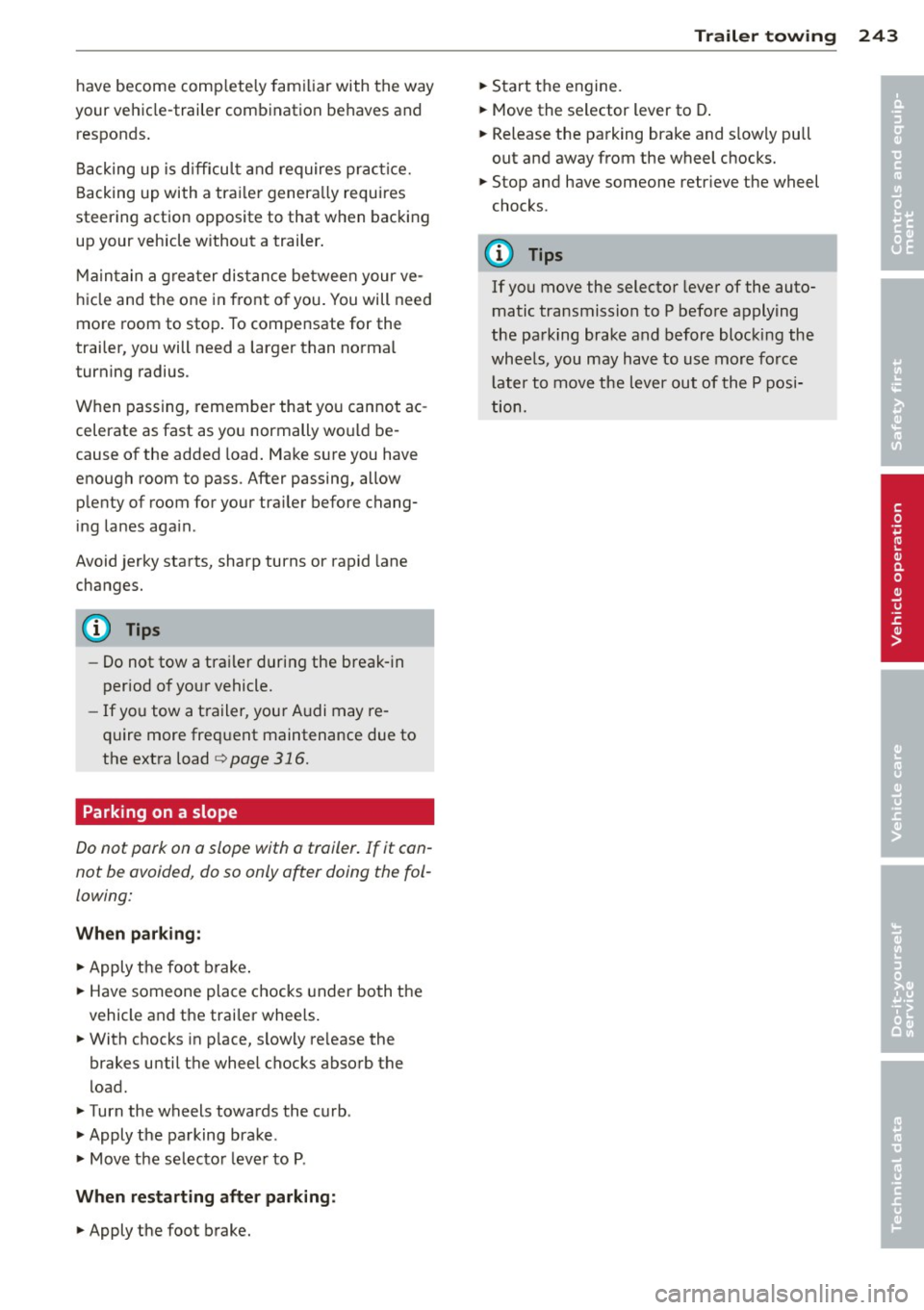
Parking on a slope
Do not park on a slope with a trailer. If it can
not be avoided, do so only after doing the fol
lowing:
When parking:
.. Apply the foot brake .
.. Have someone place chocks under both the
vehicle and the trai ler wheels .
.. With chocks in place, slowly re lease the
brakes until the wheel chocks absorb the
load .
.. Turn the wheels towards the curb .
.. Apply the parking brake .
.. Move the selector lever to P.
When restarting after parking:
.. Apply the foot brake.
Trailer towing 243
.. Start the engine.
.. Move the selector lever to D.
.. Release the parking brake and s low ly pull
out and away from the wheel chocks.
.. Stop and have someone retr ieve the wheel
chocks.
(D Tips
If you move the selector lever of the auto
matic transmission to P before applying
the parking brake and before blocking the
whee ls, you may have to use more force
l ater to move the lever out of the
P posi
tion.
•
•
Page 247 of 340

Vehicl e ca re a nd cl eanin g 245
A WARNING
-Only wash the vehicle when the ignition
is off and follow the instructions from
the car wash operator to reduce the risk of accidents .
- To reduce the r isk of cuts, protect your
self from sharp metal components when
wash ing the underbody or the inside of
t he wheel housings.
- After washing the vehicle, the braking ef
fec t may be delayed due to mo isture on
the brake rotors or ice in the winter. The
brakes must be dried first with a few
careful brake applications.
Q) Note
- If you wash t he vehicle in an automatic
car wash, yo u must fold the exterior m ir
rors in to reduce the r is k of damage to
the mirrors. Power folding exterior mir
rors* must only be folded in and out us
ing the power folding function.
- Compare the track of your vehicle with
the distance between the guide rails of
the facility -there is a risk of damage to
the wheels and tires .
- Compare the height and width of your
vehicle with the he ight and width of the
tunnel at the fac ility. -
To prevent paint damage, do not wash
the vehicle in direct sunlight.
- T o reduce the r isk o f damage to the sur
face, do not use insect removing spong
es, kitchen sponges or similar items.
- Matte finish painted vehicle compo nents:
- To reduce the risk of damage to the
surface, do not use polishing agents or
ha rd wax .
- Never use car wash cycles that apply protective wax.
It can destroy the
matte fin ish effect .
- Do not place any stickers or magnet ic
signs on vehicle parts painted w ith
matte fin ish paint. The paint cou ld be
damaged when the stickers o r magnets
a re removed.
@ For the sake of the environment
Only wash the ve hicl e in facilities spec ially
designed for that purpose . This will red uce
the r is k of dirty water contam inated with
oil from entering the sewer system.
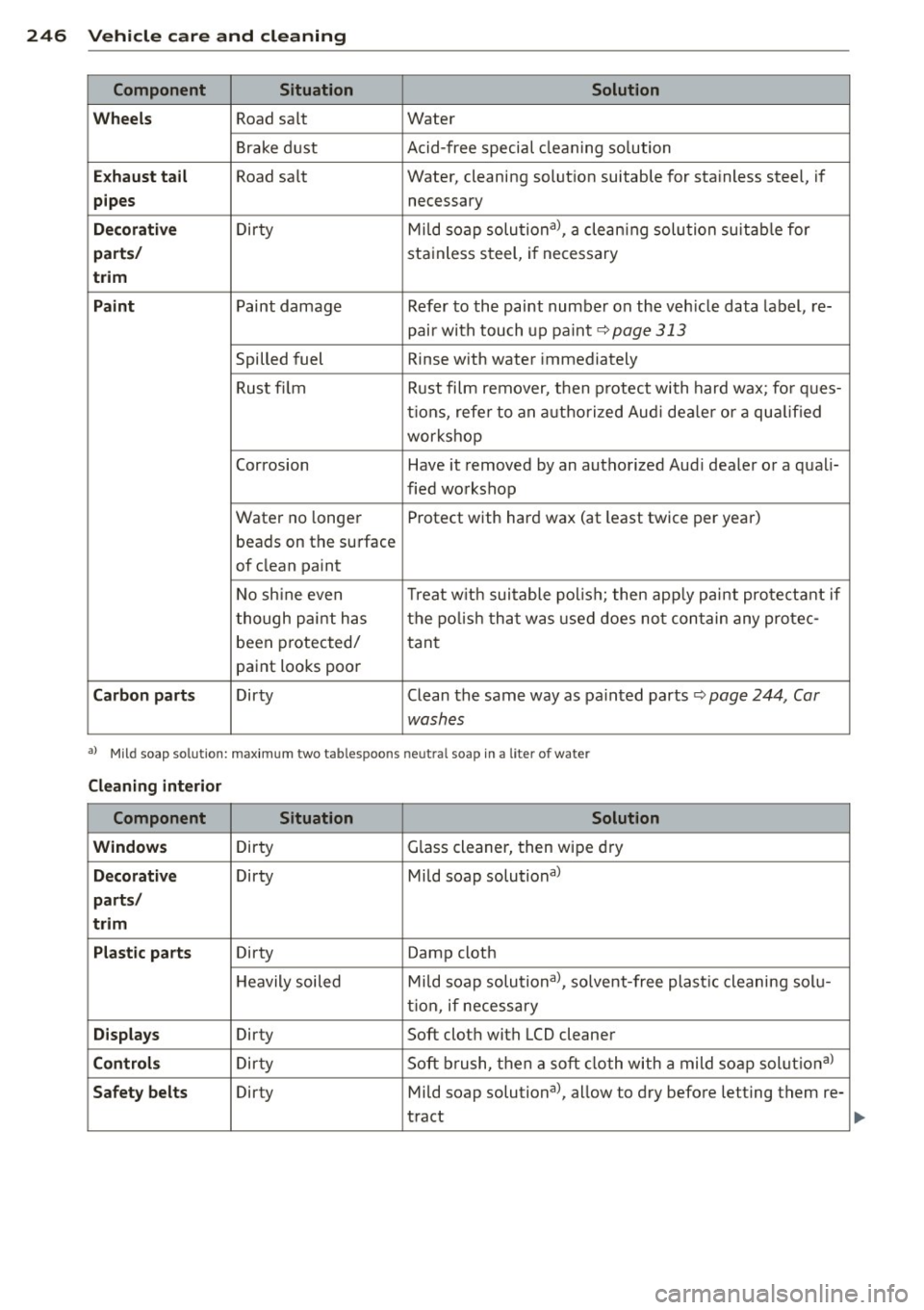
Cleaning and care information
When clean ing and caring for individual vehi
cle components, refer to the follow ing tables.
The information contained there is s imply rec
ommendations . For quest ions or for compo- nents that are not listed, refer to an author
ized Audi dealer or a qualified workshop. Also
follow the information found in c> ,& .
Cle aning e xterio r
Component Situation Solution
Wip er blades
Dirty c> page 66, Cleaning windshield wiper blades
Headlights / Dirty Soft sponge with a mild soap so lution a>
t a il lights
S en sor s/
Dirty Sensors: soft cloth w ith a so lvent-free cleaning product
camera len ses Camera lenses: soft cloth with an alcohol-free cleaning
so lution
Snow/ice Hand brush/solvent-free de -icing spray
•
•
Page 248 of 340
24 6 Vehicle care and cleaning
Component Situ ation Solution
Wheels
Road sa lt Water
Brake dust Acid-free special cleaning solution
Ex haust t ail Road salt Water, cleaning solut ion suitable for stainless steel, if
pipes necessary
Deco ra tiv e Dirty Mild soap
solutional, a cleaning solution su itab le for
parts/ sta inless steel, if necessary
trim
Paint
Paint damage Refer to the paint number on the veh icle data label, re-
pair with touch up paint ~
page 313
Spilled fuel Rinse with water immediately
Rust fi lm Rust film remover, then p rotect with hard wax; fo r ques-
tions, refe r to an a uthorized Audi deale r or a qua lified
workshop
Corrosion Have it removed by an authorized Audi dealer or a quali-
fied workshop
Water no longer Protect with hard wax (at least twice per year)
beads on the surface
of clean paint
No sh ine even Treat with suitable polish; then app ly pa int protectant if
though paint has the po lish that was used does not contain any protec-
been protected/ tant
paint looks poor
Carbon part s Dirty Clean tlhe same way as painted parts~ page 244, Car
washes
a ) M ild soap so lution: m aximu m two ta bles poons neut ral soap in a lite r of wate r
Cleaning int erior
Component Situation Solution
Windo ws
Dirty Glass cleaner, then wipe dry
D
ec orative Dirty Mild soap solutional
parts/
trim
Pla st ic pa rts
Dirty Damp cloth
Heavily soiled Mi ld soap solutional, solvent-free plast ic cleaning solu-
t ion, if necessary
D ispla ys Dirty Soft cloth with LCD cleaner
Co ntr ols Dirty Soft brush, then a soft cloth with a mild soap
solutional
S afet y bel ts Dirty Mild soap solutional, allow to dry before letting them re-
tract
Page 251 of 340
Fuel supply and filling
your f uel tank
Fuel supply
Gasoline
Applies to vehicles: with gasoline engine
Using the right fuel helps keep the environ
men t clean and preven ts engine damage.
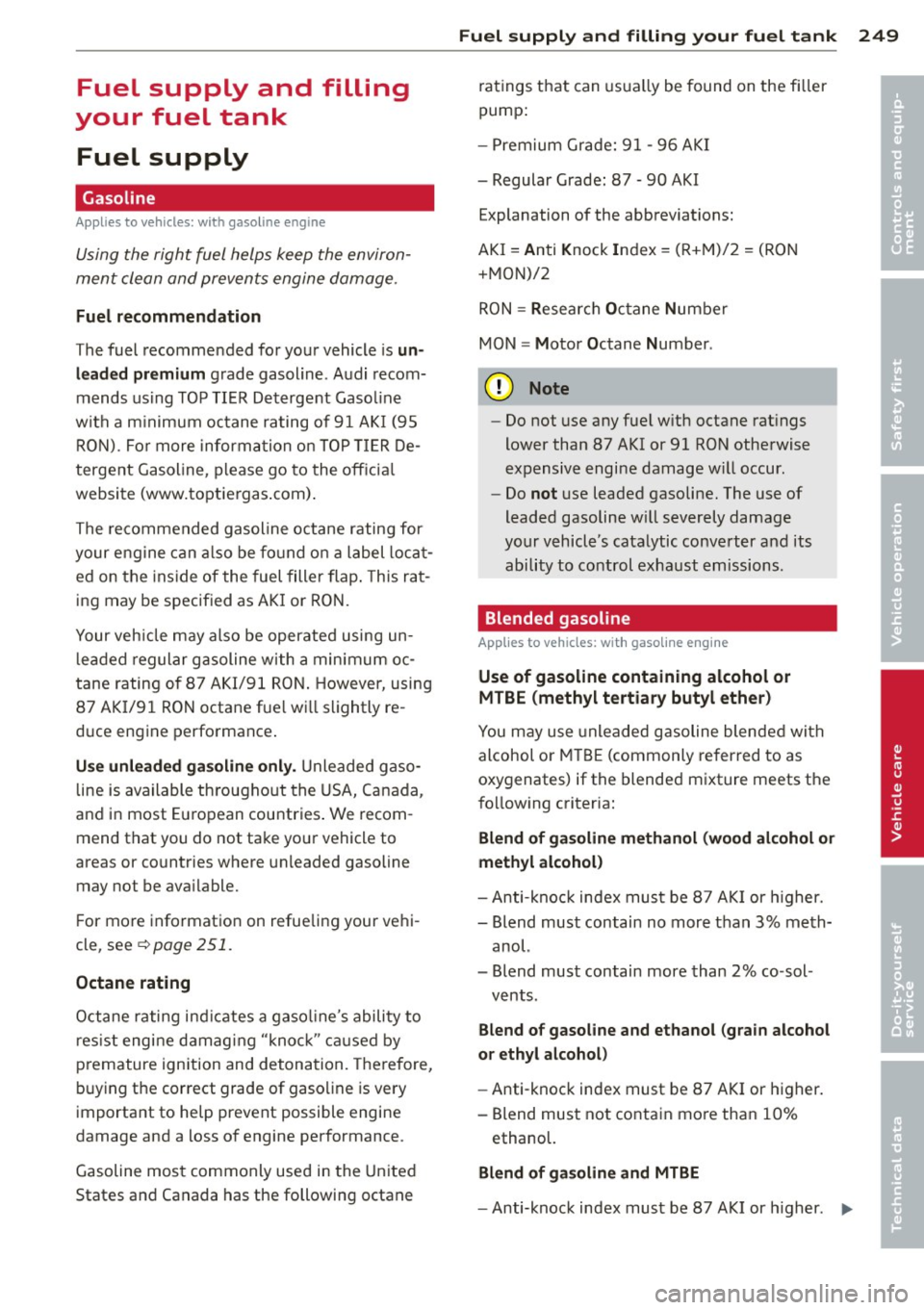
Fuel recommendation
The fuel recomme nded fo r yo ur vehicle is un
leaded premium
grade gasoline . A udi recom
mends using TO P TIE R D etergent Gaso line
w it h a m ini m um oc tane ra ting of 91 A KI (9 5
RON ). For more inform ation on TOP TIER De
tergent Gasoline, please go to the off ici al
websi te (www .to pt iergas .com) .
T he recommended gasoline octane rating for
your eng ine can also be fo und o n a label loc at
ed o n the ins ide of the fuel filler flap . This ra t
i ng may be specified as AK I or RO N.
Your veh icle may also be operate d using un
l ea ded regular gasoline with a min imu m oc
tane rating of 87 AKI/91 RO N. However, using
87 AK I/91 RON octa ne f ue l w ill sli ghtly re
d uce eng ine perfo rmance .
Use unleaded gasoline only . Unleaded gaso
line is available th rougho ut the USA, Canada,
an d in most E uropean cou ntries . We recom
mend that you do not ta ke yo ur vehicle to
areas or countries where unleaded gasoline
may not be ava ilable.
F or more informat io n on refue ling your ve hi
cle, see
q page 251.
Octane rating
Octane r ating ind icates a gaso line' s ability to
r es is t engine d am ag in g "kno ck" c aused by
p remature ign ition and detona tion. Therefore,
buy ing the correct grade of gaso line is very
importa nt to he lp prevent possible engine
damage and a loss o f engine performance.
G asoline mos t commonly used in the Unite d
States an d Canada has the following octane
Fuel supply and filling your fuel tank 249
rat in g s that can usu a lly be found on the fi ller
pump :
- Premium Gr ade: 9 1 -96 AKI
- Regular Grade: 87 - 90 AKI Explanation of the abbreviations:
AKI = Anti K nock In d ex = (R+M )/2 = (RO N
+MON )/2
RON= Resear ch O ctane Num ber
MO N = Motor Octane Number.
(D Note
- Do not use any fue l w ith octane rat ings
lower than 87 A KI or 9 1 RO N othe rwise
e xpensive engi ne damage w ill occur.
- Do
not use leaded gasoli ne . The use of
leaded gasoline w ill severely damage
yo ur vehicl e's cata lytic conve rter a nd its
abi lity to control exh aust em issions.
Blended gasoline
App lies to vehicles: wi th gaso line engine
Use of gasoline containing alcohol or
MTBE (methyl tertiary butyl ether)
You m ay use unlea ded gasoline blen ded wi th
alcohol o r M TB E (commonly referred to as
oxygenates) if the blende d mixture meets the
f o llow ing criteria:
Blend of gasoline methanol (wood alcohol or
methyl alcohol)
- Anti -k n ock index mus t be 87 A KI or higher.
- Blend must contain no mor e than 3% meth-
anol.
- Blend must contain more than 2% co-sol-
vents .
Blend of gasoline and ethanol (grain alcohol
or ethyl alcohol)
- Anti -knoc k index must be 87 AKI or h igher.
- Blend must not co nta in mo re tha n 10 %
ethanol.
Blend of ga soline and MTBE
- Anti-knock index must be 87 AKI or high er. ..,.
•
•
Page 253 of 340
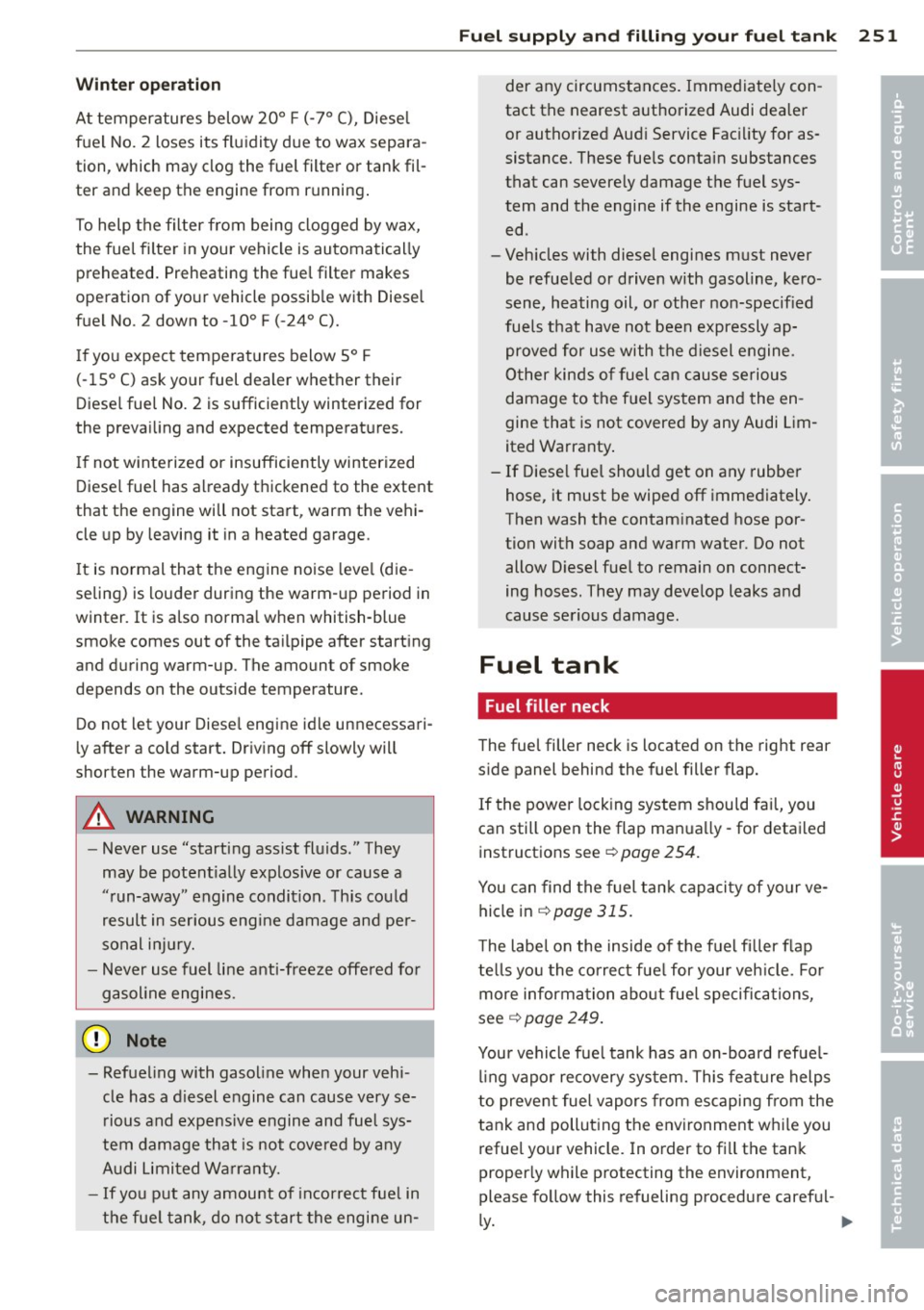
Winter operation
At temperatures below 20° F (-7° C), Diesel
fuel No.
2 loses its fluidity due to wax separa
tion, which may clog the fuel filter or tank fil
ter and keep the engine from running .
To help the filter from being clogged by wax,
the fuel filter in your vehicle is automatically
preheated. Preheating the fuel filter makes
operation of your vehicle possible with Diesel
fuel No . 2 down to -10° F (-24° C).
If you expect temperatures below 5° F
(-15° C) ask your fuel dealer whether their
Diese l fuel No. 2 is sufficiently winterized for
the prevailing and expected temperatures.
If not winterized or insufficiently winterized
Diesel fuel has already thickened to the extent
that the engine will not start, warm the vehi
cle up by leaving it in a heated garage.
It is normal that the engine noise leve l (die
seling) is louder during the warm-up period in
winter.
It is also norma l when whitish-blue
smoke comes out of the tailpipe after start ing
and during warm-up . The amount of smoke
depends on the outs ide temperature.
Do not let your Diese l engine id le unnecessari
ly after a cold start. Driving off slowly will
shorten the warm-up period .
A WARNING
-Never use "starting assist fluids." They
may be potent ially explosive or cause a
"run-away" engine condition. This could
result in serious engine damage and per
sonal injury.
- Never use fuel line anti-freeze offered for
gasoline engines .
0 Note
- Refueling with gasoline when your vehi
cle has a diesel engine can cause very se
rious and expens ive engine and fuel sys
tem damage that is not covered by any
A udi Limited Warranty.
- If you put any amou nt of incorrect fuel in
the fuel tank, do not start the engine un-
-
Fuel supply and filling your fuel tank 251
der any circumstances. Immediately con
tact the nearest authorized Audi dea ler
or authorized Audi Service Fac ility for as
sistance. These fuels contain substances
that can severely damage the fuel sys
tem and the engine if the engine is start
ed .
- Veh icles with diesel engines must never
be refueled or driven with gasoline, kero
sene, heating oil, or other non-specified
fuels that have not been expressly ap proved for use with the diesel engine.
Other kinds of fuel can cause serious
damage to the fuel system and the en
gine that is not covered by any Audi Lim
ited Warranty.
- If Diesel fuel should get on any rubber
hose, it must be wiped off immediately.
Then wash the contaminated hose por
tion with soap and warm water. Do not
allow D iesel fuel to remain on connect
ing hoses . They may develop leaks and
cause serious damage.
Fuel tank
Fuel filler neck
The fuel filler neck is located on the right rear
side panel behind the fuel filler flap.
If the power locking system shou ld fai l, you
can still open the flap manually -for detailed
instructions see¢
page 254.
You can find the fuel tank capacity of your ve
hicle inc::>
page 315.
The label on the inside of the fuel filler flap
tells you the correct fuel for your veh icle. For
more information abo ut fuel specifications,
see c::>
page 249.
Your vehicle fuel tank has an on-board refuel
ling vapor recovery system. This feature helps
to prevent fue l vapors from escaping from the
tank and pollut ing the environment while you
refuel yo ur vehicle. In order to fill the tank
properly while protecting the environment,
please follow this refueling procedure careful-
~-~
•
•
Page 254 of 340

252 Fuel supply and filling your fuel tank
_&. WARNING
Under normal operating conditions, never
carry additional fuel containers in your car .
Gas canisters and other containers used to
transport fuel can be dangerous. Such con
tainers, full or empty, may leak and could
cause afire in a collision. If you must
transport fuel to use for your lawn mower,
snow blower, etc., be very careful and al
ways observe local and state laws regard
ing the use, transportat ion and storage of
such fuel containers. Make certain the con
tainer meets industry standards (ANSI/
ASTM F8S2 -86).
(D Note
Never drive your vehicle until the fuel tank
is completely empty. The irregular supp ly
of fuel can cause misfiring . Gasoline could
enter the exhaust system and damage the
catalyt ic converter.
Refuelling
Fig . 232 Right rear vehicle side : Open ing t he fue l filler
fl ap
Fig. 233 Fu el cap hooked on the opened fue l filler fl ap
When adding fuel, the ignition and any cellu
lar phones in the vehicle must be switched
off . When activating the central locking, the fuel
filler flap is automatically unlocked or
locked. Refuel the vehicle with the ignition
turned
off.
Taking the fuel cap off
.,. To open the fue l filler f lap, press on the left
side of the flap¢
fig. 232 -arrow-.
.,. Unscrew fue l filler cap counter-clockwise
and hang it on the fuel filler flap ¢
fig. 233.
.,. Check the label on the inside of the fuel fill
er flap to determine if the vehicle must be
fueled with gasoline or diesel fuel.
Refuelling procedure
.,. Insert the fuel nozzle from the gasoline
pump into the fuel filler neck as far as it wi ll
go .
.,. Select a medium refuelling rate so that the
nozzle switches off automatically when the
tank is fu ll.
Putting the fuel cap back on
.,. After filling your tank, twist the fuel filler
cap clockwise as far as it wi ll go.
.,. Close the fuel filler flap.
T o avoid fuel spilling or evaporating from the
fuel tank always close fuel filler cap proper ly
and completely. An improperly closed fuel fill
er cap may also cause the MIL lamp¢
page 27
to come on (only vehicles with gasoline en
gine) .
_&. WARNING
Improper refueling or handling of fuel can
cause fire, explosion and severe burns.
- Fuel is highly flammable and can cause
severe bu rns and other injuries.
- Failure to shut the engine off while refu
eling and/or to insert the pump nozzle
fu lly into the fuel filler neck could cause
fuel to spray out of filler neck or to over
f low . Fu el spray and overflowing fue l can
cause a fire.
- Never use a cellular telephone while re
fue ling. The electromagnetic radiat ion
can cause sparks that can ignite fuel va
pors and cause a fire .
Page 256 of 340
254 Fuel supply and filling your fuel tank
Unlocking the fuel filler flap by hand
You can open the fuel filler flap by hand if the
power locking system should fail .
•
Fig. 234 Luggag e compart men t: Pry ing cover open
Fig. 235 Luggage compartmen t: Eme rgency open ing
of fuel filler flap
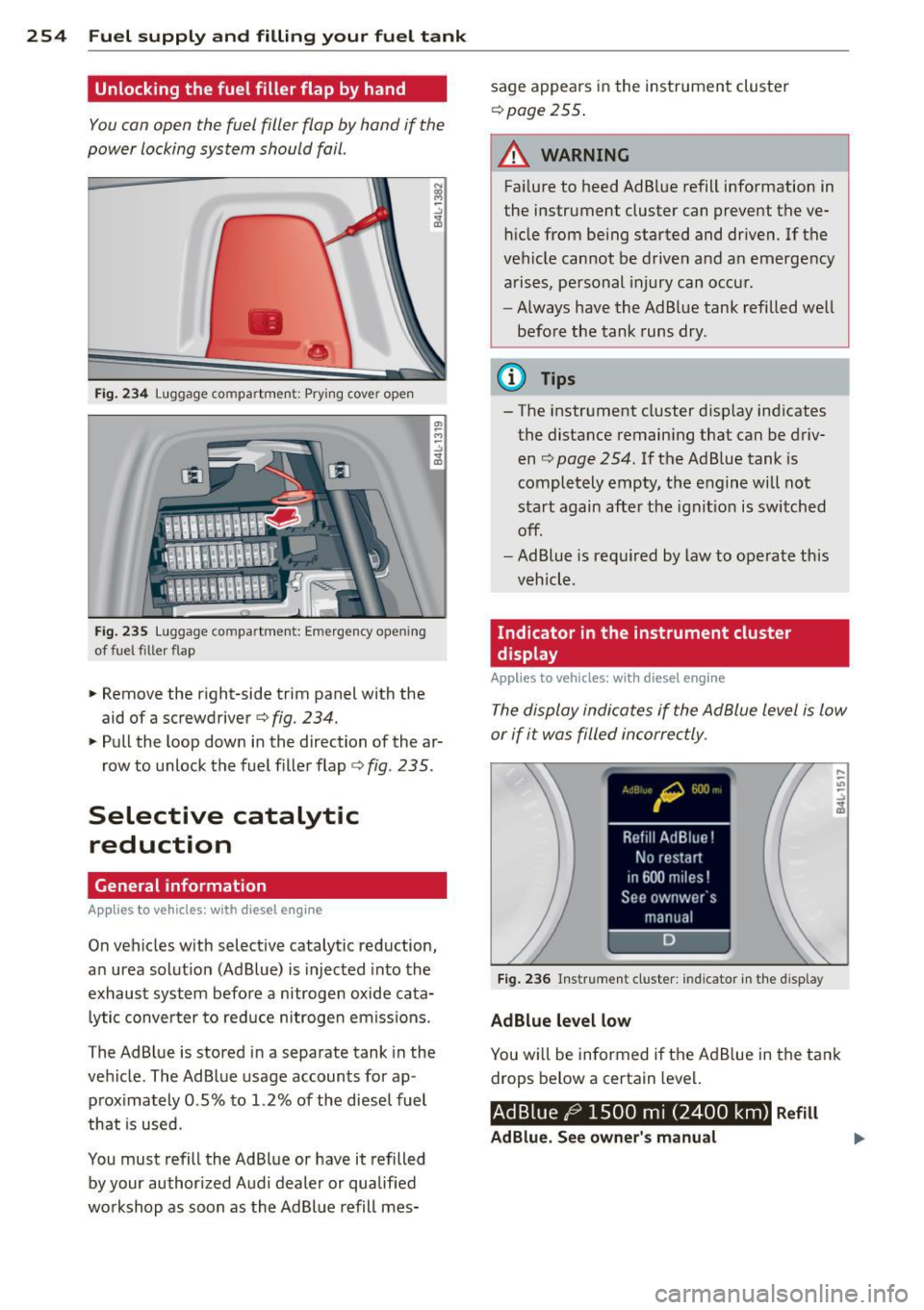
.. Remove the right-side trim panel with the
aid of a screwdriver
c:> fig. 234.
.. Pull the loop down in the direction of the ar
row to unlock the fuel f iller flap
c:> fig. 235.
Selective catalytic
reduction
General information
Applies to vehicles: with diesel engine
On vehicles with selective catalytic reduction,
an urea solution (Ad Blue) is injected into the
exhaust system before a nitrogen oxide cata lytic converter to reduce nitrogen emiss ions.
The AdBlue is stored in a separate tank in the
vehicle. The AdBlue usage accounts for ap
proximately 0.5% to 1.2% of the diesel fuel
that is used.
You must refill the Ad Blue or have it refilled
by your author ized Audi dealer or qualified
workshop as soon as the AdBlue refill mes- sage appears
in the instrum ent cluster
r=>page 255.
.&_ WARNING
-
Failure to heed AdBlue refill information in
the instrument cluster can prevent the ve hicle from being started and driven. If the
vehicle cannot be driven and an emergency
arises, personal injury can occur.
- Always have the AdBlue tank refilled well
before the tank runs dry.
(D Tips
- The instrument cluster disp lay ind icates
the distance remaining that can be driv
en
r=> page 254. If the AdBlue tank is
completely empty, the engine will not
start again after the ignit ion is switched
off.
- AdBlue is required by law to operate this
vehicle.
Indicator in the instrument cluster
display
Appl ies to vehicles: with diesel engine
The display indicates if the Ad Blue level is low
or if it was filled incorrectly .
Fig. 236 Instrument cluster: indicator in the display
AdBlue level low
You will be informed if the Ad Blue in the tank
drops below a certain level.
AdBlue l;) 1500 mi (2400 km) Refill
AdBlue. See owner's manual
Page 257 of 340
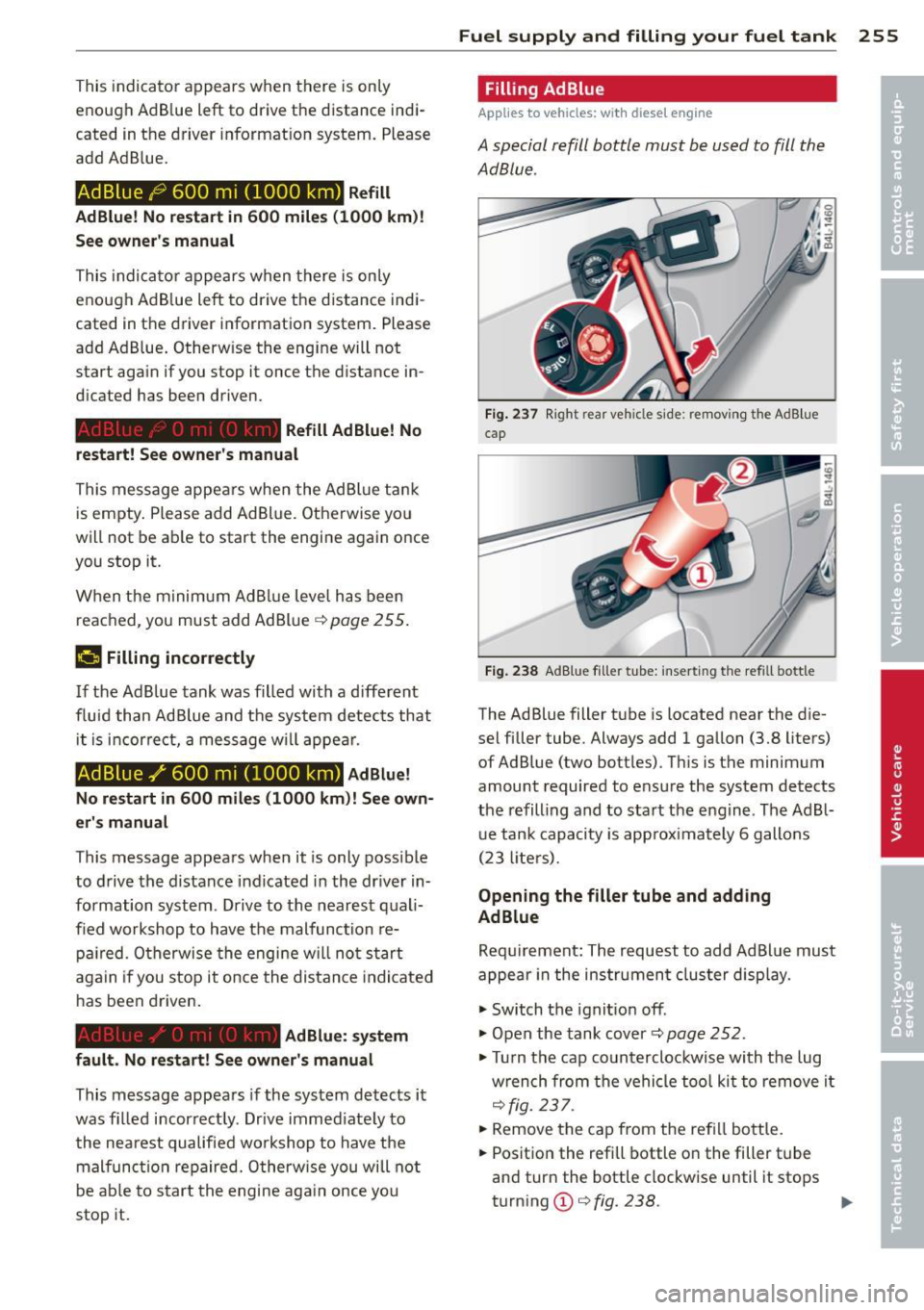
This indicator appears when there is on ly
enough Ad Blue left to drive the distance indi
cated in the driver informat ion system. Please
add Ad B lue.
Ad Blue /9 600 m i (1000 km) Refill
AdBlue! No restart in 600 miles (1000 km )!
See owner's m anual
This indica to r appears when there is on ly
enough Ad Blue left to drive the d istance indi
cated in the driver information system. Please
add Ad B lue . Otherw ise the eng ine will not
start aga in if you stop it once the distance in
dicated has been driven.
Refill AdBlue! No
restart! See owner's manual
This message appea rs when the AdBl ue tan k
is empty . Please add AdBlue. Otherwise yo u
will not be ab le to start the engine again once
you stop it.
When the minim um AdBl ue level has been
reached, you must add Ad Bl ue
q page 255 .
¢'4 Filling incorrectly
If the Ad Blue tank was filled with a diffe rent
f luid than Ad Blue and the system detec ts that
it is i ncor rect, a message w ill appe ar.
AdBlue / 600 mi (1000 km) Ad Blue!
No re start in 600 mile s (1000 km )! See own ·
e r' s manual
This message appea rs when it is only poss ible
to d rive the distance ind icated in the dr iver in
formation system . Drive to the nearest q uali
f ied work shop to have the malfunct ion re
p air ed. Otherwise the engine w ill no t start
again if you stop it o nce the distan ce indi cated
h as been driven.
AdBlue: sy stem
fault . No restart! See owner 's manual
This message appea rs if the system detects it
was fi lled incor rectly . Drive immed iate ly to
t he nea rest qualified wo rkshop to have the
m alf unct io n repaired. Otherw ise you will n ot
be ab le to s tart the engine aga in once yo u
stop it.
Fu el suppl y and filli ng your fuel t ank 255
Filling AdBlue
Applies to vehicles: with diese l engine
A special refill bottle must be used to fill the
AdBlue .
Fig. 23 7 Right rear vehicle side: removing t he AdB lue
cap
Fi g. 23 8 Ad B lue fill er tube: inserting th e refill bottle
The Ad Blue filler tube is located near the d ie
sel filler tube. Always add 1 gallon (3.8 liters)
of Ad Blue (two bott les). T his is the minimum
amount required to ens ure the system detects
the refill ing and to sta rt the e ng ine. The Ad B l
u e tank capacity is app rox imately 6 gallons
( 2 3 lite rs).
Opening the filler tube and adding
Ad Blue
Req uirement: The request to add Ad Blue must
appear in the instrumen t cluster disp lay. •
.,. Switch the ignit ion off .
.,. Open the tank cover
q pag e 2 52.
.. Tu rn the cap co untercloc kwise with the lug
w ren ch from the vehicle too l ki t t o rem ove it
qfig. 237.
.. Remove the ca p from the refi ll bott le.
.. Position the refill bottle o n the filler tube
and turn the bottle clockwise until it stops
turn ing
(D q fig. 238. 1111>
Page 261 of 340
Checking and fillin g 259
Engine compartment
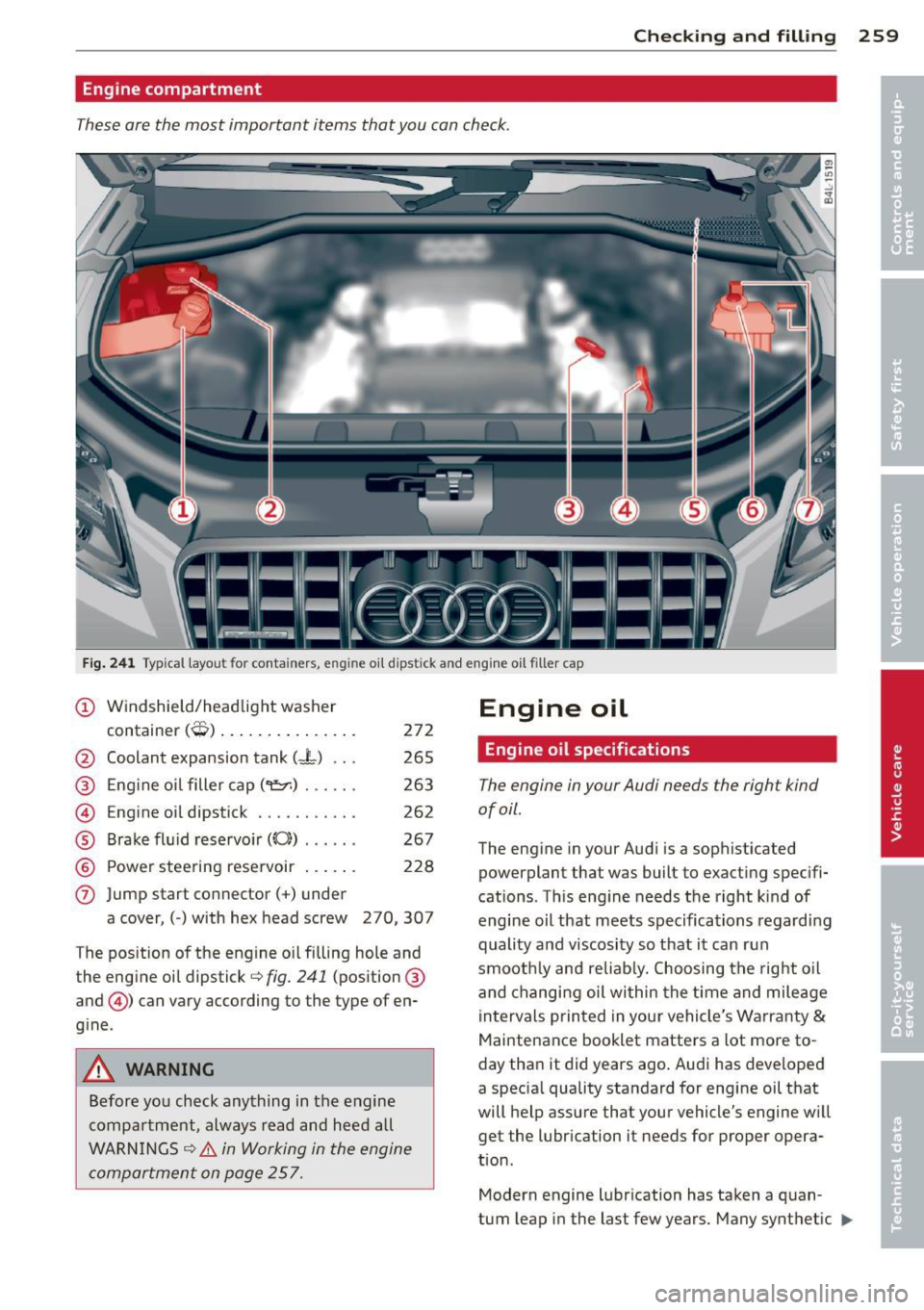
These are the most important items that you can check .
Fig. 2 41 Typ ical layout for conta iners, e ngin e oi l dipst ick and engine oi l fille r cap
(D Windshield/headlight washer
t .
(~) con ainer ,.,., ....... ... .. .. .
@ Coolant expansion tank (-L) .. .
®
@
®
®
(f)
Eng ine oi l filler cap ("1:::r.) ..... •
Engine oi l dipstick .. .... .... .
Brake fluid reservo ir
(0)) ..... .
Power stee ring reservoir ... .. .
Jump start connector(+) under 272
265
263
262
267
228
a cover, (-) with hex head screw 270, 307
The pos ition of the engine o il filling hole and
the eng ine oil dipstick¢
fig. 241 (position @
and @) can
vary according to the type of en
g ine.
A WARNING
Before you check anything in the engine
compartment, always read and heed all
WARN INGS ¢.&.
in Working in the engine
compartment on page 257.
Engine oil
Engine oil specifications
The engine in your Audi needs the right kind
of oil.
The engine in your Audi is a sophisticated
powerplant that was built to exacting spec ifi
cations . Th is eng ine needs the right k ind of
engine oil that meets specifications regardi ng
quality and viscosity so that it can run
smooth ly and reliab ly. Choosing the right o il
and changing oil within the time and mileage
intervals printed in your vehicle's Warranty
&
Maintenance booklet matters a lot more to
day than it did years ago . Audi has deve loped
a spec ia l quality standard for engine oil that
will help assure that your vehicle's engine w ill
get the lubrication it needs for proper opera
tion.
Modern engine lubrication has taken a quan
tum leap in the last few years. Many synthetic
IIJ>,
Page 264 of 340
262 Checking and filling
If you believe your engine uses too much oil,
we recommend that you consult your author
ized Audi dealer so that the cause of your con
cern can be properly diagnosed. Keep in m ind
that accurate measurement of oil consump
tion requires great care and may take some
time. Your Audi dealer has inst ruct ions for
how to measure oil consumption accurately .
_& WARNING
Stop! Before working in the engine com
pa rtment, always read and heed all WARN
INGS
9 .&. in Working in the engine com
partment on page 257.
The engine com
partme nt of any motor veh icle is a poten
tially dangerous area and can cause ser i
ous personal injury.
(D Note
- The eng ine depends on oi l to Lubricate
and cool a ll of its moving parts . The en
gine oil must be checked reg ularly and
kept at the required level.
- Make it a habit to have the engine oil Lev
el checked every time you fill the fuel
tank.
- Too little engine oi l may ca use severe en
gine damage.
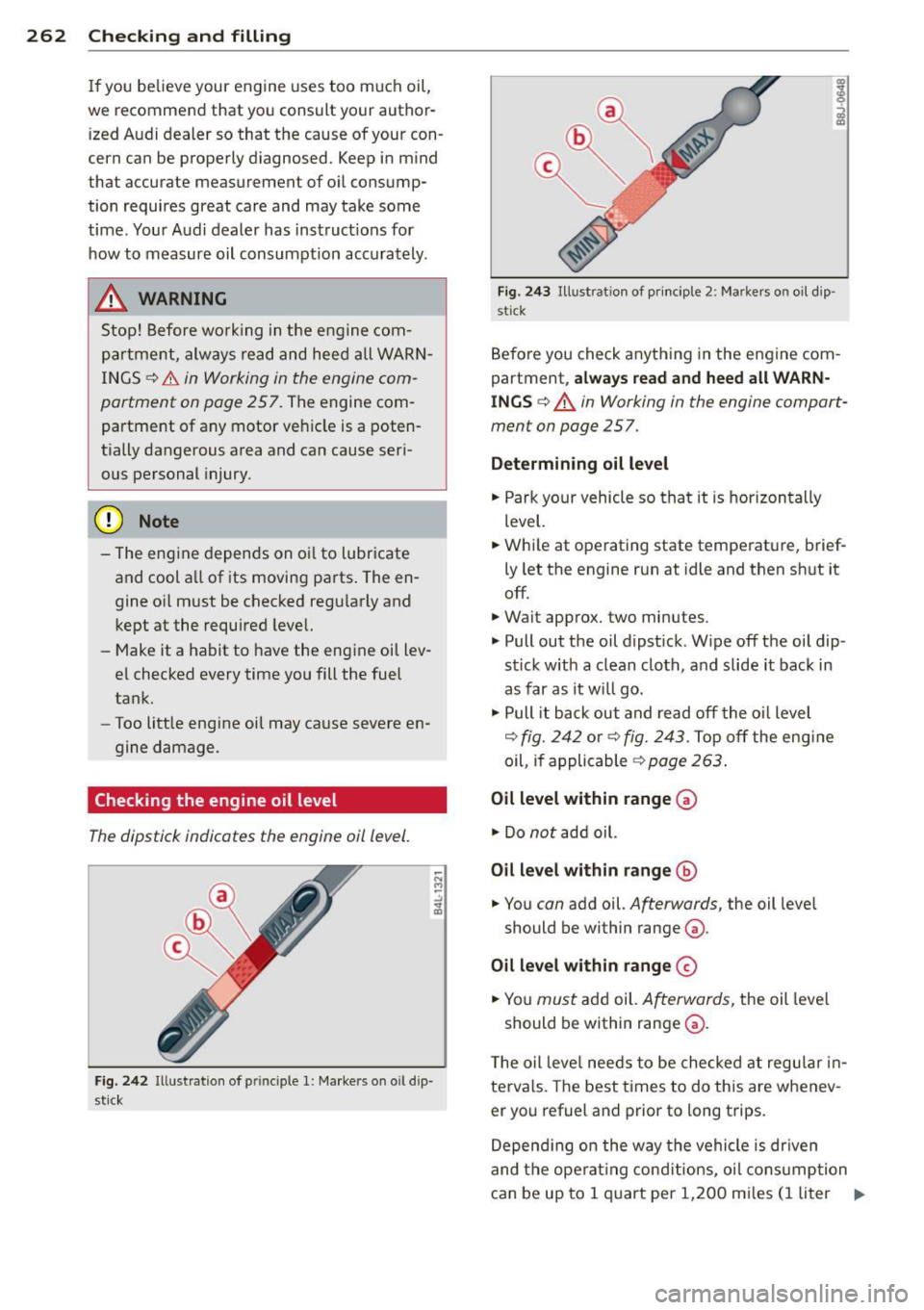
Checking the engine oil level
The dipstick indicates the engine oil level.
F ig. 2 42 Illustrat ion of p rincip le 1: Ma rkers o n oil dip·
st ick
Fig. 243 Illust ratio n of p rinciple 2: Ma rke rs on oil d ip ·
s ti ck
Befo re you check a nyth ing in the engine com
partment,
alway s read and heed all WARN
INGS 9 A in Working in the engine compart
ment on page 257 .
Determining oil level
.,. Park your vehicle so tha t it is horizontally
Level.
.,. Whi le at operating state temperature, br ief
ly let the engine run at idle and then shut it
off.
.,. Wait approx. two minutes .
.,. Pull out the oil d ipst ick . W ipe off the oil dip
st ick w ith a clean cloth, and slide it back in
as far as it wi ll go.
.,. Pull it back out and read off the o il Level
r=.> fig. 242 or 9 fig. 243. Top off the eng ine
oil, if applicable
9 page 263 .
Oil level within range@
.,. Do not add oil.
Oil le vel within r ange @
.,. You can add oil. Afterwards, the oil leve l
should be within range
G) .
Oil lev el within rang e 0
.,. Yo u must add oil. Afterwards, the oil leve l
should be within range
G) .
The oil leve l needs to be checked at regular in
terva ls. The best times to do this are whenev-
er you refuel and prior to Long trips .
Depend ing on the way the vehicle is dr iven
and the opera ting cond it ions, oi l cons umption
can be up to 1 quart per 1,200 mi les (1 liter ..,.