weight AUDI Q7 2014 Owner´s Manual
[x] Cancel search | Manufacturer: AUDI, Model Year: 2014, Model line: Q7, Model: AUDI Q7 2014Pages: 340, PDF Size: 85.02 MB
Page 172 of 340
1 7 0 Dr iving Safel y
Stowing luggage
Loading the luggage compartment
All luggage and other objects must be prop
erly stowed and secured in the luggage com
partment.
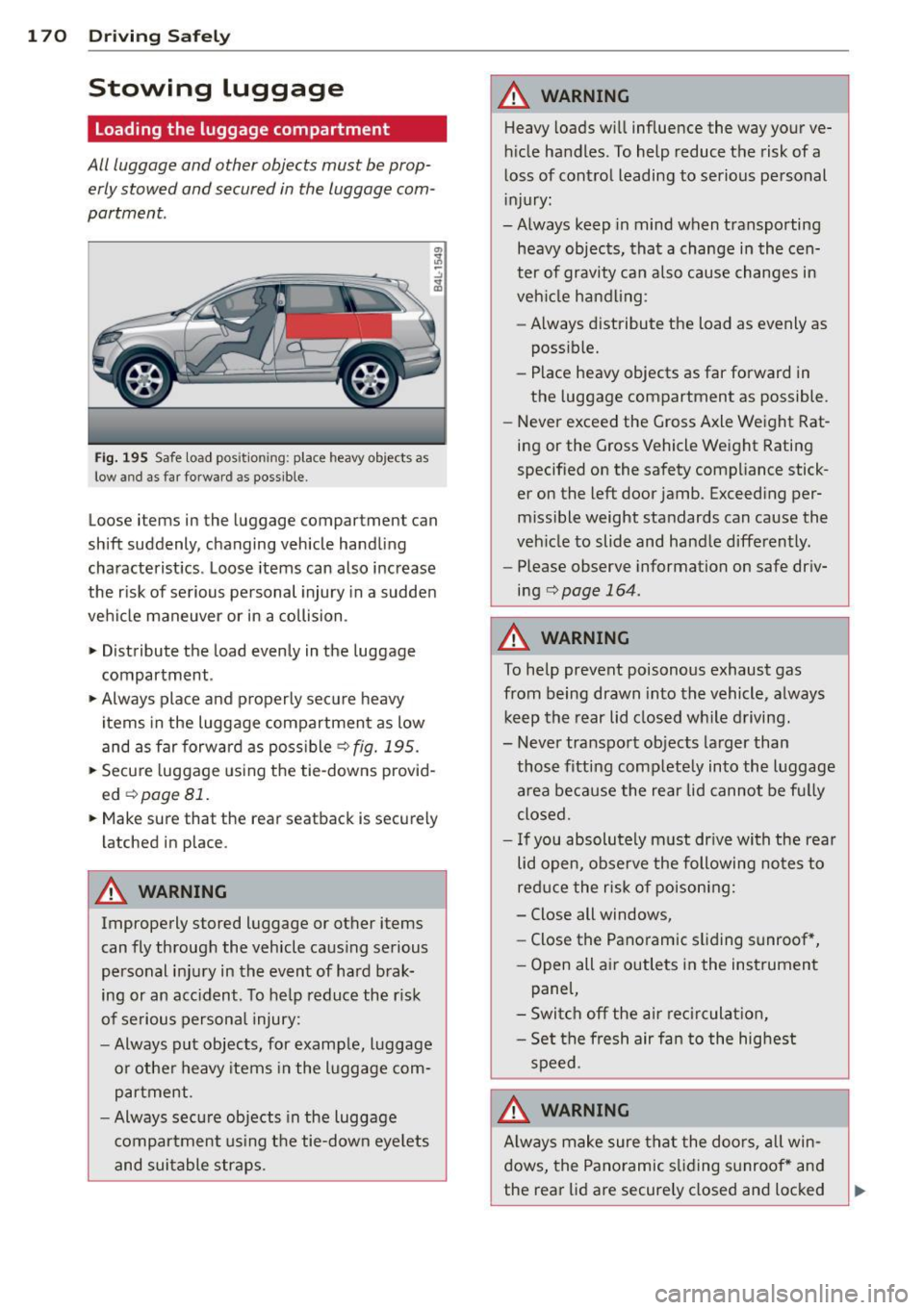
Fig . 195 Safe load position ing: place heavy objects as
low a nd as far forward as possible.
Loose items in the luggage compartment can
shift suddenly, changing vehicle handling
characteristics . Loose items can also increase
the r isk of serious personal injury in a sudden
vehicle maneuver or in a collision .
,. Distribute the load evenly in the luggage
compartment .
,. Always place and properly secure heavy
items in the luggage compartment as low
and as far forward as possible
¢fig. 195.
,. Secure luggage using the tie-downs provid
ed
¢ page Bl.
,. Make sure that the rear seatback is securely
l atched in place .
A WARNING
Improperly stored luggage or other items
can fly through the vehicle caus ing serious
personal inj ury in the event of hard brak
ing or an acc ident. To help reduce the r isk
of serious personal injury :
- Always put objects, for example, luggage
or other heavy items in the luggage com
partment.
- Always secu re objects in the luggage
compartment using the tie-down eyelets
and suitable straps.
A WARNING
-Heavy loads wi ll influence the way your ve-
hicle handles. To help reduce the risk of a
loss of control leading to serious personal
in jury:
-Always keep in mind when transporting
heavy objects, that a change in the cen
ter of gravity can also cause changes in
veh icle handling:
- Always distribute the load as evenly as
possible.
- Place heavy objects as far forward in
the luggage compartment as possible.
- Never exceed the Gross Axle Weight Rat
ing or the Gross Vehicle Weight Rating
specified on the safety compliance stick
er on the left door jamb. Exceeding per
missible weight standards can cause the
veh icle to slide and handle differently.
- Please observe information on safe driv
ing
r=;,page 164.
A WARNING
-
To help prevent poisonous exhaust gas
from being drawn into the vehicle, a lways
keep the rear lid closed while driving.
- Never transport objects larger than
those fitting comp letely into the luggage
area because the rear lid cannot be fully
closed.
- If you absolutely m ust dr ive with the rear
lid open, observe the following notes to
reduce the risk of poisoning:
- Close all windows,
- Close the Panoramic sliding sunroof *,
- Open all air outlets in the instrument
pane l,
- Switch off the air recirculat ion,
- Set the fresh air fan to the highest
speed.
A WARNING
A lways make sure that the doors, all win
dows, the Panoramic sliding sunroof * and
the rear lid are securely closed and locked
-
Page 173 of 340
to reduce the risk of inj ury when the vehi
cle is not be ing used.
- After closing the rear lid, always make
sure that it is properly closed and locked.
- Never leave your vehicle unattended es
pecially with the rear lid left open . A
child could crawl into the vehicle through
the luggage compartment and close the
rear lid becoming trapped and unable to
get out . Be ing trapped in a vehicle can
lead to serious persona l injury .
- Never let children play in or around the vehicle .
- Never let passengers r ide in the luggage
compartment . Veh icle occupants must
always be properly restrained in one of
the vehicle's seating positions.
(D Tips
- Air c irculation helps to reduce window
fogging . Sta le air escapes to the outside
th rough vents in the trim pane l. Be sure
to keep these slots free and open .
-The t ire pressure must correspond to the
load. The t ire pressure is shown on the
tire p ress ure label. The tire pressure la
bel is located on the d river's s ide B-pi llar.
The t ire pressure label lists the recom
mended cold tire inflat ion pressures for
the vehicle at its maximum capacity
weight and the tires that were on your
vehicle at the time it was manufactured .
For recommended t ire pressures for nor
mal load conditions, please see chapter
c:> page277 .
Tie-downs
The luggage compartment is equipped with
four tie-downs to secure luggage and other
items .
Use the tie-downs to secure your cargo prop
erly
c:> page 1 70, Loading the luggage com
partment.
In a coll is ion, the l aws of phys ics mean that
even smaller items that are loose in the vehi
cle will become heavy missiles that can cause
Dr iving S afel y 171
serious injury. Items in the veh icle possess en
ergy which vary with vehicle speed and th e
weight of the item . Vehicle speed is the most
s ignificant factor.
For example, in a fronta l collision at a speed
of 30 mph (48 km/h), the forces acting on a
10 -lb (5 kg) object are about 20 times the
normal weight of the item. This means th at
the weigh t of the item would suddenly be
about 200 lbs. (90 kg) . You can imagine the
i njur ies that a 200 lbs . (90 kg) item flying
freely th rough the passenger compartment
could cause in a co llision like this.
A WARNING
Weak, damaged or improper straps used
to secure items to tie-downs can fail dur
ing hard braking or in a collision and cause
serious personal injury.
-Always use s uitable mount ing straps and
properly secu re items to the tie-downs in
the l uggage compartment to he lp pre
vent items from shift ing or f lying fo r
ward as dangerous missiles.
- When the rear seat backrest is folded
down, a lways use suitable mounting
straps and properly secure items to the
tie-downs in the luggage compartment
to help p revent items from fly ing for
ward as dangerous missiles into the pas
senger compartment .
- Never attach a chi ld safety seat tether
strap to a t ie-down .
Reporting Safety
Defects
Applicable to U.S.A.
If yo u b elieve that your vehicle
ha s a defec t w hi ch could cau se
a c rash or co uld cause i njur y or
d ea th, you sh ould imm ediat ely
inform th e National Hi ghwa y
Tr affi c Sa fet y Admini strati on ..,.
•
•
Page 177 of 340
,&_ WARNING
-Sa fety belts are the sing le most effective
means availab le to reduce the risk of se
rious injury and death in automobile acci
dents. For your protection and that of
your passengers, always correctly wear safety belts when the vehicle is mov ing .
- Failure to pay attention to the warning
light that come on, could lead to person
al injury.
Why safety belts?
Frontal collisions and the law of physics
Frontal crashes create very strong forces for
people riding in vehicles.
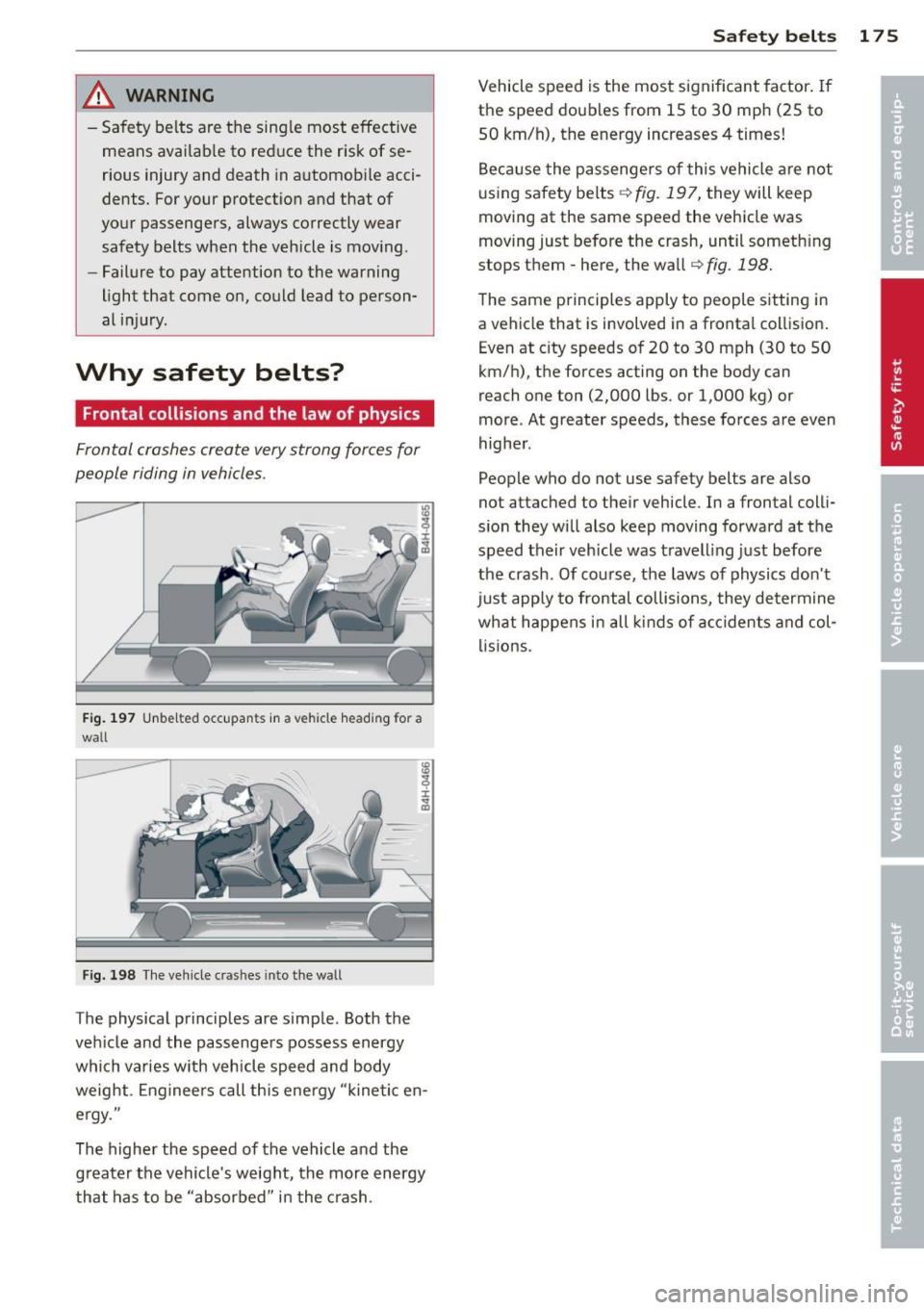
F ig . 197 Unbe lted occupants in a ve hicle heading for a
wall
Fig. 198 The vehicle cras hes into the wall
The physical principles are simple. Both the
veh icle and the passengers possess energy
which varies with vehicle speed and body weight . Engineers call this energy "kinetic en
e rgy."
The higher the speed of the vehicle and the
g reate r the vehicle's weight, the more energy
that has to be "absorbed" in the crash.
Safety belts 175
Vehicle speed is the most significant factor . If
the speed doub les from 15 to 30 mph (25 to
50 km/h), the energy increases 4 times!
Beca use the passenge rs of this vehicle are not
using safety belts¢
fig. 197, they will keep
moving at the same speed the vehicle was
moving just before the crash, until someth ing
stops them -here, the wall¢
fig. 198.
The same principles apply to people sitting in
a vehicle that is involved in a frontal collision.
Even at c ity speeds of 20 to 30 mph (30 to 50
km/h), the forces acting on the body can
reach one ton (2,000 lbs. or 1,000 kg) or
more . At greater speeds, these fo rces are even
higher.
Peop le who do not use safety belts are also
not attached to their vehicle . In a frontal colli
s ion they will also keep moving forward at the
speed their vehicle was travelling just before
the crash . Of co urse, the laws of physics don't
just app ly to frontal collisions, they determine
what happens in all kinds of acc idents and col
lisions.
Page 187 of 340
Child restraints on the front seat - some
important things to know
.. Be sure to read the important informat ion
and heed the WARNINGS for important de
tai ls about chi ldren and Advanced Airbags
c> page 204.
Even though your vehicle is equipped with an
Advanced Airbag System, make certain that
a ll chi ldren, especially those 12 years and
younger, a lways ride in the back seat properly
restra ined for their age and size. The airbag
on the passenger side makes the front seat a potentially dangerous place for a child to r ide .
The front seat is not the safest place fo r a
chi ld in a fo rward-facing chi ld safety seat. It
can be a very dangerous place for an infan t or
a child in a rea rward -facing seat.
The Advanced Airbag System i n your veh icle
h as been cert ified to comp ly with the require
men ts of Uni ted States Federa l Mo to r Veh icle
Safety Standard 208 as applicable at the time
your ve hicle was manufactured.
The Standard requires the fron t air bag on the
passenger side to be turne d off ("sup
p ressed") if a chi ld up to about one year of
age restrained in one of the rear -facing or for
ward -facing infant restraints listed i n Federal
Motor Vehicle Safety Standard 208 with wh ich
the Advanced Airbag System in your vehicle
was certified has been installed o n the front
passenger seat. For a listing of the child re
straints that we re used to certify compliance
with the US Safety Sta ndard
c> page 206.
The PASS ENGER AIR BAG OFF light in the in
strument panel te lls you when the front Ad
vanced A irbag on the passenger side has been
turned off by the e lectronic control u nit.
Each t ime you tur n on the ignition, the
PAS
SENGER AIR BAG OFF
l ight w ill come on for a
few seconds a nd:
- will stay on if the front passenger seat is not
occup ied
- will stay on if there is a small child or child
restraint on the front passenger seat
A irbag sys tem 185
- will go off if the front passenger seat is oc
cupied by an adult as registered by the
weight -sensing mat
c> page 194, Monitor
ing the Advanced Airbag System.
T he PASSENGER AIR BAG OFF light comes on
whe n the contro l unit detects a tota l weight
on the front passenger seat that req uires the
front a irbag to be turned off.
If the total weight on the front passenge r
seat is more than that of a typical 1 year-o ld
c h ild but less than the weight of a small
adult, the front airbag on the passenger side
can deploy (the
PASSENGER AIR BAG OFF
li ght does not come on). If the PASSENGER
AIR BAG OFF
light does not come on, the
front a irbag on t he passeng er side has not
been turned off by the elec troni c con trol unit
and can deploy if the control unit senses an
impact that meets the cond it ions stored i n its
memory .
For example, th e airb ag may deploy if :
-a small ch ild that is heav ie r than a typical 1
year-old ch ild is o n the front passenger seat
(regard less of whether the child is in one of
the ch ild safety seats listed
c> page 206), or
- a child who has outgrown chi ld restraints is
on the front passenge r seat.
If the front passenger airbag is turned off, the
PASSENGER AIR BAG OFF light comes on in
the instr ument cluster and stays on .
The front airbag on the passenger side may
not deploy (the PASSENGER AIR BAG OFF
l ight does not illum inate and stay lit) even if a
small ad ult o r teenager, or a passenger who is
not sitti ng uprig ht w ith their back against a
non -recli ned back rest w it h thei r feet on t he
vehicle floor i n front of the sea t is on t he front
passenger seat
c> page 165, Proper seating
position for the driver.
If the fron t passenger ai rbag dep loy s, the
Feder al Standard req uires the airbag to meet
the "low risk" dep loyment criteria to reduce
the ris k of injury t hro ugh interact ion w ith the
airbag. "Low risk" dep loyment occ urs in those
crashes that take place at lower dece lerat ions ..,_ •
•
Page 189 of 340
prevent them from providing any
protection.
- An improperly installed child restraint
can interfere with the airbag as it de
ploys and seriously injure or even kill the
child -even with an Advanced Airbag
System.
- Always carefully follow the manufactur
er's instructions provided with the child
safety seat or carrier.
- Never place additional items on the seat
that can increase the total weight regis
tered by the weight-sensing mat and can cause injury in a crash.
Front airbags
Description of front airbags
The airbag system can provide supplemental
protection to properly restrained front seat
occupants.
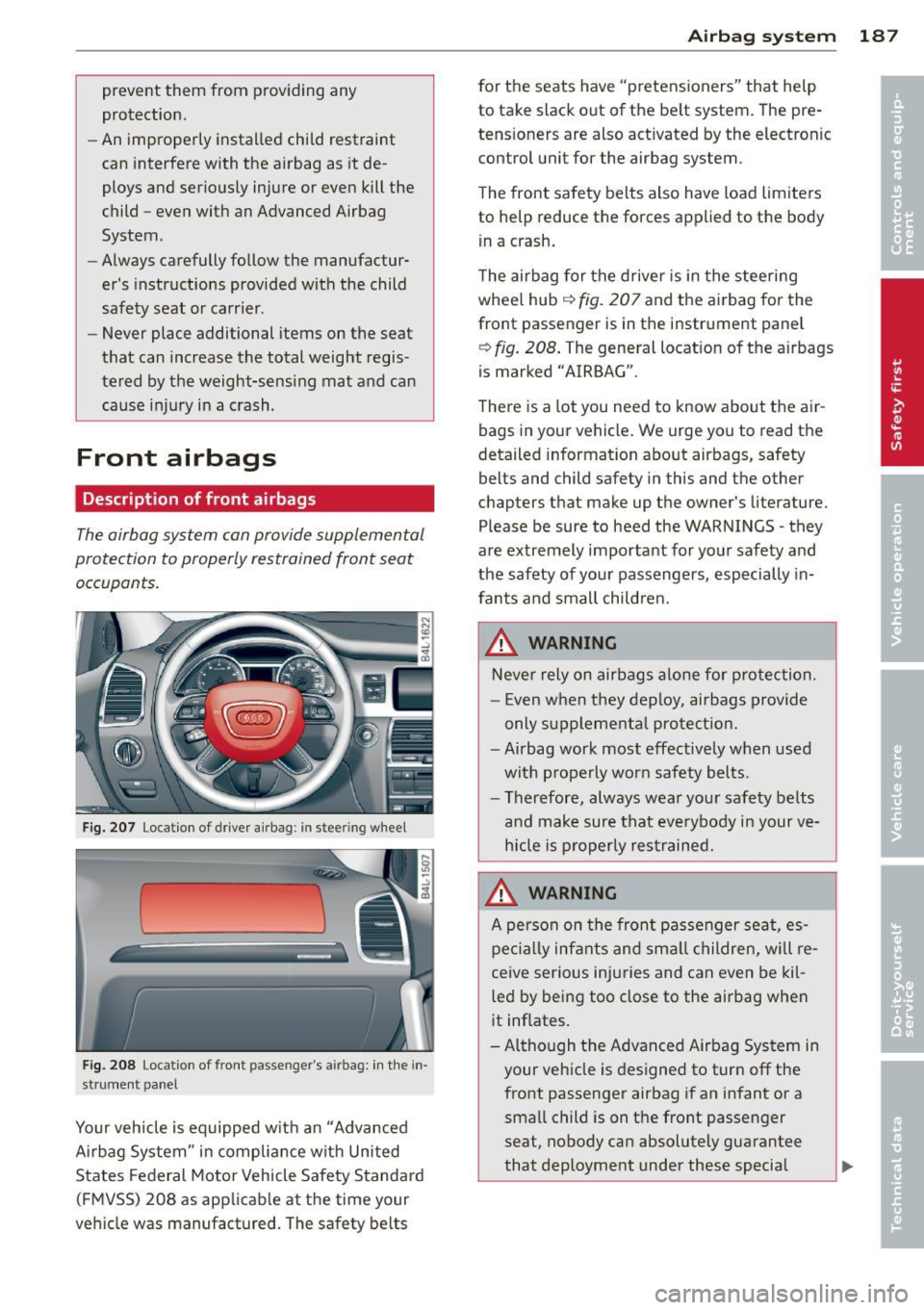
Fig. 207 Location of driver ai rb ag : in stee ring whee l
Fig. 208 Location of front passenger 's a irbag: in the in
strume nt panel
Your vehicle is equipped with an "Advanced
Airbag System " in compliance with United
States Federal Motor Vehicle Safety Standard
(FMVSS) 208 as applicable at the time your
ve hicle was manufactured. The safety belts
Airbag system 187
for the seats have "pret ens ioners " that help
to take slack out of the belt system. The pre
tensioners are also activated by the electronic
control unit for the airbag system.
Th e front safety belts also have load limiters
to help reduce the forces applied to the body
in a crash .
Th e airbag for the driver is in the steering
wheel hub
q fig. 207 and the airbag for the
front passenger is in the instrument panel
~ fig. 208. The general location of the airbags
is marked "AIRBAG" .
There is a lot you need to know about the air
bags in your vehicle. We urge you to read the
detailed information about airbags, safety
belts and child safety in this and the other
chapters that make up the owner's literature.
Please be sure to heed the WARNINGS -they
are extremely important for your safety and
the safety of your passengers, especially in
fants and small children.
_&. WARNING
Never rely on airbags alone for protection.
- Even when they deploy, airbags provide
only supplemental protection.
-Airbag work most effectively when used
with properly worn safety belts.
- Therefore, always wear your safety belts
and make sure that everybody in your ve
hicle is properly restrained.
_&. WARNING
A person on the front passenger seat, es
pecially infants and small children, will re
ceive serious injuries and can even be kil
led by being too close to the airbag when
it inflates.
- Although the Advanced Airbag System in
your vehicle is designed to turn off the
front passenger airbag if an infant or a
small child is on the front passenger
seat, nobody can absolutely guarantee
that deployment under these special
11>-
Page 190 of 340
188 Airbag system
conditions is impossible in all conceiva
ble situations that may happen during
the useful life of your vehicle.
- The Advanced Airbag System can deploy
in accordance with the "low risk" option
under the U.S. Federal Standard if a child
that is heavier than the typical one-year
old child is on the front passenger seat
and the other conditions for airbag de
ployment are met.
-Accident statistics have shown that chil
dren are generally safer in the rear seat
area than in the front seating position.
- For their own safety, all children, espe
cially 12 years and younger, should al
ways ride in the back properly restrained
for their age and size.
Advanced front airbag system
Your vehicle is equipped with a front Advanced
Airbag System in compliance with United
States Federal Motor Vehicle Safety Standard
208 as applicable at the time your vehicle was
manufactured.
The front Advanced Airbag System supple ments the safety belts to provide additional
protection for the driver's and front passeng
er's heads and upper bodies in frontal crashes .
The airbags inflate only in frontal impacts
when the vehicle deceleration is high enough.
The front Advanced Airbag System for the
front seat occupants is not a substitute for
your safety belts. Rather, it is part of the over
all occupant restraint system in your vehicle.
Always remember that the airbag system can
only help to protect you, if you are sitting up
right , wearing your safety belt and wearing it
properly. This is why you and your passengers
must always be properly restrained, not just
because the law requires you to be.
The Advanced Airbag System in your vehicle has been certified to meet the "low risk" re
quirements for 3 and 6 year-old children on
the passenger side and very small adults on
the driver side. The low risk deployment crite
ria are intended to help reduce the risk of in- jury through interaction with the front airbag
that can occur, for example, by being too close to the steering wheel and instrument
panel when the airbag inflates.
In addition, the system has been certified to
comply with the "suppression" requirements
of the Safety Standard, to turn off the front
airbag for infants 12 months old and younger
who are restrained on the front passenger
seat in child restraints that are listed in the Standard
~ page 206, Child restraints and
Advanced Airbags .
"Suppression" requires the front airbag on the
passenger side to be turned off if:
- a child up to about one year of age is re
strained on the front passenger seat in one
of the rear-facing or forward-facing infant
restraints listed in Federal Motor Vehicle
Safety Standard 208 with which the Ad
vanced Airbag System in your vehicle was
certified. For a listing of the child restraints
that were used to certify your vehicle's com
pliance with the US Safety Standard
~page 206,
-weight less than a threshold level stored in
the control unit is detected on the front pas
senger seat.
When a person is detected on the front pas senger seat, weighing more than the total
weight of a child that is about 1 year old re
strained in one of the rear-facing or forward
facing infant restraints (listed in Federal Mo
tor Vehicle Safety Standard 208 with which
the Advanced Airbag System in your vehicle
was certified), the front airbag on the passen ger side may or may not deploy.
The
PASSENGER AIR BAG OFF light comes on
when the electronic control unit detects a to
tal weight on the front passenger seat that re quires the front airbag to be turned off. If the
PASSENGER AIR BAG OFF light does not
come on, the front airbag on the passenger
side has not been turned off by the control
unit and can deploy if the control unit senses
an impact that meets the conditions stored in
its memory.
ll-
Page 191 of 340
If the total weight on the front passenger
seat is more than that of a typical 1 year -old,
but less than the weight of a small adult, the
front airbag on the passenger side may deploy (the
P ASS ENGER AIR B AG OFF light does not
come on).
For example, th e airbag may depl oy if:
-a small child that is heavier than a typical 1
year-o ld child is on the front passenger seat
(regardless of whether the child is in one of
the chi ld safety seats listed
<=) page 206),
-a chi ld who has outgrown child restraints is
on the front passenger seat.
I f the front passenger airbag is turned
off, the
PA SSENGER AIR B AG OFF light in the center
of the instrument panel wi ll come on and stay
on.
The front a irbag on the passenger side may
not deploy (the PA SSENG ER AIR BAG O FF
light does not ill uminate and stay lit) if:
- a small adu lt or teenager is on the front pas
senger seat
- a passenger who is not sitt ing upright w ith
their back against a non-reclined backrest
with their feet on the vehicle floo r in front
of the seat is on the front passenge r seat .
If the front passenger airbag deploys, the
Federal Standard requires the a irbag to meet
the " low risk" deployment cr iteria to help re
duce the risk of inju ry through interaction
with the airbag. "Low risk" deployment occurs in those crashes that take place at lower de
celerations as defined in the electronic control
un it.
<=) page 194
Al ways rememb er: Even tho ugh your vehicle
is equipped with Advanced Airbags, the safest
p lace for children is properly restrained on the
back seat. Please be sure to read the impor
tant information in the sect ions that follow
and be sure to heed all of the WARNINGS.
A WARNING
To reduce the risk of injury when an airbag inflates, a lways wear safety belts prope rly.
A irbag system 189
-If you are unrestrained, leaning forward,
sitt ing s ideways or out of pos ition in any
way, your risk of injury is much higher.
- You will a lso receive serious injuries and
could even be killed if you are up aga inst
the airbag or too close to it when it in
flates -even w ith an Advanced A irbag
<=)page 183 .
A WARNING
-
A child in a rearward-fac ing ch ild safety
seat installed on the front passenger seat
will be ser ious ly injured and can be killed if
the front airbag inflates -even with an Ad
vanced A irbag System.
- Al tho ugh the Advanced Airbag System in
your veh icle is designed to turn
off the
front airbag when a rearward -facing
child restraint has been insta lled on the
front passenger seat, nobody can abso
lutely guarantee that dep loyment is im
possible in all conceivable s ituations that
may happen dur ing the usefu l life of your
veh icle.
- The inflating airbag will h it the ch ild
safety seat or infant carrier with great
force and will smash the child safety seat
and child against the bac krest, center
armrest, doo r, or roof.
- Always install rearward-facing chi ld re
straints on the rear seat.
- If you must install a rearwa rd fac ing
child safety seat on the fro nt passenger
seat because of exceptiona l circumstan
ces and the
PASSENGER AIR BAG OFF
light does not come on and s tay on, im
mediately insta ll the rear-facing ch ild
safety seat in a rear seating position and
have the airbag system inspected by your
author ized Audi dealer.
A WARNING
If, in except iona l circumstances, you must
install a forward-facing child restraint on
the front passenger's seat:
~
•
•
Page 192 of 340
190 Airbag sys tem
-Always make sure the forward-facing
seat has been des igned and certified by
its manufacturer for use on a front seat
with a passenger front and side airbag .
- Never put the forward-facing child re
straint up aga inst or very near the instru
ment panel.
- Always move the passenger seat into its
rearmost position in the seat's fore and
aft adjustment range, as far away from
the a irbag as poss ible, before insta lli ng
the fo rward-facing chi ld restraint. The
b ackres t must be adjus ted to an upr igh t
posit io n.
- Make su re that the
PASSENGER AIR BAG
OFF
light co m es on and s tays on all the
t ime whenever the ignition is switched
on.
Advanced Airbag System components
The front passenger seat in your vehicle has a lot of very important parts of the Advanced
Airbag System in it. These parts include the
weight-sens ing mat, sensors, wiring, brack
ets, and more . The fu nction of the system in
the front passenger seat is checked by the
e lectronic control u nit when the ignit ion is on.
The control unit mo nitors the Advanced Air
bag Sys tem and turns the airbag indicator
light on when a ma lfunction in the system
components is detected . The function of the
ai rbag ind icator light is described in greater
detai l below. Because the front passenger
seat contains important parts of the Ad
vanced A irbag System, you must take care to
prevent it from be ing damaged . Damage to
the seat may prevent the Advanced A irbag for
the front passenger seat from doing its job in
a cra sh .
The front Advanced Airbag System
consists of the following:
- Crash senso rs in the front of the veh icle that
measu re ve hicle ac celera tion/de ce le ra ti on
to provide info rm ation to the Advanced Air
bag System abo ut the severity of the crash . -
An elect ronic contro l unit, with integrated
crash sensors for front and side impacts .
The control un it "decides" whether to fi re
the front a irbags based on the informat ion
received from the crash sensors. The contro l
un it also "decides" whether the safety belt
prete nsioners shou ld be act ivated .
- An Advanced A irbag w ith gas generator for
the dr iver inside the stee ring wheel hub .
- An Advanced A irbag w ith gas generator in
side the instrument panel for the front pas
senge r.
- A we ight-sensing mat under the up ho lstery
padding of the front passenger seat cushion
that measures the total weight on the seat .
The informat io n registe red is sent continu
ou sly to the elec troni c con tro l unit to regu
la te deployment of the front Advanced Air
bag on the passenger side .
- An airbag monitoring sys tem and in dicator
light in t he instr ument cluster
~ page 194.
-The PASSENGER AIR BAG OFF ligh t comes
on and sta ys on in the cen ter o f th e instr u
ment panel
~ page 194, fig . 210 and tells
you whe n the front Advanced Airbag on the
passenger side has been tu rned off .
- A sensor below the safety be lt latch for the
front seat passenger to meas ure the tension
on the safety be lt . The tension on the safety
be lt and the weight registered by the
weight-sensing mat he lp the control unit
"decide" whether the front airbag for the
front passenger seat should be turned off or
not
~ pag e 185, Child restraints on th e
front seat -some important things to
know.
- A senso r in the safety belt latch fo r th e d riv
er a nd fo r the front sea t passenger tha t
senses w het he r th at safety bel t is latched or
no t and transmi ts this information to the
electronic control unit.
A WARNING
Damage to the fr ont passenger seat can
p revent the front airbag from work ing
properly.
-
Page 193 of 340
-Improper repair or disassembly of the
front passenger and driver seat will pre
vent the Advanced Airbag System from
functioning properly .
- Repairs to the front passenger seat must
be performed by qualified and properly
trained workshop personnel.
- Never remove the front passenger or
dr iver seat from the veh icle .
- Never remove the upholstery from the
front passenger seat .
- Never disassemble or remove parts from
the seat or disconnect wires from it.
- Never carry sharp objects in your pockets
or place them on the seat. If the weight
sensing mat in the passenger seat is
punctured it cannot work properly.
- Never carry things on your lap or carry
objects on the passenger seat . Such
items can increase the weight registered
by the weight-sens ing mat and send the
wrong info rmation to the airbag control
uni t.
- Never store items under the front pas
senger seat. Parts of the Advanced Ai r
bag System under the passenge r seat
cou ld be damaged, prevent ing them and
the a irbag system from working proper
ly .
- Never place seat covers or replacement
upholste ry that have not been specifical
ly approved by A udi on the front seats.
- Seat covers can prevent the A dvanced
Airbag System from recognizing child re
straints or occupants on the front pas
senger seat and prevent the side airbag in the seat backrest from deploy ing prop
erly.
- Never use cush ions, pillows, blankets or
similar items on the front passenger
seat . The add itiona l padd ing will prevent
the weight-sens ing mat in the seat from
accu rately reg iste ring the ch ild restra int
o r person on the se at and prevent the
Advance d Airbag System from func tion
ing properly .
-If you mus t use a child restra int on the
front passenger seat and the ch ild re-
A irbag system 19 1
straint manufacture r's instructions re
quire the use of a towel, foam cushion or
something e lse to properly position the
child restraint, make certain that the
PASSENGER AIR BAG OFF light comes
on and stays on whenever the ch ild re
s t raint is installed on the front passen
ge r seat.
- If the
PASSENGER AIR BAG OFF light
does not come on and stay on, immed i
a tely insta ll child rest raint in a rear seat
ing position and have the ai rbag system
inspected by your authorized Audi dealer .
How the Advanced Airbag System
components work together
The front Advanced Airbag System and the
s ide airbags supp lement the protection of
fered by the front three-poi nt safety belts
with pretensioners and load limiters and the
adjustable head res traints to help reduce the
r isk of inj ury in a wide range of ac ciden t and
c rash situations. Be s ure to read the impor
tant information about safety and heed the
WARNINGS in this chapter.
Deployment of the Adv a need A irbag System
and t he activation of the safe ty belt preten
sioners depend on the deceleration measured
by the crash sensors and registered by the
electronic contro l unit. Crash severity depends
on speed and dece leration as we ll as the mass
and stiffness of the veh icle or object involved
in the crash .
When the e lectronic control unit registers a
l ow severity crash and the safety belt is being
used, the airbag will not deploy. If the safety
belt is not being used, the first stage deploys,
followed by the second stage after a much lat er t ime in the crash sequence.
If the electron ic control unit registers a crash
of medium severity , the first stage of the air
bag deploys followed by the second stage at a
much later time in the crash sequence -re
gard less of whether the safety belt is be ing
u sed or not . In highe r sever ity crashes as reg
iste red by the electronic con trol unit, both the
II>
•
•
Page 194 of 340
192 Airbag system
firs t a nd second stages deploy a lmost at the
same time.
O n the passenger side, regard less of safety
be lt use, the airbag will be turned off if the
weight on the passenger seat is less than the
amount programmed in the electronic control
un it. The front a irbag on the passenger side
will also be turned off if one of the child safe
ty seats that has been certified under Federal
Motor Vehicle Safety Standard 208 has been
recogn ized on the seat. The
PAS SENGER AIR
BAG OFF
light comes on and stays on to te ll
you when the front Advanced Airbag on the passenger side has been t urned off
c::> page 185, Child restraints on the front seat
- some important things to know .
~ WARNING
To reduce the risk of injury when an airbag
inf lates, always wear safety belts properly.
- If you are unrestrained, lean ing forward,
sitting sideways or out of position in any
way, your risk of inj ury is much higher.
- You wi ll also receive serious inju ries and
cou ld even be killed if you are up against
the airbag or too close to it when it in
flates - even with an Advanced Airbag
o page 183.
More important things to know about
front airbags
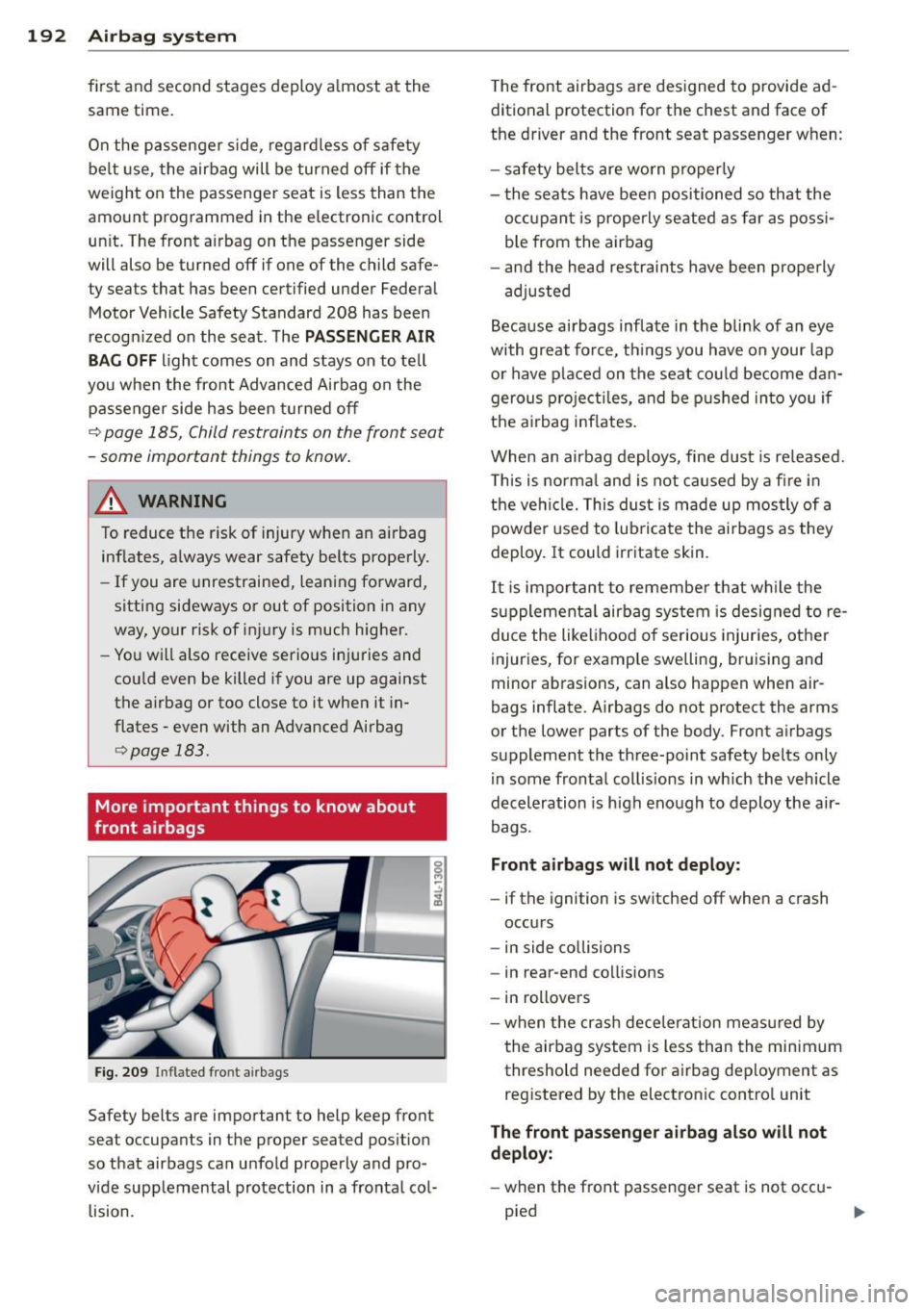
Fig. 2 09 Inflated front a irbags
Safety belts are important to help keep front
seat occupants in the proper seated pos ition
so that airbags can unfo ld properly and pro
vide supplemental protection in a frontal col lision. T
he front airbags are designed to provide ad
ditional protection for the chest and face of
the driver and the front seat passenger when:
- safety belts are worn properly
- t he seats have bee n positioned so that the
occ upan t is prope rly seated as far as poss i
b le from the airbag
- and the head restraints have been properly
ad justed
Because airbags inflate in the bli nk of an eye
with great force, th ings you have on your lap
o r have placed on the seat co uld become dan
gerous p ro jecti les, and be p ushed in to you if
the a irbag inflates.
When an airbag deploys, fine dust is re leased.
T h is is no rma l and is not caused by a fire i n
the ve hicle. This dust is made up mos tly of a
powde r used to lubricate the airbags as they
deploy.
It could irr itate skin.
It i s impo rtant to remember that wh ile the
s u pplementa l airbag system is designed to re
duce the like lihood o f serious injur ies, other
injuries , for examp le swelling, bruising and
minor ab rasions, can also happen when air
bags inflate . A irbags do not protect the arms
or the lower parts of the body. Front a irbags
supplement the three-point safety belts only i n some fronta l col lisions in wh ich the vehicle
deceleration is h igh eno ugh to deploy the air
bags.
Front airbags will not deploy:
- if the ignition is sw itched off when a crash
occurs
- in side co llisions
- in rear-end co llisions
- in rollove rs
- when the crash dece lerat ion meas ured by
the air bag system is less than the min imum
threshold needed for airbag deployment as
reg istered by the elect ronic contro l unit
The front pass enger airbag also w ill not
deploy:
- when the front passenger seat is not occu-
pied .,.