air condition AUDI Q7 2014 Owner´s Manual
[x] Cancel search | Manufacturer: AUDI, Model Year: 2014, Model line: Q7, Model: AUDI Q7 2014Pages: 340, PDF Size: 85.02 MB
Page 195 of 340
-when the weight on the front passenger
seat as sensed by the Advanced Airbag Sys
tem indicates that the front airbag on the
passenger side has to be turned off by the
electronic control unit (the
PASSENGER AIR
BAG OFF
light comes on and stays on)
A WARNING
Sitting in the wrong position can increase
the risk of serious injury in crashes.
- To reduce the risk of injury when the air
bags inflate, the driver and passengers
must always sit in an upright position,
must not lean against or place any part
of their body too close to the area where
the airbags are located.
- Occupants who are unbelted, out of posi
tion or too close to the airbag can be se
riously injured by an airbag as it unfolds
with great force in the blink of an eye
c> page 185.
A WARNING -
A child in a rearward-facing child safety
seat installed on the front passenger seat
will be seriously injured and can be killed if
the front airbag inflates -even with an Ad
vanced Airbag System.
- The inflating airbag will hit the child
safety seat or infant carrier with great
force and will smash the child safety seat
and child against the backrest, center
armrest, door or roof.
- Always install rear-facing child safety
seats on the rear seat.
- If you must install a rearward-facing
child safety seat on the front passenger
seat because of exceptional circumstan
ces and the
PASSENGER AIR BAG OFF
light does not come on and stay on, im
mediately install the rear-facing child
safety seat in a rear seating position and
have the airbag system inspected by your
authorized Audi dealer .
Airbag system 193
A WARNING
Objects between you and the airbag will
increase the risk of injury in a crash by in
terfering with the way the airbag unfolds
or by being pushed into you as the airbag inflates .
- Never hold things in your hands or on
your lap when the vehicle is in use.
- Never transport items on or in the area
of the front passenger seat . Objects
could move into the area of the front air
bags during braking or other sudden ma
neuvers and become dangerous projec
tiles that can cause serious personal in
jury if the airbags inflate.
- Never place or attach accessories or oth
er objects (such as cupholders, tele
phone brackets, large, heavy or bulky ob
jects) on the doors, over or near the area marked "AIRBAG" on the steering wheel,
instrument panel, seat backrests or be
tween those areas and yourself . These
objects could cause injury in a crash, es
pecially when the airbags inflate.
- Never recline the front passenger's seat
to transport objects. Items can also
move into the area of the side airbag or
the front airbag during braking or in a sudden maneuver. Objects near the air
bags can become projectiles and cause
injury, particularly when the seat is re
clined.
- Never tilt the front passenger seat back
rest forward when the vehicle is moving.
An inflating airbag will force the back
rest backward and can injure rear seat oc
cupants.
A WARNING
The fine dust created when airbags deploy
can cause breathing problems for people
with a history of asthma or other breath ing conditions.
-
- To reduce the risk of breathing problems,
those with asthma or other respiratory
.___ c_ o_ n_ d_ it_ i_o _ ns_ sh_o_ u_ l_ d _:g:_ e_ t _f_re _s_ h_ a_ i_r _ri ..:::g :....h _t __
_J ~
•
•
Page 197 of 340
-a rearward-facing child restraint has been
installed on the front passenger seat, or
- a forward -facing child restraint has been in
stalled on the front passenger seat, or
- the weight registered on the front passen
ger seat is equa l to or less than the com
bined weight of a typical 1 year-old restrain
ed in one of the rear-facing or forward-fac
ing infant restraints listed in Federal Motor
Vehicle Safety Standard 208 w ith which the
Advanced Airbag System in your vehicle was
certified .
If the front passenger seat is not occupied,
the front airbag will not deploy, and the
PAS ·
SENGER AIR BAG OFF
light will stay on. Nev
er install a rearward-facing child restra int on
the front passenger seat, the safest place for
a child in any kind of child restraint is at one
of the seating positions on the rear seat
¢ page 185, Child restraints on the front seat
- some important things to know
and
¢ page 204, Child Safety.
If the PASSENGER AIR BAG OFF light comes
on
when one of the conditions listed above is
met, be sure to check the light regularly to
make certain that the
PASSENGER AIR BAG
OFF
li ght stays on continuous ly whenever the
ignition is on. If the
PASSENGER AIR BAG
OFF
light does not appear on and does not
stay on all the time, stop as soon as it is safe
to do so and
- reactivate the system by turning the ignition
off and then turning it on again;
- remove and reinstall the chi ld restraint .
Make sure that the child restraint is properly
installed and that the safety be lt for the
front passenger seat has been correctly
routed through the child restraint as descri
bed in the chi ld restraint manufacturer's in
st ructio ns;
- make sure that the convert ible locking fea
ture on the safety belt for the front passen
ger seat has been activated and that the
sa fety belt has been pulled tight. The belt
must not be loose or have loops of slack so
that the sensor below the safety belt latch
on the seat can do its job
¢ page 214.
Airbag system 195
-make sure that things that may increase the
weight of the child and chi ld safety seat are
not being transported on the front passen
ger seat;
- make s ure that the safety belt tension sen
sor is not blocked. Shake the safety belt
latch on the front passenger seatback and
forth;
- If a strap or tether is be ing used to tie the
child safety seat to the front passenger
seat, make sure that it is not so tight that it
causes the weight-sensing mat to measure
more weight than is actually on the seat.
If the PASSENGER AIR BAG OFF light still
does not come on
and does not stay on con
t inu ously (when the ignition is switched on),
- take the child restraint off the front passen-
ger seat and install it proper ly at one of the
rear seat positions . Have the airbag system
inspected by you r authorized Aud i dealer
immed iate ly.
- move the ch ild to a rear seat position and
make sure that the child is properly restra in
ed in a child restraint that is appropriate for
its size and age.
The
PASSENGER AIR BAG OFF light should
NOT come on when the ignition is on and an
adult is s itting in a proper seating position on
the front passenger seat. If the
PASSENGER
AIR BAG OFF
light comes on and stays on or
flashes for about 5 seconds wh ile driving, un
der these circumstances, make sure that:
- the adult on the front passenger seat is
properly seated on the cente r of the seat
cushion with his or her back up against the
backrest and the backrest is not reclined
¢ page 165, Proper occupant seating posi
tions,
- the adult is not taking weight off the seat by
holding on to the passenger assist handle
above the front passenger door or support
ing their weight on the armrest,
- the safety be lt is being properly worn and
that there is not a lot of slack in the safety
be lt webb ing, .,..
•
•
Page 206 of 340
204 Child Saf ety
Child Safety
Important things to
know
Introduction
The rear seat is generally the safest place in a
collision.
The physical principles of what happens when
your ve hicle is in a crash app ly also to chi ldren
~ page 176, What happens to occupants not
wearing safety belts?.
But unlike adu lts and
teenagers, their muscles and bones are not
fu lly deve loped . In many respects chi ldren are
at greater risk of serious injury in crashes than
ad ults.
Because children's bod ies are not fully deve l
oped, they require restraint systems especial
l y designed for their size, weight, and body
structure. Many co untries and all states of the
United States and provinces of Canada have
laws requ iring the use of approved ch ild re
straint systems for infants and small ch ildren.
In a fronta l crash at a speed of 20 -35 mph
(30-56 km/h) the forces acting on a 13-po und
(6 kg) infant w ill be more than 20 t imes the
weight of the child. This means the weight of
the child would suddenly be more t han
260 pounds ( 120 kg). Unde r these conditions,
only an appropria te ch ild restrai nt properly
used c an reduce the risk of ser ious inju ry.
Chi ld restra ints, like adult safety belts, mus t
be used properly to be effective . Used improp
e rly, they can increase the risk of serious in
jury in an acc ident.
Consul t the child safety seat manufactu re r's
instr uctions in order to be sure the seat is
right fo r you r ch ild's size ~
page 207, Impor
tant safety instructions for using child safety
seats.
Please be sure to read and heed all of
the important informat ion and WARNINGS
about ch ild safety, Advanced A irbags, and the
i nstallation of child r estraints in this chapter .
There is a lot you need to know about the Ad
vanced A irbags in your vehicle and how they
wo rk whe n infants and children i n child re- stra
ints are on the front passenger seat . Be
ca use of the large amount of impo rtant infor
mation, we cannot repeat it a ll here . We urge
you to read the detai led information in t his
owner 's ma nual about airbags and the Ad
vanced Airbag System in your vehicle and the
very importa nt information about transport
ing ch ildr en on the fro nt passenge r seat.
Please be su re to heed the WAR NINGS -they
are extremely import ant for yo ur safe ty and
the safety o f your passenge rs, especially in
f ants and small children .
A WARNING
-Accident statistics have shown that chil
dren are generally sa fer in the rear seat
area than in the front seating position.
Always restrain any child age 12 and un
de r in the rear.
- All vehicle occupants and especially chil
d ren must be restrai ned properly when
eve r riding in a vehicle. An unrest rained
or improp erly restrained chi ld co uld be
in jur ed by str iking the i nterior o r by be
i n g ejected from the vehicle dur ing a
sud den maneuve r o r i mpac t. An un re
s traine d or improperly restrained ch ild is
also at greater risk of injury o r death
through contact with an inflating airbag.
- A suitable c hild restrai nt properly instal
led and used at one of the rear seat ing
positions prov ides the highest degree of
protection for infants and small children
in most accident situations.
A WARNING ,_
Children on the front seat of any car even
wi th Advanced Airbags can be ser iously in
j u red or even kil led when an airbag in
flates. A chi ld in a rearwa rd-fac ing c hild
safety seat in sta lled on t he fro nt passen
ger sea t will be ser iously injure d and ca n
b e killed if t he front airbag inflates .
- T he infla ting air bag will h it the chi ld
safety sea t or infan t carrie r wi th great
force and wi ll smash the child safe ty seat
an d chi ld aga inst the bac krest, center
armrest, or door.
II>-
Page 226 of 340
224 Intelligent technology
Intelligent technology
Notice about data
recorded by vehicle
control modules
Your vehicle is not equipped with an Event Da
ta Recorder (EDR), installed by some manu
facturers fo r the express purpose of capturing
data for retrieval after an accident or crash
event . EDRs are sometimes ca lled "crash re
corders".
Some state laws restrict the retr ieval or down
loading of data stored by EDRs that were in
stalled in a vehicle for the express purpose of
retrieving data after an accident or crash
event without the owner's consent.
A lthough your vehicle is not equipped with an
EDR, it is equipped with a number of electron
ic control modules for various vehicle systems
such as, for examp le, engine function, emis
sion control, as well as for the airbags and
safety belts .
These electronic contro l modules also record
vehicle-related data during normal vehicle op
eration for diagnostic and repair purposes.
The recording capacity of the electronic con
trol modules is limited to data (no sound is re
corded) and only a small amount of data is ac
tually recorded over a very limited period of
time and stored when a system fault or other
condition is sensed by a control unit. Some of
the data then stored may relate to vehicle
speed, direction, braking as we ll as restraint
system use and performance in the event of a
crash or other condition. Stored data can only
be read and downloaded with special equip
ment.
Electronic Stabilization
Control (ESC)
Description
The Electronic Stabilization Control (ESC) rein
forces driver safety. It reduces the risk of slip
p ing and improves driving stability. ESC de
tects cr itical s ituations such as the vehicle oversteering and
understeering or the wheels
spinning . The vehicle is stabilized by applying
the brakes or reducing engine torque . Once
the ESC is active, the indicator light
G1 blinks
in the instrument cluster.
ESC includes the anti-lock brake system (ABS),
brake assist system, anti-slip regulation
(ASR), electronic differential lock (EDL) and
hill descent control.
Anti-lock brake system (ABS)
ABS prevents the whee ls from locking up
when braking. The vehicle can still be steered
even during hard braking. App ly steady pres
sure to the brake pedal. Do not pump the ped al. A pulsing in the brake pedal indicates that
the system is helping you to brake the vehicle .
Brake assist system
The brake assist system can decrease braking
distance. It increases braking power when the
driver presses the brake pedal quickly in emer
gency situations. You must press and hold the
brake pedal until the situation is over . In
vehicles with adaptive cruise control*, the
brake assist system is more sensitive if the
distance detected to the vehicle ahead is too
small.
Anti-slip regulation (ASR)
ASR reduces engine power when the drive
wheels begin to spin and adapts the force to
the road conditions. This makes it easier to
sta rt, accelerate and drive up hills.
Electronic differential lock (EDL)
The EDL brakes wheels that are spinning and
transfers the drive power to the other wheels .
This function is available up to about 60 mph
(100 km/h) .
In extreme cases, EDL automatically switches
off to help keep the brake on the braked wheel
from overheat ing. EDL will switch on again au
tomat ically when conditions have returned to
normal.
Page 229 of 340
When you are driving at higher speeds wit h
the windshield wipers on, the brake pads will briefly touch the brake d iscs in regular inter
vals so as to improve reaction t ime when brak
ing on wet surfaces. You, the driver, will not
notice anything .
The effectiveness of the brakes can be reduced
when the vehicle is driven on a salt-covered
road and the brakes are not used . Here too,
you should clean
off accumulated salt coat ing
from brake discs and pads with a few careful
applications of the brake ¢ & .
Cor ro sion
There may be a tendency for dirt to build up
on the brake pads and corrosion to form on
the discs if the car is not dr iven regularly or
only for sho rt trips with little use of the
b rakes .
If the brakes are not used frequently, or if cor rosion has formed on the discs, it is advisable
to clean
off the pads and discs by b rak ing
fi rm ly a few times from a mode rately h igh
speed ¢.& .
Faults in the brake system
If you should notice a sudden increase in
brake peda l travel, t hen one of the two brake
circu its may have failed¢& .
Low brake flu id le vel
Malfunct ions can occur in the brake system if
the brake fl uid level is too low . T he brake fluid
level is monitored electronically .
Brake booste r
The brake booster increases the pressure t hat
you generate w ith the bra ke pedal. It on ly op
erates while the eng ine is running¢ &.
Brake lining wear statu s
Brake lining wea r may be c hecked by vis ual in
spection of the condition of the brake pads
through the openings in the whee l. If neces
sary, the whee l may be removed for this in
spection ¢
page 297, Changing a wheel.
Intellig ent technolog y 22 7
A WARNING
-You should perform braking maneuvers
for the purpose of cleaning the brake
system only if road conditions permit.
Othe r road use rs must not be put at risk -
you may ca use an accident!
- Before descend ing a steep grade, reduce
speed a nd s hift transmission into a lower
gea r o r l ower dr iving range. Do not ride
the br akes or ho ld t he pedal down too
long o r too often. This could cause the
brakes to get hot and diminish braking
efficiency .
- Do not " ride the brakes" by rest ing you r
foot on the pedal when you do not intend
to brake. This may ca use the brakes to
overheat, premature wear and increased
stopping distance .
- Under certain cl imatic and ope rat ing
conditions such as passing thro ugh wa
ter , dr iv ing in heavy rain o r after washing
the vehicle , the effectiveness of the
brakes can be reduced . In winte r, ice can
accumu late on the bra ke pads, lin ings,
d iscs a nd drum s. Carefu lly app ly bra ke s
for a test. Brakes w ill dry and ice co at
ings w ill be cleaned
off after a few care
fu l brake applicat ions.
- Driving for an exten ded period o f time o n
salt -cove red roads without using your
brakes can a lso affect braking efficiency .
C lean
off accum ulated salt coating from
brake discs and pads with a few careful
brake applications.
- I f you damage the front spoiler, o r if you
install a different spoiler, be sure the air
f low to the front brakes is not obstruct
ed. Otherw ise the brak e system could
overheat reducing the effectiveness of
the entire brake system.
- Failure of one b rake circuit will impai r
the braking capab ility result ing in an in
creased s topping distance. Avoid driving
the vehicle a nd have it towed to the ne ar
est a uthorized Audi dea le r or qu alified
wo rkshop.
•
•
Page 235 of 340
Catalytic converter
Applies to vehicles: with gasoline engine
It is very important that your emission con
trol system (catalytic converter) is function
ing properly to ensure that your vehicle is run
ning in an environmentally sound manner .
... Always use lead-free gasoline c::> page 249,
Gasoline .
... Never run the tank down all the way to emp
ty .
... Never put too much motor oil in your engine
c::> page 263, Adding engine oil 't=r..
.,. Never try to push-or tow-start your veh icle.
The catalytic converter is an eff icient "clean
up" device built into the exhaust system of
the vehicle. The catalytic converter burns
many of the pollutants in the exhaust gas be
fore they are released into the atmosphere.
The exclus ive use of unleaded fuel is cr it ically
i mportant for the life of the cata lytic convert
e r and proper functioning of the engine.
& WARNING ,~
T he temperature of the exhaust system is
high, both when driving and after stopping
the engine .
- Never touch the exha ust tail pipes once
they have become hot. This could result
in burns.
- Do not park or operate the vehicle in
areas where the hot exhaust system may
come in contact with dry grass, brush,
fuel spill or other material which can
cause a fire.
- Do not apply additional undercoating or
rustproofing on or near the exhaust
manifold, exhaust p ipes, catalytic con
verter or heat shields . During driving, the
substance used for undercoating cou ld
overheat and cause a fire.
(D Note
- Be aware that just one tank f illing with
leaded fuel will already seriously de-
grade the performance of the catalytic
conve rter.
Dri vin g and en vironm ent 233
-Do not exceed the correct engine oil level
c::> page 263.
- Do not drive until the fue l tank becomes
completely empty. The engine cou ld mis
fire. Unburned fuel could also get into
the exhaust system and this cou ld cause
the catalytic converter to overheat.
- Do not turn off the ignition while the ve
hicle is mov ing.
- Do not continue to operate your veh icle
under these conditions, as otherwise fuel
can reach the catalyt ic converter. Th is
cou ld result in overheating of the con
verter, requir ing its replacement.
- To assure efficient operation of the Emis
sion Control System:
- Have you r vehicle main tained properly
and in accordance w ith the se rv ice rec
ommendations in your Warranty & Maintenance book let.
- Lack of proper maintenance as we ll as
improper use of t he vehicle will impair
the function of the emission contro l
system and could lead to damage.
@) For the sa ke of the env ironment
Even when the Emission Control System is
operating properly, the exhaust gas can have a sulfur-like exhaust gas smell under
some operat ing states. This depends on
the sulfur content of the fuel being used .
Using a different brand of fuel may help,
or filling the tank with lead-free s uper
g rade gasoline.
Diesel particulate filter
App lies to vehicles: wit h diese l eng ine
The diesel part iculate filter filters nearly all of
the soot pa rticles out of the exhaust . T he fil
te r clea ns itself automat ica lly under no rma l
driv ing cond itions. If the filter cannot clean it
self (for example, because you are on ly driving
short distances), the fi lter becomes clogged
with soot and the
Ill symbo l for the diesel
particulate filter i lluminates
c::> page 36. ..,_
•
•
Page 237 of 340
Reducing unnecessary idling
Even when your car is just idling it burns up
fuel.
11-Shut the engine off when you are not driving
the vehicle.
11-Do not warm up the vehicle by letting the
engine run at idle .
It makes sense to shut
off the engine in traffic
jams, when waiting for trains to pass at rail
road cross ings, or at traffic lights that have
long waits on red. Turning the engine
off for
just 30-40 seconds saves more fuel than is
burned starting the engine again.
It takes a long time for the engine to warm up
fully when it is running at idle. However, wear
and noxious emissions are especially high
when the engine is warming up. So you should
drive away as soon as you start the engine and
avoid running at high rpms while the engine is
still warming up .
(D Note
Do not leave engine idling unattended af
ter starting. If warning lights should come
on to indicate improper operation, they
wou ld go unheeded. Extended idling also
produces heat, which cou ld result in over
heating or other damage to the vehicle or
other property .
Regular maintenance
A badly tuned engine unnecessarily wastes a lot of fuel .
11-Have your vehicle serviced at regular inter-
vals.
By having your vehicle regularly serviced by an
authorized Audi dealer helps to ensure that it
runs properly and economically. The condition
of your vehicle not only affects its safe ty and
ab ility to hold its value, it also affects fuel
consumption .
Check your oil each time you fill your tank.
Driving and environment 235
The amount of oil used is re lated to engine
load and speed.
It is normal for the oil consumption of a new
engine to reach its lowest value after a certain
mileage has been driven.
You must drive your vehicle about 3,000 miles
(S,000 kilometers) before you can properly
assess oil consumpt ion.
This also app lies to fue l consumption and en
gine output.
(D Note
- Have your veh icle ma inta ined properly
and in accordance with the service rec
ommendations in your Warranty
& Main
t enance booklet. Lack of prop er mainte
nance as well as improper use of the ve
hicle will impair the function of the
emission cont ro l system and could lead
to damage.
- Do not alter or remove any component of
the Emission Control System unless ap
proved by the manufacturer.
- Do not alter or remove any device, such
as heat shields, switches, ignition wires,
valves, which are designed to protect
your vehicle's Emission Control System and other important vehicle compo
nents.
Fewer short trips
Fuel consumption will always be relatively
high on short trips .
11-Try to avoid driv ing short distances w ith a
cold engine.
T he engine and cata lytic converter have to
reach their optimal operating temperature to
reduce fuel consumpt ion and noxious emis
s ions effectively .
Just after starting, a co ld engine in a mid-size
car on ly achieves a fuel economy of 6-8 mi les
per gallon (30-40 l/l00km). After about a
half a mile, fuel economy climbs to 12 mpg
(20 l/100 km). After about
2 .5 miles (4 km), liJI,
•
•
Page 240 of 340
238 Driving off road
sideways (depends on center o f gravity). Maxi
mum permitted latera l ang le: 35°
Breakover angle
Indicates the angle up to which the veh icle
can drive ove r a ramp at low speed w ithout
the underside of the vehicle hitt ing the edge
of the ramp.
-Vehicles without air springs: maximum
breakover angle: 21, 1
°
-Vehicles with adaptive air suspension*:
maximum breakove r angle: 23.8° (at high
level 2)
Approach/departure angle
Transition from the horizontal plane to a gra
d ient or from a grade back to level ground . In
dicates the angle up to which the vehicle can
drive onto or off a slope at low speed witho ut
str iking the bumper or the underbody.
-Vehicles without air springs: maximum ap
proach/departure angle : 21.0° (front),
23 .4° (rea r)
- Vehicles with adaptive air suspension*:
maximum approach/departure angle at high
level 2: (front) 23,5°, (rear) 25.4°
Ground clearance
The distance between the road surface and
the lowest point of the veh icle underbody .
-Vehicles without air springs: ground clear
ance: 8.1 in (204.8 mm)
- Vehicles with adaptive air suspension*:
maximum ground clearance: 9 .4 in
(239 .8 mm) at high level 2
A WARNING
Exceeding the stated maximum figures
-
can result in severe injuries or vehicle dam
age.
- All the information was gathered on lev
el, firm and non-slippery road surfaces,
and under dry weather conditions.
- Ideal conditions do not prevail offroad.
Never utilize the maximum readings to
their fullest, always leave a safety re
serve.
Driving tips
On poor road and offroad, there is always on
ly one motto: Plan ahead and drive slowly!
Please observe the following when driving
away from paved roads :
.,. Drive on ly on roads and offroad sections
which match the design of your vehicle and
your abilities as a driver. Never take risks!
.,. Dr ive slowly and plan ahead!
.,. Take into consideration the
ground clear
ance
of your vehicle .
.,. Activate the
offroad mode ¢ page 224 as
needed .
.,. Use the
hill des cent control¢ page 226
when driving down steep sections on hills .
Unpaved roads and offroad
Drive slowly on unfamiliar roads and unknown
offroad sections, and look out for unexpected
obstacles (e.g. potholes, rocks, tree stumps,
etc.).
To prevent the veh icle from bottoming and
avo id damage to the underbody, you should
drive straight across severe bumps in the
ground with only one side o f the vehicle so
that only two of your whee ls cross the bumps.
Drive briskly through sandy or ma rshy offroad
sections and do not stop, if at all possible .
Driving through water
Note the following to avoid veh icle damage
when driving through water, for example on
flooded roads:
- The water must not be any higher than the
bottom of the vehicle body.
- Do not dr ive faster than walk ing speed .
Driving on a slope
If you ever find yourse lf not able to climb a
s lope, do not try to turn around, drive back
down in
reverse. Otherwise, you run the risk
of tipping over. ..,.
Page 244 of 340
24 2 Trailer towing
chains, make sure they wi ll not drag on the
road when you are driving .
The cha ins shou ld cross under the tra ile r
tongue to prevent it from dropping in case of
separation from the hitch.
0 Note
If you are going to tow a tra ile r, you must
activa te the trailer operation mode
~ page 159, Towing a trailer.
Driving instructions
Driving with a trailer always requires extra
cor e and consid eration.
To obta in the best poss ible handling of vehicle
and tra ile r, p le ase no te the following:
.. Do not tow a loaded tra iler when your car it
self is not loaded.
.,. Be especia lly careful when pass ing othe r
vehicles .
.. Observe speed limits.
.. Do not driv e at the maximum p ermissible
speed.
.. Always apply brakes early.
.. Monitor the temperature gauge.
Weight di stributio n
Towing a loaded trai ler with an empty ca r re
sults in a high ly unstable distribution of
weight . If this cannot be avoided, drive at very
l ow speeds only to avoid the risk of los ing
steering control.
A "balanced" rig is eas ier to operate and con
trol. This means that the tow vehicle should
be loaded to the extent possible and permiss i
ble, while keeping the trailer as light as possi
b le under the circumstances. Whenever possi
b le, transfer some cargo to the luggage com
pa rtment of the tow veh icle wh ile observing
tongue load requirements and vehicle loading
considerations .
Speed
The higher the speed, the more difficult it be
comes for the driver to control the rig . Do not
drive at the maximum permiss ible speed . Re- duce your speed even more i
f load, weather or
wind conditions are unfavorable - particularly
when going downhill.
Red uce veh icle speed
immediately if the trail
er shows the slightest s ign of sway ing.
Do not
t ry to stop the swa ying by acceleratin g.
Observe speed limits. In some a reas, speeds
f or vehicles tow ing tra ile rs are lower than for
r egular vehicles.
Always apply brakes early. When driving down hill, shift into a lowe r gear to use the en
gine braking effect to s low the vehicle . U se o f
the brakes alone can cause them to overheat
and fail.
Coolant temperature
T he coo lant tempe ratu re gauge ~ page 10
must be observed caref ully. If the need le
moves close to the upper end of the scale, re
duce speed immediately and/or turn off the
air conditioner.
If the coolant temperature warn ing light in
the instr ume nt cluster starts flashing., pull
off the road , stop and let the engine
idle for
about two min utes to prevent heat build -up .
A WARNING "--
Anyone not proper ly restrained in a mov-
ing vehicle is at a much greater risk in an
accident. Never let anyone ride in your car
who is not properly wearing the restraints
p rov ided by A udi .
Trailer towing tips
Important to know
Your vehicle handles d ifferently when towing
-
a trai ler because of the additional weight and
different weight distr ibut ion. Safety, perform
ance and economy will great ly depend on how
ca refully you load your tra iler and operate
yo ur rig .
Before you act ua lly tow your tra iler, practice
turning, stopping and backing up in an area
away from traffic. Keep pract ic ing unt il you
Page 249 of 340
Vehicle care and cleaning 247
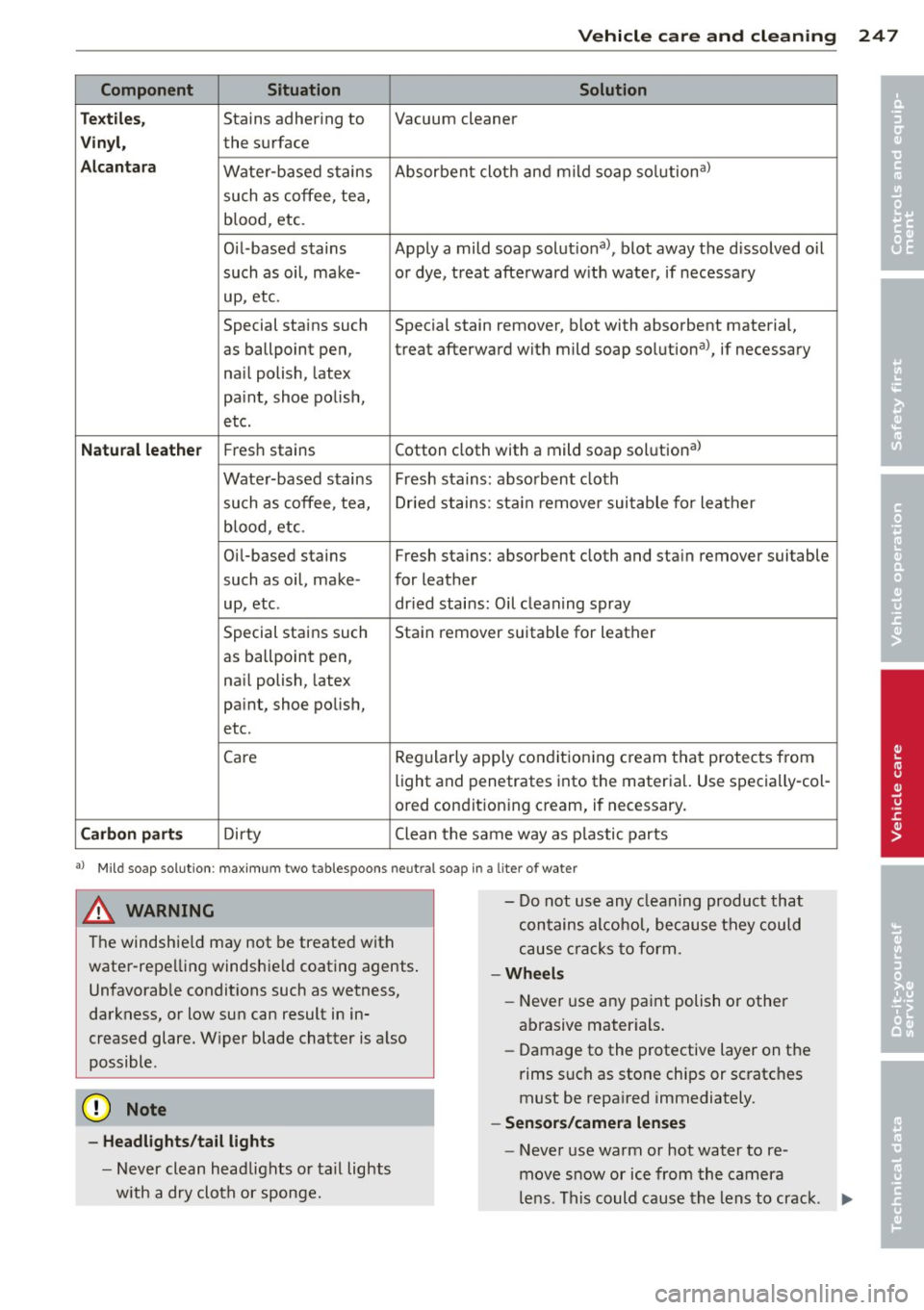
Component Situation Solution
Te xtile s,
Stains adhering to Vacuum cleaner
Vinyl, the surface
Alcantara Water-based stains Absorbent cloth and mild soap
solutional
such as coffee, tea, blood, etc.
Oil-based stains Apply a mild soap solutiona l, blot away the d issolved oil
such as oil, make- or dye, treat afterward w ith water, if necessary
up, etc.
Special stains such Special stain remover, b lot with absorbent material,
as ballpoint pen, treat afterward with mild soap solutiona l, if necessary
na il polish, latex
pa int, shoe polish,
etc.
Natural leather Fresh stains Cotton cloth with a mild soap solutiona l
Water-based stains Fresh sta ins: absorbent cloth
such as coffee, tea, Dried stains: stain remover suitable for leather
blood , etc .
Oil-based stains Fresh stains: absorbent cloth and stain remover suitable
such as oil, make- for leather
up , etc . dried sta ins: Oil cleaning spray
Special stains such Sta in remover suitable for leather
as ballpo int pen,
nai l polish, latex
paint, shoe polish,
etc.
Care Regularly apply conditioning cream that protects from
light and penetrates
into the material. Use specially-col-
ored conditioning cream, if necessary.
Carbon parts Dirty Clean the same way as plastic parts
al Mil d soap so lution: m axim um two ta bles poo ns neu tral soa p in a lite r of water
& WARNING
The windshie ld may not be treated with
water-repelling windshie ld coating agents .
Unfavorab le conditions such as wetness,
darkness, or low sun can result in in
creased glare. W iper blade chatter is also
possible.
- Headlights/tail lights
- Never clean headlights or tail lights
w ith a dry cloth or sponge. -
Do not use any cleaning product that
contains alcohol, because they could
cause cracks to form.
-Wheels
-Never use any paint polish or other
abrasive mater ials.
- Damage to the protective layer on the
rims such as stone chips or scratches
must be repaired immediately .
-Sensors/camera lenses
- Never use warm or hot water to re-
move snow or ice from the camera
len s. This could cause the lens to crack .
IJII>
•
•