battery AUDI Q7 2014 Owner´s Manual
[x] Cancel search | Manufacturer: AUDI, Model Year: 2014, Model line: Q7, Model: AUDI Q7 2014Pages: 340, PDF Size: 85.02 MB
Page 232 of 340
230 Intellig ent technol ogy
What you should know
The highest priority is given to maintaining
starting capability.
The battery is severely taxed in short-distance
driving, in city traffic and during the cold time
of year. Abundant electr ical energy is re
qu ired, but only a little is generated. It is also
cr itical if the e ngine is not running and elect ri
cal components a re turned on. In th is in
stance energy is being consumed but none is being generated .
I t is in precisely these situations that you w ill
notice energy management actively regulat
ing the distrib ution of energy.
Vehicle stand s for an ext ende d period
If you do not drive your vehicle over a period
of several days or weeks, electrical compo
nents are gradually cut back o r switched off .
This reduces energy cons umption and main
tains starting capab ility
over a longer period.
Take into consideration that when you un lock
your ve hicle, some convenience functions,
such as the interior ligh ts or the power seat
ad justmen t, may not be available. The con
venience functions will be available again
when you turn on the ignition and start the
engine.
With the engine turned off
I f you listen to the radio, for example, with
the eng ine turned off or use other MM I func
tions, the battery is being discharged .
I f sta rting capability is jeopa rdized due to en
e rgy consumpt ion, the follow ing warning ap
pears in the MMI disp lay:
Ple ase s tart engin e, otherwi se system will
s wit ch off in 3 minute s.
The warning ind icates that the system will be
turned off automatically after 3 m inutes .
If
you wish to cont inue us ing the functions, you
have to start the engine.
With the eng in e runnin g
Although e lectrical energy is gene rated when
the vehicle is being driven, the battery can be
come discharged. This happens mostly when
little energy is being generated and a great
deal consumed and the battery's state of
charge is not optimal.
To bring the energy balance back into equili brium, consumers which req uire especially
large amounts of energy are temporar ily cut
back or sw itched off. Heat ing systems in par
t icular require a great deal of energy. If you
notice, for example, that the heated seats* or
the heated rear window are not heating, they
have been tempora rily cut back or switched
off . These systems w ill be available again as
soon as t he energy balance has been restored.
You w ill also notice that engine id le speed has
been increased slightly . T h is is normal and not
a cause for con cern. By inc reas ing engine id le
speed the additional energy required is gener
ated and the battery is charged.
Driver notification in the instrument
cluster display
If battery power drops into the range where it
can limit the ability of the engine to start, this
is shown in the instrument cluster display
with the fo llow ing driver message:
(•) low batte ry charge: bat tery w ill be
ch arg ed whil e dri ving
This notificat ion reminds you that the starting
capability of the engine may be lim ited. As
soon as you start dr iv ing again, the battery
will be recharged and the not ificat io n will go
out .
Driver notific ation app ear s a nd goe s out
again
If this driver notification appears after the ig
nition is turned on or wh ile driving and it goes
out again after a while, the battery has been
adequately recharged. .,.
Page 233 of 340
Driver notification appears and does not
go out again
If this driver notification appears after the ig
nition is turned on or while driving and does
not go out again, the battery's state of charge
is not in the opt imal range. Starting ability is
restricted. Have the battery checked as soon
as poss ible by an author ized Audi dealer or
qua lified workshop.
Intelligent technology 231
•
•
Page 236 of 340
234 Driving and en vironm ent
,8. WARNING
-Do not park your vehicle over flammable
materials such as grass or leaves because
the high temperature of the diesel par
t icu late filter could start a fire .
- Do not apply an underbody protectant in the exhaust system area or a fire could start.
Avoid damaging the vehicle
When you are driving on poor roads, or over
curbs, steep ramps, etc., make certain that
low-lying parts such as spoilers and exhaust
system parts do not bottom out and get dam
aged.
This is especia lly true for vehicles with low
slung chassis (sports chassis)* and fully load
ed vehicles.
Shutting down vehicle
If you would like your vehicle to remain inop
erative for a longer period of time, contact an
Audi or other specialized dealer . They can ad
vise you on necessary precautions e.g . corro
sion prevention, maintenance and storage. Pay attention to additional information con
cerning the battery. Refer to
c::> page 268.
Operate your vehicle
economically and minimize pollution
General
Your personal style of driving will determine
the economy of your vehicle, as well as ex
haust and noise levels .
Fuel economy, environmental impact, and
wear on your engine, brakes and tires largely
depend on three factors:
- your personal driving style
- operating conditions
- technical limitations
If you anticipate what you need to do next and
drive economically, you can easily cut your
fuel consumption by 10-15 percent . This sec
tion will give you some tips on how you can help the environment and your pocketbook.
(D Tips
The consumption estimates as published by ENVIRONMENTAL PROTECTION AGENCY
(EPA) and Transport Canada may not corre
spond to your actual consumption on the road, which will vary depending upon vehi
cle load and speed, road and weather con
dit ions, trip length, etc.
· Drive smoothly and keep a lookout
ahead
Vehicles use the most fuel when they ore ac
celerating.
., Avo id unnecessary accelerating and brak ing.
Vehicles use the most fuel when they are ac
celerating . If you anticipate what is going to
happen next, you will need to brake less and,
thus, acce lerate less. Let the vehicle coast
whenever possible -for examp le when you see
that the next traffic light is red.
Avoid full throttle
Driving at moderate speeds saves fuel and
improves your mileage.
., Try and keep well below your car's maximum
speed.
Accelerating gently reduces fuel consump
tion, engine wear, and does not disturb the environment.
Fuel consumption, exhaust emissions and en
gine noise increase disproportionately at high
speeds. If you drive at approximately three
quarters of top speed, fuel consumption w ill
be reduced by one half. Never drive faster
than the posted speed limit and weather con
ditions permit.
Page 260 of 340
258 Checking and filling
-Apply the parking brake.
- Move selector lever to P (Park).
- Always let the engine cool down. Hot
components will burn skin on contact.
- To reduce the risk of being burned, never
open the hood if you see or hear steam
or coolant escaping from the engine
compartment. Wait until no steam or
coolant can be seen or heard before care
fully opening the hood.
- Keep children away from the engine com
partment.
- Never spill fluids on hot engine compo
nents. They can cause a fire.
- Never touch the radiator fan. The auxili
ary electric fan is temperature controlled
and can switch on suddenly.
- Never open the coolant reservoir cap
when the engine is still warm. The cool
ant system is pressurized and hot cool
ant could spray out.
- Protect your face, hands and arm from
steam or hot engine coolant by placing a
th ick rag over the cap when you open the
coolant reservoir .
- Do not remove the engine cover under
any circumstances. This increases the
risk of burns.
- If work on the fuel system or the electri
cal system is necessary:
- Always disconnect the battery .
- Never smoke or work near heaters or
open flames. Fluids in the engine com
partment could start a fire.
- Keep an approved fire extinguisher im
mediately available.
- To avoid electrical shock and personal in
jury while the engine is running or being
started, never touch:
- Ignition cables
- Other components of the high voltage
electronic ignition system.
- If you must perform a check or repair
with the engine running: -
First, fully apply the parking brake,
move selector lever to P (Park).
- Always use extreme caution to prevent
clothing, jewelry, or long hair from get
ting caught in the radiator fan, V-belts
or other moving parts, or from contact ing hot parts. Tie back hair before
starting, and do not wear clothing that
will hang or droop into the engine.
- Minimize exposure to emission and chemical hazards
~ &, .
A WARNING
=
California Proposition 65 Warning:
- Engine exhaust, some of its constituents, and certain vehicle components contain
or emit chemicals known to the State of
California to cause cancer and birth de
fects and reproductive harm. In addition,
certain fluids contained in vehicles and
certain products of component wear con
tain or emit chemicals known to the
State of California to cause cancer and
birth defects or other reproductive harm.
- Battery posts, terminals and related ac
cessories contain lead and lead com
pounds, chemicals known to the State of
California to cause cancer and reproduc
tive harms. Wash hands after handling.
(D Note
When adding fluids, always make sure that
they are poured into the proper container
or filler opening, otherwise serious dam
age to vehicle systems will occur.
@) For the sake of the environment
To detect leaks in time, inspect the vehicle
floor pan from underneath regularly. If
you see spots from oil or other vehicle flu ids, have your vehicle inspected by an au
thorized Audi dealer.
Page 270 of 340
268 Check ing and filling
If the brake fluid level falls considerably be
low the "MIN" mark, the brake warning/indi
cator light (U .S . mode ls:
1111 , Canadian
models: .) will come on
<::> page 19 and
<::> page 32. Do not continue to operate the ve
h icle . The complete brake system should be
thoroughly checked by an authorized Aud i
dea ler or qualified workshop and the cause
corrected. If the brake fluid level is too low,
the brake warning/indicator light will illum i
nate . Contact an authorized Aud i dealer
im
m ediatel y.
@ Tips
The brake fluid rese rvoir is located unde r
neath the cove r.
Changing brake fluid
Hove the broke fluid changed by on experi
enced technician.
Brake fluid absorbs moisture from the a ir . If
the water content in the brake fluid is too
h igh , corrosion in the brake system may result
after a per iod of t ime. The bo iling po int of the
brake fluid wi ll also decrease considerably and
decrease braking performance.
Therefore, the brake flu id must be changed
e ver y tw o year s. Always use new b rake fluid
which conforms to Federal Motor Vehicle
Standard "FMVSS 1 16 DO T 4".
The brake flu id reservo ir can be difficult to
reach, therefore, we recommend that yo u
have the brake f luid changed by you r author
ized
Audi dea ler. Your dea ler has the correct
too ls, the right brake fluid and the know -how
to do this for you.
A WARNING
- Brake fluid is poisonous . It must be stor
ed only i n the closed orig inal container
o ut of the reach of children!
- Brake fa ilure can result from old or inap
propriate b rake fluid. Observe these pre
caut ions: -
Use only brake fluid that meets SAE
specification
J 1703 and conforms to
Federa l Motor Vehicle Standard 116.
Always check with your authorized Audi
dealer to make sure you are using the
correct brake fluid . The correct type of
brake f lu id is also ind icated on the
brake flu id reservoir.
- T he brake fluid must be new. Heavy use
of the bra kes ca n cau se a vapo r lock if
the b rake fluid is left in the system too
l ong . This can seriously affect the effi
c iency of the brakes as well as your
safety. This co uld resu lt in an accident.
(D Note
Bra ke fluid will damage the paint of you r
vehicle .
(® For the sake of the environment
Because of the p rob lem of p roper disposal
of b ra ke fluid as well as the spec ial too ls
r equired and the necessary expertise, we
re commend that yo u have the brake fluid
changed by yo ur authorized Aud i dea ler.
Battery
General information
U nder normal ope rat ing cond itions, the bat
tery in yo ur Audi does not need any ma inte
nance. With
high o utside tempe ra tur es or
l ong dai ly drives we recommend that you have
the e lectrolyte level checked by an authorized
Audi dealer or qualif ied workshop. The elec
trolyte level should also be checked each time
the battery is charged
<::> page 2 70.
Have the battery checked when yo u take your
vehicle in for service. You are well advised to replace a battery that is o lder than 5 years .
With certain types of airbag deployment, the batte ry is disconnected from the veh icle elec
trical system for safety reasons¢.&
in Re
pair , core and disposal of the airbags on
page 197.
~
Page 271 of 340
Disconne cting the batt ery t erminals
Some vehicle functions (power w indow regu
l ators, for example) are lost if the battery ter
minals are disconnected . These functions have
to be re learned after the battery terminals are
connected again. To prevent this, the battery
should only be disconnected from the vehicle
electrical system when absolutely necessary
for repairs .
Vehicle s not driven fo r lo ng period s
If you do not drive your vehicle over a period
of several days or weeks, electrical compo
nents are gradually cut back or switched off .
This reduces energy consumption and main
tains starting capab ility over a longer per iod
¢ page 229 .
Take into consideration that when you unlock
your vehicle, some convenience functions,
such as the inter ior lights or the power seat
adjustment, may not be available . The con
ve nience funct ions w ill be available again
when yo u turn on the ignition and start the
engine.
Winter op eration
During the winter months, battery capacity
tends to decrease as tempe ratures d rop . This
i s because more powe r is also consumed while
start ing, and the headl ights, rea r window de
fogger, etc., are used more often.
Avo id unnecessary power consumption, par
ticularly in c ity t raffic or when t rave ling on ly
short d istances. Let you r autho rized Aud i
dealer check the capacity of the vehicle bat
tery before winter sets in ¢
page 270. A we ll
charged battery wi ll not only prevent starting
prob lems when the weather is cold, but will
also last longer .
If your vehicle is left standing for severa l
weeks at extremely low temperat ures, the
veh icle battery should be removed and
stored where it will not freeze. This will
prevent it from bei ng damaged and hav ing
to be replaced.
Checkin g and fillin g 269
Working on the battery
Be especially careful when working on or near
the battery.
The battery is located under the driver 's seat.
Before you check anyth ing under the dr iver's
seat,
read and h eed all WARNINGS G &_ .
Always heed the safety warnings , when work
ing on the vehicle battery or the vehicle e lec
trical system to prevent injury .
The following WARNINGS are ver y
important when working on the batter y:
Alway s heed the following WARN IN G SY M-
BOLS a nd safety p re caution s when working
on the battery .
®
Alway s wear e ye prote ction.
&
Bat te ry acid contains s ulfuric acid. Al-
ways w ear glov es and ey e prot ect ion .
@
No
-spar ks
- flames
- smo kin g.
A
When a batt ery i s charged , it produ ce s
hydro gen g as whi ch i s explo sive and
c o uld cau se pe rsonal injur y.
®
Alw ays k eep th e batt ery w ell out of
reac h of chi ldr en .
.8, WARNING
Whenever working on the battery or on
the electrical system, there is the risk of
injury, accident and even fire . Read and
heed the following WARNINGS:
- Always wear eye protection. Do not let
battery ac id or any lead particles get on
your skin or clothing . Shield you r eyes .
Exp losive gases can cause blindness or
other injury.
- Battery acid contains sulfuric acid. Sulfu
ric acid can cause blindness and severe
burns.
- Always wear g loves and eye protection.
-
Do no t tilt the ba ttery because acid .,. •
•
Page 272 of 340
2 70 Checking and filling
could leak out of the ventilation
openings.
- If you get battery acid in your eyes or
on your skin, immediately rinse with
cold water for several minutes and get
medical attention.
- If you should ingest any battery acid,
seek medical attention immediately.
- Do not expose the battery to an open
flame, electric sparks or an open light.
- Do not smoke.
- Do not interchange the positive and neg-
ative cables.
- When working on the battery , be sure
not to short-circuit the terminals with
tools or other metal objects. This would
cause the battery to heat up very quickly,
which could lead to damage or explosion
and personal injury.
- When a battery is charged, it produces
hydrogen gas which is explosive and
could cause personal injury .
- Always keep the battery well out of the
reach of children .
- Before work is done on the electrical sys
tem, disconnect the negative ground ca
ble .
- Before performing any work on the elec
trical system, switch off the engine and
ignition as well as any electrical equip
ment. The negative cable on the battery
must be disconnected. If you are just go
ing to replace a light bulb, then it is
enough to switch off the lights.
- Before disconnecting the battery, switch
off the anti-theft alarm system! Other
wise you will set off the alarm.
- When disconnecting the battery, first
disconnect the negative cable and then
the positive cable .
- Before reconnecting the battery, make
sure all electrical consumers are switch
ed off. Reconnect the positive cable first
and then the negative cable. Never inter
change the cables -this could start a fire!
- Never charge a frozen or a thawed-out
battery. It could explode! If a battery has
frozen, then it must be replaced. A dis- charged battery can freeze over at 32
°F
(0 oc).
-Make sure the vent hose is always attach
ed to the opening on the side of the bat
tery .
- Never use batteries which are damaged.
There is the danger of an explosion! Al
ways replace a damaged battery.
A WARNING
-
California Proposition 65 Warning:
- Battery posts, terminals and related ac
cessories contain lead and lead com
pounds, chemicals known to the State of
California to cause cancer and reproduc
tive problems. Wash hands after han
dling.
(D Note
- Do not disconnect the vehicle battery
when the ignition is switched on or when
the engine is running, otherwise, you will
damage electronic components in the
electrical system.
- If your vehicle is going to stand for a
long period of ti me without being driven,
protect the battery from "freezing", oth
erwise it will be damaged and will then
have to be replaced.
Battery charging
Starting the engine requires a well charged
battery.
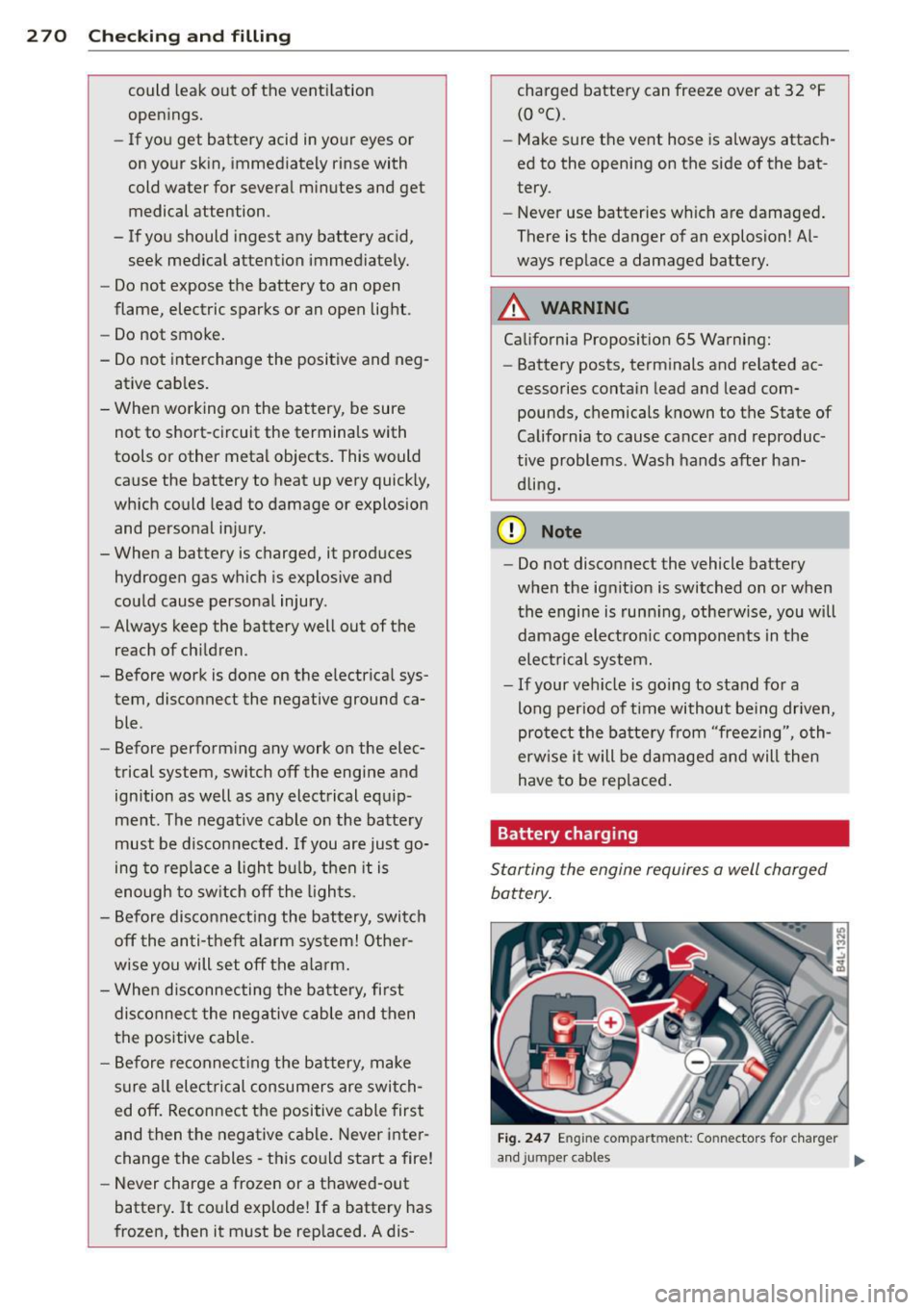
Fig. 247 E ngin e compart men t: Co nnectors fo r charger
and j umper cab les
Ill>
Page 273 of 340

Always read and heed all WARNING S below
¢ A. and
¢A. in Working on the battery on
page 269.
.,. Turn off the ignit ion and a ll electrical con
s u mers .
.,. Make sure the area is well vent ilated when
you charge the battery.
.,. Open the hood¢
page 257.
.,. Open the red cover on the posit ive pole
¢ fig . 247.
.,. Connect the charger connectors accord ing to
the instructions to the
jump start bolt s.
(Bolts unde r the red cover= "positive", Bolts
with hex head= "negative") .
.,. Only now pl ug the mains lead for the charg
ing equipment into the wall outlet and turn
it on ¢
A_.
.,. Make su re the charging rate i s not o ver
30 arnp s/14.8 Volt.
.,. When the battery is fully charged: Turn the
charging equ ipment
off and remove the
mai ns lead from the wa ll outlet.
.,. Now remove the clamps for the charging
equipment.
.,. Close the red cove r on the pos it ive po le.
.,. Close the hood¢
page 257.
A discharged batte ry can fr eez e at tempera
t ures of only O
0C. Allow a frozen batte ry to
thaw comp letely before a ttempting to charge
it ¢& . However, we recommend not using a
thawed battery again because the battery cas
ing can be cracked due to ice formation and
can leak battery acid.
Battery charging (Ma ximum charging rate
o f 30 amp s/14 .8 Volt)
When charging at low voltages (e.g . w ith a
tric kle charger ), the battery cables do not
h ave to be disconnected first. The battery
caps should
not be opened when charging a
battery .
It is not necessary to remove the battery from
the luggage compartment.
Checkin g and fillin g 2 71
Fast charging the battery (cha rging rate
ab ove 14 .8 V olt s)
For technical reasons do not use a battery
charger that uses voltage greater than 14.8
Volts to charge your vehicle's battery.
A WARNING
~ -
Charging a battery can be dangerous .
-Always follow the operating instructions
provided by the battery charger manu
facturer when charg ing your battery .
- Never charge a frozen battery.
It may ex
plode because of gas trapped in the ice.
Allow a frozen batte ry to thaw out f irst.
- Do not reuse batteries wh ic h were fro
zen. The battery hous ing may have
cracked and weakened when t he battery
froze.
- Charge the battery in a well ventilated area. Keep away from open flame or elec
tr ica l spar k. Do not smoke. Hyd rogen gas
genera ted by the battery is explos ive .
- To reduce the danger of explosion, never
connect or d isconnect c harger cab les
while the charger i s ope rat ing .
- Fast cha rging a batte ry is dange rous and
should only be a ttempted by a compe
tent techn ic ian wi th the p rope r equip
men t.
- Battery acid tha t may spi ll dur ing cha rg
ing should be washe d
off with a solu tion
of wa rm water and baking soda to neu
tralize the acid.
([) Note
Never use a fast charger as a booster to
star t the engine. This w ill seriously dam
age sens it ive e lectronic com ponen ts, s uch
as contro l units, re lays, radio, etc., as well
as the batte ry charger. •
•
Page 274 of 340

272 Ch eck ing and filling
Battery replacement
The new battery must have the same specifi
cations and dimensions as the original equip
ment battery.
Intelligen t energy management in your veh i
cle is respons ible for d istributing the e lectr i
cal en ergy throughout your vehicle
¢
page 229. T he intell igent e nergy manage
ment system w ill keep the eng ine battery
cha rged better then vehicles w ithout this sys
tem . To make sure the additional e lectrica l en
ergy is availab le once again after you have
changed the battery, we recommend that you install batteries of the same type and manu
facture only (the same as those installed at
the time your vehicle was delivered). Specifi
cations are listed on the battery hous ing . Your
author ized dealer must code the battery in
the ene rgy management system to enable you
to use the energy management f unct ions co r
rectly after replac ing the battery.
If it is not poss ible to use a battery of this
type, the new battery must have the same ca
pac ity, voltage (12 volts), amperage , con
struction and plug seal ing.
When insta lling the battery, make sure the ig
n it ion and all e lectr ica l consumers a re turned
off.
Q;) Note
Make sure the venti lation hose on the s ide
of the battery is connected, otherwise
fumes or battery ac id can leak o ut.
@ For the sake of the environment
Because of the problem of proper d isposa l
of a battery, we recommend your autho r
i z ed Audi dealer change the ba tte ry for
you. Bat teries con tain s ulfu ric ac id and
lead and m ust always be disposed of prop
erly in compliance with all environmental
reg ulations. Disposing of vehicle batteries
improper ly is very dangerous to the envi
ronment.
Windshield/headlight
washer container
F ig . 24 8 Eng in e compar tment : cover on t he wi nds hield
and headl ig ht* washe r flu id reservoi r
The washer fluid co nta iner is marked w ith the
symbol Won its cap ¢
fig. 248, ¢ page 259,
fig. 241 .
.. Before you check anything in the engine
compartment,
alwa ys read and he ed all
W ARNING S
¢ & in Working in the engine
compartment on page 257 .
.. Lift the fille r cap tongue to add washer flu
id. You can fi ll the container to the top.
.. Press the cap back onto the fi ller neck afte r
fi lling the container.
You can find the reservo ir
capacity in the table
in
¢ page 315.
Clean water should be used when filling up . If
poss ible, use soft water to prevent scaling on
the washer jets. A lways add a glass clea ne r
so lution (with frost prote ction in the winter).
0 Note
Do not mix engine coolant antifreeze o r
any other additives to fill up the wind
s hi eld washer rese rvoir.
Page 277 of 340

Groove
means the space between two adjacent tread
ribs.
Load rating (code)
means the maximum load that a tire is rated
to carry for a given inflation pressure. You
may not find this information on all tires be
cause it is no t req uired by law.
Maximum load rating
means the load rating for a t ire at the max i
mum permissible inflation pressure for that
tire.
Maximum loaded vehicle weight
means the sum of:
(a) Curb weight
(b) Accessory weight
(c) Vehicle capacity weight, and
(d) Production options weight
Maximum (permissible) inflation pressure
means the maximum cold inflation pressure
to which a tire may be inflated. Also called "maximum inflation pressure."
Normal occupant weight
means 150 lbs. (68 kilograms) times the
number of occupants seated in the vehicle up
to the total seating capacity of your vehicle.
Occupant distribution
means distribution of occupants in a vehicle.
Outer diameter
means the overa ll diamete r of an inflated new
tire.
Overall width
means the linear distance between the exteri
ors of the sidewalls of an inflated tire, includ
in g elevations due to labeling, decorations, or
protective bands or ribs.
Ply
means a layer of rubber-coated parallel cords.
Tires and wheels 275
Production options weight
means the combined weight of those installed
regular production options we ighing over 5
lbs. (2.3 kg) in excess of those standard items
which they replace, not previously considered
in curb weight or accessory weight, including
heavy duty brakes, ride levelers, roof rack,
heavy duty battery, and spec ial tr im .
Radial ply tire
means a pneumatic tire in which the ply cords
that extend to the beads are laid at substan
tia lly 90 degrees to the center line of the
tread .
Recommended inflation pressure
see ¢ page 2 7 4, Cold tire inflation pressure.
Reinforced tire
means a t ire design to operate at higher loads
and at h igher inflation pressures than the cor
re sp onding standard tire. Reinforced tires
may be identified as "XL", "xl", "EXTRA LOAD",
or "RF" on the sidewa ll.
Rim
means a metal support for a tire or a t ire and
tube assembly upon which the tire beads are
seated.
Rim diameter
means nom inal diameter of the bead seat. If
you change your wheel s ize, you will have to
purchase new tires to match the new rim di
ameter.
Rim size designation
means r im diameter and width .
Rim width
means nominal distance between rim flanges .
Sidewall
means that portion of a tire between the
tread and bead.
•
•