door lock AUDI Q7 2014 Owner´s Manual
[x] Cancel search | Manufacturer: AUDI, Model Year: 2014, Model line: Q7, Model: AUDI Q7 2014Pages: 340, PDF Size: 85.02 MB
Page 141 of 340

Driving the automatic transmission
Fig. 159 Shift g ate on the center co nso le: se lector lev
er wi th release butt on
Starting the engine
~ The selector lever must be in P or N .
Starting off
~ Press and hold the brake pedal.
~ Press and hold the release button in these
lector lever handle , select the desired selec
tor lever pos ition such as D and release the
button .
~ Wait briefly until the transmission has shift
ed (you will feel a slight movement).
~ Remove your foot from the brake pedal and
acce lerate .
Stopping temporarily
~ Keep the vehicle stationary us ing the brak
ing pedal, for examp le at traffic lights.
~ Do not press the accelerato r pedal when do -
ing this.
Stopping /parking
If the selector lever is not in the P position
when you open the driver's door, the vehicle
could roll. The message
Transmi ssion : Car
may roll! Shift to park!
appears.
~ Press and hold the brake pedal unt il the ve
hicle has come to a complete stop.
~ Set the parking brake firmly 9 page 110,
Parking.
~ Se lect the P selector lever position 9 &.-
Stopping on an incline
~ Always press the brake pedal to hold the ve
hicle in place and prevent it from "rolling
back"
9 ,& . Do not try to prevent the vehi-
Autom atic transm ission 139
cle from "rolling back" when a gear is en
gaged by increasing the engine speed
c::>(D.
Under certain circumstances, such as driving
in the mountains, it may be usefu l to switch
temporarily to the manual shift program in or
der to adjust the gears to the driving condi
tions by hand
c::> page 140 .
On slopes, activate the parking brake first and
then move the selector lever to the P position.
This prevents too much stress from being
placed on the locking mechanism.
A WARNING
- Unintended vehicle movement can cause
serious injury.
- Never leave your vehicle with the engine
running while in gear.
If you must leave
your veh icle when the engine is running,
apply the park ing brake firmly and move
the selector lever to P.
- Power is still transmitted to the wheels
when the engine is running at idle. To
prevent the vehicle from "c reeping ", you
must keep your foot on the brake when
the engine is running and the selector
lever is in D, Sor R or "tiptronic" mode is
selected.
- Do not press the accelerator pedal when
changing the se lector lever position
while the vehicle is stationary and the engine is running.
- Never shift into R or P while driving.
- Before driving down a steep slope, re-
duce your speed and shift into a lower
gear with "tiptronic".
- Do not ride the brakes or press the bra ke
pedal too often or too long when driving
down a hi ll. Constant braking causes the
brakes to overheat and substantially re
duces braking performance, increases braking distance or causes complete fa il·
ure of the brake system.
- To prevent the vehicle from rolling back
when stopping on inclines, always hold it
in place with the brake pedal or parking
brake . .,..
Page 172 of 340
1 7 0 Dr iving Safel y
Stowing luggage
Loading the luggage compartment
All luggage and other objects must be prop
erly stowed and secured in the luggage com
partment.
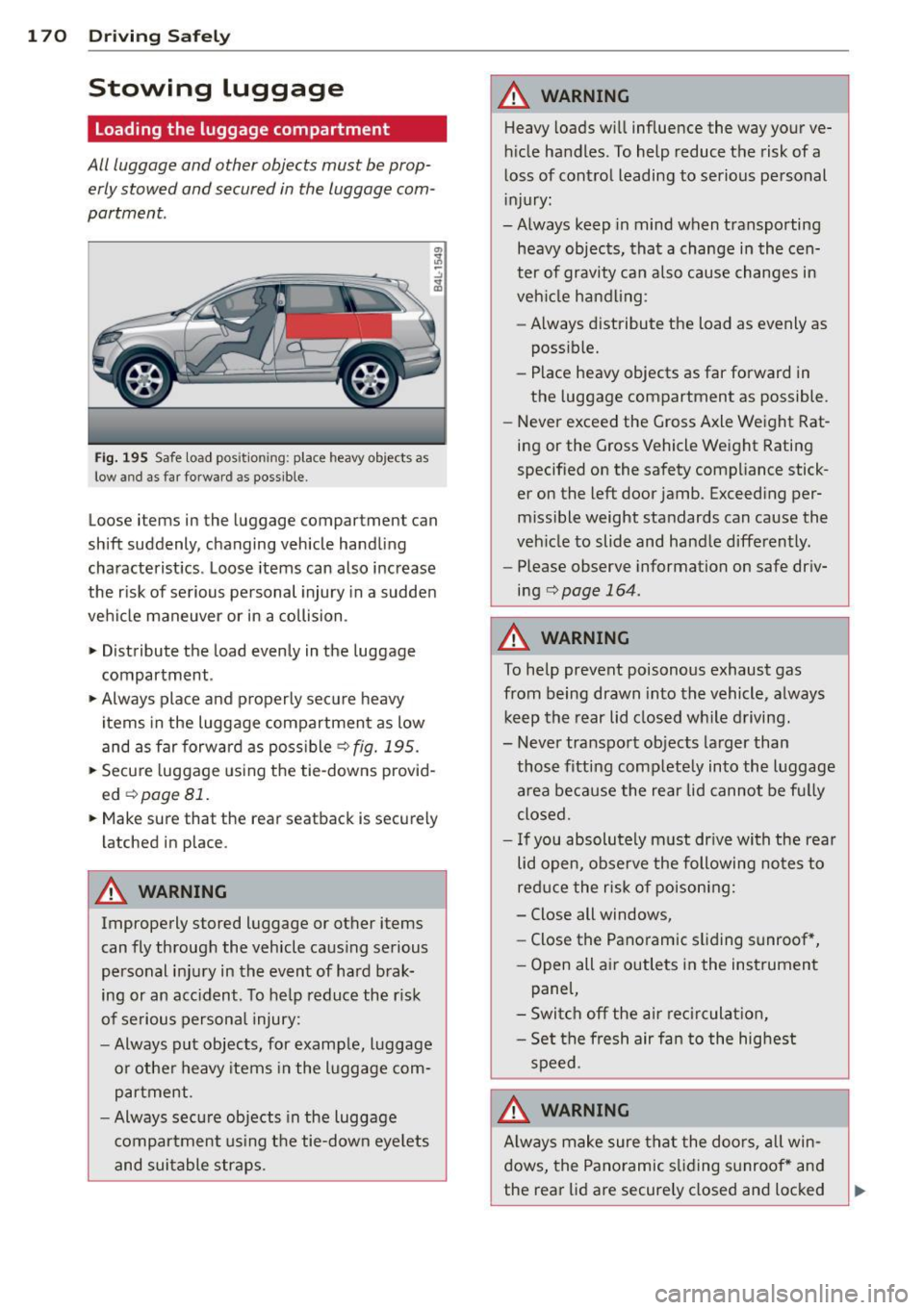
Fig . 195 Safe load position ing: place heavy objects as
low a nd as far forward as possible.
Loose items in the luggage compartment can
shift suddenly, changing vehicle handling
characteristics . Loose items can also increase
the r isk of serious personal injury in a sudden
vehicle maneuver or in a collision .
,. Distribute the load evenly in the luggage
compartment .
,. Always place and properly secure heavy
items in the luggage compartment as low
and as far forward as possible
¢fig. 195.
,. Secure luggage using the tie-downs provid
ed
¢ page Bl.
,. Make sure that the rear seatback is securely
l atched in place .
A WARNING
Improperly stored luggage or other items
can fly through the vehicle caus ing serious
personal inj ury in the event of hard brak
ing or an acc ident. To help reduce the r isk
of serious personal injury :
- Always put objects, for example, luggage
or other heavy items in the luggage com
partment.
- Always secu re objects in the luggage
compartment using the tie-down eyelets
and suitable straps.
A WARNING
-Heavy loads wi ll influence the way your ve-
hicle handles. To help reduce the risk of a
loss of control leading to serious personal
in jury:
-Always keep in mind when transporting
heavy objects, that a change in the cen
ter of gravity can also cause changes in
veh icle handling:
- Always distribute the load as evenly as
possible.
- Place heavy objects as far forward in
the luggage compartment as possible.
- Never exceed the Gross Axle Weight Rat
ing or the Gross Vehicle Weight Rating
specified on the safety compliance stick
er on the left door jamb. Exceeding per
missible weight standards can cause the
veh icle to slide and handle differently.
- Please observe information on safe driv
ing
r=;,page 164.
A WARNING
-
To help prevent poisonous exhaust gas
from being drawn into the vehicle, a lways
keep the rear lid closed while driving.
- Never transport objects larger than
those fitting comp letely into the luggage
area because the rear lid cannot be fully
closed.
- If you absolutely m ust dr ive with the rear
lid open, observe the following notes to
reduce the risk of poisoning:
- Close all windows,
- Close the Panoramic sliding sunroof *,
- Open all air outlets in the instrument
pane l,
- Switch off the air recirculat ion,
- Set the fresh air fan to the highest
speed.
A WARNING
A lways make sure that the doors, all win
dows, the Panoramic sliding sunroof * and
the rear lid are securely closed and locked
-
Page 197 of 340
-a rearward-facing child restraint has been
installed on the front passenger seat, or
- a forward -facing child restraint has been in
stalled on the front passenger seat, or
- the weight registered on the front passen
ger seat is equa l to or less than the com
bined weight of a typical 1 year-old restrain
ed in one of the rear-facing or forward-fac
ing infant restraints listed in Federal Motor
Vehicle Safety Standard 208 w ith which the
Advanced Airbag System in your vehicle was
certified .
If the front passenger seat is not occupied,
the front airbag will not deploy, and the
PAS ·
SENGER AIR BAG OFF
light will stay on. Nev
er install a rearward-facing child restra int on
the front passenger seat, the safest place for
a child in any kind of child restraint is at one
of the seating positions on the rear seat
¢ page 185, Child restraints on the front seat
- some important things to know
and
¢ page 204, Child Safety.
If the PASSENGER AIR BAG OFF light comes
on
when one of the conditions listed above is
met, be sure to check the light regularly to
make certain that the
PASSENGER AIR BAG
OFF
li ght stays on continuous ly whenever the
ignition is on. If the
PASSENGER AIR BAG
OFF
light does not appear on and does not
stay on all the time, stop as soon as it is safe
to do so and
- reactivate the system by turning the ignition
off and then turning it on again;
- remove and reinstall the chi ld restraint .
Make sure that the child restraint is properly
installed and that the safety be lt for the
front passenger seat has been correctly
routed through the child restraint as descri
bed in the chi ld restraint manufacturer's in
st ructio ns;
- make sure that the convert ible locking fea
ture on the safety belt for the front passen
ger seat has been activated and that the
sa fety belt has been pulled tight. The belt
must not be loose or have loops of slack so
that the sensor below the safety belt latch
on the seat can do its job
¢ page 214.
Airbag system 195
-make sure that things that may increase the
weight of the child and chi ld safety seat are
not being transported on the front passen
ger seat;
- make s ure that the safety belt tension sen
sor is not blocked. Shake the safety belt
latch on the front passenger seatback and
forth;
- If a strap or tether is be ing used to tie the
child safety seat to the front passenger
seat, make sure that it is not so tight that it
causes the weight-sensing mat to measure
more weight than is actually on the seat.
If the PASSENGER AIR BAG OFF light still
does not come on
and does not stay on con
t inu ously (when the ignition is switched on),
- take the child restraint off the front passen-
ger seat and install it proper ly at one of the
rear seat positions . Have the airbag system
inspected by you r authorized Aud i dealer
immed iate ly.
- move the ch ild to a rear seat position and
make sure that the child is properly restra in
ed in a child restraint that is appropriate for
its size and age.
The
PASSENGER AIR BAG OFF light should
NOT come on when the ignition is on and an
adult is s itting in a proper seating position on
the front passenger seat. If the
PASSENGER
AIR BAG OFF
light comes on and stays on or
flashes for about 5 seconds wh ile driving, un
der these circumstances, make sure that:
- the adult on the front passenger seat is
properly seated on the cente r of the seat
cushion with his or her back up against the
backrest and the backrest is not reclined
¢ page 165, Proper occupant seating posi
tions,
- the adult is not taking weight off the seat by
holding on to the passenger assist handle
above the front passenger door or support
ing their weight on the armrest,
- the safety be lt is being properly worn and
that there is not a lot of slack in the safety
be lt webb ing, .,..
•
•
Page 212 of 340
210 Child Safe ty
Child safety seats
Infant seats
Babies and infants up to about one year old
and 20 lbs. or 9 kg need special rearward-fac
ing child restraints that support the back,
neck and head in a crash.
-- /
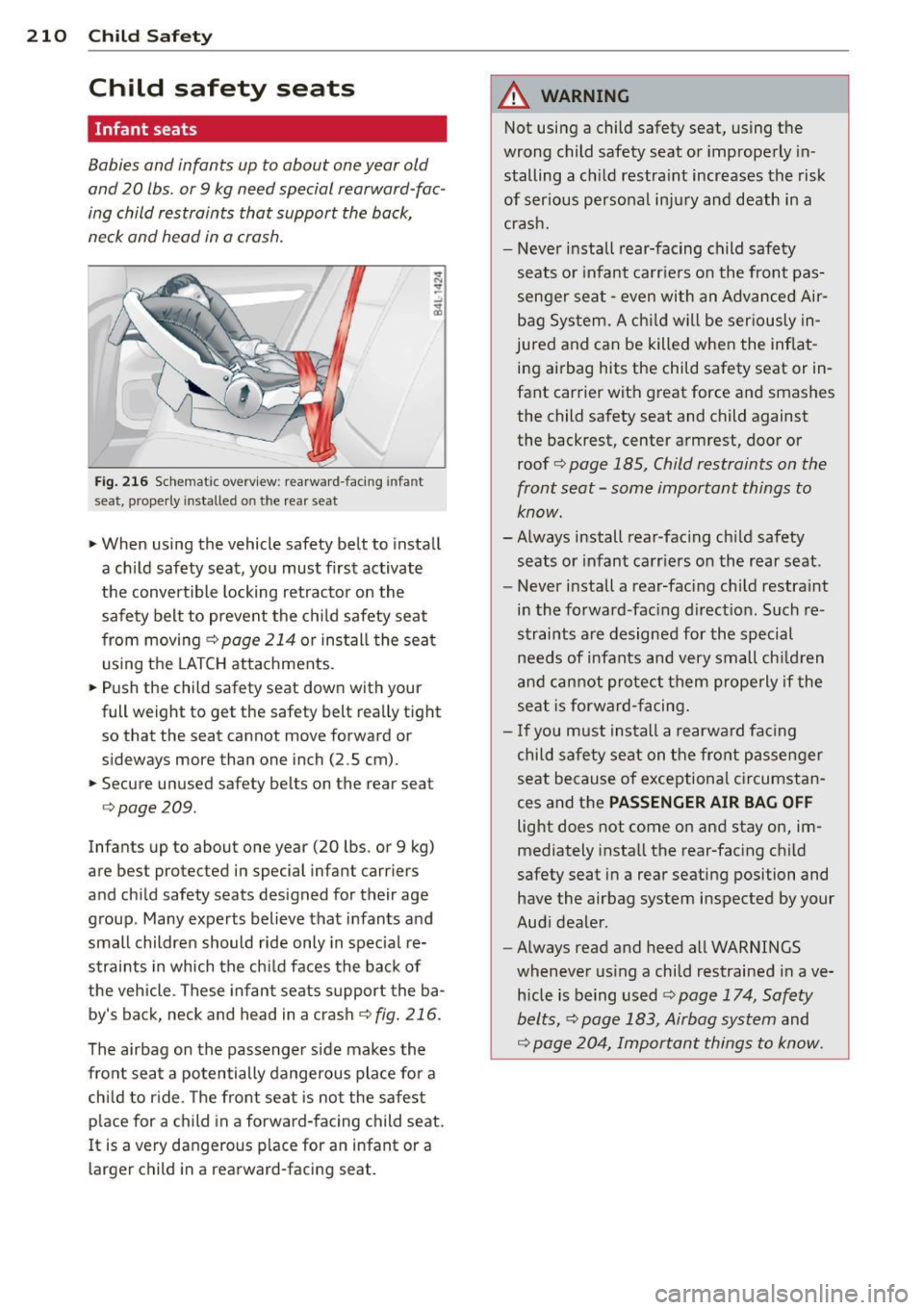
Fig . 216 Sche matic overview: rearward- facing infant
seat, properly installed o n the rear seat
> When using the vehicle safety belt to install
a ch ild safety seat, you must first activate
the convertible locking retractor on the
safety belt to prevent the child safety seat
from moving ¢
page 214 or install the seat
using the LATCH attachments.
> Push the child safety seat down with your
full weight to get the safety belt rea lly tight
so that the seat cannot move forward or
sideways more than one inch (2.5 cm).
> Secure unused safety belts on the rear seat
¢page 209.
Infants up to about one year (20 lbs. or 9 kg)
are best protected in special infant carriers
and child safety seats designed for their age
group . Many experts believe that infants and
small children should ride only in spec ial re
straints in which the chi ld faces the back of
the vehicle . These infant seats support the ba
by's back, neck and head in a crash ¢
fig. 216.
The airbag on the passenger side makes the
fro nt seat a potentially dangerous place for a
child to r ide . The front seat is not the safest
p lace for a child in a forwa rd-facing child seat.
I t is a very dangerous p lace for an infant or a
larger child in a rearward-facing seat.
A WARNING
-Not using a child safety seat, using the
wrong child safety seat or improperly in
stalling a ch ild restra int increases the risk
of ser ious personal in jury and death in a
crash.
- Never install rear-facing child safety
seats or infant ca rr ie rs on the front pas
senger sea t -even with an Advanced Air
bag Sys tem. A c hild will be ser iously in
jured and can be killed whe n the inflat
ing ai rbag hits the child safety seat or in
fant carrier with great force and smashes the child safety seat and child against
the backrest, center armrest, door or
roof ¢
page 185, Child restraints on the
front seat -some important things to
know.
- Always install rear-facing ch ild safety
seats or infant ca rr ie rs on the rear seat .
- Never install a rear-fac ing ch ild restra int
in the forward-fac ing direct ion. Such re
straints are designed for the special needs of infants and very small ch ild ren
a nd cannot protect them prope rly if the
seat is forward- facing.
- If you m ust insta ll a rearwa rd fa cing
child safety seat on the fro nt passenger
seat because of exceptiona l circumstan
ces and the
PASSENGER AIR BAG OFF
light does not come o n and stay on, im
mediately insta ll the rear-fac ing child
safety seat in a rear seating position and
have the airbag system inspected by your
Aud i deale r.
- Always read and heed all WARNINGS
whenever us ing a child restrained in ave
h icle is being used¢
page 174 , Safety
belts, ~ page 183, Airbag system
and
c::> page 204, Important things to know.
Page 259 of 340

Checking and filling Engine hood
Releasing the engine hood
The engine hood is released from inside the
vehicle .
Fig. 23 9 Drive r's s id e footw ell: eng in e hood relea se
l e v e r
"' Open the driver's door .
"' Pull the release lever on the left under the
instrument panel
i=> fig . 239 in the d irection
of the arrow .
The hood pops up slight ly under spring pres
sure.
Opening the engine hood
F ig . 2 40 Relea se le ve r u nde r the e ngin e hood
Before opening the engi ne hood, make sure
that the windshie ld wipers are flat against the
windshie ld. Otherwise, they cou ld damage the
pain t on the hood.
"' Lift the hood slight ly ¢
_A .
"' Pull up on the release under the hood
¢ fig . 240. This releases the catch.
"' Open the hood all the way . Checkin
g and fillin g 257
A WARNING
Hot engine coolant can burn you.
- To reduce the risk of being burned, never open the hood if you see or hear steam
or coo lant escaping from the eng ine
compartment . Wait unt il no steam or
coolant can be seen or heard before care
fu lly opening the hood.
Closing the engine hood
"' Pull the hood down until the pressure from
the stru ts is reduced.
"' Let the hood
drop down and latch in p lace.
Do not try to push it shut ; it may fail to en
gage ¢_& .
A WARNING
--
A hood that is not completely latched
could fly up and b lock your view while dr iv
i n g.
- When you close the engine hood, check it
to make sure the safety catch has p roper
ly engaged . The hood shou ld be flush
with the surround ing vehicle body parts.
- If you notice while driv ing that the hood
is not secured prope rly, stop at once and
close it .
Working in the engine compartment
Be especially careful whenever you work in
the engine compartment.
Whene ver you must perform any wo rk in the
eng ine compartment, for e xample checking
and filling different fluids, there is a risk of injury, burns and accidents. To pr event per
sonal injury always observe the following
WARNINGS . The engine compartment of an y
vehicle i s a hazardou s area
¢ Lh, .
A WARNING ~
To help avoid injury, befo re yo u check any
thing under the hood:
- Tu rn off the engi ne.
- Remove the igni tion key.
Page 301 of 340
Loosening
• Install the wheel bolt wrench over the
whee l bolt and push it down as far as it wi ll
go.
• Take tight hold of th e
end of the wrench
handle and turn the whee l bolts
counter
clockwise
abou t one single turn in the di rec·
tion of arrow
c::> fig. 262 .
Tightening
• Install the wheel bolt wrench over the
wheel bolt and push it down as far as it will
go .
• Take tight hold of the
end of the wrench
handle and turn each wheel bolt
clockwise
until it is seated .
& WARNING
-Do not use force or hurry when changi ng
a whee l· you can cause the vehicle to slip
off the jac k and cause serious personal
injuries .
-Do not loosen the wheel bolts more than
one turn
before you raise the veh icle with
the jack. -You risk an injury.
(j) Tips
If a wheel bolt is very tight, you may find it
easie r to loosen by carefully pushing down
on the end of the wheel bolt wrench with
one foot only. As you do so, hold on to the
car to keep yo ur balance and take care not
to slip.
Raising the vehicle
The vehicle must be lifted with th e jack first
before the wheel can be removed .
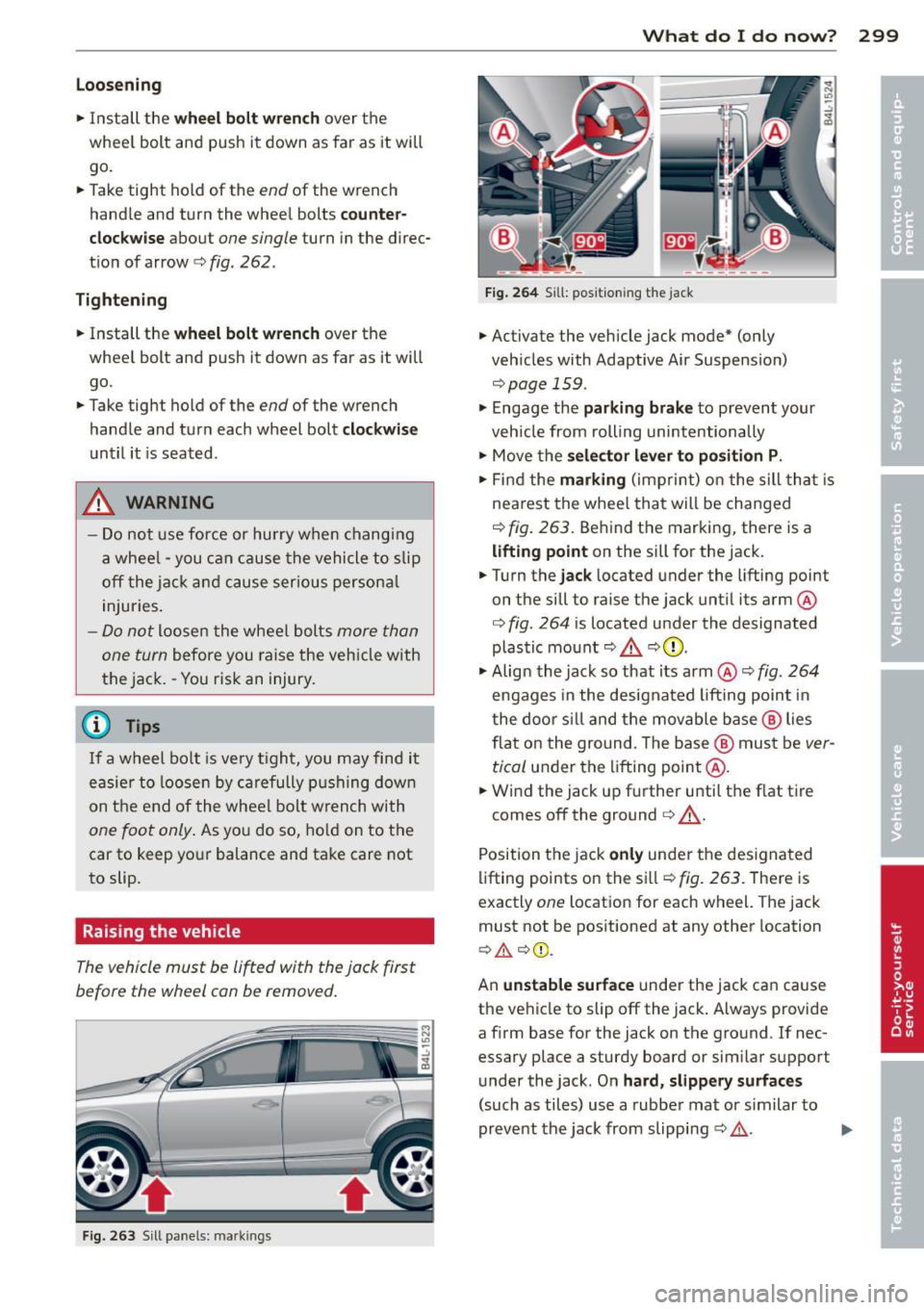
Fig. 263 Sill pane ls: m arkin gs
What do I do now? 299
Fig. 264 Sill: p ositioning the jack
• Activate the vehicle jack mode* (only
veh icles with Adaptive Air Suspension)
c::> page 159 .
• Engage the parking brake to prevent your
vehicle from rolling unintentionally
• Move the
selector lever to position P .
• Find the marking (imprint) on the sill that is
nea rest the whee l that will be changed
c::>fig. 263. Behind the marking, there is a
lifting point on the sill for the jack.
• Turn the
jack located under the lifting point
on the sill to raise the jack until its arm@
c::> fig. 264 is located under the designated
plastic mount
c::> .&. c::> Q) .
• Align the jack so that its arm@ c::> fig. 264
engages in the designated lifting point in
the door s ill and the movable base® lies
flat on the ground. The base@ must be
ver
tical
under the lifting point@.
• Wind the jack up further until the flat tire
comes off the ground
c::> .,& .
Position the jack only under the designated
lifting points on the sill
c::> fig. 263. There is
exactly
one locat ion for each whe el. The jack
must not be positioned at any other location
c::> .&. c::> Q).
An unstable surface under the jack ca n cause
the vehicle to slip off the jack. Always provide
a firm base for the jack on the ground . If nec
essary place a sturdy board or similar support
under the jack . On
hard, slippery surfaces
(such as tiles) use a rubber mat or similar to
prevent the jack from slipping
c::> ,&.. .,,.
Page 305 of 340
Fuses and bulbs 303
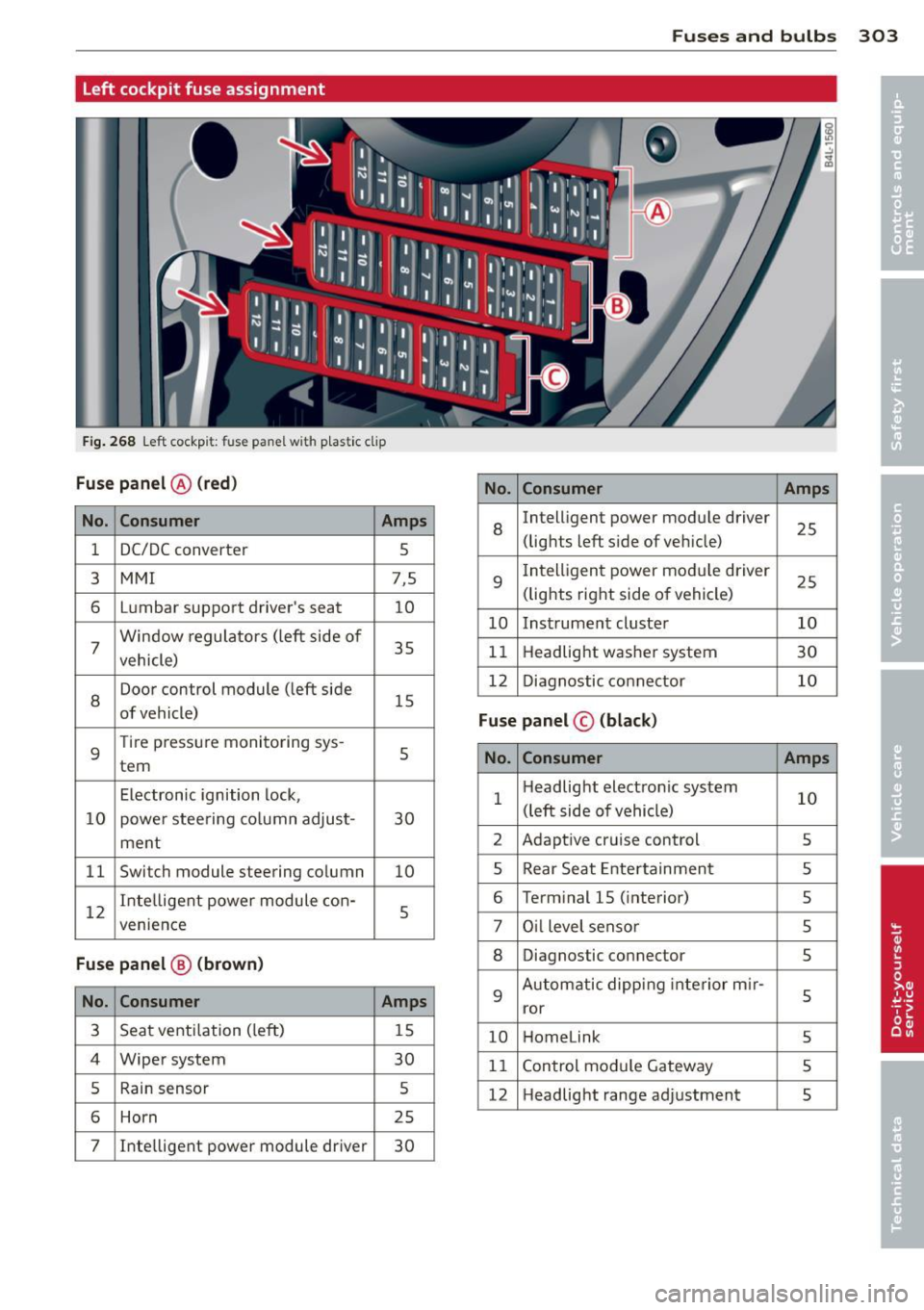
Left cockpit fuse assignment
F ig . 268 Left cockpit: fuse panel with p lastic clip
Fuse panel @ (red)
No. Consumer Amps
No. Consumer Amps
1 DC/DC converter
5
8
Intelligent power module driver
25
(lights left side of veh icle)
3
MMI 7,5
6 L umbar support driver's seat
10
7 Window
regulators (left side of
35
vehicle)
9
I ntelligent power module driver
25
(lights right side of vehicle)
10 Instrument cluster 10
11 Headlight washer system
30
8
Door control module (left side
15
of vehicle) 12
Diagnostic connector 10
Fuse panel © (black)
9
Tire pressure monitoring sys -
tern 5
No. Consumer
Amps
Electronic ignition lock,
10 power steering co lumn adjust- 30 1
Headlight
electronic system
10
(left side of vehicle)
ment 2
Adaptive cruise control
5
11 Switch module steering column
10 5 Rear
Seat Entertainment
5
12 Intelligent
power module con-
5
venience
6 Term inal 15 ( interior)
5
7 Oil level sensor
5
Fuse panel @ (brown) 8 Diagnostic connector
5
No.
Consumer Amps 9
Automatic dipping interior m ir-
5
ror
3 Seat ventilation (left)
15
10 Homelink
5
4 Wiper system
30
11 Control module Gateway 5
5 Rain sensor 5
12 Headlight
range adjustment
5
6 Horn 25
7 Inte
lligent power module driver
30
Page 325 of 340
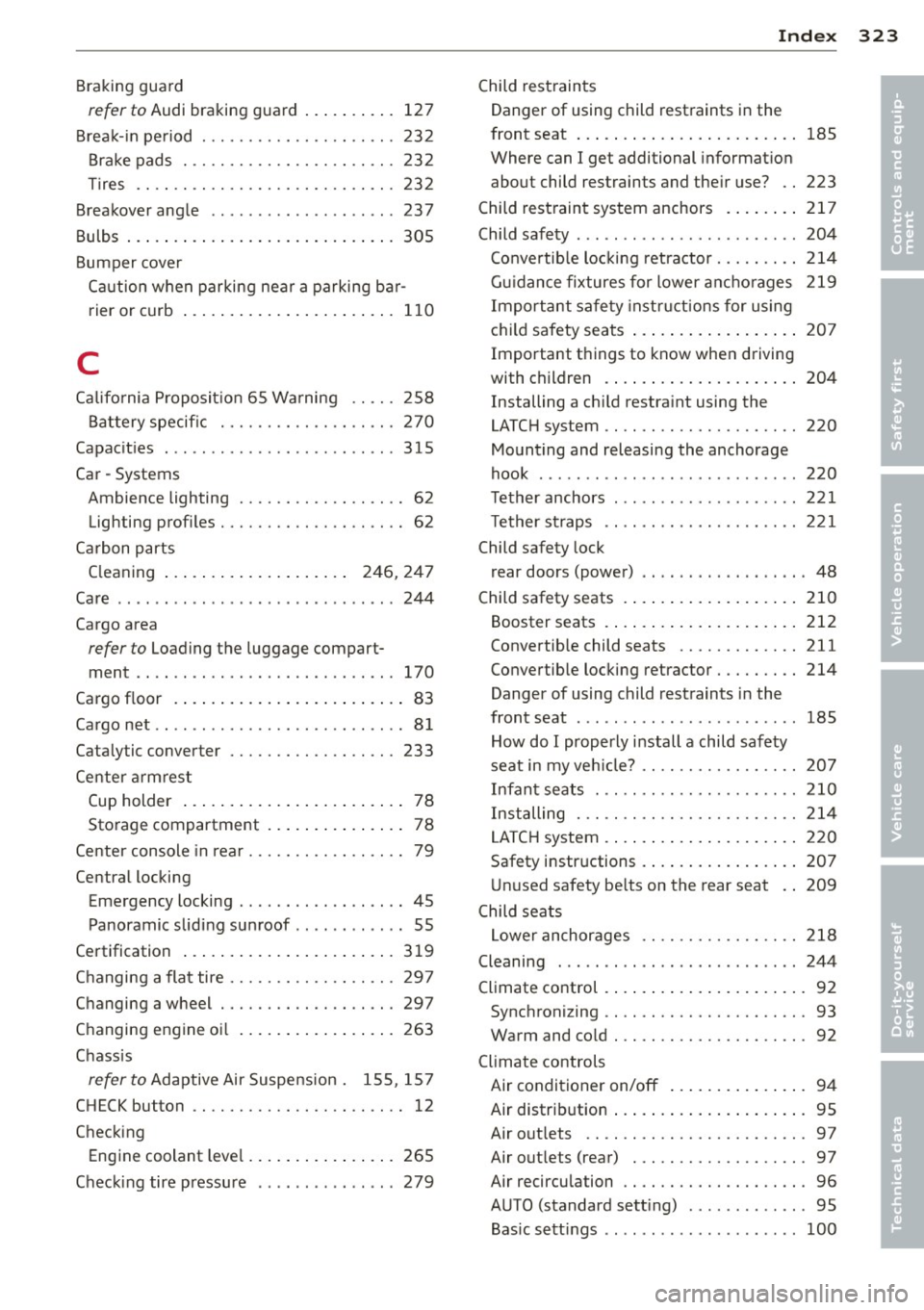
Braking guard
re fer to Audi braking gua rd ... .. .. .. . 127
Break- in pe riod ............ .... .. ... 232
Brake pads . ............. .. .. .. ... 232
T ires .... .. .. ............. .. .. ... 232
Breakoverang le ............ ... ... .. 237
Bulbs ..... .. .. .. .. .. .... ... .. .. ... 305
B umper cover
C au tion when parking near a parking ba r-
rier or c urb ... .... .... ... .. .. .. ... 110
C
Ca lifo rnia Proposit io n 65 Wa rning .. .. . 258
B att ery specific .......... .. .. .. .. . 270
Capac it ies . . . . . . . . . . . . . . . . . . . . . . . . . 315
Car - Systems Ambience lighting ........ .. .. .. .. .. 62
Lighting prof iles .......... .. .. .. .. .. 62
Carbon parts Clean ing . . . . . . . . . . . . . . . . . . . . 246, 247
Care ...... ... ...... ............. .. 24 4
Cargo area
refer to Load ing the luggage compart-
ment .. .. .. .... ... .. ... ... .. .. .. . 170
Cargo floor . ... .... .... ... .. .. .. .... 83
Ca rgo net ...... .............. ... ... . 81
Cata lytic converter ......... .. .. .. .. . 233
Center armrest Cup holder . . . . . . . . . . . . . . . . . . . . . . . . 78
Storage compartment . . . . . . . . . . . . . . . 78
Cente r console in rear ....... .. .. .. .. .. 79
Centra l locking
Emergency locking ........ .. .. .. .. .. 45
Panoramic slid ing su nroof ...... . ... .. SS
Certification . . . . . . . . . . . . . . . . . . . . . . . 319
C hanging a flat tire ......... .. .. .. .. . 297
Changing a w heel .......... .. .. .. .. . 297
Changing engine o il ..... ... .. .. .. .. . 263
Chass is
refer to Adaptive Air Suspe nsion . lSS, 157
CHECK button ............. .... .. .... 12
C hec king
Eng ine coolant leve l .... ... .. .. .. .. . 265
Checking tire pressure ......... .... .. 279
Inde x 323
Child rest raints
Danger of using child restraints in the
f ront seat . . . . . . . . . . . . . . . . . . . . . . . . 185
Where can I get additional informat ion
about child restraints and the ir use? .. 223
Child rest rain t system anchors . ... .. .. 217
Child safety ....... .. ............... 204
Co nve rtib le loc kin g retractor ..... .. .. 214
G ui dance fixtures for lower ancho rages 219
Impo rtant sa fe ty inst ructions for using
c hi ld safety seats ... . .. ..... ... .. .. 207
Impo rtant t hings to know when driving
with children . ...... .. .. ..... ... .. 204
Installing a ch ild restra int using the
LATCH system .. .. ................. 220
Mounting and releasing the anchorage
hook . ...... .. .... .......... ..... 220
T ether anchors .... ............... . 221
T ether st raps .. .. .... ........... .. 221
Child safety lock rear doors (power) . . . . . . . . . . . . . . . . . . 48
Child safety seats .... . .. ..... ... .. .. 210
Booster seats . ..... . .. .. ..... ... .. 212
Convertib le child seats ............. 211
Convertib le locking retractor ....... .. 214
Danger of using child restraints in the
front seat . . . . . . . . . . . . . . . . . . . . . . . . 18S
How do I properly install a child safety
seat in my veh icle? ............. .... 20 7
Infan t seats . .. .. .... ............. 210
Installing . .. .. .. ............... .. 214
L ATCH system . ...... .. .. ..... ... .. 220
Safety instr uctions . .. .. ..... ... .. .. 207
Un used safety be lts on the rear seat 209
Child sea ts
L owe r anchorages .... ......... .. .. 218
Cleaning ......... .. ..... .......... 244
Climate control . ..... . .. .. ..... ... .. . 92
Synchroni zing .. ...... ............. . 93
Warm and co ld . .. ............. .. .. . 92
Climate controls Air conditioner on/off ... .... ... .. .. . 94
Air distrib ution ..... . .. ..... ... .. .. . 9S
Air out lets .. .. .. ................. . 97
Air out lets (rear) . ................. . 97
Air recircu lation .. .. ........... .... . 96
AUTO (standard sett ing) .. .. ... ... .. . 9S
Bas ic sett ings .. .. .. ..... .......... 100
•
•
Page 327 of 340
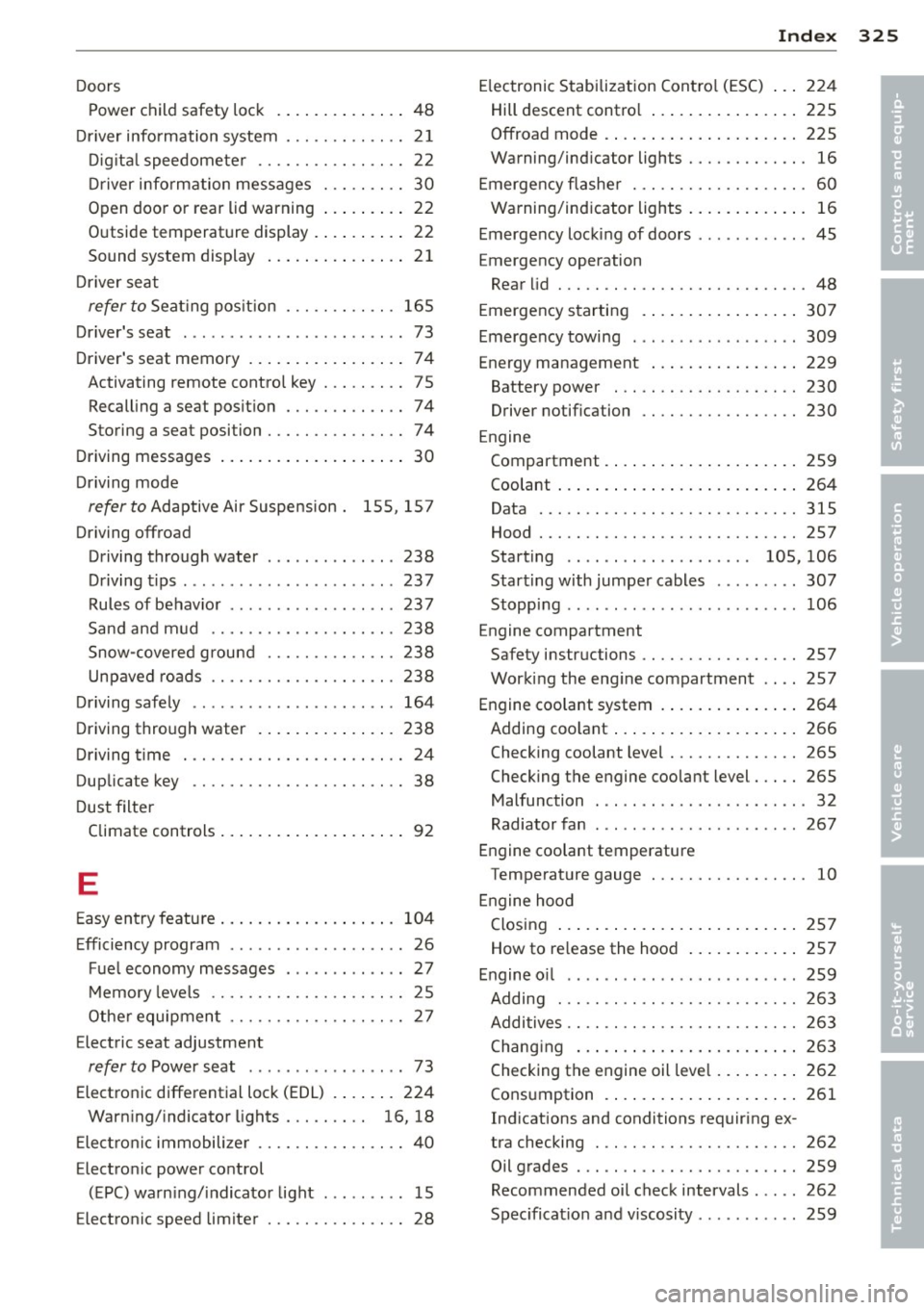
Doors
Power child saf ety lock . ... .. .. .. .. ..
48
Dr iver information system ... .. .. .. .. .. 2 1
Di gita l speedomete r ...... .. .. .. .. .. 22
D river info rmation messages . . . . . . . . . 30
Open door or rear lid warning . . . . . . . . . 22
Outside temperature display . ... .. .. .. 22
Sound system display .. ... .. .. .. .. .. 2 1
D river seat
refer to Seat ing pos it ion ... .. .. .. .. . 165
Driver's seat . . . . . . . . . . . . . . . . . . . . . . . . 73
Driver's seat memory . . . . . . . . . . . . . . . . . 7 4
Activating remote control key . .. .. .. ..
75
Recall ing a seat posit ion . . . . . . . . . . . . . 7 4
Sto ring a seat position . . . . . . . . . . . . . . . 7 4
D riving messages . . . . . . . . . . . . . . . . . . . . 30
Driving mode
refer to Adaptive Air Suspe nsion . 155, 1 57
Driving offroad
Driving through water ......... ... .. 238
Driving tips .... ........... ... ... ..
237
Rule s of behav io r ............ .. .... 23 7
S and and m ud ........... .... .. .. . 238
Snow-covered groun d ..... .. .. .. .. .
238
Unpaved roads ........... .... .. ... 238
Dr iving safe ly .......... ...... .... ..
164
Driving through water ... ... .. .. .. .. . 238
D riving t ime . . . . . . . . . . . . . . . . . . . . . . . .
24
Duplicate key . . . . . . . . . . . . . . . . . . . . . . . 38
D ust filter
Climate controls . . . . . . . . . . . . . . . . . . . .
92
E
E asy en try featu re .. ..... ... .. .. .. .. . 104
Efficiency program . . . . . . . . . . . . . . . . . . . 26
Fue l economy messages . ...... ... ... 27
M emory levels . . . . . . . . . . . . . . . . . . . . . 25
Othe r equipmen t ......... .. .. .. .. .. 2 7
Electric seat adjustment
refer to Power seat . . . . . . . . . . . . . . . . . 73
Electro nic differential lock (EDL) . ... .. . 224
Warn ing/ indicator lights . . . . . . . . . 16, 18
Ele ctr onic immobili ze r ...... .. .. .. .. .. 40
Electronic power co ntrol
( E PC) wa rn ing/indicator light ... ... ...
15
Electronic speed limiter . . . . . . . . . . . . . . . 28
Inde x 325
Electronic Stabilization Cont ro l (E SC) ... 224
Hill descent contro l ..... .... ... .. .. 225 •
Offroad mode .. .. .. . .. ... .... ... .. 225 •
Warning/ind icator lights .......... .. . 16
Emerge ncy flashe r . . . . . . . . . . . . . . . . . . . 60
Wa rning/ind icator lights ..... ... .. .. . 16
Emergency locking of doors ............ 45
Emergency operation
Rear lid . .. .. .. .. .. ............... .
48
Emergency starting . .. .. ..... ... .. .. 3 0 7
Emerge ncy towing ... . .. .. .. ... ... .. 309
Energy management ... .. .... ... .. .. 229
Battery power . .. .... ........... .. 230
Driver notification ................. 230
Engine
Compartment .... .. . .. .. ..... ... ..
259
Coolant ... .. .... .. . .. .. ..... ... .. 264
Data ..... .. .. .. ... ............ .. 315
Hood ..... .. .. .. ................. 257
Start ing . . . . . . . . . . . . . . . . . . . . 105, 106
Starting with jumpe r cables ........ . 307
Stopping ........ .. ............... 106
Engine compartment
Safety instr uctions .. ........... .... 257
Work ing the eng ine compartment .. ..
257
Engine coolant system . .. ..... ... .. .. 264
Adding coo lant ..... . .. .. ..... ... .. 266
Checking coolant level .............. 265
Checking the engine coolant level ... .. 265
Malfunction . . . . . . . . . . . . . . . . . . . . . . . 32
Radiator fan ..... .. ............... 267
Engine coolant temperature
Temperat ure gauge ............ .... .
10
Engine hood
Closing ... .. .... .. . .. .. ..... ... ..
2 57
How to re lease the hood ..... ... .. .. 257
Engine o il ..... ... .. ............... 259
Adding ... .. .. .. ............... .. 263
Addi tives .... .. ...... ........... ..
2 63
Changi ng ... .. .... .. ... ..... ... .. 263
Checking the engine oil leve l .. ... .. ..
262
Consumption . ..... . .. .. ..... ... .. 261
Ind ications and conditions requir ing ex-
tra checking . .. .. ............... ..
262
Oil grades . .. .. .. ................. 259
Recommended oil check intervals . .. .. 262
Spec ificat io n and viscosity .......... . 259
Page 329 of 340
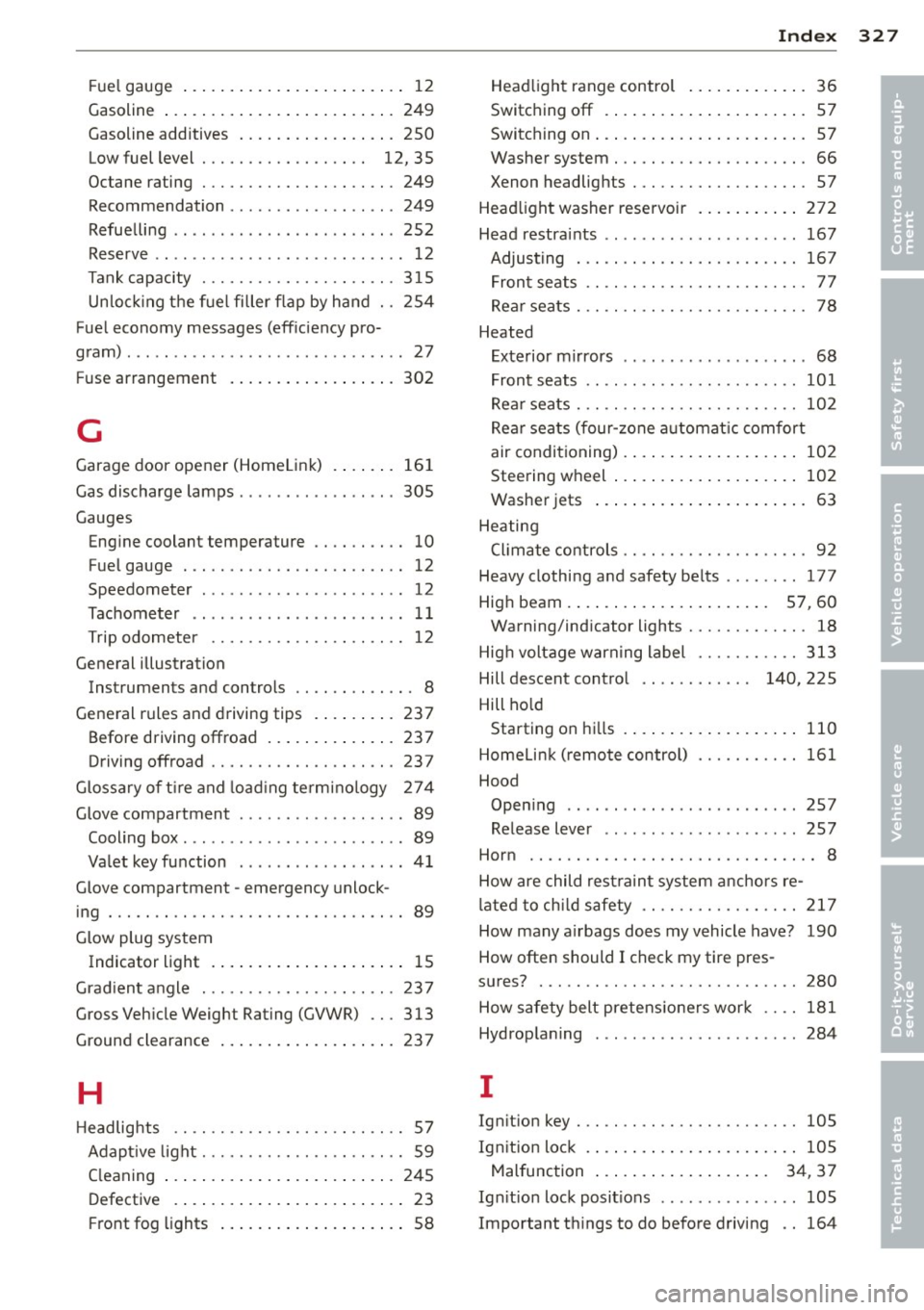
_______________________________ ___:I~n ~d ~e:.::x 327
Fuel gauge .... ... ...... ... .. .. .... 12
Gasoline ... ................ ... ... 249
Gasoline additives ....... .... ... .. . 250
Low fuel level . . . . . . . . . . . . . . . . . . 12, 35
Octane rating ............ .... .. ... 249
Recommendation .............. .... 249
Refuelling .. ... .. .. ...... .. .. .. .. . 252
Reserve .. ............ ...... .... ... 12
Tank capacity ............ .. .. .. .. . 315
Un loc kin g the fue l filler flap by hand . . 254
Fue l economy messages (efficiency pro-
gram) . .. .. .. .. ........ ... .. ... ... .. 27
Fuse arrangement ............ ... .. . 302
G
Garage door opener (Homelink) . ... .. . 16 1
Gas discharge lamps ........... .... .. 305
Gauges Engine coolant temperature .. .. .. .. .. 10
Fuel gauge . . . . . . . . . . . . . . . . . . . . . . . . 12
Speedometer . .............. ... ... . 12
Tachometer . . . . . . . . . . . . . . . . . . . . . . . 11
Trip odometer . . . . . . . . . . . . . . . . . . . . . 12
General illustration Instruments and controls . . . . . . . . . . . . . 8
General rules and driving tips .... .. .. . 237
Before driving off road ........ ... .. . 23 7
Driving offroad ........... .. .. .. .. . 237
Glossary of t ire and loading te rmino logy 274
Glove compartment . . . . . . . . . . . . . . . . . . 89
Cooling box . . . . . . . . . . . . . . . . . . . . . . . . 89
Va let key function ............... ... 41
Glove compartment - emergency unlock-
ing ... .. .. .. .. .. ........... .. .. .. .. 89
Glow plug system Indicator light .............. ... .. .. 15
Gradient angle ... ......... .... .. .. . 237
Gross Vehicle Weight Rating (GVWR) .. . 313
Ground clearance 237
H
Headlights .. .... ......... .... .. .. .. 57
Adapt ive light ............ .. .. .. .. .. 59
C leaning ... .. .............. ... ... 245
Defective .. .. .............. ... .... 23
Fr ont fog lights . . . . . . . . . . . . . . . . . . . . 58 Headlight range control
............. 36
Switching off .. .. .. .............. .. 57
Switching on ... .. .. ................ 57
Washer system . . . . . . . . . . . . . . . . . . . . . 66
Xenon headlights . . . . . . . . . . . . . . . . . . . 5 7
Headlight washer reservoir ......... .. 272
Head restraints .. ... ............... . 167
Adjust ing . .. .. .. ... .. .......... .. 16 7
Front seats . . . . . . . . . . . . . . . . . . . . . . . . 77
Rear seats . .. .. .. .. . ... ........... . 78
Heated Exterior mirrors . . . . . . . . . . . . . . . . . . . . 68
Front seats .. .. .. .. .. .... ....... .. 101
Rear seats . .. .. .. .. .. ........... .. 102
Rear seats (four-zone automat ic comfort
air conditioning) .. .. .............. . 102
Steering wheel ..... .............. . 102
Washer je ts . . . . . . . . . . . . . . . . . . . . . . . 63
Heating Climate controls .. .... ......... .. .. . 92
Heavy clothing and safety belts ........ 177
High beam... ..... .............. 57 , 60
Warning/ind icator lights . ....... .. .. . 18
High voltage warning label ....... .. .. 313
Hill descent control . . . . . . . . . . . . 140, 225
Hill ho ld
Starting on hills .... .............. . 110
Homelink (remote control)
Hood Opening 161
25 7
Release lever .. .. .. . .. ... ... ...... 257
Horn ........ .. .. .... ............. .. 8
How are child restraint system anchors re-
lated to child safety .... ...... ....... 217
How many a irbags does my vehicle have? 190
How often should I ch eck my tire pres-
sures? 280
How safety belt pretens ioners work .. .. 181
Hydroplaning ....... .......... ..... 284
I
Ignition key . .. .. .. ... ..... ....... .. 105
Ignition lock . ....... ............... 105
Malfunction . . . . . . . . . . . . . . . . . . . 34, 37
Ign it ion lock posit ions .......... .... . 105
Important things to do before driving .. 164
•
•