sensor AUDI Q7 2014 Owner´s Manual
[x] Cancel search | Manufacturer: AUDI, Model Year: 2014, Model line: Q7, Model: AUDI Q7 2014Pages: 340, PDF Size: 85.02 MB
Page 192 of 340
190 Airbag sys tem
-Always make sure the forward-facing
seat has been des igned and certified by
its manufacturer for use on a front seat
with a passenger front and side airbag .
- Never put the forward-facing child re
straint up aga inst or very near the instru
ment panel.
- Always move the passenger seat into its
rearmost position in the seat's fore and
aft adjustment range, as far away from
the a irbag as poss ible, before insta lli ng
the fo rward-facing chi ld restraint. The
b ackres t must be adjus ted to an upr igh t
posit io n.
- Make su re that the
PASSENGER AIR BAG
OFF
light co m es on and s tays on all the
t ime whenever the ignition is switched
on.
Advanced Airbag System components
The front passenger seat in your vehicle has a lot of very important parts of the Advanced
Airbag System in it. These parts include the
weight-sens ing mat, sensors, wiring, brack
ets, and more . The fu nction of the system in
the front passenger seat is checked by the
e lectronic control u nit when the ignit ion is on.
The control unit mo nitors the Advanced Air
bag Sys tem and turns the airbag indicator
light on when a ma lfunction in the system
components is detected . The function of the
ai rbag ind icator light is described in greater
detai l below. Because the front passenger
seat contains important parts of the Ad
vanced A irbag System, you must take care to
prevent it from be ing damaged . Damage to
the seat may prevent the Advanced A irbag for
the front passenger seat from doing its job in
a cra sh .
The front Advanced Airbag System
consists of the following:
- Crash senso rs in the front of the veh icle that
measu re ve hicle ac celera tion/de ce le ra ti on
to provide info rm ation to the Advanced Air
bag System abo ut the severity of the crash . -
An elect ronic contro l unit, with integrated
crash sensors for front and side impacts .
The control un it "decides" whether to fi re
the front a irbags based on the informat ion
received from the crash sensors. The contro l
un it also "decides" whether the safety belt
prete nsioners shou ld be act ivated .
- An Advanced A irbag w ith gas generator for
the dr iver inside the stee ring wheel hub .
- An Advanced A irbag w ith gas generator in
side the instrument panel for the front pas
senge r.
- A we ight-sensing mat under the up ho lstery
padding of the front passenger seat cushion
that measures the total weight on the seat .
The informat io n registe red is sent continu
ou sly to the elec troni c con tro l unit to regu
la te deployment of the front Advanced Air
bag on the passenger side .
- An airbag monitoring sys tem and in dicator
light in t he instr ument cluster
~ page 194.
-The PASSENGER AIR BAG OFF ligh t comes
on and sta ys on in the cen ter o f th e instr u
ment panel
~ page 194, fig . 210 and tells
you whe n the front Advanced Airbag on the
passenger side has been tu rned off .
- A sensor below the safety be lt latch for the
front seat passenger to meas ure the tension
on the safety be lt . The tension on the safety
be lt and the weight registered by the
weight-sensing mat he lp the control unit
"decide" whether the front airbag for the
front passenger seat should be turned off or
not
~ pag e 185, Child restraints on th e
front seat -some important things to
know.
- A senso r in the safety belt latch fo r th e d riv
er a nd fo r the front sea t passenger tha t
senses w het he r th at safety bel t is latched or
no t and transmi ts this information to the
electronic control unit.
A WARNING
Damage to the fr ont passenger seat can
p revent the front airbag from work ing
properly.
-
Page 193 of 340
-Improper repair or disassembly of the
front passenger and driver seat will pre
vent the Advanced Airbag System from
functioning properly .
- Repairs to the front passenger seat must
be performed by qualified and properly
trained workshop personnel.
- Never remove the front passenger or
dr iver seat from the veh icle .
- Never remove the upholstery from the
front passenger seat .
- Never disassemble or remove parts from
the seat or disconnect wires from it.
- Never carry sharp objects in your pockets
or place them on the seat. If the weight
sensing mat in the passenger seat is
punctured it cannot work properly.
- Never carry things on your lap or carry
objects on the passenger seat . Such
items can increase the weight registered
by the weight-sens ing mat and send the
wrong info rmation to the airbag control
uni t.
- Never store items under the front pas
senger seat. Parts of the Advanced Ai r
bag System under the passenge r seat
cou ld be damaged, prevent ing them and
the a irbag system from working proper
ly .
- Never place seat covers or replacement
upholste ry that have not been specifical
ly approved by A udi on the front seats.
- Seat covers can prevent the A dvanced
Airbag System from recognizing child re
straints or occupants on the front pas
senger seat and prevent the side airbag in the seat backrest from deploy ing prop
erly.
- Never use cush ions, pillows, blankets or
similar items on the front passenger
seat . The add itiona l padd ing will prevent
the weight-sens ing mat in the seat from
accu rately reg iste ring the ch ild restra int
o r person on the se at and prevent the
Advance d Airbag System from func tion
ing properly .
-If you mus t use a child restra int on the
front passenger seat and the ch ild re-
A irbag system 19 1
straint manufacture r's instructions re
quire the use of a towel, foam cushion or
something e lse to properly position the
child restraint, make certain that the
PASSENGER AIR BAG OFF light comes
on and stays on whenever the ch ild re
s t raint is installed on the front passen
ge r seat.
- If the
PASSENGER AIR BAG OFF light
does not come on and stay on, immed i
a tely insta ll child rest raint in a rear seat
ing position and have the ai rbag system
inspected by your authorized Audi dealer .
How the Advanced Airbag System
components work together
The front Advanced Airbag System and the
s ide airbags supp lement the protection of
fered by the front three-poi nt safety belts
with pretensioners and load limiters and the
adjustable head res traints to help reduce the
r isk of inj ury in a wide range of ac ciden t and
c rash situations. Be s ure to read the impor
tant information about safety and heed the
WARNINGS in this chapter.
Deployment of the Adv a need A irbag System
and t he activation of the safe ty belt preten
sioners depend on the deceleration measured
by the crash sensors and registered by the
electronic contro l unit. Crash severity depends
on speed and dece leration as we ll as the mass
and stiffness of the veh icle or object involved
in the crash .
When the e lectronic control unit registers a
l ow severity crash and the safety belt is being
used, the airbag will not deploy. If the safety
belt is not being used, the first stage deploys,
followed by the second stage after a much lat er t ime in the crash sequence.
If the electron ic control unit registers a crash
of medium severity , the first stage of the air
bag deploys followed by the second stage at a
much later time in the crash sequence -re
gard less of whether the safety belt is be ing
u sed or not . In highe r sever ity crashes as reg
iste red by the electronic con trol unit, both the
II>
•
•
Page 196 of 340
194 Airbag sys te m
aw ay by ge tting out of the vehicle or
o pening windows or doors.
- If you are in a collision in which airbags
deploy, wash your hands and face with
mild soap and water before eating.
- Be careful not to get the dust into your
eyes, or into any cuts or scratches.
- If the residue should get into your eyes,
flush them with water.
Monitoring the
Advanced Airbag
System
Airbag monitoring indicator light
Two separate indicators monitor the function
of the Advanced Airbag System: the airbag
monitoring indicator Light and the
PASSEN
GER AIR BAG OFF
light.
The Advanced Airbag System (including the
e lectronic control un it, sensor circuits and sys
tem wiring) is monitored cont inuously to
make sure that it is functioning properly
whenever the ignit ion is on . Each t ime you
turn on the ignition, the airbag monitoring in
d icator light
I will come on fo r a few seconds
(self diagno stics) .
The system mu st be inspected when the
indicator light
I :
- does not come on when the ignit io n is
switched on
- does not go out a few seconds after you
have swi tched on the ign ition, o r
- comes on while driving
If an airbag system malfunct ion is detected,
the ind icator light will fi rst start flash ing to
catch the driver's attention and then stay on
continuously to serve as a constant reminder
to have the system inspected immediately .
If a malfunction occurs that turns the front
a ir bag on the passenger side off, the
PAS SEN
GER AIR BAG OFF
li ght w ill come on and stay
on whenever the ignition is on.
A WARNING
An a irbag system that is not functioning
properly cannot provide supplemental pro
tection in a frontal crash.
- If the airbag ind icator light¢
page 16
comes when the veh icle is being used,
have the system inspected immediately
by your authori zed Audi dealer. It is pos
sib le that the airbag will infla te when it
is not supposed to, or will not infla te
when it should .
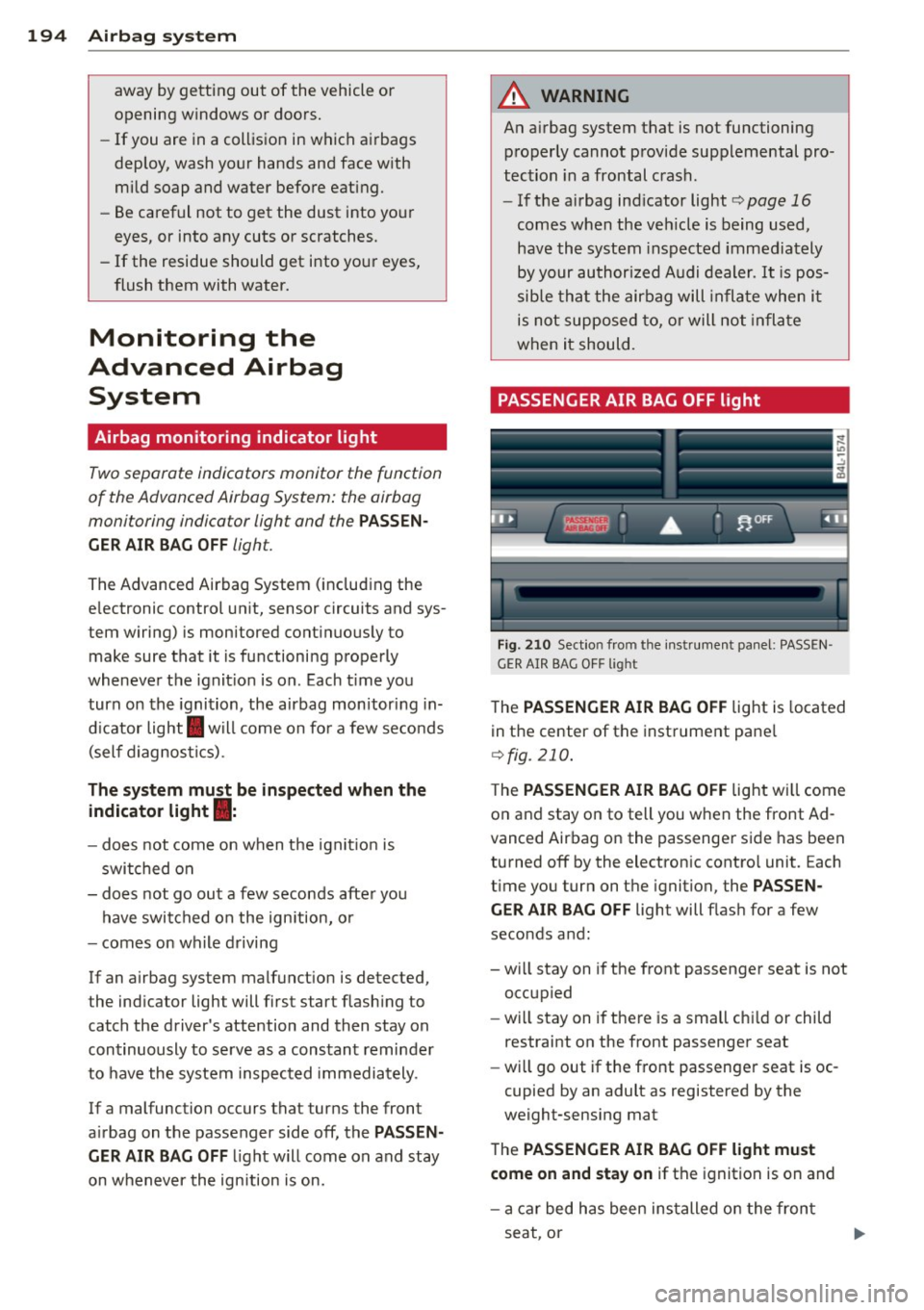
PASSENGER AIR BAG OFF light
-
.r--------------,
------------------
Fig. 210 Sect io n from the instru men t pa nel: PASS EN
GER AIR BAG OFF lig ht
The PASSENGER AIR BAG OFF light is located
in the center of the instrument pane l
¢fig . 210.
T he PAS SENGER AIR BAG OFF light wi ll come
on and stay on to tell you w hen the front Ad
vanced Airbag on the passenger side has been
turned off by the electron ic contro l unit. Each
t ime you turn on t he ignition, the
PASSEN
GER AIR BAG OFF
light will flas h for a few
seconds and:
- w ill stay on if the front passenger seat is not
occupied
- will stay on i f the re is a small chi ld or child
restraint on the front passenger seat
- will go out if the front passenger seat is oc
cupied by an adult as registered by the
weight-sensing mat
T he
PASSENGER AIR BAG OFF light must
come on and sta y on
if the ignition is on and
- a car bed has been ins talled on the fron t
seat, or
Page 197 of 340
-a rearward-facing child restraint has been
installed on the front passenger seat, or
- a forward -facing child restraint has been in
stalled on the front passenger seat, or
- the weight registered on the front passen
ger seat is equa l to or less than the com
bined weight of a typical 1 year-old restrain
ed in one of the rear-facing or forward-fac
ing infant restraints listed in Federal Motor
Vehicle Safety Standard 208 w ith which the
Advanced Airbag System in your vehicle was
certified .
If the front passenger seat is not occupied,
the front airbag will not deploy, and the
PAS ·
SENGER AIR BAG OFF
light will stay on. Nev
er install a rearward-facing child restra int on
the front passenger seat, the safest place for
a child in any kind of child restraint is at one
of the seating positions on the rear seat
¢ page 185, Child restraints on the front seat
- some important things to know
and
¢ page 204, Child Safety.
If the PASSENGER AIR BAG OFF light comes
on
when one of the conditions listed above is
met, be sure to check the light regularly to
make certain that the
PASSENGER AIR BAG
OFF
li ght stays on continuous ly whenever the
ignition is on. If the
PASSENGER AIR BAG
OFF
light does not appear on and does not
stay on all the time, stop as soon as it is safe
to do so and
- reactivate the system by turning the ignition
off and then turning it on again;
- remove and reinstall the chi ld restraint .
Make sure that the child restraint is properly
installed and that the safety be lt for the
front passenger seat has been correctly
routed through the child restraint as descri
bed in the chi ld restraint manufacturer's in
st ructio ns;
- make sure that the convert ible locking fea
ture on the safety belt for the front passen
ger seat has been activated and that the
sa fety belt has been pulled tight. The belt
must not be loose or have loops of slack so
that the sensor below the safety belt latch
on the seat can do its job
¢ page 214.
Airbag system 195
-make sure that things that may increase the
weight of the child and chi ld safety seat are
not being transported on the front passen
ger seat;
- make s ure that the safety belt tension sen
sor is not blocked. Shake the safety belt
latch on the front passenger seatback and
forth;
- If a strap or tether is be ing used to tie the
child safety seat to the front passenger
seat, make sure that it is not so tight that it
causes the weight-sensing mat to measure
more weight than is actually on the seat.
If the PASSENGER AIR BAG OFF light still
does not come on
and does not stay on con
t inu ously (when the ignition is switched on),
- take the child restraint off the front passen-
ger seat and install it proper ly at one of the
rear seat positions . Have the airbag system
inspected by you r authorized Aud i dealer
immed iate ly.
- move the ch ild to a rear seat position and
make sure that the child is properly restra in
ed in a child restraint that is appropriate for
its size and age.
The
PASSENGER AIR BAG OFF light should
NOT come on when the ignition is on and an
adult is s itting in a proper seating position on
the front passenger seat. If the
PASSENGER
AIR BAG OFF
light comes on and stays on or
flashes for about 5 seconds wh ile driving, un
der these circumstances, make sure that:
- the adult on the front passenger seat is
properly seated on the cente r of the seat
cushion with his or her back up against the
backrest and the backrest is not reclined
¢ page 165, Proper occupant seating posi
tions,
- the adult is not taking weight off the seat by
holding on to the passenger assist handle
above the front passenger door or support
ing their weight on the armrest,
- the safety be lt is being properly worn and
that there is not a lot of slack in the safety
be lt webb ing, .,..
•
•
Page 200 of 340
198 Airbag system
@ For the sake of the environment
Undep loyed airbag modu les and preten
sioners might be classified as Perchlorate Material -special handling may app ly, see
www.dtsc.ca.gov/haza rdouswaste/per chlorate. When the vehicle or parts of the
restraint system including airbag modules
and safety belts w ith pretens ioners are
scrapped, all applicable laws and regula
tions must be observed. Your authori zed
Audi dea ler is familiar with these requ ire
ments and we recommend that you have
your dea ler perform this service for you.
Other things that can affect Advanced
Airbag performance
Changing the vehicle's suspension system can
change the way that the Advanced Airbag Sys
tem performs in a crash. For example, using
tire-r im combinations not approved by Aud i,
l owering the vehicle, changing the stiffness o f
the suspension, including the springs, s uspen
sion struts, shock absorbers etc. can change
the forces that are measured by the airbag
sensors and sent to the electronic control
un it. Some suspension changes can, for exam
ple, increase the force levels measured by the
sensors and make the airbag system deploy in
crashes in wh ich it would not deploy if the
changes had not been made. Other kinds of
changes may reduce the force levels meas
u red by the sensors and prevent the airbag
from deploying when it should .
The sensors in the safety belt buckle for the
driver and front passenger sea t tell the elec
tronic control module if the safety belt is
latched or not. If the safety belt is being used,
the front airbag will deploy at a slightly high
er rate of vehicle deceleration than if the safe
ty belt is not being used. Therefore, in a par
ticular collision, it is possible that an airbag
will not deploy at a seating position where the safety belt is being used but will inflate at the
position where the safety belt is not being
used.
It is important that nothing interfere
with the safety belt buckles so that the sen- sors can send the correct info
rmation about
safety belt use to the electronic control unit.
.&_ WARNING
-
Changing the vehicle's suspension includ- ing use of unapproved tire-rim combina
tions can change Advanced Airbag per
formance and increase the risk of serious
personal injury in a crash.
- Never install suspension components
that do not have the same performance
characteristics as the components origi
nally installed on your vehicle.
- Never use tire-rim combinations that
have not been approved by Audi.
&_ WARNING
--
Items stored between the safety be lt
buckle and the center console can cause
the sensors in the buckle to send the
wrong information to the e lectronic con
trol module and prevent the Advanced Air
bag System from working properly.
- Always make sure that nothing can inter
fere with the safety belt buckles and that
they are not obstructed.
Side airbags
Description of side airbag s
The airbag system can provide supplemental
protection to properly restrained occupants.
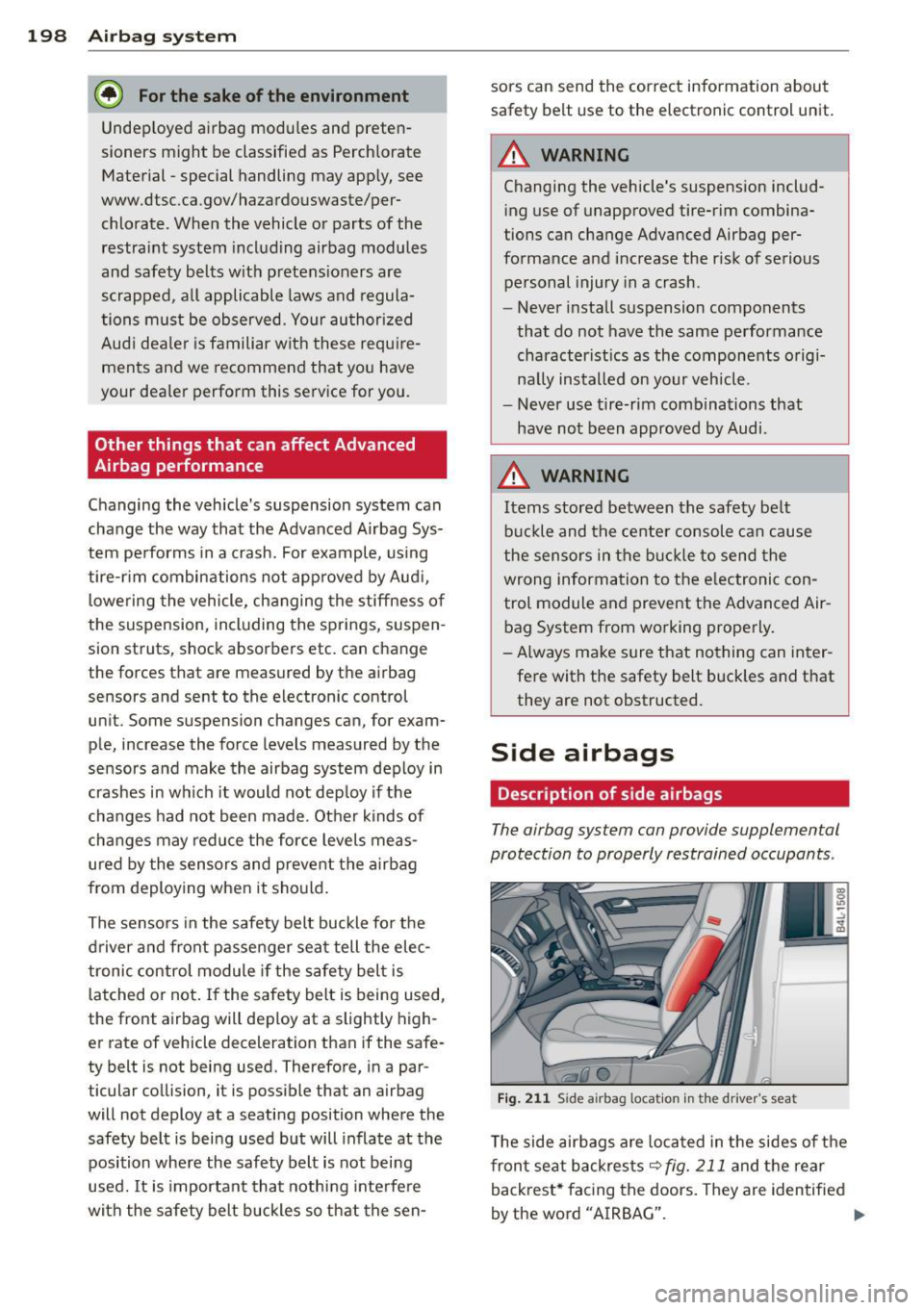
Fig. 211 Side airbag location in th e drive r's seat
The side airbags are located in the sides of the
front seat backrests
~fig. 211 and the rear
backrest* facing the doors. They are identified
by the word "AIRBAG". ....
Page 201 of 340
The side a irbag syste m basicall y consists o f:
-the e lectronic control module and external
s ide impact senso rs
- the two side airbags located in the sides of
the front backrests
- two rear side airbags (as an ordered
option)
-the a irbag warning light in the in strument
cluster .
The airbag system is monitored electron ically
t o make certain that it is functioning properly
at all times . Each time you turn on the igni
tion, the airbag system indicator l ight will
come on for a few seconds (self diagnostics) .
The s ide a irbag system supplements the safe
ty belts and can help to reduce the risk of in
jury to the driver's, front and rear* passeng er's upper torso on the side of the veh icle that
i s struck in a side collision. The a irbag dep loys
only in s ide impacts and on ly when the veh icle
acceleration registered by the control unit is
high enough. If this rate is below the refer
ence value programmed into the control unit,
the side airbags will not be triggered, even
though the car may be badly damaged as a re
sult of the collision. It is not possible to de
fine an airbag trigger ing range that will cover
every possible angle of impact, since the cir
cumstances will vary considerably between
one co llision and another. Important factors
include, for examp le, the natu re (hard o r soft)
of the impacting object, the ang le o f impact ,
vehicle speed, etc.
¢ page 200, Important
safety instructions on the side airbag system .
Aside from their normal safety function , safe
ty belts work to he lp keep the driver or front
passenger in position in the event of a side
coll ision so that the side airbags can provide
protection.
The airbag system is
not a substitute for your
safety belt . Rather, it is part of the overall oc
cupant restraint system in your vehicle . Al
ways remember that the side airbag system
can only help to protect you if you are wear ing
your safety belt and wear ing it properly . Th is
i s another reason why you should always wear
your safety belts, not just because the law re-
A irbag system 199
quires you to do so c;> page 174, General
notes .
It is important to remembe r that w hile the
s u pplementa l side airbag system is designed
to reduce the likelihood of serious injuries,
other injuries, for example, swelling, bruising,
and minor abrasions can also be associated
with deployed side airbags. Remember too,
s ide airbags will deploy only once and only in
certain kinds of accidents -your safety belts
are always there to offer protection .
Vehicle damage, repair costs or even the lack
of veh icle damage are not necessarily an indi
cation of over -sensitive or failed airbag activa
t ion. In some collis ions, both front and side
airbags may inflate. Remember too, that air bags will deploy only once and only in ce rtain
ki nds of col lis ions -yo ur safe ty belts are al
ways there to offer protection in those acc i
dents in which airbags are not supposed to
deploy or when they have a lready deployed.
The side airbag system will n ot deploy:
- when t he ignit io n is tu rned off
- in side co llisions when the acceleration
meas ured by the sensor is too low
- in front-end collisions
- in rear-end collisions
- in rollovers.
In some types of accidents the front airbags,
side curtain airbags and side ai rbags may be
triggered together.
A WARNING
- Safety belts and the airbag system will
only provide protection when occupants
are in the proper seating position
¢page 200.
-If the airbag ind icator light ¢ page 16
comes when the veh icle is being used,
have the system inspected immediately
by your authori zed Audi dealer.
It is pos
sible tha t the airbag will inflate when it
is not supposed to, or will not infla te
when it should. •
•
Page 203 of 340
-Objects between you and the airbag can
increase the risk of injury in an accident
by interfering with the way the airbag
unfolds or by being pushed into you as
the airbag inflates .
- Never place or attach accessories or
other objects (such as cupholders, tele
phone brackets, or even large, bulky
objects) on the doors, over or near the
area marked "AIRBAG" on the seat
backrests.
- Such objects and accessories can be
come dangerous projectiles and cause
injury when the supplemental side air
bag deploys .
- Never carry any objects or pets in the
deployment space between them and
the airbags or allow children or other
passengers to travel in this position .
- Always use the built -in coat hooks only
for lightweight clothing . Never leave any
heavy or sharp-edged objects in the
pockets that may interfere with side air
bag deployment and can cause personal
injury in an accident.
- Always prevent the side a irbags from be
ing damaged by heavy objects knocking
against or hitting the sides of the seat
backs.
- The airbag system can only be trigge red
once.
If the airbag has been triggered,
the system must be replaced by an au
thorized Audi dealership .
- Damage (cracks, deep scratches etc .) to
the original seat covers or to the seam in
the area of the side airbag module must
always be repaired immediately by an au
thorized Audi dealer .
- If children are seated improperly, their
risk of injury increases in the case of an
accident ~ page 204 , Child Safety .
- Never attempt to modify any compo
nents of the airbag system in any way .
- In a side collision, side airbags will not
function properly if sensors cannot cor rectly measure increasing air pressure in
side the doors when air escapes through
Airbag system 201
larger, unclosed openings in the door
panel.
- Never drive with interior door trim pan
els removed .
- Never drive when parts have been re
moved from the inside door panel and
the open ings they leave have not been
properly closed.
- Never drive when loudspeakers in the
doors have been removed unless the
speaker holes have been p roperly
closed.
- Always make certain that openings are
covered or filled if additiona l speakers
or other equipment is installed in the inside door panels .
- Always have work on the doors done by
an authorized Audi dealer or qualified
workshop.
Side curtain airbags
Description of side curtain airbags
The side curtain airbags can provide supple
mental protection to properly restrained oc
cupants .
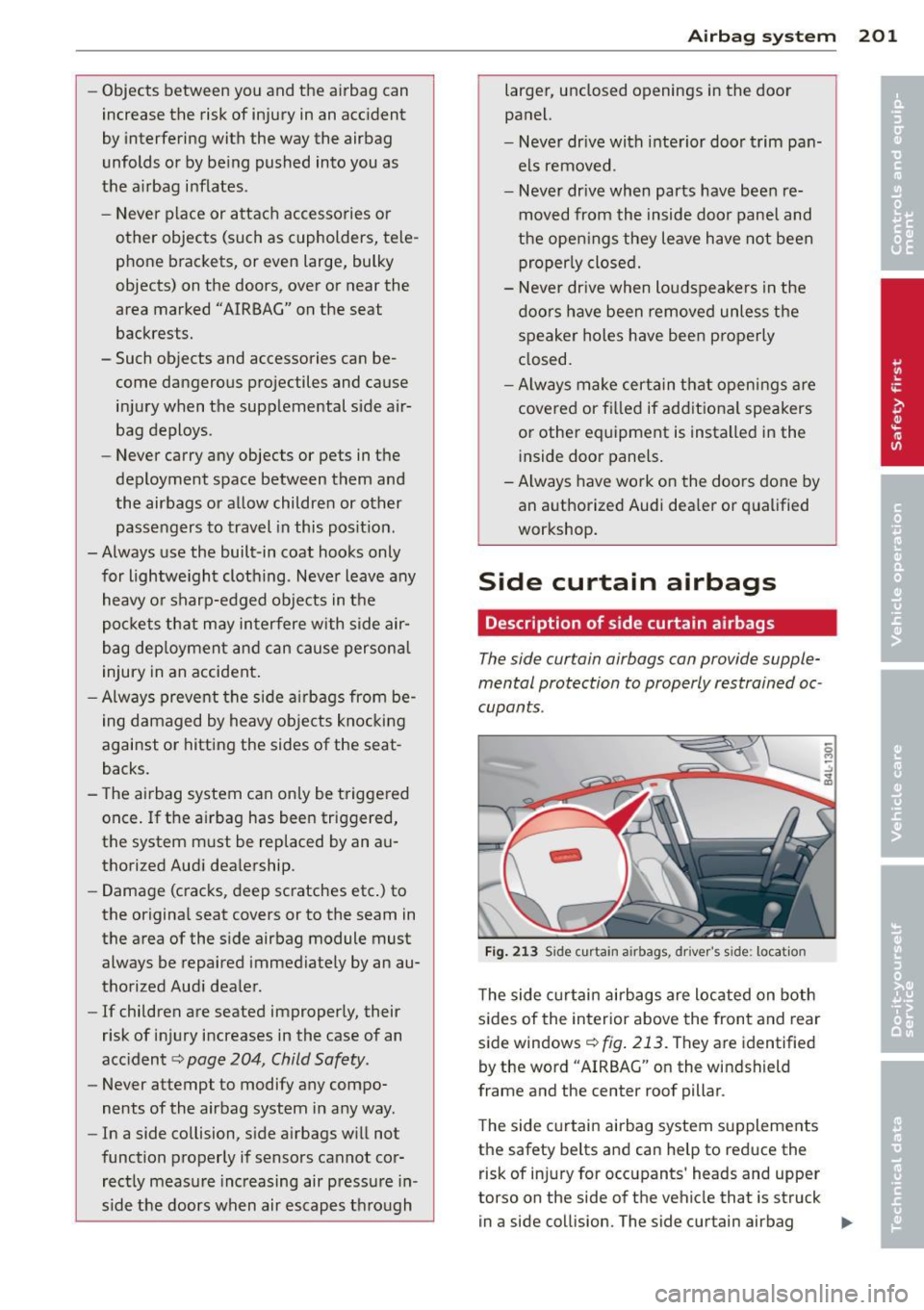
Fig. 213 Side curta in a irbags, driver's s ide: locatio n
The side c urtain airbags are located on both
sides of the interior above the front and rear
side w indows ~fig . 213 . They ar e identified
by the word "AIRBAG" on the windshield
frame and the center roof pillar .
The side curtain airbag system supplements
the safety belts and can help to reduce the
risk of injury for occupants' heads and upper
torso on the side of the vehicle that is struck
in a side collision. The side cur tain airbag ..,.
Page 204 of 340
202 Airbag system
inflates in side impacts and only when the ve
hicle acceleration registered by the control
unit is high enough. If this rate is below the
reference value programmed into the contro l
unit, the side airbags will not be triggered,
even though the car may be badly damaged as
a result of the collision . It is not possible to
define an airbag triggering range that will
cover every possible angle of impact, since the
circ umstances w ill vary cons iderably between
one co llision and another. Important factors
include, for examp le, the nat ure (hard or soft)
of the impacting object, the angle of impact,
vehicle speed, etc. c:>
page 202, How side cur
tain airbags work.
Aside from their normal safety function, safe
ty belts work to he lp keep the driver or front
passenger in position in the event of a co lli
sion so that the side curta in airbags can pro
vide protection.
The airbag system is not a substitute for your
safety belt. Rather, it is part of the overall oc
cupant restraint system in your ve hicle. Al
ways remember that the airbag system can
only help to protect you if you are wearing
your safety belt a nd wear ing it prope rly. Th is
is ano ther reason why you shou ld a lways wear
your safety bel ts, not just beca use the law re
qu ires you to do soc:>
page 174, General
notes.
It is important to remember that whi le the
side curta in a irbag system is des igned to he lp
redu ce the like lihood of serious injuries, othe r
injuries, fo r example, swell ing, bruising, and
minor abrasions can also be associated wit h
these airbags upon deployment. Remember
too, these a irbags w ill deploy on ly once and
only in certain kinds of accidents -your safety
be lts are a lways there to offer protection .
The side curtain airbag system basically
con sists of :
-The electronic control module and external
side impact sensors
- The side curtain airbags above the front and rear side w indows - The airbag indicator light in the instrument
panel
T he airbag system is mon itore d elec tronically
to make certain i t is func tioning properly at all
times . Each t ime you turn on the ignition, the
airbag system indicator light will come on for
a few seconds (sel f diagnostics).
The side curtain airbag is not activated:
- if the ignition is turned off
- in side co llision s when the accele ration
meas ured by the sensor is too low
- in rear-end col lisions .
A WARNING
-Safety belts and the airbag system will
only provide pro te ction when occupant s
are i n the proper seating posi tion
<=>page 72, General recommendations.
- If th e airbag ind ica tor light <=>page 16
comes when the veh icle is being used,
have the system inspected immediately
by your authorized A udi dealer. It is pos
sible that the airbag will inflate when it
is not supposed to, or will not inflate
when it should .
How side curtain airbags work
Side curtain airbags can work together with
side airbags to help reduce the risk of head
and upper torso injuries for occupants who
are properly restrained .
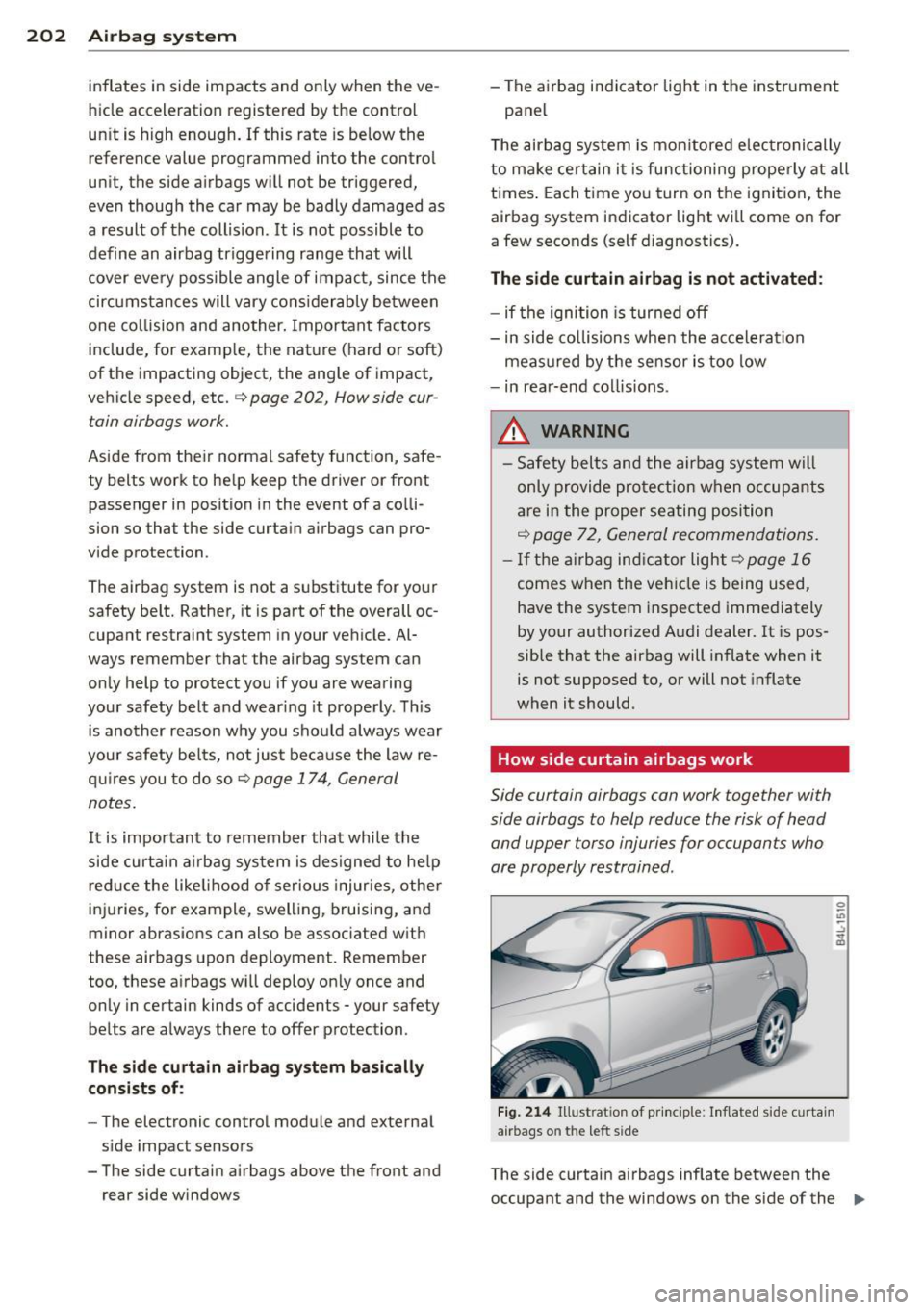
Fig. 2 14 Illust rat ion of p rincip le : I n flated side curtai n
airbags o n th e left side
The side curtain airbags inflate between the
occupant and the windows on the s ide of the
IJ>
Page 207 of 340
-Always install rear-facing child safety
seats on the rear seat.
- If you must install a rearward facing
child safety seat on the front passenger
seat in exceptional circumstances and
the
PASSENGER AIR BAG OFF light does
not come on and stay on, immediately
install the rear-facing child safety seat in
a rear seating position and have the air
bag system inspected immediately by
your Audi dealer.
_& WARNING
If, in exceptional circumstances, you must
install a forward-facing child restraint on
the front passenger's seat:
- Always make sure the forward-facing
seat has been designed and certified by its manufacturer for use on a front seat
with a passenger front and side airbag.
- Always follow the manufacturer's in
structions provided with the child safety
seat or carrier.
- Always move the passenger seat into its
rearmost position in the seat's fore and
aft adjustment range, as far away from
the airbag as possible before installing
the child restraint. The backrest must be
adjusted to an upright position .
- Always make sure that the
PASSENGER
AIR BAG OFF
light comes on and stays
on all the time whenever the ignition is
switched on.
(D Tips
Always replace child restraints that were
installed in a vehicle during a crash. Dam
age to a child restraint that is not visible
could cause it to fail in another collision
situation.
Advanced front airbag system and children
Your vehicle is equipped with an "Advanced
Airbag System" in compliance with United
States Federal Motor Vehicle Safety Standard
Child Safety 205
(FMVSS) 208 as applicable at the time your
vehicle was manufactured.
The Advanced Airbag system in your vehicle
has been certified to meet the "low-risk" re
quirements for 3- and 6-year old children on
the passenger side and small adults on the driver side. The low risk deployment criteria
are intended to reduce the risk of injury
through interaction with the airbag that can
occur, for example, by being too close to the
steering wheel and instrument panel when
the airbag inflates . In addition, the system
has been certified to comply with the "sup
pression" requirements of the Safety Stand
ard, to turn off the front airbag for infants up
to 12 months who are restrained on the front
passenger seat in child restraints that are list
ed in the Standard.
Even though your vehicle is equipped with an
Advanced Airbag system, all children, espe cially those 12 years and younger, should al
ways ride in the back seat properly restrained
for their age and size. The airbag on the pas
senger side makes the front seat a potentially dangerous place for a child to ride . The front
seat is not the safest place for a child in a for
ward-facing child safety seat. It can be a very
dangerous place for an infant or a larger child
in a rearward-facing seat .
Advanced Airbags and the weight
sensing mat in the front seat
The Advanced Airbag System in your vehicle
detects the presence of an infant or child in a
child restraint on the front passenger seat us
ing the weight -sensing mat in the seat cush
ion and the sensor below the safety belt latch
on the front passenger seat that measures the
tension on the safety belt.
The weight -sensing mat measures total
weight of the child and the child safety seat
and a child blanket on the front passenger seat. The weight on the front passenger seat
is related to the design of the child restraint
and its "footprint", the size and shape of the
bottom of the child restraint as it sits on the ..,.
•
•
Page 208 of 340
206 Child Saf ety
seat. The weight of a child restraint and its
"footprint" vary for different kinds of chi ld re
straints and for the d ifferent models of the
same kind of child restraint offered by child
restraint manufacturers .
The weight ranges for the individual types, makes and mode ls of ch ild restra ints that the
NHTSA has specified in the Safety Standard
together with the weight ranges of typical in
fants and typical 1 year-old child have been
stored in the control unit of the Advanced A ir
bag System. When a ch ild restrai nt is being
used on the front passenger seat with a typi
cal 1 yea r-old chi ld, the Advanced Airbag Sys
tem compares the weight measured by the
weight sensing mat with the information stor
ed in the electronic contro l unit.
The electron ic cont rol unit a lso registers the
tension on the front passenger safety belt.
The tension on the safety be lt for the front
passenger seat will be different for an adult
who is properly using the safety belt as com
pared to the tension on the belt when it is
used to attach a child restraint to the seat.
The sensor below the latch for the safety belt
for the front seat passenger measures the
tension on the be lt . T he input from this sen
sor is then used with the we ight to "dec ide",
whe ther there is a ch ild restraint w ith a typ ica l
1 year-o ld child on the front passenger seat
and whether or not the airbag must be turned
off .
Child restraints and Advanced Airbags
Regardless of the child restraint that you use,
make sure that it has been certified to meet
United States Federal Motor Vehicle Safety
Standards and has been certified by its manu
facturer for use w ith an airbag . Always be sure
that the ch ild restraint is p roperly insta lled at
one of the rear seat ing pos itions . If in excep
tional c ircu mstances you must use it on the
front passenger seat, carefu lly read all of the
info rmation on c hild safety and Advanced Air
bags and heed a ll of the applicable WARN
INGS. Make certain that the child restraint is
correctly recognized by the weig ht-sensing mat inside the front passenger seat, that the
front passenger airbag is turned off and that
the a irbag status is a lways correct ly signa led
by the
PAS SENGER AIR BAG OFF light.
Many types and models of child restraints
have been available over the years, new mod
els are introduced regu larly incorporating new
and improved des igns and o lder models are
taken out of product ion. Ch ild restraints are
not standard ized . Child restraints of the same
type typically have d ifferent weights and sizes
and different 'footpr ints,' the size and shape
of the bo ttom of the ch ild restra int that sits
o n the seat, when they are inst alled on a vehi
cle seat. These d ifferences make it v irtually
impossible to certify compliance with the re
quirements for advanced airbags with each
and every ch ild restraint that has ever been
sold in the past or will be sold over the course of the useful life of your veh icle.
For this reason, the United States National
Highway Traffic Safety Administrat ion has
published a list of spec ific type, makes and
models of child restraints that mus t be used
to certify comp liance of the Advanced Airbag
System i n your veh icle w ith the suppression
requirements of Federal Motor Vehicle Safety
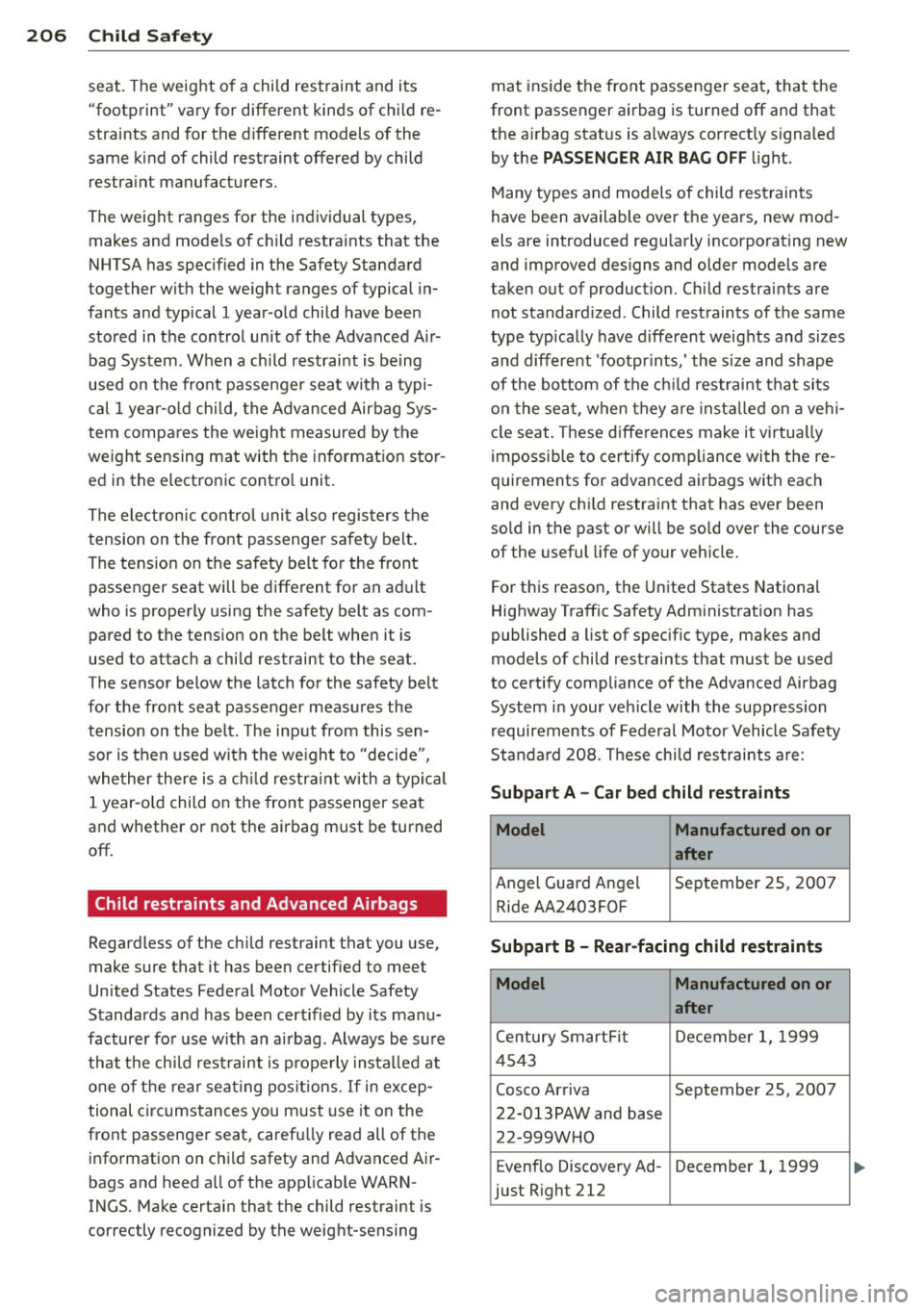
Standard 208. These chi ld restraints are :
Subpart A - Car bed child restraints
Model Manufactured on or
after
Angel Guard A ngel September 25 , 200 7
R ide AA 2403FOF
Subpart B -Rear-facing child restraints
Model Manufactured on or
after
Century Smart Fit December 1, 1999
4543
Cosco Arriva September 25, 2007
22-013PAW and base 22-999WHO
E venflo Discovery Ad- December 1, 1999
just Right 212