airbag AUDI Q7 2014 Owner´s Manual
[x] Cancel search | Manufacturer: AUDI, Model Year: 2014, Model line: Q7, Model: AUDI Q7 2014Pages: 340, PDF Size: 85.02 MB
Page 214 of 340
212 Child Safety
to the backrest on the vehicle seat. Ad
just or remove the rear seat head restraint if it is difficult to install the
child seat with the head restraint in place
<=> page 78 . Install the head restraint
again immediately once the child seat is
removed. Driving without head restraints
or with head restraints that are not prop erly adjusted increases the risk of serious
or fatal neck injury dramatically.
- Always read and heed all WARNINGS
whenever using a child restrained in ave
hicle is being used<=>
page 174, Safety
belts,
<=> page 183, Airbag system and
i=> page 204, Important things to know.
A WARNING
If exceptional circumstances require the
use of a forward-facing child restraint on
the front passenger's seat, the child's safe
ty and well-being require that the follow ing special precautions be taken:
- Make sure the forward-facing seat has
been designed and certified by its manu
facturer for use on a front seat with a passenger front and side airbag.
-A lways follow the manufacturer's in
structions provided with the child safety
seat or infant carrier.
- Always move the front passenger seat in
to the rearmost position of the passen
ger seat's fore and aft adjustment range, and as far away from the airbag as possi
ble before installing the child restraint.
- Always make sure that nothing prevents
the front passenger's seat from being
moved to the rearmost position in its
fore and aft adjustment range.
- Always make sure the backrest is in an
upright position.
- Make sure that the
PASSENGER AIR BAG
OFF
light comes on and stays on all the
time whenever the ignition is switched
on.
- If the light does not stay on, perform the
checks
<=> page 194, Monitoring the Ad
vanced Airbag System.
-
- Take the child restraint off the front pas
senger seat and install it properly at one
of the rear seat positions if the
PASSEN
GER AIR BAG OFF
light does not stay on
whenever the ignition is switched on.
Booster seats and safety belts
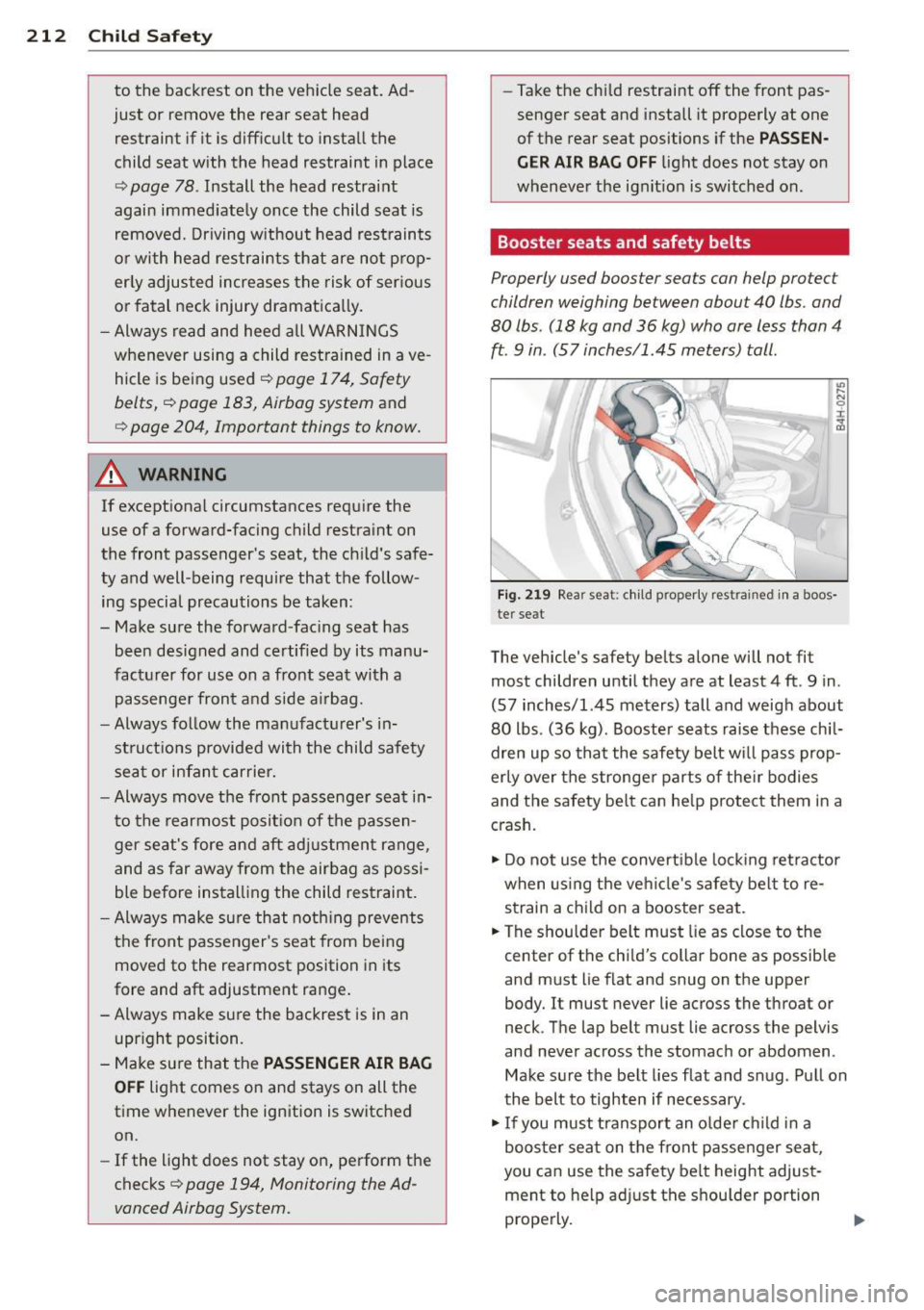
Properly used booster seats can help protect
children weighing between about 40 lbs. and
80 lbs. (18 kg and 36 kg) who are less than 4
ft.
9 in . (57 inches/1 .45 meters) tall.
"' ....
"' 0 ±
o5
Fig. 219 Rear seat: c hild properly restrained in a boos
te r seat
The vehicle 's safety belts alone will not fit
most children until they are at least 4 ft. 9 in .
(57 inches/1.45 meters) tall and weigh about
80 lbs. (36 kg). Booster seats raise these chil
dren up so that the safety belt will pass prop
erly over the stronger parts of their bodies
and the safety belt can help protect them in a
crash.
.,. Do not use the convertible locking retractor
when using the vehicle's safety belt to re
strain a child on a booster seat.
.. The shoulder belt must lie as close to the
center of the child's collar bone as possible
and must lie flat and snug on the upper
body. It must never lie across the throat or
neck . The lap be lt must lie across the pelvis
and never across the stomach or abdomen .
Make sure the belt lies flat and snug. Pull on
the belt to tighten if necessary .
.,. If you must transport an older child in a
booster seat on the front passenger seat,
you can use the safety belt height adjust
ment to help adjust the shoulder portion
properly.
Page 215 of 340
~ Secure unused safety belts on the rear seat
¢ page 209.
Children up to at least 8 years old (over 40
lbs. or 18 kg) are best protected in child safe
ty seats designed for their age and weight. Ex perts say that the skeletal structure, particu
larly the pelvis, of these children is not fully
developed, and they must not use the vehicle
safety belts without a suitable child restraint .
It is usually best to put these children in ap
propriate booster seats. Be sure the booster
seat meets all applicable safety standards .
Booster seats raise the seating position of the
child and reposition both the lap and shoulder
parts of the safety belt so that they pass
across the child 's body in the right places. The
routing of the belt over the child's body is very
important for the child's protection, whether
or not a booster seat is used . Children age 12
and under must always ride in the rear seat.
Children who are at least 4
ft . 9 in. (57 in
ches/1.45 meters) tall can generally use the
vehicle's three point lap and shoulder belts .
Never use the lap belt portion of the vehicle's
safety belt alone to restrain any child, regard
less of how big the child is. Always remember
that children do not have the pronounced pel
vic structure required for the proper function
of lap belt portion of the vehicle's three point
lap and shoulder belts. The child's safety ab
solutely requires that a lap belt portion of the
safety belt be fastened snugly and as low as
possible around the pelvis. Never let the lap
belt portion of the safety belt pass over the
child's stomach or abdomen.
In a crash, airbags must inflate within a blink
of an eye and with considerable force. In order
to do its job, the airbag needs room to inflate
so that it will be there to protect the occupant
as the occupant moves forward into the air bag.
A vehicle occupant who is out of position and
too close to the airbag gets in the way of an inflating airbag. When an occupant is too
close, he or she will be struck violently and
Child Safety 213
will receive serious or possibly even fatal in
jury.
In order for the airbag to offer protection, it is
important that all vehicle occupants, especial
ly any children, who must be in the front seat
because of exceptional circumstances, be
properly restrained and as far away from the
airbag as possible . By keeping room between
the child's body and the front of the passen
ger compartment, the airbag can inflate com
pletely and provide supplemental protection
in certain frontal collisions .
_&. WARNING
Not using a booster seat, using the boos
ter seat improperly, incorrectly installing a booster seat or using the vehicle safety
belt improperly increases the risk of seri
ous personal injury and death in a collision
or other emergency situation. To help re
duce the risk of serious personal injury
and/or death:
- The shoulder belt must lie as close to the
center of the child's collar bone as possi
ble and must lie flat and snug on the up
per body . It must never lie across the
throat or neck . The lap belt must lie
across the pelvis and never across the
stomach or abdomen. Make sure the belt lies flat and snug. Pull on the belt to
tighten if necessary.
- Failure to properly route safety belts
over a child's body will cause severe inju
ries in an accident or other emergency
situation
¢page 174.
- The rear side of the child safety seat
should be positioned as close as possible
to the backrest on the vehicle seat. Ad
just or remove the rear seat head re straint if it is difficult to install the child
seat with the head restraint in place
¢ page 78. Install the head restraint
again immediately once the child seat is
removed . Driving without head restraints
or with head restraints that are not prop
erly adjusted increases the risk of serious
-
or fatal neck injury dramatically. ~
•
•
Page 216 of 340
214 Child Saf ety
- Childre n on the front seat of any car,
even with Advanced A irba gs, can be seri
ous ly injured or even killed when an a ir
bag inflates .
- Never let a child stand or knee l on any
seat, for exam ple the front seat.
- Never let a child ride in the cargo area of your vehicle .
- Always remember that a chi ld leaning
forward, sitt ing s ideways or out of posi
t ion in any way during an acc ident can be
struck by a deploying airbag . This will re
sult in serious personal injury or death .
- If you must install a booster seat on the
front passenger seat because of excep
t ional circumstances the
PASSENGER
AIR BAG OFF
light must come on and
stay on, whenever the ignition is sw itch
ed on.
- If the
PASSENGER AIR BAG OFF light
does not come on and stay on, perform
the checks described¢
page 194, Moni
toring the Advanced Airbag System.
- T ake the child restrain t off the front pas
senger seat and install it properly at one
of the rear seat positions if the
PASSEN
GER AIR BAG O FF
light does not stay on
whenever the ignition is switched on.
- Always read and heed all WARNINGS
whenever using a child restrained in ave
hicle is being used
¢page 174, Safety
belts,
c:::;, page 183, Airbag system and
c:::;, page 204, Important things to know.
Installing a child safety
seat
Securing a child safety seat using a
safety belt
Safety belts for the rear seats and the front
passenger can be locked with the convertible locking retractor to properly secure child
safety seats .
The safety belts emergency locking retractors
for the rear seats safety belts and for the
front passenger's seat safety belt have a con
ve rtible locking retracto r fo r child restra ints . T
he safety belt m ust be locked so that be lt
webbing cannot unree l. The retractor can be
activated to lock the safety belt and prevent
the safety belt webbing from loosening up
during norma l dr iving. A child safety seat can
o n ly be properly insta lled when the safety belt
i s loc ked so that the child and child safety
sea t w ill stay in place .
Always remember: Even tho ugh your vehicle is
equipped with an Advanced Airbag system, all
c h ildren, especially those 12 years and young
er, shou ld always r ide in the back seat prope r
l y restra ined fo r the ir age and size.
_& WARNING
Imp ro perly ins talled ch ild safety sea ts in
crease the risk of serious pe rsonal injury
and death in a co llision.
- Always make s ure that the safe ty belt re
trac to r i s loc ked when insta lling a child
safety seat . An un locked safety belt re
tracto r cannot hold the child safety seat
in place dur ing norma l driving or in a
crash.
- Always buckle the child sa fety seat firmly
in place even if a ch ild is not sitt ing in it.
A loose child safety seat can fly around du ring a sudden stop or in a collision.
- Always make sure that the rear seat
backrest to wh ich the center rear safety
be lt is attached is securely latched when
eve r the rea r center safety belt is being
used to secure a c hild restra int.
- If the backrest is not securely la tched,
the child and the child restraint will be
thrown forward togethe r with t he back
rest and will strike part s of the vehicle
interior. The child can be seriously in
jured or killed.
- Never inst all rear-facing child s afety
seats or in fant ca rrie rs on the front pas
senger seat . A child will be serious ly in
jured and can be killed when the passen ger airbag in flates.
- The inflating air bag will h it the ch ild
safety seat or infant carrier with great
force and will smash the child safety seat ..,.
Page 217 of 340
and child against the backrest, center
armrest, door or roof.
- Always install rear-facing child safety
seats or infant carriers on the rear seat.
- Forward-facing child safety seats or in
fant carriers installed on the front pas
senger's seat may interfere with the de
ployment of the airbag and cause serious
injury to the child.
- It is safer to install a forward-facing
child safety seat on the rear seat .
- Always read and heed all WARNINGS whenever using a child restrained in ave
hicle is being used¢
page 204 . Special
precautions apply when installing a child
safety seat on the front passenger seat
¢ page 185, Child restraints on the front
seat -some important things to know.
A WARNING
Always take special precautions if you
must install a forward or rearward-facing
child restraint on the front passenger's
seat in exceptional situations:
-Whenever a forward or rearward-facing
child restraint is installed on the front
passenger seat, the
PASSENGER AIR
BAG OFF
light must come on and stay on
whenever the ignition is switched on.
- If the
PASSENGER AIR BAG OFF light
does not come on and stay on, perform
the checks described¢
page 194, Moni
toring the Advanced Airbag System.
- Take the child restraint off the front pas
senger seat and install it properly at one
of the rear seat positions if the
PASSEN
GER AIR BAG OFF
light does not stay on
whenever the ignition is switched on.
- Improper installation of child restraints
can reduce their effectiveness or even
prevent them from providing any protec
tion.
- An improperly installed child restraint
can interfere with the airbag as it de
ploys and seriously injure or even kill the
child.
Child Safety 215
- Always carefully follow the manufactur
er's instructions provided with the child
safety seat or carrier.
- Never place additional items on the seat
that can increase the total weight regis
tered by the weight-sensing mat and can
cause injury in a crash .
A WARNING
Forward-facing child restraints:
- Always make sure the forward-facing
seat has been designed and certified by its manufacturer for use on a front seat
with a passenger front and side airbag.
- Never put the forward-facing child re straint up, against or very near the in
strument panel.
- Always move the passenger seat into its rearmost position in the seat's fore and
aft adjustment range, as far away from
the airbag as possible before installing
the forward-facing child restraint. The
backrest must be adjusted to an upright
position.
- Make sure that the PASSENGER AIR BAG
OFF
light comes on and stays on all the
time whenever the ignition is switched
on .
A WARNING
Rearward-facing child restraints:
- A child in a rearward-facing child safety
seat installed on the front passenger
seat will be seriously injured and can be killed if the front airbag inflates -even
with an Advanced Airbag System.
- The inflating airbag will hit the child
safety seat or infant carrier with great
force and will smash the child safety seat
and child against the backrest, center
armrest, door or roof .
-Always be especially careful if you must
install a rearward facing child safety seat
on the front passenger seat in exception-
al circumstances. .,.
•
•
Page 218 of 340
216 Child Safety
-A tight tether strap on a rearward-facing
child restraint attached to the front pas
senger seat can put too much pressure on the weight-mat in the seat and regis
ter a heavier weight in the Advanced Air
bag System. The heavier weight regis
tered can make the system work as
though an adult were on the seat and de
ploy the Advanced Airbag when it must
be suppressed causing serious or even
fatal injury to the child.
- Make sure that the
PASSENGER AIR BAG
OFF
light comes on and stays on all the
time whenever the ignition is switched
on.
- If the
PASSENGER AIR BAG OFF light
does not come on and stay on, immedi
ately install the rear-facing child safety
seat in a rear seating position and have
the airbag system inspected by your Audi dealer.
Activating the convertible locking
retractor
Use the convertible locking retractor to se
cure a child restraint.
Always heed the child safety seat manufactur
er's instructions when installing a child re
straint in your vehicle. To activate the conver
tible locking retractor:
• Place the child restraint on a seat, prefera
bly on the rear seat.
• Slowly pull the belt
all the way out.
• Route it around or through the child re
straint belt path¢,&.
• Push the child safety seat down with your
full weight to get the safety belt really tight.
• Insert the belt tongue into the buckle for
that seating position.
• Guide the safety belt back into the retractor
until the belt lies flat and snug on the child
safety seat.
• You should hear a "clicking" noise as the
belt winds back into the inertia reel. Test the
convertible locking retractor by pulling on
the belt . You should no longer be able to pull the belt out of the retractor.
The con
vertible locking retractor is now activated.
• Make sure that the red release button is fac
ing away from the child restraint so that it
can be unbuckled quickly.
• Pull on the belt to make sure the safety belt
is properly tight and fastened so that the
seat cannot move forward or sideways more
than one inch (2 .5 cm).
_&. WARNING
-
Using the wrong child restraint or an im
properly installed child restraint can cause
serious personal injury or death in a crash.
- Always make sure that the safety belt re-
tractor is locked when installing a child
safety seat. An unlocked safety belt re
tractor cannot hold the child safety seat
in place during normal driving or in a
crash.
- Always buckle the child safety seat firmly
in place even if a child is not sitting in it.
A loose child safety seat can fly around
during a sudden stop or in a crash.
- Always make sure the seat backrest to
which the child restraint is installed is in
an upright position and securely latched
into place and cannot fold forward . Oth
erwise, the seatback with the child safety
seat attached to it could fly forward in
the event of an accident or other emer
gency situation.
- Always read and heed all WARNINGS
whenever using a child restrained in ave
hicle is being used~
page 204. Special
precautions apply when installing a child
safety seat on the front passenger seat
¢ page 185, Child restraints on the front
seat -some important things to know .
Page 224 of 340
222 Child Safe ty
- Improper use o f child restraint anchors
(including tether anchors) can lead to in
jury in a collision. The anchors are de signed to withstand only those loads im
posed by correctly fitted ch ild restraints.
- Never mount two chi ld restraint systems
on one LATCH lower anchor point.
- Never attach two child restraint systems
to one tether strap or tether anchorage.
- Never attach a tether strap to a tie-down
hook in the luggage compartment.
- Never use child restraint tether ancho
rages to secure safety belts or other
kinds of occupant restra ints.
- Never secure or attach any luggage or
other items to the LATCH lower ancho
rages o r to the tether anchors .
-If a tether or other strap is used to at
tach a child restraint to the front passen
ger seat, make sure that it is not so
t ight, that it causes the weight-sensing
mat to measu re more weight than is ac
t u ally on the seat .
- The heav ier weight reg iste red can make
the Advanced Airbag System work as
t hough an ad ult were on the seat and de
ploy the Advance d Airbag when it must
be s uppressed causing serious or even
fatal injury to the child.
- If you must install a rearward facing
child safety seat on the front passenger
seat because of exceptional circ umstan
ces and the
PAS SENGER AIR BAG OFF
light does not come on and stay on, im
med iately install the rear-facing child
safety seat in a rear seating position and
have the a irbag system inspected by your
Audi dealer.
Installing the upper tether strap on the
anchorage
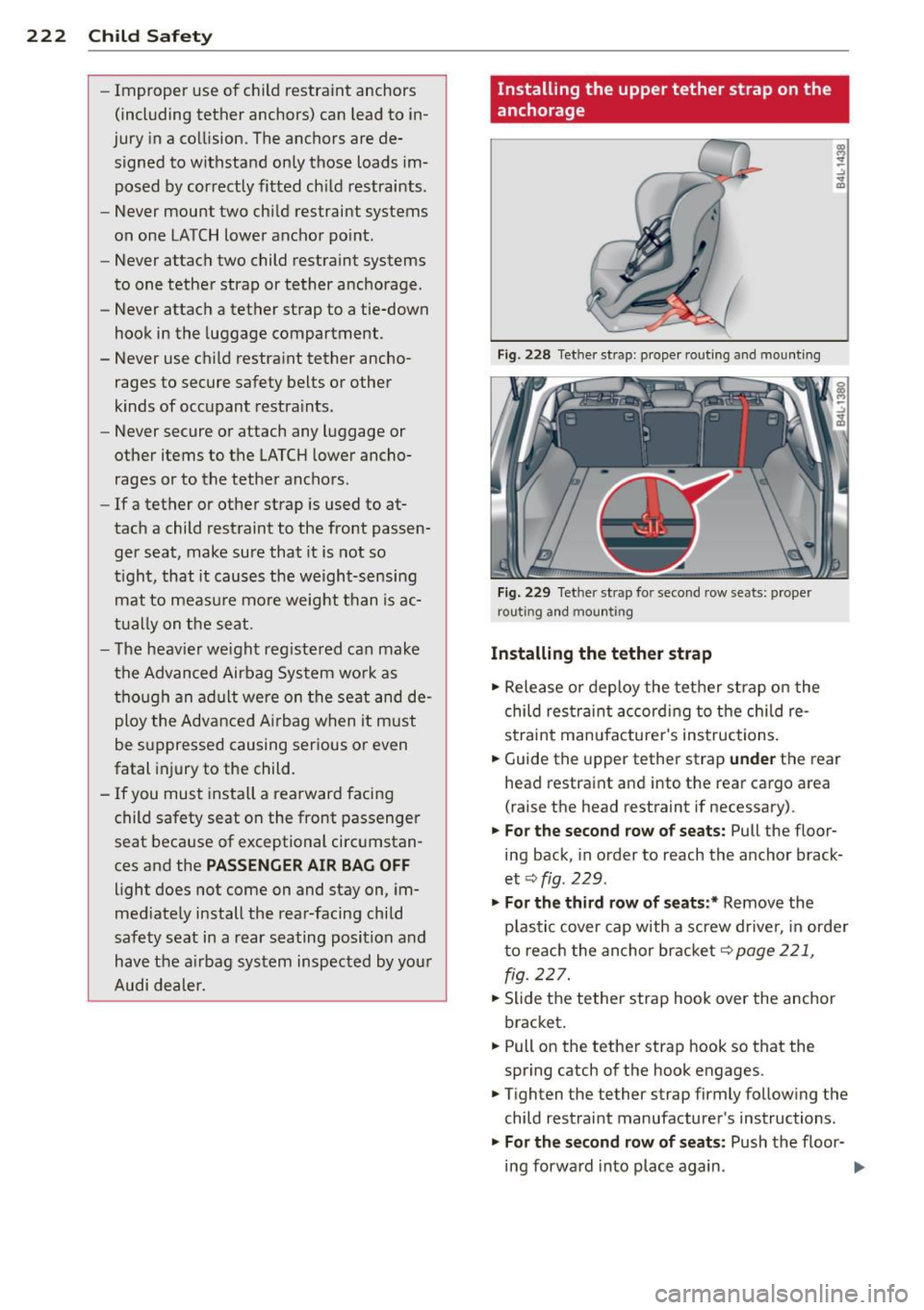
Fig. 228 T et her st rap: prope r rou ting and mou ntin g
Fi g. 229 Tet her st rap fo r seco nd row seats: prope r
rou ting a nd moun ting
Installing the tether strap
.,. Release or deploy the tether st rap on the
child res traint a ccording to the child re
straint manufacture r's instruc tions .
.,. Guide the upper tether strap
under the rear
head restra int and into the rear cargo area
(raise the head restra int if necessary).
.,. For the second row o f seats: Pull the floor
ing back, in order to reach the anchor brack
et
r=:> fig. 229.
.,. Fo r the third row of seats:* Remove the
plastic cover cap w ith a screw driver, in orde r
to reac h the anchor bracket ¢
page 221,
fig. 227.
.,. Slide the tether strap hook over the anchor
bracket .
.,. Pull on the tether strap hook so that the
spring catch of the hook engages .
.,. Tighten the tether strap firmly following the
child restraint manufacturer's instructions .
.,. For the s econd row of seat s: Push the floor-
ing forwa rd into place again . .,._
Page 225 of 340
Relea sin g the teth er str ap
"' Loosen the tens ion following the child re
stra int manufac turer's instructions .
"' Depress the spring catch on the hook and re
lease it from the anchorage.
"' For the second row of se ats: Push the floor
ing forward into place aga in.
"' For the third row of seats:* Replace the
plast ic cover cap .
([) Note
If you leave the child restraint with the
tether strap firmly insta lled for severa l
days, th is cou ld leave a mark on the up
holstery on the seat cushion and bac krest
in the area whe re the tether strap was in
s talled. The upho lstery wo uld a lso be per
manently stretched around the tethe r
strap . This applies especially to leather
seats .
Using tether straps on rearward-facing
child restraints
Currently , few rear-facing child restraint sys
tems come w ith a tether . P lease read and
h eed the child restraint system manufactur
e r's instruc tions caref ully to determine how to
p roperly insta ll the tethe r.
A WARNING ,~
A child in a rearward -facing child sa fety
seat insta lled on the front passenger seat
w ill be seriously injured and can be k illed if
the front a irbag inflates - even with an Ad
vanced Airbag System.
- The inflating a irbag wi ll hit the child
safety seat or infant carrier w ith great
force and w ill smash the ch ild safety seat
and child against the backrest, center
armrest, or door .
- A tight tether or other strap on a rear
ward-fac ing child restra int attached to
the front passenger seat can put too much pressure on the weight-mat i n the
s ea t and regis ter a heavier we igh t in the
Advanced Airbag System. The heav ier
Child Sa fet y 223
weight registered can make the system
work as though an adult were on the seat
and deploy the Advanced Airbag when it must be suppressed causing ser ious or
even fatal injury to the ch ild.
- If you must install a rearward fac ing
child safety seat on the front passenger
seat because of exceptional c ircumstan
ces and t he
PASSENGER AIR BAG OFF
lig ht does not come on and stay on, im
mediately insta ll the rear-fac ing ch ild
safety sea t in a rear seating position and
have the airbag system i nspected by your
Audi dea le r.
Additional Information
Sources of information about child
restraints and their use
T he re a re a number of sour ces of add itiona l
information about child rest raint se lection, in
stallation and use:
N HT SA advises t hat the bes t chi ld safety seat
is the one that fi ts you r ch ild and fits in you r
vehicle, and that yo u will use correct ly and
consistently.
T ry before yo u buy!
U.S National Highway Traffi c Safety Admin
i s tration
T el.: 1-888-3 27-4 236 (TIY: 1-800-424-9153)
http://www .nhtsa.gov
National SAFE KIDS Campaign
Tel.: (202) 662-0600
http://www .safe kids.o rg
Safety BeltSafe U.S.A
Tel.: (800) 745 -SAFE (English)
Tel.: (800) 747-SANO (Span ish)
http://www .ca rseat.org
Transport Canada Information C entre
Tel.: 1-800-333-0371 or call
1-613-998-86 16 if you a re in the Ottawa area
http://www.tc.gc.ca/eng/ roadsafety/
menu. htm
Audi Cu stomer R elation s
Tel.: (800) 822-2834
•
•
Page 226 of 340
224 Intelligent technology
Intelligent technology
Notice about data
recorded by vehicle
control modules
Your vehicle is not equipped with an Event Da
ta Recorder (EDR), installed by some manu
facturers fo r the express purpose of capturing
data for retrieval after an accident or crash
event . EDRs are sometimes ca lled "crash re
corders".
Some state laws restrict the retr ieval or down
loading of data stored by EDRs that were in
stalled in a vehicle for the express purpose of
retrieving data after an accident or crash
event without the owner's consent.
A lthough your vehicle is not equipped with an
EDR, it is equipped with a number of electron
ic control modules for various vehicle systems
such as, for examp le, engine function, emis
sion control, as well as for the airbags and
safety belts .
These electronic contro l modules also record
vehicle-related data during normal vehicle op
eration for diagnostic and repair purposes.
The recording capacity of the electronic con
trol modules is limited to data (no sound is re
corded) and only a small amount of data is ac
tually recorded over a very limited period of
time and stored when a system fault or other
condition is sensed by a control unit. Some of
the data then stored may relate to vehicle
speed, direction, braking as we ll as restraint
system use and performance in the event of a
crash or other condition. Stored data can only
be read and downloaded with special equip
ment.
Electronic Stabilization
Control (ESC)
Description
The Electronic Stabilization Control (ESC) rein
forces driver safety. It reduces the risk of slip
p ing and improves driving stability. ESC de
tects cr itical s ituations such as the vehicle oversteering and
understeering or the wheels
spinning . The vehicle is stabilized by applying
the brakes or reducing engine torque . Once
the ESC is active, the indicator light
G1 blinks
in the instrument cluster.
ESC includes the anti-lock brake system (ABS),
brake assist system, anti-slip regulation
(ASR), electronic differential lock (EDL) and
hill descent control.
Anti-lock brake system (ABS)
ABS prevents the whee ls from locking up
when braking. The vehicle can still be steered
even during hard braking. App ly steady pres
sure to the brake pedal. Do not pump the ped al. A pulsing in the brake pedal indicates that
the system is helping you to brake the vehicle .
Brake assist system
The brake assist system can decrease braking
distance. It increases braking power when the
driver presses the brake pedal quickly in emer
gency situations. You must press and hold the
brake pedal until the situation is over . In
vehicles with adaptive cruise control*, the
brake assist system is more sensitive if the
distance detected to the vehicle ahead is too
small.
Anti-slip regulation (ASR)
ASR reduces engine power when the drive
wheels begin to spin and adapts the force to
the road conditions. This makes it easier to
sta rt, accelerate and drive up hills.
Electronic differential lock (EDL)
The EDL brakes wheels that are spinning and
transfers the drive power to the other wheels .
This function is available up to about 60 mph
(100 km/h) .
In extreme cases, EDL automatically switches
off to help keep the brake on the braked wheel
from overheat ing. EDL will switch on again au
tomat ically when conditions have returned to
normal.
Page 270 of 340
268 Check ing and filling
If the brake fluid level falls considerably be
low the "MIN" mark, the brake warning/indi
cator light (U .S . mode ls:
1111 , Canadian
models: .) will come on
<::> page 19 and
<::> page 32. Do not continue to operate the ve
h icle . The complete brake system should be
thoroughly checked by an authorized Aud i
dea ler or qualified workshop and the cause
corrected. If the brake fluid level is too low,
the brake warning/indicator light will illum i
nate . Contact an authorized Aud i dealer
im
m ediatel y.
@ Tips
The brake fluid rese rvoir is located unde r
neath the cove r.
Changing brake fluid
Hove the broke fluid changed by on experi
enced technician.
Brake fluid absorbs moisture from the a ir . If
the water content in the brake fluid is too
h igh , corrosion in the brake system may result
after a per iod of t ime. The bo iling po int of the
brake fluid wi ll also decrease considerably and
decrease braking performance.
Therefore, the brake flu id must be changed
e ver y tw o year s. Always use new b rake fluid
which conforms to Federal Motor Vehicle
Standard "FMVSS 1 16 DO T 4".
The brake flu id reservo ir can be difficult to
reach, therefore, we recommend that yo u
have the brake f luid changed by you r author
ized
Audi dea ler. Your dea ler has the correct
too ls, the right brake fluid and the know -how
to do this for you.
A WARNING
- Brake fluid is poisonous . It must be stor
ed only i n the closed orig inal container
o ut of the reach of children!
- Brake fa ilure can result from old or inap
propriate b rake fluid. Observe these pre
caut ions: -
Use only brake fluid that meets SAE
specification
J 1703 and conforms to
Federa l Motor Vehicle Standard 116.
Always check with your authorized Audi
dealer to make sure you are using the
correct brake fluid . The correct type of
brake f lu id is also ind icated on the
brake flu id reservoir.
- T he brake fluid must be new. Heavy use
of the bra kes ca n cau se a vapo r lock if
the b rake fluid is left in the system too
l ong . This can seriously affect the effi
c iency of the brakes as well as your
safety. This co uld resu lt in an accident.
(D Note
Bra ke fluid will damage the paint of you r
vehicle .
(® For the sake of the environment
Because of the p rob lem of p roper disposal
of b ra ke fluid as well as the spec ial too ls
r equired and the necessary expertise, we
re commend that yo u have the brake fluid
changed by yo ur authorized Aud i dea ler.
Battery
General information
U nder normal ope rat ing cond itions, the bat
tery in yo ur Audi does not need any ma inte
nance. With
high o utside tempe ra tur es or
l ong dai ly drives we recommend that you have
the e lectrolyte level checked by an authorized
Audi dealer or qualif ied workshop. The elec
trolyte level should also be checked each time
the battery is charged
<::> page 2 70.
Have the battery checked when yo u take your
vehicle in for service. You are well advised to replace a battery that is o lder than 5 years .
With certain types of airbag deployment, the batte ry is disconnected from the veh icle elec
trical system for safety reasons¢.&
in Re
pair , core and disposal of the airbags on
page 197.
~
Page 320 of 340
318 Con sum er Inf ormation
-Always make sure the transmission se
lector lever (automatic transmiss ion) is
in P (Park position) and the park brake is
firmly applied .
@) For the sake of the environment
-Changing the engine settings wi ll ad
versely affect em iss ion levels. This is det
rimental to the environment and increas
es fuel consumption .
- Always observe env ironmental regula
tions when dispos ing of old engine oil,
used brake fluid, dirty engine coolant,
spent batteries or worn out tires.
- Undeployed airbag modules and preten
s ioners might be classified as Perchlo
rate Material -spec ial handling may ap
ply, see www.dtsc.ca .gov/hazardous
was te/perch lorate . When the veh icle or
parts of the res traint system including
airbag modules safety belts wit h preten
sioners are scrapped, all applicable laws
and regulations must be observed. Your
authori zed Aud i dea ler is familiar with
these requirements and we recommend
that you have your dealer perform this
serv ice for you .
Additional accessories,
modifications and
parts replacement
Additional accessories and parts
replacement
Always consult an authorized Audi dealer be
fore purchasing accessories.
Your veh icle incorporates the latest safety de
sig n featu res ensu ring a high standard of a c
tive and passive safety .
This safety could be comp romised by non-ap
proved changes to the ve hicle. For this reason ,
if pa rts have to be replaced , please obse rve
the following points when install ing addition
a l accessories: Approved Audi accessories and genuine Aud
i
parts are available from authorized A udi deal
ers.
T hese dea le rs a lso have the necessary facili
ties, tools and tra ined specialists to install the
parts and acc essories proper ly .
A WARNING
-Using the wrong spare parts or using non-
approved accessories can cause damage to
the veh icle and ser ious persona l injury.
- Use on ly accessories express ly approved
by Audi and gen uine Audi spare parts
- These parts and accessories have been
specia lly designed to be used on yo ur ve
h icle .
- Never install accessor ies such as tele
phone crad les or beverage ho lders on a ir
bag covers or within the airbag deploy
ment zones . Do ing so will increase the
risk of injury if a irbags are triggered in an
accident!
- Before you check anything in the engine
compa rtment, always read and heed a ll
WARNI NGS
9 page 257.
(D Note
-If items other than genu ine Audi spare
parts, add-on equipment and accessory
items are used or if repair work is not
performed accord ing to specified meth
ods, this c an resu lt in seve re damage to
your vehicle's eng ine and body (such as
corrosion) and adversely affect yo ur vehi
cle's warranty .
- If emergency repairs must be performed
elsewhere, have the vehicle examined by
an authorized Audi dealer as soon as
possible .
- The manufacturer cannot be held liable
for damage wh ich occ urs due to failure
to comply with these stipu lations.