check engine AUDI Q7 2015 Owner´s Manual
[x] Cancel search | Manufacturer: AUDI, Model Year: 2015, Model line: Q7, Model: AUDI Q7 2015Pages: 350, PDF Size: 86 MB
Page 228 of 350
226 Intellig ent technol ogy
firm ly a few times from a mode rately high
speed ¢.&. .
Faults in the brake system
If you should notice a sudden increase in
brake peda l travel, t hen one of the two bra ke
circ uits may have failed ¢.&. .
Low brak e flu id le vel
Malfunct ions can occur in the brake system if
the brake fluid level is too low . T he brake fluid
l eve l is monitored electronically .
Bra ke boo ster
The brake booster increases the pressure that
you generate w ith the brake pedal. It only op
erates while the eng ine is running ¢,&. .
Brake lining we ar sta tu s
Brake lining wear may be checked by visual in
spection of the condition of the brake pads
through the openings in the wheel. If neces
sary, the wheel may be removed for this in
spection ¢
page 307, Changing a wheel.
A WARNING
- You should perfo rm bra king maneuve rs
for the p urpose of clean ing the b rake
system on ly if road condit ions permit.
Other road users must not be put at risk -
you may cause an accident!
- Be fore descending a steep grade, reduce
speed and shift transmission into a lower
gear or lower driving range. Do not ride
the brakes or hold the pedal down too long or too often. This could cause the
brakes to get hot and dimin ish braking
efficiency .
- Do not "ride the brakes" by resting your
foot on the pedal when you do not intend
to brake . Th is may cause the brakes to
overheat, premature wear and inc reased
stopping distance.
- Under certain climat ic and operating
condit ions such as passing through wa
ter, driving in heavy ra in or after wash ing
the vehicle, the effect iveness of the
brakes can be reduced . In winter, ice can accumu
late on the brake pads, linings,
discs and drums. Carefully app ly brakes
for a test. Brakes will dry and ice coat ings w ill be cleaned off after a few care
ful brake applicat ions .
- Driving for an extended period of time on
salt-covered roads without using your
brakes can also affect braking efficiency .
Clean off accumulated salt coating from
b rake discs and pads with a few ca reful
brake applications.
- If you damage the front spoiler, or if you
i n stall a diffe rent spoiler, be s ure the a ir
f low to the front brakes is not obs truct
ed . Otherwise the brake system could
overheat reducing the effectiveness of
the entire brake system .
- Fai lure of one brake circuit will impai r
the braking capability resulting in an in
creased stopping distance . Avoid driving
the vehicle and have it towed to the near
est authorized Audi dea ler or qualified
workshop .
- Never let the ve hicle roll to a stop with
the engine shut off.
- If the brake booster is not working, the
brake peda l must be pressed cons idera
b ly harder to make up for the lack of
booster assistance.
Servotronic - advanced power steering system
The power steering systems uses the power of
the running engine to allow precise steering
with Little effort.
T he advanced Servotronic power steer ing sys
tem senses the road speed and electronica lly
adjusts power assistance to provide comforta
ble and safe steering response exactly match
ed to the vehicle speed.
Power s teer ing will not work if the engine is
off. As a result, the steering wheel will be hard
to turn.
T he powe r steering fluid level is checked d ur-
ing the sched uled maintenance services . ..,.
Page 229 of 350
M N
0 ...J
'SI: ,...., \!) ..,.,
,...., ..,., ,....,
(D Note
If there is an electronic malfunction, ser
votronic
w ill still function like a conven
tional power steer ing system, providing a
constant steer ing support force that is no
longer proportionate to the vehicle speed.
This is most noticeable when turning the
steer ing whee l at low speeds (for examp le
when parking), -more effo rt will be re
qui red than usual.
- Be awa re of the different than usual
stee ring response and adjust your stee r
i ng force accord ingly .
- Have the problem checked and set right
by an Aud i dealer as soon as possible .
(D Tips
-When the engine is runn ing, never hold
the steer ing whee l turned a ll the way to
the right or to the left for longer than 15
seconds. The power s teer ing p ump w ill
overheat the hydraulic fluid if you keep ho lding the steering whee l turned a ll the
way . This is likely to damage the power
steering system .
- If the power steer ing system should fai l
entirely, or if the engine is not running
(for example, while being towed), you
will still be ab le to steer the vehicle .
However,
considerably more effort will
be required to do so .
- If the power steering system should
have a leak, or is not functioning proper
l y, contact your authorized Aud i dealer
i mmediately.
- The power steering system requires a
spec ially formulated hydraulic fluid . T he
power steer ing reservo ir is the one locat
ed farthest to the rear on the left side o f
the engine compartment
~ page 258.
The correct fluid leve l in the reservoir is
important for proper functioning of the
power steer ing .
Int ellig ent technolog y 22 7
Driving with your
quattro
With all-wheel drive , all four wheels are driv
en .
Gener al info rmation
With all-wheel drive, power is distributed to
all four wheels. This happens au toma tically
depending on your driving style and the road
cond it ions at the time . See also
~ page 223.
Winter t i res
When d riving in the winter, your vehicle with
a ll-wheel drive has an advan tage, even with
regular tires. In winter road conditions it may
be advisable to mount winter tires (or all -sea
son tires) for improved driveability and brak
ing: these tires must be mounted on
a ll four
wh eels. See also ~ page 298, Winter tires.
Tire ch ains
Where tire chains are mandatory on certain
roads, this normally also applies to veh icles
with all-wheel drive~
page 299, Snow
chains .
Replacing whee ls/tire s
Vehicles with all-wheel drive must always
have tires of the same s ize . Also avoid tires
with different tread depths . For deta ils see
page ~
page 291, New tires and replacing
tires and wheels.
.8, WARNING
A lways adj ust yo ur dr iv ing to road and t ra f
fic conditions . Do not let the extra sa fety
afforded by all-wheel drive tempt you into
taking extra risks.
- Altho ugh the a ll-wheel drive is very ef
fective, always remember that braking
capacity is limited by tire traction . You
should therefore not drive at excessive
speeds on icy or slippery road surfaces.
- On wet road surfaces, be careful not to
drive too fast because the front wheels
could begin to slide on top of the water
(aquaplaning). If th is should occur, you •
•
Page 231 of 350
M N
0 ..J
'SI: ,...., \!) 1.1'1 ,...., 1.1'1 ,....,
when you turn on the ignition and start the
engine.
With the engine turned off
If you listen to the radio, for example, with
the engine turned off or use other MMI func
tions, the battery is being d ischa rged.
I f starting capability is jeopardized due to en
e rgy consumpt ion, the following warning ap
pears in the MMI display:
Please start engine, otherwise system will
switch off in 3 minutes.
The warning ind icates that the system will be
turned off automatically after 3 minutes. If
you wish to cont inue using the functions, you
have to start the engine.
With the engine running
Although electrical energy is generated when
the vehicle is be ing driven, the battery can be
come discharged . Th is happens mostly when
little energy is be ing generated and a great
deal consumed and the battery's state of
charge is not optimal.
To br ing the energy balance back into equili
brium, consumers which require especially
l arge amounts of energy are temporarily cut
back or swit ched off. Heating systems in par
t icular requ ire a great deal of energy.
If you
notice, for example, that the heated seats* or
the heated rear window are not heating, they
have been temporari ly cut back or switched
off. These systems will be avai lab le again as
soon as the energy balance has been restored.
You will a lso notice that engine idle speed has
been increased slightly . This is norma l and not
a cause for concern . By increasing engine idle
speed the add itiona l energy required is gener
ated and the battery is charged.
Driver notification in the instrument
cluster display
If battery power drops into the range where it
can limit the ability of the engine to start, this
Intelligent technology 229
is shown in the instrument cluster display
with the following driver message:
(•) I.ow battery charge: battery will be
charged while driving
T h is not ificat ion reminds you that the start ing
capability of the engine may be limited. As
soon as you start driv in g again, the battery
will be recharged and the not ific at ion w ill go
out.
Driver notification appears and goes out
again
If t his driver notification appears after the ig
nition is tu rned on or whi le driving and it goes
out again after a while, the battery has been
adequately recharged.
Driver notification appears and does not
go out again
If this driver notification appears after the ig
nition is turned on or whi le driving and does
not go out again, the battery's state of charge
is not in the optimal range. Starting ab ility is
restricted . Have the battery checked as soon
as possible by an authorized Aud i dealer or
qualified workshop.
•
•
Page 235 of 350
M N
0 ..J
'SI: ,...., \!) 1.1'1 ,...., 1.1'1 ,....,
Reducing unnecessary idling
Even when your car is just idling it burns up
fuel.
11-Shut the engine off when you are not driving
the vehicle.
11-Do not warm up the vehicle by letting the
engine run at idle .
It makes sense to shut
off the engine in traffic
jams, when waiting for trains to pass at rail
road cross ings, or at traffic lights that have
long waits on red. Turning the engine
off for
just 30-40 seconds saves more fuel than is
burned starting the engine again.
It takes a long time for the engine to warm up
fully when it is running at idle. However, wear
and noxious emissions are especially high
when the engine is warming up. So you should
drive away as soon as you start the engine and
avoid running at high rpms while the engine is
still warming up .
(D Note
Do not leave engine idling unattended af
ter starting. If warning lights should come
on to indicate improper operation, they
wou ld go unheeded. Extended idling also
produces heat, which cou ld result in over
heating or other damage to the vehicle or
other property .
Regular maintenance
A badly tuned engine unnecessarily wastes a lot of fuel .
11-Have your vehicle serviced at regular inter-
vals.
By having your vehicle regularly serviced by an
authorized Audi dealer helps to ensure that it
runs properly and economically. The condition
of your vehicle not only affects its safety and
ab ility to hold its value, it also affects fuel
consumption.
Check your oil each time you fill your tank.
Driving and environment 233
The amount of oil used is re lated to engine
load and speed.
It is normal for the oil consumption of a new
engine to reach its lowest value after a certain
mileage has been driven.
You must drive your vehicle about 3,000 miles
(S,000 kilometers) before you can properly
assess oil consumpt ion.
This also app lies to fue l consumption and en
gine output.
(D Note
- Have your veh icle ma inta ined properly
and in accordance with the service rec
ommendations in your Warranty
& Main
t enance booklet. Lack of prop er mainte
nance as well as improper use of the ve
hicle will impair the function of the
emission cont ro l system and could lead
to damage.
- Do not alter or remove any component of
the Emission Control System unless ap
proved by the manufacturer.
- Do not alter or remove any device, such
as heat shields, switches, ignition wires,
valves, which are designed to protect
your vehicle's Emission Control System and other important vehicle compo
nents.
Fewer short trips
Fuel consumption will always be relatively
high on short trips .
11-Try to avoid driving short distances w ith a
cold engine.
T he engine and cata lytic converter have to
reach their optimal operating temperature to
reduce fuel consumpt ion and noxious emis
s ions effectively .
Just after starting, a co ld engine in a mid-size
car only achieves a fuel economy of 6-8 mi les
per gallon (30-40 l/l00km). After about a
half a mile, fuel economy climbs to 12 mpg
(20 l/100 km). After about
2.5 miles (4 km), liJI,
•
•
Page 237 of 350

M N
0 ...J
'SI: ,...., \!) 1.1'1 ,...., 1.1'1 ,....,
Driving off road
Driving in difficult road
conditions and offroad
General information
The operation of the E lectronic Stabilization
Control (ESC) is expanded fo r operation away
from paved roads. In situations where slip or a
differential lock ing funct ion is required, the
offroad mode can be activated
c::;, page 223.
H ill descent control is a lso ava ilable in the off
road mode, which automat ically brakes the
ve hicl e and thereby keeps speed consta nt
when differe nt w heel speeds a re detected
when descending a hill
¢page 2 2 5. Your A ud i
a lso has permanent a ll-wheel drive in addi
tion.
H oweve r, your Aud i is no t a pure off road ve hi
cle. I t was not built for d riving unde r extreme
conditions, e.g. fo r trips that are in the nat ure
of an expedition .
Drive only on road s and offro ad sections
which match the de sign of y our vehicl e and
you r abilitie s as a dri ver. Ne ver t ake ri sks!
Before driving offroad
- Check the eng ine oi l level, t ire pressu re,
coolant level, and the fluid level in the w ind
shield washe r reservo ir.
- Stow luggage items a nd other objects in the
l uggage compartment, and sec ure t hem
against s lid ing aro und.
After driving offroad
- After trips off road, remove any twigs and
othe r foreign objects from the grill, the un
derbody and the wheels. Pay spec ia l atten
t ion to fore ign ob jects (stones) which have
become lodged in t he tire tre ad.
- Clean t he body and the vehicle unders ide,
and inspect the veh icle for possible damage.
- Clean dirty w indows, headlamp lenses, rear
li gh ts, and license plates .
- Perfo rm a brake check (particularly after
t ravell ing throug h water).
Driving off road 235
A WARNING
- Drive especially attentively and plan
ahead in diff icu lt road conditions and
when off road. Excessive speed o r inco r
rect maneuve rs can cause injuries and
damage to the vehicle.
-
- Always adapt your speed and driving
style to road, offroad, t raff ic, and weath
e r condition s. D rive e spe cially slowly off
road when yo ur view is restricted.
- Please be aware that in offroad mode,
pa rti cularly on a smoo th and s lippery
road, the whee ls may have an increased
tendency to spin and the vehicle may
break away -danger of skidding!
- Stability is limited in the offroad mode .
@ For the sake of the environment
Avoid damage to the environment and re
spect na ture.
@ Tips
Only d rive where it is permitted and stay
on marked roads and paths.
Explanation of some technical terms
T he following data refer to ideal cond itions .
Depend ing on ve hicle load and gro und condi
tions and the environment, the numbers may
vary .
It is the driver's responsibility to decide
whether a veh icle can overcome a specific s it
uat ion
c::;, &, .
Gradient angle
The number o f meters in altitude ga ined over
a distance of 109.4 ya rds or 100 meters
(grade) are given as a percentage o r degrees.
Information about the grad ient the vehicle
can climb under its own power (depends in
part on the road surface and engine power).
Max imum perm itted grade : 31
°
Gr ound cle arance
The distance between the road s urface and
the lowest point of the vehicle underbody.
•
•
Page 238 of 350
236 Driving o ff road
- Veh icles wi thout air spring s: ground clear
ance : 8.1 in (204 .8 mm)
- Veh icles w ith adap tiv e air su sp en sion *:
maximum ground clearance: 9.4 in
(239.8 mm) at high level 2
A WARNING
Exceeding the stated maximum figures
can result in severe injuries or vehicle dam
age.
- All the information was gathered on lev el, firm and non-slippery road surfaces,
and under dry weather conditions.
- Ideal conditions do not prevail offroad.
Never utilize the maximum read ings to
their fullest, always leave a safety re
serve .
Driving tips
On poor road and offroad, there is always on
ly one motto : Plan ahead and drive slowly!
P lease obse rve the following when dr iving
away from paved road s:
• Drive only on roads and offroad sections
which match the design of your vehicle and
your abilities as a driver. Never take risks!
• Drive slowly and plan ahead!
• Take in to consideration the
g round cl ea r
a nc e
of your vehicle .
• Activate the
offroad m ode Q page 223 as
needed.
• Use the
hill desce nt control ~ page 225
when driving down steep sect ions on hills.
Unp aved road s and offroad
Drive slowly on unfamiliar roads and unknown
offroad sections, and look out for unexpected
obstacles (e.g. potho les, rocks , tree stumps ,
etc .).
To prevent the vehicle from bottom ing and
avoid damage to the underbody, you should
d rive st ra ight ac ross severe bumps in the
g round with on ly one s ide of the vehicle so
that on ly two of your wheels cross the bumps. Drive brisk
ly through sandy or marshy offroad
sections and do not stop , if at all possible .
Driving through w ater
Note the following to avoid veh icle damage
when d riving through wate r, for example on
flooded roads :
- The water must not be any higher than the
bottom of the vehicle body.
- Do not dr ive faster than walk ing speed .
Driving on a slope
If you ever find you rself not able to climb a
s lope, do not try to turn around, drive back
down in
r e v erse . Otherwise, you run the r isk
of tipp ing over .
If the veh icle th re at en s to t ip ov er whe n
dr ivin g a cross a slop e, you mus t immediate
ly ste er downhill in the dir ection of th e
s lop e.
Do not park your vehicle on steep slopes or
grades .
To reduce the risk of t ipping over, drive on
s lopes in th e direction of the downward s lope
(fall line) -
not c ross wise.
A WARNING
-After driv ing through water, mud, slush,
etc ., the brakes may be s low to take effect
because of wet brake rotors and pads . D ry
the brakes first by brak ing carefully to re
store t he fu ll braking effect.
(D Note
Vehicle components such as the eng ine,
transmission, suspension or e lectrica l sys
tem can be severe ly damaged by dr iv ing
th rough water .
(D Tips
-Check the depth of the water before d riv
ing through it .
- Do not stop the vehicle, drive in reverse or switch the engine off when driving
through water.
Page 241 of 350
M N
0 ...J
'SI: ,...., \!) 1.1'1 ,...., 1.1'1 ,....,
Weight Rating will also change the per
formance and handling characteristics of
your vehicle, which could cause a crash result ing in serious injury or death .
- The Gross Vehicle Weight Rat ing for your
vehicle would be exceeded if your vehicle is simultaneously equipped with Panor
amic sliding sunroof; th ird-row seating;
trailer towing equipment (factory or
dealer-installed), and running boards
(dea ler-installed) . UNDER NO CIRCUM
STANCES MAY ALL SUCH ITEMS BE IN
STALLED ON THE SAME VEHICLE.
Operating instructions
MAX 6.9"
MAX175mm
E
1/1 E 1/1 ... a)
m
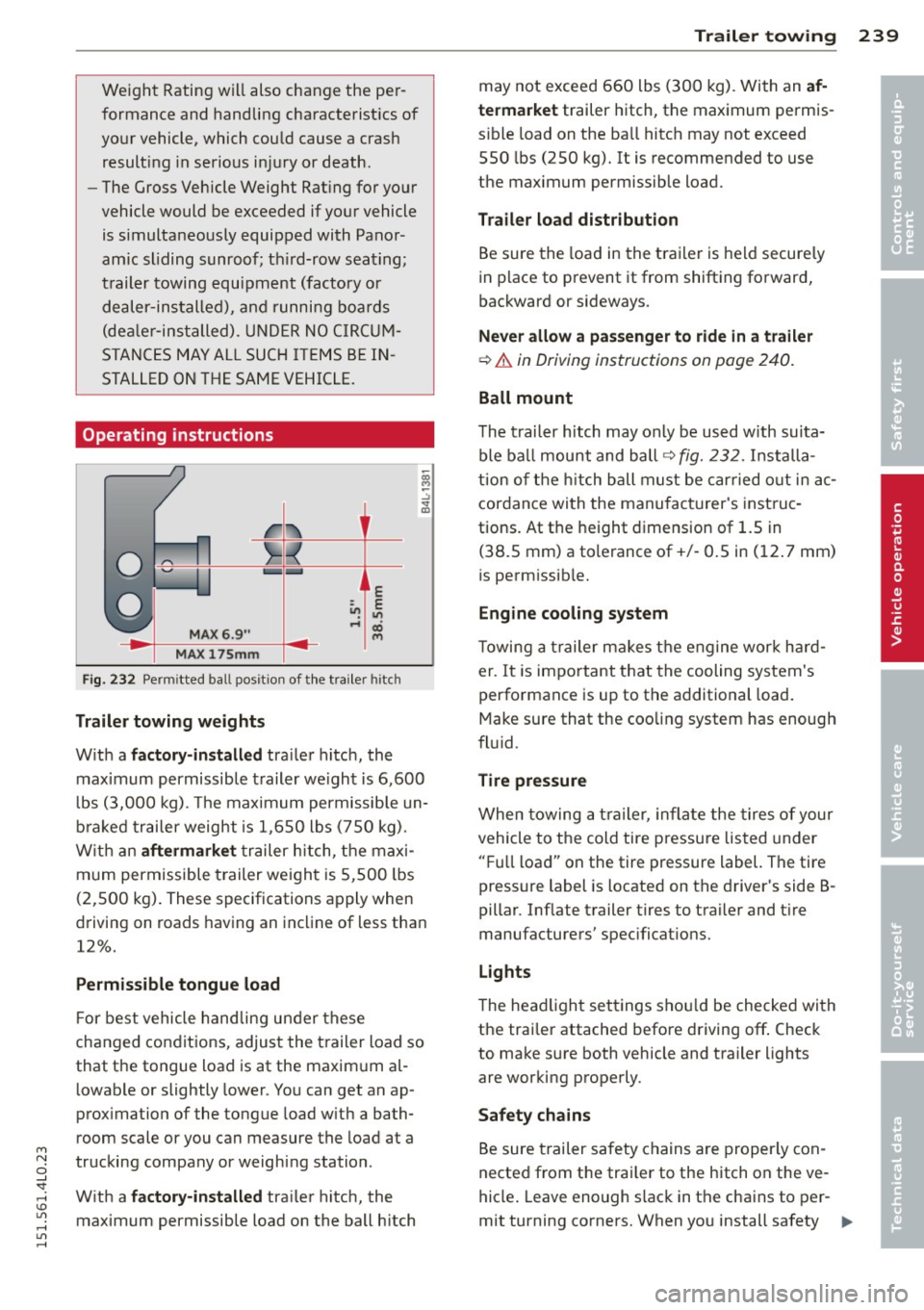
Fig. 232 Perm itted ba ll posit ion of t he tra iler hitch
Trailer towing weights
W ith a factory-installed tra iler hitch, the
maximum permissible trailer we ight is 6,600
l bs (3,000 kg). The maximum permissible un
braked trailer weight is 1,650 lbs (750 kg).
With an
aftermarket trailer hitch, the maxi
mum permissible t railer we ight is 5,500 lbs
(2,500 kg). These specifications apply when
driving on roads having an incline of less than
12%.
Permissible tongue load
For best vehicle handling under these
changed cond itions, adjust the trailer load so
that the tongue load is at the maximum al
l owable or slightly lower. You can get an ap
prox imation of the tongue load with a bath
room scale or you can measure the load at a
trucking company or weighing station .
With a
factory-installed tra iler hitch, the
maximum permissible load on the ball hitch
Trailer towing 239
may not exceed 660 lbs (300 kg). With an af
termarket
trailer hitch, the maximum permis
s ib le load on the ba ll hitch may not exceed
550 lbs (250 kg).
It is recommended to use
the maximum permissible load.
Trailer load distribution
Be sure the load in the trailer is held secure ly
in place to prevent it from shifting forward,
backward or sideways.
Never allow a passenger to ride in a trailer
¢.& in Driving instructions on page 240.
Ball mount
The trailer hitch may only be used w ith suita
ble ball mount and ball ¢
fig. 232. Installa
t ion of the hitch ball must be carried out in ac
cordance with the manufacturer's instruc
tions. At the height dimension of 1.5 in
(38.5 mm) a tolerance of+/- 0.5 in (12 . 7 mm)
is perm issib le.
Engine cooling system
Towing a trailer makes the engine work hard
er . It is important that the cooling system's
performance is up to the additional load .
Make sure that the cooling system has enough
fluid .
Tire pressure
When towing a tra iler, inflate the tires of your
vehicle to the cold tire pressure listed under
" Full load" on the tire pressure label. The tire
pressure label is located on the driver's side B
pillar . Inf late trailer tires to trai ler and t ire
manufacturers' spec ificat ions .
Lights
The headlight settings sho uld be checked with
the trailer attached before driving
off . Check
to make sure both vehicle and trailer lights
are working properly .
Safety chains
Be sure trailer safety chains are properly con
nected from the trailer to the hitch on the
ve
hicle . Leave enough slack in the chains to per
mit turning corners. When you install safety
Ill-
•
•
Page 251 of 350
M N
0 ...J
'SI: ,...., \!) ..,.,
,...., ..,., ,....,
-Blend must contain not more than 1S%
MTBE.
Seasonally adjusted gasoline
Many gasoline grades are blended to perform
espec ially we ll for winter or summer driving.
During seasonal change-over, we suggest that
you fill up at busy gas stat ions where the sea
sonal adjustment is more likely to be made in
time .
(D Note
-Methanol fuels which do not meet these
requirements may cause corrosion and
damage to plastic and rubber compo
nents in the fuel system.
- Do not use fue ls that fail to meet the
specified criter ia in this chapter.
- If you are unable to determine whether
or not a particular fue l blend meets the
specifications, ask your service station or
its fuel supp lier.
- Do not use fuel for which the contents
cannot be identified.
- Fuel system damage and performance
problems resulting from the use of fuels
different from those specified are not
the responsibility of Audi and are not
covered under the New Vehicle or the Emission Control System Warranties.
- If you experience a loss of fuel economy
or driveability and performance prob l ems due to the use of one of these fuel
blends, we recommend that you switch
to unblended fuel.
Gasoline additives
Applies to vehicles : wit h gasoli ne e ng in e
A majo r concern among many auto manufac
ture rs is carbon deposit build-up caused by
the type of gasoline you use.
Although gasoline grades differ from one manufacturer to another , they have certain
things in common. All gasoline g rades contain
substances that can cause deposits to collect
on vital engine parts, such as fuel injectors
and intake valves. Although most gasoline
Fuel supply and filling your fuel tank 249
brands include additives to keep engine and
fuel systems clean, they are not equally effec
tive .
Audi recommends using TOP TIER Detergent
Gasoline . For more information on TOP TIER
Detergent Gasoline, please go to the official
webs ite (www.toptiergas.com).
After an extended per iod of using inadeq uate
fuels, carbon deposit build-ups can rob your
engine of peak performance.
CD Note
Damage or malf unct ion due to poor fuel
quality is not covered by the Audi New Ve
hicle Limited Warranty.
Diesel fuel
Applies to veh icles: w ith diesel engine
Always use ULSD (Ultra Low Sulfur Diesel)
No. 2. The ULSD No. 2 meets the ASTM D97S.
Diesel fuel with concentrations of biodiesel
highe r than S % such as Bll, B2O or BlOO are
strictly prohib ited .
Se rv ice stat ion fuel pumps are labeled with
the cor rect fuel informat ion for easy recogn i
tion by the user. If the diesel fuel pump is not
labeled ask the station operator what fuel is
being dispensed before filling up your vehicle.
ULSD No. 2 may not be available outside the
USA and Canada. Be sure to check before trav
eling to other countries .
ULSD No. 2 can become thicker in very cold
temperatu res, and this can impair the en
gine's start ing and running. Depending on the
season, gas stations provide ULSD No. 2 that
flows better in cold temperatures so that you
can continue operating your vehicle as usua l.
CD Note
-Yo ur vehicle's diesel engine was de
signed soley for use with ULSD No. 2.
Therefore, never use gasoline, heating oil, other fuels or flow improvers. These
conta in substances that will severely
damage the fuel system and the engine . .,.
•
•
Page 253 of 350
M N
0 ...J
'SI: ,...., \!) 1.1'1 ,...., 1.1'1 ,....,
~ Check the label on the inside of the fuel fi ll
er flap to determine if the vehicle must be
fueled with gasoline or diesel fuel.
Refuelling procedure
~ Insert the fuel nozzle from the gasol ine
pump into the fue l filler neck as far as it will
go.
~ Se lect a medium refuelling rate so that the
no zzle switches off automatica lly when the
tank is full.
Putting the fuel cap back on
~ After filling your tank, twist the fuel fi ller
cap clockwise as far as it will go.
~ Close the fuel filler flap.
To avoid fuel spi lling or evaporating from the
fuel tank always close fuel fi ller cap properly
and comp lete ly. An improperly closed fuel fill
er cap may also cause the M IL lamp
r=) page 2 7
to come on (only vehicles with gasoline en
gine) .
A WARNING
Improper refueling or handling of fuel can
cause fire, explosion and severe burns.
- Fuel is highly flammable and can cause
severe burns and other injuries .
- Failure to shut the engine off while refu
eling and/or to insert the pump nozzle
fully into the fuel filler neck could cause
fuel to spray out of f iller neck or to over
flow. Fuel spray and ove rflow ing fuel can
cause a fire.
- Never use a cellular telephone wh ile re
fueling. The electromagnetic radiation
can cause sparks that can ignite fue l va
pors and cause a fire.
- Never get back into you r vehicle while re
fueling. If in exceptiona l circumstances
you must get back in your vehicle whi le
refueling, make certain that yo u close
the door and touch metal to discharge
static electricity before touching the fill
er nozzle again. Static electricity can
cause sparks that can ignite fuel vapors
released during refueling.
Fuel supply and filling your fuel tank 251
-Never smoke or have an open flame any
where in or near your vehicle when refu
eling or filling a portable fuel conta iner .
- For your safety, we strongly recommend
that you do not travel with a portable
fuel container in your vehicle . The con
tainer, full or empty may leak and could
cause a fire, especially in a crash.
- If, under exceptional circumstances, you
must transport a portable fuel container,
please observe the following:
- Never fill a portable fuel container
while it is anywhere in or on the vehicle
(for example, in the luggage compart
ment, or on the trunk). Stat ic electrici
ty can build up while filling and can ig
nite fuel vapors causing a fire .
- Always place a portable fuel conta iner
on the ground before filling.
- Always keep the filler no zzle complete
ly inside the portable container before
and dur ing filling .
- If filling a portable container made of
metal, the f iller nozzle must always be
in contact with the conta iner . This will
help prevent static electric ity from d is
charging and cause a fire .
- Never spill fue l inside the vehicle or
luggage compartment. Fuel vapors are
highly flammable .
- Always observe local and state/provin
cia l laws regarding the use, storage
and transportation of fuel containers.
- Make certain the fuel container meets
in dustry standa rds (ANSI/ AS TM
F852-86).
(D Note
If any fuel has spilled onto the car, it
shou ld be removed immediately to prevent
damage to the paint.
@ For the sake of the environment
As soon as the correctly operated nozzle
switches off automat ica lly for the first
time, the tank is full. Do not try to add
more fuel because fuel may spill out. In •
•
Page 258 of 350
256 Checking and filling
Checking and filling
Engine hood
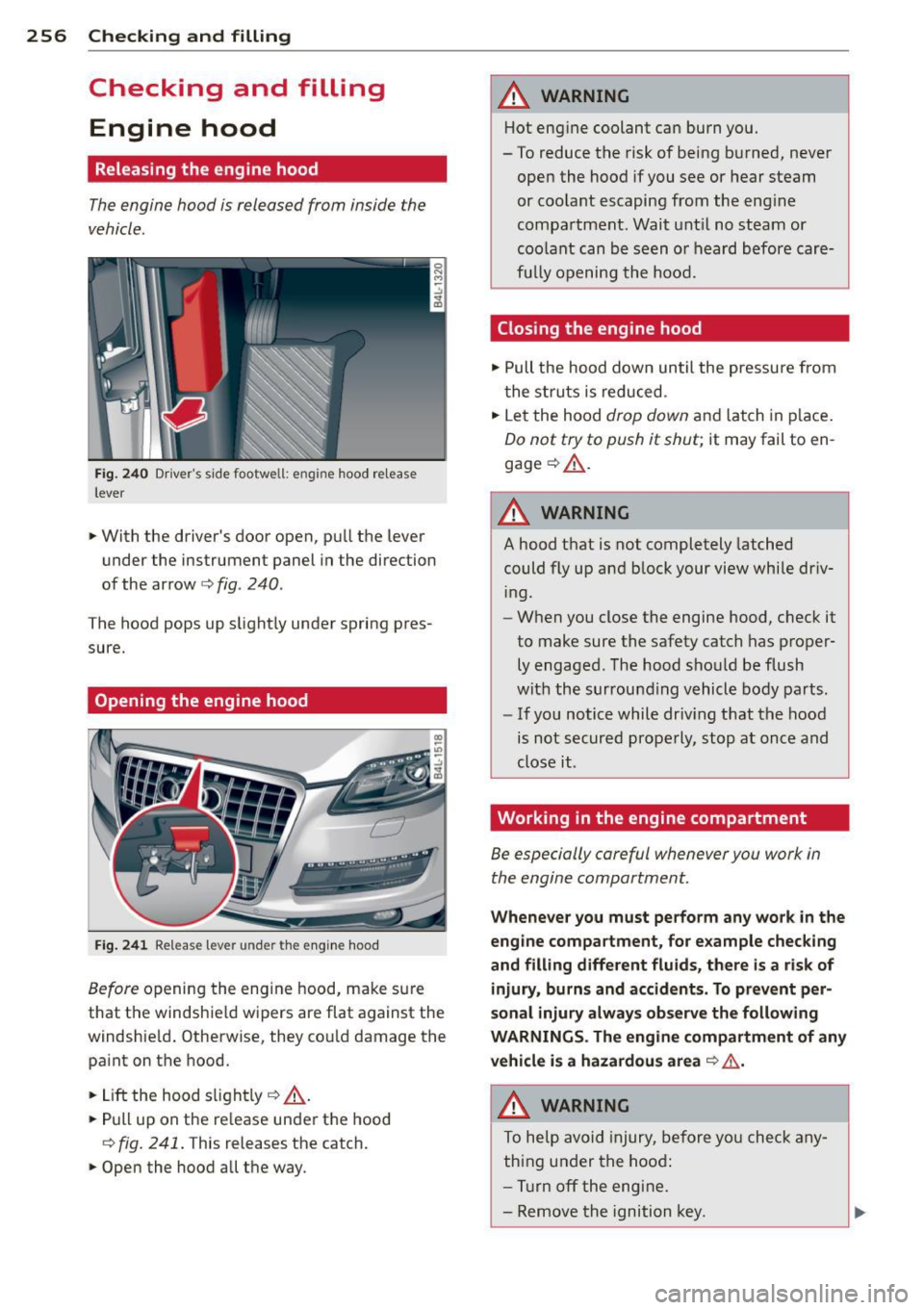
Releasing the engine hood
The engine hood is released from inside the
vehicle.
F ig . 2 40 Dr iver's side footwell: eng ine hood re lease
lever
.. With the driver's door open, pull the lever
under the instrument panel in the direction
of the arrow¢
fig. 240.
The hood pops up slight ly under spring pres
sure.
Opening the engine hood
F ig. 241 Re lease lever under the eng ine hood
Before o pening the engine hood, make s ure
that the windsh ie ld w ipers are flat against the
windshie ld . Otherwise, they could damage the
pa int on the hood .
.. Lift the hood sli ght ly¢ &_.
.. Pull up on the release unde r the hood
¢
fig . 241 . This releases the catch.
.. Open the hood all the way.
A WARNING
-Hot eng ine co olant can burn you.
- To reduce the risk of being b urned, never
o pen the hood if you see or hear steam
or coo la nt escaping from the eng ine
compa rtment . W ait unt il no steam or
coo lant can b e seen o r heard before care
fu lly openi ng the ho od.
Closing the engine hood
.. Pull the hood down un til the pressure from
t he stru ts is reduced .
.. Le t t he hood
drop down and latch in p lace .
Do not try to push it shut; it may fail to en
gage ¢&_ .
A WARNING
--
A hood that is not completely latched
could fly up an d block your vi ew while dr iv
i ng.
- W hen you close the engine hood, c heck it
to make sure the safety catch has p roper
ly engaged . The hood sho uld be flush
wit h the surrou nding vehicle body parts.
- If you notice while dr iv ing t hat t he hood
is not s ecured properly, stop at once and
close it .
Working in the engine compartment
Be especially careful whenever you work in
the engine compartment .
Whenever you must perform any wo rk in the
engine compartment, for example checking
and filling different fluids, th ere is a risk of
injury, burns and accidents. To pr event per
sonal injury alway s observe the following
WARNINGS. The engine compartm ent of any
vehicle is a hazardous area
¢ &, .
A WARNING
To he lp avoid injury, before yo u check any
thi ng under the hoo d:
- Tu rn off the eng ine.
- Remove the igni tion key.