Child seats AUDI Q7 2015 Owner´s Manual
[x] Cancel search | Manufacturer: AUDI, Model Year: 2015, Model line: Q7, Model: AUDI Q7 2015Pages: 350, PDF Size: 86 MB
Page 4 of 350
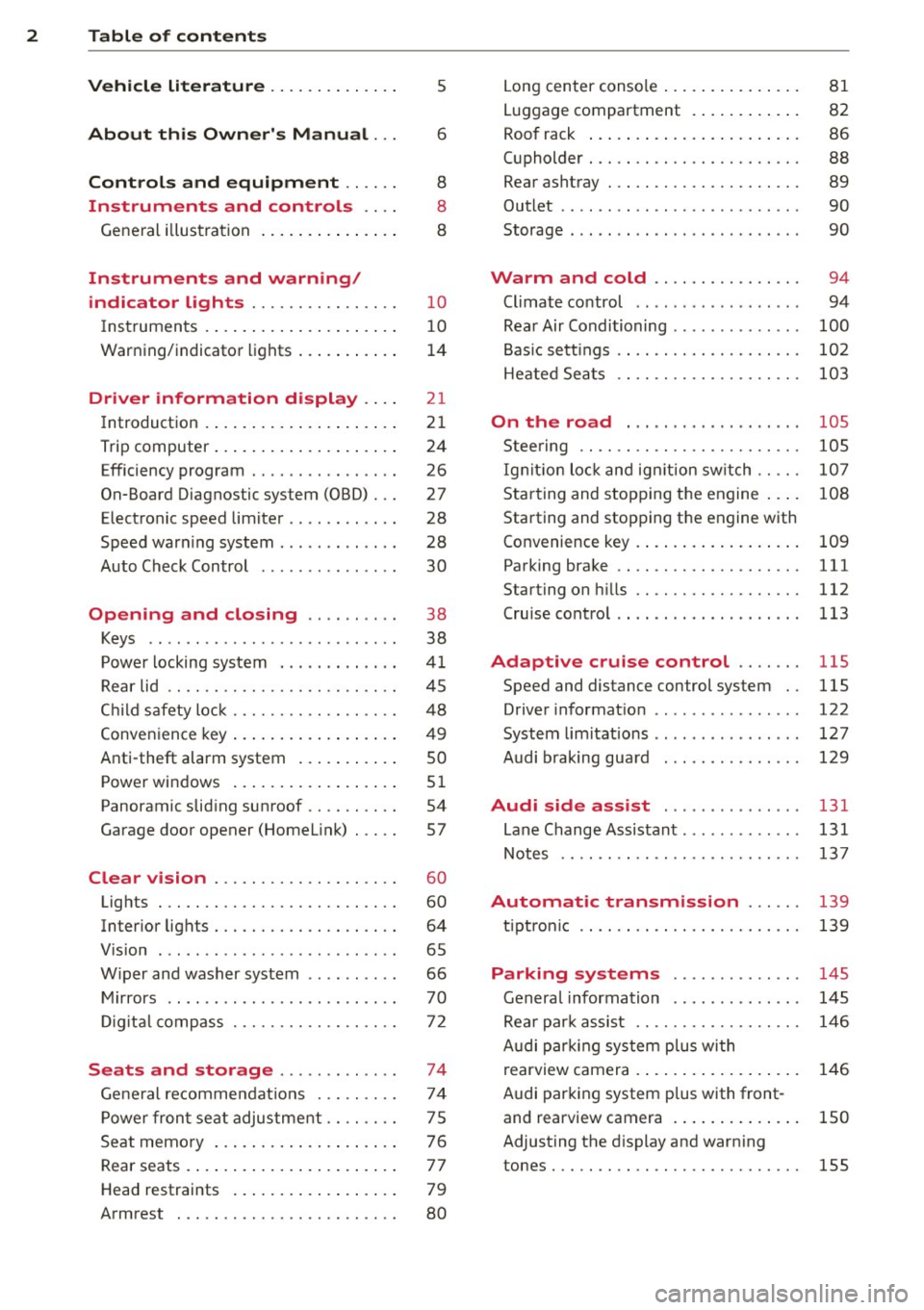
2 Table of content s
Vehicle lite ratu re .. .. .. .. .. ... .
About thi s Owner' s Manual ...
C ontr ols and equi pm ent .. ... .
Ins truments and controls .. . .
General illustration ...... ... .. ... .
Instruments and warning /
indicator lights ............... .
Instruments ............ ... .. ... .
Warning/indicator lights .. ... ... .. .
Driver information d isplay .. . .
Introduction .............. ... ... .
Trip computer ........... ... .. ... .
Efficiency program ............... .
On-Board Diagnostic system (OBD) .. .
Electronic speed limiter ......... .. .
Speed warn ing system .......... .. .
Auto Check Control ............ .. .
Opening and closing ...... .. . .
Keys ........................ .. .
Power locking system ............ .
Rear lid .. .. .......... ..... .. .. . .
Child safety lock ................. .
Convenience key .. ......... ... ... .
Anti-theft alarm system ........ .. .
Power windows ........... ... ... .
Panoramic sliding sunroof ......... .
Garage door opener (HomeLink) .... .
Clear vision ................... .
Lights ... .. .................... .
Interior lights . ............... ... .
V1s1on ... .. ... .... ...... ...... . .
W iper and washer system ...... .. . .
Mirrors ........................ .
Dig ita l compass ................. .
Seats and storage ......... .. . .
General recommendat ions ........ .
Power front seat adjustment ....... .
Seat memo ry ............. ... ... .
Rear seats . ................. .... .
Head restraints .. ......... ... ... .
Armrest . ... ............ .. .. .. . .
5
6
8
8
8
10
10
14
21
21
24
26
27
28
28
30
38
38
41
45
48
49
so
51
54
57
60
60
64
65
66
70
72
74
74
75
76
77
79
80
Long center console . . . . . . . . . . . . . . . 81
Luggage compartment . . . . . . . . . . . . 82
Roof rack . . . . . . . . . . . . . . . . . . . . . . . 86
(upholder . . . . . . . . . . . . . . . . . . . . . . . 88
Rear ashtray . . . . . . . . . . . . . . . . . . . . . 89
Outlet . . . . . . . . . . . . . . . . . . . . . . . . . . 90
Storage . . . . . . . . . . . . . . . . . . . . . . . . . 90
Warm and cold . . . . . . . . . . . . . . . . 94
Climate control . . . . . . . . . . . . . . . . . . 94
Rear Air Conditioning . . . . . . . . . . . . . .
100
Basic sett ings . . . . . . . . . . . . . . . . . . . . 102
Heated Seats . . . . . . . . . . . . . . . . . . . . 103
On the road . . . . . . . . . . . . . . . . . . . 105
Stee ring . . . . . . . . . . . . . . . . . . . . . . . . 105
Ignit ion lock and ignition sw itch . . . . . 107
Starting and stopping the engine . . . . 108
Starting and stopping the engine with
Convenience key . . . . . . . . . . . . . . . . . .
109
Parking brake . . . . . . . . . . . . . . . . . . . . 111
Starting on hills . . . . . . . . . . . . . . . . . . 112
Cruise control . . . . . . . . . . . . . . . . . . . . 113
Adaptive cruise control . . . . . . . 115
Speed and distance control system . . 115
Driver information . . . . . . . . . . . . . . . . 122
System limitations . . . . . . . . . . . . . . . . 127
Audi braking guard . . . . . . . . . . . . . . . 129
Audi side assist . . . . . . . . . . . . . . . 131
Lane Change Assistant............. 131
Notes ...... .. .. .... ........ .... 137
Automatic transmission ..... .
tipt ron ic ....................... .
Parking systems
General information ............. .
Rear park assist ................. .
Audi parking system plus with
rearview camera . ................ .
Audi parking system plus with front-
and rearview camera ............ . .
Adjusting the display and warning
tones .......................... .
139
139
145
145
146
146
150
155
Page 5 of 350
M N
0 ...J
'SI: ,...., \!) 1.1'1 ,...., 1.1'1 ,....,
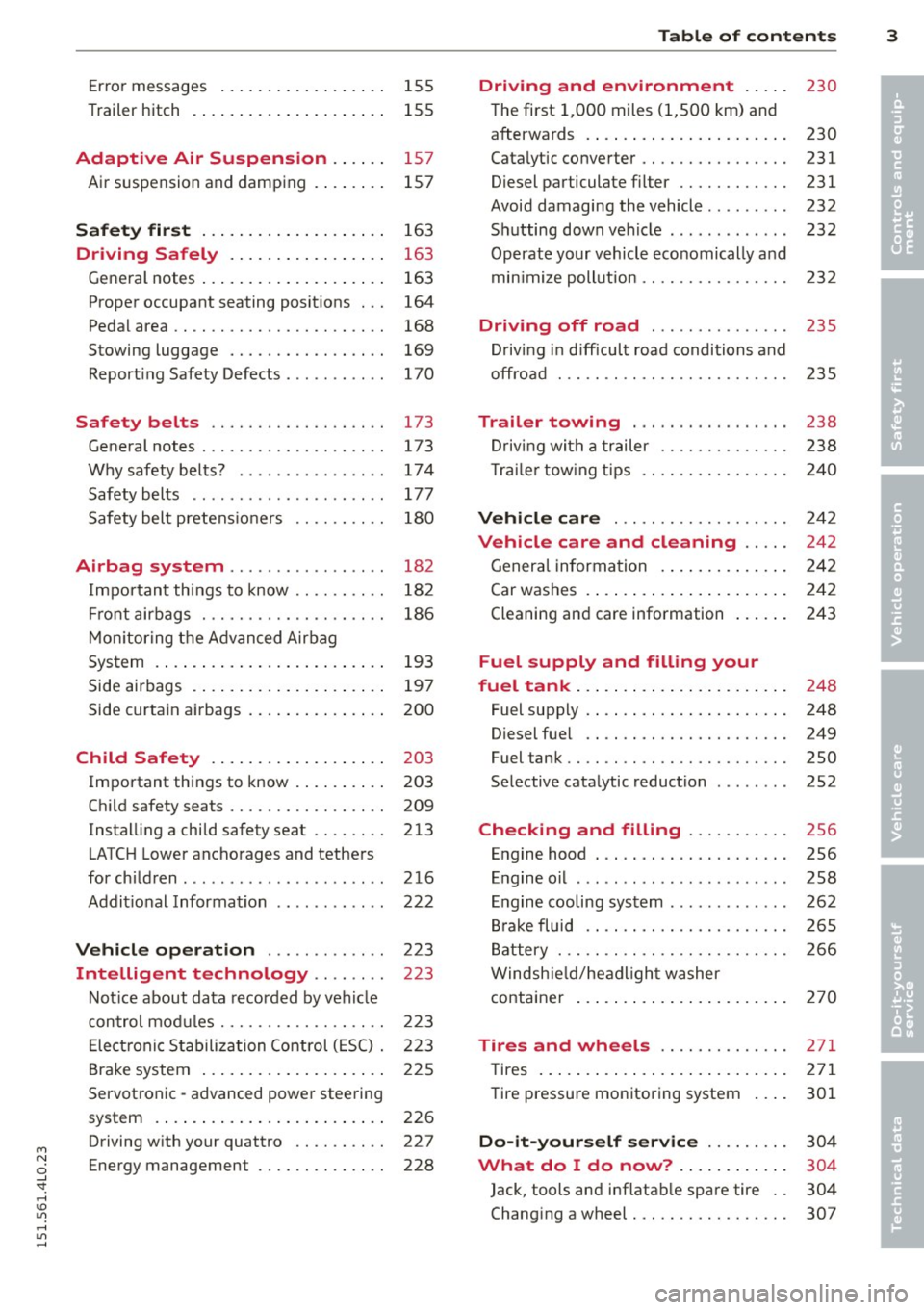
Error messages . . . . . . . . . . . . . . . . . . 155
Trailer hitch . . . . . . . . . . . . . . . . . . . . . 155
Adaptive Air Suspension .. .. . .
Air suspension and damping
S afet y fir st ... ...... ... .. .. .. . .
15 7
157
163
Driving Safely . . . . . . . . . . . . . . . . . 163
Gene ral notes ..... .... ... .. .. .. . .
Proper occupant seating posit ions . . .
Ped al area .. .. ............. .. .. . .
Stowing luggage ......... .... .. . .
Report ing Safety Defects ....... ... .
Safety belts ........... .... .. . .
General notes ............... .... .
Why safety belts? ............... .
Safety belts ..... ... ... .. .. .. .. . .
Safety bel t pretens ioners .. .. .. .. . .
Airbag system .......... ... ... .
Important things to know .. .. .. .. . .
Fr ont airbags ..... ..... .. .... .. . .
M on itoring the A dvanced Airbag
System .... .. ... .. ..... ... .. .. . .
Side airbags . ... ...... ... .. .. .. . .
Side curtain ai rbags .... ... .. .. .. . .
Child Safety .. .. .... ... .. .. .. . .
Important th ings to know . ... .. .. . .
Ch ild safety seats ......... .... .. . .
Instal ling a child safe ty seat .. .. .. . .
LATC H Lower ancho rages and tethers
for chi ldren .... .. ... ... .. .. .. .. . .
Addit ional Information
Vehicle operation ... .. .. .. .. . .
Intelligent technology .. .. . .. .
163
164
168
169
1 70
173 1 73
174
177
180
182
18 2
186
193
197
200
203
203
209
213
216
222
223
223
Not ice about data recorded by vehi cle
con trol mod ules . . . . . . . . . . . . . . . . . . 223
E lect ronic S tabiliz ation Control ( ESC) . 223
Brake system . . . . . . . . . . . . . . . . . . . . 225
Servotronic -advanced powe r steering
system . . . . . . . . . . . . . . . . . . . . . . . . . 226
Driving w ith your quattro . . . . . . . . . . 227
Energy management . . . . . . . . . . . . . . 228
Table of contents 3
Driving and environment . . . . .
230
The first 1,000 miles (1 ,500 km) and
afterwa rds . . . . . . . . . . . . . . . . . . . . . . 230
Catalytic co nverter . . . . . . . . . . . . . . . . 231
Diesel particulate filter . . . . . . . . . . . . 231
Avoid damaging the vehicle . . . . . . . . . 232
S h utting down veh icle . . . . . . . . . . . . . 232
Operate yo ur v ehicl e economically and
min imi ze poll ution .. . ............ .
Driving off road .............. .
D riv ing i n diff icult road conditions and
offroad . .. .. .. .. .... ........... .
Trailer towing .... .. .. ... ..... .
Drivi ng with a trailer ........... .. .
T rail er tow ing t ips .. . ............ .
Vehicle care ... .. .. ........... .
Vehicle care and cleaning .... .
Genera l informa tion . ... .... ... .. .
Car was hes . ..... .. . .. .. ..... ... .
Cleaning and care information ... .. .
Fuel supply and filling your
fuel tank ... .... .. . .. .. ..... ... .
Fuel supp ly . ... .. .. .. ... ..... ... .
Diesel f uel .. .. .. .... ........... .
Fuel tank .. .. .. .. ... ............ .
Se lective cata lytic reduction ....... .
Checking and filling .......... .
En gine hood . .... .... .... ... .... .
E n gine o il ... .. .. .. . .. .... .... .. .
Engine cooling system ............ .
Br ake fluid .. .. .. ............... .
B attery ... .. .. .. .. .. ........... .
Windsh ie ld /hea dligh t washer 2
32
235
2 35
238
2 38
2 40
2 42
2 4 2
2 4 2
242
243
2 4 8
248
249
250
252
256
256
258
262
2 65
2 66
container . . . . . . . . . . . . . . . . . . . . . . . 2 70
Tires and wheels . . . . . . . . . . . . . . 271
T ires . . . . . . . . . . . . . . . . . . . . . . . . . . . 2 71
Tire pressure monitoring system 301
Do-it-yourself service . . . . . . . . . 304
What do I do now? . . . . . . . . . . . . 304
Jack, too ls an d inf lata ble spare tire . . 304
Changi ng a wheel . . . . . . . . . . . . . . . . . 307
•
•
Page 76 of 350
7 4 Seats and stor age
Seats and storage
General recommen
dations
Why is your seat adjustment so
important?
The safety belts and the airbag system can
only provide maximum protection if the front
seats are correctly adjusted.
There are various ways of adjusting the front
seats to provide safe and comfortable support
for the driver and the front passenger. Adjust
you r seat prope rly so that :
- you can easily and quickly reach all the
switches and controls in the instrument
panel
-your body is properly supported thus reduc
ing physical stress and fatigue
- the safety be lts and airbag system can offer
maximum protection
¢ page 182 .
In the following sections, you will see exactly
how you can best adjust your seats .
There are special regulations and instructions
for installing a child safety seat on the front
passenger's seat. Always follow the informa
tion regarding child safety provided in
q page 203, Child Safety.
A WARNING
Incorrect seating position of the driver and
all other passengers can result in serious
personal injury.
- Always keep your feet on the floor when
the vehicle is in motion -never put your
feet on top of the instrument panel, out
of the w indow or on top of the seat cush
ion . This applies especially to the passen
gers .
If your seating position is incorrect,
you increase the risk of injury in the case
of sudden braking or an acc ident.
If the
airbag inflates and the seating position
is incorrect, this could result in personal
injury or even death.
- It is important for both the driver and
front passenger to keep a distance of at least 10
inches (25 cm) between them
selves and the steering wheel and/or in
strument panel. If you're sitting any
closer than this, the airbag system can not protect you properly . In addition, the
front seats and head restraints must be
adjusted to your body height so that they
can give you maximum protection.
- Always try to keep as much distance as
possible between yourself and the steer
ing wheel or instrument panel.
- Do not adjust the driver's or front pas
senger's seat while the vehicle is moving.
Your seat may move unexpectedly, caus
ing sudden loss of vehicle control and
personal injury. If you adjust your seat
while the veh icle is moving, you are out
of position.
Driver's seat '
The correct seat position is important for safe
and relaxed driving.
We recommend that you adjust the driver's
seat in the following manner :
.,. Adjust the seat in fore and aft direction so
that you can easily push the peda ls to the
floor wh ile keeping your knees sl ightly bent
q A in Why is your seat adjustment so im
portant? on page 74.
.. Adjust the seatback so that when you sit
with your back against the seatback, you can
still grasp the top of the steering wheel.
.. Adjust the head restraint so the upper edge
is as even as possible with the top of your
head . If that is not poss ible , try to adjust
the head restraint so that it is as close to
this position as possib le
q page 79.
A WARNING
Never place any objects in the driver's foot
well. An object could get into the pedal
area and interfere with pedal function. In
case of sudden braking or an accident, you
would not be able to brake or accelerate .
Page 77 of 350
M
"' 0 _,
"". rl I.O
"' rl
"' rl
Front passenger's seat
Always move the front passenger seat into the rearmost position .
To avoid contact with the airbag while it is de
ploying, do not sit any closer to the instru
ment panel than necessary and always wear
the three-point safety belt provided adjusted
correctly . We recommend that you adjust the
passenger's seat in the following manner:
.. Move the front passenger seat into the rear
most position of the fore and aft adjustment
range
~ .&. in Why is your seat adjustment
so important? on page 74.
• Bring the backrest up to an (almost) upright
position.
Do not ride with the seat reclined.
.. Adjust the head restraint so the upper edge
is as even as possible with the top of your
head . If that is not possible, try to adjust
the head restraint so that it is as close to
th is position as possible ¢
page 79 .
.. Place your feet on the floor in front of the
passenger's seat .
Power front seat
adjustment
Seat adjustment controls
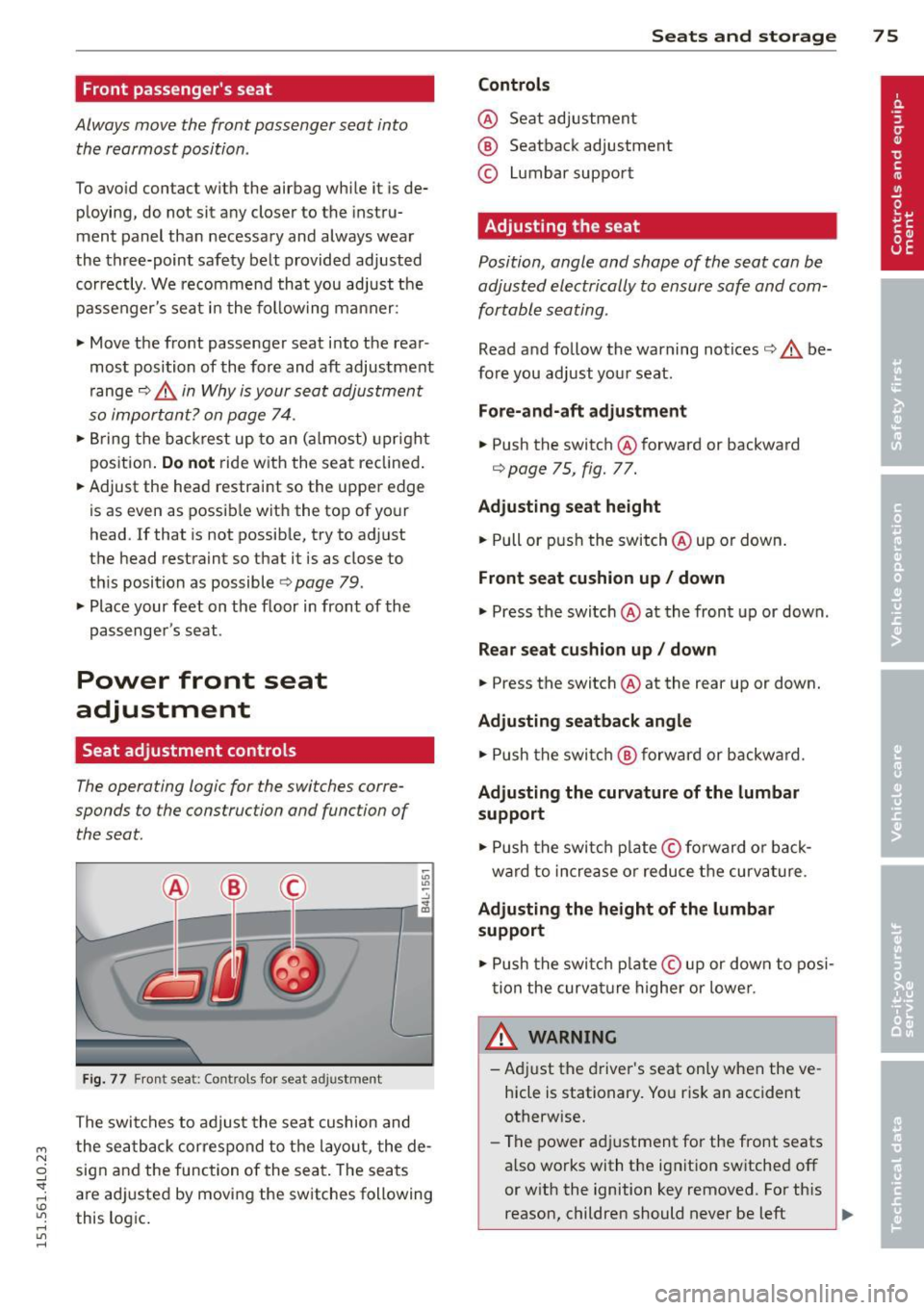
The operating logic for the switches corre
sponds to the cons truction and function of
the seat.
ui
"' ~ -" __.___,., 1,--~--,-,:,
Fig. 77 Fron t seat: Co ntr ols for seat a djustment
The switches to adjust the seat cushion and
the seatback correspond to the layout, the de
sign and the function of the seat. The seats
are adjusted by moving the switches following
this logic.
Seats and storage 75
Controls
@ Seat adjustment
® Seatback adjustment
© Lumbar support
Adjusting the seat
Position, angle and shape of the seat can be
adjusted electrically to ensure safe and com
fortable seating .
Read and follow the warning notices¢.&. be
fore you adjust your seat .
Fore-and-aft adjustment
.. Push the switch @forward or backward
¢ page 75, fig. 77 .
Adjusting seat height
.. Pull or push the switch @up or down.
Front seat cushion up/ down
.. Press the switch @at the front up or down .
Rear seat cushion up/ down
.. Press the switch @at the rear up or down.
Adjusting seatback angle
.. Push the switch @ forward or backward.
Adjusting the curvature of the lumbar
support
.. Push the switch plate© forward or back
ward to increase or reduce the curvature.
Adjusting the height of the lumbar
support
.. Push the switch plat e© up or down to posi
tion the curvature higher or lower .
A WARNING
-Adjust the driver's seat only when the ve
hicle is stationary. You risk an accident
otherwise.
- The power adjustment for the front seats
also works with the ignition sw itched off
or with the ignition key removed. For this
reason, children should never be left
IJIJ>
Page 82 of 350
80 Seats and storage
@ Tips
Correctly adjusted head restraints and
safety belts are an e xtremely effective
comb inat ion of safety features.
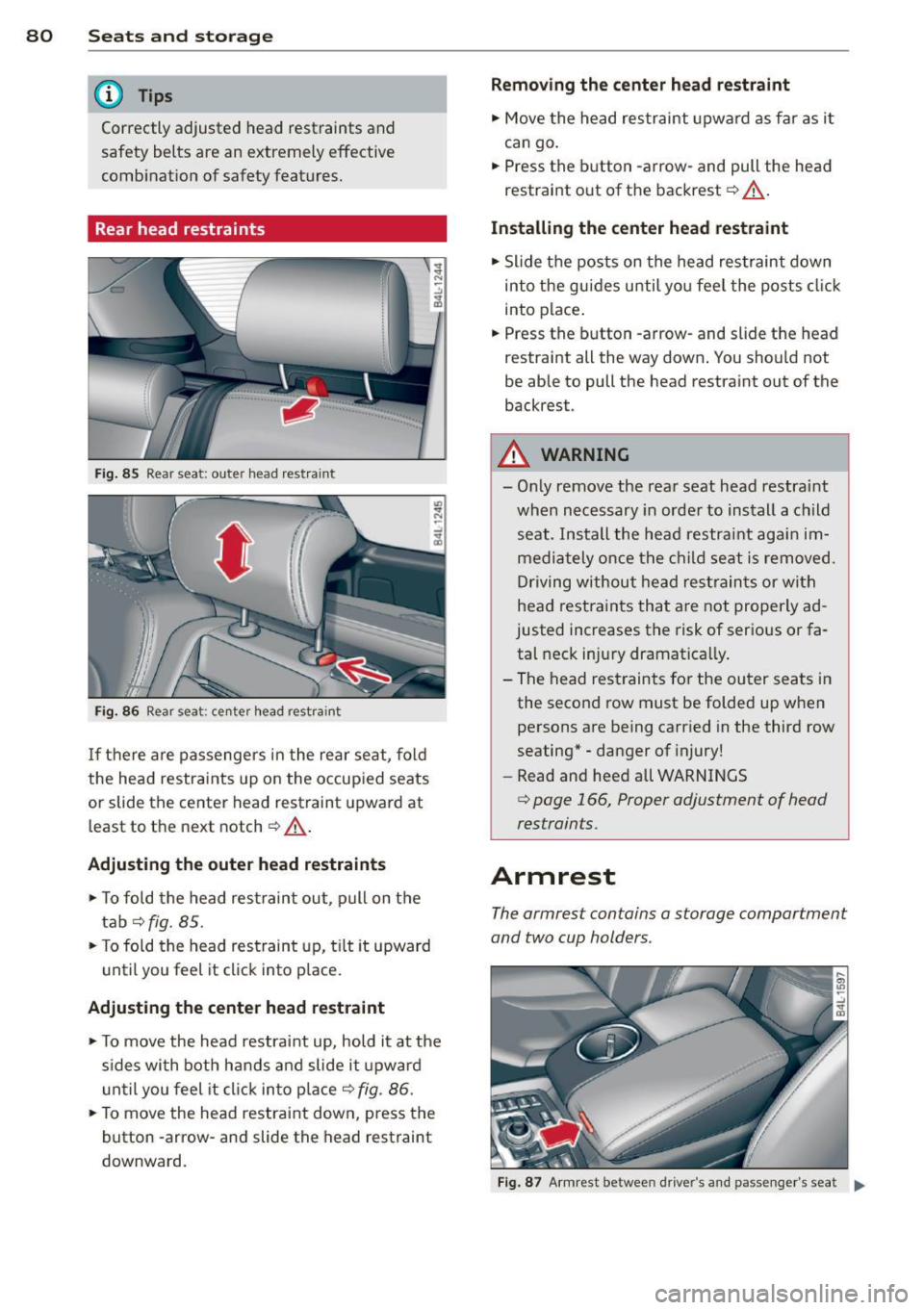
Rear head restraints
F ig. 85 Rear s eat: ou ter hea d re st rai nt
Fi g. 86 Rear se at: ce nte r h ead restra int
If the re are passengers in the rear seat, fold
the head restraints up on the occupied seats
or slide the cente r head restraint upward at
least to the next notch
~ .,& .
Adjusting the outer head restraints
.,. To fold the head restraint out, pull on the
tab ¢
fig. 85.
.. To fo ld the head restraint up, ti lt it upward
until you feel it click into p lace.
Adjusting the center h ead restraint
.,. To move the head restra int up , hold it at the
s ides wi th both hands and slide it upwa rd
u ntil you feel it cl ick into p lace
C? fig . 86 .
.. To move the head restraint down, press the
button -arrow -and slide the head restraint
downward.
Remo ving the center head re straint
.,. Move the head res traint upw ard as f ar as i t
can go.
.. Press the b utton -arrow -and pull the head
restraint o ut of the backrest
C? .,& .
Installing the center head restraint
.. Slide the posts on the head restraint down
into the guides u ntil you feel the posts click
into place .
.. Press the b utton -arrow- and slide the head
restraint all th e way down . You should not
be able to pull the head restraint out of the
backrest .
A WARNING
=
-On ly remove the rea r seat head restra int
when necessary in orde r to install a child
seat . Install the hea d restraint aga in im
mediately once the child se at is removed.
Driving without head res train ts or with
head restraints that are not properly ad
justed increases the r isk of serious or fa
tal neck injury dramatica lly.
- The head restraints for the outer seats in
the second row must be folded up when
persons are being carr ied in the third row
seating* -danger of injury!
- Read and heed all WARNINGS
¢ page 166, Proper adjustment of head
restraints .
Armrest
The armres t con tains a s torage compartment
and two cup holders .
Fig . 8 7 A rm rest betwee n dri ve r's an d pas se nge r's seat ...
Page 165 of 350
M N
0 ...J
'SI: ,...., \!) 1.1'1 ,...., 1.1'1 ,....,
Driving Safely
General notes
Safe driving habits
Please remember -safety first!
This chapter contains important information,
tips, instructions and warnings that you need
to read and observe for your own safety, the
safety of your passengers and others . We have
summarized here what you need to know
about safety belts, airbags, ch ild restra ints as
well as child safety. You r safety is for us
priori
ty number 1.
Always observe t he information
a nd warn ings in th is se ct ion - for yo ur own
safety as well as that of your passengers .
The information in this se ction applies to all
model ve rsion s of your veh icle . Some of the
feat ures descr ibed in th is sec tions may be
standa rd equipment on some models, or may
be optional equipment on others . If you are
not sure, ask yo ur authorized Aud i dea ler.
A WARNING
- Always make sure that you follow the in
st ruct ions and heed the WARNINGS i n
this manual. It is in your interest and in
the inte rest of you r passengers.
- Always keep all of the Owner's Literature
man uals in your Audi when you lend o r
sell your vehicle so that this im po rtant
information will a lways be availab le to
the driver and passengers.
- Always keep the Owner's Literature han
dy so that you can find it easily if yo u
have ques tion s.
Safety equipment
The safety features are part of the occupant
restraint syst em and work togeth er to help
redu ce the risk of injury in a wide variety of
accident situations .
Your safety and the safety of your passenge rs
should not be left to chance. Advances in
t echnology have made a var iety o f fea tures
avai lable to he lp red uce the risk of i njury in an
Dr iving Safel y 163
accident . The following is a list of just a few of
the safety features in yo ur Audi :
- sophis ticated s afety be lts fo r drive r and a ll
passenger sea ting posit ions,
- be lt tens ione rs fo r the fro nt seats and the
outer sea ting pos it ions in the second row
seating,
- be lt h eight adjustment fo r th e front seats
a nd the o ute r seat ing positions in the sec
ond row sea ting,
- he ad restra ints for e ach sea ting pos it ion,
- front airbags,
- side airbags in the fro nt seats a nd the outer
seating posit ions i n the second row seat
ing*,
- side curta in airbags,
- special LATCH anchorages for child re-
straints,
- adjustab le steeri ng column.
T hese individual safety features, can work to
gether as a system to he lp protect you and
your passengers in a wide range of accide nts.
These features cannot work as a system if
they are not always correctly adjusted and cor
rect ly used .
Safety is everybody's responsibil ity!
Important things to do before driving
Safety is everybody 's job! Vehicle and occu
pant safety always depends on the informed
and careful driver.
Fo r yo ur safety and the safety of your passen
gers,
before driving always:
.. Ma ke s ure that all lights and signa ls are op
erating correctly .
.. Ma ke s ure that the tire pressure is co rrect .
.. Make s ure that all windows are clean and a f
ford good vis ibility to the outs ide.
.. Secure all luggage and o ther items carefu lly
¢ page 90.
.. Make s ure that nothing can interfere with
the peda ls.
.. Adj ust fron t se at, head res traint and m irrors
c orrectly fo r you r heigh t. .,..
•
•
Page 167 of 350
M N
0 ...J
'SI: ,...., \!) 1.1'1 ,...., 1.1'1 ,....,
~ Always keep both feet in the footwell so
that you are in control of the vehicle at all
times.
For detailed information on how to adjust the
driver's seat, see
¢ page 75.
A WARNING
Drivers who are unbelted, out of position
or too close to the airbag can be seriously
injured by an airbag as it unfolds. To help
reduce the risk of serious personal injury:
- Always adjust the driver's seat and the
steering wheel so that there are at least
10 inches (25 cm) between your breast
bone and the steering wheel.
- Always hold the steering wheel on the
outside of the steering wheel rim with
your hands at the 9 o'clock and 3 o'clock positions to help reduce the risk of per
sonal injury if the driver's airbag inflates.
- Never hold the steering wheel at the
12 o'clock position or with your hands at
other positions inside the steering wheel
rim or on the steering wheel hub. Hold
ing the steering wheel the wrong way
can cause serious injuries to the hands,
arms and head if the driver's airbag de
ploys.
- Pointing the steering wheel toward your
face decreases the ability of the supple
mental driver's airbag to protect you in a
collision .
- Always sit in an upright position and nev
er lean against or place any part of your
body too close to the area where the air
bags are located.
- Before driving, always adjust the front
seats and head restraints properly and
make sure that all passengers are prop
erly restrained.
- Never adjust the seats while the vehicle
is moving . Your seat may move unexpect
edly and you could lose control of the ve
hicle.
- Never drive with the backrest reclined or
tilted far back! The farther the backrests
are tilted back, the greater the risk of in-
Driving Safely 165
jury due to incorrect positioning of the
safety belt and improper seating posi
tion .
- Children must always ride in child safety
seats ¢
page 203. Special precautions
apply when installing a child safety seat
on the front passenger seat¢
page 182.
Proper seating position for the front
passenger
The proper front passenger seating position
is important for safe, relaxed driving .
For your own safety and to reduce the risk of
injury in the event of an accident, we recom
mend that you adjust the seat for the front
passenger to the following position :
~ Adjust the angle of the seatback so that it is
in an upright position and your back comes
in full contact with it whenever the vehicle is
moving .
~ Adjust the head restraint so the upper edge
is as even as possible with the top of your
head. If that is not possible , try to adjust
the head restraint so that it is as close to
this position as possible¢
page 166.
~ Keep both feet flat on the floor in front of
the front passenger seat .
~ Fasten and wear safety belts correct
ly ¢
page 177 .
For detailed information on how to adjust the
front passenger 's seat, see ¢
page 7 4.
A WARNING ,_
Front seat passengers who are unbelted,
out of position or too close to the airbag
can be seriously injured or killed by the air
bag as it unfolds. To help reduce the risk of
serious personal injury:
- Passengers must always sit in an upright
position and never lean against or place
any part of their body too close to the
area where the airbags are located.
- Passengers who are unbelted, out of po
sition or too close to the airbag can be
seriously injured by an airbag as it
•
•
Page 168 of 350
166 Driving Safely
unfolds with great force in the blink of
an eye .
- Always make sure that there are at least
10 inches (25 cm) between the front
passenger's breastbone and the instru
ment panel.
- Each passenger must always sit on a seat of their own and properly fasten and
wear the safety belt belonging to that
seat.
- Before driving, always adjust the front
passenger seat and head restraint prop
erly .
- Always keep your feet on the floor in
front of the seat. Never rest them on the
seat, instrument panel, out of the win
dow, etc. The airbag system and safety
belt will not be able to protect you prop
erly and can even increase the risk of in
jury in a crash.
- Never drive with the backrest reclined or
tilted far back! The farther the backrests
are tilted back, the greater the risk of in
jury due to incorrect positioning of the
safety belt and improper seating posi
tion.
- Children must always ride in child safety
seats
c::> page 203. Special precautions
apply when installing a child safety seat
on the front passenger seat
c::> page 182 .
Proper seating positions for passengers
in rear seats
Rear seat passengers must sit upright with
both feet on the floor consistent with their
physical size and be properly restrained whenever the vehicle is in use .
To reduce the risk of injury caused by an incor
rect seating position in the event of a sudden
braking maneuver or an accident, your pas
sengers on the rear bench seat must always
observe the following :
.. If there are passengers in the rear seat, fold
the head restraints up on the occupied seats
or slide the center head restraint upward at
least to the next notch
c::> page 80.
.. Make sure that the seatback is securely
latched in the upright position
c::> page 82.
.. Keep both feet flat in the footwell in front of
the rear seat .
.. Fasten and wear safety belts properly
c::> page 177.
.. Make sure that children are always properly
restrained in a child restraint that is appro
priate for their size and age
c::> page 203.
_& WARNING
Passengers who are improperly seated on
the rear seat can be seriously injured in a
crash.
- Each passenger must always sit on a seat
of their own and properly fasten and
wear the safety belt belonging to that seat .
- Safety belts only
offer maximum protec
tion when the seatback is securely latch
ed in the upright position and the safety
belts are properly positioned on the
body. By not sitting upright, a rear seat
passenger increases the risk of personal
injury from improperly positioned safety
belts!
- Always adjust the head restraint properly
so that it can give maximum protection.
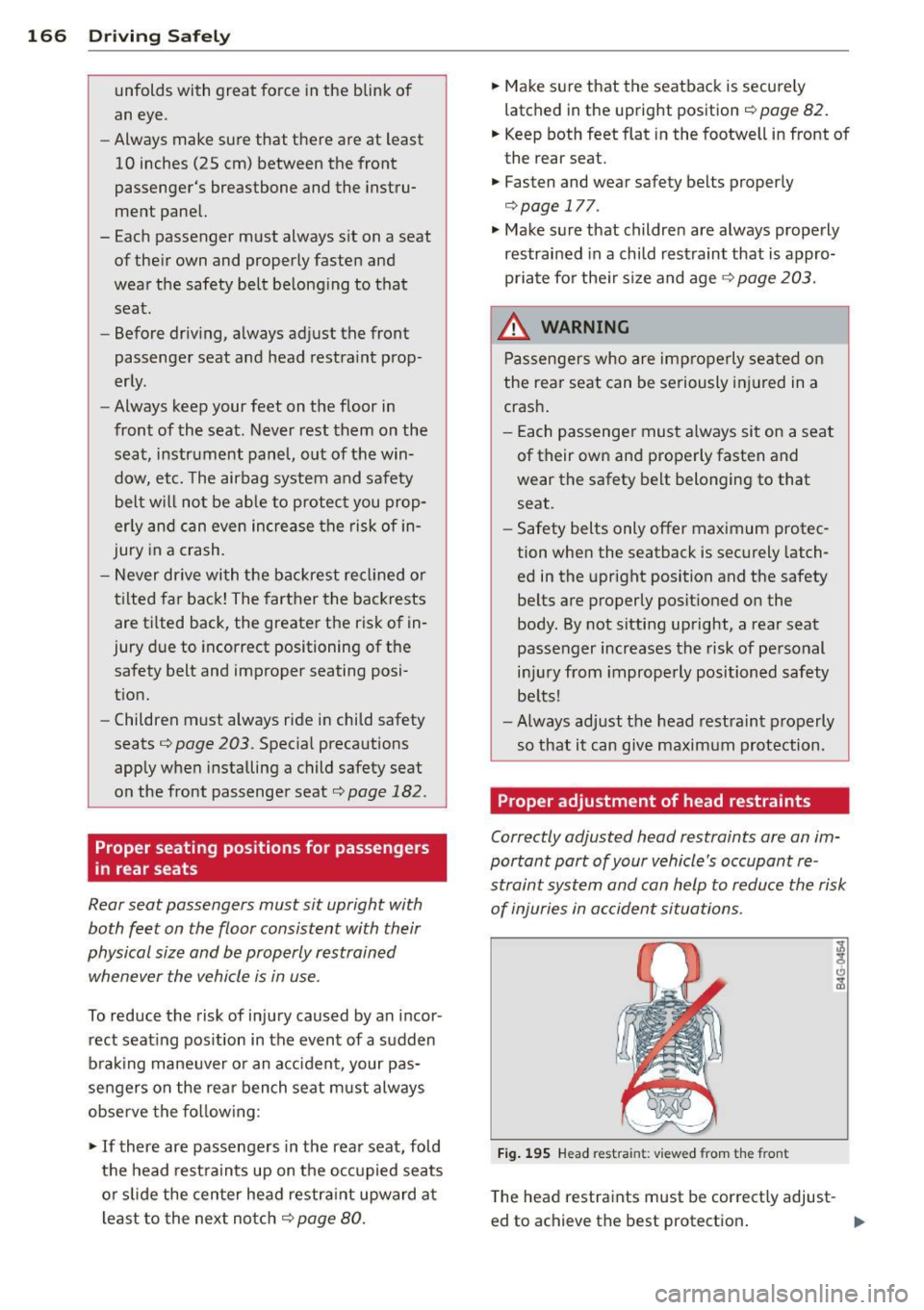
Proper adjustment of head restraints
-
Correctly adjusted head restraints are an im
portant part of your vehicle's occupant re
straint system and can help to reduce the risk
of injuries in accident situations.
Fig. 19S H ead restra int: vi ew ed from the front
The head restraints must be correctly adjust-
ed to achieve the best protection. .,.
Page 169 of 350

M N
0 ...J
'SI: ,...., \!) 1.1'1 ,...., 1.1'1 ,....,
~ Adjust the head restraints so the upper edge is as even as possib le with the top of yo ur
head. If that is not possib le, try to ad just
the head restraint so that it is as close to
th is position as possible ¢
fig. 195.
~ If there are passengers in rear seat, fo ld the
head restraints up on the occupied seats or
s li de the center head restra int upward at
least to the next notc h.
Adjust ing head restraints ¢
page 79.
A WARNING
All seats are equipped with head re
st raints. Dr iv ing without head restra ints or
w it h head restra ints that are not properly
adjusted incre ases the risk of ser io us or fa
t al neck injury dramat ica lly. To help reduce
the risk of injury:
- Always drive wit h the head restraints in
place and properly adjusted.
- E very person in the veh icle must have a
properly ad justed head restra int .
- Alw ays make sure e ach pe rson in the ve
hicle properly adjus ts the ir head re
st raint . Adj ust the head rest rain ts so the
upper edge is as even as possib le wit h
the top of your head. If that is not possi
ble, try to adjust the head restra int so
that it is as close to this position as pos
sible .
- Never attempt to adjust head restraint
wh ile driving. If you have driven off and
must adjust the dr iver headrest for any
reason, first stop the vehicle safe ly be
fore attempting to adjust t he head re
st ra in t.
- Children must always be properly re
strained in a ch ild restrai nt that is app ro
pr iate for their age and s ize
c> page 203.
Examples of improper seating posit ions
The occupant restraint system can only re
duce the risk of injury if vehicle occupants are
properly seated.
Improper seat ing posit ions can cause serious
inju ry or death . Saf ety belts can on ly work
Dr iving S afel y 167
when they are properly positioned on the
body. Improper seating positions red uce the
effectiveness of safety belts and will even in
crease the r isk of injury and death by moving
the safety belt to crit ica l areas of the body.
Improper seating positions a lso increase t he
risk of serious in ju ry and death when an a ir
bag deploys and str ikes an occupant who is
not in the p roper sea ting posit ion. A dr iver is
responsible for the s afe ty of all ve hicle occu
pan ts and espec ially for children . There fore:
~ Never allow anyone to assume a n incor rect
seating posi tion when the vehicle is being
used¢ &.
The following bullet ins list o nly some samp le
pos itions t hat will i ncrease the risk of se rio us
injury and dea th. O ur hope is that t hese exam
ples will ma ke yo u more aware o f seating po
s itions tha t are dangerous .
Therefore, whenever the vehicle is
moving:
- neve r st and up in the vehicle
- neve r stand on the seats
- neve r kneel on the seats
- neve r ride w it h the seatback reclined
- never lie down on the rear seat
- neve r lean up against the instrument panel
- never sit on the edge of the seat
- neve r sit sideways
- neve r lean out the window
- neve r put your feet out the window
- never put your feet on the instrument panel
- neve r rest your feet on the seat cush ion or
back of the seat
- never ride in the footwell
- never ride in the cargo area
A WARNING
Imp roper seating posit ions increase the
risk of serious persona l injury and death
whenever a vehicle is being used.
-Always make sure that all vehicle occ u-
pants stay in a proper seating position
a nd are p roperly rest rained whenever the
veh icle is being used .
-
•
•
Page 175 of 350
Safety belts
General notes
Always wear safety belts!
Wearing safety bel ts correc tly saves live s!
This chapter explains why saf ety belts ar e nec
essary, how they work and how to adjust and
wear them correc tly .
... Read all the information that follows and
heed all of the instructions and WARNINGS.
A WARNING
Not wearing safety belts or wearing them
improperly increases the risk of serious
personal injury and death .
- Safety belts are the single most effective
means available to reduce the risk of se
rious injury and death in automobile acci
dents . For your protection and that of
your passengers, always correctly wear
safety belts when the vehicle is moving.
- Pregnant women, injured, or physically
impaired persons must also use safety
belts. Like all vehicle occupants, they are
more likely to be seriously injured if they
do not wear safety be lts . The best way to
protect a fetus is to protect the mother -
throughout the entire pregnancy.
Number of seats
Vehicles with five seats: Your vehicle has two
front seats and three rear seats. Each seating
position has a safety belt.
Vehicles with six seats:* Your vehicle has two
front seats, two seats in the second row and two seats in the third row. Each seating posi
tion has a safety belt .
Vehicles with seven seats:* Your vehicles has
two front seats, three seats in the second row and two seats in the third row. Each seating
~ position has a safety belt.
0 ..J
'SI: ,...., \!) 1.1"1 ,....,
"' ,....,
Safety belts 173
A WARNING
Not wearing safety belts or wearing them
improperly increases the risk of serious
personal injury and death .
- Never strap more than one person, in
cluding small children, into any belt . It is
especially dangerous to place a safety
be lt over a child sitting on your lap.
- Never let more people ride in the vehicle
than there are safety belts available .
- Be sure everyone riding in the vehicle is
properly restrained with a separate safe
ty belt or child restraint.
Safety belt warning light
Your vehicle has a warning system for the
driver and front seat passenger (on USA mod
els only) to remind you about the importance
of buckling-up.
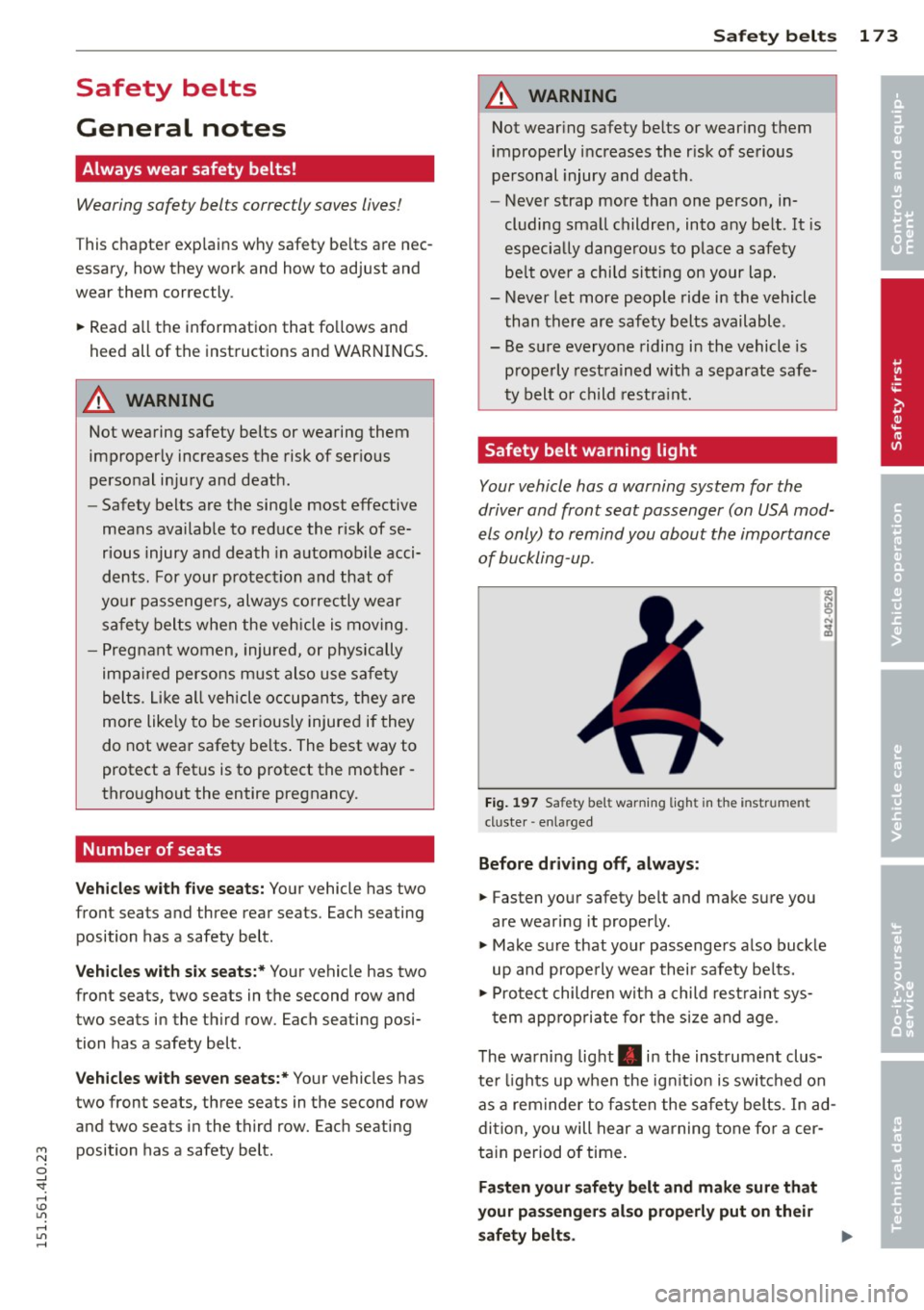
Fig. 197 Safet y bel t warn in g ligh t in the inst rum ent
cl uster -enla rged
Before driving off, always:
... Fasten your safety belt and make sure you
are wearing it properly .
"' Make sure that your passengers also buckle
up and properly wear their safety belts.
"' Protect children with a child restraint sys-
tem appropriate for the s ize and age.
The warning light . in the instrument clus
ter lights up when the ign it ion is switched on
as a reminder to fasten the safety belts. In ad
dition, you will hear a warning tone for a cer
tain period of time.
Fasten your safety belt and make sure that
your passengers also properly put on their
safety belts.
•
•