fold seats AUDI Q7 2017 Owner´s Manual
[x] Cancel search | Manufacturer: AUDI, Model Year: 2017, Model line: Q7, Model: AUDI Q7 2017Pages: 402, PDF Size: 100.39 MB
Page 285 of 402
u (0 ...... N r--. N ...... 0
0
:E
could even be killed if you are up aga inst the
airbag or too close to it when it inflates -
even with an Advanced Airbag
9page 273.
More important things to know about front
airbags
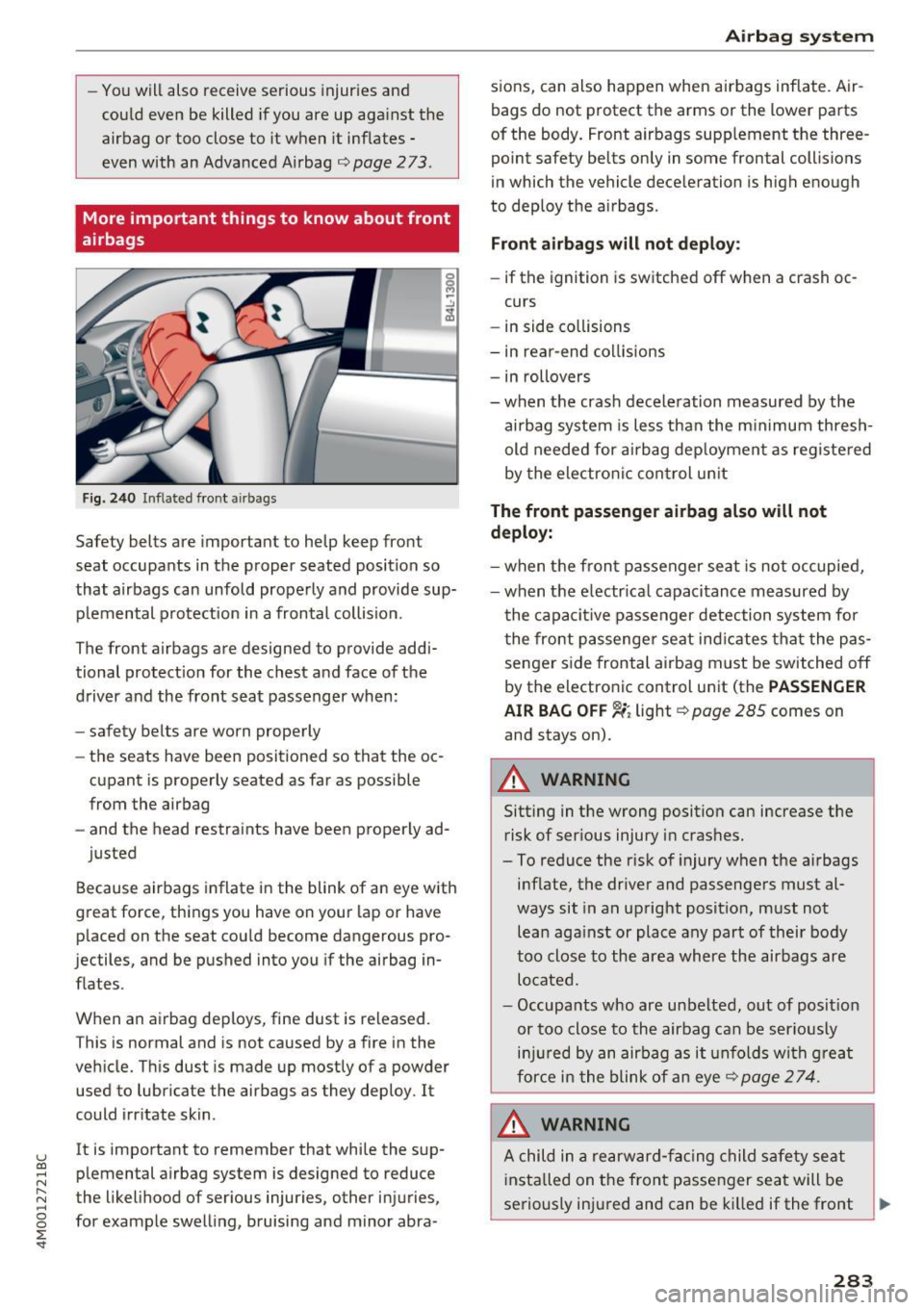
F ig. 2 40 Inflated front airbags
0 0 M
-.a ;z
Safety belts are impo rtant to help keep front
seat occupants in the proper seated position so
that airbags can unfold properly and provide sup p lemental protection in a frontal collision.
The front airbags are designed to provide addi
tional protect ion for the chest and face of the
driver and the front seat passenger when:
- safety belts are worn properly
- the seats have been positioned so that the oc-
cupant is properly seated as far as possible
from the airbag
- and the head restraints have been properly ad-
justed
Because airbags inflate in the blink of an eye w ith
great force, things you have on your lap or have p laced on the seat could become dangerous pro
jectiles, and be pushed into you if the airbag in flates .
When an airbag deploys, fine dust is released.
This is normal and is not caused by a fire in the
veh icle. This dust is made up mostly of a powder
used to lubricate the airbags as they deploy . It
could irr itate skin .
It is important to remember that while the sup
plemental airbag system is designed to reduce
the likelihood of ser ious injuries, other injuries,
for example swelling, bruising and minor abra -
Airbag sys tem
sions, can also happen when airbags inflate. Air
bags do not protect the arms or the lower parts
of the body. Front airbags supp lement the three
point safety belts only in some frontal collisions
in which the vehicle dece leration is high enough
to deploy the airbags .
Front airbags will not depl oy :
- if the ign ition is switched off when a crash oc-
curs
- in side co llisions
- in rear-end coll isions
- in rollovers
- when the crash deceleration measured by the
ai rbag system is less than the m inimum thresh
old needed for airbag dep loyment as registe red
by the electronic control un it
The front pass enge r airbag also w ill not
deploy:
- when the fron t passenger seat is not occupied,
- when the e lectr ical capacitance measured by
t he capacit ive passenger detection system for
the front passenge r seat ind icates that the pas
senger side frontal airbag m ust be switched off
by the electronic control unit (the
PASSENGER
AIR BA G OFF
"1; light 9 page 285 comes on
and stays on).
_& WARNING
Sitting in the wrong position can increase the
risk of ser ious injury in crashes.
- To reduce the risk of injury when the a irbags
inflate, the driver and passengers must al
ways sit in an upright posit ion, must not
lean aga inst or place any part of their body
too close to the area where the airbags are lo cated.
- Occupants who are unbelted, out of posit ion
or too close to the airbag can be serio usly
inj ured by an airbag as it unfolds wi th g reat
for ce in the blink of an eye
r:!>page 2 74.
_& WARNING
A child in a re arward-fa cing child safety seat
i nsta lled on t he front passenger sea t will be
serious ly in jured and can be ki lled if the front
Iii-
283
Page 286 of 402

Airbag system
airbag inflates -even with an Advanced Airbag
System.
- The inflating airbag will hit the child safety
seat or infant carrier with great force and
will smash the child safety seat and child
against the backrest, center armrest, door
or roof .
- Always install rear-facing child safety seats
on the rear seat .
- If you must install a rearward-facing child
safety seat on the front passenger seat be
cause of exceptional circumstances and the
PASSENGER AIR BAG OFF~; light does not
come on and stay on, immediately install
the rear-facing child safety seat in a rear
seating position and have the airbag system inspected by your authorized Audi dealer.
A WARNING
Objects between you and the airbag will in
crease the risk of injury in a crash by interfer
ing with the way the airbag unfolds or by be
ing pushed into you as the airbag inflates.
- Never hold things in your hands or on your
lap when the vehicle is in use.
- Never transport items on or in the area of
the front passenger seat. Objects could move into the area of the front airbags dur
ing braking or other sudden maneuvers and
become dangerous projectiles that can
cause serious personal injury if the airbags
inflate .
- Never place or attach accessories or other
objects (such as cupholders, telephone
brackets, large, heavy or bulky objects) on
the doors, over or near the area marked "AIRBAG'' on the steering wheel, instru
ment panel, seat backrests or between
those areas and yourself. These objects could cause injury in a crash, especially
when the airbags inflate.
- Never recline the front passenger's seat to
transport objects. Items can also move into
the area of the side airbag or the front air bag during braking or in a sudden maneu
ver. Objects near the airbags can become
284
-
projectiles and cause injury, particularly
when the seat is reclined .
- Never place or transport objects on the
front passenger seat. Objects on the front passenger seat could cause the capacitive
sensor in the seat to signal to airbag system
that the seat is occupied by a person when it
in fact is not, or that the person on the seat
is heavier than he or she actually is. The
change in electric capacitance because of
such objects can cause the passenger front
airbag to be turned on when it should be
off, or can cause the airbag to work in a way
that is different from the way it would have
worked without objects on the seat.
- Always make sure that there is nothing on
the front passenger seat that will cause the
capacitive passenger detection system in
the seat to signal to the Airbag System that
the seat is occupied by a person when it is not , or to signal that it is occupied by some
one who is heavier than the person actually
sitting on the seat. The presence of an ob
ject could cause the passenger front airbag
to be turned on when it should be off, or
could cause the airbag to work in a way that
is different from the way it would have
worked without the object on the seat.
A WARNING
The fine dust created when airbags deploy can cause breathing problems for people with a history of asthma or other breathing condi
tions .
- To reduce the risk of breathing problems,
those with asthma or other respiratory con
ditions should get fresh air right away by
getting out of the vehicle or opening win
dows or doors.
- If you are in a collision in which airbags de
ploy, wash your hands and face with mild
soap and water before eating.
- Be careful not to get the dust into your eyes,
or into any cuts or scratches.
- If the residue should get into your eyes,
flush them with water .
Page 311 of 402
u co ...... N r-... N ...... 0
0
:E: '
the child restraint is installed is in an up
right position and securely latched into
place and cannot fold forward. Otherwise,
the seatback with the child safety seat at
tached to it could f ly forward in the event of
an accident or other emergency situation.
- Always read and heed all WARNINGS when
ever using a child restrained in a veh icle is
being used
c::> page 295. Specia l precaut ions
apply when installing a child safety seat on
the front passenger seat
c::> page 2 7 4, Child
restraints on the front seat -some impor
tant things to know.
Deactivating the convertible locking
retractor
The convertible locking retractor for child re
straints will be deactivated automatically when
the belt is wound all the way back into the re
tractor .
~ Press the red button on the safety belt buckle.
The belt tongue will pop out of the buckle.
~ Guide the safety belt all the way back into its
stowed position .
Always let the safety belt retract completely into
its stowed position. The safety belt can now be
used as an ordinary safety belt without the con
vertible locking retractor for child restraints.
If the convertible locking retractor should be ac
tivated inadvertently, the safety belt must be un
fastened and guided completely back into its
stowed position to deact ivate this feature. If the
convert ible locking retractor is not deactivated,
the safety belt w ill gradually become tighter and
uncomfortable to wear.
_& WARNING
-
Improperly installed chi ld safety seats in
crease the risk of serious personal injury and
death in a collision.
- Never unfasten the safety belt to deactivate
the convertible locking retractor for child re
straints while the vehicle is moving . You
Child safety
would not be restrained and could be seri
ously injured in an accident.
- Always read and heed all WARNINGS when
ever using a child restrained in a vehicle is
be ing used
c::> page 295. Special precautions
apply when install ing a child safety seat on
the front passenger seat
c::> page 274, Child
restraints on the front seat -some impor
tant things to know.
LATCH system (lower
anchorages and tethers
for children)
Child Restraint System anchors and how
are they related to child safety
To provide a simpler and more practicab le way to
attach the child restraint on the vehicle seat,
Federal regulations require special lower ancho
rages in vehicles and devices on new child re
straints to attach to the vehicle anchorages .
In the United States, the combination of the
tether anchorages and the lower anchorages is
now generally called the LATCH system for
"Lower Anchorages and Tethers for Children". In
Canada, the terms "top tether" with "lower uni
versa l anchorages" (or "lower universal anchor
age bars") are used to descr ibe the system .
In other countries the term "ISOFIX" is used to
describe the lower anchorages .
Forward-facing child restraints manufactured af
ter September 1, 1999, are required by U.S. fed
eral regulations to comply with new child head
movement performance req uirements. These
new performance requirements make a tether
necessary on most new ch ild seats.
Installing a child restraint that requires a top
tethe r without one can seriously impair the per
formance of the child restraint and its ab ility to
pro tect the child in a collision. Installing a child
restra int that requi res a top tether without the
top tether may be a violation of state law.
Child restraint manufacturers offer LATCH lower
anchorages on their child seats w ith hook-on or ..,.
309
Page 391 of 402
u co ...... N r-... N ...... 0
0
:E: '
Emergency starting . . . . . . . . . . . . . . . . . . . 372
Emissions control system . . . . . . . . . . . . . . 321
E nergy management . . . . . . . . . . . . . . . . . . 153
Engine Coolant . . . . . . . . . . . . . . . . . . . . . . . . . . . . 328
Engine data . . . . . . . . . . . . . . . . . . . . . . . . 380
Start/Stop system . . . . . . . . . . . . . . . . . . . . 84
Starting/stopping . . . . . . . . . . . . . . . . . . . . 82
Starting with jumper cab les . . . . . . . . . . . 3 72
Engine compartment . . . . . . . . . . . . . . . . . . 322
Opening and closing the hood . . . . . . . . . . 323
Safety precautions . . . . . . . . . . . . . . . . . . . 322
Engine oil . . . . . . . . . . . . . . . . . . . . . . . . . . . 324
Adding . . . . . . . . . . . . . . . . . . . . . . . . . . . . 326
Changing . . . . . . . . . . . . . . . . . . . . . . . . . . 327
Checking the oil level . . . . . . . . . . . . . . . . . 326
Consumption . . . . . . . . . . . . . . . . . . . . . . . 326
Dipstick . . . . . . . . . . . . . . . . . . . . . . . . . . . . 326
Oi l consumption . . . . . . . . . . . . . . . . . . . . . 325
Specification and viscosity . . . . . . . . . . . . . 324
Engine sound . . . . . . . . . . . . . . . . . . . . . . . . 134
E ngine Start/Stop mode
refer to Start/Stop system . . . . . . . . . . . . . 86
Entering characters/numbers (speller) . . . . 164
Entering letters (speller) . . . . . . . . . . . . . . . 164
Entertainment sliding menu . . . . . . . . . . . . 162
E ntry/ex it lighting . . . . . . . . . . . . . . . . . . . . . 50
Entry assistance Rear seats . . . . . . . . . . . . . . . . . . . . . . . . . . . 61
Environment Proper disposal of drained engine oil . . . . 327
Unleaded fuel . . . . . . . . . . . . . . . . . . . . . . . 314
ESC . . . . . . . . . . . . . . . . . . . . . . . . . . . . . . . . 148
Hill descent assist . . . . . . . . . . . . . . . . . . . 150
Offroad mode . . . . . . . . . . . . . . . . . . . . . . . 149
E vasive steering support . . . . . . . . . . . . . . . 119
Event Data Recorder (EDR) . . . . . . . . . . . . . 154
Expanded view . . . . . . . . . . . . . . . . . . . . . . . . 14
Exterior lighting . . . . . . . . . . . . . . . . . . . . . . . 48
Exterior mirrors . . . . . . . . . . . . . . . . . . . . . . . 52
E xternal voice operat ion . . . . . . . . . . . . . . . . 17 4
F
Factory default settings
Multi Media Interface . . . . . . . . . . . . . . . . 250
Index
Fader (sound) . . . . . . . . . . . . . . . . . . . . . . . . 253
Fastening Booster seats . . . . . . . . . . . . . . . . . . . . . . . 305
Convertib le child safety seats . . . . . . . . . . 303
Infant seats . . . . . . . . . . . . . . . . . . . . . . . . 301
Fast forwarding/rewinding (audio/video
file) . . . . . . . . . . . . . . . . . . . . . . . . . . . . . . . . 23 7
Fast forwarding (audio/video file) . . . . . . . . 237
Fast route 212
Favorites Media ...... .. .. .. ....... ...... .. .. 240
Navigation . . . . . . . . . . . . . . . . . . . . . . . . . 207
T elephone. . . . . . . . . . . . . . . . . . . . . . . . . . 181
File formats (media drives) . . . . . . . . . . . . . 243
Floor mats . . . . . . . . . . . . . . . . . . . . . . . . . . . 261
Folding the backrest down/up . . . . . . . . . . . . 62
Foot pedals . . . . . . . . . . . . . . . . . . . . . . . . . . 261
For the sake of the env ironment
Environmentally-friendly driving . . . . . . . . 79
Fueling . . . . . . . . . . . . . . . . . . . . . . . . . . . . 316
Leaks...... ... .. .. ................. 323
Warming up the engine . . . . . . . . . . . . . . . . 82
Free text search . . . . . . . . . . . . . . . . . . . . . . 165
Media . . . . . . . . . . . . . . . . . . . . . . . . . . . . . 239
Navigation . . . . . . . . . . . . . . . . . . . . . . . . . 206
Radio . . . . . . . . . . . . . . . . . . . . . . . . . . . . . 224
Telephone. . . . . . . . . . . . . . . . . . . . . . . . . . 185
Freeze protection
Coolant . . . . . . . . . . . . . . . . . . . . . . . . . . . . 328
Frequency band . . . . . . . . . . . . . . . . . . 223, 226
Front airbags
Description . . . . . . . . . . . . . . . . . . . . . . . . . 277
How they work . . . . . . . . . . . . . . . . . . . . . . 283
Frontal collisions and the laws of physics . . 266
Front passenger's door emergency locking . . 39
Front seats Adjusting . . . . . . . . . . . . . . . . . . . . . . . . . . 258
Child restraints in the front seat . . . . . . . . 274
also refer to Seats . . . . . . . . . . . . . . . . . . . . 59
Fuel Additives... ... .. .. ................ . 314
Blended gasoline . . . . . . . . . . . . . . . . . . . . 314
Current consumption . . . . . . . . . . . . . . . . . . 15
Diesel . . . . . . . . . . . . . . . . . . . . . . . . . . . . . 314
Fuel filler neck . . . . . . . . . . . . . . . . . . . . . . 316
Fuel gauge . . . . . . . . . . . . . . . . . . . . . . . 10, 12
Fuel tank capacity . . . . . . . . . . . . . . . . . . . 379
389