tire pressure AUDI Q7 2017 Owner´s Manual
[x] Cancel search | Manufacturer: AUDI, Model Year: 2017, Model line: Q7, Model: AUDI Q7 2017Pages: 402, PDF Size: 100.39 MB
Page 339 of 402
u
(a) Curb weight
(b) Accessory weight
(c) Vehicle capacity weight, and
(d) Production options we ight
Ma ximum (permissible)
inflation pressure
means the maximum cold infla
tion pressure to which a t ire may
be inflated. Also called "maxi
mum inflation pressure."
Normal occupant weight
means 150 lbs. (68 kilograms)
times the number of occupants
seated in the veh icle up to the to
tal seating capacity of your vehi c le.
Occupant distribution
means distribution of occupants
in a vehicle.
Outer diameter
means the overall diameter of an
inflated new tire.
Overall width
means the linear distance be
tween the exteriors of the side
walls of an inflated tire, including
elevations due to labeling, deco
rations, or protective bands or
~ ribs . N
" N .... 0
0
l'. ...
Wheels
Ply
means a layer of rubber-coated
parallel cords .
Production options weight
means the combined weight of
those installed regular production
options weighing over 5 lbs. (2.3 kg) in excess of those standard
items which they replace, not pre
viously considered in curb weight
or accessory weight, including
heavy duty brakes, ride levelers,
roof rack, heavy duty battery, and
special trim .
Radial ply tire
means a pneumatic tire in which
the ply cords that extend to the beads are laid at substantially 90
degrees to the centerline of the
tread.
Recommended inflation
pressure
see ~ page 336, Cold tire infla
tion pressure .
Reinforced tire
means a tire designed to operate
at higher loads and at higher in
flation pressures than the corre sponding standard tire. Rein
forced tires may be identified as .,.
337
Page 340 of 402

Wheels
"XL" "xl" "EXTRA LOAD" or "RF" I I I
on the sidewall.
Rim
means a metal support for a tire
or a tire and tube assembly upon
which the tire beads are seated.
Rim diameter
means nominal diameter of the
bead seat . If you change your
wheel size, you w ill have to p ur
chase new tires to match the new rim diameter .
Rim size designation
means rim diameter and width.
Rim width
means nomina l distance between
rim flanges.
S idewall
means that portion of a tire be
tween the tread and bead .
Speed rating (letter code)
means the speed at which a tire is
designed to be driven for extend
ed periods of time. The rat ings
range from 93 mph (150 km/h)
to 186 mph (298 km/h)
¢ table
on page 334.
You may not find
this information on all tires be
cause it is not requ ired by law.
33 8
The speed rating letter code,
where applicable, is molded on
the tire sidewall and ind icates the
maximum permissible road
speeds
¢ .&. in Winter tires on
page 348.
Tire pressure monitoring system
means a system that detects
when one or mo re of a vehicle's
tires are underinflated and illum i
na tes a low tire pressure warning
telltale .
Tread
means that portion of a tire that
comes into contact w ith the road .
Tread separation
means pulling away of the tread
from the t ire carcass .
Treadwear indicators (TWI)
means the projections within the
principal grooves designed to give
a vis ua l indication of the deg rees
of wear of the t read. See
¢ page 342, Treadwear indicator
for mo re information on measur-
ing tire wear. .,.
Page 343 of 402
u a,
-N
" N .... 0
0
l: ..
different tire speeds. For this reason, in case of emergency, only
use a spare tire that has the same
circumference as the regular
tires.
&,_ WARNING
-Do not use steel rims that are 17 inches or larger. Other
wise, damage to the vehicle
and an accident could result.
-For technical reasons, it is not
possible to use tires from oth
er vehicles -in some cases,
you cannot even use tires from
the same vehicle model.
-Make sure that the tires you
select have enough clearance
to the vehicle. Replacement
tires should not be chosen
simply based on the nominal
size, because tires with a dif
ferent construction can differ greatly even if they are the
same size. If there is not
enough clearance, the tires or
the vehicle can be damaged
and this can reduce driving
safety and increase the risk of
an accident.
-Only use tires that are more
than six years old when abso-
Wheels
lutely necessary and drive
carefully when doing so.
-Run-flat tires* may only be used on vehicles that were
equipped with them at the
factory
¢ page 3 52.
-If you install wheel covers on
the vehicle, make sure they al low enough air circulation to
cool the brake system. If they
do not, this could increase the
risk of an accident.
Tire wear/damage
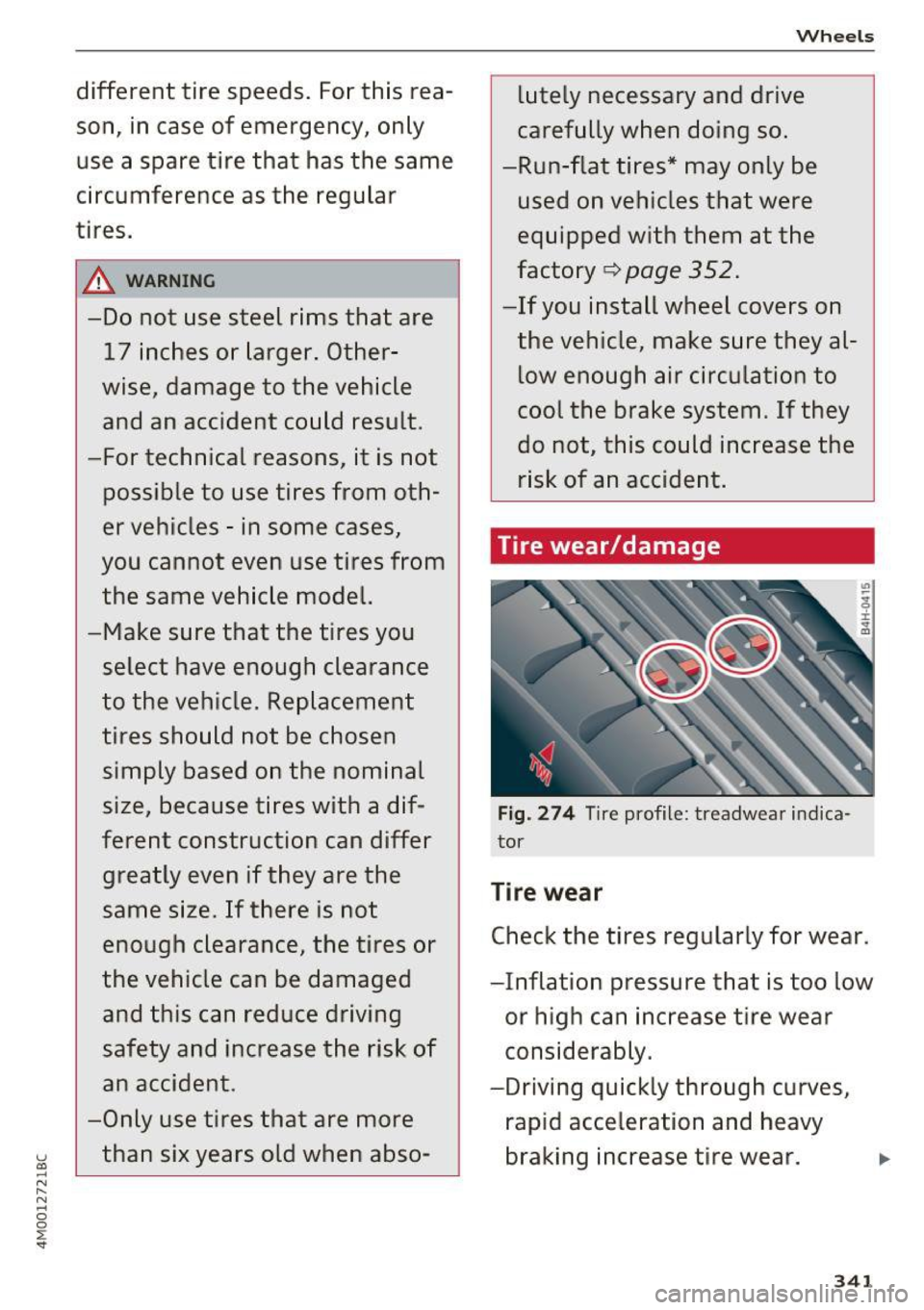
Fig. 274 T ire profile: treadwear indica
tor
Tire wear
Check the tires regularly for wear.
-Inflation pressure that is too low
or high can increase tire wear
considerably.
-Driving quickly through curves, rapid acceleration and heavy
braking increase tire wear.
341
Page 345 of 402
This can increase the risk of an accident because it has a nega
tive effect on handling, driving
through curves, and braking, and because it increases the risk of hydroplaning when driv
ing through deep puddles.
Tire pressure
I
4
0
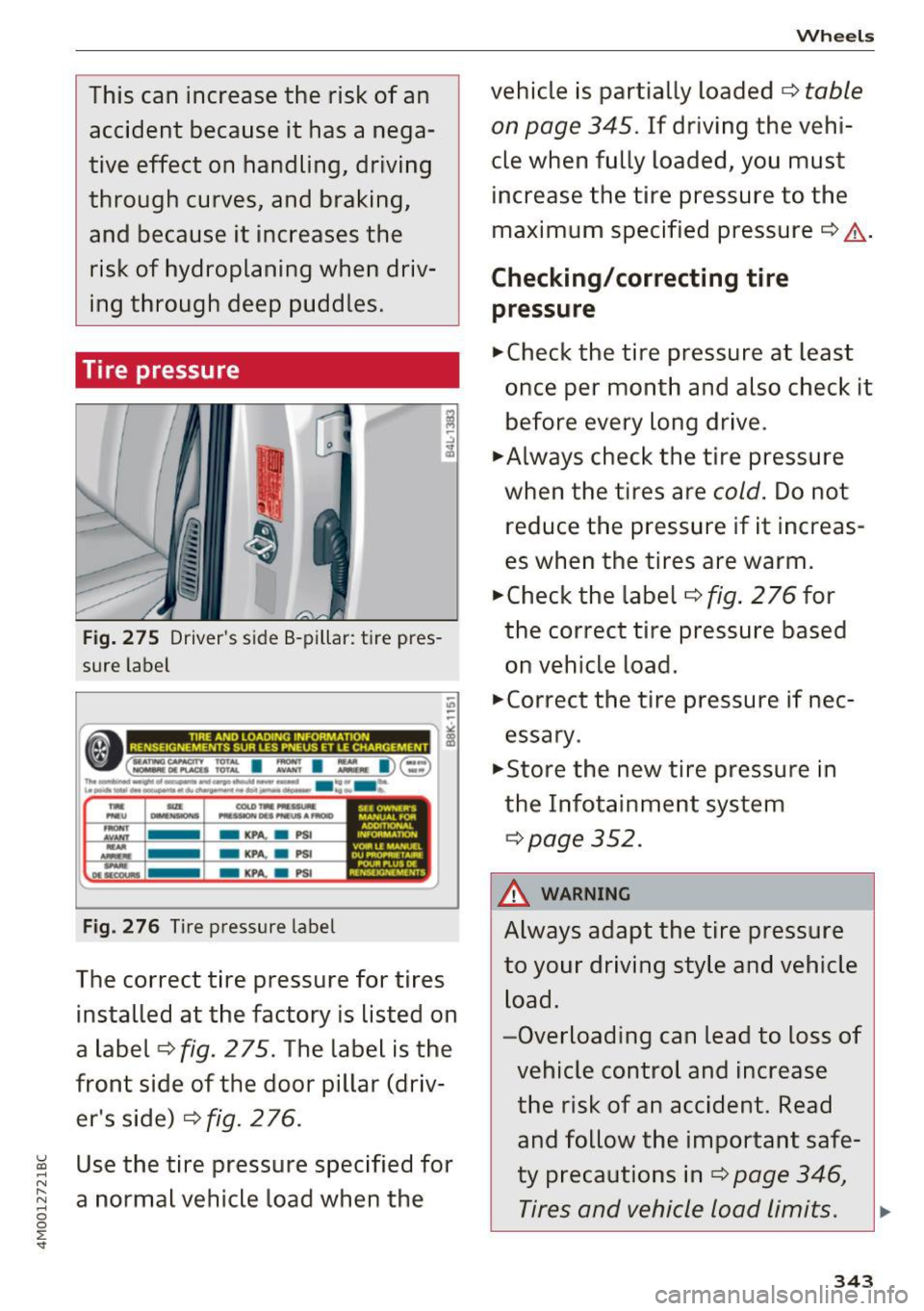
Fig. 275 Driver's side B-pillar: tire pres
sure label
Fig. 276 Tire pressure label
The correct tire pressure for tires
installed at the factory is listed on
a label¢
fig. 2 75. The label is the
front side of the door pillar (driv er's side) ¢
fig. 2 76.
~ Use the tire pressure specified for
N
:::; a normal vehicle load when the .... 0 0 ~
vehicle is partially loaded¢ table
on page 345.
If driving the vehi
cle when fully loaded, you must
increase the tire pressure to the
maximum specified pressure¢&, .
Checking/correcting tire
pressure
.,.Check the tire pressure at least
once per month and also check it before every long drive.
.,.Always check the tire pressure
when the tires are
cold. Do not
reduce the pressure if it increas
es when the tires are warm .
.,.Check the label ¢
fig. 2 76 for
the correct tire pressure based
on vehicle load.
.,.Corre ct the tire pressure if nec
essary .
.,.Store the new tire pressure in
the Infotainment system
¢ page 352.
A WARNING
Always adapt the tire pressure
to your driving style and vehicle
load.
-Overloading can lead to loss of vehicle control and increase
the risk of an accident. Read and follow the important safe
ty precautions in¢
page 346,
Tires and vehicle load limits .
343
Page 346 of 402
Wheels
-The tire must flex more if the tire pressure is too low or if
the vehicle speed or load are
too high . This heats the tire up
too much. This increases the
risk of an accident because it
can cause the tire to burst and
result in loss of vehicle con
trol.
-Incorrect tire pressure in creases tire wear and has a
negative effect on driving and
braking behavior, which in
creases the risk of an accident.
(D Note
Replace lost valve caps to re
duce the risk of damage to the
tire valves.
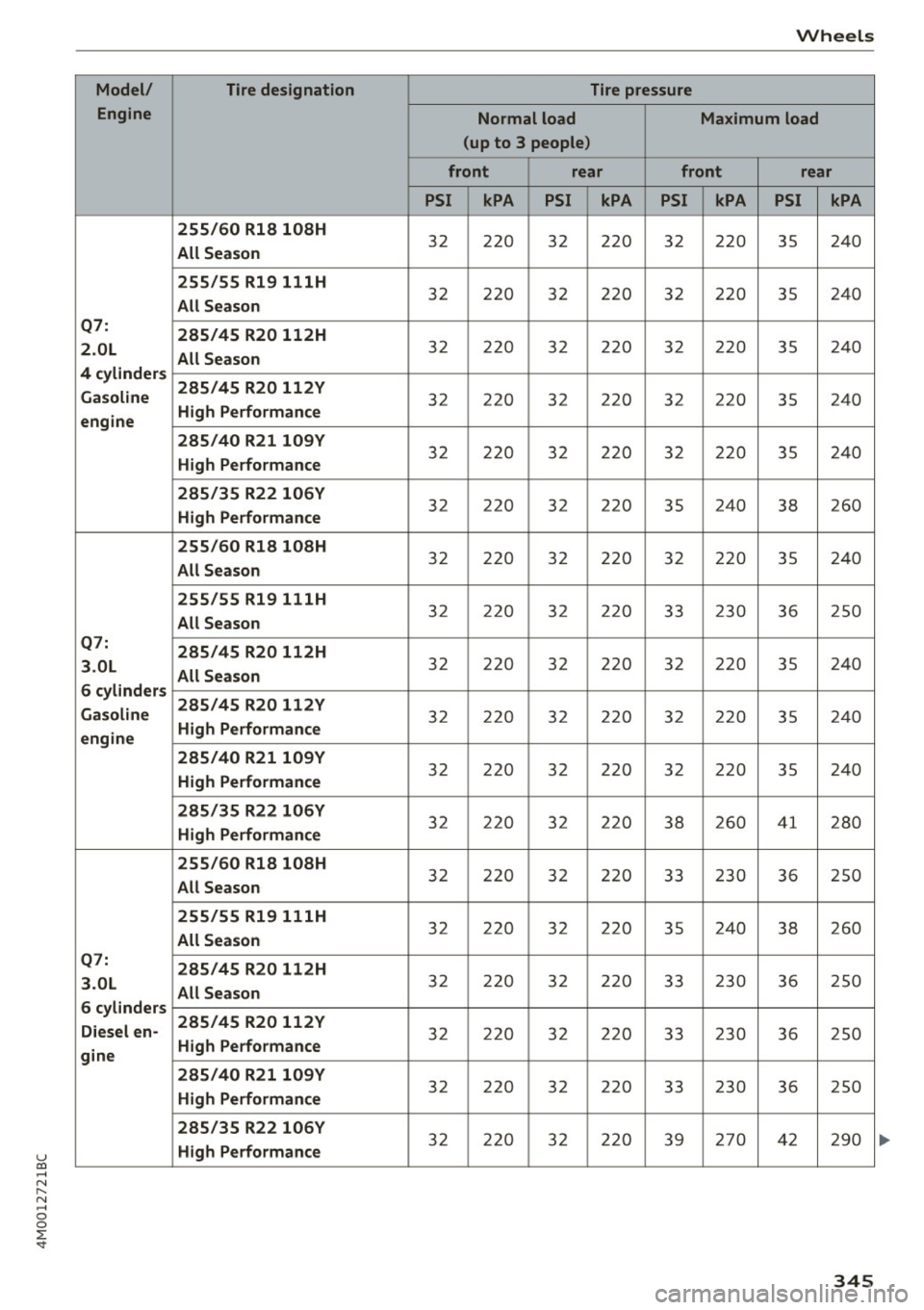
Tire pressure table
Please note that the information
contained in the following table
was correct at the time of print
ing, and the information is sub
ject to change. If there are differ
ences between this information
and the tire pressures specified
on the label on the driver's side 8-pillar, always follow the specifica
tion on the 8-pillar label
¢ page 343, fig. 275.
344
(i} For the sake of the environment
-Tire pressure that is too low
increases fuel consumption.
-Fuel consumption may also in
crease when driving with the
comfort tire pressure is se
lected .
(D Tips
Audi recommends using the
tire pressure specified for a
normal load
¢ table on
page 345
or for a full load
when the vehicle is partially loaded.
Make sure that the tire designa
tion on your tire matches the des ignation on the tire pressure label
and the tire pressure table.
The following table lists recom mended tire pressures in cold
tires according to the load and
the size of the tires installed.
Page 347 of 402
u co ...... N r-... N ...... 0
0
:E: '
Engine
Q7:
2.0L
4 cylinder s
Gasoline
engine
Q7:
3.0L
6 cylinder s
Gasoline
engine
Q7:
3.0L
6 cylinders
Diesel en-
gine Tire designation
255 /60 Rl8 108H
All Season
255 /55 Rl9 lllH
All Season
285/45 R20 112H
All Season
285 /45 R20 112V
High Performance
285 /40 R21109Y
High Performance
285/35 R22 106V
High Performance
255 /60 Rl8 108H
All Season
2 55 /55 Rl9 lllH
All Season
285 /45 R20 112H
All Season
285 /45 R20 11 2V
High Performance
285/40 R21109Y
High Performance
285 /35 R22 106V
High Performan ce
255/60 Rl8 108H
All Season
255/55 Rl9 lllH
All Season
285 /45 R20 112H
All Season
285/45 R20 112V
High Performance
285 /40 R21109Y
High Performance
285 /35 R22 106V
High Performance
Wheels
Tire pressure
Normal load
Maximum load
(up to 3 people )
front rear front rear
PSI kPA PSI kPA PSI kPA PSI kPA
32 220 32 220 32 220 35
240
32 220 32 220 3 2 220 35 2 40
32 220 32 220 3 2 220 35 24 0
32 220 32 220 32 220 35 240
3 2 2 20 3 2 220 3 2 220 35 24 0
32 220 32 220
35 240
38 260
32 220 32 220 32 220 35 240
3 2 220 32 220 33 230 36 250
32 220 32 220 32 220 35 240
32 220 32 220 3 2 220 35 240
32 220 32 220 32 220 35 2 40
32 220 32 220 38 260 41
280
3 2 220 32 220 33 23 0 36 2 50
32 220 32 220
35 240
38 260
32 220 32 220 33 230 36 250
3 2 22 0 32 220 33 230 36 250
32 220 32 220 33 230 36 250
3 2 220 3 2 220 39 270 42 290
345
Page 348 of 402
Wheels
&_ WARNING
Please note the important safe
ty precautions regarding tire
pressure¢
page 343 and load
limits¢
page 346.
Tires and vehicle load limits
There are limits to the amount of load or weight that any vehicle
and any tire can carry . A vehicle
that is overloaded will not handle
well and is more difficult to stop .
Overloading can not only lead to loss of vehicle control, but can al
so damage important parts of the
vehicle and can lead to sudden
tire failure, including a blowout
and sudden deflat ion that can
cause the vehicle to crash.
Your safety and that of your pas
sengers also depends on making
sure that load limits are not ex
ceeded. Vehicle load includes ev
erybody and everything in and on
the vehicle . These load limits a re
technically referred to as the vehi
cle's
Gross Vehicle Weight Rat
ing
("GVWR") .
The "GVWR" includes the weight of the basic vehicle, all factory in
stalled accessories, a full tan k of
fuel, oil, coolant and other fluids
3 4 6
plus maximum load. The maxi
mum load includes the number of
passengers that the veh icle is in
tended to carry ("seating capaci
ty") with an assumed weight o f
150 lbs (68 kg) for each passen
ger at a designated seat ing pos i
tion and the total weight of any luggage in the veh icle. If you tow
a trailer, the weight of the trailer
hitch and the tongue we ight of
the loaded trailer must be includ ed as part of the vehicle load.
The
Gross Axle Weight Rating
("GAWR") is the maximum load
that can be applied at each of the
vehicle's two axles .
The fact that there is an upper
limit to your vehicle's Gross Vehi
cle Weight Rating means that the
total weight of whatever is being
carried in the vehicle (inc luding
the weight of a trailer h itch and
the tongue weight of the loaded
trailer) is limited . The more pas
sengers in the vehicle or passen
gers who are heavier than the
standard weights assumed mean
that less weight can be carried as luggage .
The Gross Vehicle Weight Rating and the Gross Axle Weight Rat ing .,.
Page 349 of 402
u
"' ... N
" N ... 0
~ ...
are listed on the safety compli
ance sticker label located on the
driver's side 8-pillar.
.&_ WARNING
Overloading a vehicle can cause loss of vehicle control, a crash
or other accident, serious per
sonal injury, and even death.
-Carrying more weight than
your vehicle was designed to carry will prevent the vehicle
from handling properly and increase the risk of the loss of
vehicle control.
-The brakes on a vehicle that
has been overloaded may not
be able to stop the vehicle
within a safe distance.
-Tires on a vehicle that has
been overloaded can fail sud
denly, including a blowout and
sudden deflation, causing loss
of control and a crash.
-Always make sure that the to
tal load being transported - incl uding the weight of a trail
er hitch and the tongue
weight of a loaded trailer -
does not make the vehicle heavier than the vehicle's
Gross Vehicle Weight Rating.
Wheels
Determining correct load
limit
Use the example below to calcu
late the total weight of the pas
sengers and luggage or other
things that you plan to transport
so that you can make sure that
your vehicle will not be overload
ed.
Steps for Determining Correct Load Limit
1. Locate the statement "THE
COMBINED WEIGHT OF OCCU
PANTS AND CARGO SHOULD
NEVER EXCEED XXX KG OR XXX
LBS" on your vehicle's placard
(tire inflation pressure label)
¢ page 343, fig. 2 76.
2. Determine the combined
weight of the driver and pas
sengers that will be riding in
your vehicle.
3. Subtract the combined weight of the driver and passengers
from
"XXX" kilograms or "XXX"
pounds shown on the stick
er ¢
page 343, fig. 2 76.
4. The resulting figure equals the
available amount of cargo and
luggage load capacity. For ex
ample, if the
"XXX" amount
equals 1400 lbs. and there will.,,.
347
Page 351 of 402
u co ...... N r-... N ...... 0
0
:E: '
the tire t o burst.
- Always adapt yo ur drivi ng to the road and
traff ic conditions. Drive carefully and red uce
your speed on icy or slippery roads. Even
winter tires can lose traction on black ice.
@ For the sake of the environment
Reinstall summer ti res at the appropriate
time, because they provide better handling
when roads are free of snow and ice. Summer
tires cause less road noise, t ire wear and fuel
consumption.
(D Tips
You can also use all season tires instead of
w inter tires . Please note that in some coun
tries where w inter t ires are required, only
w inter t ires with the
die. symbol may be per
m itted.
Snow chains
Snow chains no t only imp rove the driving in wi n·
t er roa d cond itions, but a lso the brak ing.
" Only insta ll snow chains o n the
front wheels .
" Check and cor rect the sea ting of the snow
chains after dr iv ing a few feet, if necess ary. Fo l
low the ins truc tions from the ma nufa cturer .
" Note the maximum pe rmit ted speed w hen driv
ing with snow chains . Do not exce ed 30 mph
(SO km/h).
Use of snow chains is only pe rm itted with certain
rim/ti re combinations due to tec hnical reasons .
Chec k with an authorized A udi d ealer or author
ized A udi Service F acili ty to see if yo u may use
snow chains.
Use
fine-mesh snow chain s. They must not add
mo re t han 0.53 in (13 .5 mm) in height , including
the chain lock .
You mus t remove the snow c hains on roads with
out snow . Otherw ise, you could impair dr iving
abi lity and damage the tir es .
Wh eel s
A WARNING
Using incorrect snow chains or install ing snow
cha ins incorrectly can resu lt in loss of veh icle
control, which increases the risk of a n acci
dent.
(D Note
- Snow chains can damage the rims/wheel
cove rs* if the chains come into direct con
t act with them . Remove the wheel covers*
first . Use coa ted snow cha ins .
- Do not install and use snow c hains if the re is
a malfu nction in the a ir suspension*, be
cause the ve hicle height w ill be very low . If
yo u dr ive w ith snow chains anyway, the
w hee l ho usings and other ve hicle compo
nents can be seve rely damaged.
(0 Tips
When us ing snow chains, it m ay be usefu l to
swi tch the offroad mode o n
q page 149.
Low-profile tires
Applies to: vehicles with low-profile tires
Your vehicle is equipped with low -profi le tires* at
the factory . Compared to other tire/rim combina
tions, low-prof ile tires offer a w ider tread surface
and a larger rim diameter with shorter tire side
walls. This results in an agile dr iv ing style. How
ever, it may reduce the level of comfort and in
c rease road noise when driving on roads in poo r
cond it ion.
Low-profile t ires can become damaged more
quickly than standard tires when dr iving over
la rge bumps, potholes , manhole covers, speed
bumps and curbs. Therefo re, it is particularly im
po rtant to mainta in the co rrect ti re pressure
q poge 343.
To reduce the risk of damage to the tires and
r ims, drive very caref ully on poor roads.
Check your wheels regu larly every 2,000 mi
(3,000 km) for damage . For example, chec k for
bulges/cracks on the tires or deformations/
c racks on the rims . .,..
349
Page 353 of 402
u co ...... N r-... N ...... 0
0
:E: '
UJ General notes
Each tire, including t he spare (if provided),
should be checked monthly when cold and inflat
e d to the inflation pressure recommended by the
veh icle manufacturer on the vehicle placard or
tire inflat ion pressure label. (If your vehicle has
tires of a different size than the size indicated on
the veh icle placard or t ire inflation pressure la
be l, you shou ld determine the prope r ti re infla
tion pressure fo r those t ires) .
As an added safety feature , your veh icle has been
equ ipped w ith a t ire pressure monitoring system
(TPMS) that illuminates a low tire p ress ure te ll
tale whe n one or more of yo ur t ires is significant
l y under- infla ted . Accordingly, when the low tire
p ressure tellta le ill uminates, yo u should stop and
check your tires as soon as possible, and inflate
them to the proper press ure. Driving on a s ignifi
cantly under-inflated tire causes the tire to over
heat and can lead to t ire failure. Under-inflation
also reduces fuel efficiency and tire tread life,
and may affect the veh icle's handling and stop
p ing ability.
P lease note that the TPMS is not a substitute for
proper tire maintenance, and it is the driver's re
sponsib ility to ma inta in correct tire p ressure,
even if u nder-inflation has not reached t he leve l
to tr igger illum inat io n of the TPMS low tire p res
sure telltale.
Your veh icle has also been equ ipped w ith a TPMS
malfunct ion ind icator to indicate when the sys
tem is not operat ing properly. The TPMS ma l
f u nction indicator is combined w ith the low tire
p ressure tellta le. Whe n the system de tects a
mal function, the te lltale will flash fo r approxi
mate ly one min ute and then remain continuo usly
illum inated. This sequence will continue upon
subseq uent veh icle start-ups as long as the ma l
function ex ists .
When the malfunction indicator is ill uminated,
the system may not be ab le to detect or signa l
low tire press ure as intended. TPMS ma lfunctions
may occur for a var iety of reasons, including the
Wh eel s
insta llation o f replacement or alternate tires or
whee ls on the vehicle that prevent the TPMS
from functioning p roper ly . Always check the
TPMS ma lfunction te lltale after replac ing one or
more tires or wheels on your vehicle to ensure
that the rep lacement or a lternate tires a nd
wheels allow the TPMS to continue to fu nction
prope rly .
If the tire pressure monitoring indicator
appears
The tire pressure indicator in the instrument
cluster informs you if the tire pressure is too low
or if there is a system mo/function .
Using the ABS se nsors, the t ire pressu re moni to r
i ng system compares the tire tread circumfer
en ce and vibr ation character ist ics of the ind ividu
al tires . If the press ure changes in one o r more
t ires , th is is indicated in the instrument cluster
display with an indicato r light
[I] and a message.
If only one tire is affected, the location of that
t ire will be indicated.
T he tire press ures must be stored in the Infotain
ment system again each time the p ressures
change (switching between partial and full load
pressure) or after changing or replac ing a tire on
your vehicle
c:> page 352. The tire pressure mon i
tor ing system on ly mon itors the tire pressure you
have stored . Refer to the t ire pressu re label fo r
the re commended t ire pressu re fo r yo ur vehicle
c:> page 343, fig . 2 76.
T ire tread c irc umference and vibra tion characte r
ist ics can change and ca use a tire press ure wa rn
i ng if :
- the t ire pressure in one or more tires is too low
- the t ires have structural damage
- the t ire was rep laced or the t ire pressu re was
changed and it was not stored
c:> page 352
- tires that a re on ly pa rtially used are replaced
w ith new tires
Indicator lights
[I]-L oss of pressu re in at leas t one tire c:> ,&. .
Check the tires and replace or repair if necessary .
Check/correct the pressures of all four tires and .,.
351