service AUDI Q7 2018 Owner´s Manual
[x] Cancel search | Manufacturer: AUDI, Model Year: 2018, Model line: Q7, Model: AUDI Q7 2018Pages: 398, PDF Size: 185.58 MB
Page 340 of 398
Wheels
differently even if they are the
same size
i=:> &. -
.,,. If you would like to equip your
vehicle with a tire/rim combina
tion that is different from what
was installed at the factory, con
sult with an authorized Audi
dealer or authorized Audi Service
Facility before making a pur
chase
i=:> ,&. .
Because the spare tire* is differ
ent from the regular tires instal
led on the vehicle (such as winter
tires or wide tires), only use the
spare tire* temporarily in case of
emergency and drive carefully
while it is in use . It should be re
placed with a regular tire as soon
as possible.
All four wheels must be equipped
with tires that are the same brand
and have the same construction
and tread pattern so that the
drive system is not damaged by
different tire speeds . For this rea
son, in case of emergency, only
use a spare tire* that is the same
circumference as the regular
tires.
A WAR NING ~ -
-Do not use steel rims that are
17 inches or larger. Other-
338
wise, damage to the vehicle
and an accident could result .
-Only use tire/rim combina
tions and su itable wheel bolts
that have been approved by
Audi . Otherwise, damage to
the vehicle and an accident could result.
-For technical reasons, it is not
possible to use tires from oth
er vehicles -in some cases,
you cannot even use ti res from
the same vehicle model.
-Make sure that the tires you
select have enough clearance
to the vehicle . Replacement
tires should not be c hosen
simply based on the nominal
size, because tires with a dif
ferent construction can differ
greatly even if they are the
same size. If there is not
enough clearance, the tires or
the vehicle can be damaged and this can reduce driving
safety and increase the risk of
an accident .
-Only use tires that are more
than six years old when abso
lutely necessary and drive
carefully when doing so.
- Run-flat tires* may only be
used on vehicles that were
...
Page 341 of 398
0
a:,
.... N
equipped with them at the
factory
r=> page 349.
-If you install wheel covers on
the vehicle, make sure they al low enough air circulation to
cool the brake system. If they
do not, this could increase the risk of an accident.
Tire wear/damage
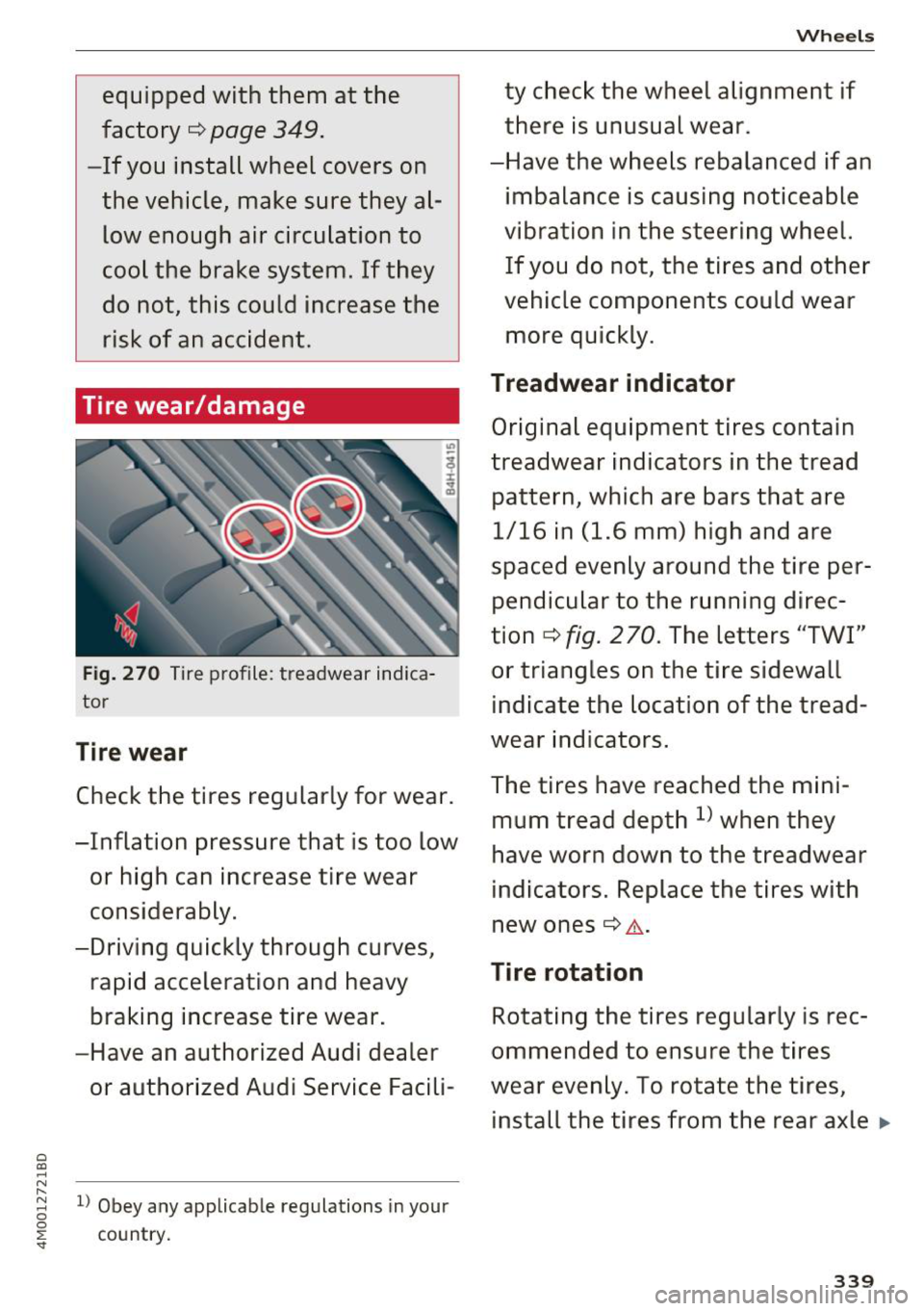
Fig. 270 Tire profile : treadwear indica
tor
Tire wear
Check the tires regularly for wear.
-Inflation pressure that is too low or high can increase tire wear
considerably.
-Driving quickly through curves, rapid acceleration and heavy
braking increase tire wear.
-Have an authorized Audi dealer or authorized Audi Service Facili-
"
8 l) Obey any applicable regulations in your
0 ~ country.
Wheels
ty check the wheel alignment if
there is unusual wear.
-Have the wheels rebalanced if an imbalance is causing noticeable
vibration in the steering wheel. If you do not, the tires and other
vehicle components could wear more quickly.
Treadwear indicator
Original equipment tires contain
treadwear indicators in the tread
pattern, which are bars that are 1/16 in (1.6 mm) high and are
spaced evenly around the tire per pendicular to the running direc
tion ¢
fig. 2 70. The letters "TWI"
or triangles on the tire sidewall indicate the location of the tread
wear indicators.
The tires have reached the mini mum tread depth
l) when they
have worn down to the treadwear
indicators. Replace the tires with
new ones¢ &.-
Tire rotation
Rotating the tires regularly is rec
ommended to ensure the tires
wear evenly. To rotate the tires, install the tires from the rear axle ..,.
339
Page 342 of 398
Wheels
on the front axle and vice versa.
This will allow the tires to have approximately the same length of
service life.
For unidirectional tires, make
sure the tires are installed accord
ing to the running direction indi
cated on the tire sidewall
¢ page 362.
Hidden damage
Damage to tires and rims can of
ten occur in locations that are
hidden. Unusual vibrations in the
vehicle or pulling to one side may indicate that there is tire damage.
Reduce your speed immediately.
Check the tires for damage. If no
damage is visible from the out
s ide, drive slowly and carefully to
the nearest authorized Audi deal er or authorized Audi Service Fa
cility to have the vehicle inspect
ed.
.&_ WARNING
Tread that has worn too low or
different tread depths on the
tires can reduce driving safety.
This can increase the risk of an
accident because it has a nega
tive effect on handling, driving
through curves, and braking, and because it increases the
340
risk of hydroplaning when driv
ing through deep puddles.
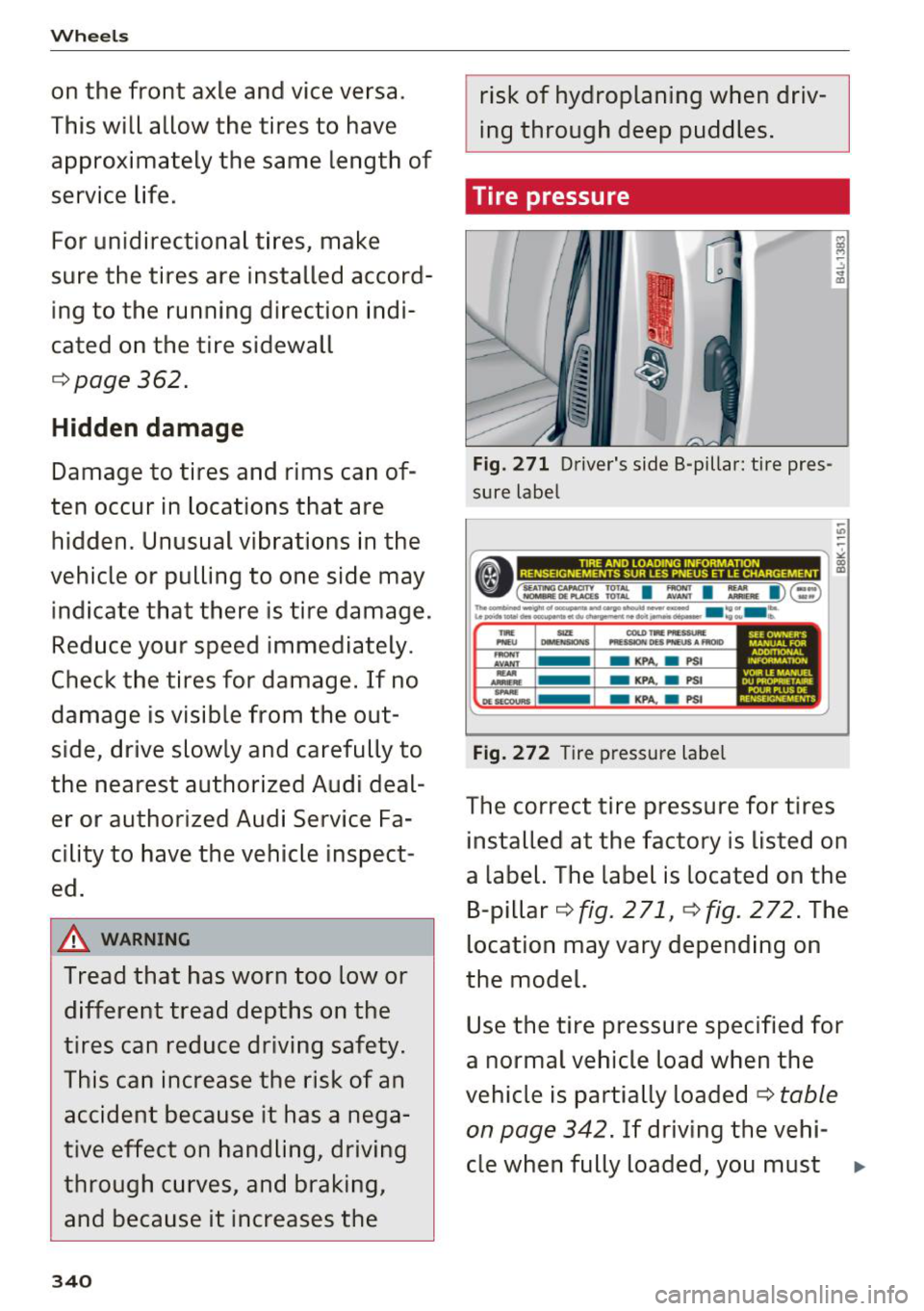
Tire pressure
I
4
Fig. 271 Driver's side 8-pillar : tire pres
sure label
-"' --~-----------~ ,;
ta (i
-...,_ -KPA. • PSI
Fig. 272 Tire pressure label
SEE OWMER"S MANU4l.FOA AODmONAI. INFORMATION VO .. Lf MAN\JIE\. DU PROPRIE"T AIRE l"OU"PlUSDE RENSEIGNEM!NTS
The correct tire pressure for tires
installed at the factory is listed on
a label. The label is located on the B-pillar
¢ fig. 271, ¢fig. 272. The
location may vary depending on
the model.
Use the tire pressure specified for
a normal vehicle load when the
vehicle is partially loaded¢
table
on page 342.
If driv ing the vehi-
cle when fully loaded, you must ...
Page 348 of 398
Wheels
tires cause less road noise, tire wear and fuel
consumption.
(D Tips
You can also use all season tires instead of
winter tires. Please note that in some coun
tries where winter tires are required, only
winter tires with the
& symbol may be per
mitted.
Snow chains
Snow chains not only improve the driving in win
ter road conditions, but also the braking .
~ Only install snow chains on the front wheels.
~ Check and correct the seating of the snow
chains after driving a few feet, if necessary . Fol
low the instructions from the manufacturer.
~ Note the maximum speed of 30 mph (SO km/
h). Note the local regulations.
Use of snow chains is only permitted with certain
rim/tire combinations due to technical reasons.
Check with an authorized Audi dealer or author
ized Audi Service Facility to see if you may use
snow chains.
Use
fine-mesh snow chains . They must not add
more than 0 .53 in (13.5 mm) in height, including
the chain lock.
You must remove the snow chains on roads with
out snow. Otherwise, you could impair driving
ability and damage the tires.
.&_ WARNING
Using incorrect snow chains or installing snow
chains incorrectly can result in loss of vehicle
control, which increases the risk of an acci
dent.
(LlJ) Note
- Snow chains can damage the rims/wheel
covers* if the chains come into direct con
tact with them. Remove the wheel covers*
first. Use coated snow chains.
- Do not install and use snow chains if there is
a malfunction in the air suspension*, be
cause the vehicle height will be
very low. If
346
you drive with snow chains anyway, the
wheel housings and other vehicle compo nents can be severely damaged.
(D Tips
When using snow chains, it may be useful to
switch the offroad mode on
r=> page 143.
Low-profile tires
Applies to: vehicles with low-profile tires
Compared to other tire/rim combinations, low
profile tires offer a wider tread surface and a
larger rim diameter with shorter tire sidewalls.
This results in an agile driving style. However, it
may reduce the level of comfort and increase
road noise when driving on roads in poor condi
tion.
Low -profile tires can become damaged more
quickly than standard tires when driving
over
large bumps, potholes, manhole covers, and
curbs . Therefore, it is particularly important to
maintain the correct tire pressure
r=.> page 340.
To reduce the risk of damage to the tires and
rims, drive
very carefully on poor roads.
Check your wheels regularly every 2,000 mi
(3,000 km) for damage . For example, check for
bulges/cracks on the tires or deformations/
cracks on the rims.
After a heavy impact or damage, have the tires
and rims inspected or replaced immediately by
an authorized Audi dealer or authorized Audi
Service Facility.
Low-profile tires can wear out faster than stand
ard tires .
Uniform tire quality grading
- Tread wear
- Traction AA ABC
- Temperature ABC
Quality grades can be found where applicable on
the tire side wall between tread shoulder and maximum section width
r=.> page 331, fig. 269.
Page 349 of 398
Cl a:, ...... N
" N ...... 0
0
::r '
perature
A.
All passenger car tires must conform to Federal
Safety Requirements in addition to these grades.
Tread wear
The tread wear grade is a comparative rating
based on the wear rate of the tire when tested
under controlled conditions on a specified gov
ernment test course.
For example, a tire graded 150 would wear one
and one ha lf (1 1/2) times as well on the govern
ment course as a tire graded 100.
The relative performance of tires depends upon
the actual conditions of their use, however, and
may depart significant ly from the norm due to
variations in driving habits, service practices and
differences in road characteristics and climate.
Traction
The traction grades, from highest to lowest, are
AA, A, B and
C. Those grades represent the tire's
ability to stop on wet pavement as measured un
der controlled conditions on specified govern
ment test surfaces of asphalt and concrete . A tire
marked C may have poor traction performance
¢ &, .
Temperature
The temperature grades are A (the highest), B,
and C, representing the tire's resistance to the
generation of heat and its ability to dissipate
heat when tested under controlled conditions on
a specified indoor laboratory test wheel.
Sustained high temperature can cause the mate
rial of the tire to degenerate and reduce tire life,
and excessive temperature can lead to sudden
tire failure¢ &,.
The grade C corresponds to a level of perform
ance which all passenger car tires must meet un
der the Federal Motor Vehicle Safety Standard
No. 109. Grades Band A represent higher levels
of performance on the laboratory test wheel than
the minimum required by law.
Wheels
A WARNING
--
The traction grade assigned to this tire is
based on straight-ahead braking traction
tests, and does not include acceleration, cor
nering, hydroplaning or peak traction charac
teristics.
A WARNING
The temperature grade for this tire is estab
lished for a tire that is properly inflated and
not overloaded. Excessive speed, underinfla
tion, or excessive loading, either separately or
in combination, can cause heat buildup and
possible tire failure.
A WARNING
-
--
Temperature grades apply to tires that are
properly inflated and not over or underinflat
ed.
Tire pressure monitoring system
ill
General notes
Each tire, including the spare (if provided),
should be checked monthly when cold and inflat
ed to the inflation pressure recommended by the
vehicle manufacturer on the vehicle placard or
tire inflation pressure label. (If your vehicle has
tires of a different size than the size ind icated on
the vehicle placard or tire inflation pressure la
bel, you should determine the proper tire infla
tion pressure for those tires).
As an added safety feature, your vehicle has been
equipped with a tire pressure monitoring system
(TPMS) that illuminates a low tire pressure tell
tale when one or more of your tires is significant ly under -inflated. Accordingly, when the low tire
pressure telltale illuminates, you should stop and
check your tires as soon as possible, and inflate
them to the proper pressure. Driving on a signifi cantly under-inflated tire causes the tire to over
heat and can lead to tire failure . Under-inflation
also reduces fue l efficiency and tire tread life,
and may affect the vehicle 's handling and stop-
ping ability. .,.
347
Page 350 of 398
Wheels
Please note that the TPMS is not a substitute for
proper tire maintenance, and it is the driver's re
sponsibility to maintain correct tire pressure,
even if under-inflation has not reached the level
to trigger illumination of the TPMS low tire pres
sure telltale.
Your vehicle has also been equipped with a TPMS
malfunction indicator to indicate when the sys
tem is not operating properly. The TPMS mal
function indicator is combined with the low tire pressure telltale. When the system detects a
malfunction, the telltale will flash for approxi
mately one minute and then remain continuously
illuminated. This sequence will continue upon
subsequent vehicle start-ups as long as the mal
function exists.
When the malfunction indicator is illuminated,
the system may not be able to detect or signal
low tire pressure as intended. TPMS malfunctions
may occur for a variety of reasons, including the
installation of replacement or alternate tires or
wheels on the vehicle that prevent the TPMS
from functioning properly . Always check the
TPMS malfunction telltale after replacing one or
more tires or wheels on your vehicle to ensure
that the replacement or alternate tires and
wheels allow the TPMS to continue to function
properly.
If the tire pressure monitoring indicator
appears
Applies to: vehicles with Tire Pressure Monitoring System in
dic ato r
The tire pressure indicator in the instrument
cluster informs you if the tire pressure is too low
or if there is a system malfunction.
Using the ABS sensors, the tire pressure monitor
ing system compares the tire tread circumfer
ence and vibration characteristics of the individu
al tires . If the pressure changes in one or more
tires, this is indicated in the instrument cluster
display with an indicator light
RI] and a message.
If only one tire is affected , the location of that
tire will be indicated.
The tire pressures must be stored in the Infotain
ment system again each time the pressures
348
change (switching between partial and full load
pressure) or after changing or replacing a tire on
your vehicle ~
page 349. The tire pressure moni
toring system only monitors the tire pressure you have stored. Refer to the tire pressure label for
the recommended tire pressure for your vehicle
~ page 340, fig . 272.
Tire tread circumference and vibration character
istics can change and cause a tire pressure warn
ing if:
- the tire pressure in one or more tires is too low
- the tires have structural damage
- the tire was replaced or the tire pressure was
changed and it was not stored
~ page 349
- tires that are only partially used are replaced
with new tires
Indicator lights
RI] -loss of pressure in at least one tire~,& .
Check the tires and replace or repair if necessary.
Check/correct the pressures of all four tires and
store the pressure again in the Infotainment sys
tem
~ page 349.
m (Tire Pressure Monitoring System) Tire
pressure: malfunction! See owner's manual.
If
m appears after switching the ignition on or
while driving and the
RI] indicator light in the in
strument cluster blinks for approximately one
minute and then stays on, there is system mal
function. Try to store the correct tire pressures
~ page 349. In some cases, you must drive for
several minutes after storing the pressures until
the indicator light turns off . If the indicator light
does turn off or turns on again after a short peri
od of time, drive to an authorized Audi dealer or
authorized Audi Service Facility immediately to
have the malfunction corrected.
& WARNING
- If the tire pressure indicator appears in the
display, reduce your speed immediately and
avoid any hard steering or braking maneu
vers. Stop as soon as possible and check the
tires and their pressure.
Page 351 of 398
-The driver is responsib le for maintaining the
correct tire pressure. You must c heck the
t ire pressure regu larly.
- Under certa in conditions (s uch as a sporty
dr iv ing style, winter cond itions o r unpaved
roads), the tire p ressure monitoring system
indicator may be de layed .
(D Tips
-The t ire press ure monitoring system can al
so stop work ing when there is an ESC mal
funct ion.
- Using snow chains may result in a system
malfunction.
- The t ire press ure monitoring system in your
A udi was calib rated with "A udi Orig inal
Tires"
<=)page 337. Using these t ires is rec
omme nded .
Storing tire pressures
Applies to: vehicles with Tire Pressure Monitoring System in
dicator
If the tire pressure changes or a tire is replaced,
it must be confirmed in the Infotainment sys
tem.
~ Make s ure before storing that the tire pressures
of a ll fou r tires meet the specified values and
are adapted to the load
Q page 340 .
~ Switch the ign ition on.
~ Se lect in the Infotainment system: ! MENUI but
ton
> Vehicle > Service & checks > Tire pres
sure monitoring > Store tire pressur e> Yes,
store now .
(D Tips
Do not store the tire press ures if snow chains
are insta lled.
Run-flat ti res
Applies to: vehicles with run-flat tires
A run-flat tire helps to maintain vehicle mobility
when there is a loss of pressure .
Cl ~ Run-flat t ires have re inforced sidewalls that pro-
~ tect the t i re if there is a loss of press ure. N ,-1 0
0
::r '
If the t ire pressure monitoring system indicates a
l oss of pressure in one or severa l tires, yo u can
contin ue driving on run -flat tires fo r at least 20
miles (30 km). Drive to an authorized Audi dealer
or authorized Aud i Serv ice Facility immediately to
have the problem corrected .
Continuing to drive on run-flat tires is n o
longer possible if
- there is visible damage to the tires, such as
cracks in the sidewalls .
- strong vibrat ions are felt w hile driving, or the
tire beg ins to smoke due to a strong build-up of
heat .
- the t ire was heavi ly damaged, for example in an
accident There is a r isk that parts of the tire
tread will detach and damage important ve hi
cle components .
- the E lectron ic Stab ilizat ion Control (ESC) is not
work ing or is cont inuously r unning .
- the t ire pressure monitoring system is not
work ing .
If it is no longer poss ible to continue driving de
spite hav ing run-flat tires, see an author ized Audi
dealer or author ized Audi Service Fac ility for as
s istance.
A WARNING
-
R un-f lat t ires may only be used on vehicles
that we re equipped with them at the fa ctory.
- The vehicle must have suspens ion designed
for run-flat tires and a facto ry-installed tire
p ress ure mo nitor ing syste m.
- I nco rrect use of r un-f lat t ires can lead to ve
h icl e damage o r accidents. Contact an au
thor ized A udi dealer or au thori zed A udi
Serv ice Facili ty to lear n if r un-f la t tir es may
be used on you r vehicle an d if so, which
ones.
- If r un-fla t ti re s are used, they m ust be in
stalled on all fo ur whee ls. Mix ing ti re types
is not permitted.
- If yo u have to drive when the tire press ure is
too low or there is no tire press ure, note the
following : .,..
349
Page 352 of 398
Wheels
-Do not dr ive faste r than 50 mph (80 km/
h) because this increases the risk of an ac
cident. Observe any laws specific to the
country where yo u are driv ing.
- Avoid full-th rottle accele ration, heavy
braking, and fast cornering, because this
increases the r isk of an accident .
- The vehicle may become more difficult to
control.
- See an autho rized Aud i deale r or a uthor
ized Audi Service Fac ility for assistance if
the t ire is too heavily damaged.
- Have the faulty tires replaced and the rims
checked fo r damage by an author ized A udi
dealer or author ized Audi Service Facil ity.
- The driver is responsib le for the vehicle, fo r
correcting the t ire pressure and for rep lac
ing faulty parts. Therefore, always adjus t
yo ur driv ing to the g iven s ituation .
(D Tips
-Audi Orig inal run-flat tires can be identified
by the "AOE" labeling on the tire sidewall.
- You can use the tire mob ility k it*
c:> page 357 on run-flat ti res.
350
Page 354 of 398
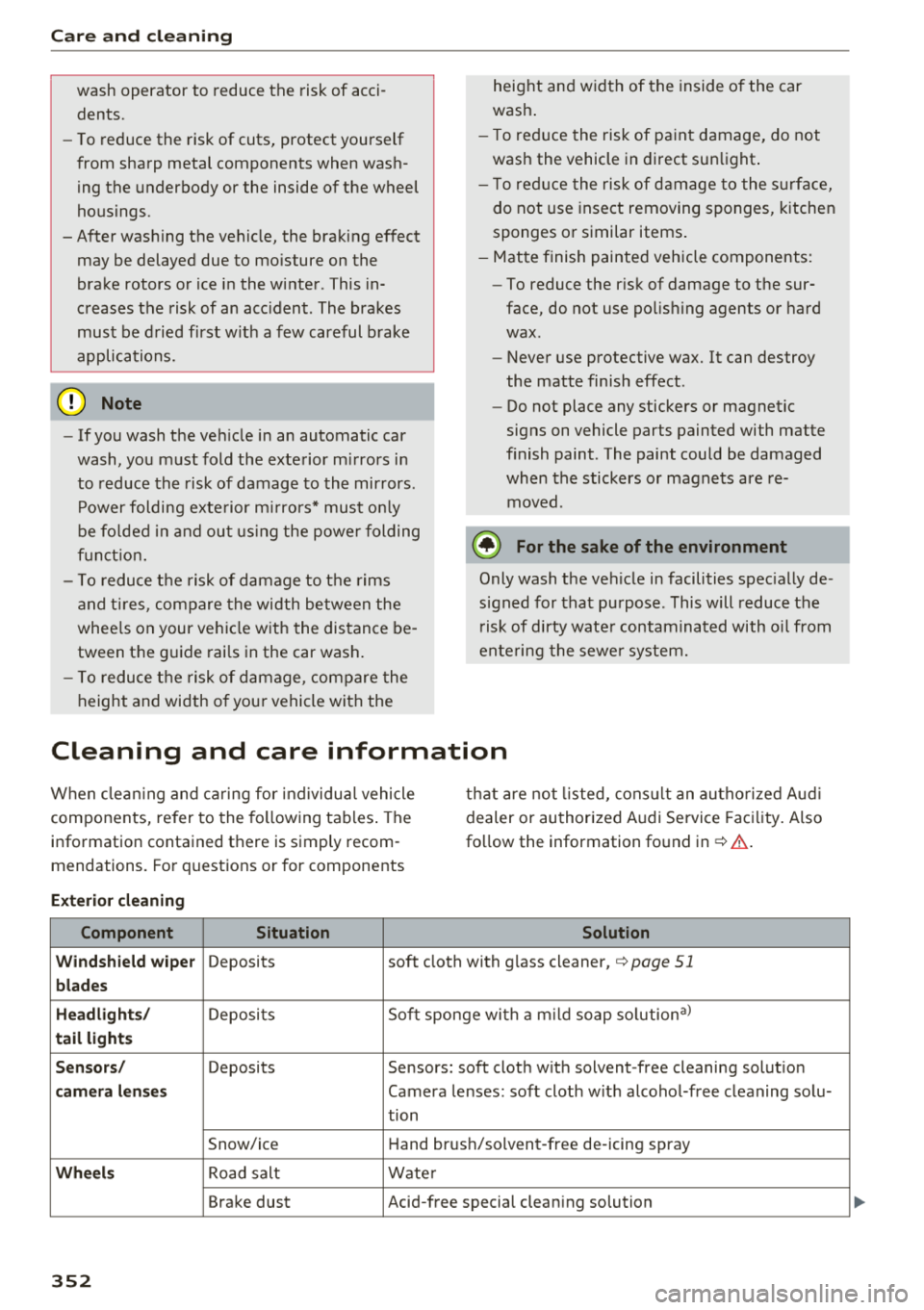
Care and cl eaning
wash operator to reduce the risk of acci
dents.
- To reduce the risk of cuts, protect yourself
from sharp metal components when was h
ing the underbody or the inside of the wheel
housings .
- After washing the vehicle, the braking effect may be delayed due to mo isture on the
brake rotors or ice in the winter . This in
creases the risk of an acc ident . The brakes
must be d ried first w it h a few careful b rake
applications.
@ Note
- If you wash the ve hicle in an automatic car
wash, you must fold the exterior m irrors in
to reduce the risk of damage to the mirrors .
P ower folding exte rior m irrors* must o nly
be fo lded in and out using the powe r folding
f u nct io n.
- To reduce t he risk of damage to the rims
and t ires , compare the width be tween the
whee ls on your ve hicl e w it h t he distance be
tween the g uide rai ls in the car wash .
- To reduce t he risk of damage, compare the
height and width o f you r vehicle with the heig
ht and w idth of the inside o f the car
was h.
- T o red uce the risk of pa in t damage, do not
was h the vehicle in direct sun light .
- T o red uce the risk of d amage to the s urf ace,
do not use insect removing sponges, k itchen
sponges or similar items .
- Matte finish painted vehicle components:
- To reduce the r isk of damage to the sur-
face, do not use polis hing agents or hard
wax .
- Never use protective wax. It can destroy
the matte finish effect .
- Do not place any stickers or magnet ic
signs on vehicle parts painted with matte
finish paint . The paint cou ld be damaged
when the stickers or magnets are re
moved .
@ For the sake of the environment
Only wash the ve hicle in facilities spec ia lly de
s igned for that pu rpose . This will reduce the
r isk of dirty wate r contaminated with o il from
ente ring the sewe r system.
Cleaning and care information
W hen clea ning and ca ring for ind ividua l vehicle
components, refer to the fo llowing tables . The
information contained there is simply recom
m endations. Fo r qu estions or for compon ents t
h at are not listed, cons ult an autho rized Aud i
dealer or authorized A udi Service Fac ility. Also
fo llow the information fo und inc:>.&. .
Ext erior cleaning
Component Situation Solution
Windshield wiper
Deposits soft cloth with glass cleane r, c:> page 51
blades
Headlights /
Deposits Soft sponge with
a m ild soap solution a)
tail light s
S ensors /
Deposits Sensors: soft cloth with solvent -free cleaning solut ion
camera lenses Camera lenses: soft cloth w it h alcohol-free cleaning solu-
tion
Snow/ic e Hand brush/solv ent-free de -icing spray
Wheels Road salt Water
Brake dust Acid-free special cleaning solution
352
Page 355 of 398
Cl a:, ...... N
" N ...... 0
0
::r '
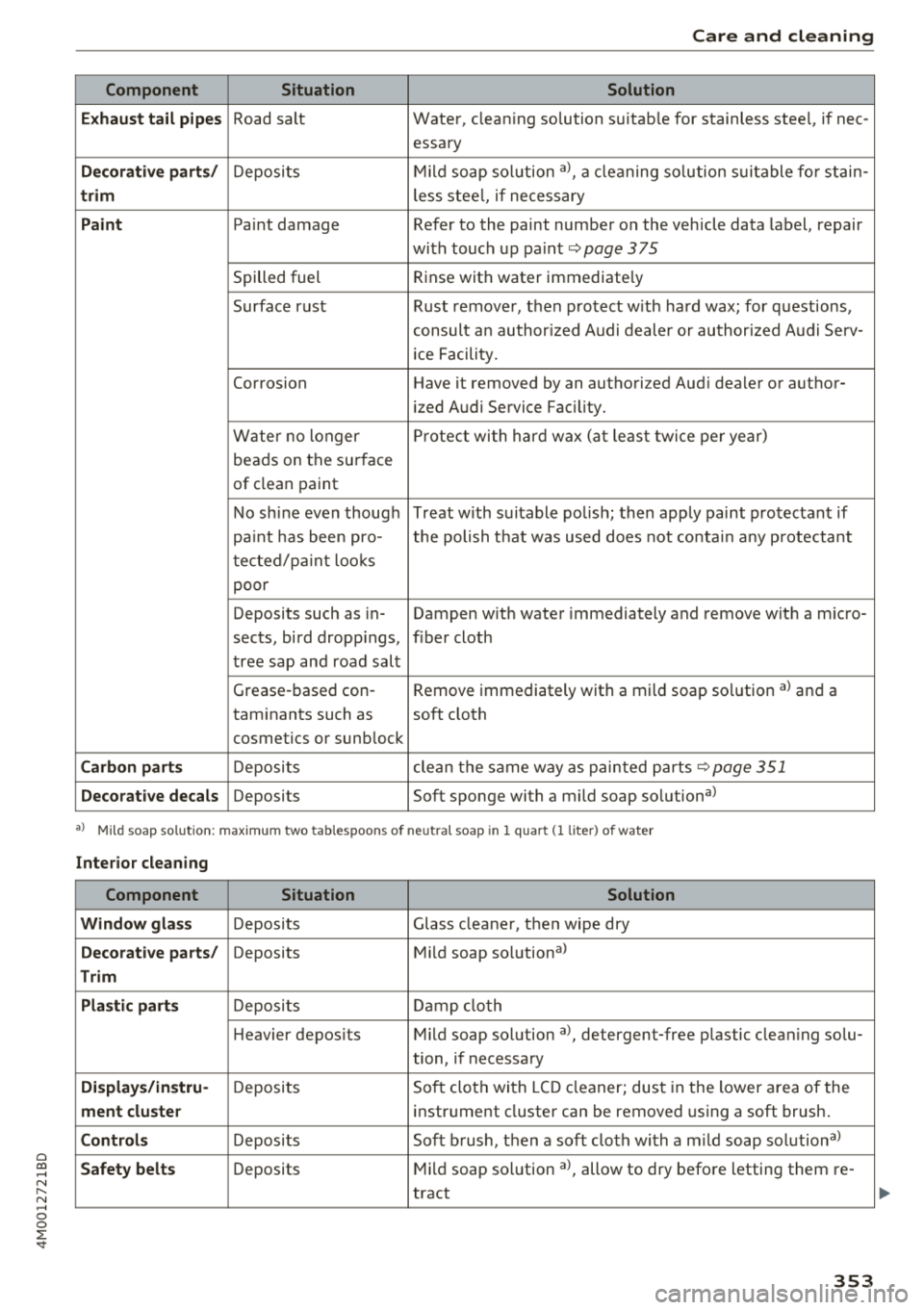
Component Situation Solution
Exhaust tail pipes
Road salt Water, cleaning solution suitab le for stainless steel, if nee -
essary
Decorative parts/ Deposits Mild
soap solution a>, a cleaning solution suitable for stain-
trim less steel, if necessary
Paint Paint damage Refer to the paint number on the vehicle data label, repair
with touch up paint
r:=;, page 375
Spilled fuel Rinse
with water immediate ly
Surface rust Rust remover, then protect with hard wax; for questions,
consult an author ized Audi dealer or author ized Audi Serv-
ic e Facility.
Corrosion Have it removed by an authorized Aud i dealer or author-
ized Audi Service Fac ility.
Water no longer Protect
with hard wax (at least twice per year)
beads on the surface
of clean paint
No shine even though Treat with suitable polish; then apply paint protectant if
pa int has been pro- the polish t hat was used does not contain any protectant
tected/paint looks
poor
Deposits such as in- Dampen w ith water immediately and remove with a m icro-
sects, bird dropp ings, f iber cloth
tree sap and road salt
Grease-based con- Remove immediately with a mild soap solution a) and a
taminants such as soft cloth
cosmetics or sunb lock
Carbon parts Deposits clean the same way as painted parts r:=;,page 351
Decorative decals Deposits Soft sponge with a mild soap solutiona>
•> Mi ld soap solution: maximu m two tab lespoons of ne utral soap in 1 quar t (1 lite r) of water
Interior cleaning
Component Situation Solution
Window glass
Deposits Glass cleaner, then wipe dry
Decorative parts/ Deposits Mild soap solutional
Trim
Plastic parts
Deposits Damp cloth
H eavier depos its Mild soap solution a>, detergent-free p lastic clean ing solu-
tion, if necessary
Displays/instru-Deposits Soft cloth with LCD cleaner; dust in the lower area of the
ment cluster instrument cluster can be removed using a soft brush.
Controls Deposits Soft brush, then a soft cloth with a m ild soap solutiona>
Safety belts Deposits Mild
soap solution a>, allow to dry before letting them re -
tract
353