warning AUDI Q7 2018 Owner´s Manual
[x] Cancel search | Manufacturer: AUDI, Model Year: 2018, Model line: Q7, Model: AUDI Q7 2018Pages: 398, PDF Size: 185.58 MB
Page 326 of 398
Check ing and F illing
Detergent additives in the oil will make fresh oi l
look dark after the engine has been running for a
short t ime. Th is is norma l and is not a reason to
change the oil more often than recommended.
Because of the prob lem of p roper disposa l, along
with the special tools and necessary expertise re
qu ired, we strongly recommend that you have
your oil changed by an authorized
Audi dealer or
a qualified service station .
If you choo se to change your oil your self , please
note the following important information:
A WARNING
To reduce the risk of personal injury if you
must change the engine oil in your veh icle
yourself:
- Wear eye protection.
- To reduce the risk of burns from hot engine
o il, let the eng ine cool down to the touch.
-
- When removing the oi l drain plug with your
fingers, stay as far away as poss ible. A lways
keep your forearm paralle l to the ground to
help prevent hot oi l from running down your
arm.
- Drain the oil into a container des igned for
this purpose, one large enough to hold at least the total amount of oil in your eng ine .
- Engine oil is poisonous. Keep it well out of
the reach of chi ldren .
- Cont inuous contact w ith used engine oil is
harmful to yo ur sk in. A lways protect your
sk in by washing o il off thoroug hly w ith soap
and water.
@ Note
Never mix o il add it ives wit h your engine o il.
These additives ca n damage your eng ine and
adversely affect your Aud i Lim ited New Veh i
cle Warranty.
@ For the sake of the environment
- Before changing your oil, f irst make sure
you know w here yo u can properly dispose of
the used oil.
- Always dispose of used engine oil properly. Do not dump it on garden soi l, wooded
324
areas, into open streams or down sewage
drains.
- Recycle used engine o il by ta king it to a used
engine oi l collection facility in yo ur a rea, or
contact a service station.
Cooling system
Coolant
The eng ine cooling system is filled w ith a mixtu re
of p urified wate r and coolant additive a t the fac
tory. This coolan t m ust no t be no t changed.
The coo lant level is mon itored through th e . in
dicator light
r=;, page 22. However, we do recom
mend oc cas io nally checking the coolant leve l
manu ally.
If you must add coolant, use a mixture of water
and coolant additive . Mix ing the coo lant add itive
with dist illed wate r is recommended.
Coolant additive
The coolant additive is made of anti-freezing and
corrosion protection agents . Only use the follow
i ng coolant additives . These add itives may be
mixed wi th each other.
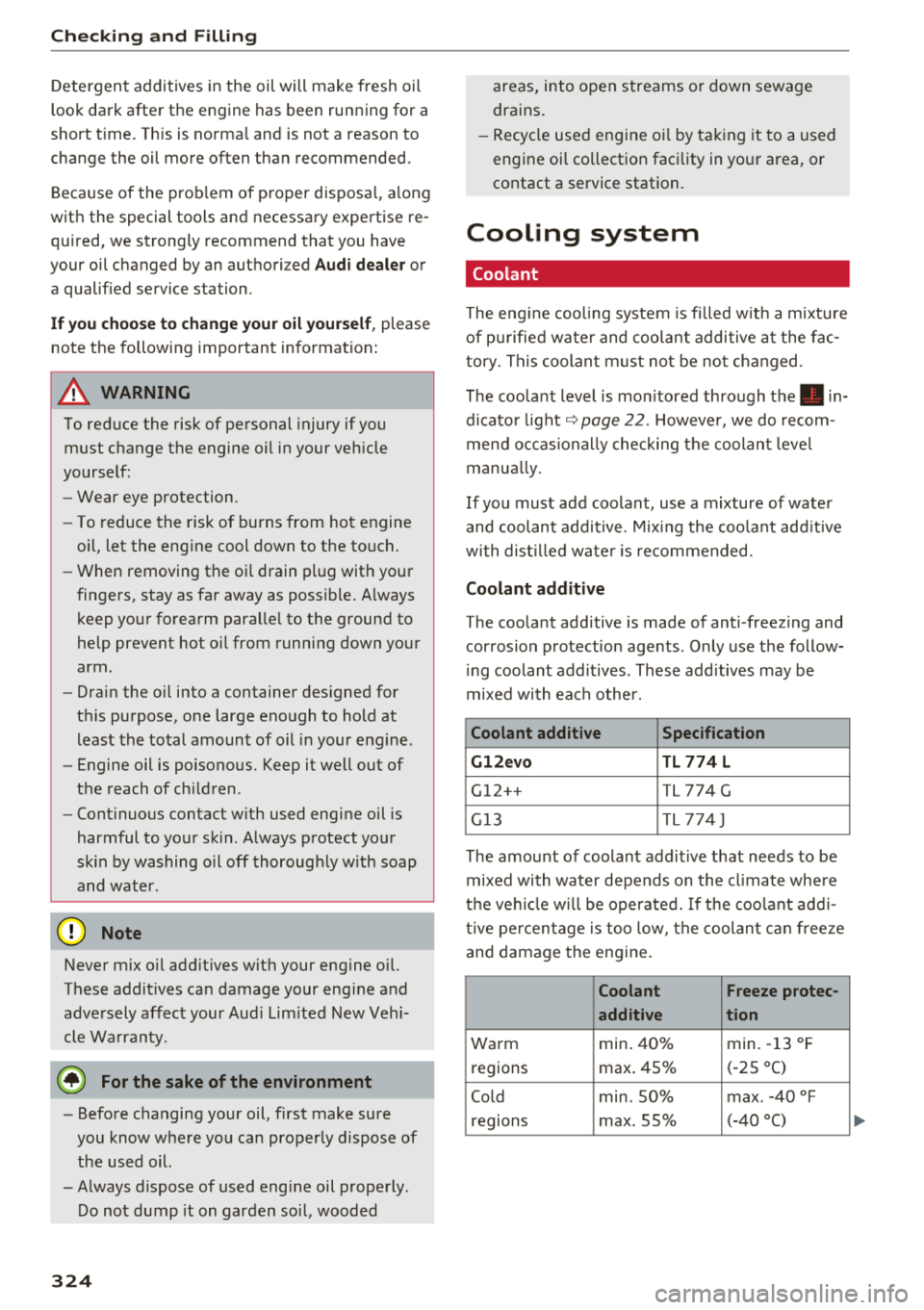
Coolant additive Specification
G12 evo TL 774 L
G12 ++ TL 774 G
G 13
TL 774 J
The amou nt of coolant addit ive that needs to be
mixed with water depends o n the c lima te where
t h e ve hicle w ill be operated. If the coo lant add i
t ive pe rcen tage is too low, the coolan t ca n freeze
and damage the engine.
Coolant Freeze protec-
additive tion
Wa rm min
. 40% min. -13 °F
regions max
. 45% ( -25 °C)
Cold min. 50% max. -40 °F
regions max. 55% (-40 °C)
Page 327 of 398
a co ...... N r--. N ...... 0
0
:E '
-Before the start of winter, have an author
ized Audi dealer or author ized Audi Service
Facility check if the coolant additive in your
vehicle matches the percentage appropriate
for the climate . Th is is especially important
when driving in co lder climates.
- If the appropriate coolant additive is not
available in an emergency, do not add any
other additive. You could damage the en
gine. If this happens, only use wa te r and re
store the co rrect mixture ratio with the
spec ified coo lan t additive as soon as possi
ble .
- Only refill with new coo lant.
- Radiator sealant must no t be mixed with
the coo lant.
Adding coolant
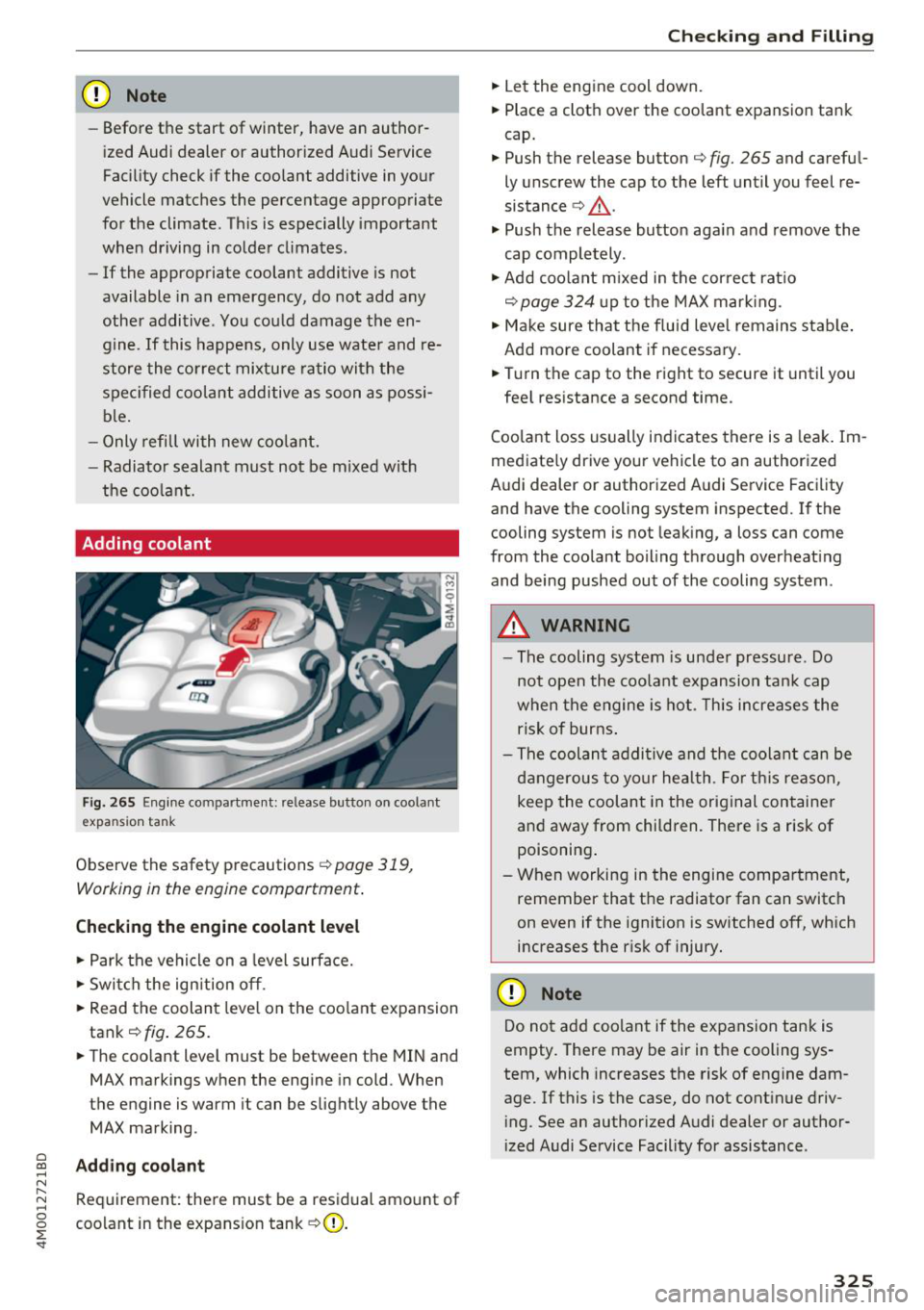
Fig . 26 5 Eng ine compartme nt: release button on coolant
expansion tank
Observe the safety precautions ¢ page 319,
Working in the engine compartment .
Checking the engine coolant level
.,. Park the vehicle on a level surface .
.,. Swi tch the ign ition off.
... Read the coolant leve l on the coo lant expansion
tank¢
fig . 265.
... The coolant level must be between the MIN and
MAX markings when the engine in cold. When
the engine is warm it can be slightly above the
MAX marking.
Adding coolant
Requirement: there must be a residual amount of
coo lant in the expans ion tank
¢ (D .
Chec king and Filling
.,. Let the engine cool down.
... Place a cloth over the coolant expansion tank
cap.
... Push the release button
¢fig. 265 and carefu l
ly unscrew the cap to the left until you feel re
sistance ¢.&, .
.,. Push the release button aga in and remove the
cap comple tely .
.,. Add coo lant m ixed in the cor rec t rat io
¢page 324 up to t he MAX mar king.
... Ma ke sure that t he f luid level remains stab le .
Add mo re coolant if necessary .
... Tu rn the cap to the right to secure it until you
fee l res istance a second time.
Coola nt loss usually in dicates there is a leak . Im
mediate ly drive your vehicle to a n authorized
Audi dealer or authorized A udi Service Facility
and have the cooling system inspected.
If the
cooling system is not leaking, a loss can come
from the coolant boiling through overheat ing
and being pushed out of the cooling system .
A WARNING ,.__
-The cooling system is under pressure. Do
not open the coo lant ex pansion tan k cap
when t he engine is hot. This increases the
ris k of burns .
- Th e coolan t addi tive and the coolan t can be
dangerou s to yo ur he alt h . Fo r th is reason,
keep the coolant in the original cont ainer
an d away from children. There is a risk of
poisoning .
- When working in the engine compar tment,
remember that t he radiator fan can switch
on even if the ignition is switched off, which increases the risk of injury .
{U) Note
Do not add coolant if the expansion tank is
empty. There may be air in the cooling sys
tem, which increases the risk of engine dam
age. If this is the case, do not cont inue driv
i ng. See an authorized A udi dealer or author
i zed Audi Service Facility for assistance .
-
325
Page 328 of 398
Checking and Filling
Brake fluid
N
N
~ N ,l: CX) al
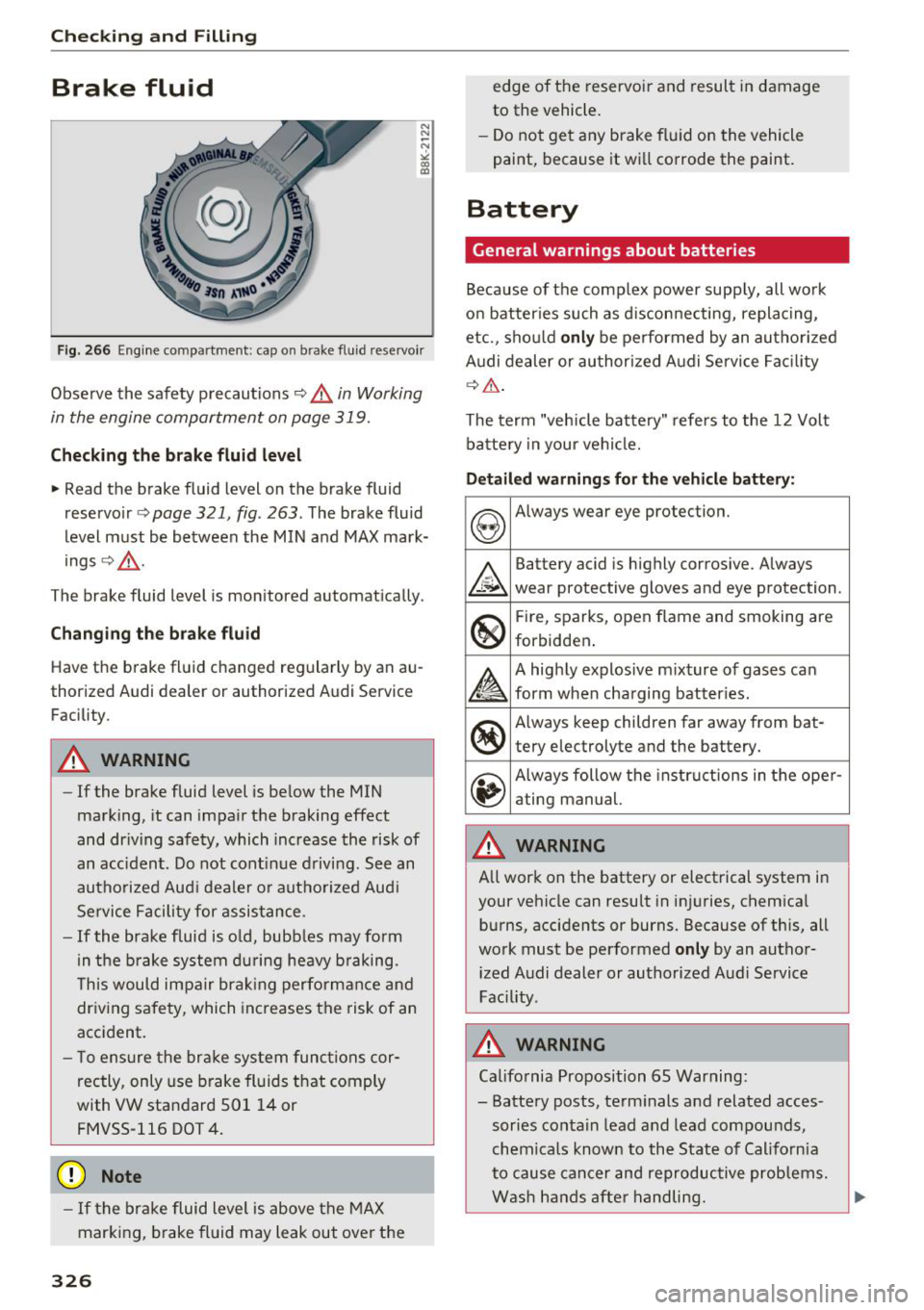
Fig. 266 Engine compartment: cap on brake flu id reservo ir
Observe the safety precautions c> .&. in Working
in the engine compartment on page 319.
Checking the br ake fluid l evel
~ Read the brake fluid level on the brake fluid
reservo ir
c> page 321, fig . 263 . The brake fluid
level must be between the MIN and MAX mark
ings
Q ,&. .
The brake fluid level is mon itored automat ically .
Chan ging the b ra ke fluid
Have the brake fluid changed regularly by an au
thorized Audi dealer or authorized Audi Servic e
Facility .
A WARNING
-If the brake fluid level is be low the MIN
marking, it can impair the braking effect
and dr iving safety, which increase the risk of
an accident. Do not cont inue d riving . See an
authorized Aud i dealer or autho rized Audi
Service Facility for assistance .
-If the brake fluid is o ld, bubbles may form
in the b rake system du ring heavy b raking.
T his would impair brak ing performance and
driving safety, which increases the risk of an
accident.
- T o ensure the brake system functions cor
rectly, only use brake fluids t hat comply
with VW standard 501 14 or
FMVSS-116 DOT 4 .
(D Note
-If the brake fluid level is above the MAX
mark ing, brake fluid may leak out over the
326
edge of the reservoi r and result in damage
to the vehicle.
- Do not get any brake fluid on the vehicle
paint, because it will corrode the paint.
Battery
General warnings about batteries
Because of the comp lex power supp ly, all wo rk
on batter ies such as d isconnecting, replacing,
etc., sho uld
onl y be performed by an autho rized
Audi dealer or au thorized A udi Servi ce Fac ility
Q _& .
The term "vehicle battery" refers to the 12 Volt
ba ttery in your vehicle.
Detail ed warnings for th e vehicle battery :
&
Battery acid is highly corros ive. Always
wear protective gloves and eye protection .
So
®
Fire, sparks, open flame and smoking are
forbidden .
£
A highly explosive m ixture of gases can
form when charging batter ies.
®
Always keep children far away from bat-
tery electrolyte and the battery.
~
Always follow the instructions in the oper -
ating manual.
A WARNING
All work on the battery or electrical system in
your vehicle can result in injuries, chemical burns, accidents or burns. Because of this, all
work must be performed
on ly by an author
ized Audi dealer or authorized Audi Service
Fac ility .
A WARNING
California Proposition 65 Warning:
- Battery posts, term inals and related acces
sories conta in lead and lead compounds,
chemicals known to the State of California
to cause cancer and reproductive problems.
Wash hands after handling.
~
Page 329 of 398
a co ...... N r--. N ...... 0
0
:E '
-If the vehicle will be p arked for long periods
of time, protect it against t he cold so that it
will not be destroyed by "freezing"
¢ page 327.
- There are electrical components under the
cargo floor behind a trim pane l that warm
up du ring operat ion. To reduce the r isk of
the components overheat ing, do not store
ob jects s uch as blankets u nder the ca rgo
floor. If they overheat, the components will
swi tch off tempo rar ily. Thi s wi ll be indicated
by a message in the ins trumen t clus ter, un
ti l the temperature returns to normal.
@,l For the sake of the environment
'8' B atteries cont ain poll uti ng substa nces s uch
a s s ulfu ric a cid and le ad. Contact an aut hor
ize d Au di dealer or a uthorized Aud i Service
Facility for more info rmation.
Vehicle battery
The term "vehicle battery" refers to the 12 Volt
battery in your vehicle.
Not running the vehicle for long periods of
time
If yo u do not dr ive you r vehicle for seve ral days or
weeks, e lectrical equipment is gradually sca led
back or switched off. This reduces ene rgy use and
ensu res the veh icle w ill be able to start after long
pe riods of time¢
page 147. Some convenience
functions, suc h as inter ior light ing or power seat
adjustment, may not be available under certa in
circumstances. These convenience funct ions w ill
be ava ilable again once you switc h the ign ition on
and start the engine.
Even when electrical equ ipment is switched off,
the equ ipment can still d rain the vehicle battery
if the vehicle is not drive n for long per iods of
time. Deep d rain ing results in a chemical reaction
that des troys the inside of the vehicle b attery.
The vehicle batte ry must be charged every mont h
to reduce the risk of this happening ¢
page 327.
Contact an author ized Audi dealer or authorized
Aud i Service Facility for more information.
Chec king and Filling
Winter operation
Co ld wea ther places higher dem ands on the vehi
cl e battery . This res ults in reduced s tarting ab ili
ty. Have the vehicle battery checked by an au
t h orized Audi dea le r or authorized Audi Service
Facility before the cold time of year.
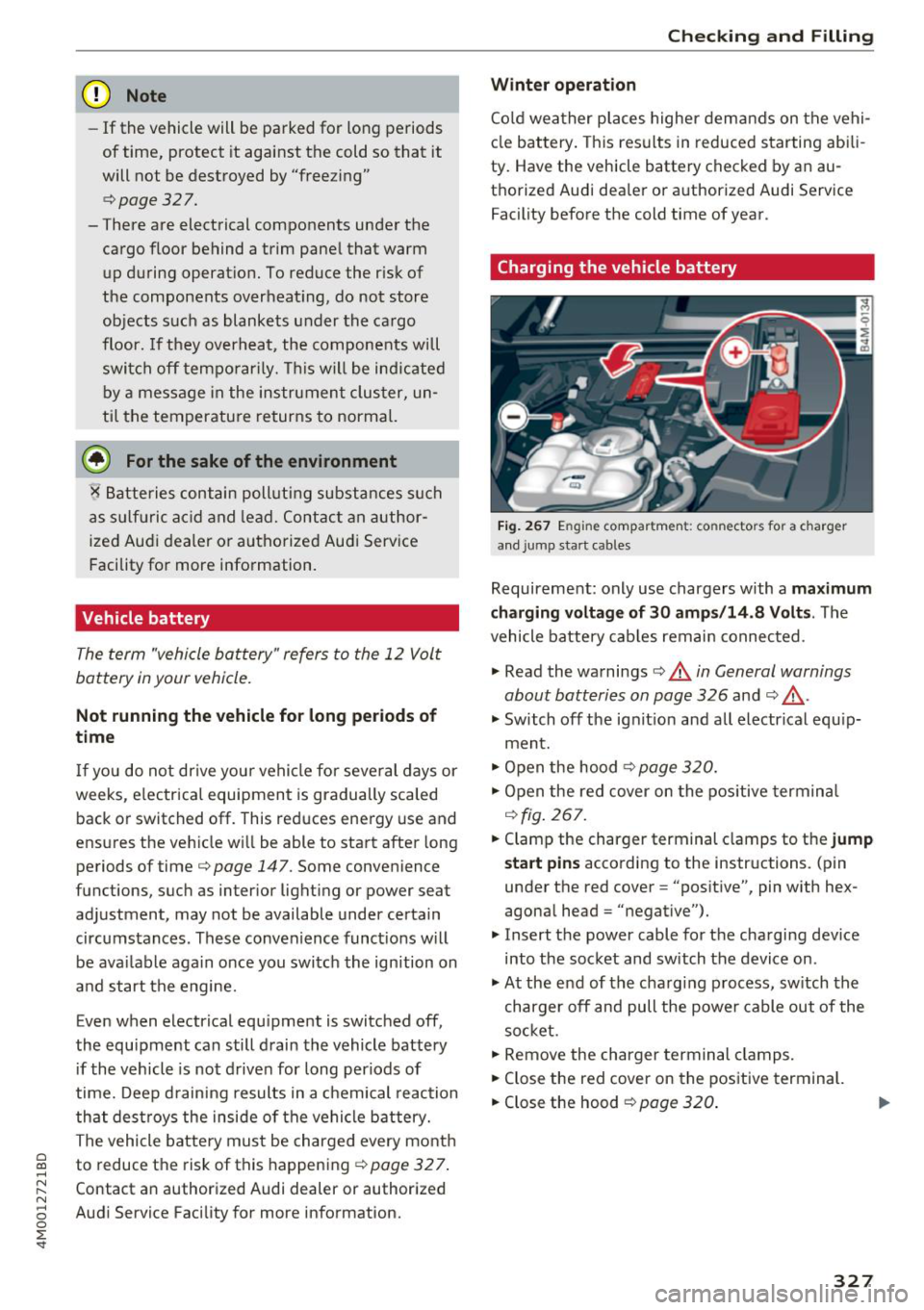
Charging the vehicle battery
Fi g. 2 67 En g in e compar tmen t: co nnecto rs fo r a c harger
and j ump start cab les
Requireme nt: only use chargers with a ma ximum
charging voltage of 30 amp s/14 .8 Volts .
The
vehicle battery cab les remain connec ted .
.,. Read the warnings ¢
A in General warnings
about batteries on page 326
and ¢ &_ .
.,. Switch off the ignit ion and all electrical equ ip
ment .
.,. Open the hood ¢
page 320.
.,. Open the red cover on the pos itive termina l
¢fig . 267.
.,. Clamp the charger terminal clamps to the jump
start pins
accord ing to the instructions. (pin
under the red cove r= "positive", pin with he x
agona l head= "negat ive").
.,. Insert t he power cable for t he charging dev ice
into the socket and switch the device on .
.,. At the end of the charg ing p rocess, sw itch the
charger off and pull the power cable out of the
so cket.
.,. Remove the ch arger termin al cl amps.
.,. Close the red cover on the positive termina l.
.,. Close the hood
¢ page 320 .
327
Page 330 of 398
Checking and Filling
& WARNING
- A highly explosive mixture of gases can form
when charging batter ies . Only charge the
vehicle battery in well-vent ilated areas .
- A drained vehicle battery can freeze at tem
peratures a round 32 QF (0 QC) . A frozen or
thawed veh icle battery must not be charged
and must not be used anymore. If ice fo rms,
the battery housing ca n crack and ba tte ry
electrolyte can lea k out, which increases the
risk of an explosion and chemi cal bu rns.
Contact an authorized Au di dea le r o r au
tho rized Audi Serv ice Facility fo r more info r
mation.
- Do not connect o r disconnect the ch arging
cable while charg ing because this increases
t h e risk of an exp losion.
(D Tips
- Only charge the vehicle battery through the
con nections in the engine compartment .
- Read a ll of t he manufacture r's ins tructions
for the charger befo re charg ing the vehicle
battery.
Windshield washer system
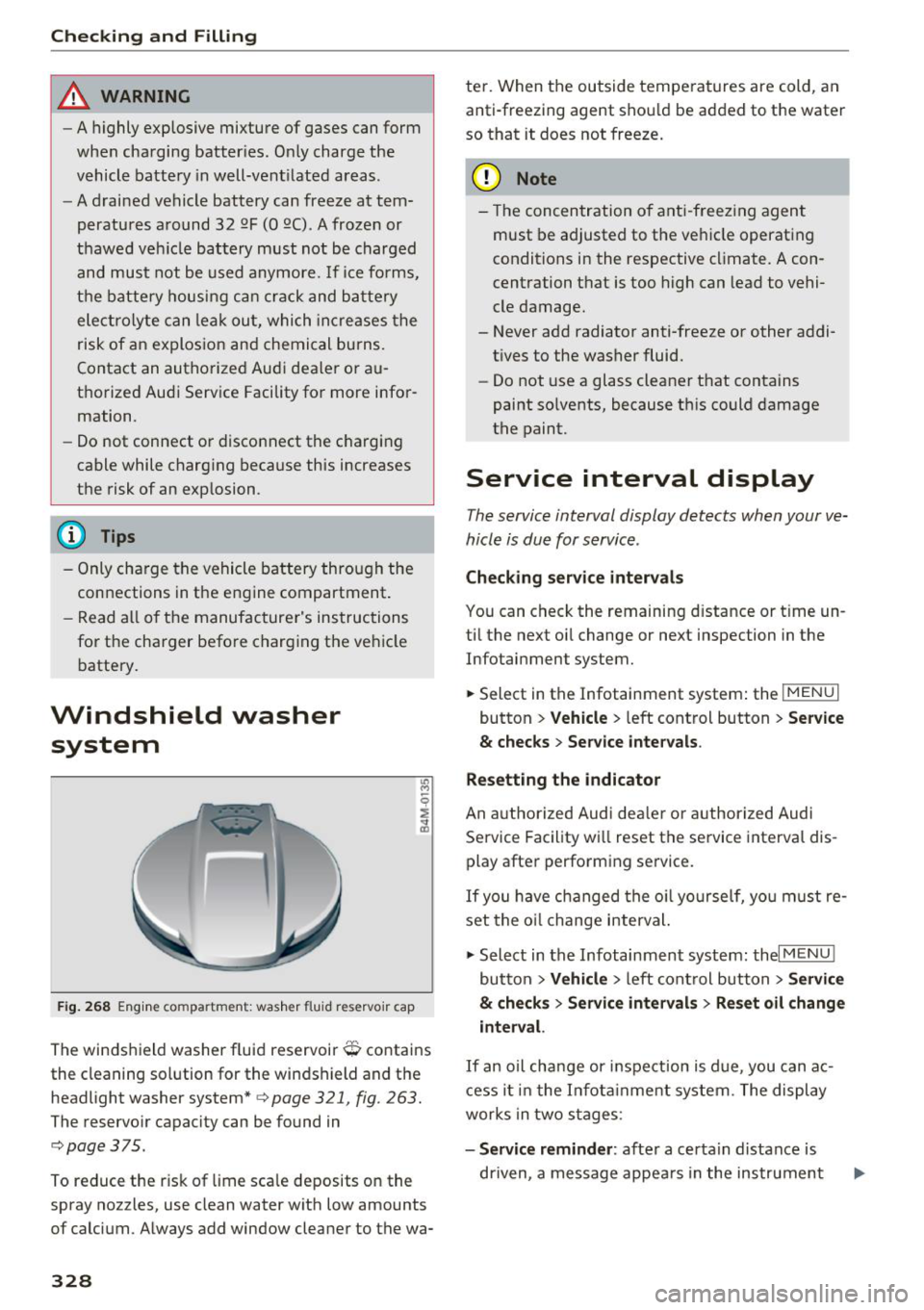
F ig. 26 8 Eng ine co mpa rtment: was her fluid reservo ir cap
The winds hield washer fluid reservoir O contains
the cleaning solution for the windshield and the
headlight washer system*
c> page 321, fig . 263.
The reservo ir capacity can be found in
c:;, page 375.
To reduce the r isk of lime sca le deposits o n the
spray nozzles, use clean water with low amounts
of calcium . Always add window cleane r to the wa-
328
te r. When the outside tempe ratures are cold, an
anti-freezing agent shou ld be added to the water
so that it does not freeze.
(D Note
- The concentration o f anti -freezing agent
must be adjusted to the ve hicle operating
conditions in the respective cl imate. A con
centration that is too high can lead to vehi
cle damage.
- Never add radiator anti-freeze or other addi tives to the washer fluid.
- Do not use a glass cleaner t hat contains
paint so lvents, because t his could damage
the paint.
Service interval display
The service interval display detects when your ve
hicle is due for service .
Checking service intervals
You can check the remaining d istance or t ime un
ti l the next oi l change or next inspection in the
Infotainment system.
.,. Select in the Infotainment system : the
I MENU I
button > Veh icle > left cont rol button > Se rvi ce
& checks > Service inter vals .
Resetting the indicator
An a utho rized Audi deal er or author ized Audi
Se rvice Facility wi ll reset the service interval dis
play after performing se rvice .
If you have changed the o il yourself, yo u must re
set the o il change interval.
.,. Select in the Infotainment system: thel
MENU !
button > Vehicle > left cont rol button > S ervice
& checks > Service intervals > Reset oil change
interval.
I f an o il cha nge or inspection is due, you can ac
cess i t in the I nfot ainment system . T he display
works in two s tages :
-Service reminder : after a certa in distance is
dr iven, a message appea rs in the instrument
Page 332 of 398
Wheels
Wheels
Wheels and T ires
General information
~check your tires regularly for
damage (punctures, cuts, cracks
and bulges). Remove foreign ob
jects from the tire tread.
~ If driving over curbs or similar
obstacles, drive slowly and ap proach the curb at an angle.
~Have faulty tires or rims re
placed immediately.
~ Protect your tires from oil,
grease and fuel.
~ Mark tires before removing
them so that the same running
direction can be maintained if
they are reinstalled.
~Lay tires flat when storing and
store them in a cool, dry location
with as little exposure to light as
possible.
_&. WARNING -
-Never drive faster than the maximum permitted speed
for your tires. This could cause
the tires to heat up too much.
This increases the risk of an
accident because it can cause
the tire to burst .
-Always adapt your driving to the road and traffic condi-
330
tions . Drive carefully and re
duce your speed on icy or slip
pery roads . Even winter tires
can lose traction on black ice.
(@ Note
-Please note that summer and
winter tires are designed for
the conditions that are typical
i n those seasons . Aud i recom
mends using winter tires dur
ing the winter months . Low
temperatures significantly de
crease the elasticity of summ
er tires, which affects traction
and braking ability. If summer
tires are used in very cold
temperatures, cracks can form
on the tread bars, resulting in
permanent tire damage that
can cause loud driving noise
and unbalanced tires.
-Burnished, polished or chromed rims must not be used in winter driving condi
t ions. The surface of the r ims
does not have sufficient corro
sion protection for this and
could be permanently dam
aged by road salt or similar
substances.
Page 338 of 398
Wheels
maximum permissible road
speeds . See also ¢
A in General
information on page 330.
Tire pressure monitoring system
means a system that detects
when one or more of a vehicle's tires are underinflated and illumi
nates a low tire pressure warning
telltale .
Tread
means that portion of a tire that
comes into co ntact with the road.
Tread separat ion
means pulling away of the tread
from the tire carcass.
Treadwear indicators (TWI}
means the projections within the
pr incipal grooves designed to g ive
a vis ual indication of the degrees
of wear of the tread. See
¢ page 339, Treadwear indicator
for more information on meas ur
ing tire wear.
Uniform Tire Quality Grading
is a tire information system devel
oped by the United States Nat ion
a l Highway Traffic Safety Admin
istration (N HTSA) that is designed
to he lp buyers make relative com-
33 6
parisons among tires . The UTQG
is not a safety rat ing and not a
guarantee that a tire will last for
a prescribed number of miles (kilo meters) or perform i n acer
tain way . It simply g ives ti re buy
ers add itiona l information to
combine with other considera
tions, such as price, brand loyalty
and dealer recommendations. Un
de r UT QG, tires a re graded by the
tire manufacturers in three areas: treadwear, tract ion, and tempera
ture res istance. The UTQG info r
mation on the tires , molded into
the sidewalls .
U.S. DOT Tire Identification
Number (TIN}
This is the tire's "serial number" .
It beg ins with the letters "DOT"
and indicates that the tire meets
all federal s tandards. The next
two numbers or le tters indicate
the plant whe re it was manufac
tured, and t he last four num bers
represent the week and year of
manufac ture. Fo r example,
DOT ... 2217 ...
means that the tire was produced
in the 22nd week of 2017. The
other num bers are ma rketing co
des that may or may not be used
~
Page 342 of 398
Wheels
on the front axle and vice versa.
This will allow the tires to have approximately the same length of
service life.
For unidirectional tires, make
sure the tires are installed accord
ing to the running direction indi
cated on the tire sidewall
¢ page 362.
Hidden damage
Damage to tires and rims can of
ten occur in locations that are
hidden. Unusual vibrations in the
vehicle or pulling to one side may indicate that there is tire damage.
Reduce your speed immediately.
Check the tires for damage. If no
damage is visible from the out
s ide, drive slowly and carefully to
the nearest authorized Audi deal er or authorized Audi Service Fa
cility to have the vehicle inspect
ed.
.&_ WARNING
Tread that has worn too low or
different tread depths on the
tires can reduce driving safety.
This can increase the risk of an
accident because it has a nega
tive effect on handling, driving
through curves, and braking, and because it increases the
340
risk of hydroplaning when driv
ing through deep puddles.
Tire pressure
I
4
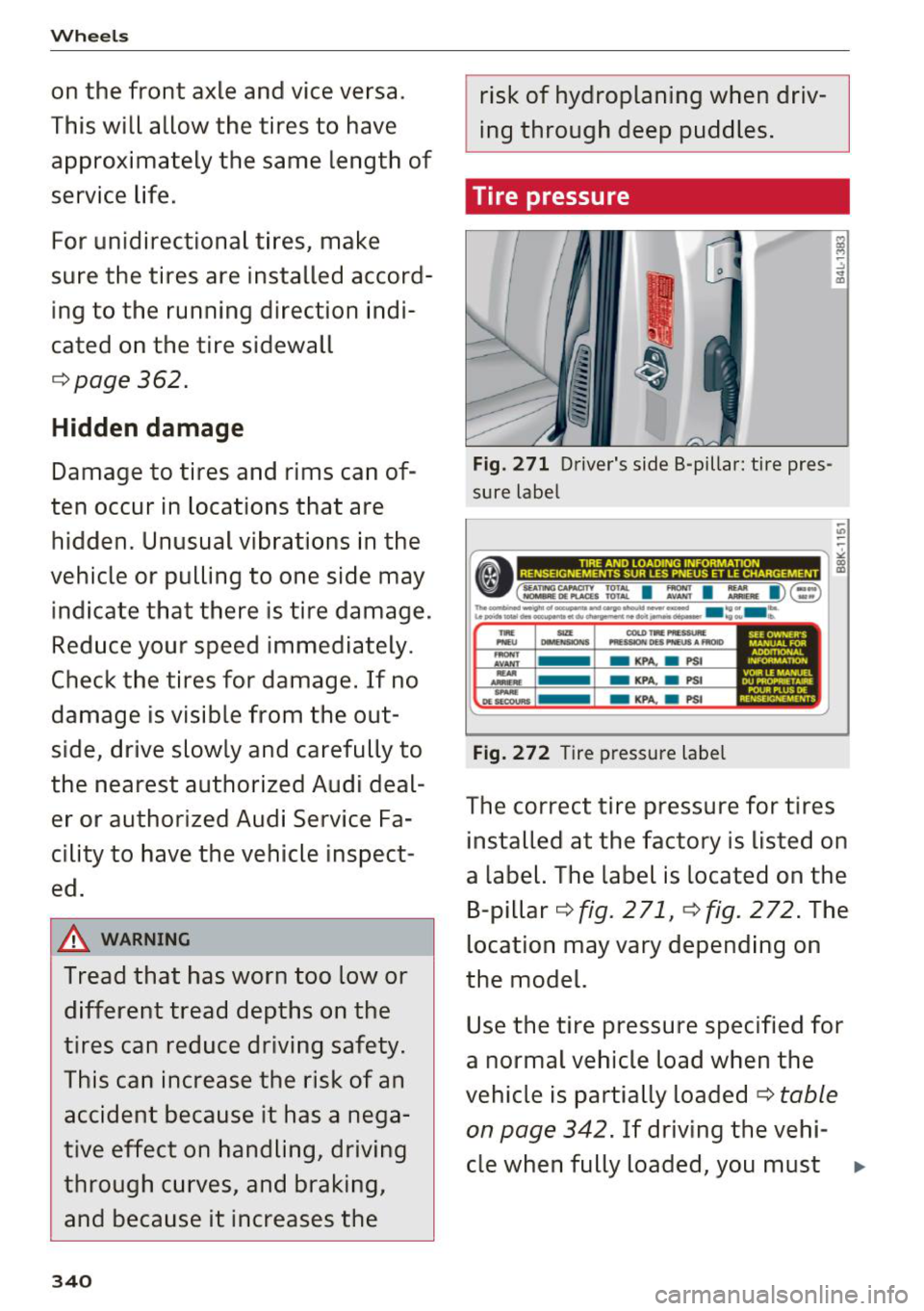
Fig. 271 Driver's side 8-pillar : tire pres
sure label
-"' --~-----------~ ,;
ta (i
-...,_ -KPA. • PSI
Fig. 272 Tire pressure label
SEE OWMER"S MANU4l.FOA AODmONAI. INFORMATION VO .. Lf MAN\JIE\. DU PROPRIE"T AIRE l"OU"PlUSDE RENSEIGNEM!NTS
The correct tire pressure for tires
installed at the factory is listed on
a label. The label is located on the B-pillar
¢ fig. 271, ¢fig. 272. The
location may vary depending on
the model.
Use the tire pressure specified for
a normal vehicle load when the
vehicle is partially loaded¢
table
on page 342.
If driv ing the vehi-
cle when fully loaded, you must ...
Page 343 of 398
0 a, .... N
" N
increase the tire pressure to the
maximum specified pressure¢,& .
Checking/correcting tire
pressure
.,.Check the tire pressure at least
once per month and also check it
before every long drive.
.,.Always check the tire pressure
when the tires are
cold. Do not
reduce the pressure if it increas
es when the tires are warm .
.,.Check the labe l¢
fig. 2 72 for
the correct tire pressure based
on vehicle load.
.,,.Correct the tire pressure if nec
essary.
.,.Store the new tire pressure in
the Infotainment system
¢ page 349.
& WARNING
Always adapt the tire pressure
to your driving style and vehicle
load.
-Overloading can lead to loss of
vehicle control and increase
Tire pressure table
Please note that the information
contained in the following table
was correct at the time of print ing, and the information is sub-
...
g ject to change. If there are differ-l: ..
Wheels
the risk of an accident. Read
and follow the important safe
ty precautions in ¢
page 343,
Tires and vehicle load limits.
-The tire must flex more if the
tire pressure is too low or if
the vehicle speed or load are
too high. This heats the tire up
too much . This increases the
risk of an accident because it
can cause the tire to burst and
result in loss of vehicle con
trol.
-Incorrect tire pressure in creases tire wear and has a negative effect on driving and
braking behavior, which in
creases the risk of an accident.
@ Note
Replace lost valve caps to re
duce the risk of damage to the
tire valves.
@ For the sake of the environment
Tire pressure that is too low in
creases fuel consumption .
ences between this information
and the tire pressures specified
341
Page 346 of 398
Wheels
are listed on the safety compli
ance sticker label located on the
driver's side B-pillar.
A WARNING ,-= · -
Overloading a vehicle can cause
loss of vehicle control, a crash
or other accident, serious per
sonal injury, and even death .
-Carrying more weight than your vehicle was designed to carry will prevent the vehicle
from handling properly and i ncrease the risk of the loss of
vehicle control.
-The brakes on a veh icle that
has been overloaded may not
be able to stop the vehicle
within a safe distance.
-Tires on a vehicle that has been overloaded can fail sud
denly, including a b lowout and
sudden deflation, causing loss
of contro l and a crash.
-Always make sure that the to tal load being transported -i nc luding the weight of a tra il
er hitch and the tongue
weight of a loaded trailer
does not make the vehicle
h eavier than the vehicle's
Gross Vehicle Weight Rating.
3 44
Determining correct load
limit
Use the example below to calcu
late the tota l weight of the pas
sengers and luggage or other
things that you plan to transport
so that you can make sure that
your vehicle will not be over load
ed.
Steps for Determining Correct Load Limit
1 . Locate the statement " TH E
COMBIN ED WE IGH T OF OCC U
PANTS AND CARGO SHOU LD
NEVER EXCEED XXX KG OR XXX
LBS" on your vehic le's placard
(tire inflation pressure label)
¢ page 340, fig . 272 .
2. Determine the combined
weight of the drive r and pas
sengers that will be riding in
your vehicle.
3. Subtract the combined weight
of the driver and passengers
from
"XXX" kilograms or "XXX"
pounds shown on the stick
er ¢
page 340, fig. 272 .
4. The resu lting figure equa ls the
available amount of cargo and
luggage load capacity . For ex
ample, if the "XXX" amount
eq uals 1400 lbs. and there will~