ESP AUDI Q7 2018 Owner´s Manual
[x] Cancel search | Manufacturer: AUDI, Model Year: 2018, Model line: Q7, Model: AUDI Q7 2018Pages: 398, PDF Size: 185.58 MB
Page 87 of 398
Difficult terrain and off-road
When driving in unfamiliar areas and offroad,
drive slowly and keep on the watch for unexpect
ed obstacles (such as potholes, rocks, tree
stumps, etc.).
To prevent the vehicle from bottoming out and to
reduce the risk of underbody damage, you should
drive across uneven ground on only one side of
the vehicle so that only two of your wheels cross
the uneven area, instead of driving across the
center of the uneven area with all four wheels.
Drive quickly through sandy or marshy off-road
sections and do not stop , if at all possible.
Driving through water
Also read the information found in r=;, page 74.
Driving on a slope
If you are ever unable to drive up a hill, do not try
to turn around . Drive back down in
reverse in
stead . Otherwise you run the risk of t ipping over.
If the vehicle threatens to tip over when driving
across a slope, you must immediately steer
downhill in the direction of the slope.
Do not park your vehicle on steep hills .
To reduce the r isk of tipping over, drive on hills in
the direction of the downward slope (fa ll line) -
never crosswise.
Tilt angle display
Description
Applies to: vehicles wit h a tilt ang le display
110 · I l 1ft / offrnortr1 ( ~ ....
All road
!r
-
Q
l " __,.._
Comfort 4 ~
J
ll" 11• Auto O" •
Dynamic
~ ~
Individual 11• I/"
~t-;s
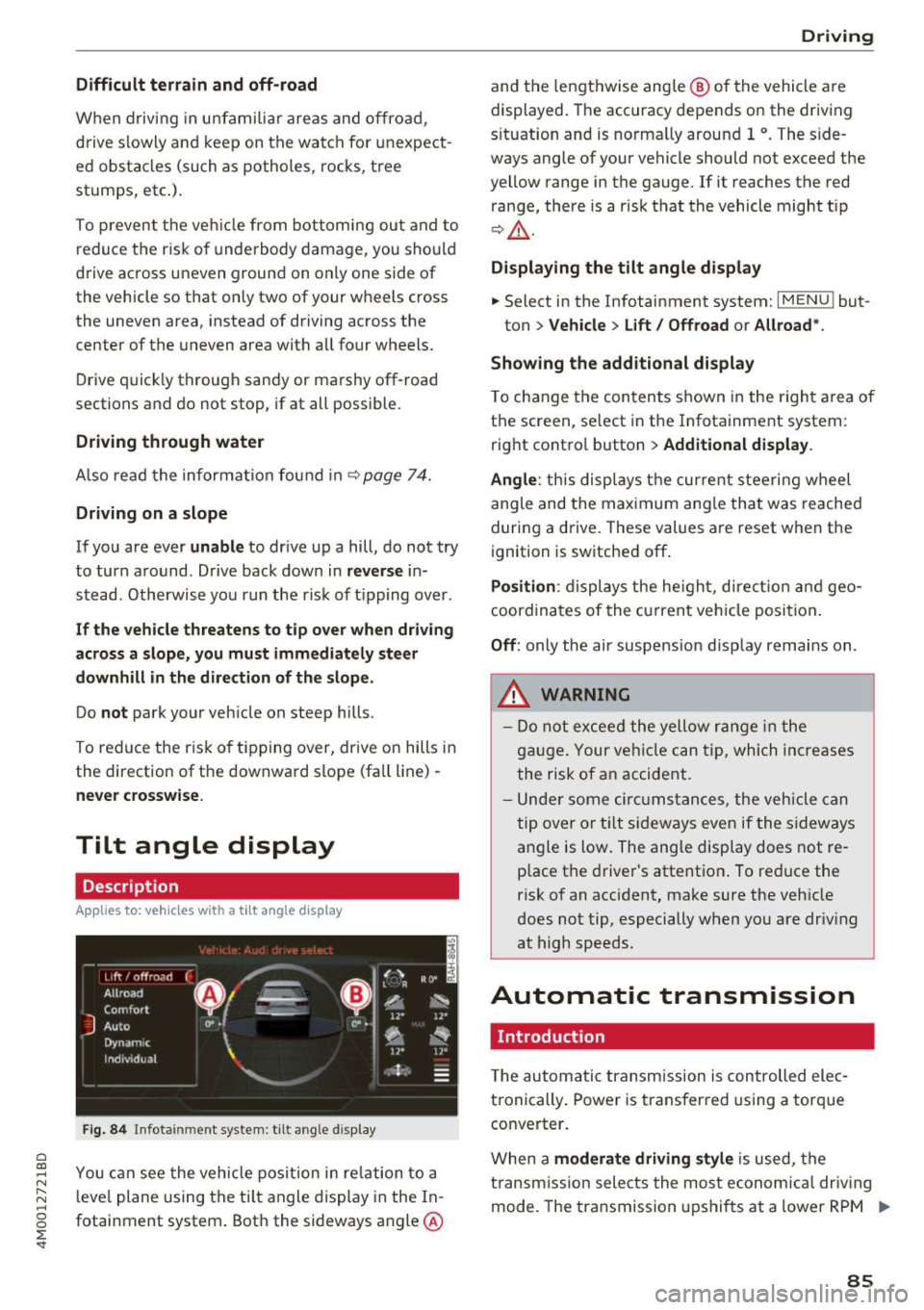
Fig. 84 Infotainment system : tilt angle d isplay
a
~ You can see the vehicle position in relation to a N
~ leve l plane using the tilt angle display in the In-~
g fotainment system . Both the sideways angle @
:E '
and the lengthwise ang le @ of the vehicle are
displayed. The accuracy depends on the driving
s ituation and is norma lly around 1
°. The side
ways angle of your vehicle should not exceed the
yellow range in the gauge. If it reaches the red
range, there is a risk that the vehicle might tip
r=;,_& .
Displaying the tilt angle display
.. Select in the Infotainment system: I MENU ! but-
ton>
Vehicle > Lift/ Offroad or Allroad*.
Showing the additional display
To change the contents shown in the right area of
the screen, se lect in the Infotainment system:
right control button>
Additional display.
Angle :
this disp lays the current steering wheel
angle and the maximum angle that was reached
during a drive . These values are reset when the
ignition is switched off .
Position: displays the height, direct ion and geo
coordinates of the current vehicle posit ion.
Off : only the air suspension display remains on .
.&_ WARNING
- Do not exceed the yellow range in the
gauge. Your vehicle can tip, which increases
the risk of an accident.
- Under some circumstances , the vehicle can
tip over or tilt sideways even if the sideways
angle is low. The angle display does not re
p lace the driver's attention . To reduce the
risk of an accident, make sure the vehicle
does not tip, especially when you are driv ing
at high speeds.
Automatic transmission
Introduction
T he automatic transmission is controlled elec
tronically . Power is transferred using a torque
converter.
When a
moderate driving style is used, the
transmission selects the most economical driving
mode. The transmission upshifts at a lower RPM .,.
85
Page 94 of 398

Trail er to wing
Trailer towing
Driving with a trailer
General information
Your veh icle is primari ly intended for transport
ing peop le and luggage. Howeve r, if you dr ive
with a tra iler , follow the techn ica l requirements ,
the operation and driving tips, and the lega l reg
ulations.
Dr iving w ith a trailer affects the vehicle 's fuel
consumpt ion, performance and wear. It a lso re
quires higher concentration from the driver .
A WARNING
Do not transport any people in a trailer due to
the risk of fatal injury .
Technical requirements
Certain requirements must be met when towing
a trailer.
Trailer hitch
Only use a trailer hitch with a removab le ball
h itch mount and ball h itch. The tra ile r hitc h must
be pe rm it t ed for the vehicle, the tra iler and the
permitted tota l weight of the trailer being
pu lled . Above all, it must be secure ly and safe ly
attached to the vehicle trailer.
Never mo unt a t rai ler hitch on the bumper. The
trai ler hitc h must be mounted in a way that does
not impair the function of the bumper. Do not
make any changes to the exhaust system and the
brake system.
Check regu larly if the trai ler hitc h is securely
mounted . A lways follow the instructions given by
the trai ler hitch manufacturer .
Trailer brakes
If t he tra ile r has its own bra ke system, then fol
low the manufacturer specifica tions. Howeve r,
the brake system on the trai ler must never be
connected to the vehicle brake system.
92
Engine cooling system
D riving w ith a tra ile r means a higher load on t he
engine and the cooling sys tem. The coo ling sys
tem must be designed for additiona l load and
contain enoug h coo lant ~@ .
A WARNING -
- Never mount a "weight -distributing" or
"load-balancing" trailer coupler as the trail
er hitch. The ve hicle was not des igned for
these types of tra iler h itches. The tra iler
h itch can malfunction and t he tra ile r can
b reak off from the vehicle.
- If t he tra ile r i s equ ipped w ith elect ronic
brakes, these brakes can not be activated by
a facto ry-installed control system, whi ch in
creases the r isk of an accide nt.
- To red uce the r is k of injury, always remove
the ball hitch mount if no tra ile r is mo unt
ed.
@ Note
L onge r incl ines cannot be dr iven without a
su itab le cooli ng system, especially if the out
s ide temperatu res a re high. ot herwise, this
i nc reases the risk of eng ine da mage.
Operating instructions
Several things must be noted when towing a
trailer.
Towing capacity
The permitted towing capacity must not be ex
ceeded under any circumstances~
page 376.
You can dr ive up larger inclines if you are not us
i ng the maximum towing capacity.
The towing capacities given only apply to e leva
tions up to 3,200 ft (1,000 m) above sea level. As
the e levation increases, the engine power de
creases due to the decreasing air pressures. T his
reduces the hill climb ing ability and towing ca
pac ity . For every additional 3,200
ft (1,000 m),
t h e maximum permitted tow ing weight must be
r educed by app roximately 10% . T he pe rm itted
tow ing weight is t he comb ined we igh t of the
( loaded) vehicle and the (loaded) trailer .
Page 96 of 398
Trail er to wing
If you have to drive th rough diffic ult road condi
tions, you can raise the vehicle again after hitch
ing the trai ler or after adjust ing the tongue
weight .
{QJ Note
Applies to: vehicles with air suspension
-Changes in temperature or load can affect
the he ight of the vehicle.
- Set the a ir suspension to the standard vehi
cle heig ht, otherwise the applicab le tongue
weig ht no longer applies to your vehicle .
(D Tips
-Use chocks when parking on incl ines if the
trailer is loaded.
- We recommend also having the vehicle in spected between the inspection intervals if
you are towing a trai ler frequently.
- Avo id driving wit h a trailer du ring the vehi
cle break-i n period .
Driving with a trailer
Driving with a trailer requires extra caution.
Speed
Adhere to the legal speed l imi ts. Follow t he lega l
regulations specif ic to the country.
As the speed inc reases, the d riving stability of
the t railer dec reases . The refore you sho uld not
exceed t he max imum legal speed limit when
there are unfavorable road, weather and/or wind
conditions. This especially applies when driving
downhill.
You must a lways reduce yo ur speed as soon as
you not ice even the s lightest swinging motion of
the trailer . Never try to "straighten out" the trail
er by accelerating.
The weig ht dis trib ution is very poo r if t he ve hicle
is empty and the trailer is loaded. However if you
must drive under these circumstances, t hen drive
especia lly slowly.
94
Brak es
Brake in a time ly manner. Downs hift be fo re dr iv
i ng down hill so that the engine can assist with
braking ~&, .
When using a t railer w it h over run bra kes, fi rst
brake ge ntly t hen q uickl y. This red uces the r isk o f
jerking while braking if the trailer wheels lock up .
Engine coolant temperatur e
Pay attention specifically to the coolant tempera
ture display when there a re high outs ide temper
at ures , and whe n driving on long i nclines
~ page 11. Shift to a highe r gear in a t imely man
ner .
A WARNING
Constant braking causes the b rakes to over
h eat and substantially reduces bra king per
formance, increases b raking distance o r caus
es complete failure of the brake system.
-
Page 97 of 398
a co ...... N r--. N ...... 0
0
:E '
Description
App lies to: vehicles with speed warning system
The speed warning system helps you to stay be
low a specified maximum speed that can be set,
changed or deleted in the Infotainment system .
The speed warning system warns you if you are
exceeding the maximum speed that you have set .
A warning tone will sound as soon as your speed
exceeds the stored value slightly . The indicator
l ight also turns on in the instr ument cluster d is
p lav
[0] (USA models)/ [81 (Ca nada models) and
a message. The indica tor l igh t
[0]/ [OJ and the
message turn off if the speed fa lls back be low
the stored maximum speed.
Sett ing a threshold is recommended if you would
like to be reminded when yo u reach a certa in
maximum speed . Situations where you may want
to do so include driving in a country with a gener
al speed lim it or if there is a specified maximum
speed for winter tires.
Setting the warning threshold
Select in the I nfotai nment system:
IMENU I but
ton
> Ve hicle > le ft control button > Dri ver a ss is
tance
> Speed warning > Manual.
@ Tips
Regard less of the speed warning system, you
should always monitor yo ur speed using the
speedomete r and make sure you are following
the legal speed limit.
A ssi st a nce systems
Cruise control system
Switching on
Applies to: vehicles with cruise control system
The cruise con trol system makes it possible to
drive at a constant speed starting at 15 mph
(20 km/h) .
0
f
~
0
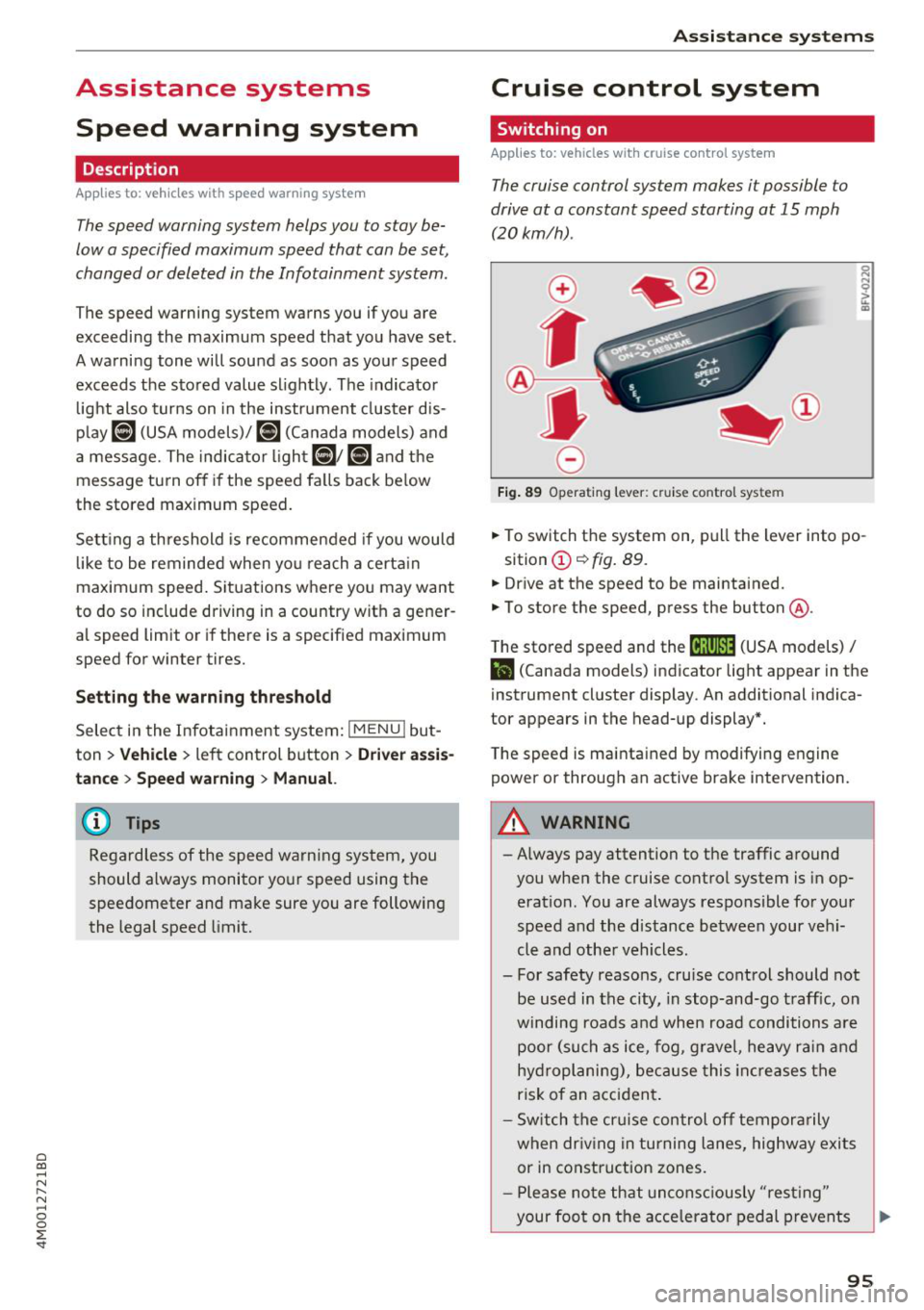
Fig. 89 Op era ting leve r: cru ise co ntrol sys te m
.,. To switch t he system on, pull the lever into po-
sition
(D ¢ fig. 89 .
.,. Drive at the speed to be maintained.
.,. To store the speed, press the button @.
T he stored speed and the
@jltJ~i, (USA models) /
l'I (Canada models) ind icator lig ht appear in the
instrument cluster display . An additional indica
tor appears in the head-up display*.
T he speed is mainta ined by modifyi ng engine
power or through an active brake intervention.
A WARNING
- Always pay attention to the traffic a round
you when the cruise control system is in op
eration . You are always responsible for you r
speed and the distance be tween your ve hi
cle and othe r vehicles .
- For safety reasons, cru ise cont rol should not
be used in the city, in stop -and-go t raff ic, on
winding roads a nd when road conditions a re
poor (su ch as ice, fog, g rave l, heavy ra in and
hy droplani ng), bec ause this in cr eases the
risk of an acciden t.
- S witch the cr uise con trol off tempor arily
when dr iv in g in turning lanes, highway exits
or in construction zones.
- P lease no te th at uncon sc iously "resting "
your foot on the accelerator ped al prevents
95
Page 99 of 398

a co ,-1 N r--. N ,-1 0
0
:E "
sign recognition
Description
App lies to: ve hicles with camera-based traffic sign recogni
tio n
~ 180 m1 & I f1' I! ' I Pl I
! IJ' mm .. I~ / .-.
I 1:9:11 " '
) ' a!i ,,' i '
Fig. 90 Instrument cluster: traff ic sign recognition
F ig. 9 1 Windsh ield: camera window for t raffic sign recog
nition
Traffic sign recognit io n assis ts you when driving
by d isp lay ing detected speed limits or signs pro
h ibit ing passing in the instrument cluster d isp lay
c::> fig . 90 . Within the limits of the system, the le
gal speed lim its in school zones are detected and
d isp layed.
General info rmation
Traffic sign recognit ion can detect standa rd
speed limit sig ns that are within the camera's vis
ua l field. With assistance from navigation data,
detected speed limits are evaluated and shown in
the disp lay . The traffic sign for the current de
tected speed l imit will bli nk in the display if you
exceed the war ning th reshold set in the Infotain
ment system
c::> page 98 .
The traffic sign recogn ition is subject to certain
system limitations and may be unavailab le or on
ly partia lly available in the followi ng situations:
A ssi st a nce systems
- when visibility is poor, s uch as in snow, rain,
fog or heavy spray
- when there is glare, for example from oncom
ing traffic or the sun
- at high speeds
- if the camera 's visual field
c::> fig. 91 is cove red,
for examp le by dirt or st icke rs. For i nfo rmation
on cleaning, see
c::> page 351 .
- if the traff ic signs are comp letely or partially
covered, for examp le by trees, snow, dirt or
other vehicles
- if speed traffic signs do not conform to the
stand ards
- if traffic signs are damage d or ben t
- if traff ic sig ns are d isplayed o n sig n holders
w ith elec tronic s igns
- if the traffic signs o r the configu ration of the
road have changed (navigation data is no lon
ge r up-to-da te)
_&. WARNING
P ay atten tion to traffic and the area around
your vehicle when traffic sign recogn ition is
turned on . The traffic signs insta lled on the
road a lways ta ke precedence over the display.
The driver is a lways responsible for assessing
the traffic situation.
- Under some circ umstances, traffic s ign rec
ognition may not detect traff ic signs cor
rectly or detect them at a ll. As a resu lt, the
system may not dis play the correct speed lim it or any speed limit.
- Traffic sign recognit ion does not adapt your
veh icle's speed to match the speed limit!
- The display in the instrument cluster is
based on the units of measurement used for
speed in that country. As a result, the dis p lay
50 i n t he inst rument cl uste r can mean
eithe r km/h or mph, depend ing o n the cou n
try.
-
97
Page 101 of 398
Cl a:, ...... N
" N ...... 0
0
::r '
.,. On t he mult if u nct ion s teer ing whee l, tur n the
l e ft thumbw hee l
0 ~ page 12 unt il t he desired
menu item is displayed in the instrument cl us
ter .
.,. Press the left thumbwhee l to confirm the selec
t ion.
A WARNING
Your focus should always be on driving your
veh icle safely . As the dr ive r, yo u have com
plete responsib ility for safety in traffic. Only
use t he f unctions s uch as the lap time r in s uch
a way tha t you alw ays ma int ain com plete con
tr ol ove r your vehicle in all tra ffic s itu ations.
(D Tips
You ca n ret rieve information from the t rip
computer while t he lap t ime r stopwatch i s
r u nning.
Lap times and timing
Applies to: vehicles with lap timer
Requirement: the lap t imer must be o pen
~ page 98 .
Timing laps
.,. To start tim ing manually, se lect Start lap 1 in
the menu .
-
.,. To start tim ing a utomat ica lly as soon as you
begin to drive, select
Drive off to start lap 1 or
Start by driving off in the men u .
.,. To measure the lap t ime, select
New lap in the
menu. T his starts timing the next lap at the
same t ime.
After completing a lap, the difference between
the last lap and the previous best lap time w ill be
ind icated with a"-" or" +".
Pausing timing and displaying a split time
.,. To insert a pa use m , se lect Pau se in t he menu.
.,. To resume timing, se lect
Re sume in the men u .
.,. To display a split time, se lect
Split time in the
men u. The split t ime
[fw] appears for approxi
mately 10 seconds in the instrument cluste r.
The timing of the current lap continues.
A ss istance systems
Resetting timing
.,. Using the mul tifun cti on steer ing whee l, sele ct
Re set time s in the menu.
(D Tips
- A m axim um of 99 lap t imes can be meas
ure d.
- If tim ing is pa used, you can continue i t later
even if yo u swi tc h t he ign ition o ff.
- Saved lap ti mes ca nnot be indiv id ua lly de
le ted from the tot al results.
- Th e saved lap t ime r va lues w ill remain after
sw itching the ign ition off.
Lap statistics
Applies to: vehicles with lap timer
Displaying lap statistics
You can display the numbe r of laps dr iven, the
fas test lap" +", the slowes t lap" -", and the aver
age t ime "0" in the instr ument cluster .
.,. On the multifunc tion steering w heel, select the
left contro l bu tton
> Lap stati stic s o r Sta tis
tics .
.,. Turn the thumbwheel down o r up to display the
individual lap times .
.,. To return to t he lap timing that was begun,
press the left thumbwheel.
Resetting lap statistics
.,. On the mul tif unc tion stee ring w heel, selec t:
the right control button
> Reset statistics.
(D Tips
The lap st atis tic s lis t the lap t imes fo r th e l ast
3 0 l aps . The fastest and slowes t lap time o ut
of up to 99 meas ured laps are a lso d isplayed.
Predictive efficiency
assist
Introduction
T he predict ive e fficiency assist he lps the driver to
drive with anticipation and therefore helps to
save fuel. The system accesses p redictive t rip da -
ta (including speed limits, inclines and the radius
Iii"
99
Page 102 of 398

Ass is tance sy stem s
of curves) from the navigation system* . Informa
tion from the camera-based traffic sign recogni
tion * is also applied to recognize traffic signs
¢ page 97.
The messages displayed depend on the naviga
tion data* being up -to-date and the correct iden
tification by the traffic sign recognition *.
When adaptive c ruise contro l* is sw itched off,
the predictive efficiency assist only p rovides noti
fications without controlled interventions. See
¢ page 100, Predictive messages (efficiency as
sist).
When adaptive cruise contro l* is switched on, the
system responds to upcoming situations auto mat ica lly. See
¢ page 100, Predictive control
( efficiency assist).
Predictive messages (efficiency assist)
Applies to: vehicl es w ith predictive effic iency assist
Ind icat or in the instrument clu ster display
Predictive messages appear in the instrument
cluster display to show the driver the appropriate
time to coast when a s ituation ahead requires
you to dr ive at a lower speed .
The messages are only shown if the cruise control
system* or adaptive cruise control* is switched
off.
An additiona l ind icator appears in the head-up
d isp lay* .
Symbol Meaning
Remove your foot from the acceler -
~
ator pedal to slow down, because
there is a situation ahead that re- quires a lower speed.
If you see
Dr ive r assistance in the instrument
cluster display, the following symbols will indi
cate which situat ion the system is currently re
acting to.
Symbol Meaning
MPH
U SA mod els :
Speed lim it
km/h
Ca nada models :
Speed limit
100 Symbol Mean
ing
_J!L Intersection --- ---
1!1
~ Traffic c ircle ··Of 'i,
If there are mult iple situations, then these situa
tions will appear in order in the display .
A WARNING
Pay attention to traffic and the area around
your vehicle when the efficiency ass ist is
switched on. The driver is always respons ible
for assessing the traffic situation.
(D Tips
- T he wo rding of the message may vary de
pend ing o n the dr iving mode set in d rive se
lect*¢
page 128 and the c urrent selec to r
lever position. No messages are disp layed
when in the "S" se lector lever position or in
D ynamic mode .
- When a route is p lanned using the nav iga
tion system*, then the message feed is
based on this route. Without route guid
ance, the system uses an assumed route for
the message feed.
- There will not be a message for every situa tion ahead, for example if there is not enough distance remaining to react to the
situat ion .
- No messages are displayed when at speeds
under 20 mph (30 km/h) .
Predictive control (efficiency assist)
-
Applies to: vehicles with Aud i adapt ive cru ise control and pre
dict ive efficie ncy assist
Fig. 93 Inst rument cluster : predictive control
Page 103 of 398

Cl a:, ...... N
" N ...... 0
0
::r '
The predictive cont rol 1 l uses the map info rma
tion from the navigation system in order to react proactive ly when driving. Information from the
cam era-based traffic sign recognition * is a lso ap
plied to recognize traffic signs¢ page 97. When
coming up to areas wi th speed limits or changes
in the course of the road (such as curves, inter
sections or traffic c ircles), the system brakes au
tomatically and then accelerates back up to the
set speed .
Overriding control
The driver can override the predict ive control at
a ny time by press ing the accelerator or brake
pedal. If the system changes the vehicle speed to
adapt to speed limits, you ca n cha nge the speed
usi ng the lever ¢page 106, fig. 100 .
Always switch off the predictive control in
the following situations:
-When increased atte ntion is needed from the
drive r.
- In poor weat her cond it ions such as snow or
heavy ra in.
- When driving on roads in poor condition .
Indicator in the instrument cluster display
When switching on the adaptive cru ise cont rol
for the first time, the message
ACC: R + B ac
ti ve
in the instrument cluste r indicates the ava il
ab ility of the predictive control.
T he
'?·;SOmh symbo l appears when the system
is reg ulating the speed to match a speed lim it. If
this is the case, the system is regulating a speed
of SO mph (80 km/h) . The speed is then taken
over by the adaptive cru ise control. The speed in
the speedomete r LE D ring ad justs to the speed to
be maintained ¢page 104, fig. 99.
Thell.II
¢ fig. 93 symbo l appe ars whe n there is an adap
ta tion to t he ro ute ahea d.
I f you are in the
Driver assistance d isp lay in the
in str ument cluster, then the fo llow ing symbols
w ill in dica te w hic h oc currence t he sys tem is cu r
r en tly responding to:
ll This is not availa ble in s om e co untri es.
A ss istance systems
Symbol Meaning
MPH
USA models:
Speed limit
km/h
Canada model s:
Speed limi t
ll
Curve
_J!L Intersection
,:r
w
T raffic ci rcle
A WARNING
-
- Read the wa rnin gs on ¢.&. in General infor
mation on page 103 and on¢
& in De
scription on page 97.
- Pay attent ion to traffic and the a rea around
your veh icle when pred ictive cont rol is
sw itched on. The driver is always responsi
ble for assessing the traffic situation.
- There is an increase in the risk of an acci
dent, because the system does not consider
"right of way" rules and also does not re
spond to traffic lights .
- The system only cons iders t raff ic signs that
g ive a speed lim it .
- The permitted speed can be exceeded if the
adaptation to a speed lim it is incorrect . The
d river is responsible for adher ing to the pe r
mitte d speed .
- The s peed at w hich a curve is dr iven th rough
does not necessarily match your own driving
s tyle. Brake the vehicle yo urself whe n need
e d t o redu ce the risk of an a ccid en t.
0) Tips
- If a speed lim it is detected, the stored
speed is also adjusted in the speedometer LE D line when the ada ptive cru ise control is
n ot a ctive .
- The adaptat ion by the system depends on
t he driving mode se t in dr ive se lec t*.
- Switching off predict ive con trol, fo r exam
ple whe n driving in low t raff ic zones, does
101
Page 105 of 398
a co ...... N r--. N ...... 0
0
:E '
cruise control syst em . Th e stored spe ed is main
tained. When approach ing a veh icle driving
ahead, the adaptive c ruise control system auto
mat ica lly brakes to mat ch that vehicle's speed
and then maintains the set distance . As soon as
the system does not detect a vehicle driving ahead, adaptive cruise contro l accelerates up to
the stored speed.
In stop -and -go traff ic, adaptive cru ise control can
brake unt il the vehicle is stat io nary and then can
also start driving again automatically under cer
tain condi tions ¢
page 106.
In traffic jams or stop -and -go traffic, traffic jam
assist can assist the driver¢
page 109 .
Which function s can be contr olled ?
When you switch adapt ive cruise control on, you
can set the current speed as the "control speed"
¢ page 104, Swi tching on/off.
When driving, you can stop c ruise contro l
¢
page 10 7 or change the speed ¢ page 106 at
any time.
You can a lso set the distance to the vehicle driv
ing ah ead and s et the driv ing mode of the adap
tive cruise control¢
page 10 7.
General information
Applies to: ve hicles with Audi adaptive cruise co ntro l
•·•·•·a
Fig. 95 Fro nt o f th e vehi cle: se nsor s and video cam era
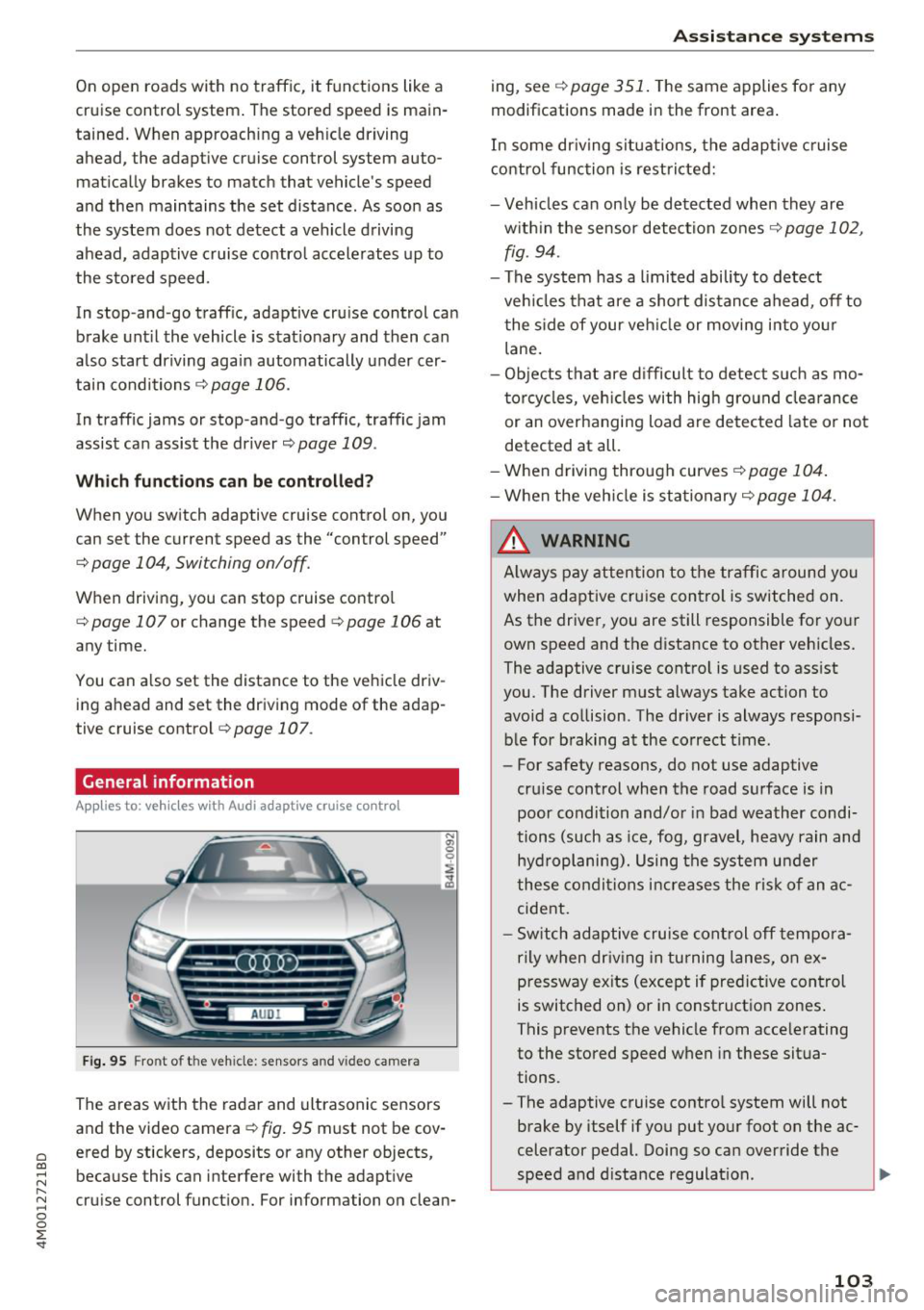
The areas w ith the radar and ultrasonic sensors
and the video camera¢
fig. 95 must not be cov
ered by stickers, deposits or any other objects, because this can interfe re with the adapt ive
cru ise control funct ion. For information on clean-
A ssi st a nce systems
ing, see¢ page 351 . The same applies fo r any
modifications made in the front area .
In some dr iving situations, the adap tive c ruise
contro l func tion is restricte d:
- Veh icles can on ly be detected when they are
w ith in the sensor detection zones
¢ page 102,
fig. 94 .
-The system has a limited ability to detect
ve hicles that are a short dis tance ahead, off to
t he s ide of your veh icle or moving i nto yo ur
lane.
- Objects that are d ifficult to detect s uch as mo
tor cycles, veh icles with high gro und clea rance
or an overhanging load are detected late or not
detected at all.
- When driving through curves
¢ page 104.
-W hen the veh icle is sta tionary ¢ page 104 .
A WARNING
Always pay atten tion to the traffic around you
when adaptive cru ise con trol is switched on .
As the driver, you are still responsible for your
own speed and the distance to other veh icles.
The adaptive cruise control is used to ass ist
you. The driver must always take action to
avoid a collision . The driver is always responsi
b le for braking at the correct time.
- For safety reasons , do not use adaptive
cru ise cont rol when the road surface is in
poor condi tion and/or in bad weather condi
tions (such as ic e , fog, gravel, heavy rain and
hyd roplani ng) . Using the system under
these co ndi tions i ncreases the ris k of an a c
cident.
- Sw itch adaptive cru ise cont rol off tempo ra
r ily when dr iving in tu rning lanes, on e x
p re ssw ay ex its (except if pre dictive control
is switched on) or in construct io n zones .
This prevents t he vehicle f rom acce le rating
to the stored speed when in these situa
tions.
- The adaptive cruise contro l system will not
brake by itself if you put yo ur foot on the ac
celerator pedal. Doing so can over ride the
speed and d istance regulat ion .
~
103
Page 106 of 398
Assistance systems
-When approaching stationary obstacles
such as stopped traffic, adaptive cruise con
trol will respond with limited function.
- Adaptive cruise control does not respond to
people, animals, or cross ing or oncoming
objects.
- The function of the radar sensors can be af
fected by reflective objects such as guard
rails, the entrance to a tunnel, heavy rain or
ice.
(D Note
The sensors can be displaced by impacts or
damage to the bumper, wheel housing and
underbody . Th is can impair the adaptive
cruise control. Have an authorized Audi dealer
or authorized Audi Service Facility check their
function.
@ Tips
For an explanation on conformity with the
FCC regulations in the United States and the
Industry Canada regulations, see
¢page 380.
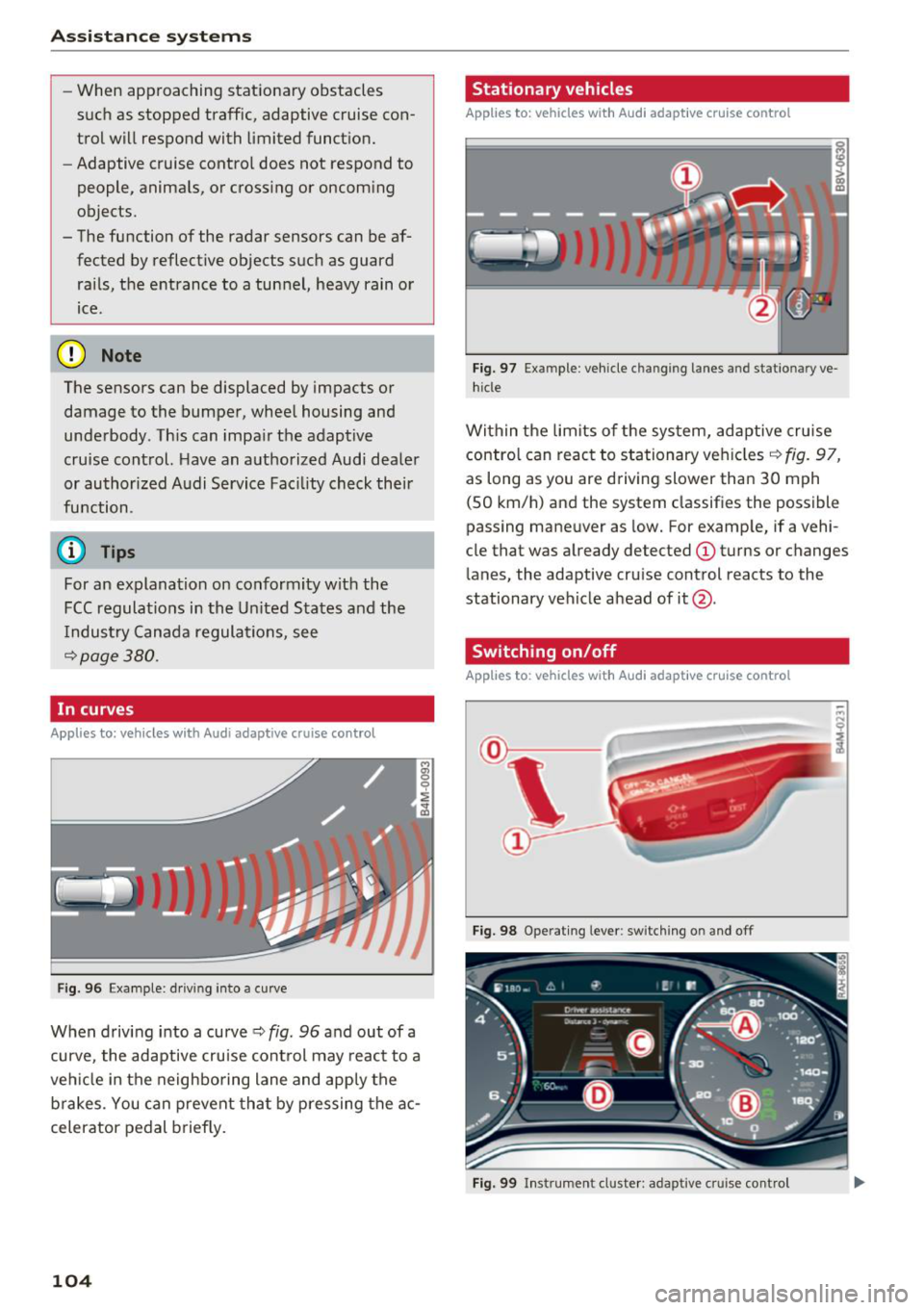
In curves
A pp lies to: ve hicles w ith Audi adaptive cruise co ntrol
Fig . 96 Exam ple: driving into a curve
When driving into a curve ¢ fig. 96 and out of a
curve, the adaptive cruise control may react to a
vehicle in the neighboring lane and apply the
brakes. You can prevent that by pressing the ac
celerator pedal briefly.
104
Stationary vehicles
App lies to : vehicles wit h Audi adap tive cruise control
))
Fig . 97 Exa mple : ve hicl e ch an gi ng la nes a nd statio nary ve
hicle
Within the limits of the system, adaptive cruise control can react to stationary vehicles ¢
fig. 97,
as long as you are driving slower than 30 mph
(SO km/h) and the system classifies the possible
passing maneuver as low. For example, if a vehi
cle that was already detected
(D turns or changes
lane s, the adaptive cruise control reacts to the
stationary vehicle ahead of it@ .
Switching on/off
App lies to: vehicles wit h Audi ada ptive c ru ise contro l
Fig. 98 Operating lever: switching on and off
Fig. 99 In strumen t cluster: adapt ive cru ise control