child lock AUDI Q7 2021 Owner´s Manual
[x] Cancel search | Manufacturer: AUDI, Model Year: 2021, Model line: Q7, Model: AUDI Q7 2021Pages: 332, PDF Size: 117.99 MB
Page 72 of 332
Sitting correctly and safely
ZA\ WARNING
— There is one head restraint for each seat. All
vehicle occupants must adjust the head re-
straint correctly before every trip. Having
head restraints that are not adjusted cor-
rectly or not installed in the vehicle increas-
es the risk of a neck injury during sudden or
unexpected driving or braking maneuvers or
in a collision.
— Only remove the rear seat head restraints if
it is necessary to install a child safety seat
= page 80. Stow the removed head re-
straints securely, for example in the luggage
compartment. Reinstall the head restraints
immediately once the child safety seat has
been removed. Driving without head re-
straints increases the risk of serious neck in-
juries.
ae memes)
Applies to: vehicles with adjustable head restraints
RAZ-0683,
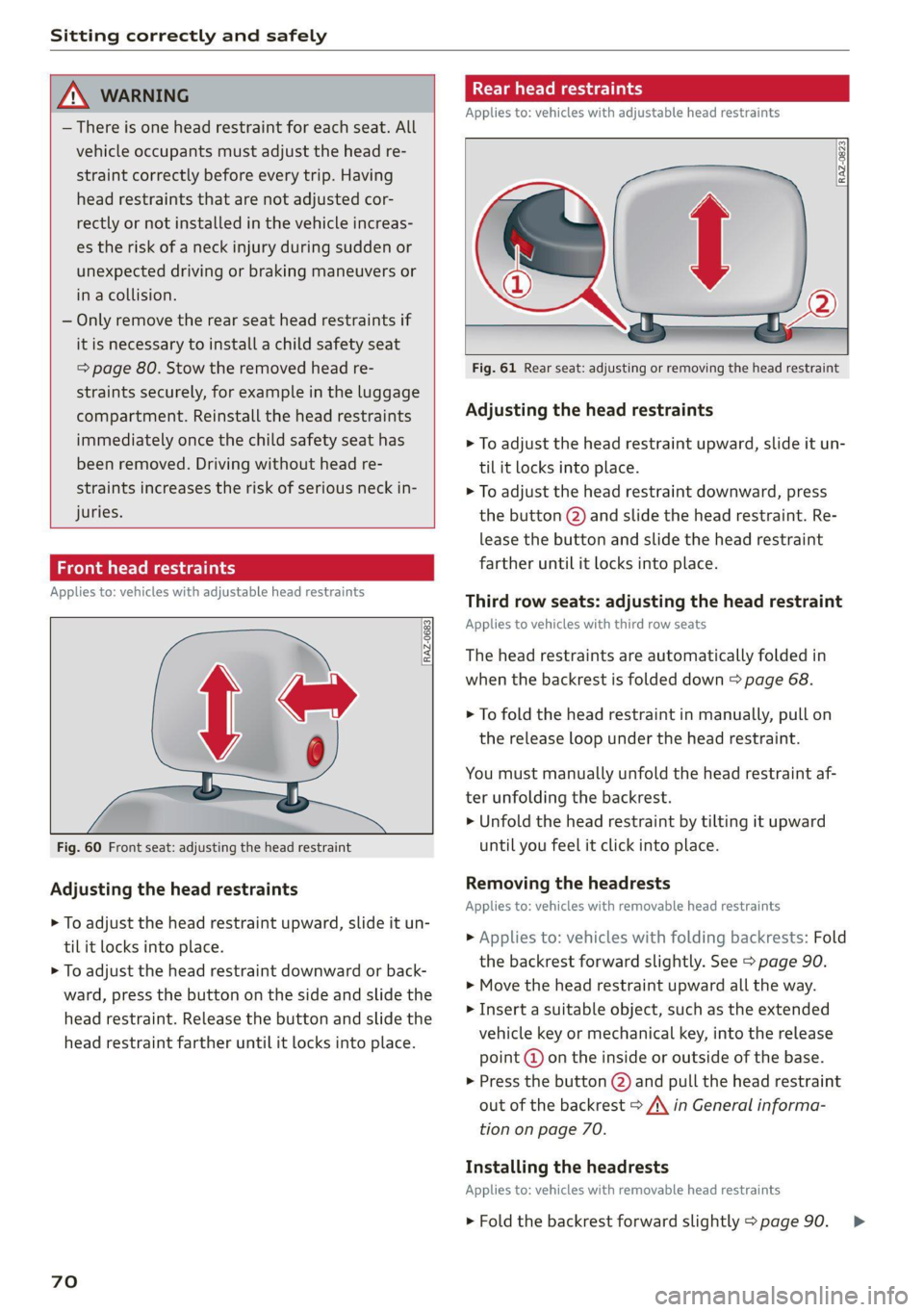
Fig. 60 Front seat: adjusting the head restraint
Adjusting the head restraints
> To adjust the head restraint upward, slide it un-
til it locks into place.
> To adjust the head restraint downward or back-
ward, press the button on the side and slide the
head restraint. Release the button and slide the
head restraint farther until it locks into place.
70
Rear head restraints
Applies to: vehicles with adjustable head restraints
RAZ-0823
Fig. 61 Rear seat: adjusting or removing the head restraint
Adjusting the head restraints
> To adjust the head restraint upward, slide it un-
til it locks into place.
> To adjust the head restraint downward, press
the button @) and slide the head restraint. Re-
lease the button and slide the head restraint
farther until it locks into place.
Third row seats: adjusting the head restraint
Applies to vehicles with third row seats
The head restraints are automatically folded in
when the backrest is folded down > page 68.
> To fold the head restraint in manually, pull on
the release loop under the head restraint.
You must manually unfold the head restraint af-
ter unfolding the backrest.
> Unfold the head restraint by tilting it upward
until you feel it click into place.
Removing the headrests
Applies to: vehicles with removable head restraints
> Applies to: vehicles with folding backrests: Fold
the backrest forward slightly. See > page 90.
> Move the head restraint upward all the way.
> Insert a suitable object, such as the extended
vehicle key or mechanical key, into the release
point @ on the inside or outside of the base.
> Press the button (2) and pull the head restraint
out of the backrest > A\ in General informa-
tion on page 70.
Installing the headrests
Applies to: vehicles with removable head restraints
> Fold the backrest forward slightly > page 90. >
Page 76 of 332
Sitting correctly and safely
Safety belt monitoring system
eB - If the indicator light turns on or flashes, a
safety belt is not fastened or it has been unbuck-
led while driving. Above certain speeds, addition-
al warning tones will sound.
sting the height of the safety belt
é B 2
= + a
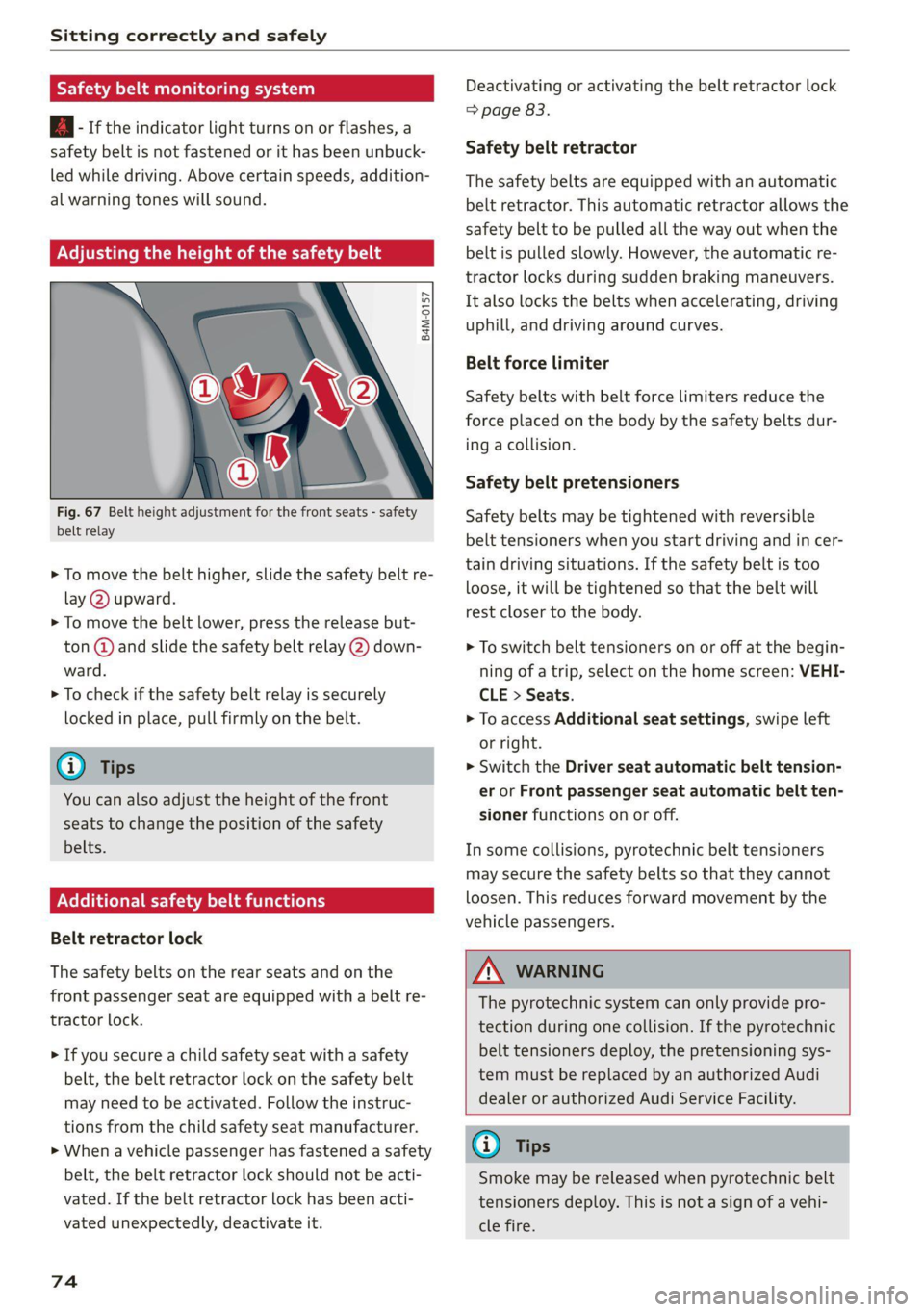
Fig. 67 Belt height adjustment for the front seats - safety
belt relay
> To move the belt higher, slide the safety belt re-
lay @ upward.
> To move the belt lower, press the release but-
ton @ and slide the safety belt relay (2) down-
ward.
> To check if the safety belt relay is securely
locked in place, pull firmly on the belt.
@ Tips
You can also adjust the height of the front
seats to change the position of the safety
belts.
Pelee Cea era imately
Belt retractor lock
The safety belts on the rear seats and on the
front passenger seat are equipped with a belt re-
tractor lock.
> If you secure a child safety seat with a safety
belt, the belt retractor lock on the safety belt
may need to be activated. Follow the instruc-
tions from the child safety seat manufacturer.
> When a vehicle passenger has fastened a safety
belt, the belt retractor lock should not be acti-
vated. If the belt retractor lock has been acti-
vated unexpectedly, deactivate it.
74
Deactivating or activating the belt retractor lock
=> page 83.
Safety belt retractor
The safety belts are equipped with an automatic
belt retractor. This automatic retractor allows the
safety belt to be pulled all the way out when the
belt is pulled slowly. However, the automatic re-
tractor locks during sudden braking maneuvers.
It also locks the belts when accelerating, driving
uphill, and driving around curves.
Belt force limiter
Safety belts with belt force limiters reduce the
force placed on the body by the safety belts dur-
ing a collision.
Safety belt pretensioners
Safety belts may be tightened with reversible
belt tensioners when you start driving and in cer-
tain driving situations. If the safety belt is too
loose, it will be tightened so that the belt will
rest closer to the body.
> To switch belt tensioners on or off at the begin-
ning of a trip, select on the home screen: VEHI-
CLE > Seats.
> To access Additional seat settings, swipe left
or
right.
> Switch the Driver seat automatic belt tension-
er or Front passenger seat automatic belt ten-
sioner functions on or off.
In some collisions, pyrotechnic belt tensioners
may secure the safety belts so that they cannot
loosen. This reduces forward movement by the
vehicle passengers.
Z\ WARNING
The pyrotechnic system can only provide pro-
tection during one collision. If the pyrotechnic
belt tensioners deploy, the pretensioning sys-
tem must be replaced by an authorized Audi
dealer or authorized Audi Service Facility.
@ Tips
Smoke may be released when pyrotechnic belt
tensioners deploy. This is not a sign of a vehi-
cle fire.
Page 83 of 332
4M1012721BC
Sitting correctly and safely
injury during a sudden braking maneuver or
accident. This especially applies to children
in the front passenger's seat or children who
have their head near the side airbag deploy-
ment area, if the airbag system is deployed
during an accident. This incorrect seating
position can cause severe or even fatal inju-
ries.
Make sure there is enough space in front of
the child in the child safety seat. If necessa-
ry, adjust the angle and position of the seat
in front of the child safety seat.
If you are transporting a child in a rear-fac-
ing child safety seat in the rear of the vehi-
cle, remove the Audi Entertainment mobile
device from the backrest on the front seat to
reduce the risk of injury.
The rear side of a forward-facing child safety
seat should be positioned as close as possi-
ble to the backrest on the vehicle seat. If the
head restraints make it difficult to install a
child safety seat, adjust or remove them if
necessary > page 69. Reinstall the head re-
straints immediately once the child safety
seat has been removed.
Always make sure that the backrest on the
seat where the child safety seat is installed
is securely locked in place and cannot move
forward. Otherwise, the backrest where the
child safety seat is secured could move for-
ward in the event of an accident or other
emergency situation.
NEVER use a rear-facing child safety seat on
a seat with an ACTIVATED FRONT AIRBAG;
this could cause DEATH or SERIOUS INJU-
RIES to a CHILD.
— Always secure child safety seats on the
rear seats. If exceptional circumstances re-
quire the child safety seat to be placed on
the front passenger's seat, then the front
passenger's airbag must be deactivated.
Always make sure that
PASSENGER AIR BAG OFF %; stays on
while driving. If
PASSENGER AIR BAG OFF %, does not
turn on, remove the child safety seat and
install it again according to the child safe-
ty seat manufacturer instructions. If
PASSENGER AIR BAG OFF #; still
does not turn on, the front passenger's
seat must not be used. Drive to an author-
ized Audi dealer or authorized Audi Service
Facility and have the airbag system in-
spected.
— If you must use a forward-facing child safety
seat on the front passenger's seat, move the
seat as far back as possible so that it is as
far as possible from the front passenger's
airbag. While doing this, make sure the seat
can be adjusted all the way. A child in a child
safety seat on the front passenger's seat can
receive a severe impact if the front passeng-
er's airbag deploys, which increases the risk
of serious or fatal injury.
— Replace the child safety seat after an acci-
dent because there could be damage that is
not visible.
— Even if a child is not sitting in the child safe-
ty seat, the child safety seat must be se-
cured. An unsecured child safety seat may
be thrown through the vehicle interior dur-
ing sudden braking maneuvers or an acci-
dent.
Correct positioning for children
Always secure children in a child safety seat de-
signed for the body size, weight, and age of the
child.
You can secure child safety seats in your vehicle
using the lower LATCH anchors or the safety
belts. You can also secure child safety seats to
the top tether anchor. Depending on the child
safety seat, it may also be necessary to secure it
to the top tether anchor. In Canada, securing for-
ward-facing child safety seats to the top tether
anchors is required by law.
Always transport children in the rear seats
Accident statistics show that children that are se-
cured correctly in the rear seats are safer than in
front seats. Always transport children in suitable
child safety seats secured on the rear seats.
81
>
Page 85 of 332
4M1012721BC
Sitting correctly and safely
seat. The marked points with a symbol are locat-
ed on the cushions > fig. 70 or the covers
=> fig. 71 for the lower LATCH anchors. You can lo-
cate the LATCH anchors using the marking points.
> Applies to: vehicles with a rear bench seat that
can be moved forward/back: If you are securing
a child safety seat in the second row, move the
rear seat all the way back.
> Activate the child safety lock > page 44.
> If you are securing a child safety seat in the sec-
ond row, remove the cushion between the seat
surface and the backrest.
> If you are securing a child safety seat in the
third row, remove the cover on both LATCH an-
chors.
> If you secure a child safety seat to the rear seat,
secure any unused safety belts that are within
reach of the child > A\ in Securing child safety
seats with a safety belt on page 84.
> Secure the child safety seat according to the
child safety seat manufacturer instructions.
> Pull on the child safety seat to check if both
sides are engaged correctly in the LATCH an-
chors.
> If possible, also secure the child safety seat to
the respective top tether anchor on the seat
=> page 84.
ZA WARNING
The LATCH anchors in the vehicle are only de-
signed for child safety seats with the LATCH
system. To reduce the risk of serious or fatal
injury, never secure other child restraint sys-
tems, belts, or objects to the anchors.
@) Tips
The LATCH anchors are designed for a total
weight (child and child safety seat combined)
up to 65 lbs (29 kg). If the total weight is
greater than this, the child safety seat must
be secured with the vehicle safety belt.
Securing child safety seats with a safety
belt
Observe the safety precautions > page 80. The
front passenger’s seat is a dangerous location for
a child, even with an advanced airbag system. If
exceptional circumstances require the child safe-
ty seat to be placed on the front passenger's
seat, then the front passenger's airbag must be
deactivated. Please note the important informa-
tion for this > page 81, Correct positioning for
children and > page 78, Advanced airbag sys-
tem.
Securing child safety seats
» Applies to: vehicles with a rear bench seat that
can be moved forward/back: If you are securing
a child safety seat in the second row, move the
rear seat all the way back.
> Activate the child safety lock > page 44.
> If you secure a child safety seat to the rear seat,
secure any unused safety belts that are within
reach of the child > A\, > page 85.
> If you secure a child safety seat to the front
passenger's seat, adjust the front passenger's
seat to the highest position.
>» Secure the child safety seat according to the
child safety seat manufacturer instructions.
> If necessary, activate the belt retractor lock
=> page 83, Activating the belt retractor lock.
> If the child safety seat is secured on the front
passenger's seat, adjust the front passenger's
seat backrest until it rests flat against the child
safety seat. Also make sure that the upper safe-
ty belt fixture is behind the child safety seat.
> If you secure a child safety seat on the rear
seat, also secure it to the correct top tether an-
chor if possible > page 84.
Activating the belt retractor lock
If you secure a child safety seat using the vehicle
safety belt, you must activate the belt retractor
lock. Follow the child safety seat manufacturer
instructions.
The belt retractor lock prevents the safety belt
from becoming loose while driving, which could
result in the child safety seat no longer being ad-
equately secured.
> Secure the child safety seat according to the
child safety seat manufacturer instructions.
While doing so, pull out the safety belt. Insert
the safety belt into the belt latch that belongs
to that seat until it audibly locks.
83
>
Page 86 of 332
Sitting correctly and safely
> Pull the upper belt out completely and then al-
low it to retract. You will hear a clicking sound
while the belt is retracting. It will not be possi-
ble to pull the safety belt out any farther.
> Push the child safety seat into the seat and al-
low the belt to retract more.
> Make sure that the child safety seat cannot
move more than 1 inch (2.5 cm).
Deactivating the belt retractor lock
> Unbuckle the safety belt from the belt latch.
> Remove the child safety seat according to the
manufacturer instructions.
> Allow the safety belt to retract completely. The
belt retractor lock is deactivated.
Aw
—A safety belt that is not locked by the belt
retractor lock or a locking device cannot se-
cure a child safety seat while driving or in
the event of an accident, which increases the
risk of fatal injury. Always make sure the
belt retractor lock on the safety belt is acti-
vated if the child safety seat manufacturer
instructions require it.
— Due to the risk of fatal injury, never place a
rear-facing child safety seat on the front
passenger's seat when the front passenger's
airbag is switched on.
— For the child safety seat to offer the maxi-
mum protection, it is especially important
to route the vehicle safety belt correctly. Al-
ways follow the instructions from the child
safety seat manufacturer for routing the
safety belt correctly. Incorrectly fastened
safety belts can cause injuries, even during
minor accidents.
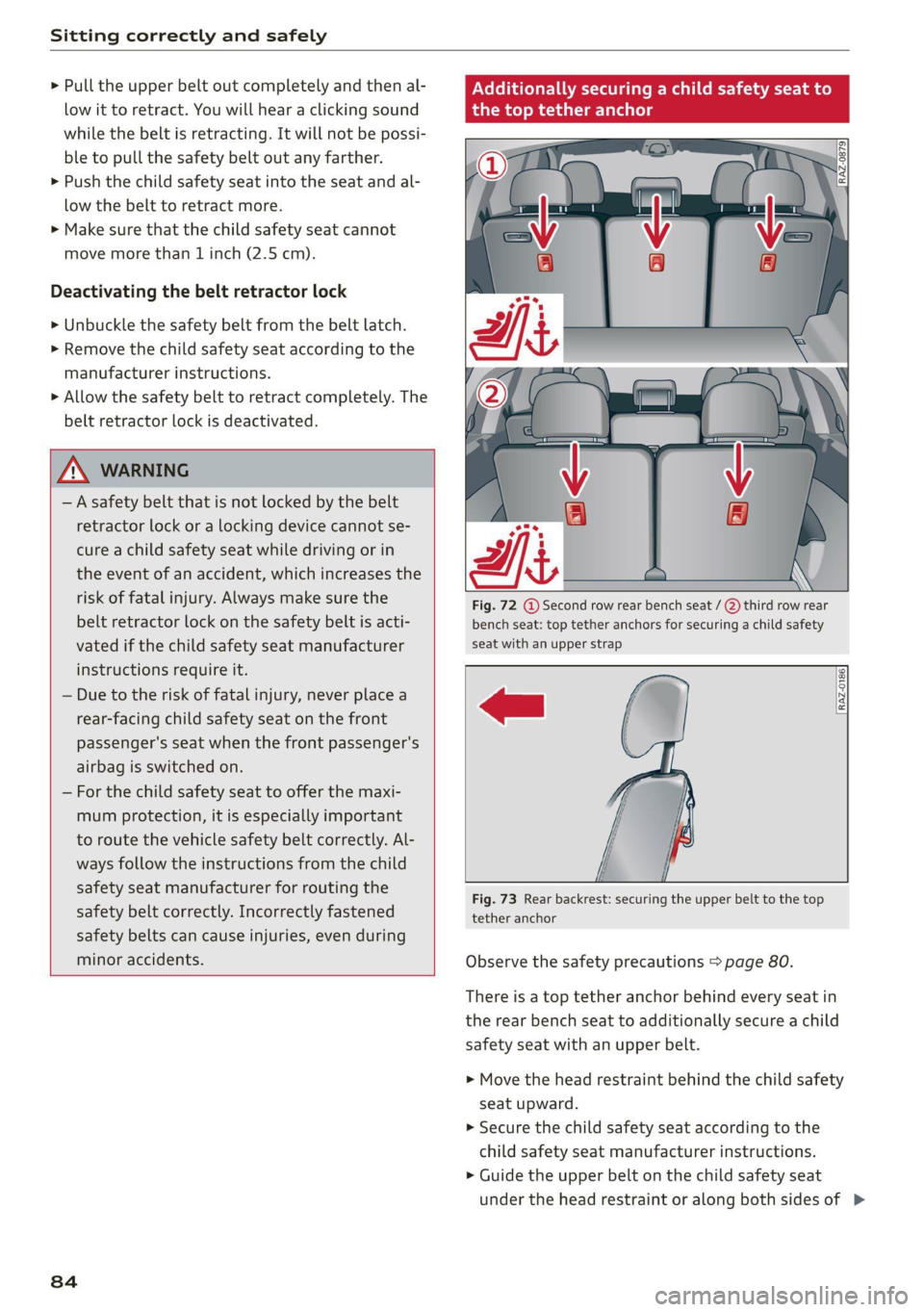
bench seat: top tether anchors for securing a child safety
seat with an upper strap
RAZ.0186)
84
Fig. 73 Rear backrest: securing the upper belt to the top
tether anchor
Observe the safety precautions > page 80.
There is a top tether anchor behind every seat in
the rear bench seat to additionally secure a child
safety seat with an upper belt.
> Move the head restraint behind the child safety
seat upward.
> Secure the child safety seat according to the
child safety seat manufacturer instructions.
> Guide the upper belt on the child safety seat
under the head restraint or along both sides of >
Page 87 of 332

4M1012721BC
Sitting correctly and safely
it and toward the rear (depending on the child
safety seat model).
> Fasten the belt to the top tether anchor
> fig. 73. While doing this, make sure the belt
is not twisted and is not running over any sharp
edges.
> Pull the belt tightly so that the child safety seat
rests at the top of the seat backrest.
» If necessary, move the head restraint behind
the child safety seat downward.
> Activate the belt retractor lock on the fastened
safety belts. To do this, pull the upper belt out
completely and then allow it to retract. You will
hear a clicking sound while the belt is retract-
ing. It will not be possible to pull the safety
belt out any farther.
>» Make sure the fastened safety belt does not
block access to the LATCH anchors. Otherwise,
it may not be possible to secure the child safety
seat to the LATCH anchors correctly.
Z\ WARNING
The top tether anchors in the vehicle are only
designed for child safety seats equipped with
an upper strap. To reduce the risk of serious or
fatal injury, never secure other child restraint
systems, belts, or objects to the anchors.
Yate emo Rt 1am nem Te
rtrd
Fig. 74 Second row rear bench seat: securing safety belts
that are not used
If a child safety seat is used on the rear bench
seat, the child must not be able to reach any
safety belts that are not being used. Secure safe-
ty belts that are within reach of the child.
> If you secure a child safety seat to the LATCH
anchors in the second row, fasten the safety
belt on the seat where the child safety seat is
installed using the seat's safety belt latch.
> If you secure a child safety seat to the LATCH
anchors in the third row, fasten the safety belt
on the seat where the child safety seat is instal-
led using the seat's safety belt latch.
> If you secure a child safety seat to one of the
outer seats in the second row, fasten the safety
belt for the center seat in its latch.
ZA\ WARNING
A child in a child safety seat could play with
the unused safety belts and then become en-
tangled in them, which increases the risk of
fatal injury. Always secure unused safety belts
so that they are not within reach of children in
child safety seats.
8s
Page 90 of 332
Storage and convenience
adapt your driving style and speed to the
current conditions.
— The cargo net* is only strong enough to se-
cure light objects. Heavy objects are not ade-
quately secured. Attempting to secure heavy
objects increases the risk of injury.
— Never exceed the permitted axle and load
and vehicle weight > page 314.
— Never secure a child safety seat to the tie-
downs.
— Never leave your vehicle unattended, espe-
cially if the luggage compartment lid is
open. Children could enter the luggage com-
partment and close the luggage compart-
ment lid from the inside. This creates the
risk of fatal injury, since the children would
be locked in and may not be able to escape
by themselves.
— Do not allow children to play in or on the ve-
hicle. Close and lock the luggage compart-
ment lid as well as all other doors when you
leave
the vehicle.
— Never transport passengers in the luggage
compartment. Every passenger must be cor-
rectly secured with the safety belts in the
vehicle > page 71.
— Be careful when releasing the backrest and
folding
it forward. To reduce the risk of be-
ing pinched, pay attention and check when
folding backrests forward.
— The backrest must be securely latched so
objects cannot slide forward out of the lug-
gage compartment during sudden braking.
— The backrest must be latched securely to en-
sure that the safety belt is protecting the
center seating position.
— Always pull forward on the backrest to make
sure it is check if it is correctly locked in
place.
— Applies to: vehicles with third row seats: To
reduce the risk of injury, the backrest on the
second row seats must be in the upright po-
sition and locked in place if there are pas-
sengers riding in the third row.
— Applies to: vehicles with third row seats:
When there are passengers riding in the
third row seats, remove the adjustable tie-
downs* and place the rail covers on the rails
to
reduce the risk of injuries.
88
C) Note
—To reduce the risk of damage, move the rear
head restraints down > page 70 before fold-
ing the rear backrests forward.
— When folding the backrest forward, make
sure the outer safety belts are in the belt
guide recess so that they do not get pinched
in the backrest lock and damaged. Other ob-
jects should be removed from the rear
bench seat to protect the backrest from
damage.
— If you move the front seat back when the
rear seat backrest is folded forward, you
could damage the head restraints on the
rear seat.
— Make sure that the heating grid strips for
the rear window defogger are not damaged
by abrasive objects.
— Applies to: vehicles with manual luggage
compartment cover: Let the luggage com-
partment cover roll up slowly to reduce the
risk of damage.
(i) Tips
—The tire pressure must be adapted to the
load > page 269.
— You can purchase straps at specialty stores.
Page 97 of 332
4M1012721BC
Warm and cold
Applies to: vehicles with 4-zone automatic cli-
mate control: You can press J in the rear control
panel multiple times to adjust the air distribution
based on the direction of the arrow.
® Defrosting
The windshield and side windows are defrosted
or cleared of condensation as quickly as possible.
Align the outer air vents with the side windows.
The maximum amount of air flows mainly from
the vents below the windshield. Recirculation
mode switches off. The temperature should be
set at 72 °F (+22 °C) or higher. Depending on the
outside temperature, the A/C cooling mode may
automatically switch on.
& Rear window defogger
The rear window defogger only operates when
the engine is running. It switches off automati-
cally after 10 to 20 minutes, depending on the
outside temperature.
To prevent the rear window defogger from
switching off automatically, press and hold the
&® button for more than three seconds. It will re-
main on until the ignition is switched off.
AUTO
&/& Recirculation mode
In recirculation mode, the air inside the vehicle is
circulated and filtered. This prevents the unfil-
tered air outside the vehicle from entering the
vehicle interior > A\.
Pressing <> switches recirculation mode on or
off manually.
‘AUTO
When switched on, automatic recirculation
You must press the & button if fog forms on the
windows.
« Seat heating
Applies to: vehicles with heated seats
The seat heating temperature can be set at mul-
tiple levels. Press 4 once to switch on the highest
level. Press «/ again to decrease the temperature
one level at a time. The seat heating is switched
off if the button is not illuminated.
®) Seat ventilation
Applies to: vehicles with seat ventilation
The seat ventilation intensity can be set to multi-
ple levels. Press 2) once to switch on the highest
level. Press 2) again to decrease the heat level
one level at a time. The seat ventilation is switch-
ed off if the button is not illuminated.
@ Child safety lock*
If 8 turns on in the control panel in the rear, the
child safety lock is active and operation is blocked
> page 44.
§ Ionizer
Applies to: vehicles with ionizer
Hazardous particles and germs in the air may be
reduced through ionization. This helps to im-
prove the air quality for individuals in the passen-
ger compartment.
&" Fragrance
Applies to: vehicles with fragrance function
The fragrance function will dispense a scent in
the vehicle interior. It is dispensed through the
front outer vents. This will produce a pleasant
scent. The fragrance is time-delayed, especially
at low or high temperatures. You can adjust the
fragrance function > page 96.
Residual heat
The residual heat from the coolant is used to
heat the vehicle interior. To use this function,
press and hold the &% button for more than two
seconds while the ignition is switched off. The
function switches off automatically after about
15 minutes.
ZX WARNING
— You should not use the recirculation mode
for an extended period of time, because no
fresh air is drawn in and the windows can
fog when cooling mode is switched off. This
increases the risk of an accident.
— Individuals with reduced sensitivity to pain
or temperature could develop burns when
using the seat heating* function. To reduce
the risk of injury, these individuals should
not use seat heating*.
95
Page 178 of 332
Parking and maneuvering
— Remote controlled parking is only an assist
system. The driver is always responsible for
maneuvering, driving, and stopping the ve-
hicle and performing other driving maneu-
vers.
— Do not use this function if the vehicle cannot
move freely, for example when on a vehicle
jack.
— Failing to pay careful attention to the vehi-
cle's surroundings increases the risk of an
accident. Sensors and cameras have spots in
which the surrounding area cannot be de-
tected. Objects, animals, and people may
only be detected with limitations may not
be detected at all. Always monitor the traf-
fic as well as the vehicle's surroundings with
direct eye contact. Stay near the vehicle
while controlling it. Make sure you have a
clear view of the vehicle and the area sur-
rounding it. Do not become distracted.
— Applies to: vehicles with anti-theft alarm
system: There is a risk of fatal injury for peo-
ple locked in the vehicle, especially children.
The vehicle is locked during remote control-
led parking. Make sure there are no persons
inside the vehicle both before and after us-
ing remote controlled parking.
— There is a risk of asphyxiation. Never allow
the engine to run in confined spaces. After
remote controlled parking, make sure the
engine is off.
— Malfunctions when using the myAudi app in-
crease the risk of an accident. Do not exit
the app during the parking process, and
make sure that it does not go into the device
background, for example by accepting an in-
coming call. Observe the operating instruc-
tions from the manufacturer of your mobile
device.
— There is a risk of accident if the connection is
interrupted. In certain situations, the con-
nection between the mobile device and the
vehicle can be interrupted, for example from
other radio devices or when the distance to
the vehicle is too far. Make sure the connec-
tion is sufficient, and when in doubt, resume
parking the vehicle yourself.
— Blocking notifications, tones, and vibrations
increase the risk of an accident. The myAudi
app can only warn you if dangers are detect-
ed if you make sure that your mobile device
allows all notifications, tones, and vibra-
tions for the myAudi app.
176
@) Note
— Do not use remote controlled parking when
transporting cargo that projects outside of
the vehicle or when snow chains are mount-
ed.
— Remote controlled parking may guide the
vehicle either away from curbs or onto them
if other vehicles are parked on the curb.
Make sure that your vehicle's tires and rims
are not damaged. Resume control of the ve-
hicle in time or stop the parking process if
needed to prevent damage.
— In parking spaces without curbs, maintain a
distance of at least 19 inches (50 cm) from
walls and buildings in order to reduce the
risk of vehicle damage.
G) Tips
— Follow the legal regulations in the country
where you are operating the vehicle when
using remote controlled parking. Remote
controlled parking may be prohibited in
some countries. The system may be unavail-
able in countries where it has been deacti-
vated in order to comply with legal regula-
tions. Data will not be transmitted to Audi.
The driver is always responsible for adhering
to the regulations applicable in the country
where the vehicle is being operated.
— Any individual that uses the mobile device
for remote controlled parking is considered
the driver and is participating in traffic. The
driver is always responsible for adhering to
the regulations for using remote controlled
parking that are applicable in the country
where the vehicle is being operated.
— Do not endanger any other road users when
using remote controlled parking. Testing re-
mote controlled parking in a parking lot
with minimal traffic is recommended. >
Page 318 of 332
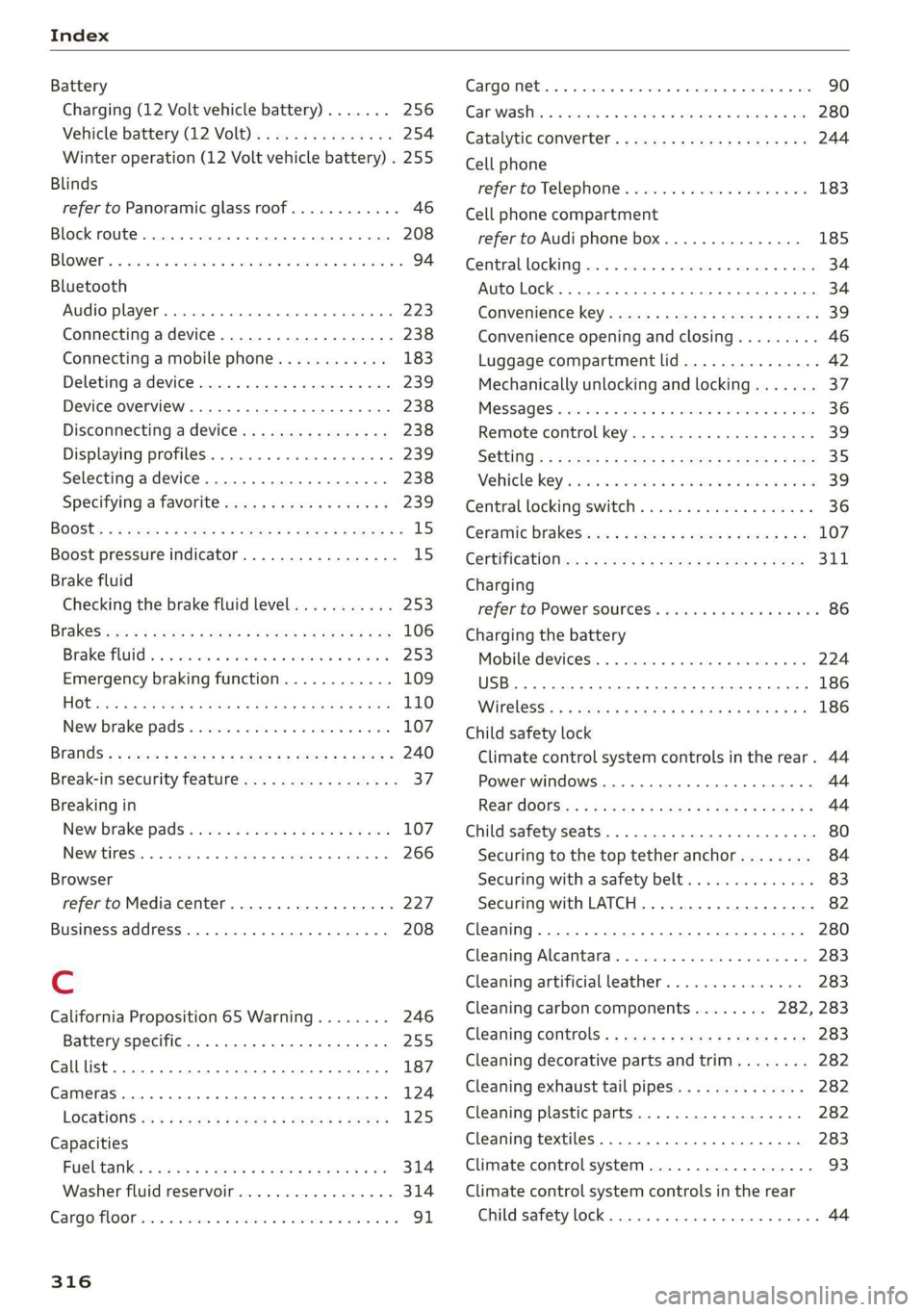
Index
Battery
Charging (12 Volt vehicle battery)....... 256
Vehicle battery (12 Volt)............... 254
Winter operation (12 Volt vehicle battery) . 255
Blinds
refer to Panoramic glass roof............ 46
BlOGK TOUTE vcs + « crsanin © 5: cavemen © & oreo © wanes 208
Oe 94
Bluetooth
Audio player. .... 0.0.2... ee eee eee eee 223
Connecting a device...............00-- 238
Connecting a mobile phone............ 183
Deleting adevice...............00000- 239
Device overvieW.... 0.0.00. ee eee eee 238
Disconnecting a device................ 238
Displaying profiles.................... 239
Selecting adevice.................00. 238
Specifying a favorite.............0000- 239
BOOStss « : eens 2 y ses « e eee bo ees Go eee ee 15
Boost pressure indicator................. 15
Brake fluid
Checking the brake fluid level........... 253
Brak@Sisss 2 ¢ sews 5 ¢ cans + 0 eee fe ore eo ee 106
Brakesfluids cs season x amamna a x anime oo somnine 6 253)
Emergency braking function............ 109
HGtticra: 2 5 susan 3 8 aatam ¥ S RGIER 2 oe 3 eR 110
New brake pads « sec se ove oe sens sees 107
Bratids:s = seem: = = weeps & = eeeng © 4 eee G4 Ree 240
Break-in security feature................. 37
Breaking in
New brake pads « sess so sesou oo camer o coaans 107
ING WEIROSE: « « winzson s » crnnace 6 9 oxenene © 0 axniean 266
Browser
refer to Media center.................. 227
Business address.............2.22--0-- 208
Cc
California Proposition 65 Warning........ 246
Battery specific...............0.-.00. 255
Calllist.. 0... 2. eee eee eee eee 187
CameraS 0... eee 124
LOCAtIONS <5 « = seem 5 2 Rem FE eR SE oe g 125
Capacities
Fuelitank’: » soos 3 2 mews 2 2 awe 2 4 came + ne 314
Washer fluid reservoir................. 314
CargoPloor eno < csccose 2 v snevece a v exevene av enecene 2 3 91
316
CarQOiMe bien: « sows v seswens wo casicows 1 wt eamwses © vt ome 90
Carwash, . s wvvsa eo soni av anaes 4 ao insane wo ane 280
Catalytic converter... 0.0... cee eee e eens 244
Cell phone
refer to Telephone...........-..-++05- 183
Cell phone compartment
refer to Audi phone box............... 185
Central
lockingsec. « 2 ces 0 x moms + 6 same a 0 ate 34
Auto Lock... 0.6... eee eee es 34
Convenience key..........-.00 eee ee ee 39
Convenience opening and closing......... 46
Luggage compartment lid............... 42
Mechanically unlocking and locking....... 37
MESSAGES « secures so acsmes +o awewes vo exon v aeMN 36
Remote control key............2-..0005 39
SGUeING.< = x sea « = sees Fo eee Fe ees FP wee 35
Vehicle key sass
Geramic brakeSwoas + ¢ eayes ¢ x seme 2 x ees & 6 3 107
GentificatiOnin: « » axa: = wee 2 sme 2 eee 311
Charging
refer to Power sourceS.........--0 eee eee 86
Charging the battery
Mobileidevicesi. . . csisceuss «sania a a avesiue 0 ¥ ave 224
USB... eee 186
Wireless: « « arms s ¢ anes gs agus a 2 awe 2 6 186
Child safety lock
Climate control system controls in the rear. 44
Power windows............0 2.0000 eee 44
ReardGorsis« + s seus «a mame 2 AeS.8 & Gale aS 44
Child safety seats.............0..000 eee 80
Securing to the top tether anchor........ 84
Securing with a safety belt.............. 83
Securing with LATCH..............2-00. 82
Cleaning... 0.2... . cee eee eee eee 280
Cleaning Alcantara................0000. 283
Cleaning artificial leather............... 283
Cleaning carbon components........ 282, 283
Cleaning controls:s « sews s sews «esas x os 283
Cleaning decorative parts andtrim........ 282
Cleaning exhaust tail pipes.............. 282
Cleaning plastic parts.................. 282
Cleaning textiles...............00.000. 283
Climate control system...........--..0-- 93
Climate control system controls in the rear
Child safety lock..... 0... ccc cece eee eee 44