airbag AUDI R8 2007 Owner's Manual
[x] Cancel search | Manufacturer: AUDI, Model Year: 2007, Model line: R8, Model: AUDI R8 2007Pages: 210, PDF Size: 8.1 MB
Page 122 of 210
Airbag system 120•
Any damage to the original seat upholstery or around the
seams of the side airbag units must be repaired immediately by a
qualified workshop.
•
Any work involving the side airbag system or removal and
installation of the airbag components for other repairs (such as
repairs to the seats) should always be performed by a qualified
workshop. Otherwise the airbag system may fail to work
properly.
Deactivating the airbagsDeactivating airbags
If airbags have been deactivated, they should be reacti-
vated as soon as possible so that they can continue to
give the required protection.There are two ways of deactivating the airbags: you can deactivate
the front passenger's airbag yourself by means of the key-operated
switch ⇒page 120. The other airbags can be deactivated by your
Audi R8 dealer.
Deactivating front passenger's airbag when a child
safety seat is in use
If you have no alternative but to install a rearward-facing child safety
seat on the front passenger's seat you must deactivate the front
passenger's airbag beforehand.
Monitoring of airbag system
The airbag warning lamp will light up for a few seconds every time
the ignition is switched on.
WARNING
•
Never install a rearward-facing child safety seat on the front
passenger's seat unless the front passenger's airbag has been
deactivated – this can result in potentially fatal injuries to the child
⇒page 123.
•
Make sure that the front passenger's airbag is reactivated by
means of the key-operated switch as soon as the child seat is no
longer needed on the front passenger's seat.
Applies to vehicles: with key-operated switch for front passenger's airbagKey-operated switch for front passenger's airbag
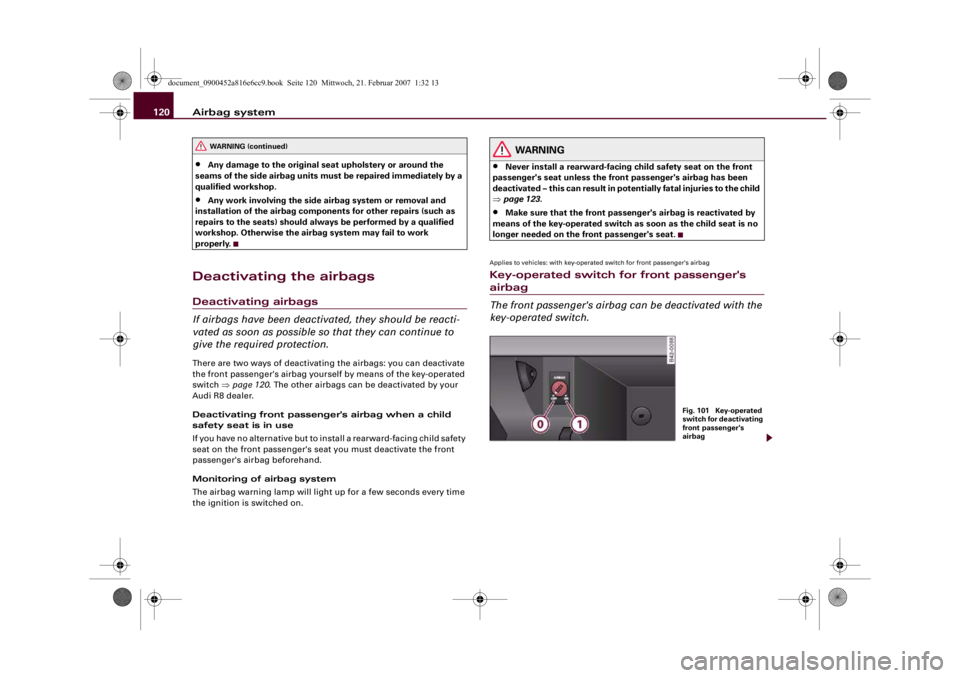
The front passenger's airbag can be deactivated with the
key-operated switch.
WARNING (continued)
Fig. 101 Key-operated
switch for deactivating
front passenger's
airbag
document_0900452a816e6cc9.book Seite 120 Mittwoch, 21. Februar 2007 1:32 13
Page 123 of 210
Airbag system121
Controls
Safety
Driving tips
General maintenance
Self-help
Technical data
The key-operated switch for deactivating the front
passenger's airbag is located in the glove box ⇒page 120,
fig. 101.
– To deactivate the front passenger's airbag, insert the
ignition key in the switch and turn it to position .
– The front passenger's airbag can be reactivated by
turning the key to position .If the front passenger's airbag has been deactivated via the key-
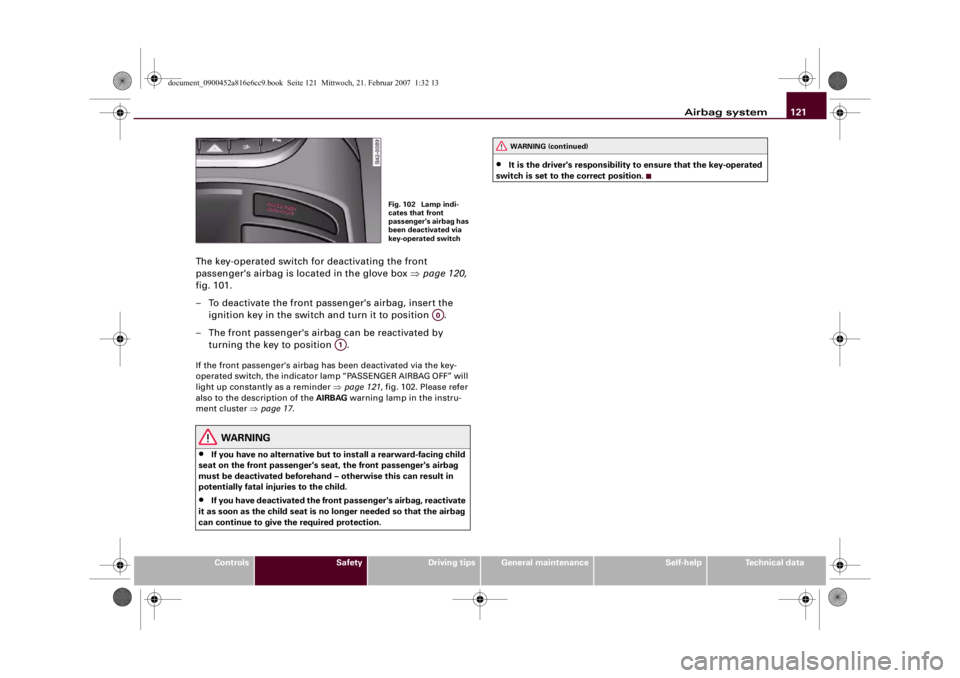
operated switch, the indicator lamp “PASSENGER AIRBAG OFF” will
light up constantly as a reminder ⇒page 121, fig. 102. Please refer
also to the description of the AIRBAG warning lamp in the instru-
ment cluster ⇒page 17.
WARNING
•
If you have no alternative but to install a rearward-facing child
seat on the front passenger's seat, the front passenger's airbag
must be deactivated beforehand – otherwise this can result in
potentially fatal injuries to the child.
•
If you have deactivated the front passenger's airbag, reactivate
it as soon as the child seat is no longer needed so that the airbag
can continue to give the required protection.
•
It is the driver's responsibility to ensure that the key-operated
switch is set to the correct position.
Fig. 102 Lamp indi-
cates that front
passenger's airbag has
been deactivated via
key-operated switch
A0
A1
WARNING (continued)
document_0900452a816e6cc9.book Seite 121 Mittwoch, 21. Februar 2007 1:32 13
Page 124 of 210
Child safety 122Child safetyPoints to remember if children are
travelling in the carIntroductionThe physical principles involved and the forces acting in a collision
apply to children just as much as adults ⇒page 110, “Forces acting
in a collision”. But, unlike adults, children do not have fully devel-
oped muscle and bone structures. This means that children are
subject to a greater risk of injury.
To reduce this risk, children must always use special child restraint
systems when travelling in the car.
Use only child restraint systems which are officially approved under
the European standard ECE R 44 and are suitable for the child. ECE R
refers to the Economic Commission of Europe Recommendation,
which categorises child restraint systems in 5 groups ⇒page 123,
“Child seat categories”. Child restraints that have been tested and
approved under the ECE R 44 standard bear the ECE-R 44 test mark
on the seat (the letter E in a circle with the test number below it).
We recommend using child restraint systems from the range of
Audi Genuine Accessories available from Audi R8 dealers. The
“Huckepack” range includes suitable restraint systems for all ages.
These systems have been specially designed for use in Audi vehicles
and comply with the ECE R 44 standard.
Follow the manufacturer's instructions and observe any statutory
requirements when installing and using child restraints ⇒ in
“Important safety notes for using child safety seats”.
Important safety notes for using child safety seats
Correct use of child safety seats can help to reduce the
risk of injury in an accident.
WARNING
•
All vehicle occupants, especially children, must wear a seat
belt while the vehicle is in motion.
•
Children who are less than 1.5 metres tall must not wear a
normal seat belt without a child restraint, as this could cause inju-
ries to the abdominal and neck areas.
•
Babies and children must never travel on another occupant's
lap.
•
A suitable child safety seat can protect your child ⇒page 123,
“Child safety seats”.
•
Never allow two children to occupy one child safety seat.
•
Never leave a child without supervision in a child safety seat.
•
Never allow a child to travel in the car without a suitable child
restraint.
•
Never allow a child to stand up or kneel on a seat while the car
is moving. In an accident, the child could be catapulted through
the car, causing possibly fatal injuries to itself and other occu-
pants.
•
If children lean forward or are otherwise out of position when
the car is moving, they are at greater risk of injury in an accident.
This is especially the case if the airbag is activated during an acci-
dent. There is then a risk of serious or potentially fatal injury.
•
To ensure proper protection, it is important to wear the seat
belts in the correct position ⇒page 112, “How to wear seat belts
properly”. Always check that the belt is properly positioned
document_0900452a816e6cc9.book Seite 122 Mittwoch, 21. Februar 2007 1:32 13
Page 125 of 210
Child safety123
Controls
Safety
Driving tips
General maintenance
Self-help
Technical data according to the instructions provided by the manufacturer of the
child safety seat. Incorrectly worn seat belts can give rise to inju-
ries even in a minor collision.
•
Never install a rearward-facing child safety seat on the front
passenger's seat unless the front passenger's airbag has been
deactivated.
•
Extra caution is advised if you are installing a child safety seat
using the same mounting bolts as the existing car seat belts. The
bolts must be screwed in all the way to the full depth of the
mounting holes and tightened to a torque of 50 Nm. Failure to
observe this precaution could result in potentially fatal injury. We
recommend having the installation performed by a qualified work-
shop.
•
Do not use a rearward-facing child safety seat on the front
passenger's seat unless the front passenger's airbag has been
deactivated. The child seat would be directly in the path of the
airbag as it inflates, and the child could sustain serious or fatal
injuries if the airbag were to be deployed.
•
However, if you have no alternative but to use a rearward-
facing child seat on the front passenger's seat, the front
passenger's airbag must be deactivated beforehand by means of
the key-operated switch. Failure to observe this precaution could
result in serious or potentially fatal injury.
•
Make sure that the front passenger's airbag is reactivated by
means of the key-operated switch as soon as the child seat is no
longer needed on the front passenger's seat.
•
When using a child safety seat of the type which faces in the
direction of travel, the front passenger's seat must be moved back
to the rearmost position.
Child safety seatsChild seat categories
Only use child restraint systems that are officially
approved and suitable for the child.Child restraint systems are covered by the European standard
ECE R 44 (issued by the Economic Commission of Europe).
The child seats are divided into 5 categories:
Children who are taller than 1.5 metres can use the existing seat
belts without a booster cushion.
Child restraints that have been tested and approved under the ECE
R 44 standard bear the ECE-R 44 test mark on the seat (the letter E
in a circle with the test number below it).
WARNING (continued)
Category
Weight
0
0 - 10 kg
⇒page 124
0+
up to 13 kg
⇒page 124
1
9 - 18 kg
⇒page 124
2
15 - 25 kg
⇒page 125
3
22 - 36 kg
⇒page 125
document_0900452a816e6cc9.book Seite 123 Mittwoch, 21. Februar 2007 1:32 13
Page 126 of 210
Child safety 124Child safety seat: category 0 / 0+
A suitable child safety seat and a correctly worn seat belt
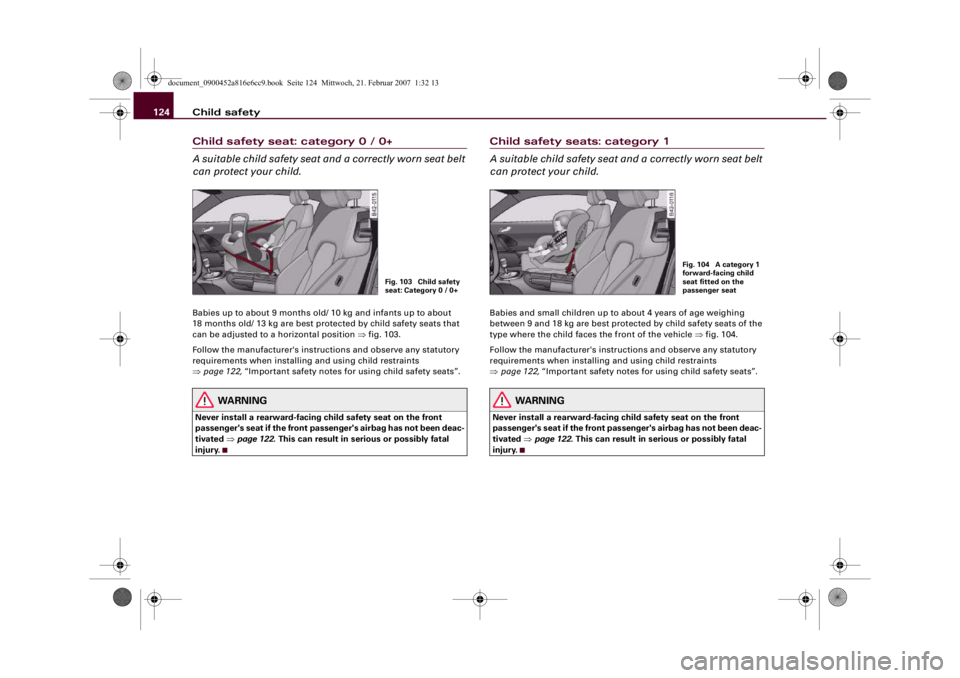
can protect your child.Babies up to about 9 months old/ 10 kg and infants up to about
18 months old/ 13 kg are best protected by child safety seats that
can be adjusted to a horizontal position ⇒fig. 103.
Follow the manufacturer's instructions and observe any statutory
requirements when installing and using child restraints
⇒page 122, “Important safety notes for using child safety seats”.
WARNING
Never install a rearward-facing child safety seat on the front
passenger's seat if the front passenger's airbag has not been deac-
tivated ⇒page 122. This can result in serious or possibly fatal
injury.
Child safety seats: category 1
A suitable child safety seat and a correctly worn seat belt
can protect your child.Babies and small children up to about 4 years of age weighing
between 9 and 18 kg are best protected by child safety seats of the
type where the child faces the front of the vehicle ⇒fig. 104.
Follow the manufacturer's instructions and observe any statutory
requirements when installing and using child restraints
⇒page 122, “Important safety notes for using child safety seats”.
WARNING
Never install a rearward-facing child safety seat on the front
passenger's seat if the front passenger's airbag has not been deac-
tivated ⇒page 122. This can result in serious or possibly fatal
injury.
Fig. 103 Child safety
seat: Category 0 / 0+
Fig. 104 A category 1
forward-facing child
seat fitted on the
passenger seat
document_0900452a816e6cc9.book Seite 124 Mittwoch, 21. Februar 2007 1:32 13
Page 129 of 210
Child safety127
Controls
Safety
Driving tips
General maintenance
Self-help
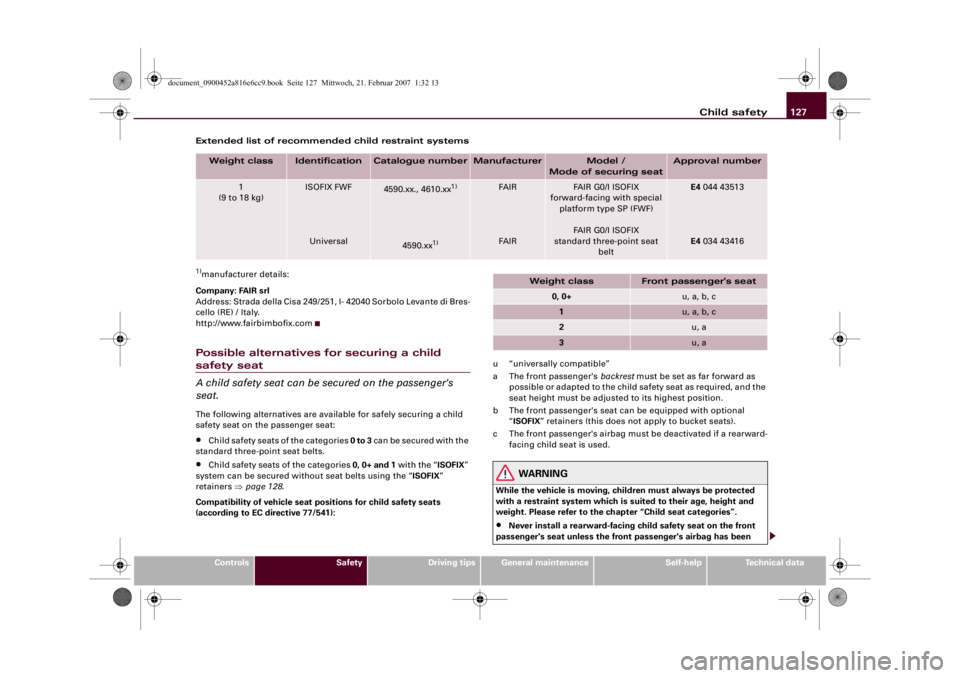
Technical data Extended list of recommended child restraint systems
1)manufacturer details:
Company: FAIR srl
Address: Strada della Cisa 249/251, I- 42040 Sorbolo Levante di Bres-
cello (RE) / Italy.
http://www.fairbimbofix.comPossible alternatives for securing a child safety seat
A child safety seat can be secured on the passenger's
seat.The following alternatives are available for safely securing a child
safety seat on the passenger seat:•
Child safety seats of the categories 0 to 3 can be secured with the
standard three-point seat belts.
•
Child safety seats of the categories 0, 0+ and 1 with the “ISOFIX”
system can be secured without seat belts using the “ISOFIX”
retainers ⇒page 128.
Compatibility of vehicle seat positions for child safety seats
(according to EC directive 77/541):u “universally compatible”
a The front passenger's backrest must be set as far forward as
possible or adapted to the child safety seat as required, and the
seat height must be adjusted to its highest position.
b The front passenger's seat can be equipped with optional
“ISOFIX” retainers (this does not apply to bucket seats).
c The front passenger's airbag must be deactivated if a rearward-
facing child seat is used.
WARNING
While the vehicle is moving, children must always be protected
with a restraint system which is suited to their age, height and
weight. Please refer to the chapter “Child seat categories”.•
Never install a rearward-facing child safety seat on the front
passenger's seat unless the front passenger's airbag has been
Weight class
Identification
Catalogue number
Manufacturer
Model /
Mode of securing seat
Approval number
1
(9 to 18 kg)
ISOFIX FWF
Universal
4590.xx., 4610.xx
1)
4590.xx
1)
FAIR
FAIR
FAIR G0/I ISOFIX
forward-facing with special
platform type SP (FWF)
FAIR G0/I ISOFIX
standard three-point seat
belt
E4 044 43513
E4 034 43416
Weight class
Front passenger's seat
0, 0+
u, a, b, c
1
u, a, b, c
2
u, a
3
u, a
document_0900452a816e6cc9.book Seite 127 Mittwoch, 21. Februar 2007 1:32 13
Page 130 of 210
Child safety 128deactivated. This could result in potentially fatal injuries. Deacti-
vate the passenger's airbag. Please refer to the chapter “Deacti-
vating airbags”.•
Note the important information and warnings concerning the
use of child safety seats found in the chapter “Important safety
notes when using child safety seats” and the installation instruc-
tions provided by the manufacturer of the child safety seat.
Applies to vehicles: with ISOFIX system“ISOFIX” child seat mounting system
Child safety seats with the “ISOFIX” system can be
secured quickly, easily and safely.
When removing or fitting the child safety seat, please be
sure to follow the manufacturer's instructions.
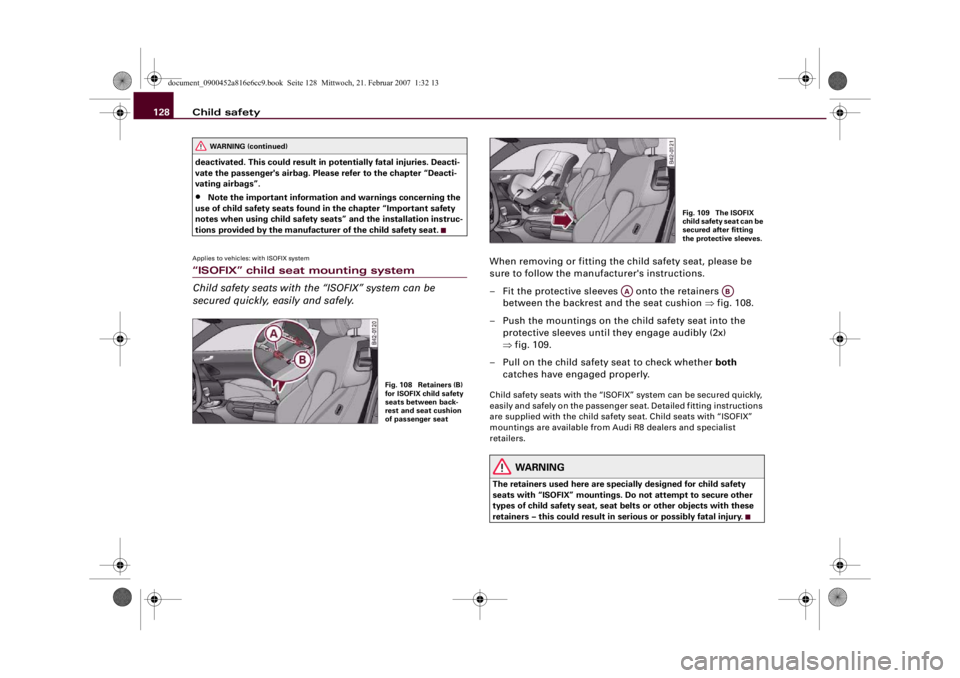
– Fit the protective sleeves onto the retainers
between the backrest and the seat cushion ⇒fig. 108.
– Push the mountings on the child safety seat into the
protective sleeves until they engage audibly (2x)
⇒fig. 109.
– Pull on the child safety seat to check whether both
catches have engaged properly.Child safety seats with the “ISOFIX” system can be secured quickly,
easily and safely on the passenger seat. Detailed fitting instructions
are supplied with the child safety seat. Child seats with “ISOFIX”
mountings are available from Audi R8 dealers and specialist
retailers.
WARNING
The retainers used here are specially designed for child safety
seats with “ISOFIX” mountings. Do not attempt to secure other
types of child safety seat, seat belts or other objects with these
retainers – this could result in serious or possibly fatal injury.
WARNING (continued)
Fig. 108 Retainers (B)
for ISOFIX child safety
seats between back-
rest and seat cushion
of passenger seat
Fig. 109 The ISOFIX
child safety seat can be
secured after fitting
the protective sleeves.
AA
AB
document_0900452a816e6cc9.book Seite 128 Mittwoch, 21. Februar 2007 1:32 13
Page 176 of 210

Accessories and modifications to the vehicle 174Accessories and modifications to the vehicleAccessories, replacement parts and repairsIt is best to consult an authorised Audi R8 dealer before
purchasing accessories and replacement parts or having
any repairs carried out.Your car is designed to offer a high standard of active and passive
safety. For this reason, we recommend that you ask an Audi R8
dealer for advice before fitting accessories or replacement parts.
This is also very important if body repairs are required. Audi R8
dealers have full information on the manufacturer-approved repair
methods and can recommend suitable accessories and spare parts.
They can also give advice regarding official requirements for the
vehicle.
We recommend you to use only Audi accessories and Audi Genuine
parts®. Audi has tested these parts and accessories for suitability,
reliability and safety. Audi R8 dealers have the necessary experience
and facilities to ensure that the parts are installed properly.
Although the market is constantly scrutinised, Audi cannot judge or
assume responsibility for the reliability, safety and suitability of
non-genuine products - even though in some instances, these parts
may have been approved by an officially recognised technical
testing authority or accompanied by an official approval certificate.
Any retro-fitted equipment which has a direct effect on the vehicle
and/or the way it is driven (e.g. cruise control system or electroni-
cally-controlled suspension) must be approved for use in your
vehicle and bear the e mark (the European Union's approval
symbol).
If any additional electrical components are fitted which do not serve
to control the vehicle itself (for instance a refrigerator box, laptop or
ventilator fan, etc.), these must bear the CE mark (manufacturer
conformity declaration in the European Union).
WARNING
Never attach accessories (such as cup holders or telephone
brackets) to the surfaces covering the airbag units or the areas
around the airbags: this could cause injury if the airbag is trig-
gered.
Note
•
Since the Audi R8 has an aluminium body, all servicing, repairs
or other work on the car body must be carried out by an Audi R8
workshop or a qualified workshop working to the specifications of
the Audi factory. This ensures that the necessary repairs or servicing
are performed properly and that only Audi Genuine parts® are
installed on your vehicle. Use of non-genuine replacement parts,
equipment or accessories on your Audi R8, or repair of the vehicle
by unqualified persons, may result in serious damage to your car
(possibly including corrosion).
•
The manufacturer cannot be held liable for damage which occurs
as a result of failure to comply with these stipulations, and such
damage is not covered under warranty.
ModificationsModifications must always be carried out according to
our specifications.Unauthorised modifications to the electronic components or soft-
ware in the vehicle may cause malfunctioning. Due to the way the
electronic components are linked together in networks, other
systems may be affected by the faults. This can seriously impair
safety, lead to excessive wear of components, and also invalidate
the type approval for your vehicle.
document_0900452a816e6cc9.book Seite 174 Mittwoch, 21. Februar 2007 1:32 13
Page 193 of 210
Fuses and bulbs191
Controls
Safety
Driving tips
General maintenance
Self-help
Technical data
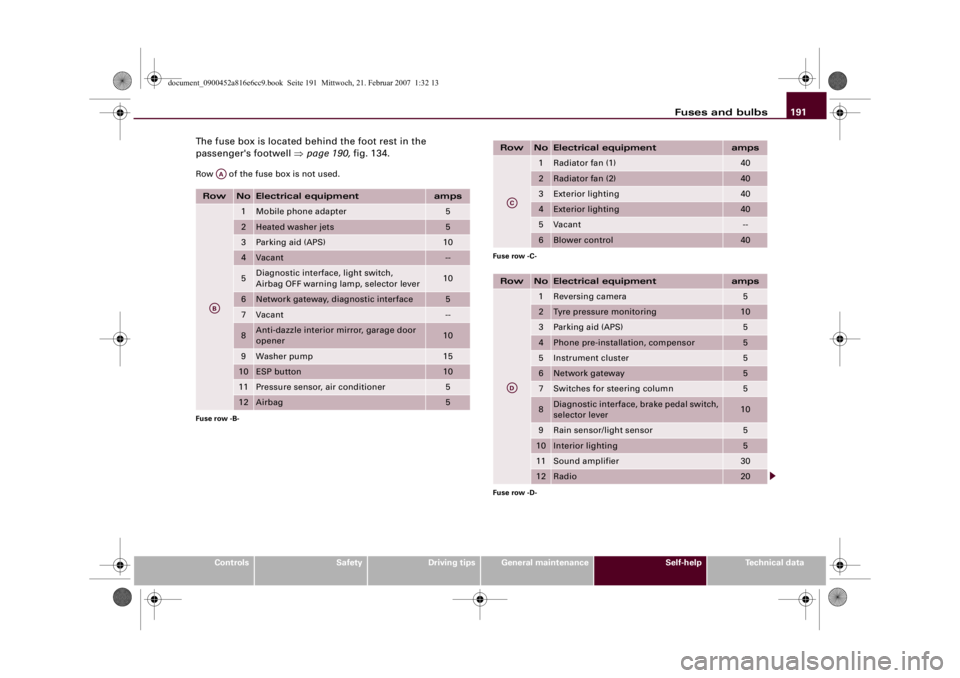
The fuse box is located behind the foot rest in the
passenger's footwell ⇒page 190, fig. 134.Row of the fuse box is not used.Row
No
Electrical equipment
amps
1
Mobile phone adapter
5
2
Heated washer jets
5
3
Parking aid (APS)
10
4
Vacant
--
5
Diagnostic interface, light switch,
Airbag OFF warning lamp, selector lever
10
6
Network gateway, diagnostic interface
5
7
Vacant
--
8
Anti-dazzle interior mirror, garage door
opener
10
9
Washer pump
15
10
ESP button
10
11
Pressure sensor, air conditioner
5
12
Airbag
5
Fuse row -B-
AAAB
Row
No
Electrical equipment
amps
1
Radiator fan (1)
40
2
Radiator fan (2)
40
3
Exterior lighting
40
4
Exterior lighting
40
5
Vacant
--
6
Blower control
40
Fuse row -C-Row
No
Electrical equipment
amps
1
Reversing camera
5
2
Tyre pressure monitoring
10
3
Parking aid (APS)
5
4
Phone pre-installation, compensor
5
5
Instrument cluster
5
6
Network gateway
5
7
Switches for steering column
5
8
Diagnostic interface, brake pedal switch,
selector lever
10
9
Rain sensor/light sensor
5
10
Interior lighting
5
11
Sound amplifier
30
12
Radio
20
Fuse row -D-
ACAD
document_0900452a816e6cc9.book Seite 191 Mittwoch, 21. Februar 2007 1:32 13
Page 204 of 210
Index 202AABS
SeeAnti-lock brake system . . . . . . . . 132
AC mode
Air conditioner . . . . . . . . . . . . . . . . . . . 79
Acceleration figures
SeePerformance, weights and
dimensions . . . . . . . . . . . . . . . . . . . . 198
Accessories . . . . . . . . . . . . . . . . . . . . . . . . 174
acoustic parking system
SeeParking aid . . . . . . . . . . . . . . . . . . . 85
Air conditioner . . . . . . . . . . . . . . . . . . . . . . 75
AC mode . . . . . . . . . . . . . . . . . . . . . . . . . 79
Air distribution . . . . . . . . . . . . . . . . . . . 77
Air recirculation mode . . . . . . . . . . . . . 78
Automatic mode . . . . . . . . . . . . . . . . . . 78
Blower . . . . . . . . . . . . . . . . . . . . . . . . . . 77
Controls . . . . . . . . . . . . . . . . . . . . . . . . . 75
Defrosting . . . . . . . . . . . . . . . . . . . . . . . 78
Dust filter . . . . . . . . . . . . . . . . . . . . . . . . 75
Heating . . . . . . . . . . . . . . . . . . . . . . . . . . 75
Pollen filter . . . . . . . . . . . . . . . . . . . . . . 75
Rear window heating . . . . . . . . . . . . . . 79
Seat heating . . . . . . . . . . . . . . . . . . . . . 80
Switching on/off . . . . . . . . . . . . . . . . . . 77
Temperature . . . . . . . . . . . . . . . . . . . . . 76
Ventilation . . . . . . . . . . . . . . . . . . . . . . . 75
Air distribution
Air conditioner . . . . . . . . . . . . . . . . . . . 77
Air recirculation mode
Vehicles with air conditioner . . . . . . . . 78Airbag . . . . . . . . . . . . . . . . . . . . . . . . . . . . 115
Deactivating . . . . . . . . . . . . . . . . . . . . . 120
Front airbags . . . . . . . . . . . . . . . . . . . . 116
Key-operated switch for front passenger's
airbag . . . . . . . . . . . . . . . . . . . . . . . . . 120
Side airbags . . . . . . . . . . . . . . . . . . . . . 118
Triggering . . . . . . . . . . . . . . . . . . . . . . 116
Warning lamp . . . . . . . . . . . . . . . . . . . . 17
Alterations to the vehicle . . . . . . . . . . . . . 174
Alternator . . . . . . . . . . . . . . . . . . . . . . . . . . 18
Warning lamp . . . . . . . . . . . . . . . . . . . . 18
Anti-dazzle interior mirror . . . . . . . . . . . . . 63
Anti-freeze additive . . . . . . . . . . . . . . . . . 159
Anti-knock properties of petrol . . . . . . . . 152
Anti-lock brake system . . . . . . . . . . . . . . . 132
Warning lamp . . . . . . . . . . . . . . . . . . . . 19
Anti-theft alarm . . . . . . . . . . . . . . . . . . . . . . 48
Interior monitor . . . . . . . . . . . . . . . . . . . 49
Tow-away protection . . . . . . . . . . . . . . 49
Anti-theft wheel bolts . . . . . . . . . . . . . . . . 182
Ashtray . . . . . . . . . . . . . . . . . . . . . . . . . . . . . 72
Audi magnetic ride . . . . . . . . . . . . . . . . 16, 88
Description . . . . . . . . . . . . . . . . . . . . . . . 88
Warning lamp . . . . . . . . . . . . . . . . . . . . 16
Audi parking system . . . . . . . . . . . . . . . . . 85
Automatic car washes
SeeWashing . . . . . . . . . . . . . . . . . . . . 144
Automatic headlight control . . . . . . . . . . . 63
Automatic headlights . . . . . . . . . . . . . . . . . 53
Defective . . . . . . . . . . . . . . . . . . . . . . . . 38
Average fuel consumption . . . . . . . . . . . . 22
Average speed . . . . . . . . . . . . . . . . . . . . . . 22Axle weights
SeePerformance, weights and
dimensions . . . . . . . . . . . . . . . . . . . . 198
BBattery . . . . . . . . . . . . . . . . . . . . . . . . . . . . 162
Charging . . . . . . . . . . . . . . . . . . . . . . . . 164
Disconnecting and connecting . . . . . 162
Long periods of non-use . . . . . . . . . . 162
Replacing . . . . . . . . . . . . . . . . . . . . . . . 162
Testing . . . . . . . . . . . . . . . . . . . . . . . . . 162
Winter conditions . . . . . . . . . . . . . . . . 162
Winter operation . . . . . . . . . . . . . . . . . 162
Battery voltage . . . . . . . . . . . . . . . . . . . . . . 37
Belt tensioners . . . . . . . . . . . . . . . . . . . . . 114
Bioethanol fuel . . . . . . . . . . . . . . . . . . . . . 152
Blower . . . . . . . . . . . . . . . . . . . . . . . . . . . . . 77
Brake system
Brake fluid . . . . . . . . . . . . . . . . . . . . . . 161
Brake light failure . . . . . . . . . . . . . . . . . 38
Brake pads worn . . . . . . . . . . . . . . . . . . 37
Brake servo . . . . . . . . . . . . . . . . . . . . . . 134
Brakes . . . . . . . . . . . . . . . . . . . . . . . . . . 134
Malfunction . . . . . . . . . . . . . . . . . . . . . . 35
Warning lamp . . . . . . . . . . . . . . . . . . . . 18
Bulb monitor . . . . . . . . . . . . . . . . . . . . . . . . 37
Bulbs . . . . . . . . . . . . . . . . . . . . . . . . . . . . . 193
Business equipment . . . . . . . . . . . . . . . . . 175CCapacities . . . . . . . . . . . . . . . . . . . . . . . . . 199
document_0900452a816e6cc9.book Seite 202 Mittwoch, 21. Februar 2007 1:32 13