engine AUDI R8 2007 Repair Manual
[x] Cancel search | Manufacturer: AUDI, Model Year: 2007, Model line: R8, Model: AUDI R8 2007Pages: 210, PDF Size: 8.1 MB
Page 161 of 210
Checking and topping up fluids159
Controls
Safety
Driving tips
General maintenance
Self-help
Technical data
•
No additives should be used with engine oil. Any damage caused
by the use of such additives would not be covered by the factory
warranty.For the sake of the environment
•
Never pour oil down drains or into the ground.
•
Always observe statutory requirements when disposing of
empty oil canisters.
Cooling systemCoolant
The purpose of the coolant is to carry heat away from the
engine. The correct amount of anti-freeze is important to
prevent the cooling system from freezing in winter.The cooling system is filled for life at the factory, so the coolant does
not need to be changed. The coolant consists of a mixture of water
and anti-freeze additive G12++. This is a glycol-based anti-freeze
with anti-corrosion additives.
Anti-freeze additive
The amount of anti-freeze additive required depends on the temper-
atures to be expected in the winter season. If the anti-freeze concen-
tration is too low the coolant can freeze, resulting in failure of the
cooling system and heater.
The cooling system is filled at the factory with the correct amount of
anti-freeze for the country concerned.
In most cases the mixture consists of 60% water and 40% additive.
This mixture gives the required anti-freeze protection at tempera-
tures down to – 25 °C and protects the alloy parts of the cooling
system against corrosion. It also prevents scaling and raises the
boiling point of the coolant.Countries with warm climate
The coolant concentration must not be reduced by adding plain
water, even in the summer or in warm climates. The concentration
of the anti-freeze additive must always be at least 40%.
Countries with cold climate
If greater anti-freeze protection is required in very cold climates, the
proportion of the anti-freeze additive G12++ can be increased. A
concentration of 60% offers protection down to about -40 °C. The
concentration of the anti-freeze additive must not be more than
60%, otherwise this would reduce the anti-freeze protection. In addi-
tion, the cooling effect will be adversely affected.
Vehicles for export to countries with a cold climate (such as Sweden,
Norway and Finland) are supplied with antifreeze protection down
to about -35 °C. The concentration of the antifreeze additive for
these countries should always be at least 50%.
Caution
•
It is advisable to have the cooling system checked before the
winter season to make sure that the anti-freeze concentration is
adequate for the conditions to be expected. This applies particularly
if you intend to take the car into a colder climate zone. If necessary,
have the anti-freeze concentration increased to 50 - 60% as required.
•
Use only antifreeze additive G12++, an additive meeting the
specification “TL-VW 774G”. Other additives may give considerably
inferior corrosion protection. The resulting corrosion in the cooling
system can lead to a loss of coolant, causing serious damage to the
engine.
•
The coolant additive G12++ must not be mixed with any other
additives.
document_0900452a816e6cc9.book Seite 159 Mittwoch, 21. Februar 2007 1:32 13
Page 162 of 210
Checking and topping up fluids 160Checking coolant level
Be careful when checking the coolant.– Switch off the ignition.
– Cover the cap on the expansion tank with a cloth, and
carefully unscrew the cap anti-clockwise ⇒.
– Read off the coolant level on the inside of the radiator
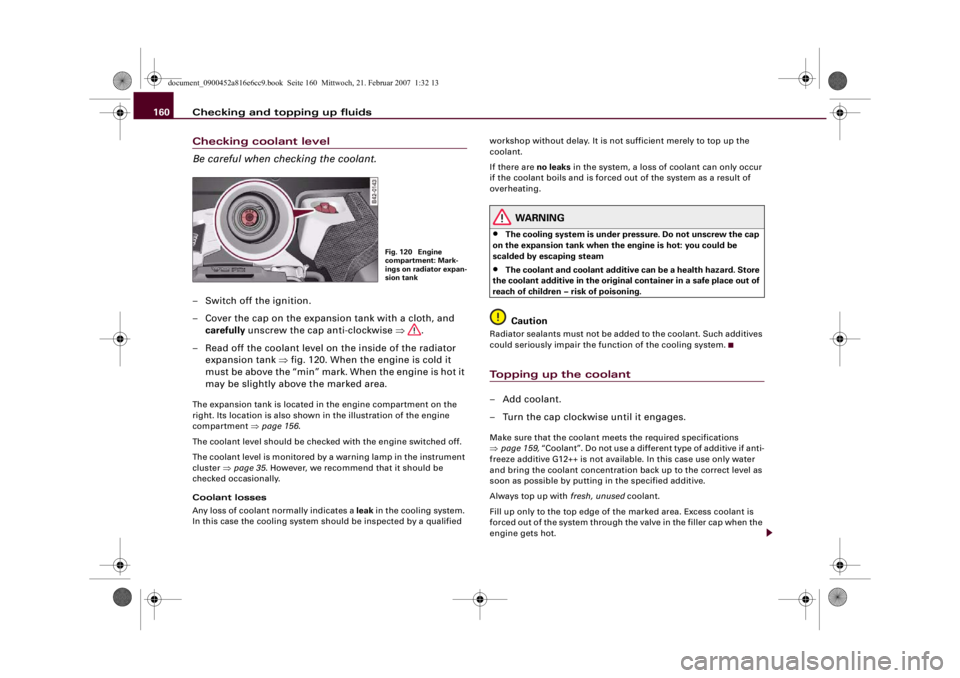
expansion tank ⇒fig. 120. When the engine is cold it
must be above the “min” mark. When the engine is hot it
may be slightly above the marked area.The expansion tank is located in the engine compartment on the
right. Its location is also shown in the illustration of the engine
compartment ⇒page 156.
The coolant level should be checked with the engine switched off.
The coolant level is monitored by a warning lamp in the instrument
cluster ⇒page 35. However, we recommend that it should be
checked occasionally.
Coolant losses
Any loss of coolant normally indicates a leak in the cooling system.
In this case the cooling system should be inspected by a qualified workshop without delay. It is not sufficient merely to top up the
coolant.
If there are no leaks in the system, a loss of coolant can only occur
if the coolant boils and is forced out of the system as a result of
overheating.
WARNING
•
The cooling system is under pressure. Do not unscrew the cap
on the expansion tank when the engine is hot: you could be
scalded by escaping steam
•
The coolant and coolant additive can be a health hazard. Store
the coolant additive in the original container in a safe place out of
reach of children – risk of poisoning.Caution
Radiator sealants must not be added to the coolant. Such additives
could seriously impair the function of the cooling system.Topping up the coolant– Add coolant.
– Turn the cap clockwise until it engages.Make sure that the coolant meets the required specifications
⇒page 159, “Coolant”. Do not use a different type of additive if anti-
freeze additive G12++ is not available. In this case use only water
and bring the coolant concentration back up to the correct level as
soon as possible by putting in the specified additive.
Always top up with fresh, unused coolant.
Fill up only to the top edge of the marked area. Excess coolant is
forced out of the system through the valve in the filler cap when the
engine gets hot.
Fig. 120 Engine
compartment: Mark-
ings on radiator expan-
sion tank
document_0900452a816e6cc9.book Seite 160 Mittwoch, 21. Februar 2007 1:32 13
Page 163 of 210
Checking and topping up fluids161
Controls
Safety
Driving tips
General maintenance
Self-help
Technical data If a lot of coolant has been lost, wait for the engine to cool down
before putting in cold coolant. Failure to do so could result in
serious engine damage.
WARNING
The coolant and coolant additive can be a health hazard. Store the
coolant additive in the original container in a safe place out of
reach of children – risk of poisoning.
For the sake of the environment
Drained off coolant should not be used again. Drain off the used
coolant into a suitable container and dispose of it in the proper
manner (observe environmental regulations).Radiator fan
The radiator fan can start running spontaneously.The radiator fan is powered electrically. The speed of the fan is
varied according to the temperature registered by a thermostat.
The radiator fan or auxiliary fan can continue to run for as long as
10 minutes after stopping the engine – even after the ignition is
switched off. It may also start running suddenly after a while if•
residual heat raises the coolant temperature, or
•
the hot engine compartment is additionally heated up by the
sun.
Brake fluidNote
When required, the brake fluid should be changed by a
competent mechanic with the proper equipment.Brake fluid gradually absorbs moisture from the atmosphere. If the
water content in the brake fluid is too high, this may cause corrosion
in the brake system over time. In addition, the boiling point of the
brake fluid will be considerably reduced. This could adversely affect
the braking ability in certain circumstances.
For this reason the brake fluid must be changed periodically.
Your vehicle's Service Schedule will tell you when the brake fluid has
to be changed.
The brake fluid is replaced by your Audi R8 dealer as part of the
Inspection Service. They are familiar with the procedure and have
the necessary special tools and spare parts as well as the proper
facilities for disposing of the old fluid.
Use only the genuine brake fluid specified by the factory Qualified
workshops know that the brake fluid “DOT 4” is approved by Audi.
The brake fluid must be fresh and unused.
WARNING
Heavy use of the brakes may cause a vapour lock if the brake fluid
is left in the system for too long. This would seriously affect the
efficiency of the brakes and the safety of the car – risk of
accident.
document_0900452a816e6cc9.book Seite 161 Mittwoch, 21. Februar 2007 1:32 13
Page 165 of 210
Checking and topping up fluids163
Controls
Safety
Driving tips
General maintenance
Self-help
Technical data removed from the vehicle cannot tip over. Otherwise, sulphuric acid
could escape.
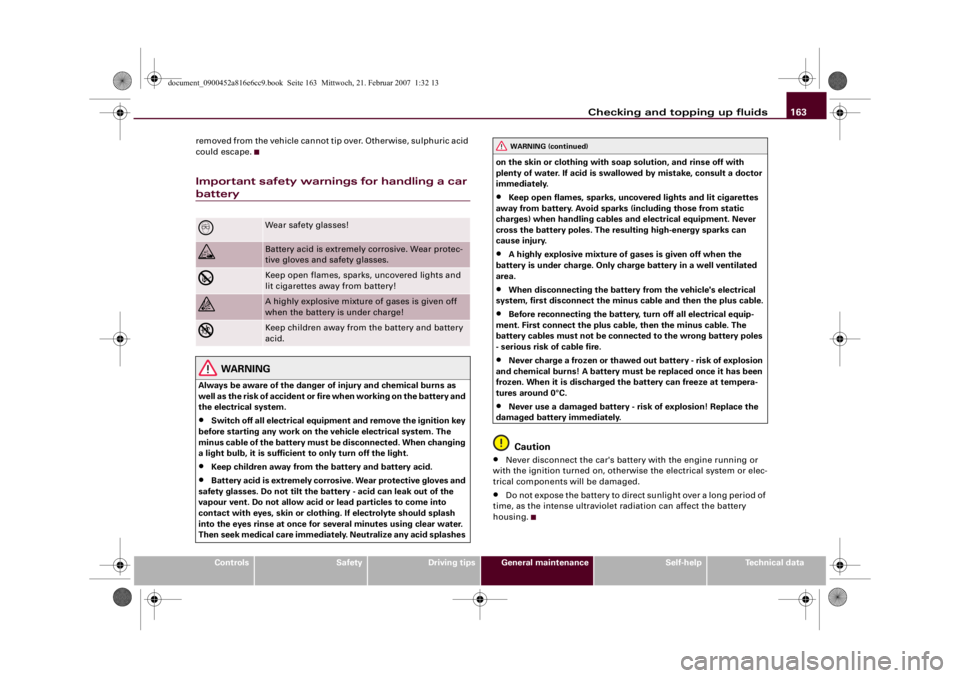
Important safety warnings for handling a car battery
WARNING
Always be aware of the danger of injury and chemical burns as
well as the risk of accident or fire when working on the battery and
the electrical system.•
Switch off all electrical equipment and remove the ignition key
before starting any work on the vehicle electrical system. The
minus cable of the battery must be disconnected. When changing
a light bulb, it is sufficient to only turn off the light.
•
Keep children away from the battery and battery acid.
•
Battery acid is extremely corrosive. Wear protective gloves and
safety glasses. Do not tilt the battery - acid can leak out of the
vapour vent. Do not allow acid or lead particles to come into
contact with eyes, skin or clothing. If electrolyte should splash
into the eyes rinse at once for several minutes using clear water.
Then seek medical care immediately. Neutralize any acid splashes on the skin or clothing with soap solution, and rinse off with
plenty of water. If acid is swallowed by mistake, consult a doctor
immediately.
•
Keep open flames, sparks, uncovered lights and lit cigarettes
away from battery. Avoid sparks (including those from static
charges) when handling cables and electrical equipment. Never
cross the battery poles. The resulting high-energy sparks can
cause injury.
•
A highly explosive mixture of gases is given off when the
battery is under charge. Only charge battery in a well ventilated
area.
•
When disconnecting the battery from the vehicle's electrical
system, first disconnect the minus cable and then the plus cable.
•
Before reconnecting the battery, turn off all electrical equip-
ment. First connect the plus cable, then the minus cable. The
battery cables must not be connected to the wrong battery poles
- serious risk of cable fire.
•
Never charge a frozen or thawed out battery - risk of explosion
and chemical burns! A battery must be replaced once it has been
frozen. When it is discharged the battery can freeze at tempera-
tures around 0°C.
•
Never use a damaged battery - risk of explosion! Replace the
damaged battery immediately.Caution
•
Never disconnect the car's battery with the engine running or
with the ignition turned on, otherwise the electrical system or elec-
trical components will be damaged.
•
Do not expose the battery to direct sunlight over a long period of
time, as the intense ultraviolet radiation can affect the battery
housing.
Wear safety glasses!
Battery acid is extremely corrosive. Wear protec-
tive gloves and safety glasses.
Keep open flames, sparks, uncovered lights and
lit cigarettes away from battery!
A highly explosive mixture of gases is given off
when the battery is under charge!
Keep children away from the battery and battery
acid.
WARNING (continued)
document_0900452a816e6cc9.book Seite 163 Mittwoch, 21. Februar 2007 1:32 13
Page 180 of 210
Self-help 178Self-helpBreakdown kitThe breakdown kit consists of a warning triangle, first-aid
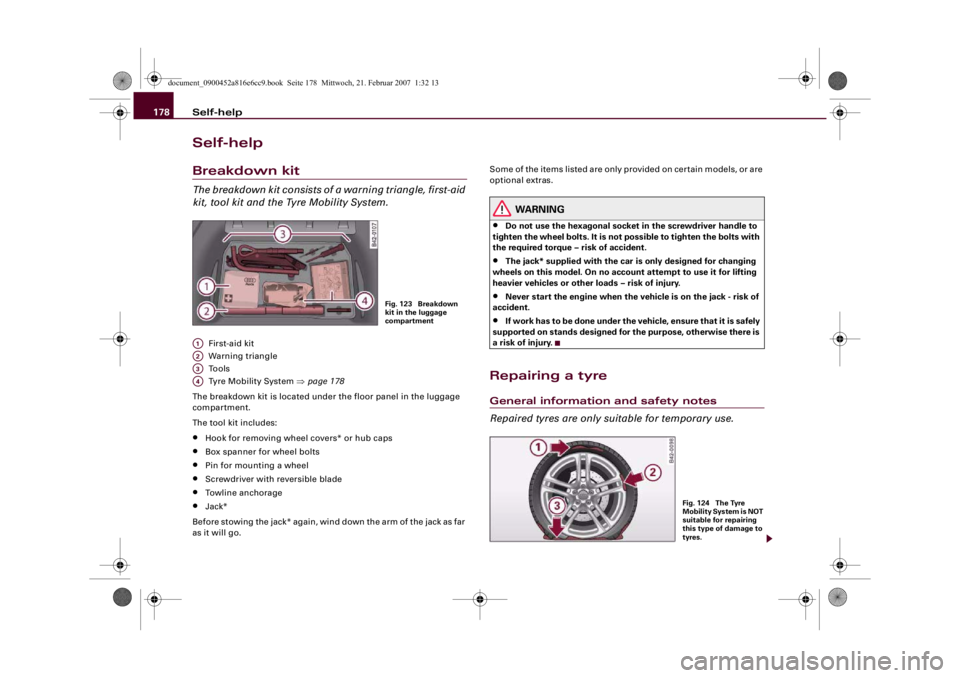
kit, tool kit and the Tyre Mobility System.
First-aid kit
Warning triangle
Tools
Tyre Mobility System ⇒page 178
The breakdown kit is located under the floor panel in the luggage
compartment.
The tool kit includes:
•
Hook for removing wheel covers* or hub caps
•
Box spanner for wheel bolts
•
Pin for mounting a wheel
•
Screwdriver with reversible blade
•
Towline anchorage
•
Jack*
Before stowing the jack* again, wind down the arm of the jack as far
as it will go.Some of the items listed are only provided on certain models, or are
optional extras.
WARNING
•
Do not use the hexagonal socket in the screwdriver handle to
tighten the wheel bolts. It is not possible to tighten the bolts with
the required torque – risk of accident.
•
The jack* supplied with the car is only designed for changing
wheels on this model. On no account attempt to use it for lifting
heavier vehicles or other loads – risk of injury.
•
Never start the engine when the vehicle is on the jack - risk of
accident.
•
If work has to be done under the vehicle, ensure that it is safely
supported on stands designed for the purpose, otherwise there is
a risk of injury.
Repairing a tyreGeneral information and safety notes
Repaired tyres are only suitable for temporary use.
Fig. 123 Breakdown
kit in the luggage
compartment
A1A2A3A4
Fig. 124 The Tyre
Mobility System is NOT
suitable for repairing
this type of damage to
tyres.
document_0900452a816e6cc9.book Seite 178 Mittwoch, 21. Februar 2007 1:32 13
Page 187 of 210
Self-help185
Controls
Safety
Driving tips
General maintenance
Self-help
Technical data
Tightening wheel bolts– Fit the box spanner as far as it will go over the wheel
bolt
5).
– Grip the box spanner as close to the end as possible and
tighten the bolt firmly by turning clockwise.
Have the tightening torque of the wheel bolts checked as soon as
possible with a torque wrench. The correct tightening torque is
120 Nm.
The inflation pressure must be checked as soon as possible.
Put the tools and jack back in the luggage compartment.
WARNING
The wheel bolts must not be loosened – this would cause a safety
risk.
Note
•
Do not use the hexagonal socket in the screwdriver handle to
loosen or tighten the wheel bolts.
•
If you notice that the wheel bolts are corroded and difficult to
turn, they must be replaced before having the tightening torque
checked.
•
In the interest of safety, drive at moderate speeds until the tight-
ening torque of the wheel bolts has been checked.
Jump-startingBefore starting the engine
If necessary, the engine can be started by connecting it to
the battery of another vehicle.If the engine should ever fail to start because of a discharged
battery, the battery can be connected to the battery of another
vehicle to start the engine. Suitable jump leads are required.
Both batteries must be rated at 12 Volts. The capacity (Ah) of the
booster battery should not be significantly lower than that of the
discharged battery.
Jump leads
The jump leads must be heavy enough to carry the starter current.
Refer to the details given by the manufacturer.
Only use jump leads with insulated battery clamps.
Positive cable – usually red
Negative cable – usually black
WARNING
•
When it is discharged the battery can freeze at temperatures
around 0°C. A frozen battery must first be thawed out before
connecting the jump leads, as it could otherwise explode.
•
Please note the safety warnings referring to working in the
engine compartment ⇒page 155.Note
•
There must be no contact between the two vehicles as otherwise
current could flow as soon as the positive terminals are connected.
•
The discharged battery must be properly connected to the
vehicle's electrical system.
5)An adapter is required to tighten the anti-theft wheel bolts ⇒page 182.
document_0900452a816e6cc9.book Seite 185 Mittwoch, 21. Februar 2007 1:32 13
Page 188 of 210
Self-help 186•
Switch off the car telephone if necessary. Details will be given in
the manufacturer's instructions for the car telephone.
Starting the engine
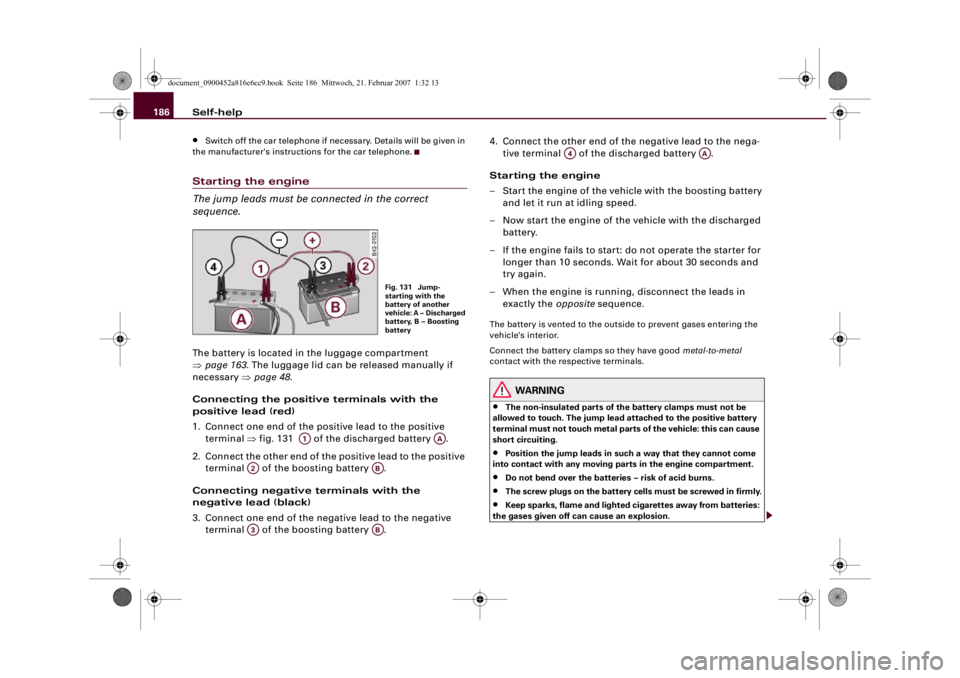
The jump leads must be connected in the correct
sequence.The battery is located in the luggage compartment
⇒page 163. The luggage lid can be released manually if
necessary ⇒page 48.
Connecting the positive terminals with the
positive lead (red)
1. Connect one end of the positive lead to the positive
terminal ⇒fig. 131 of the discharged battery .
2. Connect the other end of the positive lead to the positive
terminal of the boosting battery .
Connecting negative terminals with the
negative lead (black)
3. Connect one end of the negative lead to the negative
terminal of the boosting battery .4. Connect the other end of the negative lead to the nega-
tive terminal of the discharged battery .
Starting the engine
– Start the engine of the vehicle with the boosting battery
and let it run at idling speed.
– Now start the engine of the vehicle with the discharged
battery.
– If the engine fails to start: do not operate the starter for
longer than 10 seconds. Wait for about 30 seconds and
try again.
– When the engine is running, disconnect the leads in
exactly the opposite sequence.
The battery is vented to the outside to prevent gases entering the
vehicle's interior.
Connect the battery clamps so they have good metal-to-metal
contact with the respective terminals.
WARNING
•
The non-insulated parts of the battery clamps must not be
allowed to touch. The jump lead attached to the positive battery
terminal must not touch metal parts of the vehicle: this can cause
short circuiting.
•
Position the jump leads in such a way that they cannot come
into contact with any moving parts in the engine compartment.
•
Do not bend over the batteries – risk of acid burns.
•
The screw plugs on the battery cells must be screwed in firmly.
•
Keep sparks, flame and lighted cigarettes away from batteries:
the gases given off can cause an explosion.
Fig. 131 Jump-
starting with the
battery of another
vehicle: A – Discharged
battery, B – Boosting
battery
A1
AA
A2
AB
A3
AB
A4
AA
document_0900452a816e6cc9.book Seite 186 Mittwoch, 21. Februar 2007 1:32 13
Page 189 of 210
Self-help187
Controls
Safety
Driving tips
General maintenance
Self-help
Technical data
Caution
Please note that the described method of connecting the leads is
meant for jump-starting your vehicle. If jump-starting another
vehicle, you should not connect the negative lead (–) to the negative
terminal of the discharged battery ⇒page 186, fig. 131 , but
directly to the engine block or a solid metal part bolted to the engine
block. If the battery of the other vehicle does not have a gas vent,
there is a risk that a mixture of oxygen and hydrogen gas can accu-
mulate and cause an explosion.Tow-starting and towing awayGeneral notes
Points to observe when tow-starting or towing awayIf you use a towrope:
Notes for the driver of the towing vehicle
– The towrope must be taut before driving off.
– Engage the clutch very gently when starting to move
(press the accelerator slowly if you have R tronic).
Notes for the driver of the towed vehicle
– The ignition should be switched on so that the turn
signals, horn, windscreen wipers and washers can be
used. Please ensure that the steering wheel is unlocked
when you switch on the ignition and that it moves freely.
– Put the gear lever in neutral or move the selector lever to
position N.– The brake servo and power steering only work when the
engine is running. Considerably more effort is required
on the brake pedal and steering wheel when the engine
is switched off.
– Ensure that the towrope remains taut at all times when
towing.
Towrope or towbar
It is easier and safer to tow a vehicle with a towbar. You should only
use a towrope if you do not have a towbar.
A towrope should be slightly elastic to reduce the loading on both
vehicles. It is advisable to use a towrope made of synthetic fibre or
similar material.
Attach the towrope or the towbar only to the towing anchorages
provided for this purpose ⇒page 188.
Driving technique
Towing requires some experience – especially when using a
towrope. Both drivers should be familiar with the technique required
for towing. Inexperienced drivers should not attempt to tow-start or
tow away another vehicle.
Do not pull too hard with the towing vehicle and take care to avoid
jerking the towrope. When towing on a loose surface there is always
a risk of overloading and damaging the anchorage points.
Caution
If there is no oil in the gearbox or no lubricant in the automatic
transmission the car may only be towed with the driven wheels
lifted clear of the road, or transported on a special car transporter
or trailer.
Note
•
Note the regulations concerning towing.
A4
document_0900452a816e6cc9.book Seite 187 Mittwoch, 21. Februar 2007 1:32 13
Page 190 of 210
Self-help 188•
The hazard warning lights of both vehicles must normally be
switched on. However, observe any regulations to the contrary.
•
Make sure that the towrope is not twisted, as otherwise the front
towline anchorage on your vehicle could work itself loose.
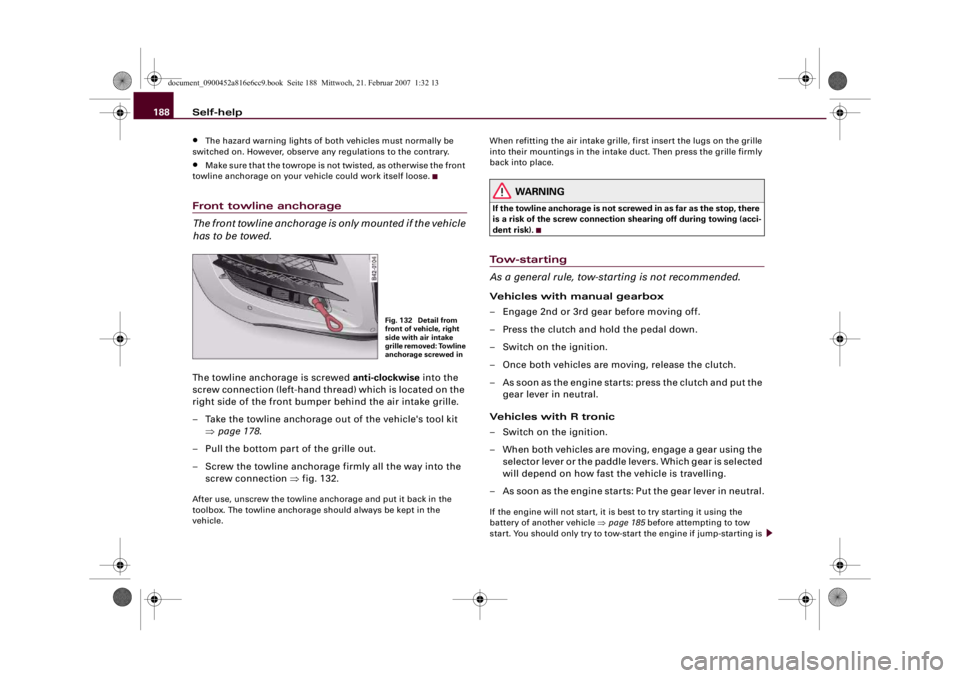
Front towline anchorage
The front towline anchorage is only mounted if the vehicle
has to be towed.The towline anchorage is screwed anti-clockwise into the
screw connection (left-hand thread) which is located on the
right side of the front bumper behind the air intake grille.
– Take the towline anchorage out of the vehicle's tool kit
⇒page 178.
– Pull the bottom part of the grille out.
– Screw the towline anchorage firmly all the way into the
screw connection ⇒fig. 132.After use, unscrew the towline anchorage and put it back in the
toolbox. The towline anchorage should always be kept in the
vehicle.When refitting the air intake grille, first insert the lugs on the grille
into their mountings in the intake duct. Then press the grille firmly
back into place.
WARNING
If the towline anchorage is not screwed in as far as the stop, there
is a risk of the screw connection shearing off during towing (acci-
dent risk).Tow-starting
As a general rule, tow-starting is not recommended.Vehicles with manual gearbox
– Engage 2nd or 3rd gear before moving off.
– Press the clutch and hold the pedal down.
– Switch on the ignition.
– Once both vehicles are moving, release the clutch.
– As soon as the engine starts: press the clutch and put the
gear lever in neutral.
Vehicles with R tronic
– Switch on the ignition.
– When both vehicles are moving, engage a gear using the
selector lever or the paddle levers. Which gear is selected
will depend on how fast the vehicle is travelling.
– As soon as the engine starts: Put the gear lever in neutral.If the engine will not start, it is best to try starting it using the
battery of another vehicle ⇒page 185 before attempting to tow
start. You should only try to tow-start the engine if jump-starting is
Fig. 132 Detail from
front of vehicle, right
side with air intake
grille removed: Towline
anchorage screwed in
document_0900452a816e6cc9.book Seite 188 Mittwoch, 21. Februar 2007 1:32 13
Page 191 of 210
Self-help189
Controls
Safety
Driving tips
General maintenance
Self-help
Technical data not successful. Tow-starting is an attempt to start the engine via the
movement of the wheels.
When tow-starting a vehicle with a petrol engine, do not tow it more
than a short distance, otherwise unburnt fuel can enter the catalytic
converter and cause damage.
WARNING
There is a high risk of accidents when tow-starting, as the towed
vehicle can easily be driven into the towing vehicle.
Caution
When tow-starting the vehicle, do not tow it further than 50 metres:
otherwise the catalytic converter could be damaged.To w i n g a w a y
Certain restrictions must be observed when towing your
vehicle.Please observe the notes ⇒page 187.
The vehicle can be towed with a towbar or towrope in the normal
way, with all four wheels on the ground. When doing so, please note
the following points:•
Make sure the gear lever is in neutral or the selector lever is in
the N position.
•
The vehicle must not be towed faster than 50 km/h.
•
The vehicle must not be towed further than 50 km. The reason
for this is: when the engine is not running, the gearbox oil pump
does not work and the gearbox is not adequately lubricated for
higher speeds or longer distances.
Caution
The vehicle must not be towed with the wheels lifted at either the
front or rear otherwise the gearbox may be damaged.
Note
If it is not possible to tow the vehicle as described above, or if it has
to be towed further than 50 km, it must be transported on a special
car transporter or trailer.
document_0900452a816e6cc9.book Seite 189 Mittwoch, 21. Februar 2007 1:32 13