engine AUDI R8 2007 Workshop Manual
[x] Cancel search | Manufacturer: AUDI, Model Year: 2007, Model line: R8, Model: AUDI R8 2007Pages: 210, PDF Size: 8.1 MB
Page 139 of 210

Intelligent technology137
Controls
Safety
Driving tips
General maintenance
Self-help
Technical data pery roads just because the car still has good acceleration in these
conditions (accident risk).
•
On wet roads bear in mind that the front wheels may start to
“aquaplane” and lose contact with the road if the car is driven too
fast. If this should happen, there will be no sudden increase in
engine speed to warn the driver, as with a front-wheel drive car. So
do not drive too fast in the wet: adjust your speed to suit the
conditions (accident risk).
Dry sump lubrication systemLarge lateral and longitudinal forces act on the engine and vehicle
when a sporty driving style is adopted. A dry sump system ensures
that the engine continues to be supplied with oil and lubricated
optimally under these conditions.
In a “normal” car, the oil is stored in the oil sump and is pumped
from there to the lubrication points inside the engine. The oil then
flows from there back into the oil sump. In extreme situations this
can cause air to be sucked into the oil pump with the result that the
oil pressure is no longer high enough.
In a dry sump lubrication system, the oil is stored in a separate oil
tank instead of the oil sump (which is “dry”). While one pump sends
oil to the engine, a second pump returns the oil from the engine to
the oil tank. The tall and slim shape of the oil tank means that the oil
pressure can be kept constant even in extreme conditions.
In addition, the oil sump is much lower on vehicles with dry sump
lubrication. This means that the engine can also be arranged lower
down for a lower centre of gravity and improved handling.
WARNING (continued)
document_0900452a816e6cc9.book Seite 137 Mittwoch, 21. Februar 2007 1:32 13
Page 140 of 210

Your vehicle and the environment 138Your vehicle and the environmentRunning inA new vehicle should be run in over a distance of 2,500 km. During
the first 1,000 km do not use full throttle and do not exceed an
engine speed of 6,000 rpm. From 1,000 to 2,000 km you should also
avoid using full throttle. From 2,000 to 2,500 km you can then
increase engine speed gradually and briefly to 8,250 rpm.
During its first few hours of running, the internal friction in the
engine is greater than later on when all the moving parts have
bedded down.
How the vehicle is driven for the first 2,500 km also influences the
engine quality. After the first 2,500 km you should continue driving
at moderate engine speeds, in particular when the engine is cold.
This helps to reduce wear and tear on the engine and increases the
potential mileage which can be covered by the engine.
You should also avoid driving with the engine speed too low.
Change down to a lower gear when the engine no longer runs
“smoothly”. Excessively high engine speeds are prevented by an
automatic rev limiter.Emission control systemsThe vehicle must only be used with unleaded petrol, otherwise the
catalytic converter will be destroyed.
Never run the tank completely dry. The irregular fuel supply can
cause misfiring, which would allow unburnt fuel to enter the
exhaust system, which could cause overheating and damage the
catalytic converter.
WARNING
•
Because of the high temperatures which can occur in the emis-
sion control system, do not park the vehicle where the exhaust
can come into contact with flammable materials under the car
(e.g. on grass or at the forest edge). - Fire hazard!
•
Do not apply any underseal agents in the area around the
exhaust system - fire hazard!
Driving abroadUnleaded petrol
A car with catalytic converter must not be run with leaded petrol
⇒page 138. Before driving abroad make sure that unleaded petrol
is available there.
Changing over headlight dip settings
The asymmetric low beams of the headlights are designed to light
up the near side of the road more intensely. If you drive in a country
where traffic drives on the opposite side of the road to the home
country, this will dazzle oncoming traffic.
The headlight dip settings must be changed to avoid dazzling
oncoming traffic. For safety reasons, you should have the dip
settings changed by a qualified workshop.
For further information about changing the dip settings on xenon*
headlights, please contact your Audi R8 dealer or other qualified
workshop.
document_0900452a816e6cc9.book Seite 138 Mittwoch, 21. Februar 2007 1:32 13
Page 141 of 210

Your vehicle and the environment139
Controls
Safety
Driving tips
General maintenance
Self-help
Technical data
Sporty drivingLetting the engine warm up and cool downYou can reduce the amount of wear and tear on your vehicle during
a sporty driving session simply by adopting a more restrained
driving style while the engine is warming up and cooling down.
You should allow the engine to warm up by keeping the engine
speed below 7000 rpm until the engine oil reaches at least 90 °C. In
addition, the tyres will not develop their full grip potential until they
have had a chance to warm up on the road.
Even though the engine continues to be cooled after you switch it
off, it is particularly important to give it time to cool down before
parking. The engine, brakes, exhaust system and gearbox will all
reach very high temperatures when you adopt a sporty driving style.
Before you park the vehicle, allow it to cool down to normal temper-
ature by driving at moderate rpm speeds for several miles.Driving on a racing circuitBefore you take your car out on a racing circuit, please ensure that
it is in perfect condition. You should check the tyre tread and brake
pads for wear. It's also a good idea to increase the tyre pressure by
0.3 bar.
The oil consumption may be slightly higher than “normal” when
driving on a racing circuit ⇒page 157.
You should always check your vehicle after driving hard. Are the
brake pads ok? Do you notice any problems with the tyres (e.g. tread
worn, blistering, etc.)? Are the air intakes free of leaves and
deposits? Is the oil level ok?
Your Audi R8 dealer will be glad to carry out an inspection before
and after you use the car on a racing circuit.
Note
•
Some racing circuits (e.g. with banked curves) can affect the
behaviour of the ESP.
•
Driving the car on a racing circuit places a heavy load on all parts
of the vehicle. This can result in increased wear and tear.
Environmental compatibilityEnvironmental protection is a top priority in the design, choice of
materials and production of your new Audi. Particular importance
has been attached to the following aspects:
Design measures for economical recycling•
Joints and connections designed for ease of dismantling
•
Modular construction to facilitate dismantling
•
Increased use of single-grade materials
•
Plastic parts and elastomers are labelled in accordance with ISO
1043, ISO 11469 and ISO 1629
Choice of materials
•
Nearly all materials used can be recycled
•
Similar types of plastics grouped together for easy recycling
•
Recycled materials used in manufacture
•
Reduced vapour emissions from plastics
•
CFC-free refrigerant in air conditioner
Compliance with the laws prohibiting the use of:
•
Cadmium
•
Asbestos
•
Lead
•
Mercury
•
Chrome VI
document_0900452a816e6cc9.book Seite 139 Mittwoch, 21. Februar 2007 1:32 13
Page 149 of 210
Care of vehicle and cleaning147
Controls
Safety
Driving tips
General maintenance
Self-help
Technical data
•
The heating element for the rear window is located on the inner
side of the window. To avoid damaging the heating element, do not
put stickers on the inner side of the window.
•
Never use warm or hot water to remove snow and ice from
windows and mirrors. This could cause the glass to crack!
Rubber seals (weatherstrips)The weatherstrips on the doors, windows, engine lid and luggage
lid will remain pliable and last longer if they are occasionally treated
with a suitable care product (for example silicone spray). This will
also prevent premature ageing and leaks. The doors will be easier to
open as well. If they are kept pliable, the door seals will be less likely
to freeze up in the winter.WheelsThe wheels require regular attention to preserve their appearance.
It is important to remove road salt and brake dust by washing the
wheels at regular intervals, otherwise the finish will be impaired.
After washing, the wheels should only be cleaned with an "acid-
free" cleaning agent for alloy wheels. This is available from Audi R8
dealers and specialist retailers. Never leave the cleaning agent on
the rims for any longer than specified in the instructions before
rinsing it off. If the wheel cleaner fluid contains acid it can attack the
surfaces of the wheel bolts.
Car polish or other abrasive agents should not be used. If the
protective paint coating is damaged by stone chips etc., the
damaged area should be touched up immediately.
WARNING
Please note when cleaning the wheels that water, ice and road salt
can impair the effectiveness of the brakes – this can cause an
accident.Care of interiorPlastic parts and leatherettePlastic parts and leatherette can be cleaned with a damp cloth. If
this is not sufficient, plastic parts and leatherette should only be
treated with a special solvent-free plastic cleaner.Applies to vehicles: with carbon partsCarbon par tsThe carbon parts on your vehicle have a painted surface. They do
not need any special care and are cleaned just like plastic parts
⇒page 147.Textile covers and trim partsTextile covers and trim parts (e.g. seats, door trim) should be
cleaned regularly with a vacuum cleaner. This will remove surface
dirt which could otherwise be rubbed into the textile material
during use. Do not use steam cleaners, as the steam could carry the
dirt deeper into the textile material.
Normal cleaning
We recommend that you use a soft sponge or lint-free, micro-fibre
cloth for normal cleaning. Only use brushes on floor coverings and
mats, as other textile surfaces could become damaged.
document_0900452a816e6cc9.book Seite 147 Mittwoch, 21. Februar 2007 1:32 13
Page 154 of 210
Fuel and filling the tank 152Fuel and filling the tankPetrolPetrol grade
The correct grade of petrol is listed inside the fuel tank
flap.The vehicle is equipped with a catalytic converter and must only be
run on unleaded petrol. Unleaded petrol must comply with the
European EN 228 standard. The petrol grades have different octane
ratings (RON). If, in exceptional circumstances, the correct octane
rating is not available, please note the following:
Your engine normally requires Super Plus unleaded petrol (98 RON).
Premium unleaded fuel with 95 RON can also be used. This can,
however, result in a slight loss of power under certain driving condi-
tions. If premium unleaded petrol is not available, the engine can be
run on regular unleaded petrol with 91 RON as an emergency
measure. In this case only use moderate engine speeds and a light
throttle. Avoid using full throttle. Fill up with premium or Super Plus
petrol as soon as possible.
Caution
•
Petrol complying with the EN 228 standard can contain small
quantities of ethanol. However, “bioethanol fuels”, which are
retailed under various different names such as E50 and E85, and
which contain a large proportion of ethanol, must not be put into
the vehicle, as this would damage the fuel system.
•
Even one tankful of leaded fuel would permanently impair the
efficiency of the catalytic converter.
•
High engine speed and full throttle can damage the engine when
using petrol with an octane rating lower than the correct grade for
the engine.
Filling the tankFilling the tankUnscrewing the tank cap
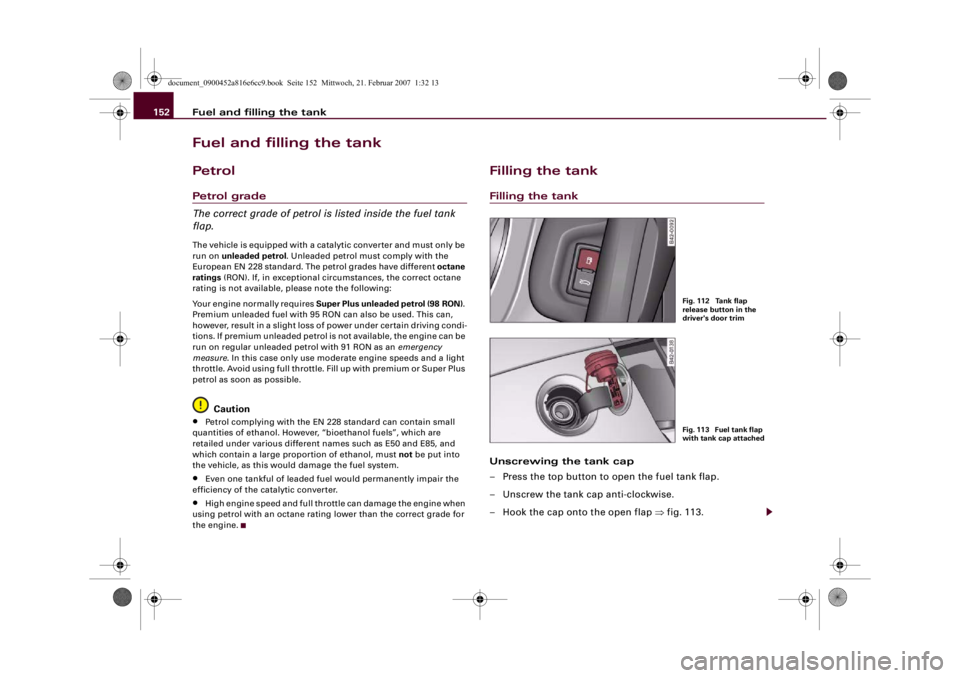
– Press the top button to open the fuel tank flap.
– Unscrew the tank cap anti-clockwise.
– Hook the cap onto the open flap ⇒fig. 113.
Fig. 112 Tank flap
release button in the
driver's door trimFig. 113 Fuel tank flap
with tank cap attached
document_0900452a816e6cc9.book Seite 152 Mittwoch, 21. Februar 2007 1:32 13
Page 156 of 210

Fuel and filling the tank 154Releasing the tank flap manually
The tank flap can be released manually if the tank
unlocking system should fail to operate.– Open the engine lid.
– Pull the plastic cord firmly to the left until the tank flap
springs open.
Fig. 114 Engine
compartment: Manual
release
document_0900452a816e6cc9.book Seite 154 Mittwoch, 21. Februar 2007 1:32 13
Page 157 of 210
Checking and topping up fluids155
Controls
Safety
Driving tips
General maintenance
Self-help
Technical data
Checking and topping up fluidsEngine lidOpening the engine lid
The engine lid is released from inside the vehicle.– Open the driver's door.
– Make sure that the rear spoiler is retracted ⇒page 134.
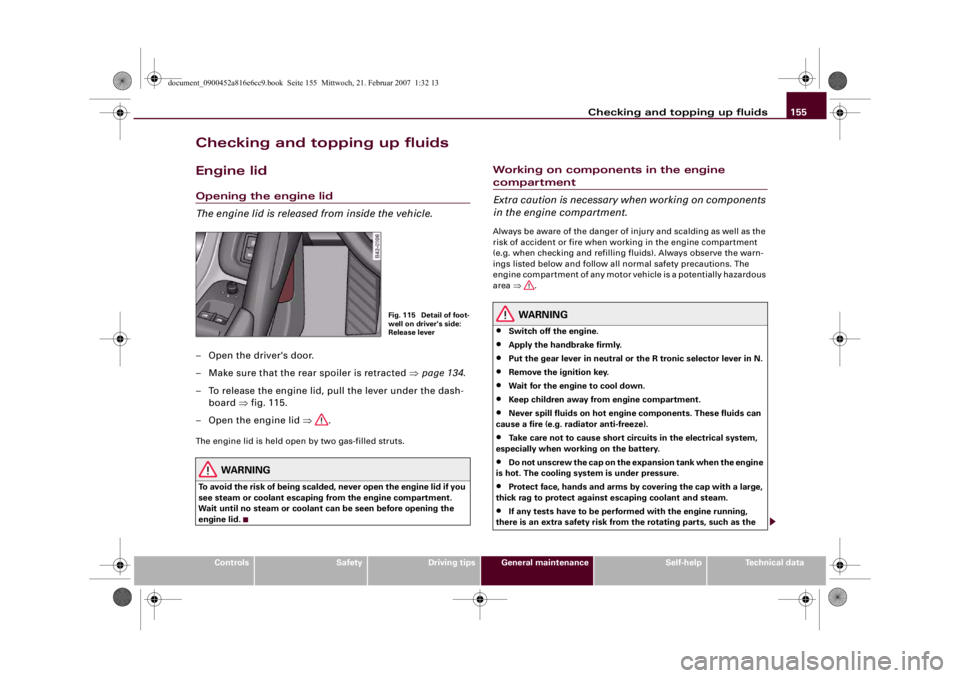
– To release the engine lid, pull the lever under the dash-
board ⇒fig. 115.
– Open the engine lid ⇒.The engine lid is held open by two gas-filled struts.
WARNING
To avoid the risk of being scalded, never open the engine lid if you
see steam or coolant escaping from the engine compartment.
Wait until no steam or coolant can be seen before opening the
engine lid.
Working on components in the engine compartment
Extra caution is necessary when working on components
in the engine compartment.Always be aware of the danger of injury and scalding as well as the
risk of accident or fire when working in the engine compartment
(e.g. when checking and refilling fluids). Always observe the warn-
ings listed below and follow all normal safety precautions. The
engine compartment of any motor vehicle is a potentially hazardous
area ⇒.
WARNING
•
Switch off the engine.
•
Apply the handbrake firmly.
•
Put the gear lever in neutral or the R tronic selector lever in N.
•
Remove the ignition key.
•
Wait for the engine to cool down.
•
Keep children away from engine compartment.
•
Never spill fluids on hot engine components. These fluids can
cause a fire (e.g. radiator anti-freeze).
•
Take care not to cause short circuits in the electrical system,
especially when working on the battery.
•
Do not unscrew the cap on the expansion tank when the engine
is hot. The cooling system is under pressure.
•
Protect face, hands and arms by covering the cap with a large,
thick rag to protect against escaping coolant and steam.
•
If any tests have to be performed with the engine running,
there is an extra safety risk from the rotating parts, such as the
Fig. 115 Detail of foot-
well on driver's side:
Release lever
document_0900452a816e6cc9.book Seite 155 Mittwoch, 21. Februar 2007 1:32 13
Page 158 of 210
Checking and topping up fluids 156drive belts and alternator, etc., and from the high-voltage ignition
system. •
Observe the following additional warnings if work on the fuel
system or the electrical system is necessary:
−Always disconnect the battery
−Do not smoke
−Never work near open flames
−Always keep an approved fire extinguisher immediately
available.Caution
When topping up fluids make sure the correct fluid is put into the
correct filler opening. This can otherwise cause serious malfunc-
tions or engine damage.
For the sake of the environment
Inspect the ground underneath your vehicle regularly so that any
leaks are detected at an early stage. If you find oil spots or other
fluids, have your vehicle inspected by a qualified workshop.
Note
On right-hand drive vehicles* some of the containers/ reservoirs
mentioned below are located on the other side of the engine
compartment.Closing the engine lid– Make sure that the rear spoiler is retracted ⇒page 134.
– To close the engine lid, pull it down to overcome the
spring pressure.– Then let it drop into the catches; do not press down ⇒.
WARNING
For safety reasons the engine lid must always be completely
closed when the vehicle is moving. After closing it always check
that it is properly secured. The engine lid must be flush with the
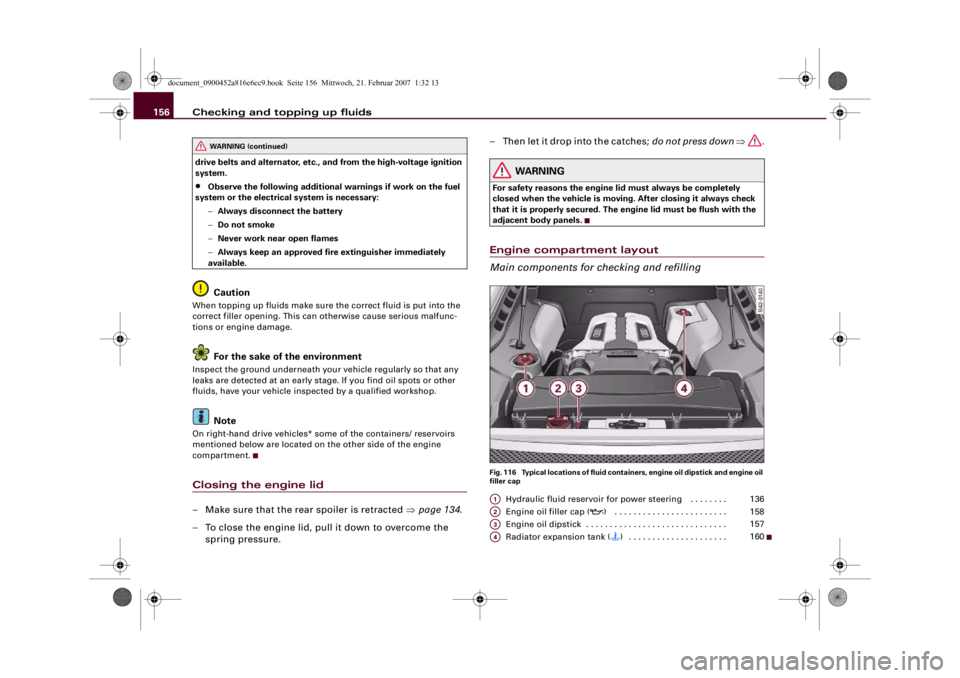
adjacent body panels.Engine compartment layout
Main components for checking and refillingFig. 116 Typical locations of fluid containers, engine oil dipstick and engine oil
filler cap
Hydraulic fluid reservoir for power steering . . . . . . . .
Engine oil filler cap (
) . . . . . . . . . . . . . . . . . . . . . . . .
Engine oil dipstick . . . . . . . . . . . . . . . . . . . . . . . . . . . . . .
Radiator expansion tank () . . . . . . . . . . . . . . . . . . . . .
WARNING (continued)
A1
136
A2
158
A3
157
A4
160
document_0900452a816e6cc9.book Seite 156 Mittwoch, 21. Februar 2007 1:32 13
Page 159 of 210

Checking and topping up fluids157
Controls
Safety
Driving tips
General maintenance
Self-help
Technical data
Engine oilGeneral notesWe recommend that you have the oil change carried out by an
Audi R8 dealership or qualified workshop according to the intervals
stated in the Service Schedule or according to the service interval
display in the instrument cluster.
Whether your vehicle is serviced at flexible service intervals or fixed
service intervals is shown in the Service Schedule.
The correct oil specifications for your engine are listed in the Te c h -
nical data section ⇒page 198, “Performance, weights and dimen-
sions”.
Check that the specifications quoted (VW standards) appear on the
container either singly or in combination with other specifications.
Flexible service intervals (LongLife Service*)
Special engine oils ⇒page 198, “Performance, weights and dimen-
sions” have been developed as part of the Audi LongLife Service
(⇒“Service Schedule”).
This type of oil must be used if you intend to take advantage of the
extended maintenance intervals allowed by Audi's LongLife Service.•
Do not mix the LongLife oil with oil intended for fixed service
intervals, as the requirements for the extended service intervals are
then no longer guaranteed.
•
In exceptional circumstances, if the engine oil level is too low
⇒page 157 and you cannot obtain the specified LongLife oil, you
can put in a small quantity of oil for fixed service intervals -
⇒page 198, “Performance, weights and dimensions”. This should
not be done more than once and no more than 0.5 litres should be
used.Fixed service intervals (Inspection Service*)
If you do not take advantage of the LongLife service for your car, you
can use the oils for fixed service intervals - ⇒page 198, “Perform-
ance, weights and dimensions”. In this case, your car must be serv-
iced after a fixed interval of 1 year / 15,000 km (10,000 miles) – see
Service Schedule.
•
In exceptional circumstances, if the engine oil level is too low
⇒page 157 and you cannot obtain the oil specified for your vehicle,
you can put in a small quantity of oil conforming to the specification
ACEA A2 or ACEA A3. This should not be done more than once and
no more than 0.5 litres should be used.
Checking the oil level
Fig. 117 Instrument
cluster: Engine oil
temperature displayFig. 118 Markings on
oil dipstick
document_0900452a816e6cc9.book Seite 157 Mittwoch, 21. Februar 2007 1:32 13
Page 160 of 210
Checking and topping up fluids 158
Checking oil level
– Warm up the engine by driving the vehicle until the oil
temperature shown in the instrument cluster is between
100 °C and 110 °C ⇒page 157, fig. 117.
– Park your vehicle on a level surface.
– Allow the warm engine to run for about two minutes at
idling speed.
– Switch off the engine and wait for two minutes.
– Check the oil level using the dipstick ⇒page 157,
fig. 118.
Oil level in area
–Do not top up oil.
Oil level in area
– Add 1 litre of oil ⇒page 158. After topping up the oil level
should be in area .Depending on how you drive and the conditions in which the car is
used, oil consumption can be up to 1.0 ltr./1000 km. Oil consump-
tion is likely to be higher for the first 5000 km.
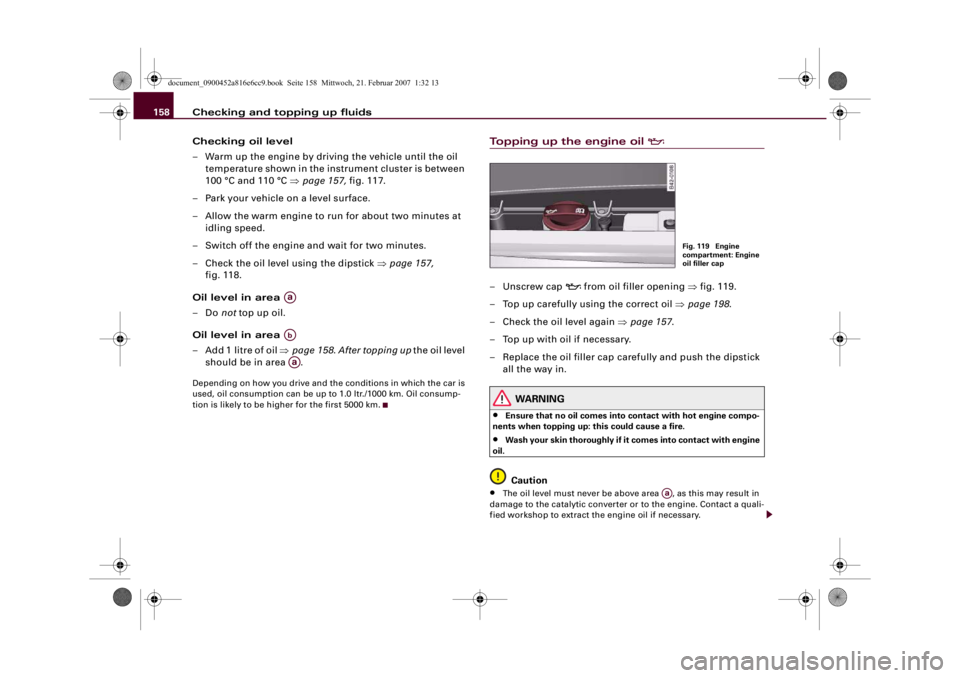
Topping up the engine oil
–Unscrew cap
from oil filler opening ⇒fig. 119.
– Top up carefully using the correct oil ⇒page 198.
– Check the oil level again ⇒page 157.
– Top up with oil if necessary.
– Replace the oil filler cap carefully and push the dipstick
all the way in.
WARNING
•
Ensure that no oil comes into contact with hot engine compo-
nents when topping up: this could cause a fire.
•
Wash your skin thoroughly if it comes into contact with engine
oil.Caution
•
The oil level must never be above area , as this may result in
damage to the catalytic converter or to the engine. Contact a quali-
fied workshop to extract the engine oil if necessary.
AaAbAa
Fig. 119 Engine
compartment: Engine
oil filler cap
Aa
document_0900452a816e6cc9.book Seite 158 Mittwoch, 21. Februar 2007 1:32 13