warning light AUDI R8 2007 Repair Manual
[x] Cancel search | Manufacturer: AUDI, Model Year: 2007, Model line: R8, Model: AUDI R8 2007Pages: 210, PDF Size: 8.1 MB
Page 169 of 210
Wheels and tyres167
Controls
Safety
Driving tips
General maintenance
Self-help
Technical data
Tyre service life
Correct inflation pressures and sensible driving habits
will increase the service life of your tyres.– Check the tyre pressures at least once a month.
– The tyre pressures should only be checked when the
tyres are cold. The slightly raised pressures of warm tyres
must not be reduced.
– The pressures must be altered to suit major changes in
the load being carried.
– Avoid fast cornering and hard acceleration.
– Inspect the tyres for irregular wear from time to time.The service life of your tyres depends on the following factors:
Tyre pressure
Under-inflation or over-inflation will reduce the life of the tyres
considerably and also impair the car's handling. The inflation pres-
sures are listed on a sticker on the driver's door pillar.
Correct inflation pressures are very important, especially at high
speeds. The pressures should therefore be checked at least once a
month and before starting a journey.
Driving habits
Fast cornering, heavy acceleration and hard braking (squealing
tyres) all increase tyre wear.
Wheel balancing
The wheels on new vehicles are balanced. However, various factors
encountered in normal driving can cause them to become unbal-
anced, which results in steering vibration.Unbalanced wheels should be rebalanced, as they otherwise cause
excessive wear on steering, suspension and tyres. A wheel must
also be rebalanced when a new tyre is fitted or if a tyre is repaired.
Incorrect wheel alignment
Incorrect wheel alignment causes excessive tyre wear, impairing the
safety of the vehicle. If you notice excessive tyre wear, contact your
Audi R8 dealer.
WARNING
•
Always adapt the tyre pressure accordingly when the vehicle
load changes.
•
Under-inflated tyres flex more and can overheat at continuous
high speeds. This can cause tread separation and tyre blow-out,
which could result in an accident. Always observe the recom-
mended tyre pressures.For the sake of the environment
Under-inflated tyres will increase the fuel consumption.
document_0900452a816e6cc9.book Seite 167 Mittwoch, 21. Februar 2007 1:32 13
Page 174 of 210
Wheels and tyres 172Remove wheel covers (if fitted) and trim rings before attaching
snow chains. For safety reasons cover caps must then be fitted over
the wheel bolts. These are available from Audi R8 dealers.
Remove the chains when roads are free of snow. Otherwise they will
impair handling, damage the tyres and wear out very quickly.
Four-wheel drive: Where snow chains are compulsory on certain
roads, this normally also applies to cars with four-wheel drive. Snow
chains may only be fitted to the rear wheels (also on vehicles with
four-wheel drive).Tyre pressure monitoring systemApplies to vehicles: with tyre pressure monitoring systemIntroduction
The tyre pressure monitoring system keeps a check on the
inflation pressures of the four road wheels while you are
driving.The system warns the driver in the event of a loss of pressure by
means of symbols and messages in the instrument cluster display.
The system employs sensors on the wheels. The radio signals from
these sensors are transmitted to the tyre pressure monitoring
system.
Please bear in mind that the tyre inflation pressure is also influ-
enced by the temperature of the tyre. For every 10°C increase in the
tyre temperature the pressure will normally increase by about
0.1 bar. The tyre heats up while the vehicle is being driven and the
tyre pressure will rise accordingly. For this reason, you should only
adjust the tyre pressures when they are cold (i.e. approximately at
ambient temperature).
To ensure that the tyre pressure monitoring system works reliably,
you should check and, if necessary, adjust the tyre pressures at
regular intervals.The tyre pressures recommended for your vehicle are given on the
sticker attached to the driver's door pillar.
Initialising the tyre pressure monitoring system
The inflation pressures for two sets of wheels (e.g. with winter and
summer tyres) are stored on your vehicle. You can change between
these two sets of wheels any number of times without re-initialising
the system.
The tyre pressure monitoring system must be re-initialised by your
Audi R8 dealer if a new set of wheels is used or the electronic
sensors are renewed.
Warning lamp
lit
If the tyre pressure is more than 0.5 bar below the reference value,
the display will show the tyre symbol
with a corresponding
message, such as Tyre pressures too low ⇒.
WARNING
•
If the warning lamp
lights up you must slow down immedi-
ately and avoid any severe braking or steering manoeuvres. As
soon as you can do so safely, stop and check the tyres and the tyre
pressures.
•
Never re-adjust the tyre inflation pressure when the tyre is hot.
This can cause serious damage to the tyre or even a blow-out,
which could result in an accident.
•
Under-inflated tyres flex more and can overheat at continuous
high speeds. This can cause tread separation and tyre blow-out,
which could result in an accident.For the sake of the environment
Under-inflated tyres lead to increased fuel consumption and tyre
wear.
document_0900452a816e6cc9.book Seite 172 Mittwoch, 21. Februar 2007 1:32 13
Page 182 of 210
Self-help 180Preparations
Certain steps must be taken before repairing a tyre.– If you have a flat tyre, stop the car well away from moving
traffic.
– Apply the handbrake firmly.
– Engage a gear.
– Check whether a repair is possible using the Tyre
Mobility System ⇒page 178.
– Ensure that all passengers leave the vehicle and move
away from the danger area ⇒.
– Take the tyre sealant can and the electric compressor out
of the holder under the floor panel ⇒page 178, fig. 123.
– Peel the sticker “max. 80 km/h” off the tyre sealant can
and fix it onto the instrument cluster where the driver will
see it.
WARNING
•
If you have a puncture in moving traffic, switch on the hazard
warning lights and place the warning triangle in a visible location.
This is for your own safety and also warns other road users.
•
Make sure your passengers wait in a safe place (for instance
behind the roadside crash barrier).Caution
Take special care if you have to repair a tyre on a gradient.
Note
Please observe the relevant regulations.
Repairing a tyre
The following sections describe the procedures for
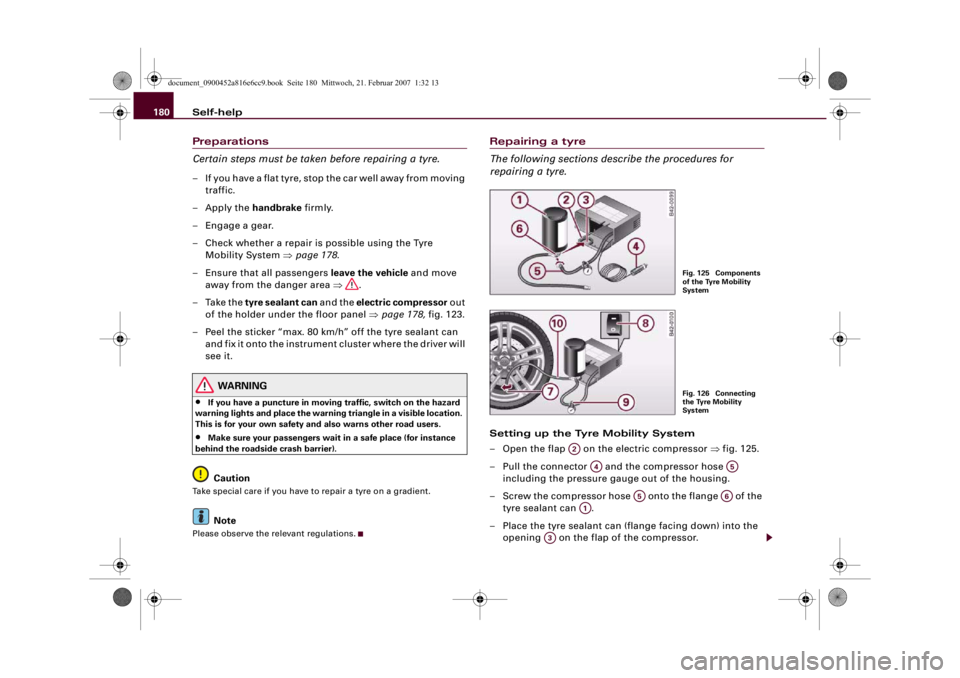
repairing a tyre.Setting up the Tyre Mobility System
– Open the flap on the electric compressor ⇒fig. 125.
– Pull the connector and the compressor hose
including the pressure gauge out of the housing.
– Screw the compressor hose onto the flange of the
tyre sealant can .
– Place the tyre sealant can (flange facing down) into the
opening on the flap of the compressor.
Fig. 125 Components
of the Tyre Mobility
SystemFig. 126 Connecting
the Tyre Mobility
System
A2
A4
A5
A5
A6
A1
A3
document_0900452a816e6cc9.book Seite 180 Mittwoch, 21. Februar 2007 1:32 13
Page 183 of 210
Self-help181
Controls
Safety
Driving tips
General maintenance
Self-help
Technical data
– Unscrew the dust cap from the valve of the damaged
tyre.
– Screw the filler hose onto the valve ⇒page 180,
fig. 126.
– Insert the connector ⇒page 180, fig. 125 into the
cigarette lighter socket.
Inflating the tyre
–Move the switch ⇒page 180, fig. 126 on the
compressor
4) to position I. After 5 minutes tyre pressure
should be at least 1.8 bar.
– Switch off the compressor by moving switch to
position0. If the necessary tyre pressure of at least 1.8
bar is not reached please follow the instructions given in
the section Re-inflating the tyre.
Re-inflating the tyre
– Remove the filler hose from the valve and pull the
connector out of the socket.
– Slowly move the vehicle forwards and backwards about
10 metres. This enables the sealant to be distributed
more evenly.
– Remove the empty tyre sealant can and screw the
compressor hose ⇒page 180, fig. 125 directly onto
the valve.
– Insert the connector into the cigarette lighter socket.– Move the switch ⇒page 180, fig. 126 on the
compressor to position I. After 5 minutes tyre pressure
should be at least 1.8 bar.
– Switch off the compressor by moving switch to
position0. If the necessary tyre pressure of at least 1.8
bar is not reached this means that the tyre cannot be
repaired using the tyre sealant. You should obtain profes-
sional assistance.
Dismantling the Tyre Mobility System
– Remove the filler hose from the valve and pull the
connector out of the socket.
– Screw the dust cap onto the valve.
– Put the empty tyre sealant can back into its original pack-
aging and then secure it in the holder under the floor
panel in such a way that it will not leak.
– Then drive away immediately so that the tyre sealant can
spread evenly in the tyre.
WARNING
•
Please observe the manufacturers' safety notes on the stickers
on the compressor and the tyre sealant can.
•
If it was not possible to build up a tyre pressure of 1.8 bar
within 5 minutes this means that the tyre is too badly damaged.
Do not drive on.
•
Seek professional assistance if the repair of a tyre puncture is
not possible with the sealing compound.
4)The compressor should never be used for longer than 8 minutes.
A10
A7
A4
A8A5A4
A8
document_0900452a816e6cc9.book Seite 181 Mittwoch, 21. Februar 2007 1:32 13
Page 186 of 210
Self-help 184•
The car can be damaged if the jack is not applied at the correct
jacking points. There is also a risk of injury since the jack can slip
off suddenly if it is not properly engaged.Caution
A trolley jack or lifting platform must not be applied at the points
shown ⇒page 183, fig. 128 -arrows-.Taking off / putting on the wheel
Step-by-step instructions for taking off and putting on the
wheel.Change the wheel as described below after loosening the
wheel bolts and raising the vehicle with the jack.
Taking off the wheel
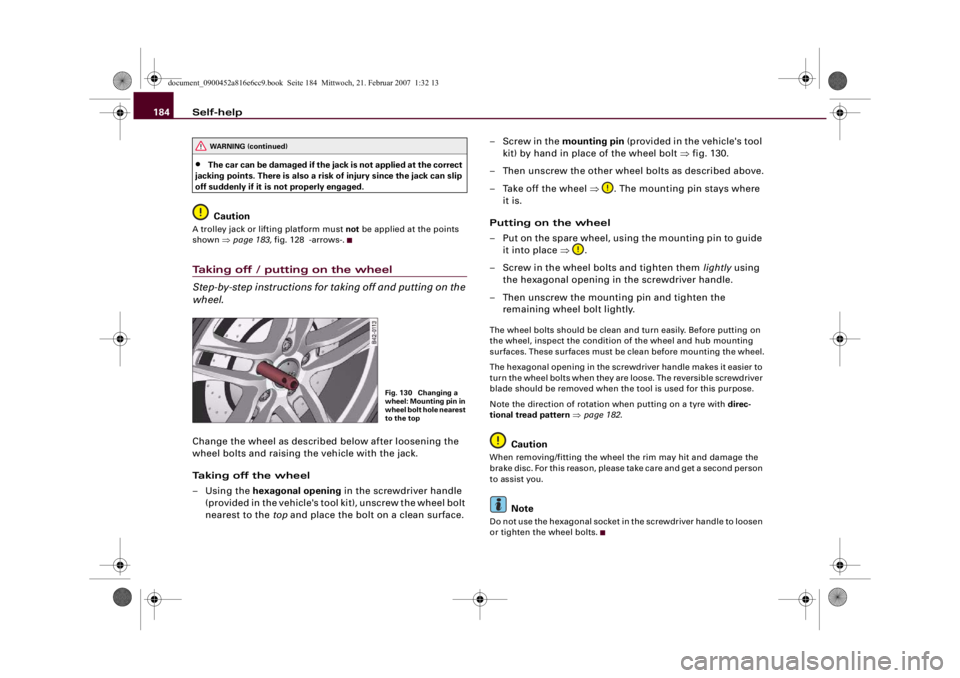
–Using the hexagonal opening in the screwdriver handle
(provided in the vehicle's tool kit), unscrew the wheel bolt
nearest to the top and place the bolt on a clean surface.–Screw in the mounting pin (provided in the vehicle's tool
kit) by hand in place of the wheel bolt ⇒fig. 130.
– Then unscrew the other wheel bolts as described above.
– Take off the wheel ⇒. The mounting pin stays where
it is.
Putting on the wheel
– Put on the spare wheel, using the mounting pin to guide
it into place ⇒.
– Screw in the wheel bolts and tighten them lightly using
the hexagonal opening in the screwdriver handle.
– Then unscrew the mounting pin and tighten the
remaining wheel bolt lightly.
The wheel bolts should be clean and turn easily. Before putting on
the wheel, inspect the condition of the wheel and hub mounting
surfaces. These surfaces must be clean before mounting the wheel.
The hexagonal opening in the screwdriver handle makes it easier to
turn the wheel bolts when they are loose. The reversible screwdriver
blade should be removed when the tool is used for this purpose.
Note the direction of rotation when putting on a tyre with direc-
tional tread pattern ⇒page 182.
Caution
When removing/fitting the wheel the rim may hit and damage the
brake disc. For this reason, please take care and get a second person
to assist you.
Note
Do not use the hexagonal socket in the screwdriver handle to loosen
or tighten the wheel bolts.
WARNING (continued)
Fig. 130 Changing a
wheel: Mounting pin in
wheel bolt hole nearest
to the top
document_0900452a816e6cc9.book Seite 184 Mittwoch, 21. Februar 2007 1:32 13
Page 188 of 210
Self-help 186•
Switch off the car telephone if necessary. Details will be given in
the manufacturer's instructions for the car telephone.
Starting the engine
The jump leads must be connected in the correct
sequence.The battery is located in the luggage compartment
⇒page 163. The luggage lid can be released manually if
necessary ⇒page 48.
Connecting the positive terminals with the
positive lead (red)
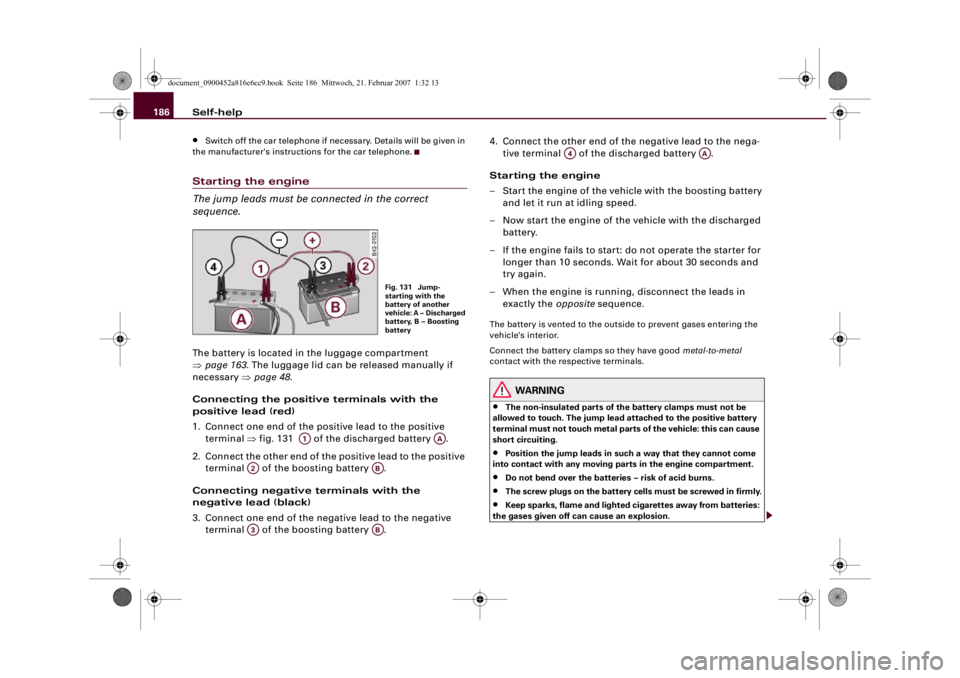
1. Connect one end of the positive lead to the positive
terminal ⇒fig. 131 of the discharged battery .
2. Connect the other end of the positive lead to the positive
terminal of the boosting battery .
Connecting negative terminals with the
negative lead (black)
3. Connect one end of the negative lead to the negative
terminal of the boosting battery .4. Connect the other end of the negative lead to the nega-
tive terminal of the discharged battery .
Starting the engine
– Start the engine of the vehicle with the boosting battery
and let it run at idling speed.
– Now start the engine of the vehicle with the discharged
battery.
– If the engine fails to start: do not operate the starter for
longer than 10 seconds. Wait for about 30 seconds and
try again.
– When the engine is running, disconnect the leads in
exactly the opposite sequence.
The battery is vented to the outside to prevent gases entering the
vehicle's interior.
Connect the battery clamps so they have good metal-to-metal
contact with the respective terminals.
WARNING
•
The non-insulated parts of the battery clamps must not be
allowed to touch. The jump lead attached to the positive battery
terminal must not touch metal parts of the vehicle: this can cause
short circuiting.
•
Position the jump leads in such a way that they cannot come
into contact with any moving parts in the engine compartment.
•
Do not bend over the batteries – risk of acid burns.
•
The screw plugs on the battery cells must be screwed in firmly.
•
Keep sparks, flame and lighted cigarettes away from batteries:
the gases given off can cause an explosion.
Fig. 131 Jump-
starting with the
battery of another
vehicle: A – Discharged
battery, B – Boosting
battery
A1
AA
A2
AB
A3
AB
A4
AA
document_0900452a816e6cc9.book Seite 186 Mittwoch, 21. Februar 2007 1:32 13
Page 190 of 210
Self-help 188•
The hazard warning lights of both vehicles must normally be
switched on. However, observe any regulations to the contrary.
•
Make sure that the towrope is not twisted, as otherwise the front
towline anchorage on your vehicle could work itself loose.
Front towline anchorage
The front towline anchorage is only mounted if the vehicle
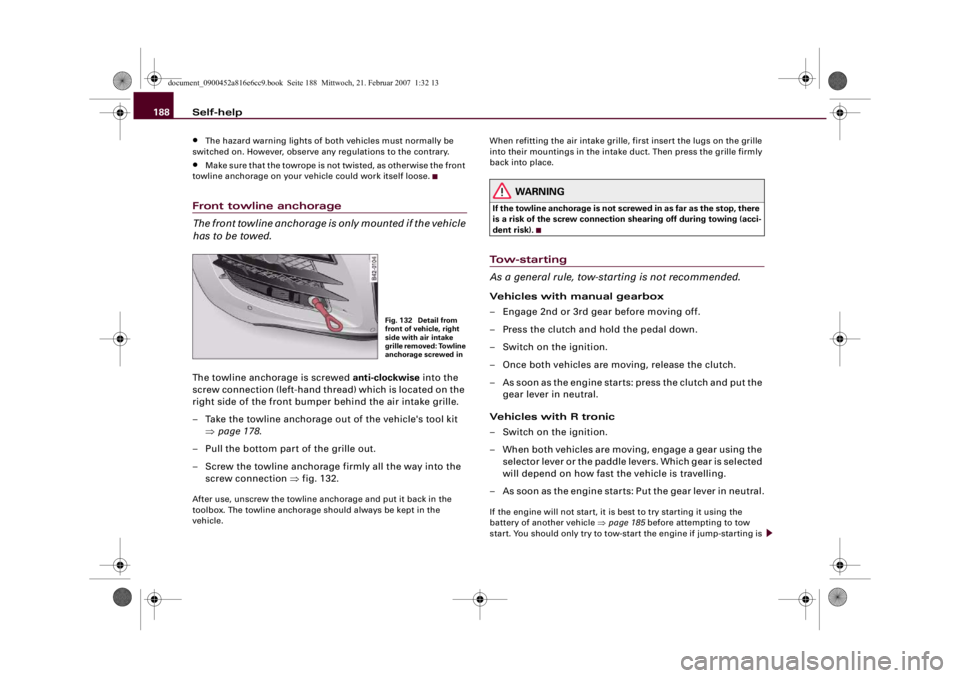
has to be towed.The towline anchorage is screwed anti-clockwise into the
screw connection (left-hand thread) which is located on the
right side of the front bumper behind the air intake grille.
– Take the towline anchorage out of the vehicle's tool kit
⇒page 178.
– Pull the bottom part of the grille out.
– Screw the towline anchorage firmly all the way into the
screw connection ⇒fig. 132.After use, unscrew the towline anchorage and put it back in the
toolbox. The towline anchorage should always be kept in the
vehicle.When refitting the air intake grille, first insert the lugs on the grille
into their mountings in the intake duct. Then press the grille firmly
back into place.
WARNING
If the towline anchorage is not screwed in as far as the stop, there
is a risk of the screw connection shearing off during towing (acci-
dent risk).Tow-starting
As a general rule, tow-starting is not recommended.Vehicles with manual gearbox
– Engage 2nd or 3rd gear before moving off.
– Press the clutch and hold the pedal down.
– Switch on the ignition.
– Once both vehicles are moving, release the clutch.
– As soon as the engine starts: press the clutch and put the
gear lever in neutral.
Vehicles with R tronic
– Switch on the ignition.
– When both vehicles are moving, engage a gear using the
selector lever or the paddle levers. Which gear is selected
will depend on how fast the vehicle is travelling.
– As soon as the engine starts: Put the gear lever in neutral.If the engine will not start, it is best to try starting it using the
battery of another vehicle ⇒page 185 before attempting to tow
start. You should only try to tow-start the engine if jump-starting is
Fig. 132 Detail from
front of vehicle, right
side with air intake
grille removed: Towline
anchorage screwed in
document_0900452a816e6cc9.book Seite 188 Mittwoch, 21. Februar 2007 1:32 13
Page 193 of 210
Fuses and bulbs191
Controls
Safety
Driving tips
General maintenance
Self-help
Technical data
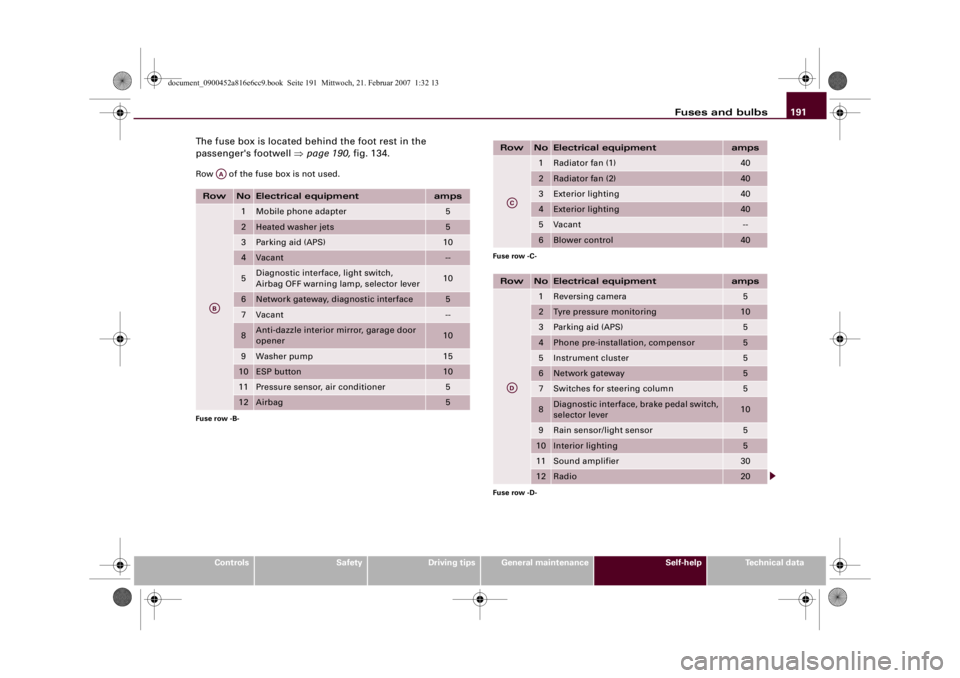
The fuse box is located behind the foot rest in the
passenger's footwell ⇒page 190, fig. 134.Row of the fuse box is not used.Row
No
Electrical equipment
amps
1
Mobile phone adapter
5
2
Heated washer jets
5
3
Parking aid (APS)
10
4
Vacant
--
5
Diagnostic interface, light switch,
Airbag OFF warning lamp, selector lever
10
6
Network gateway, diagnostic interface
5
7
Vacant
--
8
Anti-dazzle interior mirror, garage door
opener
10
9
Washer pump
15
10
ESP button
10
11
Pressure sensor, air conditioner
5
12
Airbag
5
Fuse row -B-
AAAB
Row
No
Electrical equipment
amps
1
Radiator fan (1)
40
2
Radiator fan (2)
40
3
Exterior lighting
40
4
Exterior lighting
40
5
Vacant
--
6
Blower control
40
Fuse row -C-Row
No
Electrical equipment
amps
1
Reversing camera
5
2
Tyre pressure monitoring
10
3
Parking aid (APS)
5
4
Phone pre-installation, compensor
5
5
Instrument cluster
5
6
Network gateway
5
7
Switches for steering column
5
8
Diagnostic interface, brake pedal switch,
selector lever
10
9
Rain sensor/light sensor
5
10
Interior lighting
5
11
Sound amplifier
30
12
Radio
20
Fuse row -D-
ACAD
document_0900452a816e6cc9.book Seite 191 Mittwoch, 21. Februar 2007 1:32 13
Page 204 of 210

Index 202AABS
SeeAnti-lock brake system . . . . . . . . 132
AC mode
Air conditioner . . . . . . . . . . . . . . . . . . . 79
Acceleration figures
SeePerformance, weights and
dimensions . . . . . . . . . . . . . . . . . . . . 198
Accessories . . . . . . . . . . . . . . . . . . . . . . . . 174
acoustic parking system
SeeParking aid . . . . . . . . . . . . . . . . . . . 85
Air conditioner . . . . . . . . . . . . . . . . . . . . . . 75
AC mode . . . . . . . . . . . . . . . . . . . . . . . . . 79
Air distribution . . . . . . . . . . . . . . . . . . . 77
Air recirculation mode . . . . . . . . . . . . . 78
Automatic mode . . . . . . . . . . . . . . . . . . 78
Blower . . . . . . . . . . . . . . . . . . . . . . . . . . 77
Controls . . . . . . . . . . . . . . . . . . . . . . . . . 75
Defrosting . . . . . . . . . . . . . . . . . . . . . . . 78
Dust filter . . . . . . . . . . . . . . . . . . . . . . . . 75
Heating . . . . . . . . . . . . . . . . . . . . . . . . . . 75
Pollen filter . . . . . . . . . . . . . . . . . . . . . . 75
Rear window heating . . . . . . . . . . . . . . 79
Seat heating . . . . . . . . . . . . . . . . . . . . . 80
Switching on/off . . . . . . . . . . . . . . . . . . 77
Temperature . . . . . . . . . . . . . . . . . . . . . 76
Ventilation . . . . . . . . . . . . . . . . . . . . . . . 75
Air distribution
Air conditioner . . . . . . . . . . . . . . . . . . . 77
Air recirculation mode
Vehicles with air conditioner . . . . . . . . 78Airbag . . . . . . . . . . . . . . . . . . . . . . . . . . . . 115
Deactivating . . . . . . . . . . . . . . . . . . . . . 120
Front airbags . . . . . . . . . . . . . . . . . . . . 116
Key-operated switch for front passenger's
airbag . . . . . . . . . . . . . . . . . . . . . . . . . 120
Side airbags . . . . . . . . . . . . . . . . . . . . . 118
Triggering . . . . . . . . . . . . . . . . . . . . . . 116
Warning lamp . . . . . . . . . . . . . . . . . . . . 17
Alterations to the vehicle . . . . . . . . . . . . . 174
Alternator . . . . . . . . . . . . . . . . . . . . . . . . . . 18
Warning lamp . . . . . . . . . . . . . . . . . . . . 18
Anti-dazzle interior mirror . . . . . . . . . . . . . 63
Anti-freeze additive . . . . . . . . . . . . . . . . . 159
Anti-knock properties of petrol . . . . . . . . 152
Anti-lock brake system . . . . . . . . . . . . . . . 132
Warning lamp . . . . . . . . . . . . . . . . . . . . 19
Anti-theft alarm . . . . . . . . . . . . . . . . . . . . . . 48
Interior monitor . . . . . . . . . . . . . . . . . . . 49
Tow-away protection . . . . . . . . . . . . . . 49
Anti-theft wheel bolts . . . . . . . . . . . . . . . . 182
Ashtray . . . . . . . . . . . . . . . . . . . . . . . . . . . . . 72
Audi magnetic ride . . . . . . . . . . . . . . . . 16, 88
Description . . . . . . . . . . . . . . . . . . . . . . . 88
Warning lamp . . . . . . . . . . . . . . . . . . . . 16
Audi parking system . . . . . . . . . . . . . . . . . 85
Automatic car washes
SeeWashing . . . . . . . . . . . . . . . . . . . . 144
Automatic headlight control . . . . . . . . . . . 63
Automatic headlights . . . . . . . . . . . . . . . . . 53
Defective . . . . . . . . . . . . . . . . . . . . . . . . 38
Average fuel consumption . . . . . . . . . . . . 22
Average speed . . . . . . . . . . . . . . . . . . . . . . 22Axle weights
SeePerformance, weights and
dimensions . . . . . . . . . . . . . . . . . . . . 198
BBattery . . . . . . . . . . . . . . . . . . . . . . . . . . . . 162
Charging . . . . . . . . . . . . . . . . . . . . . . . . 164
Disconnecting and connecting . . . . . 162
Long periods of non-use . . . . . . . . . . 162
Replacing . . . . . . . . . . . . . . . . . . . . . . . 162
Testing . . . . . . . . . . . . . . . . . . . . . . . . . 162
Winter conditions . . . . . . . . . . . . . . . . 162
Winter operation . . . . . . . . . . . . . . . . . 162
Battery voltage . . . . . . . . . . . . . . . . . . . . . . 37
Belt tensioners . . . . . . . . . . . . . . . . . . . . . 114
Bioethanol fuel . . . . . . . . . . . . . . . . . . . . . 152
Blower . . . . . . . . . . . . . . . . . . . . . . . . . . . . . 77
Brake system
Brake fluid . . . . . . . . . . . . . . . . . . . . . . 161
Brake light failure . . . . . . . . . . . . . . . . . 38
Brake pads worn . . . . . . . . . . . . . . . . . . 37
Brake servo . . . . . . . . . . . . . . . . . . . . . . 134
Brakes . . . . . . . . . . . . . . . . . . . . . . . . . . 134
Malfunction . . . . . . . . . . . . . . . . . . . . . . 35
Warning lamp . . . . . . . . . . . . . . . . . . . . 18
Bulb monitor . . . . . . . . . . . . . . . . . . . . . . . . 37
Bulbs . . . . . . . . . . . . . . . . . . . . . . . . . . . . . 193
Business equipment . . . . . . . . . . . . . . . . . 175CCapacities . . . . . . . . . . . . . . . . . . . . . . . . . 199
document_0900452a816e6cc9.book Seite 202 Mittwoch, 21. Februar 2007 1:32 13
Page 205 of 210

Index203
Controls
Safety
Driving tips
General maintenance
Self-help
Technical data Car keys . . . . . . . . . . . . . . . . . . . . . . . . . . . . 40
Carbon parts
Exterior . . . . . . . . . . . . . . . . . . . . . . . . . 146
Interior . . . . . . . . . . . . . . . . . . . . . . . . . 147
Care of vehicle . . . . . . . . . . . . . . . . . . . . . . 144
Catalytic converter . . . . . . . . . . . . . . . . . . 138
Central locking system . . . . . . . . . . . . . . . . 42
Deadlock mechanism . . . . . . . . . . . . . . 44
Locking . . . . . . . . . . . . . . . . . . . . . . . . . . 44
Locking and unlocking the vehicle from
inside . . . . . . . . . . . . . . . . . . . . . . . . . . 45
Locking doors manually . . . . . . . . . . . . 46
Luggage lid . . . . . . . . . . . . . . . . . . . . . . . 47
Opening and closing windows . . . . . . . 43
Security central locking . . . . . . . . . . . . 46
Switches . . . . . . . . . . . . . . . . . . . . . . . . . 45
Unlocking . . . . . . . . . . . . . . . . . . . . . . . . 44
Ceramic brake discs
Changing a wheel . . . . . . . . . . . . . . . . 184
Changing a wheel . . . . . . . . . . . . . . . . . . . 182
Changing bulbs . . . . . . . . . . . . . . . . . . . . . 193
Chassis number . . . . . . . . . . . . . . . . . . . . . 196
Child safety . . . . . . . . . . . . . . . . . . . . . . . . 122
Child safety seat . . . . . . . . . . . . . . . . . . . . 123
Child seat categories . . . . . . . . . . . . . . 123
Fitting . . . . . . . . . . . . . . . . . . . . . . . . . . 126
ISOFIX system . . . . . . . . . . . . . . . . . . . 128
Safety notes . . . . . . . . . . . . . . . . . . . . . 122
Cigarette lighter . . . . . . . . . . . . . . . . . . . . . 72
Cleaning . . . . . . . . . . . . . . . . . . . . . . . . . . . 144
Cleaning Alcantara . . . . . . . . . . . . . . . . . . 150Cleaning seat covers
Alcantara . . . . . . . . . . . . . . . . . . . . . . . . 150
Natural leather . . . . . . . . . . . . . . . . . . . 149
Textile covers . . . . . . . . . . . . . . . . . . . . 147
Cleaning textile covers and trim parts . . 147
Closing
Engine lid . . . . . . . . . . . . . . . . . . . . . . . 156
Clutch overheating . . . . . . . . . . . . . . . . . . . 38
Colour code . . . . . . . . . . . . . . . . . . . . . . . . 196
Coming home function . . . . . . . . . . . . . . . . 54
Compartment for (sun)glasses . . . . . . . . . 73
Compass in mirror . . . . . . . . . . . . . . . . . . . 65
Conformity certification . . . . . . . . . . . . . . . 98
Controls and displays
Overview . . . . . . . . . . . . . . . . . . . . . . . . . . 9
Convenience close . . . . . . . . . . . . . . . . . . . 43
Convenience open . . . . . . . . . . . . . . . . . . . . 43
Cooling system
Anti-freeze additive . . . . . . . . . . . . . . . 159
Checking coolant level . . . . . . . . . . . . 160
Coolant . . . . . . . . . . . . . . . . . . . . . . . . . 159
Coolant temperature gauge . . . . . . . . . 12
Malfunction . . . . . . . . . . . . . . . . . . . . . . 35
Radiator fan . . . . . . . . . . . . . . . . . . . . . 161
Topping up coolant . . . . . . . . . . . . . . . 160
Cruise control system . . . . . . . . . . . . . . . . . 86
Adjusting stored speed . . . . . . . . . . . . . 87
Indicator lamp . . . . . . . . . . . . . . . . . . . . 17
Setting speed . . . . . . . . . . . . . . . . . . . . . 87
Switching off . . . . . . . . . . . . . . . . . . . . . 88
Switching off temporarily . . . . . . . . . . . 88
Cup holders . . . . . . . . . . . . . . . . . . . . . . . . . 72
Current fuel consumption . . . . . . . . . . . . . 22
DDashboard lighting
SeeInstrument lighting . . . . . . . . . . . . . 55
Date display . . . . . . . . . . . . . . . . . . . . . . . . . 12
Daytime running lights . . . . . . . . . . . . . . . . 52
Deactivating front passenger's airbag . . 120
Deadlock mechanism . . . . . . . . . . . . . . . . . 44
Defrosting windows . . . . . . . . . . . . . . . . . . 78
Deluxe automatic air conditioner
Economical operation . . . . . . . . . . . . . . 79
Description of R tronic . . . . . . . . . . . . . . . . 90
Digital clock . . . . . . . . . . . . . . . . . . . . . . . . . 12
Digital compass . . . . . . . . . . . . . . . . . . . . . . 65
Dimensions . . . . . . . . . . . . . . . . . . . . . . . . 198
Dipped headlights . . . . . . . . . . . . . . . . . . . . 52
Defective . . . . . . . . . . . . . . . . . . . . . . . . . 37
Distance covered . . . . . . . . . . . . . . . . . . . . . 23
Door catches, engine lid and front lid
warning . . . . . . . . . . . . . . . . . . . . . . . . 20
Doors
Locking doors manually . . . . . . . . . . . . 46
Driver
SeeSitting position . . . . . . . . . . . . . . . 104
Driver information system
CD and radio display . . . . . . . . . . . . . . . 20
Door catches, engine lid and front lid
warning . . . . . . . . . . . . . . . . . . . . . . . . 20
Help . . . . . . . . . . . . . . . . . . . . . . . . . . . . . 25
Menu button . . . . . . . . . . . . . . . . . . . . . . 25
Menu display . . . . . . . . . . . . . . . . . . . . . 24
On-board computer . . . . . . . . . . . . . . . . 22
Outside temperature display . . . . . . . . 20
document_0900452a816e6cc9.book Seite 203 Mittwoch, 21. Februar 2007 1:32 13