lock AUDI R8 COUPE 2020 Repair Manual
[x] Cancel search | Manufacturer: AUDI, Model Year: 2020, Model line: R8 COUPE, Model: AUDI R8 COUPE 2020Pages: 308, PDF Size: 82.41 MB
Page 229 of 308

4S1012721BA
Checking and Filling
— Do not use any gasoline mixture whose
composition cannot be identified.
— Audi does not assume any responsibility for
damage to the fuel system or for perform-
ance problems caused by using gasoline
mixtures different from those specified.
This type of damage also does not fall under
the New Vehicle Limited Warranty or under
the emissions control system warranty.
— If you notice a higher fuel consumption or
poor handling or performance problems due
to such gasoline mixtures, we recommend
fueling with unblended gasoline.
Gasoline additives
An important issue for many automobile manu-
facturers is combustion residue in the engine
that results from the use of certain fuels.
Although types of gasoline differ depending on
the manufacturer, there are similarities. Certain
substances in the gasoline may cause deposits in
the engine. Additives in the gasoline that should
keep the engine and fuel system clean do not all
function equally.
Audi recommends using TOP TIER Detergent Gas-
oline. For additional information on TOP TIER De-
tergent Gasoline, visit www.toptiergas.com.
If you use incorrect fuels over a long period of
time, the maximum engine performance may be
impaired by combustion residue.
@) Note
— Damage or malfunctions caused by the use
of incorrect types of gasoline are not cov-
ered by the New Vehicle Limited Warranty.
— Only gasoline additives that have been ap-
proved by Audi may be used.
Refueling
Fueling procedure
Your vehicle is equipped with a capless fuel filler
system.
B4S-0209
Fig. 173 Right rear side of the vehicle: opening the fuel
filler door
@
B4S-0210
Fig. 174 Right rear side of the vehicle: fuel pump nozzle
inserted
The fuel filler door is unlocked or locked by the
central locking system.
> Press on the left side of the fuel filler door to
open it > fig. 173.
> Insert the fuel pump nozzle all the way into the
fuel tank filler neck > fig. 174. Make sure it is
seated correctly.
> Begin fueling. Once the fuel pump nozzle turns
off the first time, the fuel tank is full. Do not
continue fueling, or else the expansion space in
the tank will be filled with fuel.
> After the fuel pump has switched off, wait five
seconds before removing the nozzle to allow
the rest of the fuel to finish dripping into the
fuel tank.
> Close the fuel filler door and then press on the
left side until it latches.
227
>
Page 230 of 308
Checking and Filling
The correct fuel type for your vehicle can be
found ona label located on the inside of the fuel
filler door. For additional information on fuel, see
=> page 226.
For the tank capacity in your vehicle, refer to the
Technical Data > page 290.
ZA\ WARNING
Improper fueling procedures and improper
handling of fuel can lead to explosions, fires,
severe burns, and other injuries.
— Do not smoke. Keep away from open flames.
— The ignition must be switched off when re-
fueling.
— Mobile devices, radio devices, and other ra-
dio equipment should always be switched
off when refueling. Electromagnetic rays
could cause sparks and start a fire.
— If you do not insert the fuel pump nozzle all
the way into the filler tube, then fuel can
leak out. Spilled fuel can ignite and start a
fire.
— Never get into the vehicle when refueling. If
there is an exceptional situation where you
must enter the vehicle, close the door and
touch a metal surface before touching the
fuel pump nozzle again. This will reduce the
risk of electrostatic discharge that can cause
flying sparks. Sparks can start a fire when
refueling.
ZA WARNING
The vehicle must not be refueled with a re-
serve canister due to the risk of fire.
@) Note
— Remove fuel that has overflowed onto any
vehicle components immediately to reduce
the risk of damage to the vehicle.
— Never drive until the fuel tank is completely
empty. The irregular supply of fuel that re-
sults from that can cause engine misfires.
Uncombusted fuel may enter the exhaust
system and increase the risk of damage to
the catalytic converter.
228
— Never insert any portable nozzles, funnels
or after-market containers into the fuel fill-
er neck.
— Do not pry open the fuel filler neck forceful-
ly or press against it with foreign objects to
open the tank system.
@) For the sake of the environment
— Do not overfill the fuel tank, or fuel could
leak out when the vehicle is warming up.
— Fuel should never enter the sewer system or
come into contact with the ground.
@ Tips
— If adverse weather conditions cause the fuel
filler door to freeze shut, press on the cen-
ter of the filler door with the heel of your
hand and then try opening it again.
— The fuel filler door on your vehicle does not
lock if you lock the vehicle from the inside
using the central locking switch.
@) Tips
— Your vehicle is equipped with a misfueling
guard. It allows the vehicle to be fueled only
with the correct fuel pump nozzle.
—Aworn or damaged nozzle or a nozzle that
is too small may not be able to open the die-
sel misfueling guard. If this is the case, try
turning the nozzle before inserting it in the
fuel filler neck, use a different fuel pump, or
see an authorized Audi dealer or authorized
Audi Service Facility for assistance.
Emissions control
system
General information
ZA WARNING
The temperature of the exhaust system is
high, both when driving and after stopping
the engine.
— Never touch the exhaust tail pipes once they
have become hot. This could result in burns.
— Do not park your vehicle over flammable
materials such as grass or leaves because >
Page 233 of 308

4S1012721BA
Checking and Filling
Opening and closing the engine
compartment lid
The engine compartment lid is released from in-
side the vehicle.
© s
Ss S
db eS t a
Fig. 176 Driver's side: unlocking the engine compartment
lid
Opening the engine compartment lid
Requirement: the ignition must be switched on.
> Pull the &> switch. The engine compartment
lid opens > A\.
Closing the engine compartment lid
> Push the engine compartment lid down until it
locks into place > A\.
. WARNING
— Never open the engine compartment lid
when there is steam or coolant escaping
from the engine compartment, because
there is a risk that you could be burned.
Wait until no steam or coolant is escaping.
— For safety reasons, the engine compartment
lid must always be latched securely while
driving. Because of this, always check the
engine compartment lid after closing it to
make sure it is latched correctly. When
latched correctly, the engine compartment
lid will be flush with the other body panels.
@ Tips
An emergency release can be used if the en-
gine compartment lid cannot be released with
the switch > page 231.
Engine compartment lid emergency release
The emergency release loop is located under the
trim panel behind the front passenger's seat.
3 3 s S &
g a
=N
Fig. 177 Front passenger's seat: emergency release loop
> Pull the loop forward to release the engine
compartment lid. The engine compartment lid
opens > A\ in Opening and closing the engine
compartment lid on page 231.
231
Page 239 of 308

4S1012721BA
Checking and Filling
Coolant Freeze protec-
additive tion
Warm min. 40% min. -13 °F
regions max. 45% (-25 °C)
Cold min. 50% max. -40 °F
regions max. 55% (-40 °C)
@) Note
— Before the start of winter, have an author-
ized Audi dealer or authorized Audi Service
Facility check if the coolant additive in your
vehicle matches the percentage appropriate
for the climate. This is especially important
when driving in colder climates.
— If the appropriate coolant additive is not
available in an emergency, do not add any
other additive. You could damage the en-
gine. If this happens, only use water and re-
store the correct mixture ratio with the
specified coolant additive as soon as possi-
ble.
— Only refill with new coolant.
— Radiator sealant must not be mixed with
the coolant.
@ Tips
In certain weather conditions, water can
evaporate on the radiator and exit the side
vents as steam after stopping the engine.
Adding coolant
Applies to: vehicles without power top
st SN
S QD < a
Fig. 183 Engine compartment: markings on the coolant
expansion tank
Observe the safety precautions > page 229, Gen-
eral information.
Checking the engine coolant level
>» Park the vehicle on a level surface.
>» Switch the ignition off.
> Allow the engine to cool.
> Place a large, thick cloth over the coolant ex-
pansion tank cap and unscrew the cap counter-
clockwise > A\.
> Read the coolant level using the coolant level
float. The coolant level float may only stick out
over the edge of the coolant expansion tank a
maximum of 0.39 in (1 cm) when the engine is
cool.
Adding coolant
If you must add coolant, use a mixture of water
and coolant additive. Mixing the coolant additive
with distilled water is recommended.
> Add coolant in the correct mixture ratio
=> page 236 until the dipstick is no more than
0.39 in (1 cm) above the edge of the coolant
expansion tank.
> Make sure that the fluid level remains stable.
Add more coolant if necessary.
> Close the cap securely.
Coolant loss usually indicates that there is a leak.
Immediately drive your vehicle to an authorized
Audi dealer or authorized Audi Service Facility
and have the cooling system inspected. If the
cooling system is not leaking, coolant loss can re-
sult from the coolant boiling due overheating
and then being forced out of the cooling system.
ZA\ WARNING
— The engine compartment in any vehicle can
be a dangerous area. Stop the engine and al-
low it to cool before working in the engine
compartment. Always follow the informa-
tion found in > page 229, General informa-
tion.
— Never open the engine compartment lid if
you can see or hear steam or coolant escap-
ing from the engine compartment. This in-
creases the risk of burns. The cooling system
is under pressure. When you no longer see
or hear steam or coolant escaping, you may
open the engine compartment with caution. |>
237
Page 240 of 308

Checking and Filling
— When working in the engine compartment,
remember that the radiator fan can switch
on even if the ignition is switched off, which
increases the risk of injury.
— Coolant additive and coolant can be danger-
ous to your health. For this reason, store the
coolant in the original container and away
from children. There is a risk of poisoning.
o Note
Do not add coolant if the expansion tank is
empty. Air could enter the cooling system and
damage the engine. If this is the case, do not
continue driving. See an authorized Audi deal-
er or authorized Audi Service Facility for assis-
tance.
Adding coolant
Applies to: vehicles with power top
° ©
S a + oO
Fig. 185 Power top storage bay: coolant expansion tank
Observe the safety precautions > page 229, Gen-
eral information.
The coolant expansion tank is located in the pow-
er top storage compartment cover on the right
side under the oval metal cover > fig. 185. To
check the coolant level, the vehicle must be level
238
and the power must be in the service position
> fig. 184.
Bringing the closed power top into the
service position
> Switch the ignition on.
> Pull and hold the power top switch.
> Press and hold the rear window switch as well
until the power top moves into the service posi-
tion > fig. 184.
Bringing the open convertible to into the
service position
> Switch the ignition on.
» Press and hold the power top switch.
> Press and hold the rear window switch as well
until the power top moves into the service posi-
tion > fig. 184.
Opening the coolant expansion tank cover
> Stop the engine and allow it to cool.
> Switch the ignition off.
> Carefully remove the bolts in the cover (4) using
a screwdriver and remove the cover. The cool-
ant expansion tank is located underneath
> fig. 185.
Checking the engine coolant level
> Place a cloth over the coolant expansion tank
cap and unscrew the cap counterclockwise
of.
> Read the coolant level using the coolant level
float. The coolant level float may only stick out
over the edge of the coolant expansion tank a
maximum of 0.39 in (1 cm) when the engine is
cool.
Adding coolant
If you must add coolant, use a mixture of water
and coolant additive. Mixing the coolant additive
with distilled water is recommended.
> Add coolant in the correct mixture ratio
=> page 236 until the dipstick is no more than
0.39
in (1 cm) above the edge of the coolant
expansion tank.
> Make sure that the fluid level remains stable.
Add more coolant if necessary.
> Close the cap securely.
Page 269 of 308
4S1012721BA
Care and cleaning
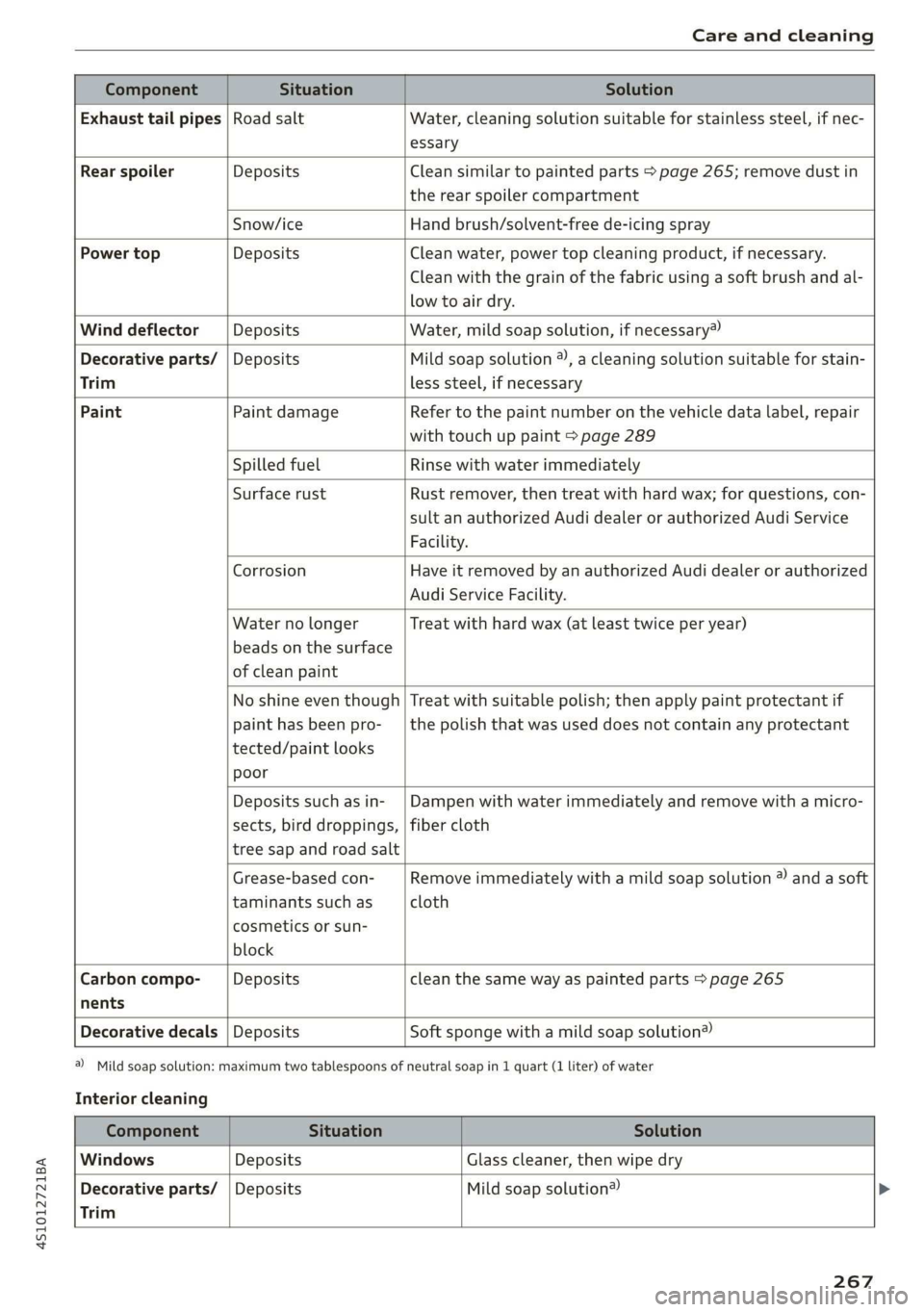
Component Situation Solution
Exhaust tail pipes | Road salt Water, cleaning solution suitable for stainless steel, if nec-
essary
Rear spoiler Deposits Clean similar to painted parts > page 265; remove dust in
the rear spoiler compartment
Snow/ice Hand brush/solvent-free de-icing spray
Power top Deposits Clean water, power top cleaning product, if necessary.
Clean with the grain of the fabric using a soft brush and al-
low to air dry.
Wind deflector Deposits Water, mild soap solution, if necessary”)
Decorative parts/ | Deposits Mild soap solution ®), a cleaning solution suitable for stain-
Trim less steel, if necessary
Paint Paint damage Refer to the paint number on the vehicle data label, repair
with touch up paint > page 289
Spilled fuel Rinse with water immediately
Surface rust Rust remover, then treat with hard wax; for questions, con-
sult an authorized Audi dealer or authorized Audi Service
Facility.
Corrosion Have it removed by an authorized Audi dealer or authorized
Audi Service Facility.
Water no longer
beads on the surface
of clean paint
Treat with hard wax (at least twice per year)
No shine even though
paint has been pro-
tected/paint looks
poor
Treat with suitable polish; then apply paint protectant if
the polish that was used does not contain any protectant
Deposits such as in-
sects, bird droppings,
tree sap and road salt
Dampen with water immediately and remove with a micro-
fiber cloth
Grease-based con-
taminants such as
cosmetics or sun-
block
Remove immediately with a mild soap solution ® and a soft
cloth
Carbon compo- Deposits clean the same way as painted parts > page 265
nents
Decorative decals | Deposits Soft sponge with a mild soap solution®
a) Mild soap solution: maximum two tablespoons of neutral soap in 1 quart (1 liter) of water
Interior cleaning
Component Situation Solution
Windows Deposits Glass cleaner, then wipe dry
Decorative parts/ | Deposits Mild soap solution®
Trim
267
Page 275 of 308
4S1012721BA
Emergency assistance
> Inflate the tire to between 29 psi (200 kPA)
and 36 psi (250 kPA) and read the pressure on
the gauge.
> If this tire pressure is not reached, remove the
filler hose. Drive slowly approximately 33 feet
(10 m) forward or in reverse so that the sealant
can be distributed in the tire. Inflate the tire
again > A\.
ZA\ WARNING
— Read and follow the manufacturer's safety
precautions on the compressor and in the in-
structions on the bottle of sealant.
— Ifa tire pressure of 29 psi (200 kPA) cannot
reached after inflating for 6 minutes, then
the tire is too severely damaged. Do not con-
tinue driving.
— If the tire cannot be repaired with the tire
sealant, see an authorized Audi dealer or au-
thorized Audi Service Facility for assistance.
@) Tips
Do not operate the compressor for more than
six minutes continuously, or it can overheat.
Once the compressor has cooled, you can con-
tinue to use it.
CeeTnn eas]
Applies to: vehicles with tire mobility kit
> Affix the sticker that says "max. 50 mph (max.
80 km/h)" that is provided with the tire mobili-
ty kit within the driver's field of vision.
> Stop the vehicle after driving for about 10 mi-
nutes and check the tire pressure.
> If the tire pressure is lower than 19 psi (130
kPA), then the tire is too severely damaged. Do
not continue driving.
Z\ WARNING
Pay attention to the following after repairing
the tire:
— Do not drive faster than 50 mph (80 km/h).
— Avoid hard acceleration or braking and driv-
ing fast around curves.
— The vehicle may become more difficult to
control.
— If the tire is too severely damaged, see an
authorized Audi dealer or authorized Audi
Service Facility for assistance.
(@) For the sake of the environment
You can give the used tire sealant bottle to an
authorized Audi dealer or authorized Audi
Service Facility for disposal.
G) Tips
Remember to obtain a new bottle of sealant
from an authorized Audi dealer or authorized
Audi Service Facility after repairing a tire.
Replacing wheels
You must complete the preparation before
changing a tire.
> Read and follow the important safety precau-
tions > page 271, General information.
> Set the parking brake.
> Select the "P" selector lever position.
> Lay out the vehicle tool kit > page 271.
ZA\ WARNING
When using the vehicle jack* on a road with a
steep hill or when offroad, you must take ex-
tra precautions to prevent the vehicle from
rolling. Use suitable objects to block the front
and back of the wheel that is diagonal from
the wheel with the flat tire.
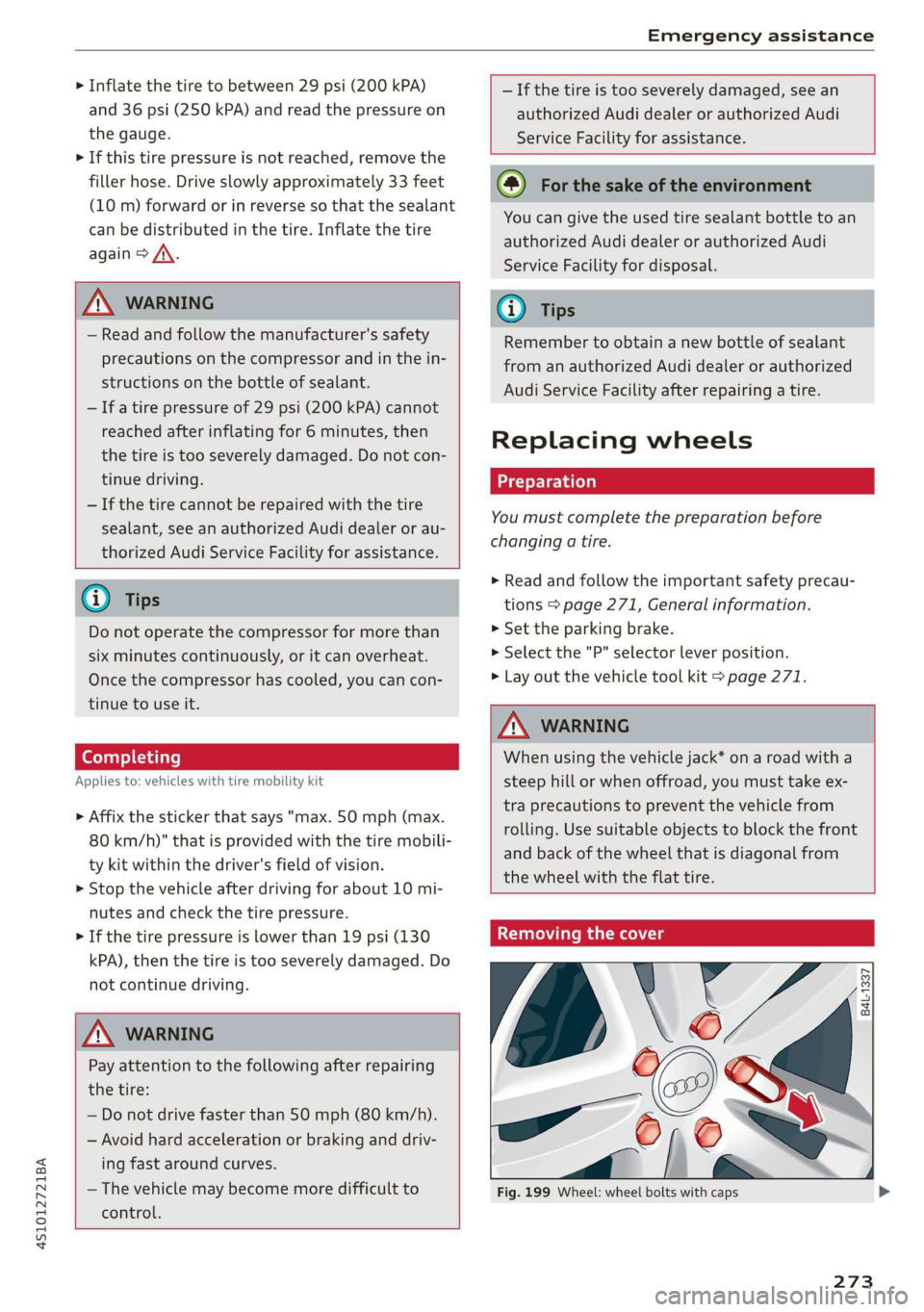
Removing the cover
te
Fig. 199 Wheel: wheel bolts with caps
273
Page 280 of 308
Emergency assistance
The jump start cable connections are located in
the luggage compartment.
Follow the information about the vehicle battery
=> page 240.
Connecting the positive cable (red) to the
positive terminal
> Open the cover for jump starting > page 242,
fig. 188.
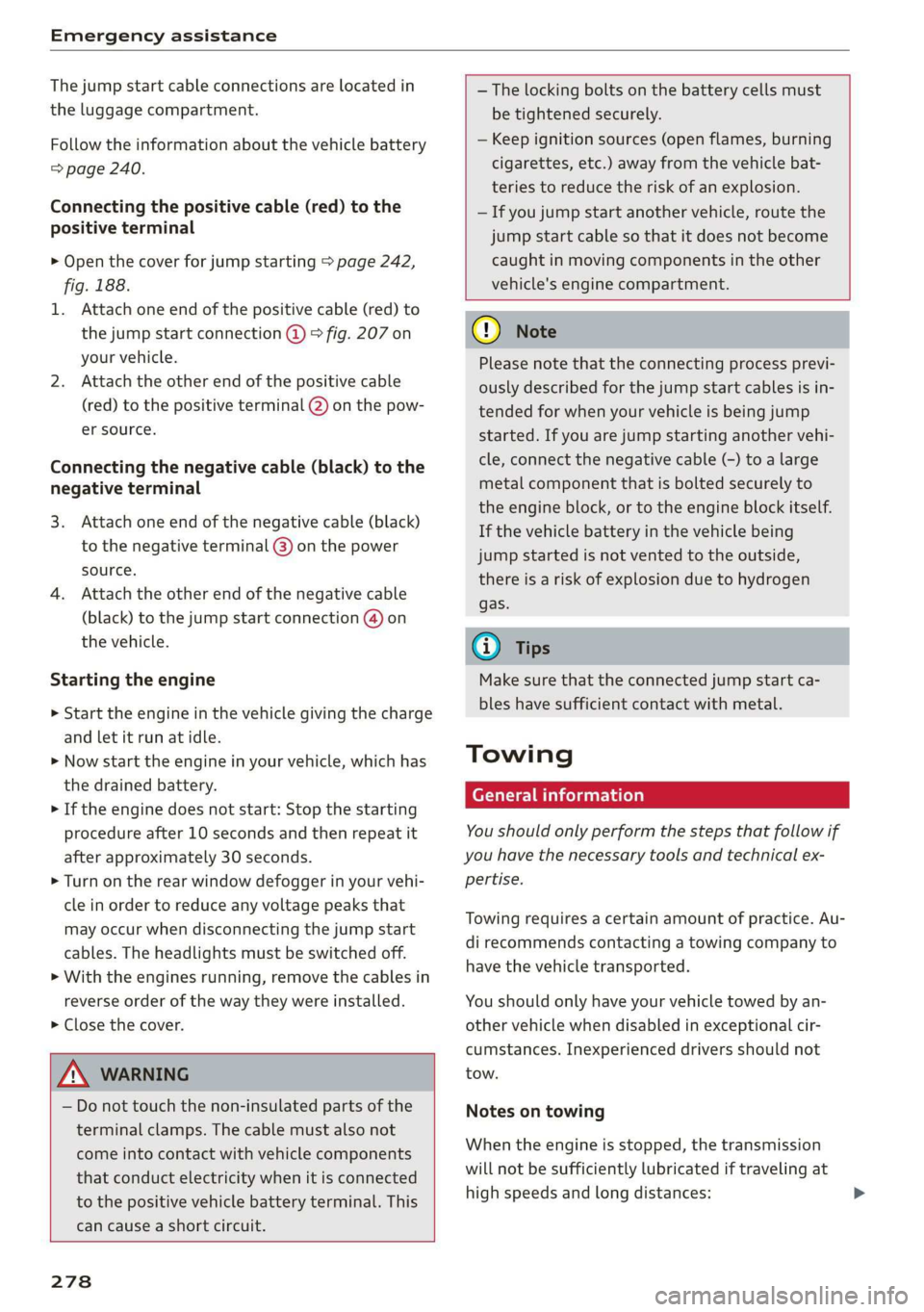
1. Attach one end of the positive cable (red) to
the jump start connection @ © fig. 207 on
your vehicle.
2. Attach the other end of the positive cable
(red) to the positive terminal @) on the pow-
er source.
Connecting the negative cable (black) to the
negative terminal
3. Attach one end of the negative cable (black)
to the negative terminal @) on the power
source.
4. Attach the other end of the negative cable
(black) to the jump start connection @) on
the vehicle.
Starting the engine
> Start the engine in the vehicle giving the charge
and let it run at idle.
> Now start the engine in your vehicle, which has
the
drained battery.
> If the engine does not start: Stop the starting
procedure after 10 seconds and then repeat it
after approximately 30 seconds.
> Turn on the rear window defogger in your vehi-
cle in order to reduce any voltage peaks that
may occur when disconnecting the jump start
cables. The headlights must be switched off.
> With the engines running, remove the cables in
reverse order of the way they were installed.
> Close the cover.
ZX WARNING
— Do not touch the non-insulated parts of the
terminal clamps. The cable must also not
come into contact with vehicle components
that conduct electricity when it is connected
to the positive vehicle battery terminal. This
can cause a short circuit.
278
—The locking bolts on the battery cells must
be tightened securely.
— Keep ignition sources (open flames, burning
cigarettes, etc.) away from the vehicle bat-
teries to reduce the risk of an explosion.
— If you jump start another vehicle, route the
jump start cable so that it does not become
caught in moving components in the other
vehicle's engine compartment.
@) Note
Please note that the connecting process previ-
ously described for the jump start cables is in-
tended for when your vehicle is being jump
started. If you are jump starting another vehi-
cle, connect the negative cable (-) to a large
metal component that is bolted securely to
the engine block, or to the engine block itself.
If the vehicle battery in the vehicle being
jump started is not vented to the outside,
there is a risk of explosion due to hydrogen
gas.
G) Tips
Make sure that the connected jump start ca-
bles have sufficient contact with metal.
Towing
General information
You should only perform the steps that follow if
you have the necessary tools and technical ex-
pertise.
Towing requires a certain amount of practice. Au-
di recommends contacting a towing company to
have the vehicle transported.
You should only have your vehicle towed by an-
other vehicle when disabled in exceptional cir-
cumstances. Inexperienced drivers should not
tow.
Notes on towing
When the engine is stopped, the transmission
will not be sufficiently lubricated if traveling at
high speeds and long distances:
Page 281 of 308
4S1012721BA
Emergency assistance
— The maximum permitted towing speed is 30
mph (50 km/h).
— The maximum permitted towing distance is 30
miles (50 km).
Additional information on towing with a tow
truck
The vehicle must not be towed with the front axle
or rear axle raised. Do not wrap any chains or ca-
bles around the brake lines.
Tow bar and towing cable
The vehicle can be towed with a tow bar or tow-
ing cable. Both drivers should be familiar with
the special considerations when towing, especial-
ly when using a towing cable.
Always make sure the traction force does not ex-
ceed the permitted level and there are no shock
loading conditions. There is always the risk of the
coupling becoming overloaded when driving off-
road.
For the most safety and security, drive with a tow
bar. You should use a towing cable only if a tow
bar is not available. Use a towing cable made of
synthetic elastic cable similar elastic material.
ZA WARNING
— Towing highly increases the risk of an acci-
dent, for example from colliding with the
towing vehicle.
— To reduce the risk of an accident, do not al-
low anyone to remain inside the vehicle
when it is being transported by a tow truck
or a special transporter.
@) Note
— If normal towing is not possible, for exam-
ple if the transmission is faulty or if the
towing distance is greater than 30 miles
(50 km), then transport the vehicle on a
special carrier.
— If the vehicle is towed by a tow truck at the
axle that is not permitted, this can cause se-
vere damage to the transmission.
D_ Requirement: the vehicle battery must have a sufficient
charge level.
— The vehicle must not be tow started for
technical reasons.
G) Tips
— If the power supply is interrupted, the se-
lector lever will not move out of the "P" po-
sition. The parking lock must be released
using the emergency release before towing
the vehicle > page 73.
— Follow the local legal regulations for tow-
ing.
Read and follow the important information under
=> page 278.
Preparations
> Only secure the towing cable or tow bar at the
designated towing loop > page 280.
> Make sure the towing cable is not twisted. Oth-
erwise it could disconnect from the towing loop
while towing.
> Switch the emergency flashers on in both vehi-
cles > page 44. However, do not do this if it
prohibited by law.
Towing vehicle (front)
> Only start to drive when the towing cable is
taut.
> Be especially careful when accelerating.
> Avoid sudden braking or driving maneuvers.
Vehicle being towed (rear)
> Make sure the ignition is switched on so that
the steering wheel is not locked and so that you
can use the turn signals, the horn, and the
windshield wipers if needed > A\.
> The brake booster only works when the engine
is running. Power steering only works when the
ignition is switched on and the vehicle is roll-
ing )). If the brake booster and power steering
are not functioning, you must press the brake
pedal much harder and use more force to steer.
> Release the parking brake > page 65.
279
>
Page 293 of 308
4S1012721BA
A
A/C (climate control system) .............. 57
ACCESSOFICES .. 0... ee eee eee 53, 286
Active rollover protection system......... 177
Retracting rollover protection.......... 178
Adaptive light. ......... 0.0.0 cece ee eee 78
Adaptive light (indicator light) ............ 20
Adjusting the additional display........... 14
Adjusting the air distribution............. 57
Adjusting the center console lighting....... 45
Adjusting the sound..............-.0005 171
Adjusting the temperature............... 57
Advanced Airbag System
Gilde mcesc « » asc «a aren os aoeuem so wweecn 2 213
Components. .......... 000s eee eee aes 194
Front airbags............-. cee eee eee 192
How the components work together..... 196
AirbaGion < + says + © wows so wwe ¢ ome 2 ee 187
Tindieator Light wisi «2 vesrevs & x covsens xo enenom « © 17
Airbag’system « «wees + wae ws saver 0 6 asseee 206
Advanced Airbag System............... 191
Cal Giccc s 2 wees & 2 ween Fs eee Fe eeeS Ee 201
Childtrestraints.« « wwivcw 2 3 seowws v2 meow 2 wees 213
Components (front airbags)...........- 194
Danger of fitting a child safety seat on the
front passenger seat..............000. 188
Disposal... .. 0.0... cee eee eee ee eee 201
Front airbags.............. eee eee eee 191
How do the front airbags work?......... 196
How many airbags does my vehicle have?. 194
Important information................ 187
Important safety instructions on the knee
AiKbaAgIsyStEMMs « sasssus ss assis wo snenace a o wr 204
Knee airbags...........-..00--00 eee 202
MONITORING saves « = cezge a 2 eae Fe Qa ez ee 198
PASSENGER AIR BAG light............. 199
Repairs... 06... eee eee 201
Safety Instructions. << veces eewe se ree 200
Siderairbags’. « «sic. ci ewan x + cece « eecee 204
Side curtain airbags...............000. 207
Warning/Indicator lights.............. 198
When must the system be inspected?.... 198
Alarm system
refer to Anti-theft alarm system.......... 26
Alignment pin (tire changing) ............ 271,
All-weather lights ......... 0.0.0 c eee eeee 40
AlUS@aSON TINCS secs es eos ee were © o meee we 259
Allwheel drive wicou. 6 neva ss eswa ev eve oe 89
All wheel drive (indicator light)............ 20
Alternative routes ........ceseceeeeeees 138
AMBIENCE UGH se + 3 eee s saves @ 8 Hee GE He 45
AMI
refer to Audi music interface....... 155,156
Android Auto
refer to Audi smartphone interface...... 165
Announcements (settings)
refer to Voice guidance................ 138
Anti-freeze
Windshield washer system............. 242
Anti-lock braking system (ABS)............ 86
Anti-Slip Regulation................00 00 86
Anti-theft alarmrsyster «voces so eons « « wie © 26
Anti-theft wheel bolts...............04. 274
Apple CarPlay
refer to Audi smartphone interface...... 165
APM ests: sssaws « «arene 6 acca vo wescene a @ esesess oe 52
Aspect ratio (Wide0) sess « . icews « 6 naews o 0 ve 160
ASR
refer to Anti-Slip Regulation............. 86
Audi connect
refertoconnect...................005 124
Audi connect Infotainment
Personal hotspot « vss s cease ss eeu s coer 125
Services overvieW...........0000000 ee 127
Audi magnetic ride
refer to Suspension control.............. 78
Audi music interface................0-- 155
Audi music stream
refer to Wi-Fi...........00200 ee 129, 153
Audio files... 0.02... cece eee ee eee 157
Audio player
Bluetooth audio player................ 153)
Wi-Fi audio player....... 0... cee cece ee 153
Audio track. ......... 0.00 e eee eee ee 160
Audi phone box.............-.000 ee eee 112
Audi smartphone interface.......... 165, 169
Audi virtual cockpit
refer to Instrument cluster.............. 10
AUTO
Automatic climate control system........ 57
Automatic headlights.................. 40
Auto Lock (central locking) ............... 21.