oil AUDI R8 SPYDER 2011 User Guide
[x] Cancel search | Manufacturer: AUDI, Model Year: 2011, Model line: R8 SPYDER, Model: AUDI R8 SPYDER 2011Pages: 244, PDF Size: 59.74 MB
Page 41 of 244
electronic immobilizer is automatically acti
vated once aga in.
If an unauthorized key was used, SAFE is dis
played continuously in the odometer display
field.
~ WARNING
-
Always take the key with you when you
leave the vehicle. The key can disarm the
electronic engine immobilizer and permit
an unauthorized person to start the engine
and enable operation of the vehicle sys
tems such as power window leading to se
rious personal injury.
@ Tips
- The vehicle cannot be started if an unau
thorized key is used . The vehicle may not
start if another radio device such as a key
for another vehicle or a transponder is
located on the key ring .
- For Declaration of Compliance to United
States FCC and Industry Canada regula
tions
r::;, page 212.
Power locking system
General description
The power locking system locks or unlocks oil
doors simultaneously.
When opening and closing the doors , the
power locking system locks or unlocks
both
doors together.
The remote master key locks and unlocks the
doors using a radio signal
r::;, page 40.
Locking and unlocking with the key
You can also lock and unlock your vehicle us
ing the key in the lock on the driver's door.
The unlocking and locking mode can be
changed in the Driver Information System
r::;,page24.
Both doors are locked automatically when the
vehicle is locked and the anti-theft alarm sys
tem is activated.
Opening and closing 39
Auto Lock
The Auto Lock function locks all doors and the
front lid once speed has exceeded approxi
mately 9 mph (15 km/h).
The car is unlocked automatically once the ig
nition key is removed . In addition, the vehicle
can be unlocked if the power locking system
opening function~ is activated or one of the
door levers is used.
Turn signals
All the turn signals flash to indicate when the
vehicle is locked and unlocked. The turn sig
nals flash twice when the vehicle is unlocked.
The turn signals flash once when all the doors
and the front lid are locked. The interior lights
are also switched on or off automatically ac
cording to the position of the door contact
switch.
A WARNING
- When you lock your vehicle from outside,
nobody -especially children -should re
main inside the vehicle. Remember,
when you lock the vehicle from the out
side the windows cannot be opened from
the inside.
- When you leave the vehicle, always re
move the ignition key and take it with
you. This will prevent passengers (chil
dren, for example) from accidentally be ing locked in the vehicle should they acci
dentally press the power locking switch
in one of the doors.
- Do not leave children inside the vehicle
unsupervised. In an emergency it would
be impossible to open the doors from
the outside without the key.
(D Tips
-The driver's door can be locked and un
locked with the key if the power locking
system fails. The passenger's door can
be locked manually
r::;, page 42.
Page 80 of 244
78 On the road
Ignition on @
Afte r switching the ignition on, the needles
move a ll the way up and then down .
I f it is difficult to tu rn the key afte r you have
i nserted it into the ignition lock, turn the
steering wheel back and forth. This will take
the load off the steering lock mechan ism and
you will be able to turn the key freely and start the engine .
Starting the engine @
In th is position the engine sta rts. While the
engine is start ing, the power s upply to the
headlights and other e lectr ica l cons umers is
tempo rari ly interrupted to conserve battery
power. After the engine has started, release
the key and it will return to posit ion @.
Before the starter can be operated again the
key must be turned back to position@. The
non-repeat lock prevents you from damaging
the starter when the engine is runn ing .
A WARNING
-Never remove the key from the ign ition
lock whi le the vehicle is moving. The
steeri ng wheel will lock causing loss of
contro l.
- If you have to leave your vehicle - even
for just a m inute - always remove t he ig
nition key and ta ke it with you. This is es
pecially important if you a re going to
leave ch ildren behind in the vehicle. The
children co uld star t t he engine or use
other vehicle controls . Unsupervised use
of vehicle controls (for examp le, power
windows) can cause serious personal in
jur ies.
(D Tips
If the veh icle battery has been discon nect
ed and then reconnected, then you must leave the key in pos ition @for abo ut 5
seconds before you can start t he engine.
-
Starting the engine
The engine can only be started with your orig
inal Audi key.
On vehicles with R tronic *, the engine can be
started in the ne utra l position N and in each
gear (1 - 6 and R).
.. Se t the park ing brake ¢,&. .
.. On ve hicles with ma nual transmission *, fully
depress the cl utch peda l.
.. Press and hold the brake peda l.
.. Turn the ignition key to posit ion @
¢ page 77, fig . 85 - do not depress the gas
pedal when starting the engine .
.. Let go of the key as soo n as the engine
starts - the sta rter must not cont inue to
r u n. On veh icles w it h R t ro nic , sele ct ge ar
posi tion N.
A cold engine may at first be loud afte r it has
been started. This is due to the hydrau lic
valves b uilding up the oil p ress ure. This is no r
mal and no need fo r conce rn .
If th e engine does not start imm ediately, stop
t ry ing after 10 seconds and t hen t ry to res tart
t h e engine abou t 30 seconds later.
A WARNING
-
- Never star t or le t the eng ine run in a con
f ined o r enclosed area . Exha ust fumes
from the en gine contain carbon monox
ide, a co lorless and odorless gas. Carbon
monox ide ca n be fatal if inhaled.
- Never leave the engine id ling unattend
ed. An unattended veh icle w ith a run ning
e ngine poses a danger of personal injury
or theft.
- With the engine r unning and a gear en
gaged, you have to hold the ve hicle w it h
the foot brak e.
(D Note
-Avo id h igh engine speeds, fast accelera
tion or heavy engine loads while the en
gine is still cold. This could damage the
eng ine.
Page 153 of 244
as a pulsing motion of the brake pedal, ac
companied by some noises. In order for ABS
to be able to operate optimally in th is range,
you must keep the brake pedal depressed -
never "pump the brakes" . You should not ex
pect that braking d istances w ill be
shortened
under all circumstances with ABS . Braking dis
tance may even be slightly
longer, for exam
p le on gravel or wi th fresh snow on a slippery
surface .
If a sign ificant
speed differential between the
d rive wheels on one axle is determined (for
examp le, on a su rface that is s lippery
on one
side),
the EDS brakes the spinn ing whee l and
transfers power to the other drive whee ls.
This is done up to a speed of about 60 mph (100 km/h) . Noises from the brake system
signal that whee l spin is being controlled.
I f one whee l spins when starting from a com
p lete stop because o f a different grip (for ex
ample , one wheel o n ice), keep your foot
hard
on the accelerator until the veh icle starts to
move.
If the wheels spin , ASR wi ll automatically re
duce engine torque and match power to road
surface conditions .
Switching on Sport mod e
In specific driving situations (e.g. Launch Con
trol), you swi tch ASR and ESP to Sport mode
by pressing the
[!I button once . The indicator
light
11 illuminates and ESP sport -Wa rni ng!
Restric ted stab ility
appears . "Slip" is matched
to the speed. You should do this only if your
driving skill and traffic cond it ions permit .
Switching ASR /ESP off
In certain sit uations (e .g . in deep snow, on a
l oose surface, o r when rocking the vehicle
free), switch ASR and ESP off by pressing the
[ill button for more than 3 seconds. The ind ica
tor light
I) illuminates and ES P sw itc hed off -
Warning! R estricted stability
appears . You
should do th is only if your driving skill and
traffic cond itions pe rmit .
Int ellig ent technolog y 151
Switching ASR /ESP on
Activate ASR/ ESP by p ressing the [!I button
again. The message
ESP on appears in the d is
play briefly.
Brake overheating
So that the disc b rake on a b raked wheel does
not overheat, the EDS switches off automati
ca lly if there is un usua lly severe loa ding at
th is wheel. The vehicle is st ill drivable and has
the same properties as a vehicle wit hout EDS .
As soon as the brake has cooled down, EDS
swi tches on aga in automatically.
A WARNING
- Even ESP, ABS, EDS and ASR cannot over
come the laws of physics . You should
keep this in m ind in particular on an icy
or wet road. If the systems intervene,
you shou ld adjust your speed immediate
ly to road and traff ic conditions . Do not
be tempted by the increased safety pro
vided to take risks -you risk having an
accident.
- Please keep in mind that the r isk of an
accident is i ncreased by driving too fast,
pa rti cularly in corners and on icy or wet
ro ads, and by drivi ng too close to the ve
hicle ahead . Even ES P, ABS, E DS and ASR
cannot eliminate the increased risk of
having an accident.
-Apply the throttle ca re fully when accel
erating on a consistently s lippery sur
face, e.g. on ice and snow . The drive
wheels can spin in spite of the EDS and thereby affect vehicle stability -you risk
having an accident .
- Please note that when ASR or ESP/ASR is
deactivated, the drive wheels can spin on
icy and slippery roads and the veh icle can
break away -the re is a risk of skidd ing!
(D Tips
- In the event of a defect in the rear spoil-
er system or in Audi magnet ic ride, it can
happen that ASR and ASR/ESP cannot be .,.
•
•
Page 154 of 244
152 Intelligent te chn olog y
deactivat ed, or they are activated auto
matically in the deactivated state .
- If a malfunction occurs in the E DS, this is
signaled by an indicator light, see
~ page 18.
- Some tracks (e.g . steeply banked turns)
may affect ESP response.
Rear spoiler
T h e rear spoil er improv es vehicle handling
and enhances driver control .
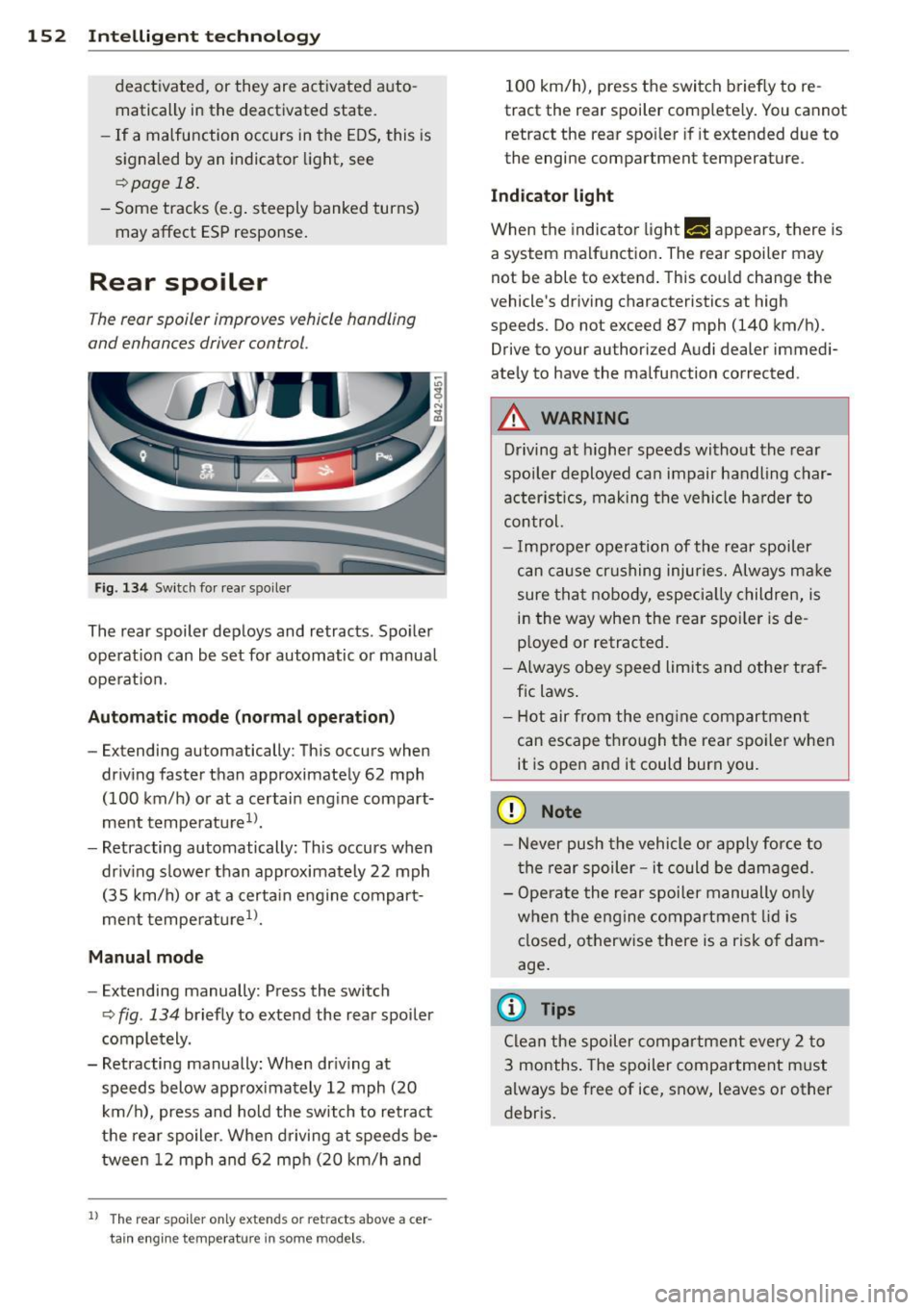
Fig . 134 Sw it ch for re ar s po ile r
The rear spoi ler deploys and retracts . Spo iler
operat ion can be set fo r automatic or manual
operation.
Automatic mode (no rmal operation )
-Extending automa tically : This oc curs when
driv ing faster than approximately 62 mph
(100 km/h) or at a certain eng ine compart
ment tempe rature
1>.
- Retracting automatically : This occurs when
dr iv ing slower than approximately 22 mph
(35 km/h) or at a certain engine compart
ment temperature
1> .
M anual mode
- Extending manually : Press the switch
~ fig . 134 briefly to extend the rear spoiler
completely .
- Retracting manually : When dr iv ing at
speeds below approximately 12 mph (20 km/h), press and hold the switch to retract
the rear spo iler. When driving at speeds be
tween 12 mph and 62 mph (20 km/h and
l) The rear s po iler o nly e xten ds or ret racts a bove ac er
ta in eng in e te mp erat ure in some m odels.
100 km/h), press the switch briefly to re
tract the rea r spoiler comp lete ly. You cannot
retract the rear spoi ler if it extended due to
the engine compartment temperature .
Indicator light
When the indicato r light f.-j appears, there is
a system malfunction . The rear spoiler may
not be able to extend . This cou ld change the
veh icle's d riving characterist ics at h igh
s peeds. Do not exceed 87 mph (140 km/h) .
Drive to your au thorized Audi dealer immedi
ately to have the malfunction corrected .
A WARNING
Driving at higher speeds without the rear
spoiler deployed ca n impair handling char
acteristics, making the ve hicle ha rder to
control.
- I mp rope r operation of the rear spoiler
can cau se crushing injuries. Always ma ke
sure tha t nobody, especia lly children, is
i n the way when the rear spoi ler is de
p loyed or retracted.
- Always obey speed limits and other traf
fic laws .
- H ot air from the eng ine compartmen t
can escape thro ugh the rear spo iler when
it is open and it could burn you .
(D Note
-Never push the vehicle or apply force to
t he rear spoiler -it could be damaged.
- Ope rate the rear spoiler manually on ly
when the eng ine compartmen t lid is
closed, otherwise there is a ris k of dam
age .
(D Tips
Clean the spoiler comp artment eve ry 2 to
3 months. The spoiler compa rtment m ust
always be free of ice, snow, leaves or other
debr is.
Page 156 of 244
154 Intelligent technology
Other road users must not be put at risk -
you may cause an accident!
- Before descending a steep grade, reduce
speed and shift transmission into a lower
gear or lower driving position . Do not
ride the brakes or hold the pedal down
too long or too often. This could cause
the brakes to get hot and diminish brak ing efficiency .
- Do not "ride the brakes" by resting your
foot on the pedal when you do not intend
to brake . This may cause the brakes to
overheat, premature wear and increased
stopping distance.
- Under certain climatic and operating
conditions such as passing through wa
ter, driving in heavy rain or after washing
the vehicle, the effectiveness of the
brakes can be reduced. In winter, ice can
accumulate on the brake pads, linings,
discs and drums. Cautiously apply brakes
for a test . Brakes will dry and ice coat
ings will be cleaned off after a few cau
tious brake applications .
- Driving for an extended period of time on
salt-covered roads without using your
brakes can also affect braking efficiency .
Clean off accumulated salt coating from
brake discs and pads with a few cautious
brake applications.
- If you damage the front spoiler, or if you
install a different spoiler, be sure the air
flow to the front brakes is not obstruct
ed. Otherwise the brake system could
overheat reducing the effectiveness of
the entire brake system.
- Failure of one brake circuit will impair
braking capability, resulting in increased
stopping distance. Avoid driving the vehi
cle and have it towed to the nearest au
thorized Audi dealer or qualified work
shop.
- Never let the vehicle roll to a stop with
the engine shut off .
- If the brake booster is not working, for
example when towing your vehicle, or because the brake booster has somehow
been damaged, the brake pedal must be pressed considerably harder to make up
for the lack of booster assistance.
Power steering
When the engine is running , power steering
makes i t easier for the driver to steer.
Power steering helps the driver steer the vehi
cle with little physical effort.
If the engine is not running, the power steer
ing system is also not working . In this case ,
you will find it extremely difficult to turn the
steering wheel.
If you turn the steering fully to the left or
right when the vehicle is stationary, you place
a very heavy load on the power steering sys
tem. Turning the steering wheel fully to the left or right will cause noise in the system. It
also reduces engine idle speed.
(D Note
Do not hold the steering turned fully to
the left or right for more than 10 seconds
when the engine is running . There is a risk
of damage to the power steering system .
(D Tips
-In the event of a power steering system
failure, or if the engine is not running
(while being towed), you will still be able
to steer the vehicle. However, you will re
quire more effort to do so .
- If the power steering system has a leak
or is defective, you should immediately
contact a qualified workshop .
- The power steering system requires a
special hydraulic fluid. The power steer
ing fluid reservoir is located in the en
gine compartment. The correct hydraulic
fluid level is important for proper opera
tion of the power steering system. The
power steering fluid level is checked ac
cording to the Audi maintenance service
schedule.
Page 159 of 244
will be recharged and the notification will go
out.
Driver notification appears and goes out
again
If this driver notification appears after the ig
nition is turned on or while driv ing and it goes
out again after a wh ile, the battery has been
adequately recharged.
Driver notification appears and does not
go out again
If this driver notification appears after the ig
nition is turned on or while driv ing and does
not go out again, the battery's state of charge
is not in the optimal range. Starting ability is
restricted. Have the battery checked as soon
as poss ible by an author ized Audi dealer or
qualified workshop.
Dry sump lubrication
H igh lateral and long itud inal forces affect the
engine and the vehicle during sporty driving.
Dr y sump l ubr ica tion ensures that your engine
i s supplied w ith oil and properly lub ricated
even under these conditions.
I n a "normal" veh icle the o il pump sends the
oil from the oil pan to the lubrication points in
the engine. The oil then returns to the oil pan .
I n extreme situations, the oil pump may draw
in air, which results in insufficient oil pressure.
With dry sump lubrication, the oil is not in the
oil pan (it is "d ry"), but in a separate oi l tank.
While one pump supplies the engine with oi l,
a second pump suctions the oi l out of the en
g ine and returns it to the oil tank . Because the
oil tank is ta ll and narrow, o il pressure is con
stant even under extreme conditions.
In addition, the oil pan in vehicles with dry
sump lubrication is noticeably sha llower. Th is
allows the engine to be installed lower in the
vehicle, bringing down the center of gravity .
This improves your vehicle's handling .
Intelligent technology 157
•
•
Page 161 of 244
-Have you r vehicle maintained properly
and in accordance with the service rec
ommendat ions in your Warranty
& Main
tenance booklet.
- Lack of proper maintenance as well as
improper use of the vehicle will impair
the function of the Emission Control Sys
tem and could lead to damage.
Sporty driving
Warming up and cooling down
By carefully warming up and cooling down
your vehicle, you can he lp ensure that it is not
overstressed unnecessarily during sporty driv
ing.
When warming up, the vehicle is driven at a maximum engine speed of
6000 RPM
(Vl0 engine) or 7000 RPM (V8 engine) in or
der to raise the engine oil temperature to a minimum of
140 °F (60 °(). The tires also on
ly reach their full road holding capability once
they have warmed up .
The cooling fan can continue to run in your ve h icle after the engine is switched
off. H owev
er, driving the vehicle to cool it down is part ic
ularly important. During sporty driving, the
engine and brakes, the exhaust system, and
the t ransm ission all become ex treme ly hot.
Before you park the vehicle, you shou ld d rive
it for a few mi les/kilometers at light load in
the low rpm range to allow it to coo l down .
Driving on a track
Before you take your vehicle out on a track,
ensure that it is in perfect condition. For ex
ample, you should check the tire tread and the brake pads . It is best to increase t ire pressure
by about 0 .3 bar .
When driving on a track, oil consumption may be somewhat higher than in "normal" opera
tion ¢page
180.
You shou ld definitely inspect your vehicle af
ter subjecting it to severe condit ions. Are the
brake pads OK? Is there anything unusual
Dri vin g and en vironm ent 159
about the ti res, including the inner and outer
sidewa lls (e.g . tread, blistering)? Are the air
intakes free of leaves and tire dust? Is the o il
l evel OK?
Your authorized Audi dea ler or qua lified work
shop will be happy to undertake an inspection
before and after use on the race track.
(D Tips
- Some race tracks (e.g . steeply banked
t u rns) may affect the response of the
ESP .
- When driven on a race track, all vehicle
parts are severe ly stressed. This can re
sult in increased wear.
Operation and maintenance
Fuel economy, env ironme nta l impact, and
wear on your eng ine, brakes and tires largely
depend on three factors:
- your personal driving style
- operating conditions
- technical limitations
By having your ve hicle reg ularly se rv iced by an
authorized Aud i dea ler helps to ens ure that i t
r uns properly and econom ica lly. The condition
of your veh icle not only affects its safety and
ability to ho ld its va lue, it a lso affects
f u el
con sumptio n.
The amount o f oi l used is re lated to engine
load and speed .
It is normal fo r the oil consump tion of a new
engine to reac h its lowest value after a certa in
mileage has been d riven.
You must drive your veh icle about 3,000 mi les
(5,000 kilometers) before you can p rope rly
assess oil consumpt ion.
This also app lies to fue l cons umption and en
gine output.
(D Note
- Have your veh icle ma inta ined properly
and in accordance with the service
•
•
Page 163 of 244
Cleaning and protect ion
General information
Regular core preserves vehicle value.
Regular and correct care will contribute to
maintaini ng the beauty and value of your Au
d i. Furthermore, good care may be a condition
for substantiating a warranty cla im should
corrosion damage or paint defects occur.
Your authorized Audi R8 dealer has a variety
of
d edicat ed ve hicl e-car e produ ct s. Please
make sure you apply them correctly .
A WARNING
-Cleaning agents may be poisonous. Keep
them out of the reach of children.
- Heed all caution labels .
- Always read directions on the container before using any product. Follow the di
rect ions carefu lly.
- Most chemical cleaners are concentrated and have to be diluted .
- Use spot removing fluids only in well
ventilated areas .
- Do not use gasoline, kerosene, d iesel
fuel, nail polis h remover or other volatile
fluids . They may be toxic, flammab le or
haza rdous in other ways. Do not wash,
wa x or d ry the vehicle wi th the ign it ion
on or the eng ine running.
- Do not clean the undersides of chassis,
fenders, wheel covers, e tc. wit h out pro
tecting your hands and arms . You may
c u t yourself on sharp -edged metal parts .
- Moist ure and ice on brakes may imp air
braking efficiency
c:> page 153, Broking.
T est the brakes carefully each time you
wash the vehicle.
@) For the sake of the environment
Select only environmentally friend ly clean
ing products . Leftover clean ing products
should not disposed of in the household
waste .
Cleaning and protec tion 16 1
Care of exterior
Washing your vehicle
The longer i nsect rema ins, bird dropp ings,
t ree res in , ro ad and indust rial dust, tar , soo t
particles, road salt, and o ther aggressive de
pos its remain on the vehicle su rface, the more
lasting their destructive effect will be . High
temperatures, for example from intense s un
light, intensify the corrosive effect.
After the end of winter road salting, the un derside of the vehicle shou ld be thoroughly
washed .
Automatic car washes
You must t ake the necessary precautions s uch
as clos ing t he windows and convert ible top
before using an automatic car wash.
If yo ur
vehicle has specia l accessories - e.g . spoilers,
radio antenna -it is best to speak to the oper
ator of the car wash c:>(D .
Only use car washes where the vehicle re
mains stationary and the cleaning equipment
moves around the veh icle while washing and
drying. It is not possib le to use car washes
where the vehicle is moved forward on a con
veyer
c:> ,& .
It is preferab le to wash your vehicle in a
brush less carwash .
Washing with a pow er wa sher
When was hing yo ur vehicle with a power
washe r, be sure to follow the operating in
structions for the power washer. This applies particu larly to the
p ressure and the spra ying
distance .
Mainta in sufficient distance from
soft materials such as rubber hoses, sound
deade ning mater ial, and the park ing aid sen
sors* that are located i n the front or rear
bumper.
Do not use washers with
a ro tating jet or a
nozzle spraying
a h igh pr essur e je t of wate r in
any case.
IJl,-
•
•
Page 164 of 244
162 Cleaning and protection
Hand washing
When washing your vehicle by hand, first soft
en the dirt with copious amounts of water and
rinse it
off as best you can.
Then clean the vehicle using a soft
sponge, an
auto glove or a low-pressure wash brush.
Work from the top down to the bottom, start
ing with the convertible top
¢ page 163. Use
a
shampoo only for v ery stubborn dirt.
Rinse the sponge or auto glove thoroughly at
frequent intervals.
Clean the wheels, door sills and similar areas last. Use a separate sponge for this.
_& WARNING
-Car washes with conveyors can damage
the vehicle tires, which could cause the tire to lose pressure suddenly while driv
ing and put you at risk for an accident.
Do not use car washes with conveyors.
- Switch
off the ignition when you wash
your vehicle to avoid an accident.
- Protect your hands and arms from sharp
metal edges when you clean the under
body, the inside of the wheel wells or the
wheel covers to avoid cutting yourself.
- When washing your vehicle in the winter :
Moisture and ice in the brake system can
affect the brakes.
- Never wash tires with a jet that sprays
water in a direct stream . This could cause
invisible damage to the tires and weaken
them, even if the spray is from a relative
ly long distance and for a short time .
Damaged and weakened tires can fail
and cause accidents and personal injury.
(D Note
- Never drive your vehicle through any au
tomatic car wash that fails to provide ei
ther sufficient clearance for your vehicle
or sufficient track width for your tires. Risk of expensive damage to the vehicle's
underbody , tires, and rims!
- As described in your Warranty
& Mainte
nance booklet, damage or malfunction due to misuse of the vehicle or failure to
operate the vehicle in accordance with
the
instructions of this Owner's Manual
will not be covered under warranty.
- Fold the exterior mirrors flat - there is a
risk of damaging the exterior mirrors .
Power folding exterior mirrors must not
be folded in or out by hand. Use the pow
er function!
- Do not wash the vehicle in direct sun
light. You may damage the paint.
- Do not use sponges designed to remove
insects, rough kitchen sponges, or simi
lar products. You risk damaging the
paint surface.
- You should remove debris (such as in
sects) from the headlight lenses on a
regular basis, for example when refuel
ing your vehicle. Never clean the head
lights with a dry cloth or sponge . Use a
wet cloth or sponge .
It is best to use
soapy water.
- Never clean tires using a nozzle that
sprays water in a direct stream. Damage
can occur even with a relatively long
spraying distance and for a very short
time.
- To avoid damaging your vehicle, always
make sure that there is sufficient dis
tance between the spray head and soft materials like rubber hoses, plastic parts
and sound-deadening materials. Never
aim the spray head at the same point for
a long time. This also applies to cleaning
headlights and painted bumpers. Re
member: the closer the nozzle is to the
surface of the material, the greater the
stress on the material.
- Never clean the convertible top using a
power washer.
@) For the sake of the environment
Wash your vehicle only at specially de
signed facilities. They can prevent any dirty
water contaminated by oil from entering
the waste water. In certain areas washing
a car outside of such facilities is not per
mitted.
Page 165 of 244
Convertible top care
The convertible top requires special core.
Keeping your top looking great and making
certain that it lasts a long time depend to a
great extent on proper use and care. Remove b ird droppings as soon as possible, since the
corrosive chem icals in them will cause the
rubber impregnat io n i n your top to swell and
possibly allow the fab ric to leak.
W ith
normal soiling, all you need to do is
clear the top with a soft brush and clear wa
ter. Always brush in the direction of the fabric
from front to rear.
If the top is
very dirty and has spotted areas
clean it with a brush us ing a convert ible top
cl eane r. A lways brush in the direction of the
fabr ic from front to rear. Rinse w ith plenty of
clear wa te r, a nd a llow the top to air -dry.
Chamois are not suitable fo r d ry ing the top.
Never use gasoline, spot remover, benzene,
pa int thinner or solvents to remove spots. We
recommend that you only use cleaners espe
cially fo rmu lated for use on convertible tops,
a nd that you follow the p rod uce use directions
caref ully. Au thor ized A udi deals can provide
deta iled i nformation.
A WARNING
Always read and heed a ll WA RNINGS and
the information on
r:!;> page 1 61.
CD Note
N ever use a high-pressu re power was he r to
clean t he conver tible top.
Wind deflector
C lea r the wind deflecto r with water or, if it is
heavi ly soiled, a chemically neutra l cleaning
solut ion.
A WARNING
Always read and heed a ll WARNI NGS and
the information on
r:!;>poge 161.
Cleaning and protec tion 163
Waxing and polishing
Waxing
Wax ing pro tects the paint. When water no
l o nger clearly
b eads on the clean pai nt you
sho uld renew yo ur vehicle's pro tect io n by ap
ply ing a good
hard w ax polish .
Even if you regularly use a wa x process in the
ca r wash, we recommend protect ing the pa int
at leas t tw ice pe r year u sing har d wax.
It is muc h eas ie r to clean insects and other
debris from
freshly waxed paint.
Polishing
Polishing is necessary on ly if the paint on your
vehicle has lost its shine and if you cannot
achieve any gloss with wax mater ials.
If the po lish you use does not contain any
preservative ingredients, yo u will have to wax
the paint afterwards.
A WARNING
Always read and heed all WARNING and
other Information ~ page 161.
CD Note
Do not treat matte anodized meta l trim,
plastic, or rubber parts with polish or wax.
Trim strips
Fo r environmental reasons, Audi fabricates
the b right t rim s trips and trim p ieces from
pure ch romium-free al uminum.
-
D irt and marks on the trim strips shou ld be
removed w it h a
pH-balan ced cleani ng agent
(do not use a chrome cleane r). Pa int polishes
are a lso not suitable for the ca re of decorative
parts and trim s trips. Al ka line cleane rs wh ich
are often used be fore en ter ing c ar washes can
ca use du ll o r milky spots when they dry.
Autho rized Aud i dea le rs ca rry clean ing p rod
u cts which have bee n tested f or use on yo ur
vehicle and are no t harmfu l to the environ
ment.
•
•