oil AUDI R8 SPYDER 2011 Owner's Guide
[x] Cancel search | Manufacturer: AUDI, Model Year: 2011, Model line: R8 SPYDER, Model: AUDI R8 SPYDER 2011Pages: 244, PDF Size: 59.74 MB
Page 185 of 244
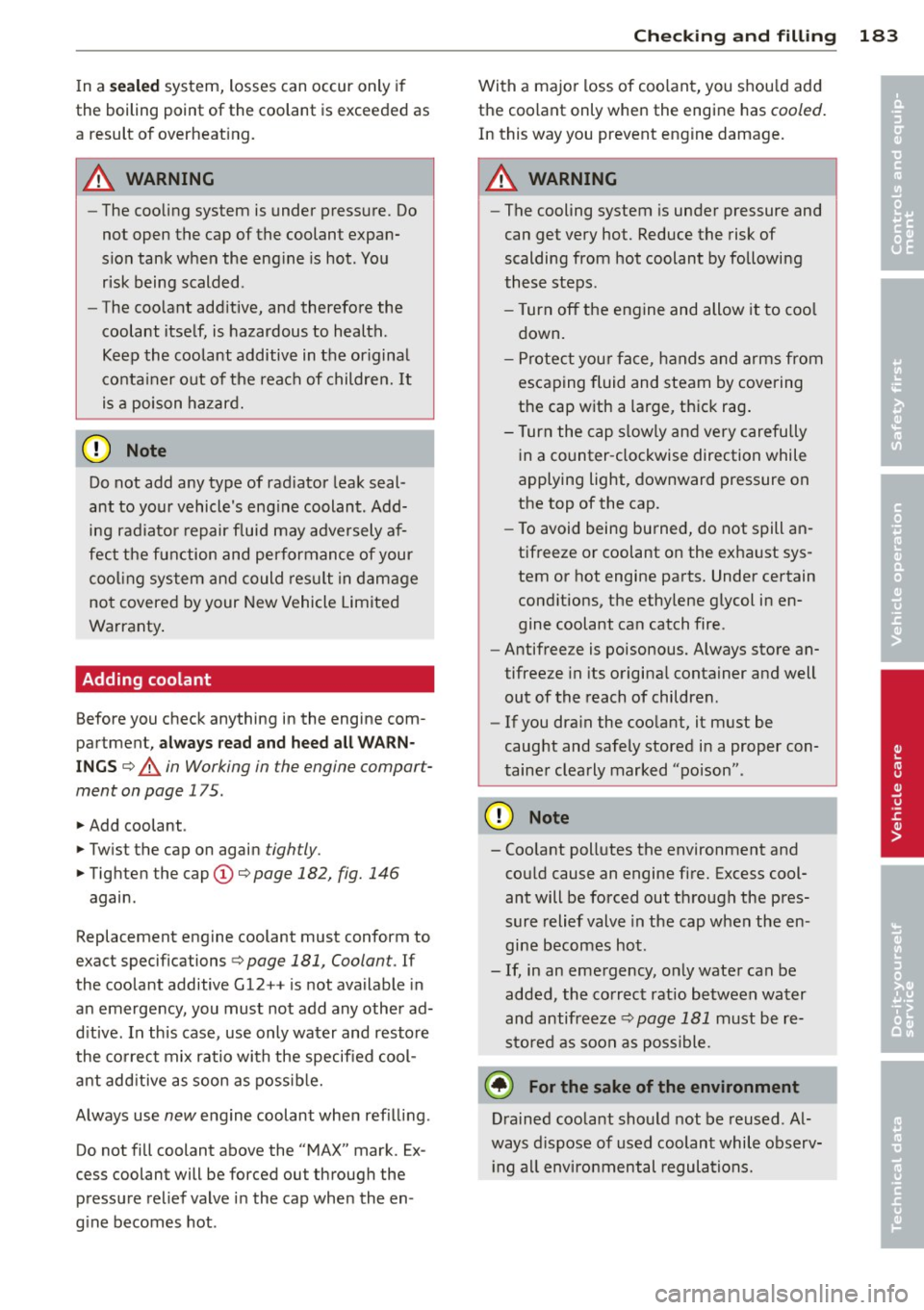
In a se ale d system, losses can occur only if
the boiling point of the coolant is exceeded as
a result of overheat ing.
A WARNING
- The cooling system is under press ure. Do
not open the cap of the coolant expan
sion tank when the eng ine is hot. You
risk being scalded .
- The coo lant add itive, and therefore the
coolant itse lf, is hazardous to health.
Keep the coolant additive in the origina l
co nta iner out of the reach of children.
It
is a poison hazard.
CD Note
Do not add any type of rad iator leak seal
ant to your vehicle's eng ine coolant. Add
ing radiator repair f luid may adve rsely af
fect the fu nction and performance of your
coo ling system and could res ult in damage
not covere d by your New Vehicle Limited
Warranty .
Adding coolant
Before you check anything in the engine com
partment,
always read and heed all WARN
INGS ¢ & in Working in the engine compart
ment on page 175 .
.. Add coolant .
.. Tw ist the cap on again
t ightly.
.. Tighte n the cap (D ¢ page 182, fig. 146
again .
Replacement engine coolant must conform to
exact specifications ¢
page 181, Coolant. If
the coolant additive Gl2++ is not available in
an emergency, you must not add any other ad
d itive . In th is case, use only water and restore
the co rrec t mix ratio wi th the specified cool
ant add itive as soon as possib le.
Always use
new engine coolant when ref illing .
Do not fill coolant above the " MAX" mark. Ex
cess coolant will be forced out through the p ressure relief valve i n the cap when the en
g ine becomes hot .
Checking and fillin g 183
With a major loss of coolant, you shou ld add
the coolant only when the engine has
cooled.
In this way you prevent engine damage.
A WARNING
- The cooling system is unde r pressure and
can get very hot. Reduce the risk of
scalding from hot coolant by followi ng
these steps .
- Turn off t he engine and allow it to coo l
down.
- Protect you r fa ce, hands and arms from
escaping fluid and steam by covering
the cap with a large, th ic k rag.
- Turn the cap s lowly and very carefully
in a counter -clockwise direction while
applying light, downward pressure on
the top
of the cap.
- To avoid being bu rned, do not spill an
tifreeze or coolant on the ex haust sys
tem or hot engine pa rts. Under certain
cond itions, the ethylene glycol in en
gine coolant can catch fire .
- Antifreeze is poisonous . Always store an
tifreeze in its origina l container and well
out of the reach of children .
- If you dra in the coo lant, it m ust be
caught and safely stored in a proper con
taine r clearly marked " poison" .
CD Note
- Coolant pollutes the environment and
cou ld cause an engine fire. Excess cool
ant will be forced out through the pres
sure relief valve in the cap w hen the en
gine becomes hot .
- If, in an eme rgency, o nly wate r can be
added, the co rrec t ratio between wa ter
and antifreez e
¢page 181 must be re
stored as soon as poss ible.
@) For the sake of the environment
D ra ined coola nt sho uld not be reused. Al
ways d ispose of used coolant while observ
i ng a ll environmental regula tions. •
•
Page 198 of 244
196 Tires and wheels
wheels you have to adjust the tire pressures
on all wheels.
A WARNING
Incorrect tire pressures and/or underinfla
tion can lead sudden tire failure, loss of
control, collision, serious personal injury
or even death.
- When the warning symbol
RI] appears in
the instrument cluster, stop and inspect
the tires .
- Incorrect tire pressure and/or underinfla
tion can cause increased tire wear and
can affect the handling of the vehicle and
stopping ability .
- Incorrect tire pressures and/or underin flation can also lead to sudden tire fail
ure, including a blowout and sudden de
flation, causing loss of vehicle control.
- The driver is responsible for the correct
tire pressures for all tires on the vehicle .
The applicable pressure values are locat
ed on a sticker on the driver's side 8-pil
lar.
- Only when all tires on the vehicle are fil
led to the correct pressure, the tire pres
sure monitoring system can work cor
rectly.
- The use of incorrect tire pressure values
can lead to accidents or other damage.
Therefore it is essential that the driver
observe the specified tire pressure values
for the tires and the correct pressures for
the function of the tire pressure monitor
ing system .
- Always inflate tires to the recommended
and correct tire pressure before driving
off .
- Driving with underinflated tires bend
more, letting them get too hot resulting
in tread separation, sudden tire failure
and loss of control.
- Excessive speed and/overloading can
cause heat build-up, sudden tire failure
and loss of control.
- If the tire pressure is too low or too high,
the tires will wear prematurely and the
vehicle will not handle well. -
If the tire is not flat and you do not have
to change a wheel immediately, drive at
reduced speed to the nearest service sta
tion to check the tire pressure and add
air as required .
(D Note
Driving without valve stem caps can cause
damage to the tire valves. To prevent this,
always make sure that factory installed
valve stem caps on all wheels are securely mounted on the valve.
@ For the sake of the environment
Underinflated tires will also increase the
fuel consumption .
Tires and vehicle load limits
There are limits to the amount of load or
weight that any vehicle and any tire can carry .
A vehicle that is overloaded will not handle
well and is more difficult to stop. Overloading
can not only lead to loss of vehicle control,
but can also damage important parts of the
vehicle and can lead to sudden tire failure, in cluding a blowout and sudden deflation that
can cause the vehicle to crash.
Your safety and that of your passengers also depends on making sure that load limits are
not exceeded. Vehicle load includes everybody
and everything in and on the vehicle . These
load limits are technically referred to as the
vehicle 's
Gross Vehicle Weight Rating
("GVWR").
The "GVWR" includes the weight of the basic
vehicle, all factory installed accessories, a full
tank of fuel, oil, coolant and other fluids plus
maximum load. The maximum load includes
the number of passengers that the vehicle is
intended to carry ("seating capacity") with an
assumed weight of 150 lbs. (68 kg) for each
passenger at a designated seating position
and the total weight of any luggage in the ve-
hicle. ..,_
Page 201 of 244
A WARNING
Sudden tire failure can lead to loss of con
trol, a crash and serious personal injury!
- Never drive a vehicle when the tread on
any tire is worn down to the wear indica
tors.
- Worn tires are a safety hazard, they do
not grip well on wet roads and increase
your risk of "hydroplaning" and loss of
control.
- Always keep chemicals that can cause
tire damage, such as grease, oil, gasoline
and brake fluid away from t ires.
- Tires age even if they are not be ing used
and can fail suddenly, especially at high
speeds . Tir es that are more than 6 years
old can only be used in an emergency
and then with special care and at lower
speeds.
- Never mount used tires on your vehicle if
you are not sure of their" previous histo
ry ." Old used tires may have been dam
aged even though the damage cannot be
seen that can lead to sudden tire failure
and loss of vehicle control.
Tires and wheels 199
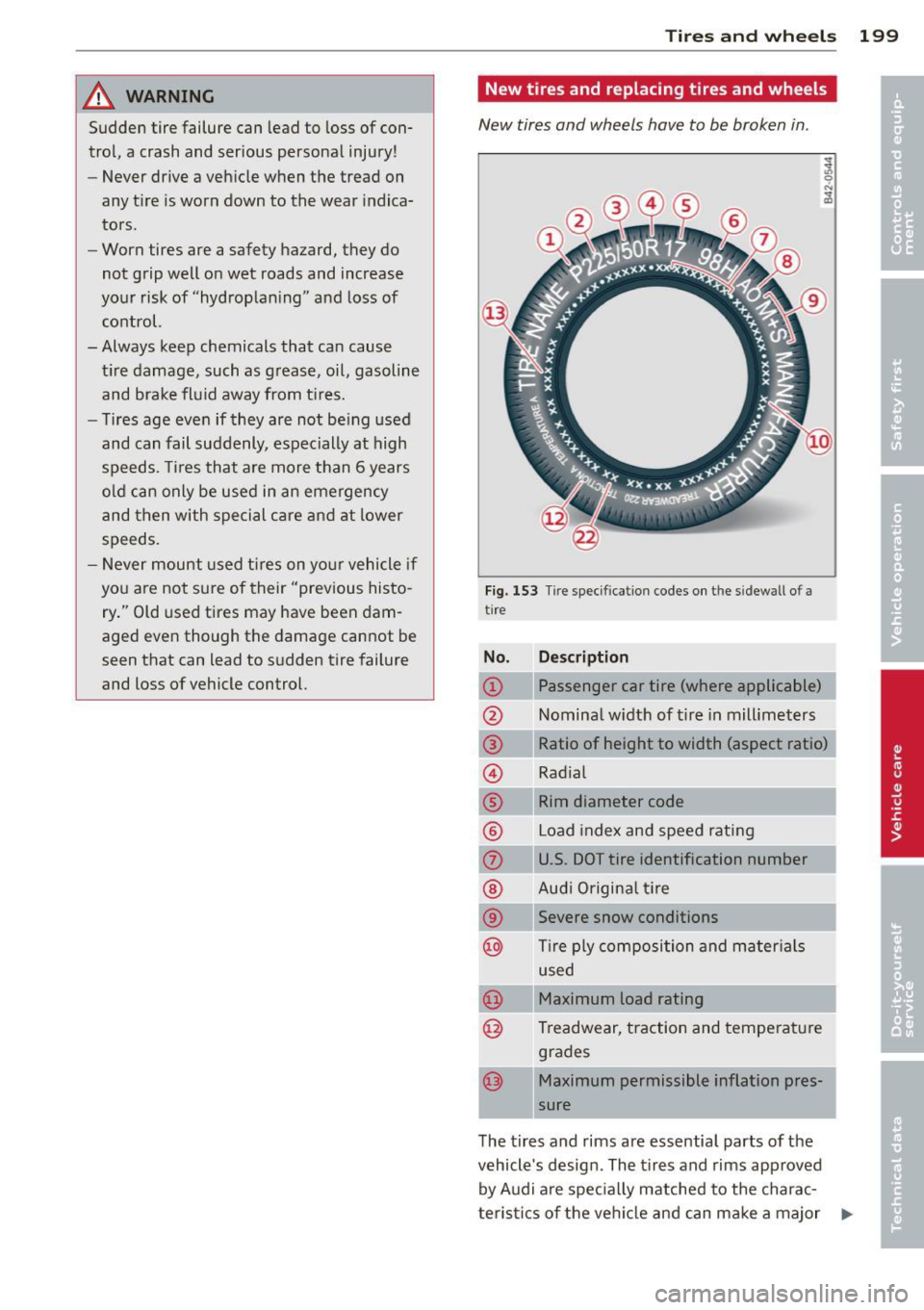
New tires and replacing tires and wheels
New tires and wheels have to be broken in .
Fig. 153 Tir e specificat ion codes on t he s idewall o f a
tire
No. Description
CD Passenger car tire (where applicable)
@ Nominal w idth of tire in millimeters
® Ratio of height to width (aspect ratio)
© Radial
® Rim diameter code
® Load index and speed rating
(f) U.S. DOT tire identification number
® Audi Origina l tire
® Severe snow conditions
@ T ire ply composition and materials
used
@ Maximum load rating
@ Treadwear, traction and temperature
grades
@ Maximum permissible inflation pres-
sure
The tires and rims are essential parts of the
vehicle's design . The tires and rims approved
by Audi are spec ially matched to the charac
teristics of the vehicle and can make a major .,.
•
Page 207 of 244
the wheel bolts. These are available from au
thorized Audi dealers.
A WARNING
Using the wrong snow chains for your vehi
cle or installing them incorrectly can in
crease the risk of loss of control leading to
serious personal injury.
- Snow chains are available in different
sizes. Always make sure to follow the in
structions provided by the snow chain
manufacturer .
- When driving with snow chains, never
drive faster than the speed permitted for
your specific snow chains.
- Always observe local regulations.
- Remove snow chains before driving on
roads not covered with snow to avoid
damaging tires and wearing the snow
chains down unnecessarily.
- Snow chains, which come into direct con
tact with the wheel rim, can scratch or
damage it. Therefore, make sure that the
snow chains are suitably covered . Check
the position of the snow chains after
driving a few yards and correct if neces
sary. Follow the instructions from the
snow chain manufacturer when doing so.
(D Tips
Where snow chains are mandatory oncer
tain roads, this normally also applies to ve
hicles with all-wheel drive.
Wheel bolts
Wheel bolts must always be tightened to the
correct torque.
The design of wheel bolts is matched to the
factory installed rims. If different rims are fit
ted, the correct wheel bolts with the right
length and correctly shaped bolt heads must
be used. This ensures that wheels are fitted
securely and that the brake system functions
correctly .
Tires and wheels 205
In certain circumstances, you may not use
wheel bolts from a different vehicle -even if it
is the same model
r:!> page 211.
A WARNING
Improperly tightened or maintained wheel
bolts can become loose causing loss of
control, a collision and serious personal in
jury.
- Always keep the wheel bolts and the
threads in the wheel hubs clean so the
wheel bolts can turn easily and be prop erly tightened.
- Never grease or oil the wheel bolts and
the threads in the wheel hubs. They can
become loose while driving if greased or
oiled, even if tightened to the specified
torque.
- Only use wheel bolts that belong to the
rim being installed.
- Never use different wheels bolts on your
vehicle.
-Always maintain the correct tightening
torque for the wheel bolts to reduce the
risk of a wheel loss. If the tightening tor
que of the wheel bolts is too low, they
can loosen and come out when the vehi
cle is moving.
If the tightening torque is
too high, the wheel bolts and threads
can be damaged and the wheel can be
come loose.
(D Note
The specified torque for the wheel bolts is
90 ft lb (120 Nm) with a tolerance of ± 7 .4
ft lb( ± 10 Nm). Torque wheel bolts diago
nally. After changing a wheel, the torque
must be checked as soon as possible with a
torque wrench -preferably by an author
ized Audi dealer or qualified workshop.
Low aspect ratio tires
Your Audi is factory-equipped with low aspect
ratio tires. These tires have been thoroughly
tested and been selected specifically for your model for their superb performance, road feel
and handling under a variety of driving
IJ>,
•
•
Page 211 of 244
Consumer Information
Warranty coverages
Your Audi is covered by the following war
ranties :
-New Vehicle Limited Warranty
- Limited Warranty Against Corrosion Perfo-
ration
- Emissions Control System Warranty
- Emissions Performance Warranty
- California Emissions Control Warranty (USA
vehicles only)
- California Emissions Performance Warranty
(USA vehicles only)
Detailed information regarding yo ur warran
ties can be found in your
Warranty & Mainte
nance booklet .
Operating your vehicle
outside the U.S.A. or
Canada
Government regulations in the United States
and Canada require that automobiles meet
specific emission regulations and safety
standards. Therefore, veh icles built for the
U.S.A. and Canada differ from vehicles sold in
other countries .
I f you p lan to take your vehicle outside the
continental limits of the United States or Can
ada, there is the possibility that
- unleaded fuels for vehicles with cata lytic
converter may not be available;
- fuel may have a considerably lower octane
rating . Improper fuel may cause engine
damage;
- service may be inadequate due to lack of
proper service facilities, tools or testing
equipment;
- replacement parts may not be readily availa
ble.
- Navigation systems for vehicles built for the
U.S.A. and Canada will not necessari ly work
in Europe, and may not work in other coun
tries outside of North America.
Consumer Information 209
@ Note
Audi cannot be responsible for mechanical
damage that could result from inadequate
fuel, serv ice or parts availab ility.
Audi Service Repair
Manuals and Literature
Audi Offic ial Factory Service Manuals and Lit
erature are published as soon as possible after
model introduct ion. Service Manuals and liter
at ure are available to order from the Audi
T echnical Literature Ordering Center at:
https: //www. audi.techliterature.com
Maintenance
' General
Your vehicle has been designed to help keep
maintenance requirements to a minimum.
However, a certain amount of regular mainte
nance is still necessary to assure your vehicle's
safety, economy and reliability . For detailed
vehicle maintenance consult your Warranty& Maintenance booklet.
Under difficult operating conditions , for ex
ample at extremely low outside temperatures,
in very dusty regions, etc., some service work
shou ld be pe rformed between the intervals
specified. This applies particularly to:
- oil changes, and
- cleaning or replacing the air fi lter.
@ For the sake of the environment
By regu larly maintaining your vehicle, you
help make sure that emission standards
are maintained, thus minimizing adverse
effects on the environment.
Important considerations for you and
your vehicle
T he increasing use of electron ics, soph isticat
ed fuel injection and emission control sys
tems, and the genera lly increasing technica l
complexity of today's automobiles, have ..,_
•
•
Page 212 of 244
210 Consum er Inf orm ati on
steadi ly reduced the scope of maintenance
and repairs which can be carried out by vehicle
owners.
Als o, sa fe ty a nd en vir onm ent al con
cerns p lace very strict limits on the nature of
repairs and adjustments to engine and trans
miss ion parts which an owner can perform .
Maintenance, adjustments and repa irs usua lly
require special tools, testing devices and oth
er equipment available to specially trained
workshop personnel in order to assure proper pe rformance, reliab ility and safety of the vehi
cle and its many systems .
Improper maintenance, adjustments and re pa irs can impair the operation and reliab ility
of your vehicle and even void your vehicle war
ranty. Therefore , proof of servic ing in accord
ance w ith the ma intenance schedule may be a
condition for upholding a poss ible warranty
claim made within the warranty period.
Above all, operational safety can be adversely
affected, c reating unnecessary risks for you
and your passengers .
If in doubt about any se rv icing, have it done
by your author ized Audi dealer or any other
p roperly equipped and qualified workshop .
We strong ly urge you to give yo ur a utho rized
Aud i dealer the opportunity to perfo rm all
schedu led maintenance and necessary repairs.
Your dea ler has the facilities, original parts
and trained spec ialists to keep your vehicle
running properly .
Performing limit ed ma int enance your self
The following pages describe a limited num
ber of proced ures which can be performed on
your ve hicle with ordinary too ls, shou ld the
need arise and trained personnel be unavaila
ble. Before performing any of these proce
dures, always thoroughly read all of the app li
cable text and carefully follow the instruc
tions given . Always rigorously observe the
WARNINGS p rovided.
Before you ch eck a nything in th e eng ine
co mpartm ent , alwa ys re ad and h eed all
WA RNINGS
c::> .&. and c::> ..&. in Working in the
engine compartment on page 175.
A WARNING
- Serious personal injury may occur as a re
sult of improperly performed mainte
nance, adjustments or repa irs .
- Always be extremely careful when work
ing on the vehicle . Always follow com
monly accepted safety pract ices and gen
eral common sense. Never r is k personal
injury.
- Do not attempt any of the maintenance ,
checks or repairs descr ibed on the fol
lowing pages if you are not fu lly fam iliar
with these or other procedures with re
spect to the vehicle, or are uncertain how
to proceed .
- Do not do any work without the proper
too ls and equipment. Have the necessa ry
work done by your authorized A udi deal
er or another proper ly equipped and
qualified workshop.
- Always remove the ignition key before
anyone gets under the veh icle.
- Always support your veh icle with safety
stands if it is necessary to work under neath the vehicle . The jack* is not ade
quate for this purpose and cou ld collapse
causing ser ious personal inju ry.
- If you must work underneath the vehicle
with the wheels on the ground, a lways
make sure the vehicle is on level ground,
that the wheels a re a lways secure ly
b locked and that t he engine cannot be
started.
- Always make sure the transmission se
lec to r l ever is in "N" (Neut ral) (R t ron ic)
or Neutral (manual transmission) and
the hand bra ke is f irmly app lied.
@ For the sake of the environment
- Changing the engine sett ings will ad
verse ly affect emission leve ls. Th is is det
r imental to the environment and increas
es fuel consumpt ion .
- Always observe environmenta l regu la
tions when disposing of old eng ine oil,
used brake flu id, dirty engine coo lant,
spent batte ries o r worn out tires.
Page 230 of 244
228 Data
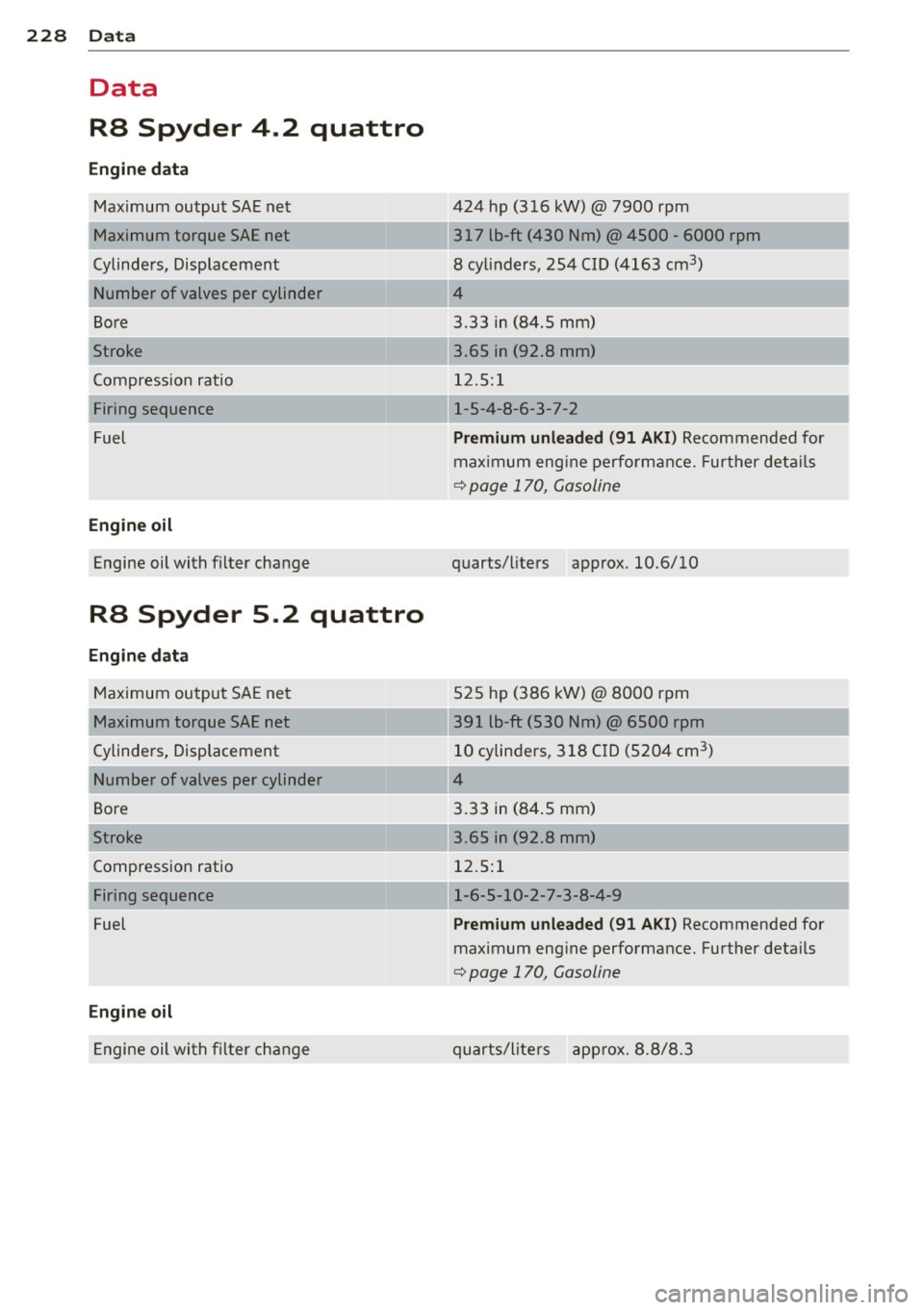
Data
RB Spyder 4.2 quattro
Engine data
424 hp (316 kW)@ 7900 rpm
------,..--
Maximum output SAE net
Maximum torque SAE net
Cylinders, Displacement
Number of valves per cylinder
Bore
317 lb-ft (430 Nm) @ 4500 - 6000 rpm
8 cylinders, 254 CID (4163 cm3)
----~--
4
3.33 in (84 .5 mm)
3.65 in (92 .8 mm)
Stroke
Compression ratio
---------·
12.5:1
1-5-4-8-6-3-7-2
Firing sequence
Fuel _________ ...
Engine oil
Engine oil with filter change
RB Spyder 5.2 quattro
Engine data
Maximum output SAE net
Maximum torque SAE net
Cylinders, Displacement
Number of valves per cylinder
Bore
Stroke
Compression ratio
Firing sequence
Fuel
Engine oil Engine oil with filter change
Premium unleaded (91 AKI) Recommended for
maximum eng ine performance. Further details
¢ page 170, Gasoline
q1Uarts/liters approx.
10.6/10
525
hp (386 kW)@ 8000 rpm
391 lb-ft (530 Nm)@ 6500 rpm
10 cylinders, 318 CID (5204 cm3 )
4
3.33 in (84 .5 mm)
3.65 in (92.8 mm)
12.5:1
1-6-5-10-2-7-3-8-4-9
Premium unleaded (91 AKI) Recommended for
maximum engine performance. Further details
¢ page 170, Gasoline
quarts/l iters approx.
8.8/8.3
Page 231 of 244
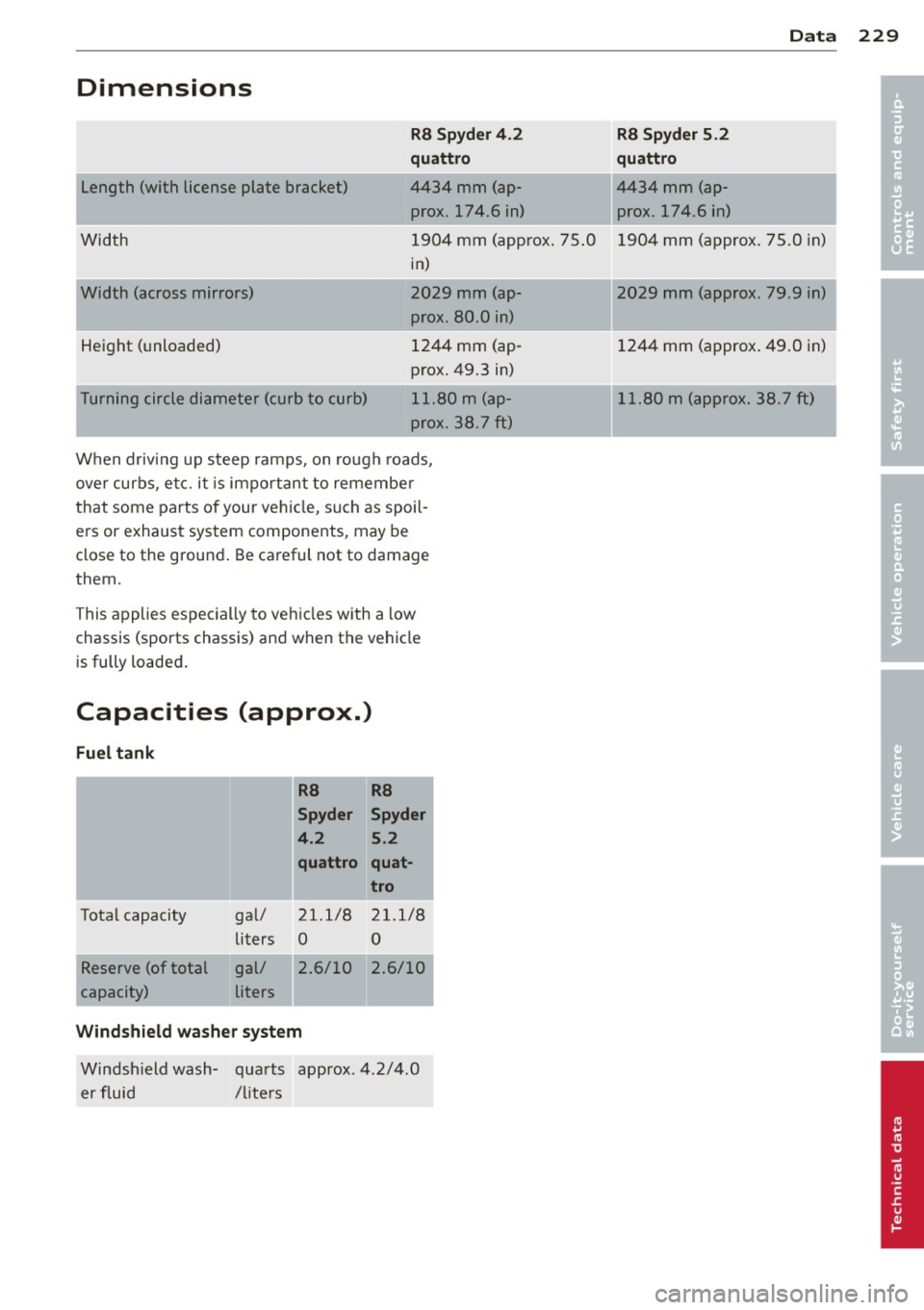
Dimensions
!Length (with license plate bracket)
Width
Width (across mirrors)
Height (unloaded)
T urning circle diameter (curb to curb) R8 Sp
yd er 4. 2
quattro
4434 mm (ap prox. 174.6 in)
1904 mm (approx . 75 .0
in)
2029 mm (ap prox. 80.0 in)
1244 mm (ap
prox. 49.3 in)
11.80
m (ap
prox. 3 8. 7
ft)
When driving up steep ramps, on rough roads,
over curbs, etc. it is important to remembe r
that some parts of your vehicle, such as spoil
ers or exhaust system components, may be
close to the ground . Be careful not to damage
them.
This applies especially to vehicles with a low chassis (sports chassis) and when the vehicle
is fully loaded .
Capacities (approx.)
Fuel tank
R8 R8
Spyder Spyder
4 .2 5.2
quattro quat -
tro
Total capacity gal/ 21.1/8 21.1/8
liters 0 0
Reserve (of total gal/ 2.6/10 2 .6/10
capacity) liters
Windshield wa she r sys tem
Windsh ield wash- quarts approx. 4.2/4.0
er fluid /liters
D ata 229
R8 Spyder 5.2
qu attro
4434 mm (ap prox. 174.6 in)
1904 mm (approx. 75.0 in)
2029 mm (approx. 79.9 in)
1
1244 mm (approx. 49.0 in)
11.80 m (approx. 38. 7
ft)
•
•
Page 232 of 244

230 Index
A
A/C operation ................. .... .. 75
ABS
refer to Anti-Lock Brake System . .. .. . 150
A cces sories . . . . . . . . . . . . . . . . . . . . . . . . 211
Active rollover protection system . .. ... 107
Retracting rollover protection ... .. ... 107
Adding
Eng ine coolant ... ..... ... .. .. .. .. .
183
Eng ine oil .. .. . ... ... .. .. .. .. .. .. . 180
Addit ional accessories .. .... .... .. .. . 211
Additives .................. ... .... . 180
Adjustable steering column ...... .. .... 77
Adju sting front sea ts ....... .. .. .. .. . .
66
Advanced Airbag System
Children ... ............... .. .... .
139
Compon ents ................ ..... . 124
Front ai rbags . . . . . . . . . . . . . . . . . . . . . 122
How the component s work togethe r .. 125
Mon ito ring . .... .. ... .. .. .. .. .. .. . 128
Weight-sen sing mat .. .... .. .. .. .. . 139
Airbag system . . . . . . . . . . . . . . . . . 117, 136
Car e ... .. .. ................ ..... . 130
Child restraints .. .. ... ...... .. .. .. .
140
Components (fron t air bags) .. .. .... . 124
Danger of fitting a child safety seat on
the front passenger seat . . . . . . . . . . . .
119
Disposal ............. ........ .... 130
Front airbags ... .. ... .... .. .. .. .. . 121
H ow do the front airbags work? . .... . 126
How many airbags does my vehicle
have? .................... .. .... .
124
Important safety instructions on the
knee airbag system ....... .. .. .. .. .
134
Important things to know . . . . . . . . . . . 117
Indica tor ligh t .... .... ..... .. .. .. . 128
Knee airbags ... ... .... ..... .. .. .. . 132
Monitoring ................. ... ... 128
PASSENGER AIR BAG OFF light . . . . . . . 128
Service .. ...... .. ... .... .. .. .. .. . 130
Side airbags ..... .. .. .... .. .. .. .. . 135
Warning/indicator light ..... ... .... .. 17
When must the system be inspected? . 128
Air cond itioning
A/C operation . .... .... ..... .. .. .. .. 75
A ir distribution .... ....... .. .. .. .. ..
74
Air recirculation mode ......... .... .. 75 Automatic mode
.............. .... . 75
Controls . . . . . . . . . . . . . . . . . . . . . . . . . .
72
Defrost ..... .. .. .. .............. .. 75
E conomi cal use .. ....... ..... ..... .
76
Fan .. .... .. .. .. ...... ... .... .... . 74
Rear window defogger . . . . . . . . . . . . . . . 76
Switching on and off .... ......... .. . 74
Temperature ... ............ ........ 73
Air d istribution . . . . . . . . . . . . . . . . . . . . . . 7 4
Air recirculation mode Air condit ioning . ................. .. 75
All-wheel drive .. ............ .......
155
Winter tires . .. .. ... .. ..... ... .... 203
Anti-free ze
refer to Engine cool ant system ... .. .. 181
Anti-Lock Brake System .......... .... 150
Warning/indicator light ............ .. 18
Anti-Slip Regulation System .. .... .... 150
Anti- theft alarm system ... .... ... .... . 43
Anti-theft whee l bolts .............. . 216
Ashtray ........... .... ........... .. 69
ASR
refer to An ti-Slip Regulation System .. 150
Asterisk .... .. .. .. .. ................ . 6
Audi magnetic ride ................. ..
82
Description . . . . . . . . . . . . . . . . . . . . . . . . 82
Wa rning/ind icator light ... .. .. .. .. .. . 15
Aud i Servi ce Repa ir Manuals and Li te ra-
ture ........ ... .. .. ... ....... .... .
209
Automated manua l transmission
ref er to R tronic . ................. .. 85
Automat ic be lt retractor ...... .. ... .. 112
Autom atic car w ash
refer to Washing ........... ....... 16 1
Automatic headlight ................. 55
Automat ic headl ight control ...... .. .. .
62
Automatic headlight s
Defective . . . . . . . . . . . . . . . . . . . . . . . . . 3 5
Auto Safety Hotline ............. ....
105
Average fuel mileage . . . . . . . . . . . . . . . . . 23
Aver age speed . .. .. .. ..... .. .. .. .... . 23
B
Battery ..... ..... .. ............... 184
Cha rging .. .. .. .. ...... .. .. ... .... 186
Checking . . . . . . . . . . . . . . . . . . . . . . . . . 184
Page 235 of 244

Energy management .... ... .. .. .. .. . 155
Battery power . . . . . . . . . . . . . . . . . . . . 156
Driver notification ..... ... .. .. .. .. . 156
E ng ine
Coolan t .......................... 181
E ng ine compartment lid ... .. .. .. .. . 175
Starting . . . . . . . . . . . . . . . . . . . . . . 77, 78
Stopping . . . . . . . . . . . . . . . . . . . . . . . . . . 79
E ng ine compartmen t ................ 177
Safety ins truc tions ........ .. .. .. .. . 17 5
Eng ine compartment lid
C losing . . . . . . . . . . . . . . . . . . . . . . . . . . 176
Release lever . . . . . . . . . . . . . . . . . . . . . 17 5
Eng ine coolant system ............... 181
Malfunct io n . . . . . . . . . . . . . . . . . . . . . . . 32
T emperature gauge ................. 11
Engine data .. .... .. .... ... .. .. .. ... 228
E ng ine oi l ... ............. .... .. ... 178
Adding .. .. ............. .. .. .. ... 180
Addit ives . . . . . . . . . . . . . . . . . . . . . . . . . 180
Chec king the engine oi l level . ... .. .. . 180
D ry s ump lubrication ... ... .. .. .. .. . 157
Indications and cond it ions requ iring ex-
tra check ing ............. .... .. ... 180
Level ............................. 33
O il consumption ................. .. 179
O il grades .. ... .. .. ... ... .. .. .. .. . 178
Sensor defective .................... 33
Specification and viscos ity .. .. .. .. .. . 178
Tempe ra tu re d isp lay ................ 10
Eng ine oil pressure
Malfunct io n ... ........... ...... ... 33
Eng ine speed limitat ion .. ... .. .. .... .. 36
E nvi ro nment
Ca tal ytic conve rter ........ .. .. .. .. . 158
Fu el . .... .. .. .... .. .... ... .. .. ... 172
Un leaded fu el .... ..... ... .. .. .. ... 170
E PC
refer to E lectronic powe r control ( EPC) . 15
ESP
refer to Electronic Stabilizat io n Pro-
g ram .. .. .. .. ........ ..... ... ... . 150
refer to Electronic stab ilization p rogram
( E SP) ............................. 16
Event Data Recorder (EDR) . . . . . . . . . . . . 150
E xhaust tail pipes
C lea ning ... .. ... ..... ... .. .. .. ... 165
Inde x 233
Expansion tank . . . . . . . . . . . . . . . . . . . . . 182
F
Fan ................................ 74
Fastening Boos ter seats .. .. .. . .. .... ...... . .
Co nvertib le child safety seats ....... .
Infan t seats . .. .. ................ .
Flat bed truck
Flat tire 145
144
1
4 3
222
Changi ng ... .... .. . .. .. ..... ... .. 216
Floor mats ...... .. .. ..... .......... 104
Fo ld ing top
Care and cleaning . .... ............. 163
Foot peda ls ... .. .... . ... ...... ... .. 104
Fo r the sake of the envi ronment
Gasoline fumes and t he env ironme nt .. 172
L etting your eng ine w arm up ......... 78
Ref ueling . . . . . . . . . . . . . . . . . . . . . . . . 172
Front a irbags
Desc ription . . . . . . . . . . . . . . . . . . . . . . . 121
How they wor k ... .... ......... .. .. 126
Frontal coll is io ns and the laws of p hys ics 111
Fron t lid
Emergency re lease . .. .. .. ..... ... .. . 43
li ght . . . . . . . . . . . . . . . . . . . . . . . . . . . . . 59
Power locking system .......... .. .. . 42
Tr unk escape handle ............... 213
Front passenger
refer to Seating position . . . . . . . 100, 101
Fron t seats . . . . . . . . . . . . . . . . . . . . . . . . . 66
Child res traints in the fro nt sea t ...... 119
Front towing loop .. .. ........... .... 222
Fuel Additives . ... .... .. . .. .. ..... ... .. 170
B lended gaso line ... .. ... ..... ... .. 170
C ur rent fuel mileage ................ 23
Filler neck ... .. ...... ............. 171
Fuel supply too low . . . . . . . . . . . . . . . . . 33
Gasoline add it ives .. .............. . 171
Octane rat ing .. ... ........... .... . 170
Recommendat ion . ............. .... 170
Ref ueling . . . . . . . . . . . . . . . . . . . . . . . . 172
Rese rve ... .. .. .. ... ............ .. . 12
Tank capacity ....... .. .. ..... ... .. 228
U nl ocking the fuel fi lle r flap by hand .. 173
•
•