instrument cluster AUDI R8 SPYDER 2011 Owner's Manual
[x] Cancel search | Manufacturer: AUDI, Model Year: 2011, Model line: R8 SPYDER, Model: AUDI R8 SPYDER 2011Pages: 244, PDF Size: 59.74 MB
Page 198 of 244
196 Tires and wheels
wheels you have to adjust the tire pressures
on all wheels.
A WARNING
Incorrect tire pressures and/or underinfla
tion can lead sudden tire failure, loss of
control, collision, serious personal injury
or even death.
- When the warning symbol
RI] appears in
the instrument cluster, stop and inspect
the tires .
- Incorrect tire pressure and/or underinfla
tion can cause increased tire wear and
can affect the handling of the vehicle and
stopping ability .
- Incorrect tire pressures and/or underin flation can also lead to sudden tire fail
ure, including a blowout and sudden de
flation, causing loss of vehicle control.
- The driver is responsible for the correct
tire pressures for all tires on the vehicle .
The applicable pressure values are locat
ed on a sticker on the driver's side 8-pil
lar.
- Only when all tires on the vehicle are fil
led to the correct pressure, the tire pres
sure monitoring system can work cor
rectly.
- The use of incorrect tire pressure values
can lead to accidents or other damage.
Therefore it is essential that the driver
observe the specified tire pressure values
for the tires and the correct pressures for
the function of the tire pressure monitor
ing system .
- Always inflate tires to the recommended
and correct tire pressure before driving
off .
- Driving with underinflated tires bend
more, letting them get too hot resulting
in tread separation, sudden tire failure
and loss of control.
- Excessive speed and/overloading can
cause heat build-up, sudden tire failure
and loss of control.
- If the tire pressure is too low or too high,
the tires will wear prematurely and the
vehicle will not handle well. -
If the tire is not flat and you do not have
to change a wheel immediately, drive at
reduced speed to the nearest service sta
tion to check the tire pressure and add
air as required .
(D Note
Driving without valve stem caps can cause
damage to the tire valves. To prevent this,
always make sure that factory installed
valve stem caps on all wheels are securely mounted on the valve.
@ For the sake of the environment
Underinflated tires will also increase the
fuel consumption .
Tires and vehicle load limits
There are limits to the amount of load or
weight that any vehicle and any tire can carry .
A vehicle that is overloaded will not handle
well and is more difficult to stop. Overloading
can not only lead to loss of vehicle control,
but can also damage important parts of the
vehicle and can lead to sudden tire failure, in cluding a blowout and sudden deflation that
can cause the vehicle to crash.
Your safety and that of your passengers also depends on making sure that load limits are
not exceeded. Vehicle load includes everybody
and everything in and on the vehicle . These
load limits are technically referred to as the
vehicle 's
Gross Vehicle Weight Rating
("GVWR").
The "GVWR" includes the weight of the basic
vehicle, all factory installed accessories, a full
tank of fuel, oil, coolant and other fluids plus
maximum load. The maximum load includes
the number of passengers that the vehicle is
intended to carry ("seating capacity") with an
assumed weight of 150 lbs. (68 kg) for each
passenger at a designated seating position
and the total weight of any luggage in the ve-
hicle. ..,_
Page 209 of 244
soon as possible, and inflate them to the
proper pressure. Driving on a significant ly un
der-inflated tire causes the tire to overheat
and can lead to tire failure. Under-inflation a l
so reduces fuel efficiency and tire tread l ife,
and may affect the veh icle 's handling and
stopping ab ility.
Please note that the TPMS is not a substitute
for proper t ire maintenance, and it is the dr iv
er's responsib ility to ma inta in correct t ire
p ress ure , even if under- inflation has not
reached the leve l to t rigger illumination of the
TPMS low tire pressure telltale .
Your veh icle has also been equ ipped with a
TPMS malfunction indicato r to indicate when
the system is not ope rating properly. The
TPMS malfunc tion indica to r i s combined wi th
the low t ire p ressu re tell ta le. When the sys
tem detec ts a malf unct ion, the te lltale will
flash for approximately one minute and then remain continuo usly ill uminated . This se
q uence will cont inue upon subsequent vehicle
start-ups as long as the ma lfunction ex ists.
When the malfunction indicator is ill uminat
ed, the system may not be able to detect or
signa l low t ire pressure as intended . TPMS
malfunct ions may occ ur for a variety of rea
sons, including the ins talla tion of replace
ment or alternate tires o r whee ls on the veh i
cle that prevent the TPMS from funct io ni ng
p roperly . Always check the TPMS malfunct ion
t ellta le afte r replacing one o r more t ires or
wheels o n your veh icle to ensure tha t the re
p lacemen t or a lternate tires and wheels allow
the TPMS to continue to function properly .
Introduction
The tire pressure monitoring system monitors
air pressure in all four road wheels while the
vehicle is moving .
As soon as the tire pressu re mo nitor ing sys
tem senses a s ignificant loss o f air pressure in
one or severa l ti res, text messages and yellow
symbo ls appear in the instr ument cluster dis
p lay to alert the driver. The
[al warning light
Tire s an d wheel s 207
in the instrument cluster comes on when the
ti re is significant ly underinflated
Q page 34.
The wa rni ng lig ht [al also illu minates i n the
case of a system mal fun ct io n.
Be aware that t ire pressure is a lso dependent
o n the tempe ratu re of the t ire. For eve ry 18 ° F
(10 °C) incre ase in tir e te mper ature, tire pres
s u re inc reases by about 1.5 psi (0 .1 bar). The
ti re warms up while the vehicle is moving and
ti re p ress ure rises . So you sho uld ad just tire
pressure only when they a re
cold, when the
temperature of the tires is roughly the same
as the ambient a ir temperature.
In order to keep the tire press ure monitoring
system p roperly ca librated, t ire press ure on
all four tires sho uld be checked at regu lar in
terva ls.
The tire pressure is shown on the label located
on the dr iver's side B-pillar (v is ib le when the
door is open) .
A WARNING
When the tire pressure mo nitoring system
war ning light is lit , one o r more of your
tires is s ignificantly under-infla ted . You
shou ld stop and check your tires as soon as
pos sib le, and in flate t hem to the proper
p ress ure a s in dic ate d on the ve hicle's ti re
p ress ure lab el
¢page 19 3. D riving on a
significantly under -inflated ti re causes t he
tire to over heat and can lead to tire failure .
Under-inflat ion also is like ly to impair the
vehicle's handling and stopping ab ility.
@ For the sake of the environment
D riving wit h un der -inflated tires red uces
fuel efficiency an d tire t read life.
(D Tips
- E ach tire should be chec ked monthly
w hen the tem perature of the tires is
about the same as amb ient a ir tempera
t u re and set to the recommended infla
tion pressure as specified on the tire
pressure label
¢ pag e 193.
•
•
Page 210 of 244
208 Tir es and whee ls
- The tire pressure monitoring system
helps the driver to keep an eye on tire
pressures. But the driver st ill has the re
sponsibility for maintaining the correct
tire pressure.
- Tire pressure must only be adjusted
when the temperature of the tires is
about the same as ambient air tempera
ture.
- When tires are replaced, the sensors and
valves should not be exchanged . The
valve core, nut, valve sealing and seal
washer (rep lacement kit) needs to be re
placed. If necessary, the valve and the
whee l electronics have to be rep laced.
- The tire pressure monitoring system on
your Audi was calibrated us ing tires w ith
"RO" identification. We recommend us
i ng these tires.
- If you should put different whee ls and
ti res on yo ur vehicle (e.g. w inter wheels
and tires), yo u m ust be certain that the
whee ls and tires are compatible with the
tire pressure monitoring system . Other
wise the system w ill reg ister a ma lfunc
tion and a fault message will be d is
played . For more information, contact
your authorized Audi dealer .
- For Declaration of Compliance to United
States FCC and Industry Canada regula
tions
~ page 212 .
Programming a new set of tires
App lies to vehicles: with tire pressure monitor ing system
When driving with a new set of ti res, you can
p rogram them to the t ire pres sure monitoring
system using the menu disp lay.
"' Turn the ign ition on .
"' Se lect the menu :
Set > Tir e pr ess ure >
Wheel chang e.
"' Confirm that you wo uld like to begin the
programming p rocess. The message
Wheel
s ens ors are being in it iali sed. Thi s m ay ta ke
a fe w minute s .. .
appears in the instrument
cluster disp lay. You can switch between programmed tire sets
at any time without reinitializing the system .
(D Tips
If the programming process was not com
pleted successfully, the message
Wheel
s en sor s could not be initi alised
appea rs in
the disp lay and the
11118' indicator light
turns on. If this happens, repeat the pro
cedure .
Page 217 of 244
.. Remove the "max. 50 mph" (80 km/h) stick
er from the sealant bottle and affix it to the
instrument cluster in the driver's v iew .
A WARNING
-Turn the hazard flashers on if you have a
flat tire in moving traffic. In this way you
protect yourself and other road users.
- Make sure that all passengers are in a
safe place, out of the dange r zone (fo r
example, behind a guard ra il).
(D Note
Part icular care is necessary if you are mak
ing a t ire repair on a steep incline.
@ Tips
Obey all laws.
Making a tire repair
Tire repair consists of the following sections.
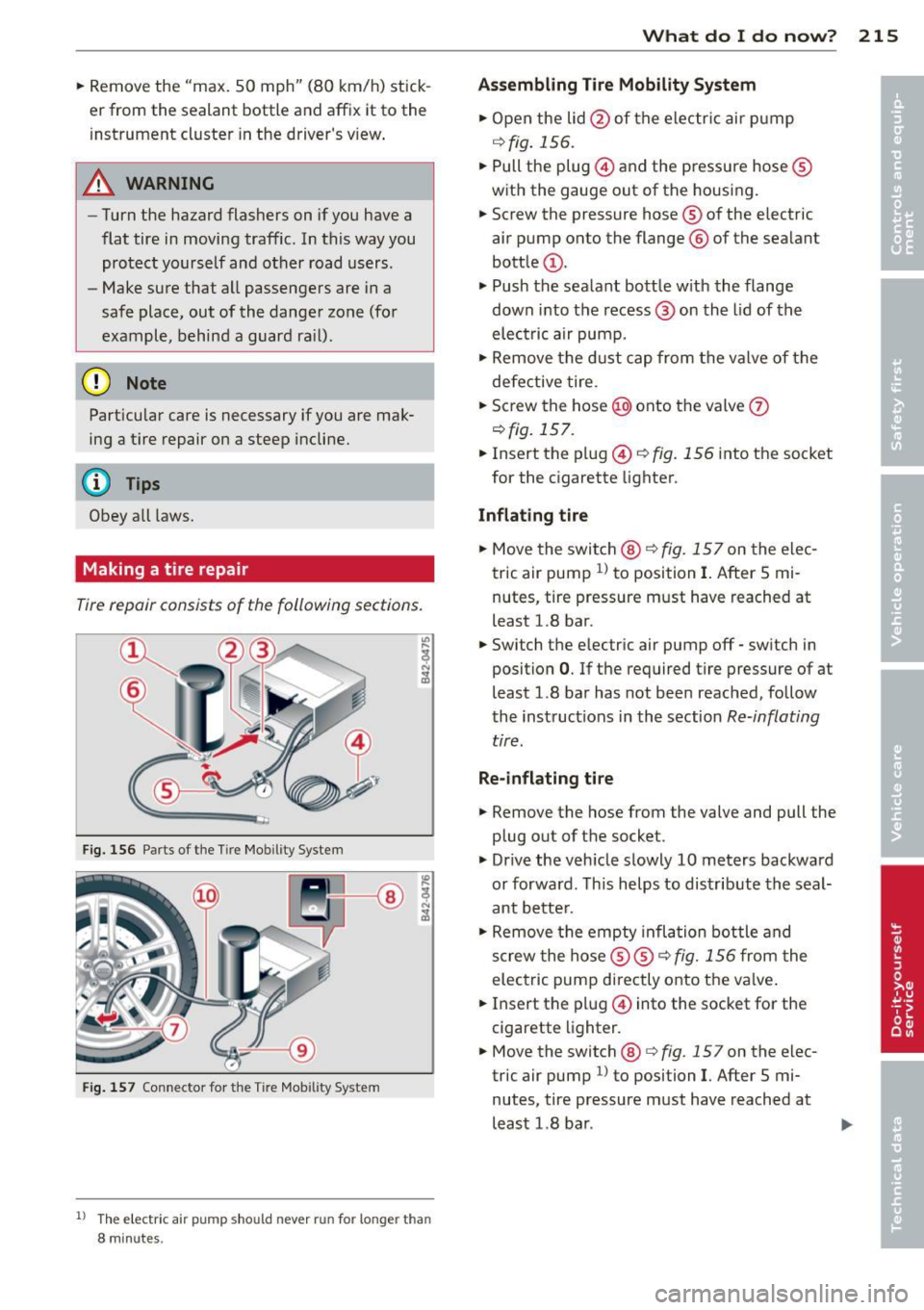
F ig. 156 Parts of the Tir e Mob ility System
F ig . 1 57 Con nector for the Ti re Mob ility System
l) The e lectr ic a ir pump s houl d never r un for long er than
8 m inutes.
What do I d o now ? 215
Assembling Ti re Mobility System
.. Open the lid @of the ele ctr ic air p ump
<:!) fig. 156 .
.. Pull the plug @and the pressure hose®
w ith the gauge out of the housing .
.. Screw the pressure hose® of the electric
air pump onto the flange @ of the sealant
bott le @ .
.,. Push the sea lant bottle w ith the flange
down into the recess @ on the lid of the
electric a ir pump.
.. Remove the dust cap from the valve of the
defe ctive tire .
.. Screw the hose @onto the valve (?)
c::> fig. 157.
.. Insert the plug@<::> fig. 156 into t he socket
for the c igarette lighte r.
Inf lating tire
.. Move the switch @ .::!)fig. 15 7 on the elec
tric air pump
l} to position I. After 5 mi
nutes, tire pressure m ust have reached at
least 1.8 bar .
.. Switch t he e lectr ic air pump off -sw itch in
position
0 . If the required tire pressure of at
least 1.8 bar has not been reached, follow
th e instruct ions in the section
Re-inflating
tire .
Re-inflating tire
.. Remove the hose from the valve and pull the
plug out of t he socket .
.. Dr ive the veh icle slowly 10 meters backward
or forward . T his helps to distribute the seal
ant bette r .
.. Remove the empty infla tion bottle and
s crew the hose ®®
c::> fig. 156 from the
electric pump directly onto the va lve .
.. Insert the plug@ into the socket for the
cigarette lighter .
.. Move the switch
@ Q fig. 15 7 on the elec
tric air pump
l} to position I. After S mi
nutes, tire pressure must have reached at
least 1.8 bar.
Page 226 of 244
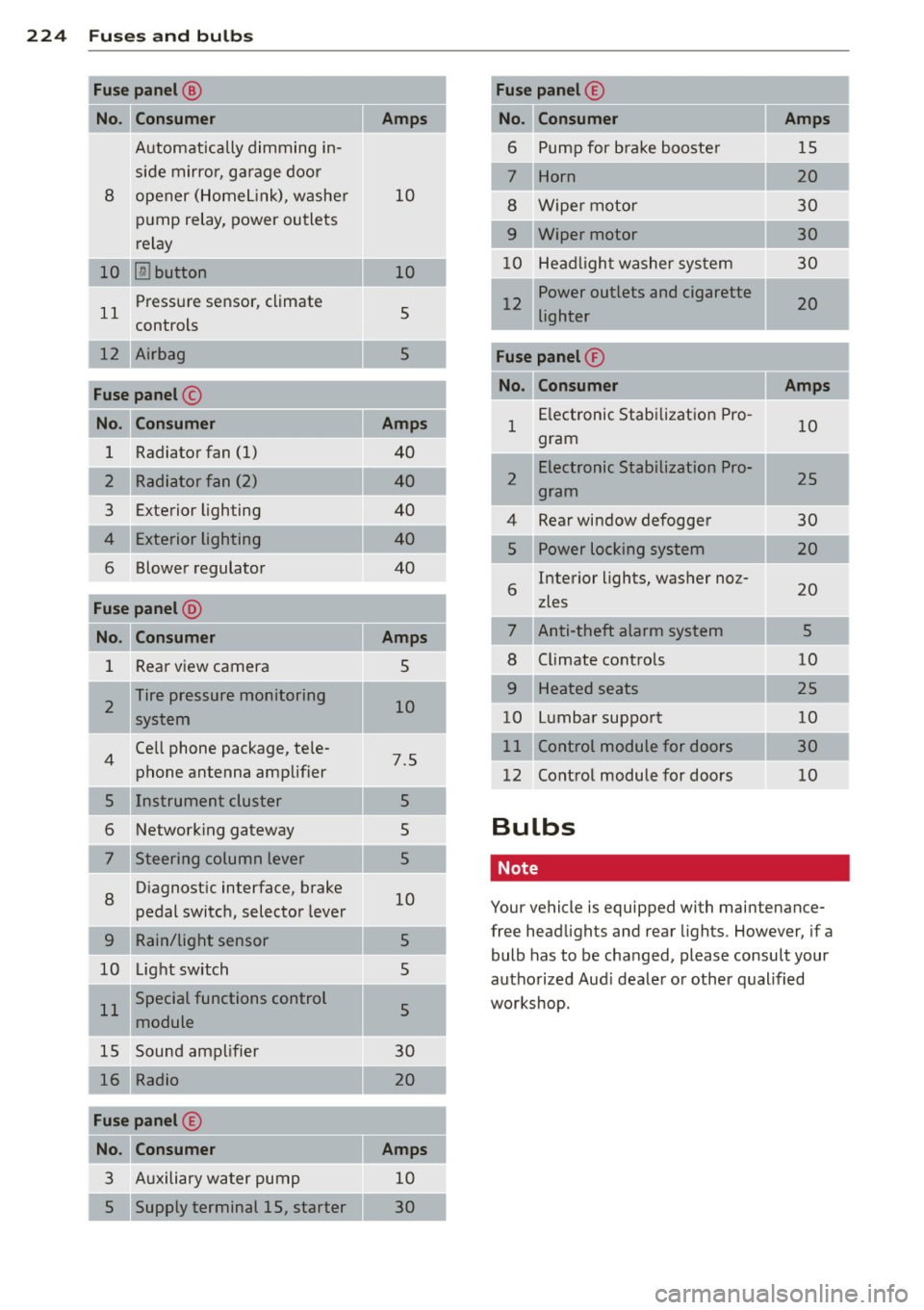
224 Fuses and bulbs
Fuse panel@
Consumer
Automatically dimming in-
side mirror, ga rage door
8 opener (Homel ink), washer
pump relay, power outlets
relay
10
~ button
11 Pressure sensor, climate
controls
12 Airbag
Fuse panel @
No . II Consumer
1 Radiator fan (1)
2 Radia tor fan (2)
3 Exterior lighting
4 Exterior lighting
6 Blower regulator
Fuse panel @
No . II Consumer
1 Rear view camera
2
Tire pressure monitoring
system
4
Cell phone package, te le-
phone antenna amplifier
5 Instrument cluster
6 Networking gateway
7 Steering column lever
8
Diagnostic interface, brake
pedal switch, selector lever
9 Rain/light sensor
10 Light switch
11 Special functions control
module
15 Sound amplifier
Radio
Fuse panel E
No. Consumer
3 Auxiliary water pump
5 Supply terminal 15, starter
Amps
10
10 5
5
II Amps
40 40
40
40
40
II Amps
5
10
7.5 5
5
5
10 5
5
5
30
20
Amps
10
30
Fuse panel @
No. Consumer
6 Pump for brake booster
7 Horn
8 Wiper motor
9 Wiper motor
10 Headlight washer system
12 Power outlets and cigarette
lighter
Fuse panel
®
No. !!Consumer
1
2
4
6
7
8
~~·
E lectronic Stabilization Pro
gram
Electronic Stabilization Pro
gram
Rear window defogger
Power locking system
Interior lights, washer noz
zles
Anti-theft alarm sys tem
Climate controls
Heated seats
Lumbar support
11 Control module for doors
12 Control module for doors
Bulbs
Note
Amps
15
20
30
30
30
20
ll Amps ,
10
25
30
20
20
5
10
25 10
30 10
Your vehicle is equipped with maintenance
free headlights and rear lights. However, if a
bulb has to be changed, please consult your
authorized Aud i dealer or other qualified
workshop .