seats AUDI R8 SPYDER 2011 Owner's Manual
[x] Cancel search | Manufacturer: AUDI, Model Year: 2011, Model line: R8 SPYDER, Model: AUDI R8 SPYDER 2011Pages: 244, PDF Size: 59.74 MB
Page 125 of 244
but less than the weight of a small adult, the
front airbag on the passenger side may deploy (the
PASSENG ER AIR BAG OF F light does not
come on).
For example, the a irb ag may depl oy if:
- a small child that is heavier than a typical 1
year-o ld child is on the front passenger seat
(regardless of whether the child is in one of
the chi ld safety seats listed
¢ page 140),
-a ch ild who has outgrown child rest raints is
on the front passenger seat.
I f the front passenger airbag is turned off, the
PA SSENGER AIR BAG OFF light in the center
of the inst rument panel w il l come on and stay
on.
The front a irbag on the passenger side may
not deploy (the PASSENGER AIR BAG OFF
light does not illuminate and stay lit) if:
- a small adult or teenager is on the front pas
senger seat
- a passenger who is not sitt ing upr ight w ith
their back against a non-reclined backrest
with their feet on the veh icle floo r in front
of the sea t is on the front passenge r seat.
If the front passenger airbag deploys, the
Federal Standard requires the airbag to meet
the " low risk " deployment criteria to help re
duce the risk of inj ury through interaction
with the airbag . "Low risk" deployment occurs
in those crashes that take place at lower de
celerations as defined in the electronic control un it
¢ page 128.
Please be sure to read the important informa
tion in the sections that fo llow and be sure to
heed a ll of the WARNINGS.
_& WARNING
To reduce the risk of injury when an airbag
inf lates, a lways wear safety belts properly.
- If you are unrestrained, leaning forward,
sitting sideways or out of position in any
way, your risk of injury is much higher.
- You w ill also receive serio us injuries and
cou ld even be killed if you are up against
the a irbag or too close to it when it in-
A irbag system 123
flates - even with an Advanced Ai rbag
¢page 117.
_& WARNING
A child in a rearward-fac ing ch ild safety
seat installed on the front passenger seat
will be ser ious ly injured and can be killed if
the front airbag inflates - even with an Ad
vanced A irbag System .
-Although the Advanced Airbag System in your veh icle is designed to turn
off the
front airbag when a rearward-facing child restraint has been instal led on the
front passenger seat, nobody can abso lutely guarantee that dep loymen t is im
possible in all conceivable situations that
may happen during the usefu l life of your
veh icle.
- The inflating airbag will hit the child
safety seat or infant carrier with great
force and will smash the child safety seat
and child against the backrest, door, or roof.
- Never install a rearward facing child
safety seat on the front passenger seat
un less the
PA SSENGER AIR BAG OFF
light comes on and stays on . If the PAS
SENGER AIR BAG OFF
light does not
come on and stay on the inflating a irbag
will hit the child safety seat or infant car rier w ith great force and w ill smash the
child safety seat and child against the
backrest, door or roof. Have the a irbag
system inspected immediately by your
author ized Audi dealer.
_& WARNING
If, in except iona l circumstances, you must
install a forward-facing child restraint on
the front passenger's seat:
- Always make sure the forward-facing
seat has been designed and certified by
its manufacturer fo r use on a front seat
with a passenger front and s ide a irbag.
- Never put the forward-facing child re
straint up against or ve ry near the instru-
ment panel.
~
•
•
Page 127 of 244
-Never remove the upholstery from the
front passenger seat.
- Never disassemble or remove parts from
the seat or disconnect wires from it.
- Never carry sharp objects in your pockets
or place them on the seat. If the weight
sensing mat in the passenger seat is
punctured it cannot work properly.
- Never carry things on your lap or carry
objects on the passenger seat. Such
items can increase the weight registered
by the weight-sensing mat and send the
wrong information to the airbag control
unit.
- Never store items under the front pas
senger seat. Parts of the Advanced Air
bag System under the passenger seat
could be damaged, preventing them and
the airbag system from working proper ly.
- Never place seat covers or replacement
upholstery that have not been specifical
ly approved by Audi on the front seats.
- Seat covers can prevent the Advanced
Airbag System from recognizing child re
straints or occupants on the front pas
senger seat and prevent the side airbag in the seat backrest from deploying prop
erly.
- Never use cushions, pillows, blankets or
similar items on the front passenger
seat. The additional padding will prevent
the weight-sensing mat in the seat from
accurately registering the child restraint
or person on the seat and prevent the
Advanced Airbag System from function ing properly.
- If you must use a child restraint on the
front passenger seat and the child re
straint manufacturer 's instructions re
quire the use of a towel, foam cushion or
something else to properly position the
child restraint, make certain that the
PASSENGER AIR BAG OFF light comes
on and stays on whenever the child re
straint is installed on the front passen
ger seat .
Airbag system 125
-If the PASSENGER AIR BAG OFF light
does not come on and stay on, the inflat
ing airbag will hit the child safety seat or
infant carrier with great force and will
smash the child safety seat and child
against the backrest, door or roof. Have
the airbag system inspected immediately by your authorized Audi dealer .
How the Advanced Airbag System
components work together
The front Advanced Airbag System and the
side airbags supplement the protection of
fered by the front three-point safety belts
with pretensioners and load limiters and the
adjustable head restraints to help reduce the
risk of injury in a wide range of accident and
crash situations. Be sure to read the impor
tant information about safety and heed the
WARNINGS in this chapter.
Deployment of the Adv a need Airbag System
and the activation of the safety belt preten
sioners depend on the deceleration measured
by the crash sensors and registered by the
electronic control unit. Crash severity depends
on speed and deceleration as well as the mass
and stiffness of the vehicle or object involved in the crash.
When the electronic control unit registers a
low severity crash and the safety belt is being
used, the airbag will not deploy. If the safety
belt is not being used, the first stage deploys,
followed by the second stage after a much lat er time in the crash sequence.
If the electronic control unit registers a crash
of medium severity, the first stage of the air
bag deploys followed by the second stage at a
much later time in the crash sequence - re
gardless of whether the safety belt is being
used or not . In higher severity crashes as reg
istered by the electronic control unit, both the
first and second stages deploy almost at the
same time .
On the passenger side, regardless of safety
belt use, the airbag will be turned off if the
weight on the passenger seat is less than the
IJII,-
•
•
Page 128 of 244
126 Airbag system
amount programmed in the electronic control
unit. The front airbag on the passenger side
will also be turned off if one of the child safe
ty seats that has been certified under Federal Motor Vehicle Safety Standard 208 has been
recognized on the seat . The
PASSENGER AIR
BAG OFF
light comes on and stays on to tell
you when the front Advanced Airbag on the
passenger side has been turned off
q page 119, Child restraints on the front seat
- some important things to know .
8_ WARNING
To reduce the risk of injury when an airbag
inflates, always wear safety belts properly.
- If you are unrestrained, leaning forward,
sitting sideways or out of position in any
way, your risk of injury is much higher.
- You will also receive serious injuries and
could even be killed if you are up against
the airbag or too close to it when it in
flates -even with an Advanced Airbag
qpage 117.
More important things to know about
front airbags
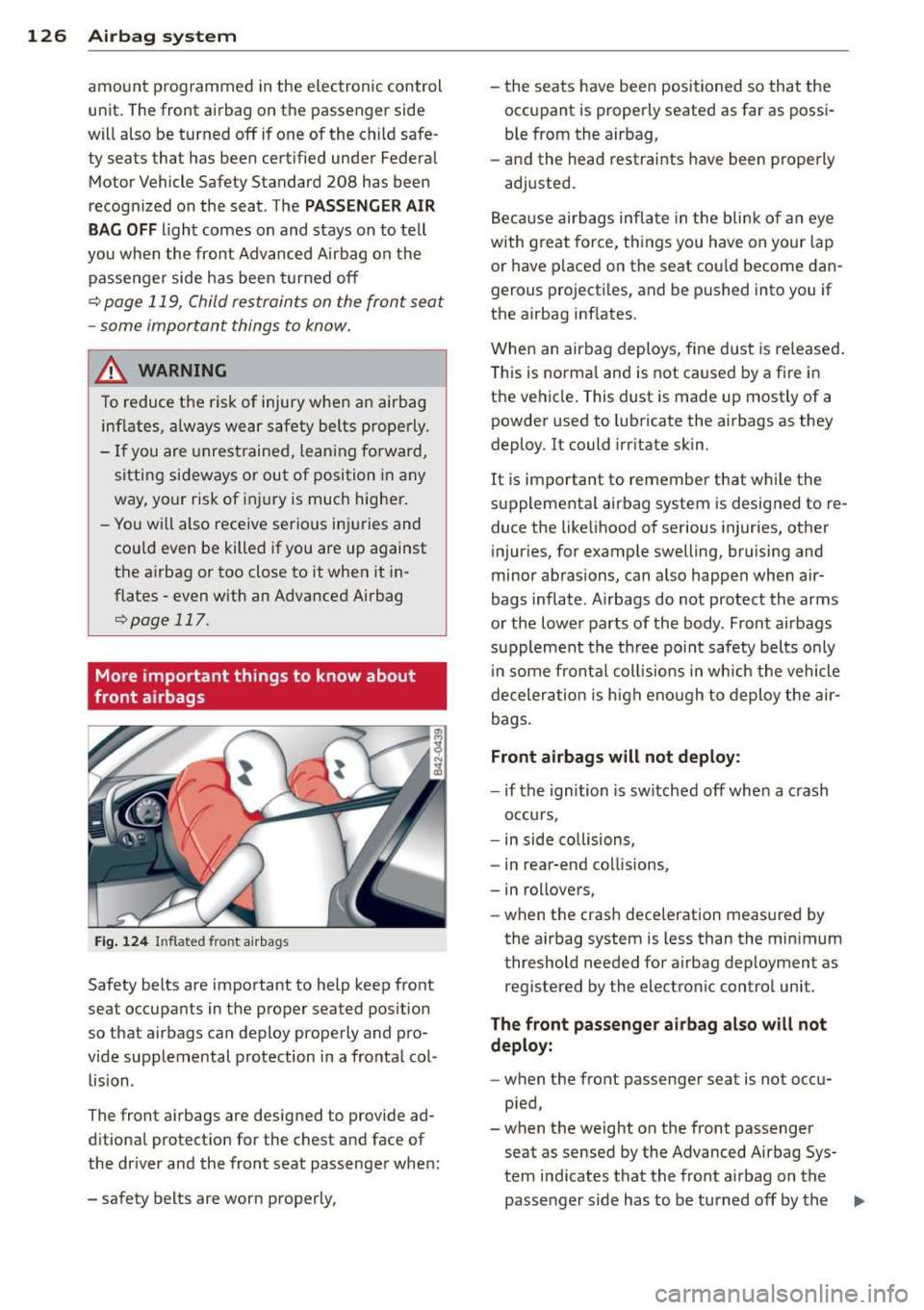
Fig. 124 Inflated front airbags
Safety belts are important to help keep front
seat occupants in the proper seated position
so that airbags can deploy properly and pro
vide supplemental protection in a frontal col
lision .
The front airbags are designed to provide ad ditional protection for the chest and face of
the driver and the front seat passenger when :
- safety belts are worn properly, -
the seats have been positioned so that the
occupant is properly seated as far as possi
ble from the airbag,
- and the head restraints have been properly
adjusted.
Because airbags inflate in the blink of an eye
with great force, things you have on your lap
or have placed on the seat could become dan
gerous projectiles, and be pushed into you if
the airbag inflates.
When an airbag deploys, fine dust is re leased.
This is norma l and is not caused by a fire in
the vehicle . This dust is made up mostly of a
powder used to lubricate the airbags as they
deploy. It could irritate skin.
It is important to remember that while the
supplemental airbag system is designed to re
duce the likelihood of serious injuries, other
injuries, for example swelling, bruising and
minor abrasions, can also happen when air
bags inflate . Airbags do not protect the arms
or the lower parts of the body. Front airbags
supplement the three point safety belts only
i n some frontal collisions in which the vehicle
deceleration is high enough to deploy the air
bags.
Front airbags will not deploy:
-if the ignition is switched off when a crash
occurs,
- in side collisions,
- in rear-end collisions,
- in rollovers,
- when the crash deceleration measured by
the airbag system is less than the minimum
threshold needed for airbag deployment as
registered by the electronic control unit .
The front passenger airbag also will not
deploy:
- when the front passenger seat is not occu
pied,
- when the weight on the front passenger
seat as sensed by the Advanced Airbag Sys
tem indicates that the front airbag on the passenger side has to be turned off by the ..,.
Page 133 of 244
A WARNING
1
Improper care, servicing and repair proce
dures can increase the risk of personal in
jury and death by preventing an airbag from deploy ing when needed or deploying
an airbag unexpected ly:
- Never cover, obstr uct, o r change the
steering wheel horn pad or airbag cover
or the instr ument pane l or modify them
in any way.
- Never attach any objects such as cup
holders or telephone mountings to the
s u rfaces covering the airbag units .
- For cleaning the ho rn pad or ins trumen t
pane l, use only a soft, dry cloth or one
moistened w ith plain water . Solvents or
cl eaners cou ld damage the airbag cover
or change the stiffness or strength of the
material so that the airbag cannot de
ploy and protect properly.
- Never repai r, adjust, or change any parts
of the airbag system.
- All work on the stee ring wheel, instru
ment pane l, front seats or electrical sys
tem (including the installation of aud io
equipment, cellular telephones and CB
radios, etc.) must be performed by a
qualified technician who has the training
and special equipmen t necessa ry.
- For any work on the ai rbag system, we
st rongly recommend that you se e you r
au thori zed Aud i dealer o r qualified wo rk
shop.
- Never mod ify the front bumper or parts
of the veh icle body.
- Always make sure that the side airbag
can inflate witho ut interferen ce:
- Never insta ll seat covers or replace
ment upho lstery over the front seat
backs that have not been spec ifically
approved by Audi.
- Never use add itiona l seat cushions that
cover the areas where the side airbags
inflate.
- Damage to the origina l seat covers or
to the seam in the area of the side air bag module must always be repa ired
A irbag system 13 1
immediately by an author ized Audi
dealer.
- The airbag system can be activate d only
once. After an airbag has inflated, it m ust be replaced by an authorized Aud i
dea ler or qualified technician who has
the technical info rmation , training and
special equipment necessary .
- The airbag system can be deployed only
once. After an airbag has been deployed,
it must be replaced with new replace
men t pa rts designed and approved espe
cially fo r you r A udi model versi on. Re
placemen t of complete airbag systems
or airbag components must be pe r
formed by qualified wo rkshops on ly .
Make sure that any airbag serv ice action
is entered in your Audi Warranty
& Main
tenance booklet under
AIRBAG REPLACE
MENT RECORD.
- For safety reasons in severe accidents,
the alternator and starter are sepa rated
from the veh icle battery with a pyrotech
nic circuit inte rrupte r.
- Wor k on the pyrotechnic c ircui t inte r
rupter m ust only be performed by a
qualified dea le r - risk of an accident!
- If the vehicle or the circuit interr upter
is scrapped, a ll applicable safety pre
cautions must be followed.
@ For the sake of the environment
Undeployed airbag modules and preten
sioners might be cl assified as Perchlorate
Materia l - specia l hand ling may a pply, see
www .dtsc .ca. gov/hazard o u swaste/ per-
ch [orate. When the veh icle or parts of the
restraint system including airbag modules
and safety be lts with pretensioners are
scrapped, all app licab le laws and regu la
tions must be obse rved. Your authorized
A udi dealer is familia r with these require
ments and we recommend that you have
your dealer per form this service for you .
•
•
• •
Page 140 of 244
138 Child Safety
Child Safety
Important things to know
Introduction
The physical princip les of what happens when
your vehicle is in a crash app ly also to children
¢ page 112. But unlike adu lts and teenagers,
their muscles and bones are not fully devel
oped. In many respects children are at greater risk of serious injury in crashes than adults.
Because children 's bod ies are not fully deve l
oped, they require restraint systems especial ly designed for their s ize, weight, and body
structure . Many countries and all states of the
United States and provinces of Canada have
l aws requ iring the use of approved ch ild re
straint systems fo r infants and small child ren.
In a frontal crash at a speed of 20-35 mph
(30-56 km/h) the forces acting on a 13-pound
(6 kg) infant w ill be more than 20 times the
weight of the child. Thi s means the weight of
the child would s uddenly be more than
260 pounds (120 kg) . Under these conditions,
only an appropriate chi ld restraint properly
used can reduce the risk of serious injury.
Child restraints, like adult safety belts, must
be used properly to be effective. Used improp
erly, they can increase the risk of ser ious in
jury in an accident.
Consult the child safety seat manufacturer's instructions in order to be sure the seat is
right for your ch ild's s ize
c> page 141 , Impor
tant safety instructions for using child safety
seats .
Please be sure to read and heed all of
the impo rtant informat io n and WARNINGS
about child safety, Advanced A irbags, and the
installation of child restraints in this chapter.
There is a lot you need to know about the Ad
vanced A irbags in your vehicle and how they
wo rk when infants and children in chi ld re
straints are on the front passenger seat. Be
cause o f the large amount of important info r
mation, we cannot repeat it all here. We urge
you to read the detailed information in this owner's manual about airbags and the Ad
vanced Airbag System in your vehicle and the
very important information about transport
ing children on the front passenger seat.
Please be sure to heed the WARNINGS - they
are extremely important for your safety and
the safety of your passengers, especially in
fants and small children.
.&, WARNING
-
A ll vehicle occupants and especially chi l
dren must be restrained properly whenev
er riding in a vehicle. An unrestrained or
improperly restrained child could be in
jur ed by str ik ing the interior or by being
ejected from the vehicle dur ing a sudden
maneuver or impact. An unrestra ined or
i mproperly restra ined child is also at great
er risk of injury or death through contact
with an inflat ing airbag.
.&, WARNING
--Children on the front seat of any car even
with Advanced Airbags can be seriously in
jured or even killed when an airbag in
flates. A child in a rearward-fac ing child
safety seat installed on the front passen
ger seat will be seriously injured and can
be killed if the front airbag inflates .
- The inflating airbag will hit the child
safety seat or infant carrier with great
force and will smash the child safety seat
and child aga inst the backrest, door or
roof.
- Never install a rearward facing child safety seat on the front passenger seat
unless the
PASSENGER AIR BAG OFF
light comes on and stays on . If the PAS
SENGER AIR BAG OFF
l ight does not
come on and stay on, the inflating airbag
will hit the child safety seat or infant car
rier w ith great force and will smash the
child safety seat and child against the backrest, door or roof. Have the airbag
system inspected immediately by your
author ized Audi dealer.
Page 143 of 244
Child Safety 141
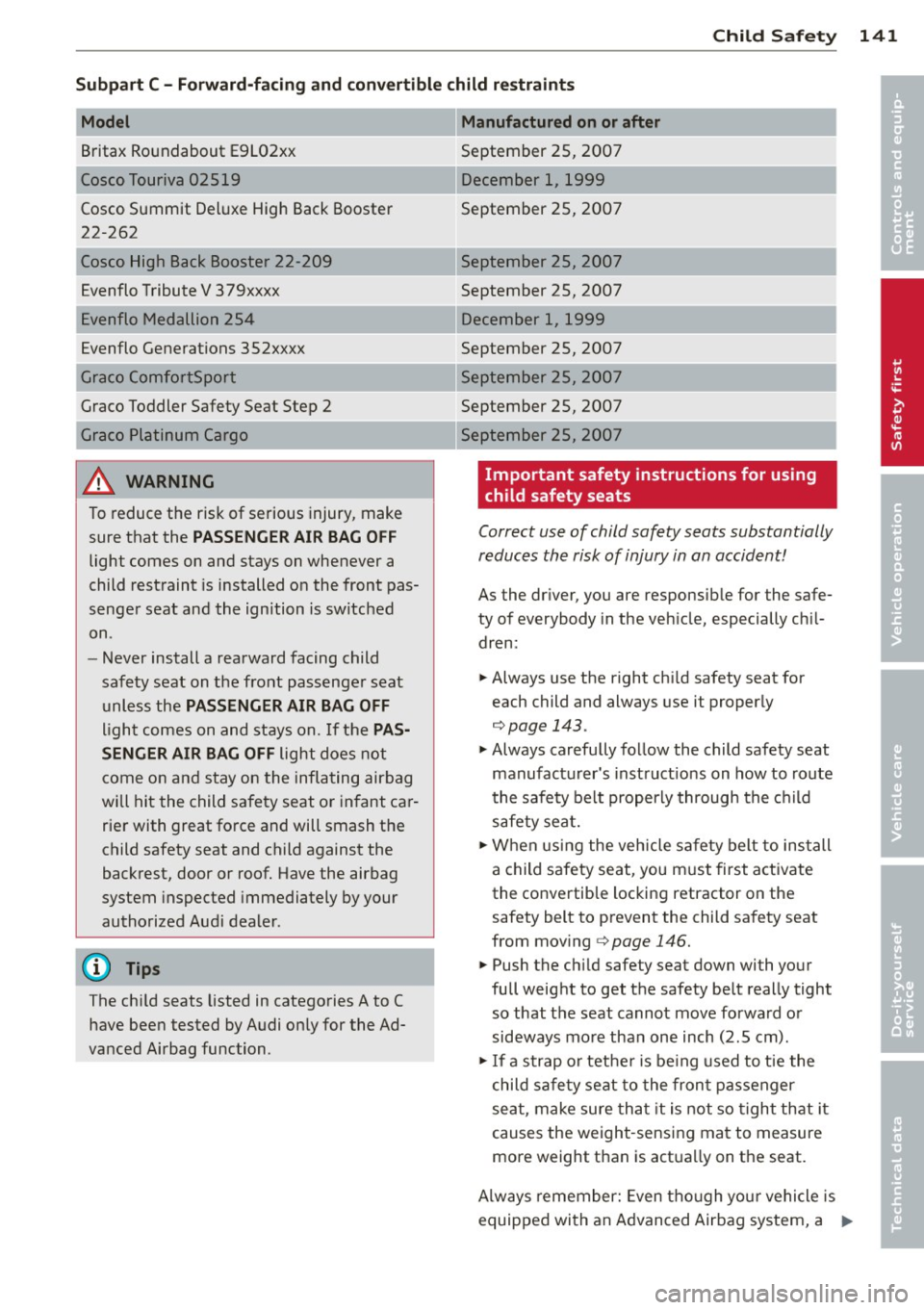
Subpart
C -Forward-facing and convertible child restraints
Model
Britax Roundabout E9L02xx
Cosco Touriva 02519
Cosco Summit Deluxe High Back Booster
22-262
Cosco High Back Booster 22-209
Manufactured on or after
September 25, 2007
December 1, 1999
September 25, 2007
September 25, 2007
September 25, 2007
Evenflo Tribute V 379xxxx
E venflo Medallion 254
----------
Evenflo Generations 352xxxx
Graco ComfortSport
----~-,
December 1, 1999
September 25, 2007
September 25, 2007
September 25, 2007
Graco Toddler Safety Seat Step 2
Graco Platinum Cargo
-------
& WARNING
To reduce the risk of serious injury, make
sure that the
PASSENGER AIR BAG OFF
light comes on and stays on whenever a
child restraint is installed on the front pas
senger seat and the ignition is switched
on .
- Never install a rearward facing child
safety seat on the front passenger seat
unless the
PASSENGER AIR BAG OFF
light comes on and stays on. If the PAS
SENGER AIR BAG OFF
light does not
come on and stay on the inflating airbag
will hit the child safety seat or infant car
rier with great force and will smash the
child safety seat and child against the
backrest, door or roof. Have the airbag
system inspected immediately by your
authorized Audi dealer .
(D Tips
The child seats listed in categories A to C
have been tested by Audi only for the Ad
vanced Airbag function. September 25, 2007
Important safety instructions for using
child safety seats
Correct use of child safety seats substantially
reduces the risk of injury in an accident!
As the driver, you are responsible for the safe
ty of everybody in the veh icle, especially ch il
dren:
.., Always use the right chi ld safety seat for
each child and always use it properly
¢page 143.
.., Always carefully follow the child safety seat
manufacturer's instruct ions on how to route
the safety belt properly through the child
safety seat.
.., When using the vehicle sa fety belt to install
a child safety seat, you must first activate
the convertib le locking retractor on the
safety belt to prevent the child safety seat
from moving ¢
page 146.
.., Push the ch ild safety seat down with your
full weight to get the safety belt really tight
so that the seat cannot move forward or
sideways more than one inch (2 .5 cm).
"'If a strap or tethe r is being used to tie the
child safety seat to the front passenger
seat , make sure that it is not so tight that it
causes the weight-sensing mat to measure
more weight than is actua lly on the seat.
Always remember: Even though your vehicle is
equipped with an Advanced Airbag system, a .,..
•
•
Page 144 of 244
142 Child Safety
child should a lways ride in the seat properly
restrained for its age and size.
A WARNING
Not using a ch ild safety seat, using the
wrong ch ild safety seat or improperly in
stalling a child restraint increases the risk
of serious personal injury and death .
- All veh icle occupants and especially chil
dren must always be restrained properly
whenever riding in a vehicle .
- An unrestra ined or improperly rest rain
ed child can be injured or killed by be
ing thrown against the inside of the ve
hicle or by being ejected from it d uring
a sudden maneuver or impact.
- An unrestrained or improperly restrain
ed child is at much greater risk of injury
or death by being struck by an inflat ing
airbag.
- Commercially ava ilable child safety seats
are required to comply with U.S. Federal
Motor Vehicle Safety Standard (FMVSS)
213 (in Canada CMVSS 213).
- When buying a ch ild restra int, sele ct
one that fits yo ur child and the veh icle .
- Only use child restrain t sys tems tha t
fu lly contact the flat portion of the
seat cushion . The child restraint must
not tip or lean to either side . Aud i does
not recommend using ch ild safety
seats that rest on legs or tube-like
frames. They do not provide adequate
contact w ith the seat.
- Always heed all legal requirements per
taining to the installation and use of
child safety seats and carefully follow
the instructions p rov ided by the manu
facture r of the seat you are using .
- Never let mo re than one child occupy a
child safety seat .
- Never let babies or older chi ld ren ride in
a vehicle while s itting on the lap of an
other passenger.
- Ho lding a chi ld in your arms is neve r a
substitute for a child restraint system. -
The st rongest pe rson could not hold
the child w ith the forces that ex ist in
an accident. The child will str ike the in
terior of the veh icle and can also be
struck by the passenger.
- The child and the passenger can also
injure each another in an acc ident.
- Never install a rearward facing child
safety seat on the front passenger seat
un less the
PASSENGER AIR BAG OFF
light comes on and stays on . If the PAS
SENGER AIR BAG OFF
l ight does not
come on and stay on the infl ating a irbag
will hit the child safety seat or infant car rier w ith great force and w ill smash the
child safety seat and child against the backrest, door or roof. Have the a irbag
system inspected immediately by your
author ized Audi dealer.
- Forward-facing child safety seats insta l
led on the front passenger's seat can in
terfere w ith the airbag when it inflates
and cause serious injury to the chi ld .
- If exceptional circumstances require the
use of a forward-facing child restraint on
the front passenger's seat, the ch ild 's
safety and we ll-being require that the
following specia l precautions be taken :
- Make sure the forward-fac ing seat has
been designed and certified by its man
ufacturer for use on a front seat w ith a
passenger front and side airbag.
-Always carefully follow the manufac turer's instructions provided w ith the
child safety seat or carrier.
- Always move the front passenger seat
i nto the rearmost position of the pas
senger seat 's fore and aft adjustment
range, and as far away from the airbag
as possible before installing the ch ild
r est raint.
- Always make sure that nothing p re
vents the front passenger's seat from being moved to the rea rmost position
i n its fore and aft adjus tment range.
- Always make sure that the backrest is
i n the upright pos ition.
Page 145 of 244
-Always buc kle the c hild safety seat firmly
in place even if a child is not s itting in it.
A loose ch il d safety seat can fly ar ound
dur ing a su dden stop or in a col lisio n.
- Always read and heed all WARNINGS
whenever using a child restrained in ave
hicle is being used
<=> page 109, Safety
belts,
c> page 117, Airbag system and
¢ page 138, Child Safety.
A WARNING
To reduce the risk of serious injury, make
sure that the
PASSENGER AIR BAG OFF
light comes on and stays on whe never a
child rest rain t is installed on the front pas
senger seat and the ignition is switched
on.
- Never install a rearward facing child safety seat on the front passenger seat
unless the
PASS ENGER AIR BAG OFF
light comes on and stays on. If the PAS
SENGER AIR BAG OFF
light does not
come o n and stay on the inflating airbag
w ill hit the child safety seat o r infant car
rier with great fo rce and will smash the
child safety seat and child again st the
backrest, door or roo f. Have the airb ag
system inspected immedia tely by your
authorized Audi dea ler.
Child safety seats
Infant seats
.
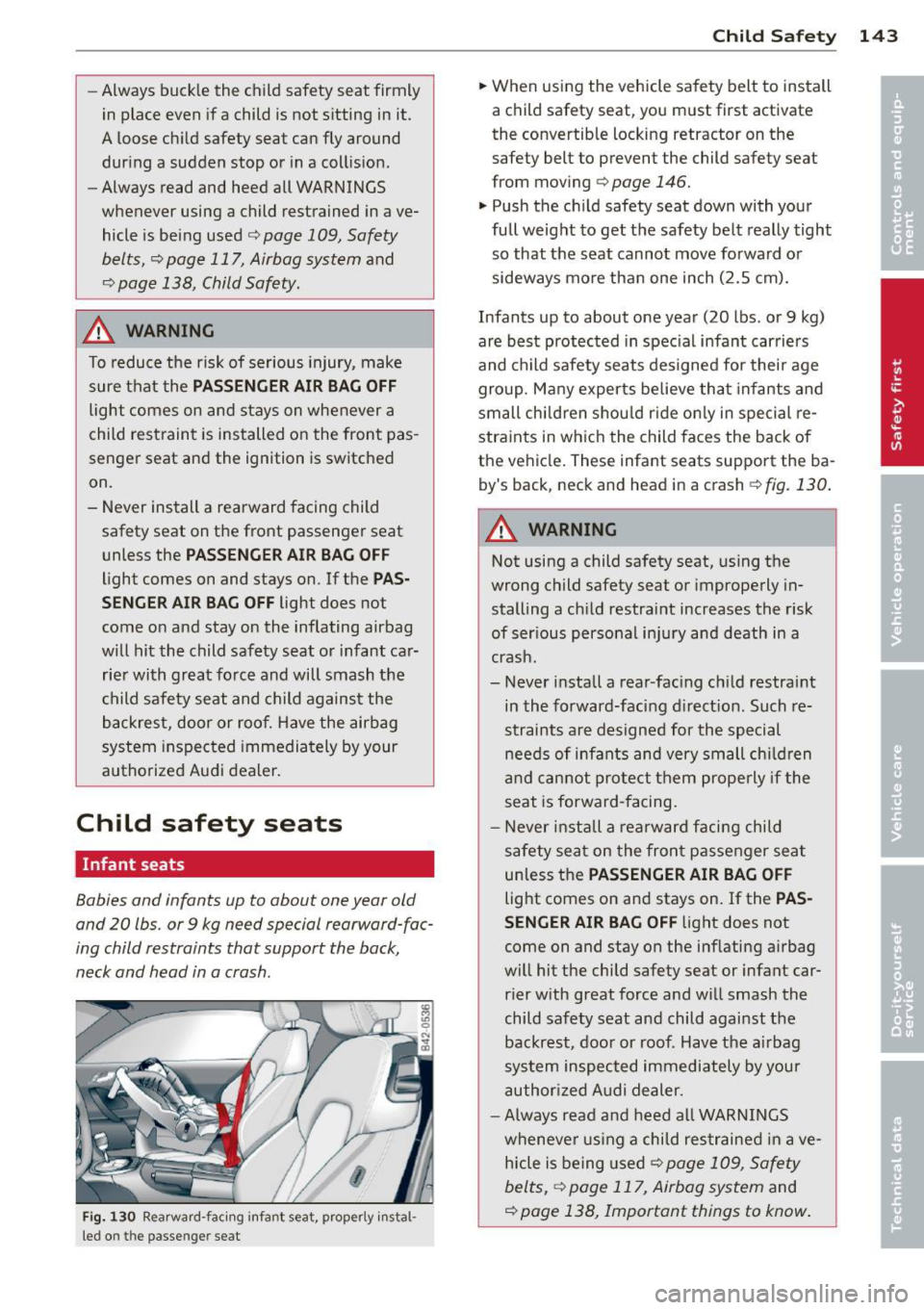
Babies and infants up to about one year old
and 20 lbs. or 9 kg need special rearward-fac
ing child restraints that support the back,
neck and head in a crash.
Fi g. 1 30 Rearward -fac ing infa nt seat , prope rly in sta l
le d on t he p asse nger seat
Child S afety 143
.. When using the vehicle sa fet y belt to install
a child safety seat , you must first activate
the convertible locking retractor on the
safety belt to prevent the child safety seat
from mov ing
c> page 146.
.. Push the ch ild safety seat down with you r
full weig ht to get t he safety be lt really tight
so that the seat cannot move forwa rd o r
sideways mo re tha n one inch ( 2.5 cm).
Infants up to about one year
(20 lbs . or 9 kg)
are best protec ted in spec ial infant carriers
and ch ild safety seats designed for thei r age
gro up. Ma ny exper ts believe that infants and
sm all chi ld ren s hou ld r ide o nly in speci al re
stra ints in which the child faces the back of
the ve hicle . These infant seats sup port the ba
by's back, neck and head in a c rash
c> fig . 130 .
A WARNING
Not using a child safety seat, using t he
wrong child safety seat or improperly in
stalling a ch ild restrai nt increases the risk
of ser ious personal inju ry and death in a
crash.
- Never i nstall a rear -fac ing ch ild restrai nt
in the forward-facing d irect ion . Such re
straints are designed for the special needs of infants and very small chi ldren
and cannot pro te ct them properly if the
seat is forward- facing.
-
- Never install a rearward facing child
safe ty sea t on the fron t passenger sea t
unless t he
PASSENGER AIR BAG OFF
light comes on and stays on. If the PAS·
SENGER AIR BAG OFF
li ght does not
come on and stay on the inf lating a irbag
wi ll hit the child safety seat or infant car
rier w ith great f orce and w ill smash the
child safety seat and child agai nst t he
backrest, door or roof. Hav e the a irbag
sy stem in spected immediately by your
a uthor ized A udi de aler.
- Always rea d and heed all WAR NIN GS
wheneve r us ing a child res traine d in ave
hicle is be ing used
c> p age 109, Safety
belts, ¢page 117, Airbag system
and
c> page 138, Important things to know .
Page 146 of 244
144 Child Safet y
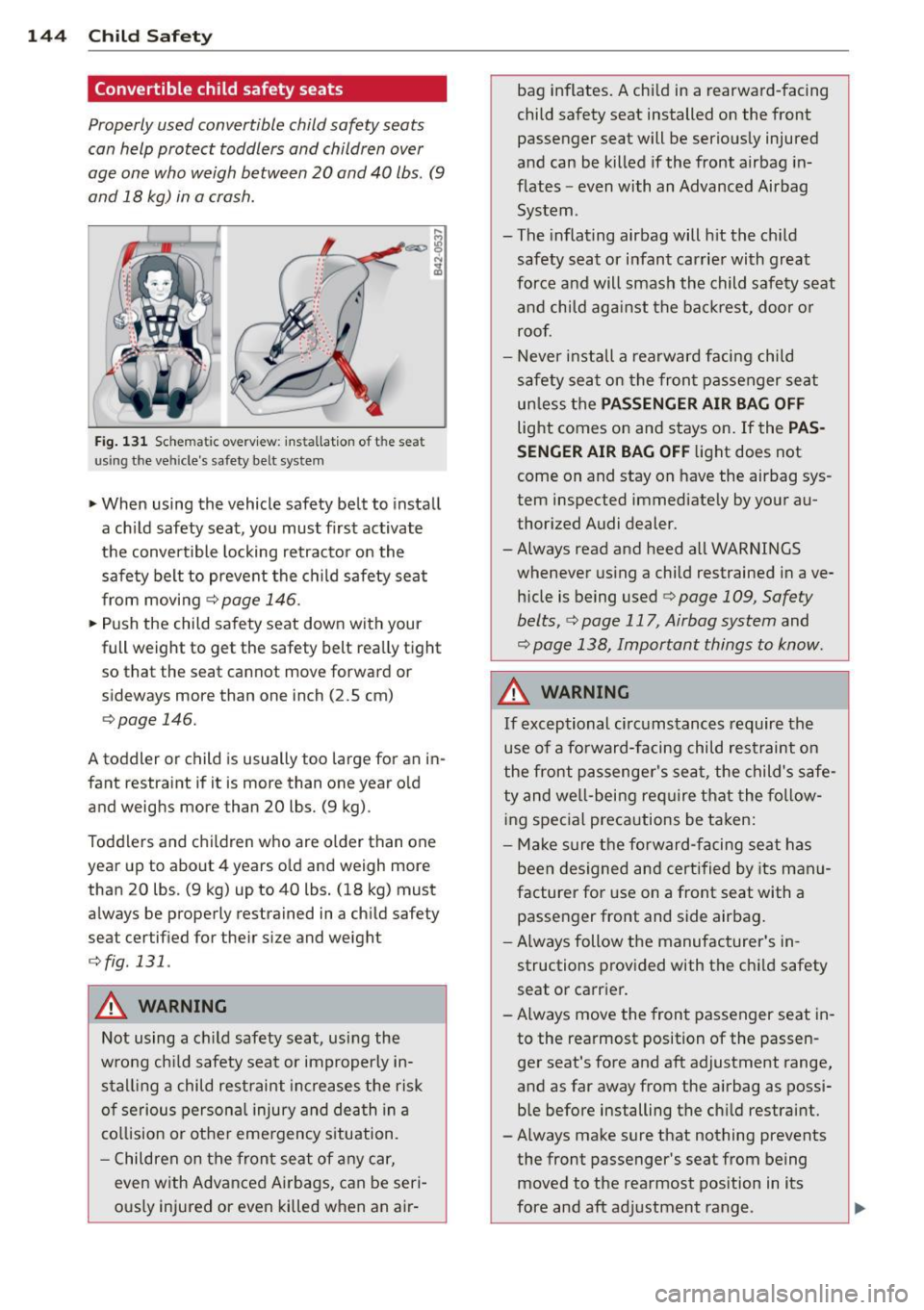
Convertible child safety seats
Properly used convertible child safety seats
can help protect toddlers and children over
age one who weigh between
20 and 40 lbs. (9
and 18 kg) in a crash.
Fig . 13 1 Schematic overv iew: in stallat ion of t he seat
us ing the ve hicle's safety belt system
~ When using the vehicle safety belt to install
a ch ild safety seat, you must first activate
the convertible locking retractor on the safety belt to prevent the c hild safety seat
from movi ng
Qpage 146.
~ Push the child safety seat down with your
full weight to get the safety belt rea lly tight
so that the seat cannot move forward or
sideways more than one inch (2.5 cm)
Qpage 146.
A toddler or child is usually too large for an in
fant restraint if it is more than one year old
and weighs more than 20 lbs. (9 kg) .
Toddlers and c hildren who are o lder than one
year up to about 4 years o ld and weigh more
than 20 lbs. (9 kg) up to 40 lbs. (18 kg) must
a lways be properly restrained in a child safety
seat certified for their size and weight
Qfig. 131 .
&_ WARNING
Not using a ch ild safety seat, us ing the
w rong ch ild safety seat or improperly in
stal ling a child re straint increases the risk
o f se rious persona l injury and de ath in a
co llision or othe r eme rgency s ituation.
- Children on t he front seat of a ny car,
even w ith Advanced A irbags, can be seri
ous ly injured or even killed when an air -bag inflates. A chi
ld in a rearward-facing
child safety seat installed on the front
passenger seat will be serious ly injured
and can be killed if the front airbag in
flates -even with an Advanced Airbag
System .
- The inflating airbag will h it the ch ild
safety seat or infant carrie r with great
for ce and will smash the child saf ety seat
and child aga inst the ba ckrest, doo r or
roof.
- Neve r install a rearward facing child
safety sea t on the fron t passenger sea t
un less t he
PASSENGER AIR BAG OFF
light comes on and stays on. If the PAS
SENGER AIR BAG OF F
light does not
come on and stay on have the airbag sys
tem inspected immediately by your au
thorized Audi dealer.
- Always read and heed all WARNINGS
whenever us ing a child restrained in ave
h icle is being used
¢ page 109, Safety
belts,
Q page 117, Airbag system and
Q page 138, Important things to know .
&_ WARNING
--
If exceptional circumstances require the
use of a fo rward-facing child restraint on
the front pa ssenger 's sea t, the child's safe
ty and we ll-bei ng req uire t hat the fo llow
i ng spec ial precautions be taken:
- Make sure the forward- facing seat has
been designed and cert ified by its man u
facturer for use on a front seat with a
passenger front and side airbag.
- Always follow the manufacturer 's in
structions p rovided with the chi ld safety
seat or carrie r.
- A lways move the front passenger seat in
to the rearmost position of the passen ger seat's fore and aft adjustment range,
and as far away from the airbag as possib le before installing t he ch ild restraint.
- Always make sure that nothing prevents
the front passenger 's seat from being
moved to the rearmost position in its
fore and aft adjustment range .
Page 147 of 244
-Always make sure the backrest 1s in an
upr ight position .
- Make sure that the
PASSENGER AIR BAG
OFF
light comes on and stays on all the
t ime whenever the ignition is switched
on.
- If the light does not stay on, perform the
checks
c;, page 128, Monitoring the Ad
vanced Airbag System.
- If the PASSENGER AIR BAG OFF light
does not come on and stay on have the
airbag system inspected immed iate ly by
your authorized Aud i dealer .
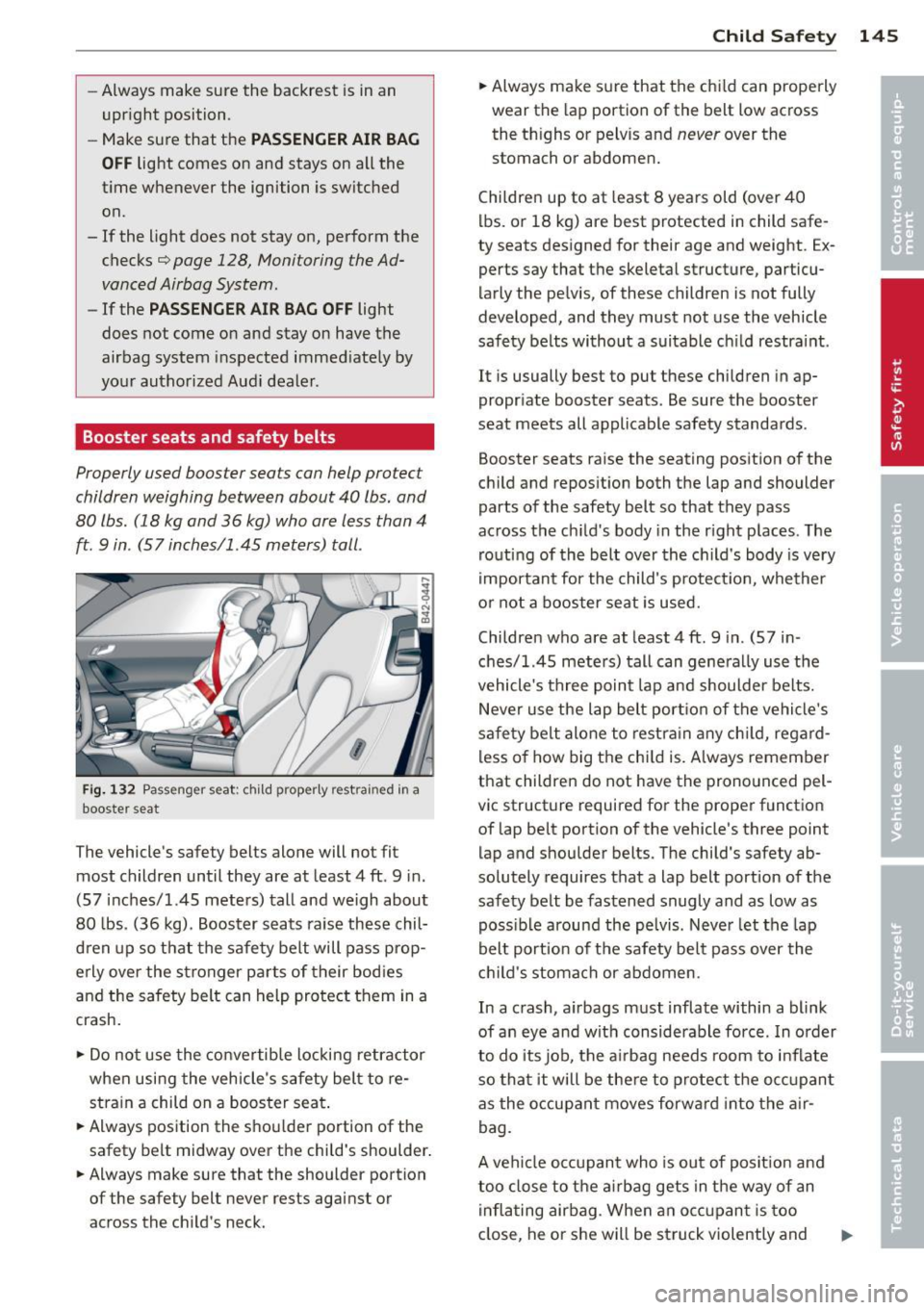
Booster seats and safety belts
Properly used booster seats can help protect
children weighing between about 40 lbs. and
80 lbs. (18 kg and 36 kg) who are less than 4
ft. 9 in. (57 inches/1 .45 meters) tall .
Fig. 132 Passenger seat : child proper ly rest ra in ed in a
booster seat
The vehicle's safety belts alone will not fit
most children until they are at least 4
ft. 9 in.
(57 inches/1.45 meters) tall and weigh about
80 lbs. (36 kg). Booster seats raise these chil
dren up so that the safety belt will pass prop
e rly over the stronger parts of their bodies
and the safety belt can help protect them in a
crash .
• Do not use the convertible locking retractor
when using the vehicle's safety belt to re
strain a child on a booster seat.
• Always position the shou lder portion of the
safety belt midway over the child's shoulder .
• Always make sure that the shoulder portion
of the safety belt never rests against or
across the ch ild's neck.
Child Safety 145
• Always make sure that the chi ld can properly
wear the lap portion of the belt low across
the th ighs or pelvis and
never over the
stomach or abdomen.
Children up to at least 8 years old (over 40
lbs. or
18 kg) are best protected in child safe
ty seats designed for their age and weight . Ex
perts say that the skeletal structure , particu
larly the pelvis, of these children is not fully
developed, and they must not use the vehicle
safety belts without a suitable ch ild restra int.
It is usually best to put these children in ap
propr iate booster seats . Be sure the booster
seat meets all applicable safety standards .
Booster seats raise the seating position of the
child and reposition both the lap and shoulder
parts of the safety belt so that they pass
across the ch ild's body in the right places . The
routing of the belt over the child's body is very
im portant for the child's protect ion, whether
or not a booster seat is used.
Children who are at least 4
ft. 9 in . (57 in
ches/1.45 meters) tall can generally use the
vehicle 's three point lap and shoulder belts.
Never use the lap belt port ion of the vehicle's
safety belt alone to restra in any child, regard
less of how big the chi ld is. A lways remember
that children do not have the pronounced pel
vic structure required for the proper function
of lap belt portion of the vehicle's three point
lap and shoulder belts. The child's safety ab
solutely requires that a lap belt portion of the
safety belt be fastened snugly and as low as
poss ible around the pelvis. Never let the lap
belt portion of th e safety be lt pass over the
child's stomach or abdomen.
In a crash, a irbags must inflate within a blink
of an eye and with considerable force . In order
to do its job, the airbag needs room to inflate
so that it will be there to protect th e occupant
as the occupant moves forwa rd into the air
bag .
A vehi cle occupant who is out of position and
too close to the airbag gets in t he way of an
inflating airbag. When an occupa nt is too
close, he or she will be struck violently and
Ill-