oil temperature AUDI R8 SPYDER 2011 Owners Manual
[x] Cancel search | Manufacturer: AUDI, Model Year: 2011, Model line: R8 SPYDER, Model: AUDI R8 SPYDER 2011Pages: 244, PDF Size: 59.74 MB
Page 12 of 244
10 Instruments and warning/indicator lights
Instruments and warning/indicator Lights
Instruments
Instrument cluster and controls
The instrument cluster is your central source of information.
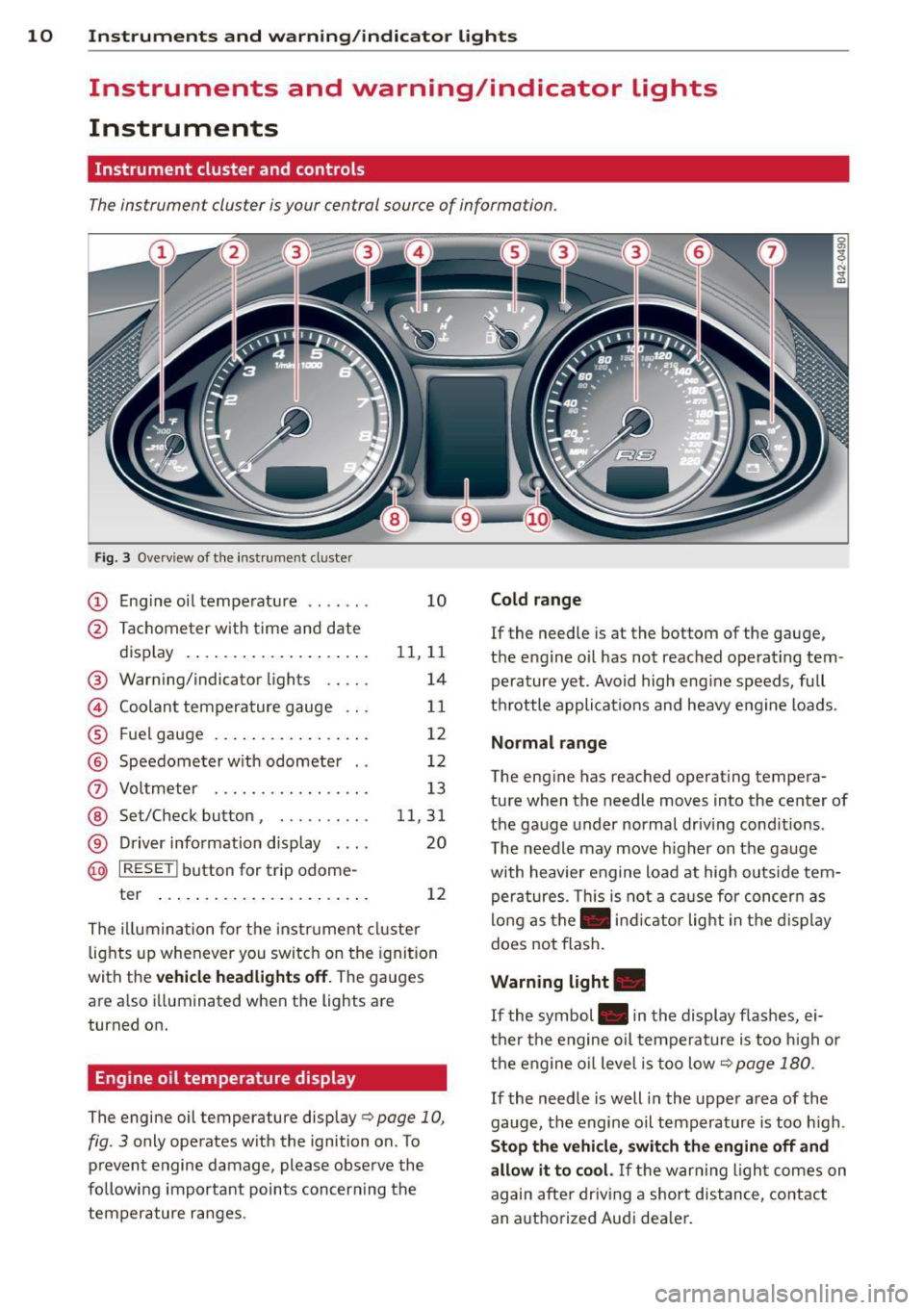
Fig. 3 Overview of the inst rumen t cluster
(D Engine oil temperature ...... .
@ Tachometer with time and date
display ................... .
® Warning/indicator lights .. .. .
© Coolant temperature gauge .. .
® Fu el gauge .............. .. .
@ Speedometer with odometer ..
(i) Voltmeter .............. .. .
@ Set/Check button , ... .. .. .. .
® Driver information display . .. .
@ I RESET ! button for trip odome-
ter ....... ............. .. .
10
11, 11 14
11
12
12
13
11, 31 20
12
The illumination for the instrument cluster
lights up whenever you switch on the ignition
with the
vehicle headlights off. The gauges
are also illuminated when the lights are
turned on.
Engine oil temperature display
The engine oil temperature display Q page 10,
fig. 3
only operates with the ignition on. To
prevent engine damage, please observe the
following important points concerning the
temperature ranges.
Cold range
If the needle is at the bottom of the gauge,
the engine oil has not reached operating tem perature yet. Avoid high engine speeds, full
throttle applications and heavy engine loads .
Normal range
The engine has reached operating tempera
ture when the needle moves into the center of
the gauge under normal driving conditions .
The needle may move higher on the gauge
with heavier engine load at high outside tem peratures. This is not a cause for concern as
long as the . indicator light in the display
does not flash.
Warning light.
If the symbol . in the display flashes, ei
ther the engine oil temperature is too high or
the engine oil level is too low
Qpage 180.
If
the needle is well in the upper area of the
gauge, the engine oil temperature is too high .
Stop the vehicle, switch the engine off and
allow it to cool.
If the warning light comes on
again after driving a short distance, contact
an authorized Audi dealer.
Page 14 of 244
12 Instruments and warning /indicator lights
If the needle is well on the right side of the
gauge, the coolant temperature is too high .
Stop the vehicle, switch the engine off and
allow it to cool.
If the warning light comes on
again after driving a short distance, contact
an author ized Audi dealer .
A WARNING
-Always observe the warni ng in
¢ page 175, Working in the engine
compartment before opening the engine
compartment lid an d checking the en
gine coo lant level.
- Never open the engine compartment lid
if yo u see or hear steam, or if you see e n
gine coolant dripping from the engine
compartment . You could burn yourse lf.
Let the engine coo l off first so that you
cannot hear or see any steam or engine
coolant.
(D Note
- Mounting additional lights or accessories
in front of the air inlets red uces the cool
i ng effect of the radiator. At h igh outside
temperatures or high engine load, the
engine could overheat .
- The front spo iler has been designed to
properly distribute the cooling air when
the veh icle is moving. If the spoiler is
damaged, th is could reduce the cooling
effect and the engine could then over
heat. Ask you r autho rized Aud i dealer for
ass istan ce.
Fuel gauge
The fuel gauge works only when the ignition is
on. When the needle reaches the red area, the
warn ing light in the instrument cluster will il
lum inate
c> page 33 (il This means you
have approximately 2.6 gallons (10 liters) of
fuel left in the tank .
Time to refuel!
The total tank capacity of your vehicle is listed
in
Technical data ¢ page 228.
(D Note
Never run the tank completely dry! An ir
regular supply of fuel can cause engine
misfiring and fuel could enter into the ex
haust system . The catalytic converter
could then overheat and be damaged.
· Speedometer with odometer
The speedome ter shows you the vehicle
speed, and the odometer shows you how
many miles (kilometers) you have driven .
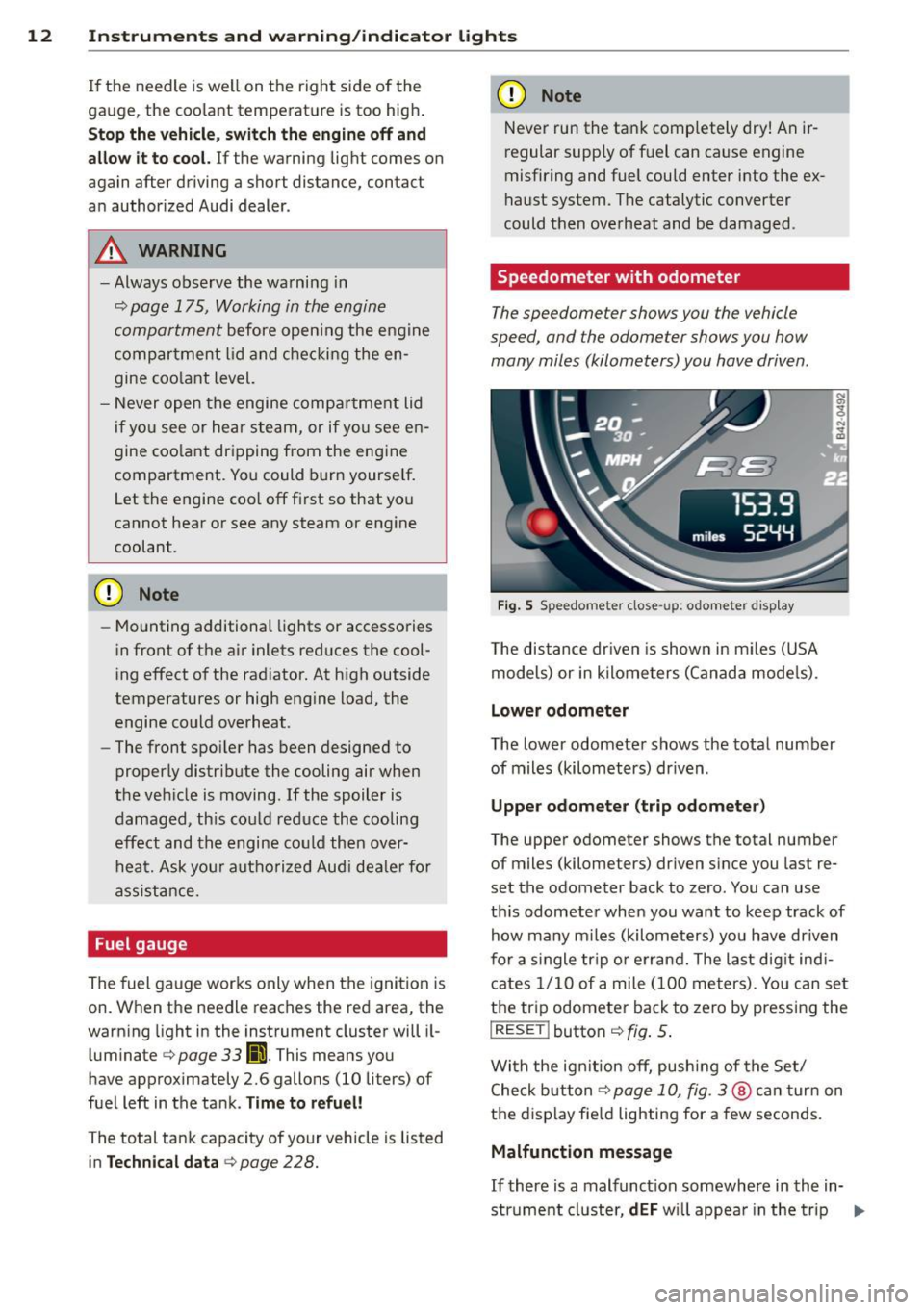
Fig. S Speedometer close -up: odome ter d isplay
The distance driven is shown in m iles (USA
models) or in kilometers (Canada mode ls).
Lower odometer
The lower odometer shows the total number
of miles (kilometers) dr iven .
Upper odometer (trip odometer)
The upper odometer shows the total number
of miles (kilometers) dr iven since you last re
set the odometer back to zero . You can use
th is odometer when you want to keep track of
how many m iles (kilometers) yo u have driven
for a single trip or errand. The last dig it ind i
cates 1/10 of a mile (100 meters) . Yo u can se t
the trip odometer back to zero by pressing the
I RESE T! button ¢ fig . 5 .
With the ign ition off, pushing of the Set/
Check button ¢ page 10, fig. 3 @ can turn on
the display field lighting for a few seconds.
Malfunction message
If there is a malfunct ion somewhere in the in-
strument cluster,
dEF will appea r in the trip .,.
Page 32 of 244
30 Driver in formation system
To sto re ma ximum sp ee d
.. Turn off the ignit ion.
.. Briefly press the button in the instrument
cluster¢ page 29, fig. 26. The odometer
and the digital clock are now illuminated .
.. Press the button for at least 2 seconds. The
currently stored maximum speed appears in
the d isplay
or the crossed out symbol for
warning threshold 2, if no max imum speed
was set previous ly.
.. Press the fu nction selector sw itch in the
wiper lever@~ fig. 2 7 up or down to
change the set value. Val ues run up or down
in steps o f 6 mph (10 km/h) .
To delete maximum speed
.. Turn off the ignit ion.
.. Briefly press the button in the instrument
cluster~ page 29, fig. 26. The odometer
and the digi tal clock are now illuminated .
.. Press the button for at least 2 seconds. The
currently stored maximum speed appears in
the disp lay.
.. Press the
l ~R_E_S-E T~I button in the w iper lever
@ ¢fig. 2 7 until the crossed out speed
warning symbol for warning threshold 2 ap
pears in the display.
A few seconds after the adjustment is com
pleted, the illumination for the odometer and
the dig ita l clock will go out.
{D) Tips
This war ning threshold can also be con
trolled through the trip computer
¢ page 25, Navigating the menu.
Warnings and symbols
Red symbols
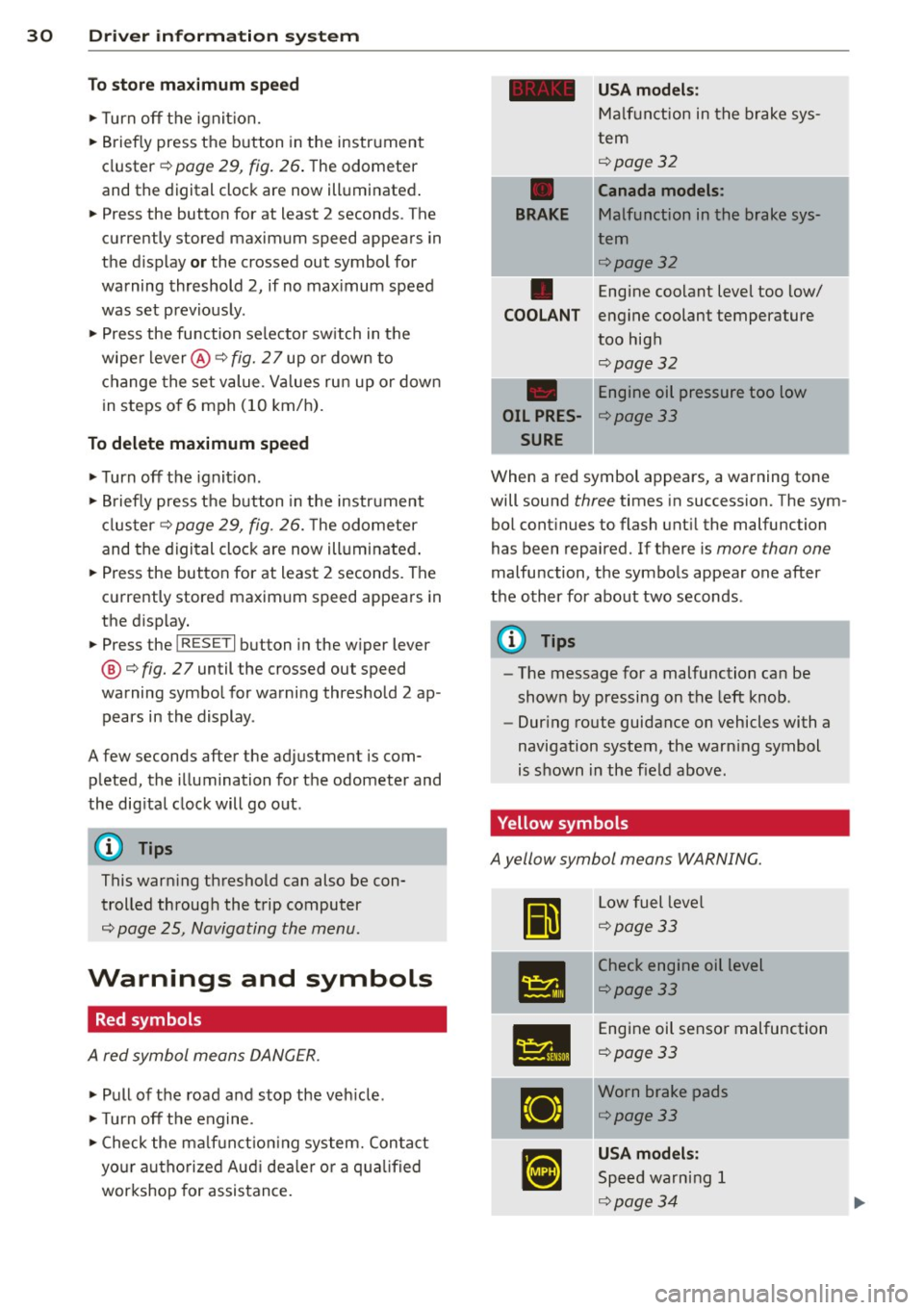
A red symbol means DANGER.
.. Pull of the road and stop the veh icle.
.. Turn off the engine .
.. Check the ma lf u nct io ni ng system. Contact
your a uthorized Aud i dea ler o r a q ua lified
workshop for assistance.
-
USA mod els :
Ma lfunction in the brake sys-
tern
~page32
•
Canada mod els :
BRAKE
Malfunction in the brake sys-
tern
~page32
•
Engine coolant leve l too low/
COOL ANT engine coolant temperature
too high
~page32
Engine oil pressure too low
OIL PRES-¢page 33
SURE
When a red symbol appears, a warning tone
will sound three times in succession. The sym
bol cont inues to flash unt il the malfunction
has been repaired. If there is more than one
malfunction, the symbols appear one after
the other for about two seconds.
@ Tips
- The message for a malfunction can be
shown by pressing on the left knob.
- Dur ing route guidance on vehicles with a
navigation system, the warn ing symbol
is shown in the field above.
Yellow symbols
A yellow symbol means WARNING.
II
L ow fuel leve l
~page33
-
•
Check engine oil level
~page33
•
Engine oil sensor malfunction
¢page33
IJ
Worn brake pads
¢page33
•
USA models :
Speed warning 1
~page34
'
Page 38 of 244
36 Driver information system
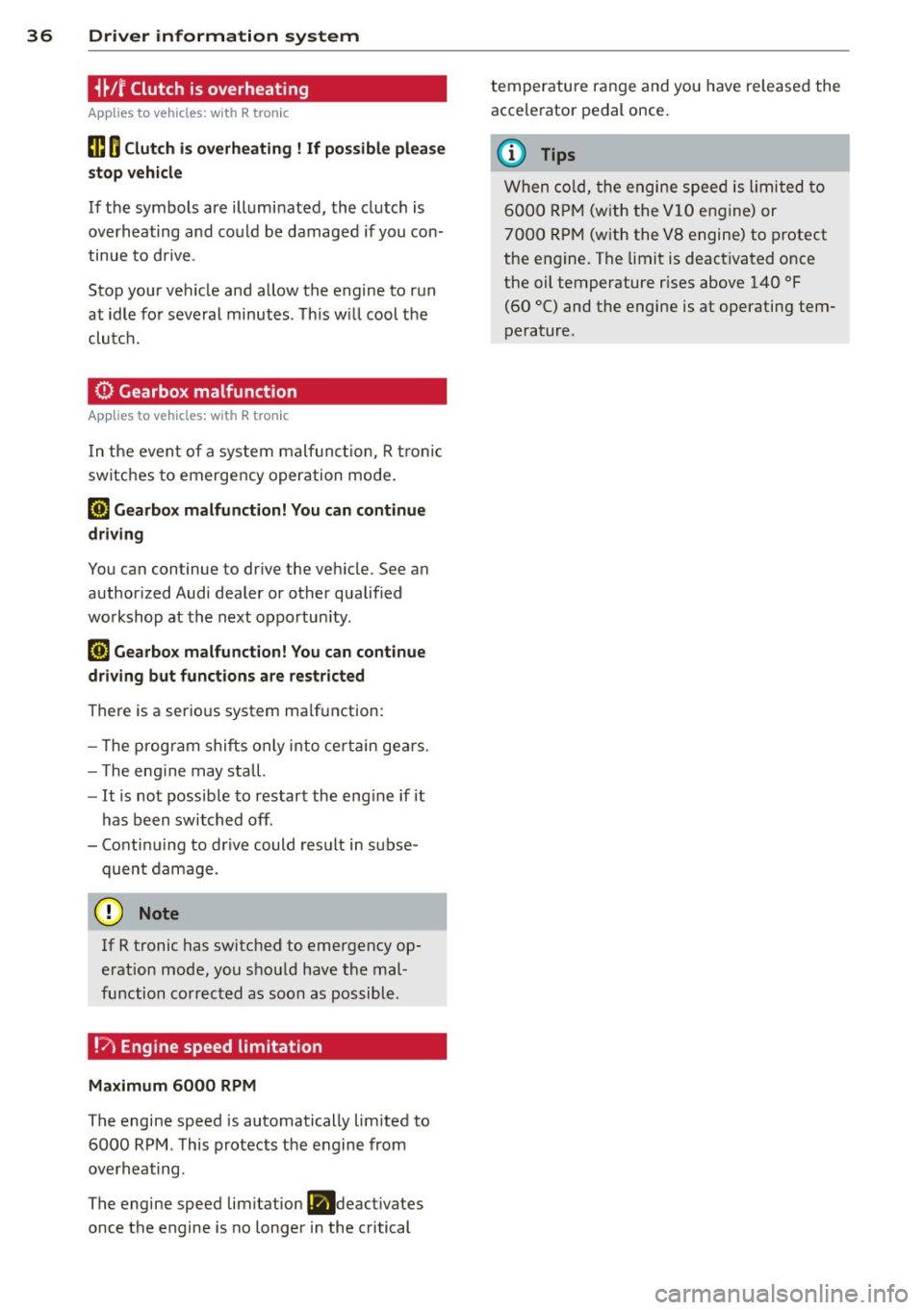
i~/r Clutch is overheating
Applies to vehicles: with R tronic
ffl O Clutch is overheating ! If possible please
stop vehicle
If the symbols are illuminated, the clutch is
overheating and could be damaged if you con
tinue to drive .
Stop your vehicle and allow the engine to run
at idle for several minutes . This will cool the
clutch.
0 Gearbox malfunction
Appl ies to vehicles: with R tronic
In the event of a system malfunction, R tronic
switches to emergency operation mode.
[O] Gearbox malfunction! You can continue
driving
You can continue to drive the vehicle. See an
author ized Audi dealer or other qualif ied
workshop at the next opportunity .
[O] Gearbox malfunction! You can continue
driving but functions are restricted
There is a serious system ma lfunction:
- T he prog ram shifts only into certain gears.
- T he eng ine may sta ll.
- It is not possible to restart the engine if it
has been switched off .
- Continuing to dr ive could result in subse
quent damage .
(D Note
If R tronic has switched to emergency op
eration mode, you should have the mal
function corrected as soon as possible.
!?) Engine speed limitation
Maximum 6000 RPM
The engine speed is automatically lim ited to
6000 RPM . This protects the engine from
overheating .
The engine speed limitation
(ll deact ivates
once the engine is no longer in the critical temperature range and you have released the
acce lerator pedal once.
(D Tips
When cold, the engine speed is limited to
6000 RPM (with the
VlO engine) or
7000 RPM (with the VS engine) to protect
the engine . The limit is deactivated once
the oil temperature rises above 140 °F
(60
°() and the engine is at operating tem
perature.
Page 154 of 244
152 Intelligent te chn olog y
deactivat ed, or they are activated auto
matically in the deactivated state .
- If a malfunction occurs in the E DS, this is
signaled by an indicator light, see
~ page 18.
- Some tracks (e.g . steeply banked turns)
may affect ESP response.
Rear spoiler
T h e rear spoil er improv es vehicle handling
and enhances driver control .
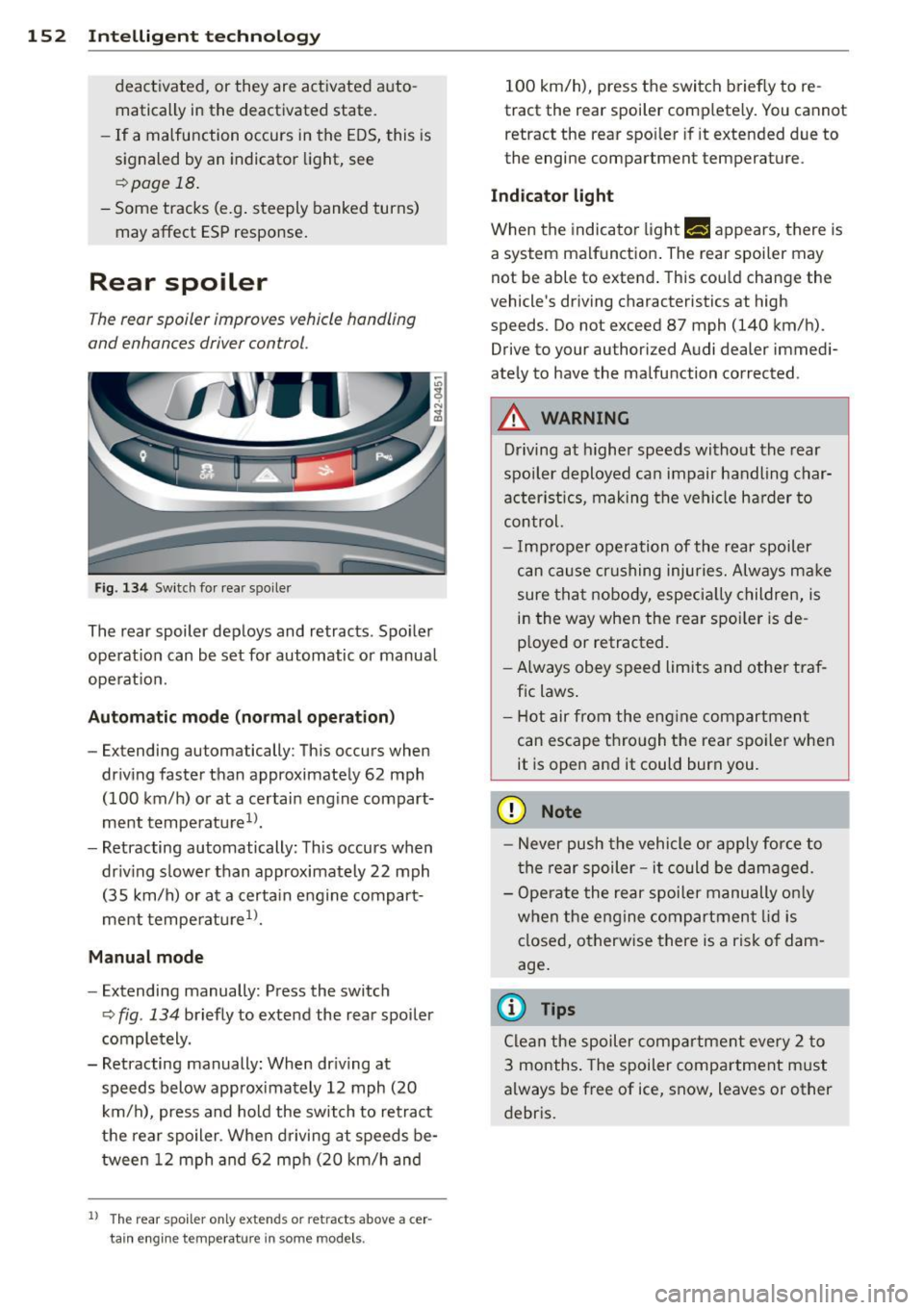
Fig . 134 Sw it ch for re ar s po ile r
The rear spoi ler deploys and retracts . Spo iler
operat ion can be set fo r automatic or manual
operation.
Automatic mode (no rmal operation )
-Extending automa tically : This oc curs when
driv ing faster than approximately 62 mph
(100 km/h) or at a certain eng ine compart
ment tempe rature
1>.
- Retracting automatically : This occurs when
dr iv ing slower than approximately 22 mph
(35 km/h) or at a certain engine compart
ment temperature
1> .
M anual mode
- Extending manually : Press the switch
~ fig . 134 briefly to extend the rear spoiler
completely .
- Retracting manually : When dr iv ing at
speeds below approximately 12 mph (20 km/h), press and hold the switch to retract
the rear spo iler. When driving at speeds be
tween 12 mph and 62 mph (20 km/h and
l) The rear s po iler o nly e xten ds or ret racts a bove ac er
ta in eng in e te mp erat ure in some m odels.
100 km/h), press the switch briefly to re
tract the rea r spoiler comp lete ly. You cannot
retract the rear spoi ler if it extended due to
the engine compartment temperature .
Indicator light
When the indicato r light f.-j appears, there is
a system malfunction . The rear spoiler may
not be able to extend . This cou ld change the
veh icle's d riving characterist ics at h igh
s peeds. Do not exceed 87 mph (140 km/h) .
Drive to your au thorized Audi dealer immedi
ately to have the malfunction corrected .
A WARNING
Driving at higher speeds without the rear
spoiler deployed ca n impair handling char
acteristics, making the ve hicle ha rder to
control.
- I mp rope r operation of the rear spoiler
can cau se crushing injuries. Always ma ke
sure tha t nobody, especia lly children, is
i n the way when the rear spoi ler is de
p loyed or retracted.
- Always obey speed limits and other traf
fic laws .
- H ot air from the eng ine compartmen t
can escape thro ugh the rear spo iler when
it is open and it could burn you .
(D Note
-Never push the vehicle or apply force to
t he rear spoiler -it could be damaged.
- Ope rate the rear spoiler manually on ly
when the eng ine compartmen t lid is
closed, otherwise there is a ris k of dam
age .
(D Tips
Clean the spoiler comp artment eve ry 2 to
3 months. The spoiler compa rtment m ust
always be free of ice, snow, leaves or other
debr is.
Page 161 of 244
-Have you r vehicle maintained properly
and in accordance with the service rec
ommendat ions in your Warranty
& Main
tenance booklet.
- Lack of proper maintenance as well as
improper use of the vehicle will impair
the function of the Emission Control Sys
tem and could lead to damage.
Sporty driving
Warming up and cooling down
By carefully warming up and cooling down
your vehicle, you can he lp ensure that it is not
overstressed unnecessarily during sporty driv
ing.
When warming up, the vehicle is driven at a maximum engine speed of
6000 RPM
(Vl0 engine) or 7000 RPM (V8 engine) in or
der to raise the engine oil temperature to a minimum of
140 °F (60 °(). The tires also on
ly reach their full road holding capability once
they have warmed up .
The cooling fan can continue to run in your ve h icle after the engine is switched
off. H owev
er, driving the vehicle to cool it down is part ic
ularly important. During sporty driving, the
engine and brakes, the exhaust system, and
the t ransm ission all become ex treme ly hot.
Before you park the vehicle, you shou ld d rive
it for a few mi les/kilometers at light load in
the low rpm range to allow it to coo l down .
Driving on a track
Before you take your vehicle out on a track,
ensure that it is in perfect condition. For ex
ample, you should check the tire tread and the brake pads . It is best to increase t ire pressure
by about 0 .3 bar .
When driving on a track, oil consumption may be somewhat higher than in "normal" opera
tion ¢page
180.
You shou ld definitely inspect your vehicle af
ter subjecting it to severe condit ions. Are the
brake pads OK? Is there anything unusual
Dri vin g and en vironm ent 159
about the ti res, including the inner and outer
sidewa lls (e.g . tread, blistering)? Are the air
intakes free of leaves and tire dust? Is the o il
l evel OK?
Your authorized Audi dea ler or qua lified work
shop will be happy to undertake an inspection
before and after use on the race track.
(D Tips
- Some race tracks (e.g . steeply banked
t u rns) may affect the response of the
ESP .
- When driven on a race track, all vehicle
parts are severe ly stressed. This can re
sult in increased wear.
Operation and maintenance
Fuel economy, env ironme nta l impact, and
wear on your eng ine, brakes and tires largely
depend on three factors:
- your personal driving style
- operating conditions
- technical limitations
By having your ve hicle reg ularly se rv iced by an
authorized Aud i dea ler helps to ens ure that i t
r uns properly and econom ica lly. The condition
of your veh icle not only affects its safety and
ability to ho ld its va lue, it a lso affects
f u el
con sumptio n.
The amount o f oi l used is re lated to engine
load and speed .
It is normal fo r the oil consump tion of a new
engine to reac h its lowest value after a certa in
mileage has been d riven.
You must drive your veh icle about 3,000 mi les
(5,000 kilometers) before you can p rope rly
assess oil consumpt ion.
This also app lies to fue l cons umption and en
gine output.
(D Note
- Have your veh icle ma inta ined properly
and in accordance with the service
•
•
Page 163 of 244
Cleaning and protect ion
General information
Regular core preserves vehicle value.
Regular and correct care will contribute to
maintaini ng the beauty and value of your Au
d i. Furthermore, good care may be a condition
for substantiating a warranty cla im should
corrosion damage or paint defects occur.
Your authorized Audi R8 dealer has a variety
of
d edicat ed ve hicl e-car e produ ct s. Please
make sure you apply them correctly .
A WARNING
-Cleaning agents may be poisonous. Keep
them out of the reach of children.
- Heed all caution labels .
- Always read directions on the container before using any product. Follow the di
rect ions carefu lly.
- Most chemical cleaners are concentrated and have to be diluted .
- Use spot removing fluids only in well
ventilated areas .
- Do not use gasoline, kerosene, d iesel
fuel, nail polis h remover or other volatile
fluids . They may be toxic, flammab le or
haza rdous in other ways. Do not wash,
wa x or d ry the vehicle wi th the ign it ion
on or the eng ine running.
- Do not clean the undersides of chassis,
fenders, wheel covers, e tc. wit h out pro
tecting your hands and arms . You may
c u t yourself on sharp -edged metal parts .
- Moist ure and ice on brakes may imp air
braking efficiency
c:> page 153, Broking.
T est the brakes carefully each time you
wash the vehicle.
@) For the sake of the environment
Select only environmentally friend ly clean
ing products . Leftover clean ing products
should not disposed of in the household
waste .
Cleaning and protec tion 16 1
Care of exterior
Washing your vehicle
The longer i nsect rema ins, bird dropp ings,
t ree res in , ro ad and indust rial dust, tar , soo t
particles, road salt, and o ther aggressive de
pos its remain on the vehicle su rface, the more
lasting their destructive effect will be . High
temperatures, for example from intense s un
light, intensify the corrosive effect.
After the end of winter road salting, the un derside of the vehicle shou ld be thoroughly
washed .
Automatic car washes
You must t ake the necessary precautions s uch
as clos ing t he windows and convert ible top
before using an automatic car wash.
If yo ur
vehicle has specia l accessories - e.g . spoilers,
radio antenna -it is best to speak to the oper
ator of the car wash c:>(D .
Only use car washes where the vehicle re
mains stationary and the cleaning equipment
moves around the veh icle while washing and
drying. It is not possib le to use car washes
where the vehicle is moved forward on a con
veyer
c:> ,& .
It is preferab le to wash your vehicle in a
brush less carwash .
Washing with a pow er wa sher
When was hing yo ur vehicle with a power
washe r, be sure to follow the operating in
structions for the power washer. This applies particu larly to the
p ressure and the spra ying
distance .
Mainta in sufficient distance from
soft materials such as rubber hoses, sound
deade ning mater ial, and the park ing aid sen
sors* that are located i n the front or rear
bumper.
Do not use washers with
a ro tating jet or a
nozzle spraying
a h igh pr essur e je t of wate r in
any case.
IJl,-
•
•
Page 181 of 244
The engine oil and oil filter must be changed
according to the mi leage (kilometers) and
time interva ls specified in your vehicle's War
ranty & Maintenance booklet. Do not exceed
these intervals -harmful deposits from old
engine o il can reduce engine performance and
can lead to expensive engine repairs.
Changing the o il at the recommended inter
vals is so very important because the lubricat
ing properties of oil decrease gradually during
normal vehicle use . If you are not sure when
you have your oi l changed, ask your author
i zed A udi Service Advisor.
Under some circumstances the engine o il
should even be changed more frequently.
Change o il more often if you drive mostly
short distances, ope ra te the vehicle in dusty
areas or mostly under s top-and-go traffic con
d itions, or when yo u use your vehicle whe re
temperatures stay below freezing point for
l ong periods.
D etergen t additives i n the o il w il l make fresh
oil look dark after the eng ine has been run
ning for a short time . This is norma l and is not
a reason to change the oi l more often than
recommended.
Damage or malfunction s due t o lack of
m aintenance
It is essen tial that you change your oil at the
r ecommended inte rva ls using only engine o il
that complies with A udi oil standard
VW 502 00. Yo ur Limited New Vehicle War
ranty does not cover damage or malfunctions
d ue to fai lure to fo llow recommended mainte
nance and use req uirements as set forth in
the Audi Owner's Manua l and Warranty&
Ma intenance book let . Your autho rized Aud i
deale r will have to deny warranty coverage un
l ess you present to the dealer p roof in the
fo rm of Se rvice o r Repair Orde rs t hat all
sched uled main tenance w as performed in a
time ly manner .
Checkin g and fillin g 179
Engine oil consumption
The engine in your vehicle depends on an ade
quate amount of oil to lubricate and cool all
of its moving parts .
In order to provide effective lubrication and
cooling of interna l eng ine components, all in
te rnal combust io n engines consume a certain
amount of oil. Oil consumpt io n va ries from
engine to e ngine and may change sig nifican tly
ove r the life of the engine. Typically, engines
with a spec ified break -in pe riod (see
c::> page 158) consume more oil d uri ng the
break-in pe riod than they consume afte r oi l
consumption has stabilized.
U nder normal cond itions, the rate of oi l con
s u mption depends on t he q uality and viscos ity
of the oil, the RP M (revolut ions per minute) at
which the engine is operated, the ambient
temperature and road conditions. Further fac
tors are the amount of oil dilut ion from water
condensa tion or fue l residue a nd the oxida
tion level of the oil. As any eng ine is subject to
wear as m ileage builds up, t he oil co nsump
t ion may increase over time until repla cement
of wo rn components may be come necessary.
Wi th a ll these va riab les coming into p lay, no
standard rate of oil consumpt io n can be es
t a bl is h ed o r spec ified . There is no alte rnative
to regular and frequent chec king of the o il lev
el, see
Note.
If the yellow engine o il level wa rning symbo l
i n the instrument cluster
1\11 lights up, yo u
sho uld check the oil leve l as soon as possib le
c::> page 180 . Top off the oil at your ear liest
convenience
c::> page 180 .
A WARNING
-Before you check anything in the engine
compartment, always read and heed a ll
WARNINGS
c::> & in Working in the engine
compartment on pag e 175.
(D Note
Driving w ith an insufficient o il level is like-
-
ly to cause severe damage to the engine. .,.
•
•
Page 201 of 244
A WARNING
Sudden tire failure can lead to loss of con
trol, a crash and serious personal injury!
- Never drive a vehicle when the tread on
any tire is worn down to the wear indica
tors.
- Worn tires are a safety hazard, they do
not grip well on wet roads and increase
your risk of "hydroplaning" and loss of
control.
- Always keep chemicals that can cause
tire damage, such as grease, oil, gasoline
and brake fluid away from t ires.
- Tires age even if they are not be ing used
and can fail suddenly, especially at high
speeds . Tir es that are more than 6 years
old can only be used in an emergency
and then with special care and at lower
speeds.
- Never mount used tires on your vehicle if
you are not sure of their" previous histo
ry ." Old used tires may have been dam
aged even though the damage cannot be
seen that can lead to sudden tire failure
and loss of vehicle control.
Tires and wheels 199
New tires and replacing tires and wheels
New tires and wheels have to be broken in .
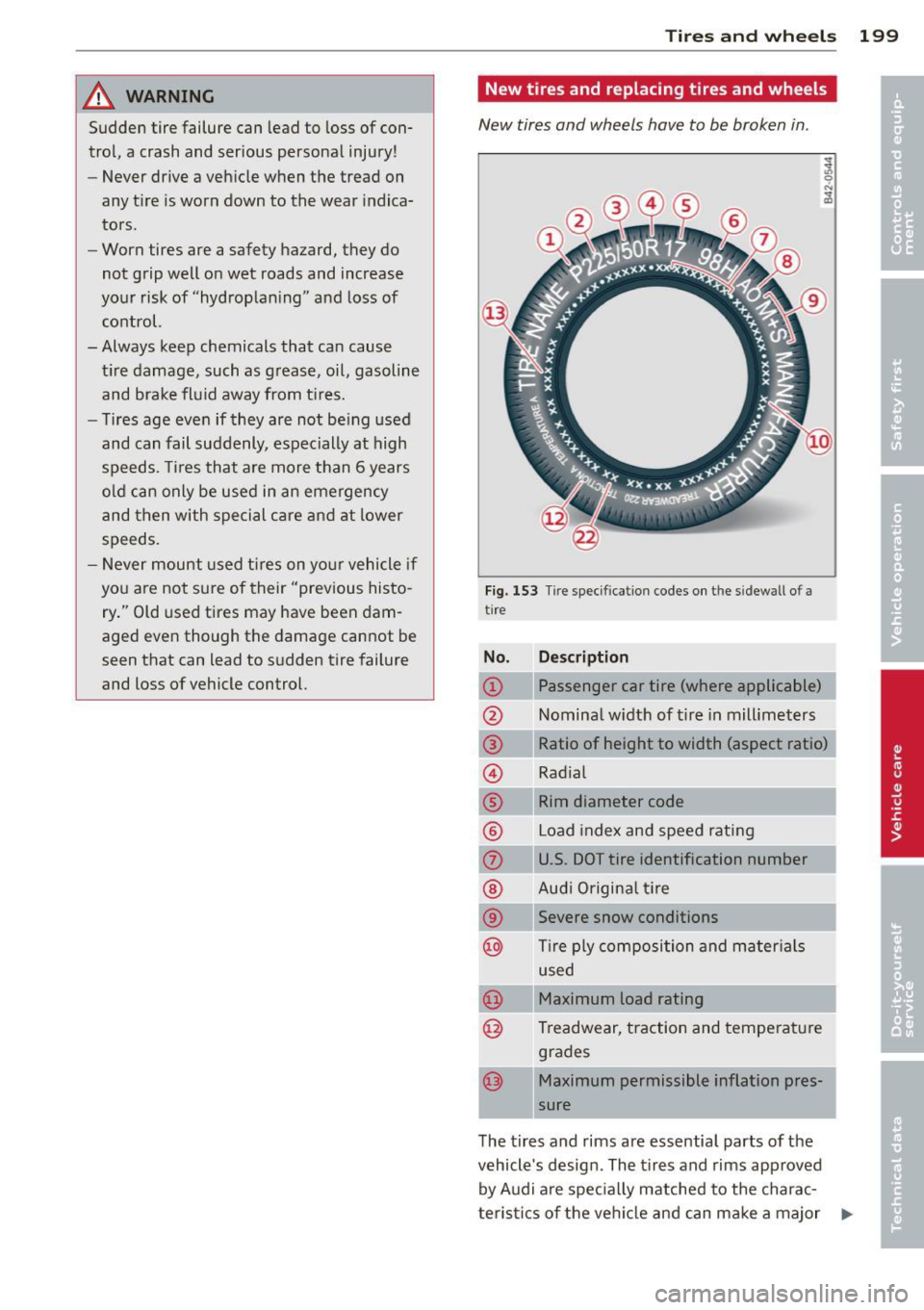
Fig. 153 Tir e specificat ion codes on t he s idewall o f a
tire
No. Description
CD Passenger car tire (where applicable)
@ Nominal w idth of tire in millimeters
® Ratio of height to width (aspect ratio)
© Radial
® Rim diameter code
® Load index and speed rating
(f) U.S. DOT tire identification number
® Audi Origina l tire
® Severe snow conditions
@ T ire ply composition and materials
used
@ Maximum load rating
@ Treadwear, traction and temperature
grades
@ Maximum permissible inflation pres-
sure
The tires and rims are essential parts of the
vehicle's design . The tires and rims approved
by Audi are spec ially matched to the charac
teristics of the vehicle and can make a major .,.
•
Page 211 of 244
Consumer Information
Warranty coverages
Your Audi is covered by the following war
ranties :
-New Vehicle Limited Warranty
- Limited Warranty Against Corrosion Perfo-
ration
- Emissions Control System Warranty
- Emissions Performance Warranty
- California Emissions Control Warranty (USA
vehicles only)
- California Emissions Performance Warranty
(USA vehicles only)
Detailed information regarding yo ur warran
ties can be found in your
Warranty & Mainte
nance booklet .
Operating your vehicle
outside the U.S.A. or
Canada
Government regulations in the United States
and Canada require that automobiles meet
specific emission regulations and safety
standards. Therefore, veh icles built for the
U.S.A. and Canada differ from vehicles sold in
other countries .
I f you p lan to take your vehicle outside the
continental limits of the United States or Can
ada, there is the possibility that
- unleaded fuels for vehicles with cata lytic
converter may not be available;
- fuel may have a considerably lower octane
rating . Improper fuel may cause engine
damage;
- service may be inadequate due to lack of
proper service facilities, tools or testing
equipment;
- replacement parts may not be readily availa
ble.
- Navigation systems for vehicles built for the
U.S.A. and Canada will not necessari ly work
in Europe, and may not work in other coun
tries outside of North America.
Consumer Information 209
@ Note
Audi cannot be responsible for mechanical
damage that could result from inadequate
fuel, serv ice or parts availab ility.
Audi Service Repair
Manuals and Literature
Audi Offic ial Factory Service Manuals and Lit
erature are published as soon as possible after
model introduct ion. Service Manuals and liter
at ure are available to order from the Audi
T echnical Literature Ordering Center at:
https: //www. audi.techliterature.com
Maintenance
' General
Your vehicle has been designed to help keep
maintenance requirements to a minimum.
However, a certain amount of regular mainte
nance is still necessary to assure your vehicle's
safety, economy and reliability . For detailed
vehicle maintenance consult your Warranty& Maintenance booklet.
Under difficult operating conditions , for ex
ample at extremely low outside temperatures,
in very dusty regions, etc., some service work
shou ld be pe rformed between the intervals
specified. This applies particularly to:
- oil changes, and
- cleaning or replacing the air fi lter.
@ For the sake of the environment
By regu larly maintaining your vehicle, you
help make sure that emission standards
are maintained, thus minimizing adverse
effects on the environment.
Important considerations for you and
your vehicle
T he increasing use of electron ics, soph isticat
ed fuel injection and emission control sys
tems, and the genera lly increasing technica l
complexity of today's automobiles, have ..,_
•
•