warning light AUDI R8 SPYDER 2012 Owner's Manual
[x] Cancel search | Manufacturer: AUDI, Model Year: 2012, Model line: R8 SPYDER, Model: AUDI R8 SPYDER 2012Pages: 236, PDF Size: 59.24 MB
Page 42 of 236
40 Convertible top
Convertible top
Convertible top
General information
The fabric convertible top opens and closes
automatically. When it is open, it is stored in
the convertible top storage bay. The converti
b le top may be opened or closed at speeds up
to 31 mph (SO km/h) .
The convertible top is wind- and wate rproof
under normal conditions . Some moisture may
collect in the vehicle interio r, b ut only under
extreme ly adverse weather conditions such as
torrential rain . That is normal and no cause
for concern.
Follow the cleaning and maintenance instruc
tions ~
page 156 to ensure the convertible
top remains wind- and waterproof. Also note
the following points:
- Only stow the convertib le top when it is
clean and dry . Grains of sand or coarse dirt
particles can cause abrasions on the conver
tible top when stowed that can lead to dam
age to the fabric over time. Stowing the con
vertib le top when it is damp can cause
marks or permanent mildew spots to form .
- Do not leave the convertible top open for
several weeks or the creases in it may be
come discolored . This is especia lly true if the
top was stowed when damp .
- Remove ice and snow before opening the
convertible top . Do not use any sharp edged
objects to remove ice and snow or the con
vertib le top could be scratched or damaged.
T he rear window may be cleared with a
standard ice scraper.
- T he fabric in the convertible top loses elas
t icity in sub-zero temperatures. We recom
mend not opening or closing the convertib le
top when the temperature is below 32 °F (0 QC). The convertible top will not open
when the temperature is 5 °F (-15 QC) or be
low.
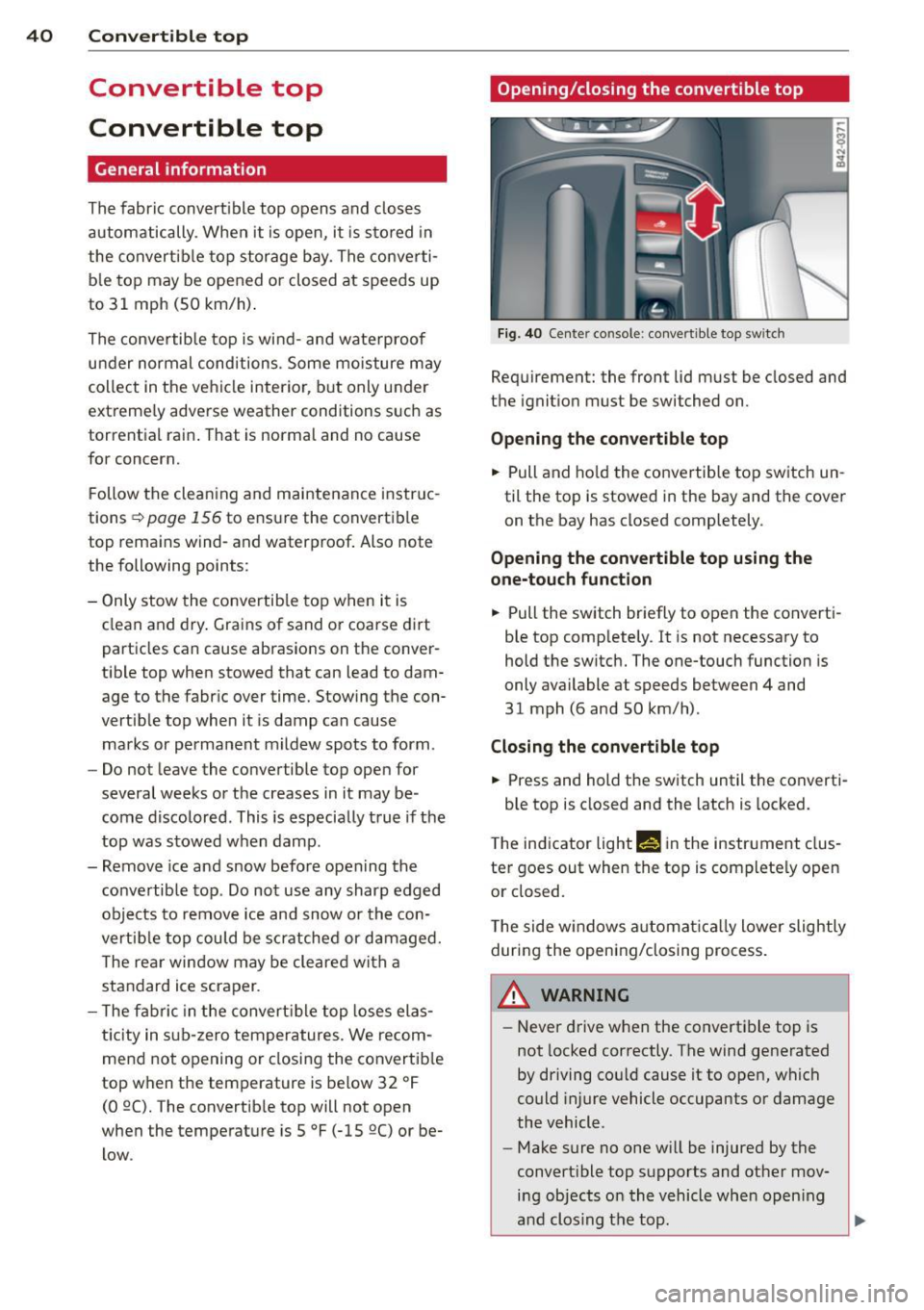
Opening/closing the convertible top
Fig. 40 Center co nsole : convertible top sw itc h
Requirement: the front lid must be closed and
the ignition must be switched on.
Opening the convertible top
.. Pull and hold the convertible top switch un
til the top is stowed in the bay and the cover
on the bay has closed completely.
Opening the convertible top using the
one-touch function
.. Pull the switch briefly to open the converti
ble top completely . It is not necessary to
hold the switch. The one-touch function is
only available at speeds between 4 and
31 mph (6 and 50 km/h) .
Closing the convertible top
.. Press and hold the switch until the converti-
ble top is closed and the latch is locked.
T he indicator light
M! in the instrument clus
ter goes out when the top is completely open
or closed.
The side w indows automa tica lly lower slightly
during the opening/closing process.
A WARNING ~
- Never drive when the convertible top is
not locked correctly . The wind generated
by driving cou ld cause it to open, which
could injure vehicle occupants or damage
the vehicle.
- Make sure no one will be injured by the
convertible top supports and other mov ing objects on the vehicle when open ing
and clos ing the top .
Page 44 of 236
42 Convertible top
Wind deflector
The wind deflector reduces turbulence in the
passenger compartment and makes driving
more comfortable.
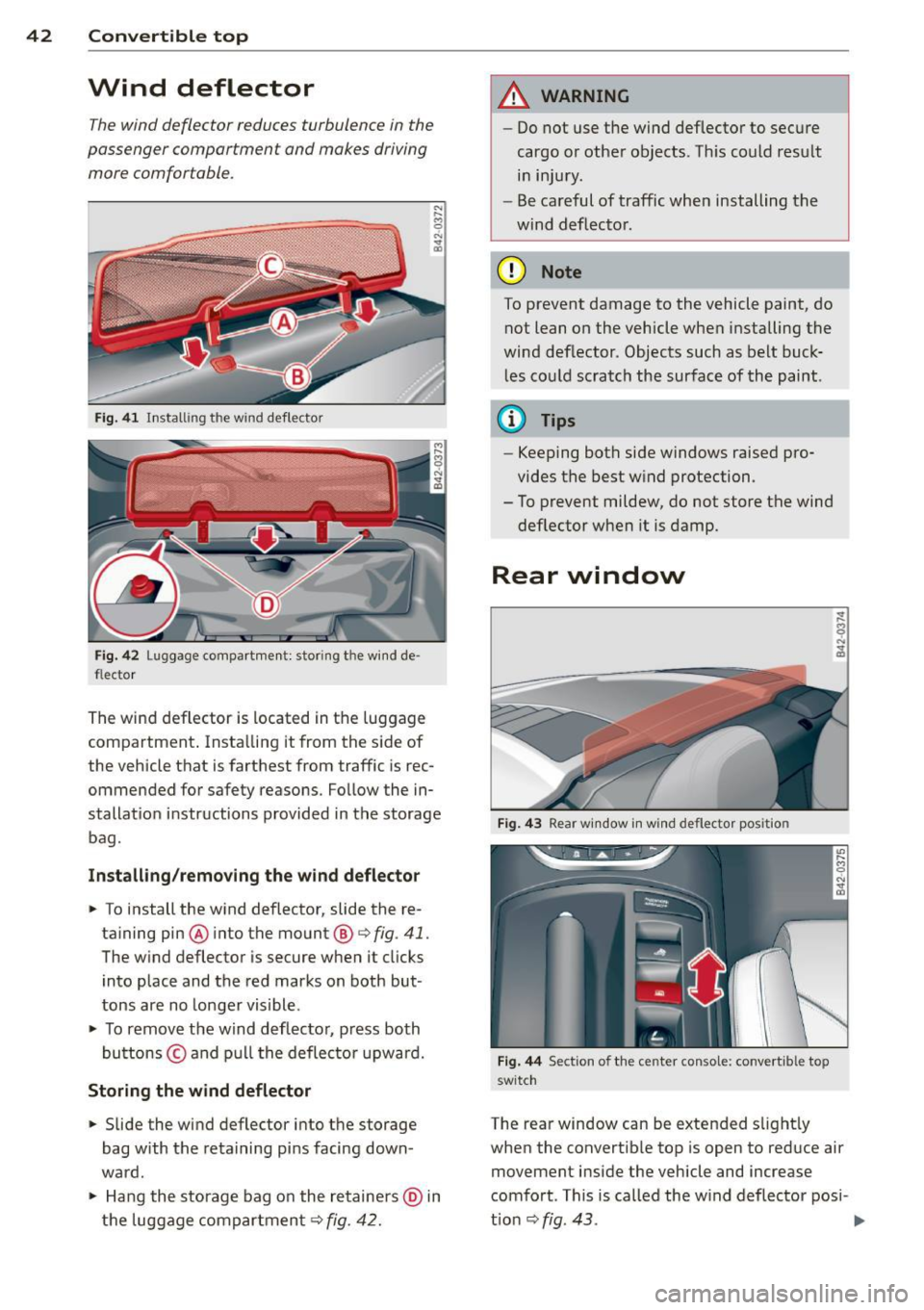
Fig. 41 Installing the wind deflector
Fig. 42 Luggage compartment: storing the wind de
flector
The wind deflector is located in the luggage
compartment . Insta lling it from the side of
the vehicle that is farthest from traffic is rec
ommended for safety reasons. Follow the in
stallat ion instructions provided in the storage
bag.
Inst alling /removing the wind deflector
... To install the wind deflector, slide the re-
ta ining pin@into the mount @
¢fig. 41.
The w ind deflector is secure when it clicks
into place and the red marks on both but
tons are no longer visible .
.,. To remove the wind deflector, press both
buttons © and pu ll the deflector upward.
Storing the wind deflector
.,. Slide the wind deflector into the storage
bag with the retaining pins facing down
ward .
.,. Hang the storage bag on the retainers @ in
the luggage compartment ¢
fig. 42.
A WARNING
-
-Do not use the wind deflector to secure
cargo or other objects. Th is could resu lt
in injury.
- Be careful of traffic when installing the
wind deflector.
@ Note
To prevent damage to the vehicle paint, do
not lean on the vehicle when installing the
wind deflector. Objects such as belt buck les could scratch the surface of the paint.
@ Tips
-Keeping both side windows raised pro
vides the best w ind protection.
- To prevent mildew, do not store the wind deflector when it is damp.
Rear window
Fig. 4 3 Rear w indow in win d deflecto r posit ion
Fig . 44 Sect io n of the cente r co nsole: conve rtible top
switch
The rear window can be extended slightly
when the convertible top is open to reduce air
movement inside the vehicle and increase
comfort. This is called the wind deflector posi-
t ion ¢
fig. 43. ..,_
Page 52 of 236
50 Clear vision
shown as active in the driver information
system.
The
coming home function illuminates the
area around the vehicle when the ignition is
switched off and the driver 's door is opened.
The length of time the lights rema in on can be
set in the menu display
(Lights> Exterior
lights > coming home) .
The leaving home function illuminates the
area around the vehicle when unlocking it.
.&_ WARNING
-Never use daytime running lights to see
where you are going. They are not bright enough and will not let you see far
enough ahead for safety, especially at dusk or when it is dark . Be aware of
changes in outside light conditions when
you are driving and respond by switching on your low beams.
- Automatic head- and taillight control is
only intended to assist the driver. This
feature does not relieve the driver of his
responsibility to check the headlights
and to turn them on manually according
to the current light and visibility condi
tions. For example, fog and rain cannot
be detected by the light sensors. Conse
quently, always switch the headlights on
under these weather conditions and
when driving in the dark .
- Crashes can happen when you cannot see
the road ahead and when you cannot be
seen by other motorists .
-Always turn on the headlights so that you can see ahead and so that others can see your car from the back.
- Please observe legal regulations when
using the lighting systems described .
@ Tips
-Always observe the specific local regula
tions for your area when to use your lights .
- Turn on low beams as evening ap
proaches or in conditions of poor visibili
ty. -
Do not attach stickers to the windshield
in front of the sensors as this can disable
the automatic head- and taillight control
and the automatic glare-dimming of the
rearview mirror(s)*.
- If you remove the ignition from the igni
tion lock while the headlights are still
on, a buzzer will sound as long as the
driver's door is open to remind you to
turn off the lights .
- In the AUTO mode, the low beams are
turned off when the ignition is turned
off . The remaining lights are turned off
when the key is taken out of the ignition.
- In cool or damp weather conditions the
headlights may fog over temporarily on
the inside .
- The critical factor is the temperature
difference between the interior and the
exterior of the headlight lens.
- With the main beams switched on, the
light-emitting area will be free of con
densation after a short time , however
the edges of the glass may still be fog
ged .
- This physical phenomenon has no ef
fect on the life of your vehicle's l ight
ing system .
Emergency flasher
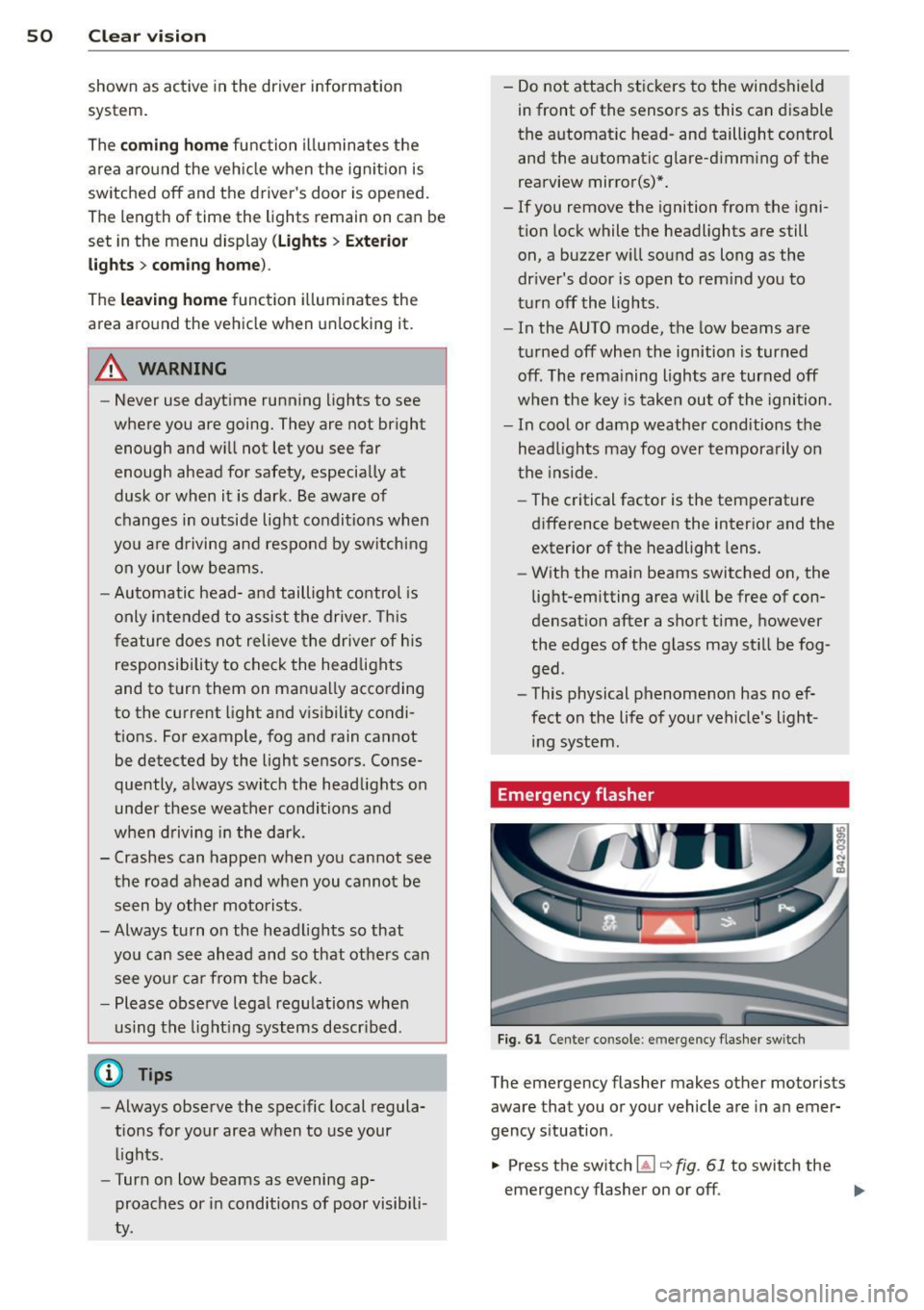
Fig. 61 Center console: em erge ncy flasher sw itc h
The emergency flasher makes other motorists
aware that you or your vehicle are in an emer
gency situa tion.
... Press the switch ~
Q fig. 61 to switch the
emergency flasher on or off .
ll>
Page 53 of 236
When the emergency flasher is on, all four
turn signal blink at the same time . The turn
signal ind icator lights
R II in the instrument
cluster, as well as the light in the emergency
flasher switch~ blink likewise . The emergen
cy flasher also works when the ignition is
switched off.
The emergency flasher wi ll automatically
sw itch on if you are in an acc ident where the
a irbag has deployed .
(D Tips
You should switch on the emergency flash
er when:
-you are the last vehicle standing in a traf
fic jam so that any other vehicles coming
can see you, or when
-your vehicle has broken down or yo u are
in an emergency situation , or when
- your vehicle is being towed by a tow
truck or if yo u are towing another vehicle
behind you.
Turn signals and high beam lever
The lever is used to operate the turn signals
and the high beam as well as the headlight
flasher .
t
t
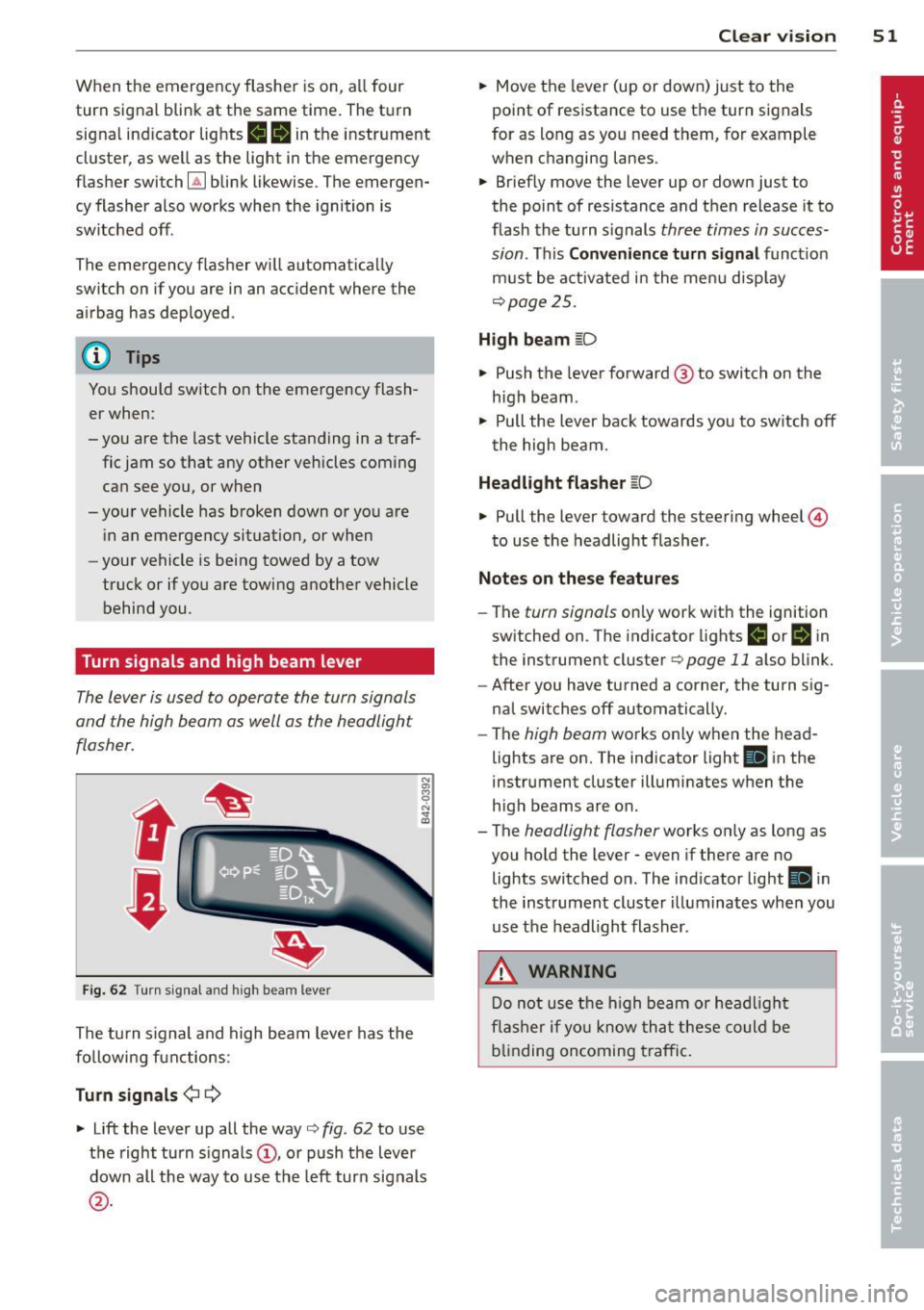
F ig . 6 2 Turn signa l an d h igh beam lever
The turn s ignal and high beam leve r has the
followi ng functions:
Turn sign als ¢ 9
N
"' 8
"' ... a,
~ Lift the lever up all the way c:> fig . 62 to use
the right turn s ignals
(D , or push the lever
down all the way to use the left turn signals
@ .
Clear vi sion 51
~ Move the lever (up or down) just to the
point of resistance to use the turn signals
for as long as you need them, for example
when changing lanes .
~ Briefly move the lever up or down just to
the point of resistance and t hen release it to
flash the turn s ignals three times in succes
sion . This
C o nveni ence turn signal funct ion
must be activated in the menu disp lay
c:> page25 .
High beam ~D
~ Push the lever forward @to switch on the
high beam .
~ Pull the lever back towards you to sw itch off
the high beam.
Headlight flasher ~D
~ Pull the lever toward the steering wheel ©
to use the headlight flasher .
Notes on the se feature s
-The turn signals only work with the ignition
switched on . T he indicator lights
IJ or Bi n
the instrument cluster c:> page 11 also blink.
- After you have turned a corner, the turn s ig-
nal switches off automatically.
- The high beam works only when the head
lights are on. The indicator light
II i n the
instrument cluster illuminates when the
high beams are on .
- The headlight flasher works only as long as
you ho ld the lever - even if there are no
lights switched o n. The ind icator light
II i n
the instrument cluste r illuminates whe n you
use the headlight flasher .
.&, WARNING
Do not use t he h igh beam or hea dligh t
fl ashe r if yo u know th at these could be
b lin ding oncoming t raffic .
Page 56 of 236
54 Clear vis ion
Moving w ip er blade s to th e service
po sit ion
.. Do not lift the wiper arms away from the
glass when they are in their parked position;
this would damage the paint on the front
lid .
.. When there is a risk of frost, make sure t hat
the wiper blades are not frozen to the wind shield .
.. Move wipe r blades to the service pos it ion
¢page 55.
The windshield wipers and washer on ly work
when the ignition is turned on.
To reduce the sensit iv ity of the sensor, move
switch @down . To increase the sens itiv ity,
move the switch up. The higher you adjust the
sens itivity, the faste r th e sensor will react
when i t senses moisture on the w indshield.
The pauses between w iper t urns depend not
only on the sensitivity setting, but on the ve
hicle speed as well.
Du ring a temporary stop, e.g . at a t raff ic sig
na l, the set wipe r speed is automatically re
duced by one stage.
When the igni tion is tu rned on, the washer
jets are heated.
_& WARNING
- Wipe r blades a re cruc ial for safe driving!
Only when they are in good condition are
they able to clear the windows properly
to provide uncompromising visibility.
Worn or damaged wiper blades are a safety hazard ¢
page 55, Replacing
front wiper blades!
- The light/ra in sensor is only des igned to
assist and support the dr iver .
It remains
entirely the driver 's responsibility to
mon itor outs ide weather conditions and
to manually activate the w ipers as soon
as rain o r dri zz le red uces visibi lity
thro ugh the windshie ld.
- T he windshie ld must not be treated with
water-repe llent materials. They can in
crease glare under poor visib ility condi
tions such as wetness, darkness, or when the s
un is low on the horizon . In addi
tion, they can cause the w indshield w ip
ers to chatter .
(D Note
In freezing or near freezing conditions:
- Always check that the wiper blades are
not frozen to the g lass before you turn
the wipers on . Loosen a wiper blade
which is frozen in place before operating
the wipers to prevent damage to the
w iper blade or the wiper motor.
- Do not use the w ipers to clear a frosted
window. Us ing the wipers as a conven
ient ice scraper will destroy the wiper
blades .
- Before you take your veh icle to an auto
matic car wash, make sure you have the
w indshield w iper system switched off
(lever in position 0), otherwise the w ind
shield w iper system could get damaged
in the car wash if it should suddenly
come on .
(D Tips
-The windshie ld w ipers are switched off
when the ignit ion is turned off. Act ivate
t he winds hield wipers after the ignition
is switched back on by moving the wind
shield wiper lever to any position.
- Worn or dirty windshield wipe r blades
cause smearing, which can affect the op
eration of the light/rain sensor . Check
the cond ition of your windsh ield wiper
blades regularly.
- When the wipers are switched on man
ually and in ra in cond itions, the auto
matic headlights turn on¢
page 49 or
off during the day when the wipers are
no longer operating . The automat ic
head lights fu nction is avai lab le in this
case on ly w hen the light switch is in the
"A UTO" posit ion¢
page 49, fig. 60.
- Make su re the washer fluid reservoir is
t opped off before goi ng on a long tr ip.
Look up ¢
page 182 for checking and
filling the washe r container .
Page 58 of 236
56 Clear vis ion
In stall ing t he wiper blade
.,. Place the rounded end of the wiper onto the
end of the w iper arm in the
op pos ite direc
tion to the arrow @
c:::> fig. 68 .
.,. Squeeze the corrugation on the wiper until
you hear it click in the wiper arm .
.,. Fold the wiper arm back onto the wind
shield .
.,. Switch the ignition on and move the wiper
lever down briefly
c:::> page 53, fig . 66 . The
wipe r will move back to the park position.
_& WARNING
- Clean yo ur wiper blades regularly w ith a
windshield washer solution to prevent
streaking. If the wiper blades are very
dirty, for examp le with insects, carefu lly
clean the w iper blades with a sponge or a
soft brush.
- For your safety, you should replace the
wiper blades once or twice a year. See
your authorized Aud i dealer for replace
ment blades.
(D Note
- The w iper blades may only be changed
c:::> page 55 in the service position! Other
wise, you r isk damaging the paint on the
front lid or the windsh ield wiper motor .
- To prevent damage to the wiper system:
-Always loosen blades which a re fro zen
to the windshield before operating
w ipers.
- Do not use gasoline, kerosene, paint
t hinner, or o ther solvents on or near
the wipe r blades .
- Do not attempt to move the wipers by
hand.
{D) Tips
The front wiper blades are different
lengths; the blade o n the dr ive r's side is
longer.
Mirrors
Dimming the mirrors
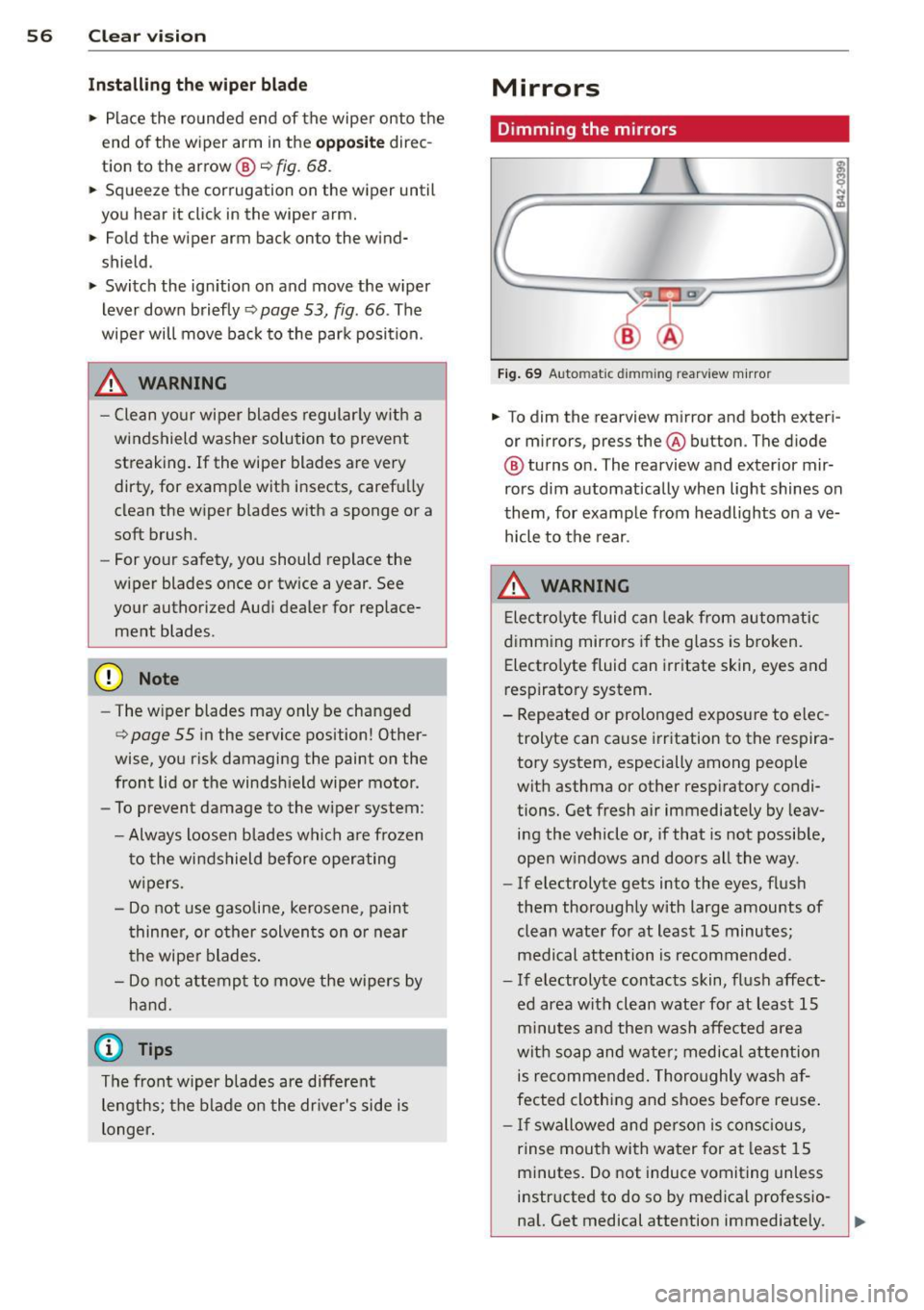
Fig . 69 Auto matic dimming rearview m irro r
.,. To dim the rearview mirror and both exteri
or m irrors, press the@ button . The diode
@ turns on. The rearview and exterior mir
rors dim automatically when light shines on
them, for example from headlights on ave
h icle to the rear .
_& WARNING
-
Elec tro lyte fluid can lea k from automatic
dimming mirrors i f the glass is b roken.
Electro lyte fluid can irritate skin, eyes and
respiratory system.
- Repeated or prolonged exposure to e lec
trolyte can cause i rr itation to the respira
tory system , especially among people
with asthma or other respiratory condi
tions. Get fresh air immediately by leav
ing the vehicle or, if that is not possib le,
open w indows and doors all the way .
- If electrolyte gets into the eyes, flus h
them thoroughly with large amou nts
of
clean water for at least 15 minutes;
medical attention is recommended.
- If electrolyte contacts skin, fl ush affect
ed area with clean wate r fo r at least 15
minutes and then wash affe cted area
wit h soap and wate r; medical attention
is recommended. Thoro ughly wash af
fected clothing and shoes before reuse .
- If swallowed and person is consc ious,
rinse mouth with water for at least 15
minutes . Do not induce vomiting unless
instructed to do so by medical professio na l. Get medical attention immediately.
Page 64 of 236
62 Seats and storage
- Never use the cupho lder or adapter as an
ashtray- risk of f ire.
CD Note
On ly drink containe rs with lids should be
carried in the cupho lder. Liquid could spill
out and damage your vehicle's e lectronic
equ ipment or sta in the upholstery, etc.
Ashtray
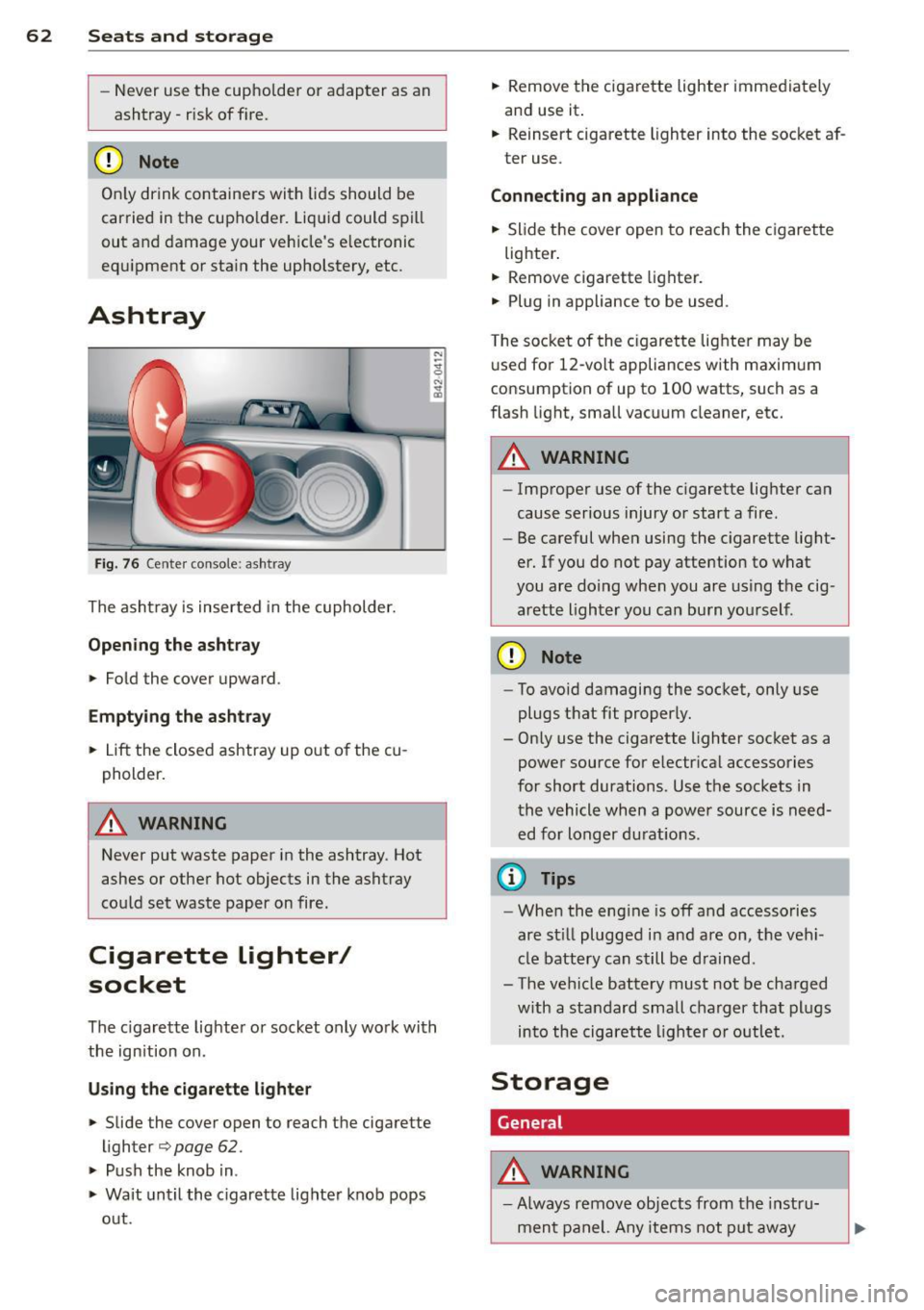
Fig . 76 Center console: ashtray
The asht ray is inserted in the cupholder.
Opening the ashtray
.,. Fold the cover upward .
Emptying the ashtray
.,. Lift the closed ashtray up o ut o f the cu
pholder.
A WARNING
Never put waste paper in the ashtray. Hot
ashes or other hot objects in the ashtray
could set waste paper on fire.
Cigarette Lighter/
socket
N
-"' 0 ..:. ... m
The c igarette lig hte r or socket only wo rk with
the ign ition on.
Using the cigarette lighter
.,. Slide the cover open to reach th e cigarette
lighter
qpage 62.
.,. Push the knob in.
.,. Wait un til the c igarette lighte r knob pops
out. .,.
Remove the cigarette lighter immediately
and use it.
.,. Reinsert cigarette lighter into the socket af
ter use.
Connecting an appliance
.,. Slide the cover open to reach the c igarette
lighter .
.,. Remove cigarette lighter .
.,. Plug in appliance to be used.
T he socket of the c igarette lighter may be
u sed for 12-volt appliances with maximum
consumption of up to 100 watts, such as a
flash light, small vacuum cleaner, etc.
A WARNING
--Improper use of the c igarette lig hter can
cause serious injury or start a fire .
- Be careful when using the c igarette light
er. If you do not pay attention to what
you are doing when you are us ing t he cig
arette lighter you can burn yo urself.
CD Note
-To avoid damaging the socket, only use
plugs that fit properly.
- Only use the cigarette lighter socket as a
powe r source for e lectr ica l accessories
for short durations . Use t he sockets in
the vehicle when a power source is need ed for longer du rat ions .
(0 Tips
-When the eng ine is off and accessories
are st ill plugged in and are on, t he vehi
cle battery can still be d ra in ed.
- The ve hicle battery must not be charged
w ith a standard small charger that pl ugs
into the cigarette lighter or outlet .
Storage
, General
A WARNING
- Always remove objects from the instr u
men t pa nel. A ny items not put away
-
Page 65 of 236
could slide around inside the vehicle
wh ile driving or when accelerating or
when applying the brakes or when driv
ing around a corner .
- When you are driving make sure that
anything you may have placed in the cen
ter console or other storage locations cannot fa ll out into the footwells . In case
of sudden braking you would not be able
to brake, depress the clutch or acceler
ate.
Glove compartment
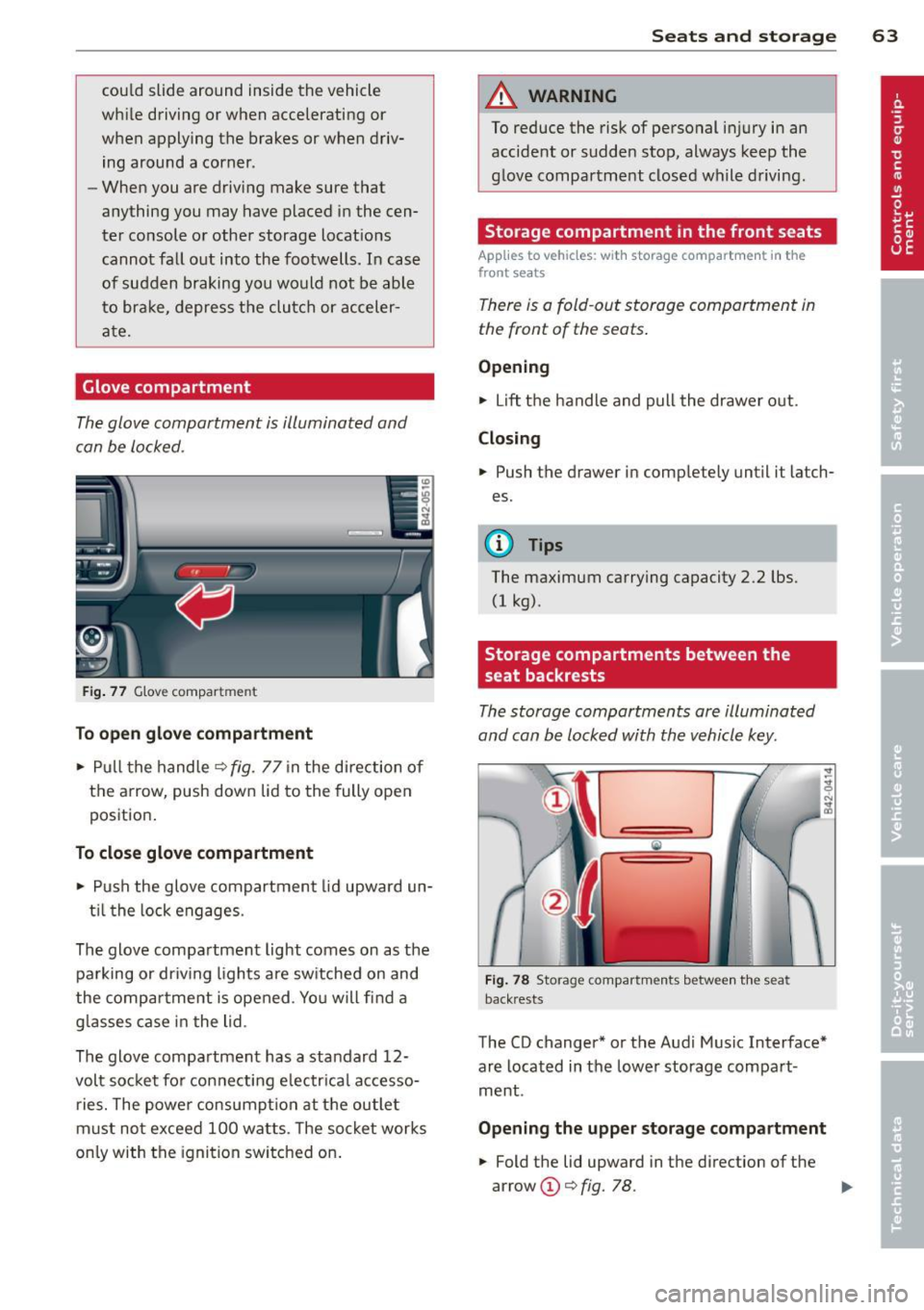
The glove compartment is illuminated and
can be locked.
F ig . 77 G love compar tmen t
To op en glove compa rtm ent
... Pull the hand le ¢ fig . 77 in the direction of
the arrow, push down lid to the fully open
position.
To close glove compartm ent
.., Push the glove compartment lid upward un-
t il the lock engages.
The glove compartment light comes on as the parking or dr iving lights are sw itched on and
the compartment is opened . Yo u will find a
g lasses case in the lid .
The glove compartment has a standard 12-
volt socket for con necting e lectrica l accesso
ries. The powe r consumpt ion at the outlet
must not exceed 100 watts. The socket works
on ly with the ignition switched on .
Sea ts a nd s to rage 63
A WARNING
To reduce the risk of personal injury in an
accident or sudden stop, always keep the
glove compartment closed while driving.
Storage compartment in the front seats
Applies to vehicles: with storage compartment in the
front seats
There is a fold -out storage compartment in
the front of the seats .
Opening
.., Lift the handle and pull the drawer out.
Closing
... Push the drawer in completely until it latch
es.
(!) Tips
The maximum carrying capacity 2 .2 lbs.
(1 kg).
Storage compartments between the
seat backrests
The storage compartments are illuminated
and can be locked with the vehicle key.
F ig . 78 Storage compar tm ents betw een th e sea t
back rests
The CD changer* or the Audi Music Interface*
are located in the lower storage compart
ment .
Opening the upper storage compartment
... Fold the lid upward in the direction of the
arrow @¢
fig. 78. ..,_
Page 71 of 236
an authorized Audi dealer when there is an
operating prob lem.
Using the climate controls economically
Economical use of the climate controls helps
to save fuel.
When climate con trol is wor king in cool ing
mode, engine performance is red uced and
fuel consumption is affected. To keep the time
the air conditioning is on as short as possib le,
you shou ld do the fo llow ing:
.,. If you wo uld like to save f uel, sw itch the air
conditioning off .
.. If you open the windows whi le driving,
switch the air conditioning off.
.,. If the vehicle is extremely hot due to the
heat of the sun, briefly open doors and win
dows.
@ For the sake of the environment
When you save fuel, you reduce em iss ions
from the vehicle.
Rear window defogger
The rear window defogger clears the rear win
dow of condensation .
.. Press the Iii button <=> page 65, fig. 79 to
turn the rear window defogger on and off.
The rear window defogger wor ks only when
the eng ine is r unning. The indicator light in
the button illuminates when the rear window
defogger is turned on.
The rear window defogger is switched off au
tomatically after approx . 10 minutes .
@ For the sake of the environment
As soon as the rear window is clear, yo u
should switc h the rea r window de fogger
off . The reduced power consumption has a
beneficial effect on f uel consumption.
Warm and c old 69
Heated seats
Applies to vehicles: with heated seats
The seat cushion and the seatback of the
front seats can be heated electrically.
.. Press the heated seats button I-J + I
<=> page 65, fig . 79 to set the leve l of heating
desired.
The range of cont ro ls goes from 1 to 3. The
heat setting selected is shown by LEDs above
the button.
A WARNING
--=
Indiv iduals wit h reduced sens itiv ity to pa in
or temperature could deve lop burns when
using the seat heat ing funct ion. To reduce
the r isk of injury, these ind ividuals should
not use seat heating.
@ Note
To avoid damage to the heat ing e lements
i n the seats, do not kneel on the seats or
place heavy loads o n a small area of the
seat.
Page 73 of 236
Ignition on @
Afte r switch ing the ignition on, the needles
move all the way up and then down .
I f it is difficult to turn the key afte r you have
i nse rted it into the ignit ion lo ck, tur n the
steer ing whee l back and forth. This will take
the load off the steering lock mechanism and
you will be able to turn the key freely and start the engine .
Starting the engin e@
In th is position the engine starts. While the
engine is start ing, the power s upply to the
headlights and other e lectrica l consumers is
temporari ly interrupted to conserve battery
pow er. Aft er the engine has started, release
the key and it will return to posit ion @.
Before the starter can be operated again the
key must be turned back to position@. The
non -repe at lock prevents you from damaging
the starter when the engine is runn ing .
A WARNING
-Never remove the key from the ign ition
lock whi le the vehicle is moving. The
steering wheel will lock causing loss of control.
- If you have to leave your veh icle -even
for just a m in ute - always remove the ig
nition key and take it with you. This is es
pecially important if you a re going to
leave c hildren behind in the vehicle. The
children co uld start the engine or use
other vehicle controls . Unsupervised use
of vehicle controls (for example, power
windows) can cause serious personal in
jur ies .
If the vehicle battery has been disconnect
ed and then reconnected, then you m ust
leave the key in pos ition @for abo ut 5
seconds before you can start the engine.
On th e ro ad 71
Starting the engine
The engine can only be started with your orig
inal Audi key.
On vehicles with R tronic *, the engine can be
start ed in the ne utra l position N and in each
gea r (1 - 6 and R).
.. Set the park ing brake ¢,&. .
.. On vehicles with man ua l transmission *,
fu lly depress the clutch pedal.
.. Press and hold the brake pedal.
.. Turn the ignition key to pos it ion ®
¢ page 70, fig. 82 - do not depress the gas
pedal when starting the engine .
.. Let go of the key as soon as the engine
starts - the sta rter must not cont inue to
r u n. On ve hicles w ith R t ro ni c, selec t gea r
posi tion N .
A cold engine may at first be loud afte r it has
been sta rted. This is due to the hydraulic
valves bu ild ing up the oil press ure . Thi s is nor
mal and no need for concern.
If the engine does not start immediately, stop
tryi ng after 10 seconds and then try to restart
the engine abou t 30 seconds later.
A WARNING
- Never start or let the eng ine run in a con
fined or enclosed area . Exha ust fumes
from the engine contain carbon monox
ide, a co lor less and odorless gas. Carbon
mo nox ide ca n be fatal if inhaled.
- Never leave the engine idling unattend
ed. An unattended veh icle with a runn ing
engine poses a danger of personal injury
or theft .
- With the engine r unning and a gear en
gaged, you have to hold the veh icle w ith
the foot brake .
(D Note
- Avoid h igh engine speeds, fast accelera
tion or heavy engine loads while the en
gine is still cold. This could damage the
eng ine .