warning light AUDI R8 SPYDER 2012 Repair Manual
[x] Cancel search | Manufacturer: AUDI, Model Year: 2012, Model line: R8 SPYDER, Model: AUDI R8 SPYDER 2012Pages: 236, PDF Size: 59.24 MB
Page 136 of 236
134 Child Safety
-An unrestrained or improperly restrain
ed child is at much greater risk of injury
or death by being struck by an inflating
airbag .
- Commercially available child safety seats
are required to comply with U.S. Federal
Motor Vehicle Safety Standard (FMVSS)
213 (in Canada CMVSS 213).
- When buying a child restraint, select
one that fits your child and the vehicle.
- Only use child restraint systems that
fully contact the flat portion of the
seat cushion. The child restraint must
not tip or lean to either side. Audi does
not recommend using child safety
seats that rest on legs or tube-like
frames . They do not provide adequate
contact with the seat .
- Always heed all legal requirements per
taining to the installation and use of
child safety seats and carefully follow
the instructions provided by the manu
facturer of the seat you are using.
- Never let more than one child occupy a
child safety seat.
- Never let babies or older children ride in
a vehicle while sitting on the lap of an
other passenger.
- Holding a child in your arms is never a
substitute for a child restraint system.
- The strongest person could not hold
the child with the forces that exist in
an accident. The child will strike the in
terior of the vehicle and can also be
struck by the passenger .
- The child and the passenger can also
injure each another in an accident.
- Never install a rearward facing child
safety seat on the front passenger seat
unless the
PASSENGER AIR BAG OFF
light comes on and stays on. If the PAS
SENGER AIR BAG OFF
light does not
come on and stay on the inflating airbag
will hit the child safety seat or infant car
rier with great force and will smash the
child safety seat and child against the
backrest, door or roof. Have the airbag system inspected immediately by your
authorized Audi dealer.
- Forward-facing child safety seats instal
led on the front passenger's seat can in
terfere with the airbag when it inflates
and cause serious injury to the child.
- If exceptional circumstances require the
use of a forward-facing child restraint on
the front passenger's seat, the child's
safety and well -being require that the
following special precautions be taken :
- Make sure the forward-facing seat has
been designed and certified by its man
ufacturer for use on a front seat with a
passenger front and side airbag.
- Always carefully follow the manufac
turer's instructions provided with the
child safety seat or carrier.
- Always move the front passenger seat
into the rearmost position of the pas
senger seat 's fore and aft adjustment
range, and as far away from the airbag
as possible before installing the child
restraint.
- Always make sure that nothing pre
vents the front passenger's seat from
being moved to the rearmost position
in its fore and aft adjustment range.
- Always make sure that the backrest is
in the upright position.
- Always buckle the child safety seat firmly
in place even if a child is not sitting in it.
A loose child safety seat can fly around
during a sudden stop or in a collision.
- Always read and heed all WARNINGS
whenever using a child restrained in ave
hicle is being used¢
page 101, Safety
belts,
¢ page 109, Airbag system and
~ page 130, Child Safety .
A WARNING ~
To reduce the risk of serious injury, make
sure that the
PASSENGER AIR BAG OFF
light comes on and stays on whenever a
child restraint is installed on the front pas
senger seat and the ignition is switched
on.
Page 137 of 236
-Never install a rearward facing child
safety seat on the front passenger seat
unless the
PAS SENGER AIR BA G OFF
light comes on and stays on . If the PA S
SEN GER AI R BAG OFF
light does not
come on and stay on the inflating airbag
will hit the child safety seat o r infant car
r ie r with great fo rce and will smash the
child safety seat and child against the
backrest, door or roof . Have the airbag
system inspected immediately by your authorized Audi dealer .
Child safety seats
Infant seats
Babies and infants up to abou t one year old
and 20 lbs . or 9 kg need special rearward -fac
ing child restraints that support the back,
neck and head in a crash.
Fig . 128 Re arwar d-fa cing in fan t sea t, pr operly instal
l e d on t he p asseng er se at
"' When using the vehicle safety belt to install
a ch ild safety seat , you must first activate
the convertible locking retractor on the
safety belt to prevent the ch ild safety seat
from moving
r::!v page 138 .
"' Push the child safety seat down wit h your
full weight to get the safety bel t rea lly tight
so that the seat cannot move forward or
sideways more than one inch (2 .5 cm) .
I nfants up to about one year (20 lbs. or 9 kg)
are best prot ected in special infant carriers
and chi ld safety seats design ed for their age
group . Many experts believe that infants and
sm all ch ildren should ride only in spec ia l re
straints in which the ch ild faces the back of
Child S afety 13 5
the vehicle. These infant seats support the ba
by 's back, neck and head in a crash
~ fig. 128.
A WARNING
Not using a child safety seat, using the
wrong child safety seat or improperly in
stalling a child restraint increases the risk
of ser ious personal injury and death in a
crash.
- Never install a rear-fac ing ch ild restraint
in the forward -facing d irect ion . Such re
straints are designed for the special needs of infants and very small chi ld ren
and cannot protect them properly if the
seat is forward-facing.
- Never install a rearward facing child
safety sea t on the fron t passenger seat
un less t he
PASSENGER AIR BAG OFF
light comes on and stays on. If the PAS·
SENGER A IR BAG OFF
light does not
come on and stay on the inf lating a irbag
will hit the child safety seat or infant car
rier w ith great f orce and w ill smash the
child safety seat and child against the backrest, door or roof . Have the a irbag
system inspected immediately by your
author ized Audi dealer.
- Always read and heed al l WARNINGS
whenever us ing a child restrained in ave
hicle is being used
r::!v page 101, Safety
belts, r::!vpage 109, Airbag system
and
r::!v page 130, Important things to know .
Page 138 of 236
136 Child Safet y
Convertible child safety seats
Properly used convertible child safety s eats
can h elp protect toddlers and children over
age one who weigh between
20 and 40 lbs. (9
and 18 kg) in a crash.
Fig . 129 Schematic overv iew: installat ion of the seat
usin g the vehicle's safety belt system
~ When using the vehicle safety belt to install
a ch ild safety seat, you must first activate
the convertible locking retractor on the safety belt to prevent the c hild safety seat
from movi ng
Q page 138.
~ Push the child safety seat down with your
full weight to get the safety belt rea lly tight
so that the seat cannot move forward or
sideways more than one inch (2.5 cm)
Qpage 138.
A toddler or child is usually too large for an in
fant restraint if it is more than one year old
and weighs more than 20 lbs. (9 kg) .
Toddlers and ch ildren who are o lder than one
year up to about 4 years o ld and weigh more
than 20 lbs . (9 kg) up to 40 lbs. (18 kg) must
always be properly restrained in a child safety
seat certi fied for the ir size and weight
Q fig. 129.
&_ WARNING
Not using a ch ild safety seat, us ing the
w rong ch ild safety seat or improperly in
stal ling a child restraint increases the risk
o f se rious persona l injury and death in a
co llision or othe r eme rgency s ituation.
- Children on t he front seat of a ny car,
even w ith Advanced A irbags, can be seri
ous ly injured or even killed when an air -bag inflates. A chi
ld in a rearward-facing
child safety seat installed on the front
passenger seat will be seriously injured
and can be killed if the front airbag in
flates -even with an Advanced Airbag
System .
- The inflating airbag will h it the ch ild
safety seat or infant carrie r with great
for ce and will smash the child saf ety seat
and child aga inst the ba ckrest, door o r
roof .
- Neve r install a rearward facing child
safety sea t on the fron t passenger seat
un less t he
PASSENGER AIR BAG OFF
light comes on and stays on. If the PAS
SENGER AIR BAG OF F
light does not
come on and stay on have the airbag sys
tem inspected immediately by your au
thorized Audi dealer.
- Always read and heed all WARNINGS
whenever us ing a child restrained in ave
h icle is being used
¢ page 101, Safety
belts,
Q page 109, Airbag system and
Q page 130, Important things to know .
&_ WARNING
--
If exceptional circumstances require the
use of a fo rward-facing child restraint on
the front pa ssenger 's sea t, the child's safe
ty and we ll-bei ng req uire t hat the fo llow
i ng spec ial precautions be taken:
- Make sure the forward- facing seat has
been designed and cert ified by its man u
facturer for use on a front seat with a
passenger front and side airbag.
- Always follow the manufacturer 's in
structions p rovided with the chi ld safety
seat or carrie r.
- A lways move the front passenger seat in
to the rearmost position of the passen ger seat's fore and aft adjustment range,
and as far away from the airbag as possib le before installing the ch ild restraint.
- Always make sure that nothing prevents
the front passenger 's seat from being
moved to the rearmost position in its
fore and aft adjustment range .
Page 140 of 236
138 Child Saf ety
will receive serious or possibly even fata l
injury .
I n o rder for the airbag to offe r protection, it is
important that all vehicle occ upants, especia l
l y any children, who must be in the front seat
because of exceptional circ umstances, be
properly restrained and as far away from the
a irbag as poss ible. By keep ing room between
the child's body and the front of the passen
ger compartment, the airbag can inflate com
p letely and provide supplemental protection
in certain frontal col lisions.
_& WARNING
Not using a booster seat, using the boos
t er sea t imprope rly, incorre ct ly ins talling a
booste r seat or using the vehicle safety
belt improperly increases the risk of se ri
ous personal injury and death in a collision
or other eme rgency s ituation. To help re
duce the risk of ser ious persona l injury
and/or death:
- The shoulder be lt must lie as close to the
center of the child 's collar bone as poss i
ble and must lie and snug on the upper
body. It mus t never lie across the throat
o r neck . The lap belt must lie across the
pelvis and never across the stomach o r
abdomen. Make sure the belt lies flat
and snug. Pull on the be lt to t igh ten if
necessary.
- F ailure to properly route sa fety belts
over a ch ild' s body will cause severe inju
ries in an acc ident or other emergency
situation
<:!;,page 101.
- Children on the front seat of any car,
even w ith Advanced A irbags, can be seri
o usly injured or even killed when an a ir
bag inflates.
- Never let a child stand or knee l on the
seat.
- Never let a child ride in the ca rgo a rea of
yo ur vehicle.
- Always remember that a chi ld leaning
forward, sitt ing s ideways or out of posi
t ion in any way during an acc ident can be
-
struck by a dep loying a irbag . This will re
sult in ser ious personal injury or death .
- If you must install a booster seat on the
front passenger seat because o f excep
tional circ umstances the
PASSENGER
AIR BAG OFF
li ght must come on and
stay on , whenever the ignition is switch
ed on .
-If the PASSENGER AIR BAG OFF light
does not come on and stay on, pe rform
the ch ecks descr ibed ¢
page 120, Moni
toring the Advanced Airbag System .
-If the PASSENGER AIR BAG OFF light
does not come on and stay on whenever
the ig nit ion is switched on the infla ting
ai rb ag w ill hi t the child sa fe ty seat or in
fant car rier with g reat force an d will
smash the child sa fety seat and child
aga inst the backrest, door or roof . Have
the airbag system inspected immed iately
by your Audi dea ler.
- Always read and heed all WAR NIN GS
whenever using a child restrained in ave
h icle is being used
¢ page 101, Safety
belts,
¢ page 109 , Airbag system and
r:!;, page 130, Important things to know.
Installing a child safety
seat
Securing a child safety seat using a
safety belt
Safety belts for the front passenger con be
locked with the convertible locking retractor
to properly secure child safety seats .
The safety belts emergency locking retracto rs
for the front passenger's seat safety belt have
a convertible locking retracto r for child re
stra ints . The safety be lt must be loc ked so
that be lt webb ing cannot unree l. The r etrac
tor can be a ctivated to lock the safety belt and
prevent the s afety be lt webb ing from loosen
ing up d uring norma l dr iv ing. A child safety
seat can only be properly insta lled when t he
safety belt is locked so that the chi ld and child
safety seat will stay in place. ..,.
Page 141 of 236
Always remember: Even though your vehicle is
equipped with an Advanced Airbag system, a
child should always ride in the seat properly
restrained for its age and size.
_&. WARNING
Improperly installed child safety seats in
crease the risk of serious personal injury
and death in a collision.
- Always make sure that the safety belt re
tractor is locked when installing a child
safety seat. An unlocked safety belt re
tractor cannot hold the child safety seat
in place during normal driving or in a
crash .
- Always buckle the child safety seat firmly
in place even if a child is not sitting in it.
A loose child safety seat can fly around
during a sudden stop or in a collision.
- The inflating airbag will hit the child
safety seat or infant carrier with great
force and will smash the child safety seat
and child against the backrest, door or
roof.
- Forward-facing child safety seats or in
fant carriers installed on the front pas
senger's seat may interfere with the de ployment of the airbag and cause serious
injury to the child.
- Always read and heed all WARNINGS
whenever using a child restrained in ave
hicle is being used
c:::;, page 130. Special
precautions apply when installing a child
safety seat on the front passenger seat
c:::;, page 111, Child restraints on the front
seat -some important things to know.
_&. WARNING
-
Always take special precautions if you
must install a forward or rearward-facing
child restraint on the front passenger's
seat in exceptional situations:
- Whenever a forward or rearward-facing child restra int is installed on the front
passenger seat, the
PASSENGER AIR
BAG OFF
light must come on and stay on
whenever the ignition is switched on.
Child Safety 139
-If the PASSENGER AIR BAG OFF light
does not come on and stay on, perform
the checks described
c:::;, page 120, Moni
toring the Advanced Airbag System.
- If the PASSENGER AIR BAG OFF light
does not come on and stay on whenever
the ignition is switched on the inflating
airbag will hit the child safety seat or in
fant carrier with great force and will
smash the child safety seat and child
against the backrest, door or roof. Have
the airbag system inspected immediately
by your Audi dealer.
- Improper installation of child restraints
can reduce their effectiveness or even prevent them from providing any protec
tion.
- An improperly installed child restraint
can interfere with the airbag as it de
ploys and seriously injure or even kill the
child.
- Always carefully follow the manufactur
er's instructions provided with the child
safety seat or carrier.
- Never place additional items on the seat
that can increase the total weight regis
tered by the weight-sensing mat and can
cause injury in a crash.
_&. WARNING
Forward-facing child restraints:
- Always make sure the forward-facing
seat has been designed and certified by
its manufacturer for use on a front seat
with a passenger front and side airbag.
- Never put the forward-facing child re straint up, against or very near the in
strument panel.
- Always move the passenger seat into its
rearmost position in the seat's fore and
aft adjustment range, as far away from
the airbag as possible before installing
the forward-facing child restraint. The
backrest must be adjusted to an upright
position. •
•
Page 142 of 236
140 Child Saf ety
- Make sure that the PASSENGER AIR BAG
OFF
light comes on and stays on all the
time whenever the ignition is switched on .
A WARNING
Rearward -fac ing c hild restra ints:
- A ch ild in a rearward-facing child safety
seat installed on the front passenger
seat will be ser iously injured and can be
killed if the front airbag inflates - even
with an Advanced Airbag System.
- The inflating a irbag will hit the child
safety seat or infant carrier wit h great
force and w ill smash the ch ild safety seat
and child against the b ackrest , door or
roof.
- Alway s be espe cially caref ul if you must
ins tall a re arwa rd fa cing child s afety seat
on the front passenge r seat in exception
al circumstances .
- A tight tet her strap on a rearward-facing
child rest raint attached to the front pas
senger seat can put too much pressu re
on the weight-mat in the seat and reg is
ter a heavier weight in the Advanced A ir
bag System. The heav ier we ight regis
tered can make the system work as
though an adult were on the seat and de
ploy the Advanced Ai rbag when it must
be s uppressed causing ser ious o r even
f a tal injury to the child .
- Make su re that the
PASSENGER AIR BAG
OFF
light comes on and stays on all the
t ime whenever the ignition is switched
on.
- Never install a rearward facing child
safety seat on the front passenger seat
unless the
PASSENGER AIR BAG OFF
light comes on and stays on . If t he PAS·
SENGER AIR BAG OFF
light does not
come on and stay on the inflating airbag
will hit the child safety seat or infant car
rie r with great fo rce and will smash the
child safety seat and child against the
backrest, door or roof. Have the airbag
system inspected immedia tely by your
au thori zed Au di d ealer .
Activating the convertible locking
retractor
Use the convertible locking retractor to se
cu re a child re strain t.
Always heed the ch ild safety sea t manufactur
er's instr uctions when installing a child re
st ra in t in your veh icle . To a ctivate the conve r
t ible lo cking re tractor:
" Place t he child res traint o n a seat .
" Slowly pu ll the belt
all the way out .
" Route it a round or throug h the child re
s train t belt pa th
~ ,& .
" Push the ch ild safety sea t down wi th yo ur
full weight to get t he safety be lt really tight.
" Insert the belt tong ue into the b uckl e for
that seating position .
" Guide the safety be lt back into the retractor
until the be lt lies flat and snug o n the child
safety seat.
" You should hear a "cl icking " noise as the
be lt winds back into the inertia ree l. Test the
convert ible lo cki ng re tr actor by pulling on
t he belt. You s hould no longer be ab le to
pull t he be lt out of the retrac to r. T he con
vertible locking retracto r is now activated .
" Ma ke s ure that the red release b utton is fac
ing away from the child restraint so that it
can be unbuckled quick ly.
" Pull on the belt to make sure the safety belt
is properly tight and fastened so that the
s e at ca nnot move forwa rd or sideways more
than one inch ( 2.S cm).
A WARNING
Using the wrong child res traint o r an i m
pr operly ins talled chi ld restraint can cause
se rious pe rsonal injury or deat h in a c rash.
- Always ma ke sure tha t t he safe ty belt re-
trac to r i s loc ked when insta lling a child
safety seat. An un locke d safety belt re
tracto r cannot hold the child safety seat
in place dur ing norma l dr iving o r in a
crash.
- Always buckle the child sa fety seat firmly
-
in place even if a ch ild is not sitt ing in it. ~
Page 145 of 236
as a pulsing mo tio n of the brake pe dal, ac
companied by some noises. I n order for ABS
to be a ble to operate optimally in th is range,
you must keep the brake pedal depressed -
never "pump the brakes" . You should not ex
pect that braking d is tances w ill be
shortened
under all circumstances w ith ABS . Braking dis
tance may even be slightly
longer , for exam
p le on gravel or wi th fresh snow on a slippery
surface .
If a sign ificant
speed differential between the
d rive w heels on one axle is determined (for
examp le, on a su rface that is s lippery
on one
side),
t he EDS brakes the spinn ing whee l and
transfers power to the other drive whee ls.
This is done up to a speed of about 60 mph (100 km/h) . Noises from the brake system
signal that whee l spin is being controlled.
I f one wheel spins when s tarting from a com
p lete stop because o f a different grip (for ex
ample , one wheel o n ice), keep your foot
hard
on the acce lerator until the veh icle starts to
move.
If the wheels spin , ASR wi ll automatically re
duce engine torque and match power to road
su rface condit ions .
Switching on Sport mode
In specific drivi ng situa tions (e.g. La unch Con
trol), you switch ASR and ESC to Sport mode
by pressing the
[!I button once . The indicator
light
11 illuminates and ESP sport -Warning!
Restricted stability
appears . "Slip" is matched
to the speed. You should do this only if your
driving skill a nd traffic cond it ions permit .
Switching ASR /ESC off
In certain sit uat ions (e .g . in deep snow, on a
l oose surface, o r when rocking the vehicle
free), switch ASR and ESC off by pressing the
[ill button for more than 3 seconds. The ind ica
tor light
II i lluminates and E SP swit ched off -
Warning! Re stricted stability appea rs . You
should do th is only if your driving skill and
traffic cond it io ns pe rmit .
Int ellig ent technolog y 143
Switching ASR /ESC on
Activate ASR/ ESC by pre ssing the [!I bu tton
again. The message
ESP on appears in the dis
play briefly.
Brake overheating
So that the disc b rake on a b raked wheel does
not over heat, the EDS switche s off au toma ti
ca lly if there is un usua lly severe loa ding a t
th is wheel. The vehicle is st ill drivable and has
the same properties as a vehicle without EDS .
As soon as the brake has coo le d down, EDS
swi tches on aga in automatically .
A WARNING
- Even ESC, ABS, EDS and AS R cannot over
come the laws of physics . You should
keep t his in m ind in particular on an icy
or wet road. If the systems intervene,
you shou ld ad just your speed immediate
ly to road and traff ic conditions . Do not
be tempted by the increased safety pro
vided to take risks -you risk having an
accide nt.
- Please keep in mind that the risk of an
accident is i ncreased by d riving too fast,
pa rti cularly in corners and on icy or wet
ro ads, and by drivi ng too close to the ve
hicle ahead . Even ESC, ABS, E DS and A SR
cannot eliminate the increased risk of
having an accident.
-Apply the throttle ca re fully when accel
erating on a consistently s lippery sur
face, e .g. on ice and snow . The drive
wheels can spin in spite of the EDS and thereby affect vehicle stability -you risk
having an accide nt.
- Please note that when ASR or ESC/ASR is
deactivated , the drive wheels can spin on
icy and sl ippery roads a nd the veh icle can
break away -the re is a risk of skidd ing!
(D Tips
- In the event of a defect in the rear spoil-
er system or in Audi magnet ic ride, it can
happen that ASR and ASR/ESC cannot be .,.
•
•
Page 146 of 236
144 Intelligent technology
deactivated, or they are activated auto
matically in the deactivated state.
- If a malfunction occurs in the E DS, this is
signaled by an indicator light, see
~ page 16.
- Some tracks (e.g . steeply banked turns)
may affect ESC response .
Rear spoiler
The rear spoiler improves vehicle handling
and enhances driver control.
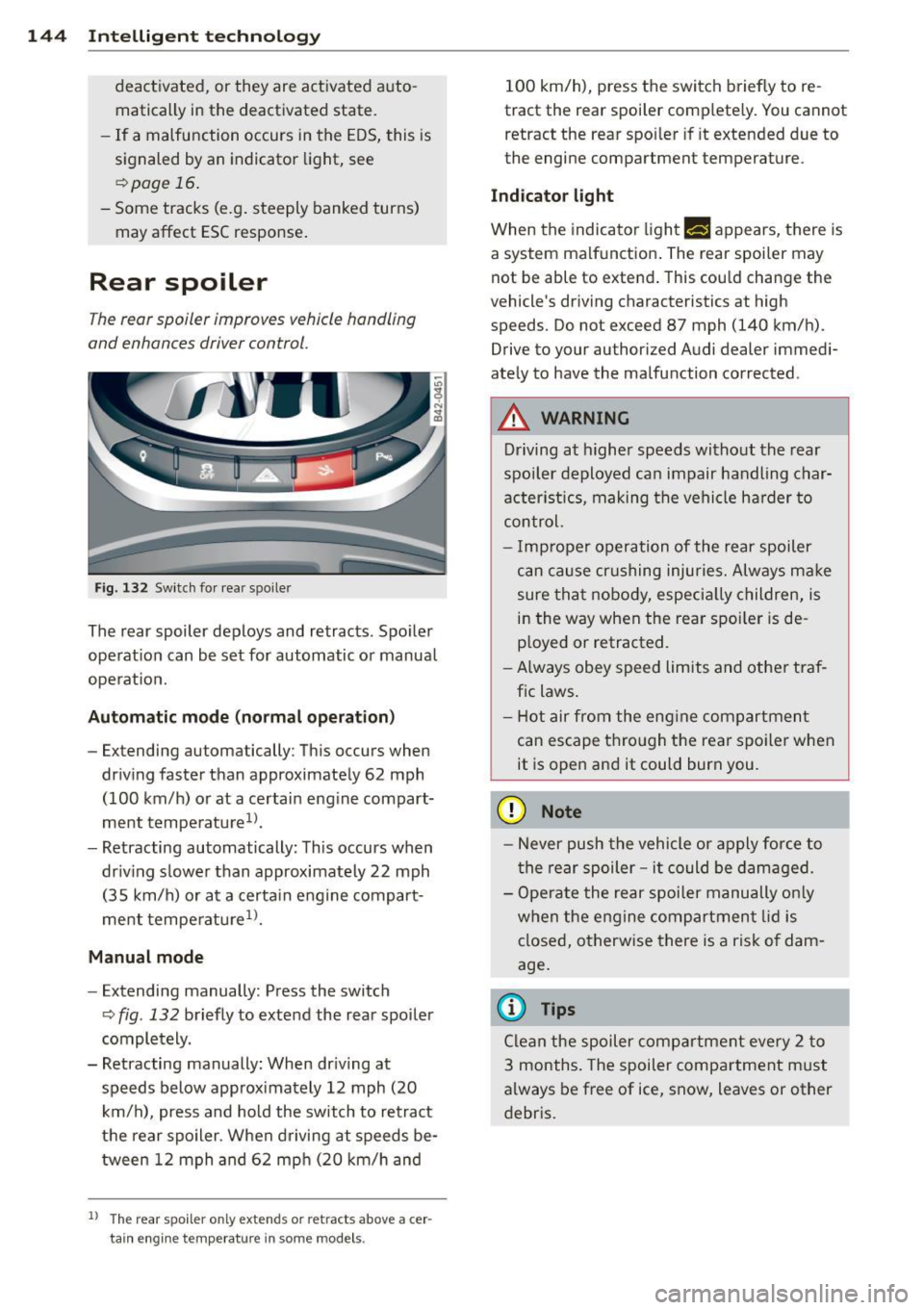
Fig. 132 Switch for rear spoile r
The rear spoiler deploys and retracts . Spo ile r
ope rat ion can be set for automatic or manual
operat ion.
Automatic mode (no rmal operation )
-Extending automatically: This occurs when
dr iv ing faster than approximately 62 mph
(100 km/h) or at a certain eng ine compart
ment temperature
1>.
- Retracting automatically: This occurs when
dr iv ing s lower than approximately 22 mph
(35 km/h) o r at a certa in engine compart
ment temperatu re
1>.
Manual mode
- Extending manually: Press the switch
~ fig. 132 briefly to exte nd the rear spoiler
completely .
- Retracting manually : When dr iv ing at
speeds below approx imately 12 mph (20
km/h), press and hold the switch to retract
the rear spo iler. When driving at speeds be
tween 12 mph and 62 mph (20 km/h and
l ) The rear s poiler only extends or retracts above acer
ta in eng in e te mpe rature in some models.
100 km/h), press the switch briefly to re
tract the rear spoiler complete ly. You cannot
retract the rear spo iler if it extended due to
the engine compartment temperature.
Indicator light
When the indicato r light f.-j appears, there is
a system malfunction . The rear spoiler may
not be able to extend . This cou ld change the
vehicle's dr iving characteristics at high
speeds. Do not exceed 87 mph (140 km/h).
Drive to your authorized Audi dealer immed i
ately to have the malfunction corrected .
A WARNING
Driving at higher speeds without the rear
spoiler deployed can impair handling char
acteristic s, making the ve hicle ha rder to
control.
- I mp rope r operation of the rear spoiler
c a n cau se crushing injuries . Always ma ke
sure tha t nobo dy, espec ia lly children, is
i n the way when the rear spoi ler is de
p loyed or retracted.
- Always obey speed limits and other traf
fic laws .
- H ot air from the eng ine compartmen t
can escape thro ugh the rear spo iler when
it is open and it could burn you.
(D Note
- N ever push the vehicle or apply force to
t he rear spoiler -it co uld be damaged.
- Ope rate the rear spoiler manually on ly
w hen the eng ine compartmen t lid is
closed, o therwise there is a r is k of dam
age .
(D Tips
Clean the spoiler comp artme nt eve ry 2 to
3 months . The spoiler compa rtment m ust
a lway s be free of ice, snow, leaves or other
debr is.
Page 147 of 236
Braking
New brake pads
During the first 250 miles (400 km), new
b rake pads do not possess their full braking
effect, they have to be "broken in" first. The
distance can be ten times longer in veh icles
with ceramic brakes*. You can compensate for
this slightly reduced brak ing power by push
ing harder on the brake pedal. Avoid heavy
braking loads during the break-in period.
Operating conditions and driving habits
The brakes on today's automobi les are sti ll
subject to wear, depending largely on operat
ing conditions and dr iv ing habits
c:> & . On ve
hicles that are either driven mostly in stop
and-go city traffic or a re driven hard, the
brake pads should be checked by your author
ized Audi dealer more often than specified in
the
Warranty & Maintenan ce booklet . Failure
to have your b rake pads inspected can result
in reduced brake performance.
On steep slopes, you shou ld use the brak ing
effect of the engine. This way, you prevent un
necessary wear on the brake system . If you
must use your brakes, do not hold the brakes
down continuously. Pump the brakes at inter
va ls.
Moisture or road salt
Under ce rta in conditions, for example, when
d riving through water or very heavy rain, or
even after washing your vehicle, the braking
effect can be reduced due to moisture (or in
freezing conditions ice) on the brake pads. A
few cautious brake applicat ions should dry
off
the brake pads or remove any ice coatings.
When you are driving at higher speeds with
the windshield wipers on, the brake pads will
briefly touch the brake d iscs in regular inter
vals so as to improve reaction t ime when brak
ing on wet surfaces. You, the driver, will not
notice anything.
The effectiveness of the brakes can be reduced
when the vehicle is dr iven on a salt-covered
road and the brakes are not used . Likewise,
Intelligent technology 145
you clean off accumulated salt coating from
brake discs and pads with a few cautious ap
plications of the brake
c:> & .
Corrosion
The re may be a tendency for dirt to build up
on the brake pads and corros ion to form on
the discs if the car is not driven regularly or
on ly for short trips with litt le use of the
brakes.
If the brakes are not used frequently, o r if cor
rosion has formed on the discs, it is advisable
to clean
off the pads and discs by braking
firmly a few times from a moderately high
speed
c:> & .
Faults in the brake system
If you shou ld notice a sudden increase in
brake pedal travel, then one of the two brake
circuits may have fai led . Drive immediately to
the nearest qualified workshop to have the
damage repaired. Drive at reduced speed on
the way there and anticipate longer stopping
distances and higher pedal pressure c:> &,.
Low brake fluid level
Malfunctions can occur in the brake system if
the brake fluid level is too low. The brake flu id
level is monitored electronically.
Brake power assist unit
T he brake power assist unit increases the
pressure that you generate with the brake
pedal. It works only when the engine is run
ning.
Brake lining wear status
Brake lining wear may be checked by visual in
spection of t he condition of the brake pads
thro ugh the openings in the wheel. If neces
sary, the whee l may be removed for this in
spection
c:> page 206 .
A WARNING
--You should perform braking maneuvers
for the purpose of cleaning the brake
system only if road conditions permit.
•
•
Page 153 of 236
-Have you r vehicle maintained properly
and in accordance with the service rec
ommendat ions in your Warranty
& Main
tenance booklet.
- Lack of proper maintenance as well as
improper use of the vehicle will impair
the function of the Emission Control Sys
tem and could lead to damage.
Sporty driving
Warming up and cooling down
By carefully warming up and cooling down
your vehicle, you can he lp ensure that it is not
overstressed unnecessarily during sporty driv
ing.
When warming up, the vehicle is driven at a maximum engine speed of 6000 RPM
(Vl0 engine) or 7000 RPM (V8 engine) in or
der to raise the engine oil temperature to a minimum of 140 °F (60 °(). The tires also on
ly reach their full road holding capability once
they have warmed up.
The cooling fan can continue to run in your ve hicle after the engine is switched
off. H owev
er, driving the vehicle to cool it down is part ic
ularly important. During sporty driving, the
engine and brakes, the exhaust system, and
the t ransm ission all become extreme ly hot.
Before you park the vehicle, you shou ld d rive
it for a few mi les/kilometers at light load in
the low rpm range to allow it to coo l down .
Driving on a track
Before you take your vehicle out on a track,
ensure that it is in perfect condition. For ex
ample, you should check the tire tread and the brake pads . It is best to increase t ire pressure
by about 0 .3 bar .
When driving on a track, oil consumption may be somewhat higher than in "normal" opera
tion
¢ page 17 4 .
You shou ld definitely inspect your vehicle af
ter subjecting it to severe condit ions. Are the
brake pads OK? Is there anything unusual
Dri vin g and en vironm ent 151
about the ti res, including the inner and outer
sidewa lls (e.g . tread, blistering)? Are the air
intakes free of leaves and tire dust? Is the o il
l evel OK?
Your authorized Audi dea ler or qua lified work
shop will be happy to undertake an inspection
before and after use on the race track.
_& WARNING
-
Some race tracks (e.g. steeply banked
turns) may affect the response of the ESC.
(D Tips
- Review the track requirements and con
ditions before you start driving.
- When driven on a race track, all vehicle
parts are severe ly stressed. This can re
sult in increased wear.
Operation and maintenance
Fuel economy, env ironmenta l impact, and
wear on your eng ine, brakes and tires la rgely
depend on three facto rs:
- your personal driving style
- operating conditions
- technical limitations
By havi ng your ve hicle reg ularly se rviced by an
a uthorized Aud i dea le r helps to ens ure that i t
runs properly and economica lly. The condition
of your vehicle not only affects its safety and
ability to ho ld its va lue, it a lso affects
f u el
consumption .
The amount of oi l used is re lated to engine
load and speed .
It is normal for the oil consump tion of a new
engine to reach its lowest value after a certa in
mileage has been driven.
You must drive your veh icle about 3,000 m iles
(5,000 kilometers) before yo u can p rope rly
assess oil consumpt io n.
Th is also app lies to fue l consumption and en-
gine o utp ut.
IJll>
•
•