engine AUDI R8 SPYDER 2012 Workshop Manual
[x] Cancel search | Manufacturer: AUDI, Model Year: 2012, Model line: R8 SPYDER, Model: AUDI R8 SPYDER 2012Pages: 236, PDF Size: 59.24 MB
Page 168 of 236
166 Fuel suppl y and filli ng your fuel t ank
transport fue l to use for your lawn mower,
snow blower, etc., be very careful and al
ways observe local and state laws regard
ing the use, transportat ion and storage of
such fuel containers. Make certain the con
tainer meets industry standards (ANSI/
AS TM F852 -86).
(D Note
Never drive your vehicle until the fuel tank
is completely dry. The irregular supply of
fuel can cause misfir ing. Gasoline cou ld
e nte r into the exhaust system and damage
the cata lytic conve rter.
Refueling
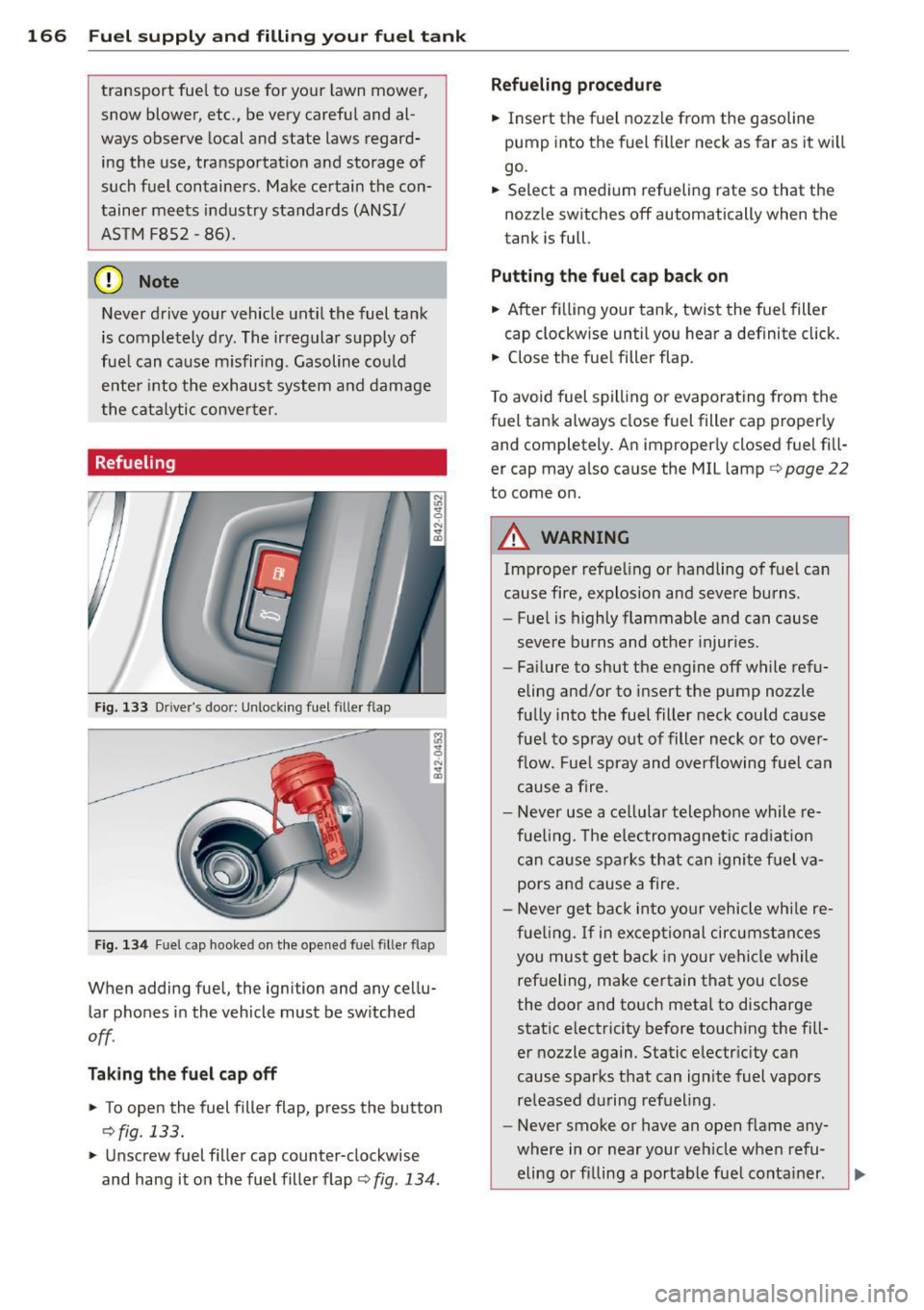
Fig. 133 D river 's doo r: Unlocki ng fuel filler flap
Fig. 134 Fuel cap hooked on the opened fuel filler flap
When adding fuel, the ignition and any cellu
lar phones in the vehicle must be sw itched
off .
Tak ing th e fuel cap off
• To open the fuel filler flap, press the button
9fig. 133.
• Unscrew fuel filler cap counter-clockwise
and hang it on the fuel filler flap ¢
fig. 134 .
Refueling procedure
• Insert the f uel nozzle from the gasoline
pump into the fuel fi ller neck as far as it wi ll
go .
• Select a med ium refueling rate so that the
nozzle switches off automatically when the
tank is full.
Putting th e fu el cap bac k on
• After fi lling your tank, twist the fuel filler
cap clockwise until you hear a definite click.
• Close the fue l filler flap.
T o avoid fuel spilling or evaporating from the
fuel tank always close fuel filler cap properly and completely. An improperly closed fuel fi ll
er cap may also cause the MIL lamp¢
page 22
to come on.
A WARNING
Improper refue ling or handling of fuel can
cause fire, explosion and severe burns.
- Fuel is highly flammable and can cause
severe burns and other injuries.
- Fai lure to shut the engine off while refu
eling and/or to insert the pump nozzle
fully into the fuel filler neck could cause
fuel to spray out of filler neck or to ove r
flow. F ue l spray and overflowing fuel can
cause a fire.
- Never use a ce llular telephone while re
fue ling. The electromagnet ic rad iat io n
can cause spa rks that can igni te fuel va
pors and cause a fire.
- Never get back into your vehicle whi le re
fue ling.
If in exceptio nal circumstances
you must get back in your vehicle while
ref ueling, make certain that you close
the door and touch metal to discharge
static electricity before touching the fill
er nozzle again. Static electricity can
cause sparks that can ignite fuel vapors
re leased d uring refueling .
- Never smoke or have an open f lame any
where in o r near your veh icle when refu
eling or filling a portable fue l conta iner.
Page 169 of 236
-For your safety, we strongly recommend
that you do not travel with a portable
fuel container in your vehicle. The con
tainer, full or empty may leak and could
cause a fire , especially in a crash .
-If, under exceptional circumstances, you
must transport a portable fuel container,
please observe the following:
- Never fill a portable fuel container
while it is anywhere in or on the vehicle (for example, in the luggage compart
ment, or on the trunk) . Static electrici
t y can build up while filling and can ig
nite fuel vapors causing a fire .
- Always place a portable fuel container
on the ground before filling .
- Always keep the filler nozzle complete
ly inside the portable container before
and during filling.
- If filling a portable container made of
metal, the filler nozzle must always be
in contact with the container . This will
help prevent static electricity from dis
charging and cause a fire.
- Never spill fuel inside the vehicle or
luggage compartment. Fuel vapors are
highly flammable.
- Always observe local and state/provin
cial laws regarding the use, storage
and transportation of fuel containers
- Make certain the fuel container meets
industry standards (ANSI/ ASTM
F852-86).
(D Note
I f any fuel has spilled onto the car, it
should be removed immediately to prevent
damage to the paint.
@ For the sake of the environment
As soon as the correctly operated nozzle switches off automatically for the first
time, the tank is full. Do not try to add
more fuel because fuel may spill out. In
addition, the expansion space in the fuel
tank will be filled -causing the fuel to
Fuel supply and filling your fuel tank 167
overflow when it becomes warm and pol
lute the environment.
a) Tips
- Running your engine while refueling may
cause vapors to escape or even fuel to
spill out of the tank. This would then
shut off the fuel nozzle before the tank
is full.
- Do not refuel your vehicle with the igni
tion switched on. The fuel gauge may
otherwise not indicate the correct fuel
level after refueling .
Unlocking the fuel filler flap
by hand
You can open the fuel filler flap by hand if the
power locking sy stem should fail .
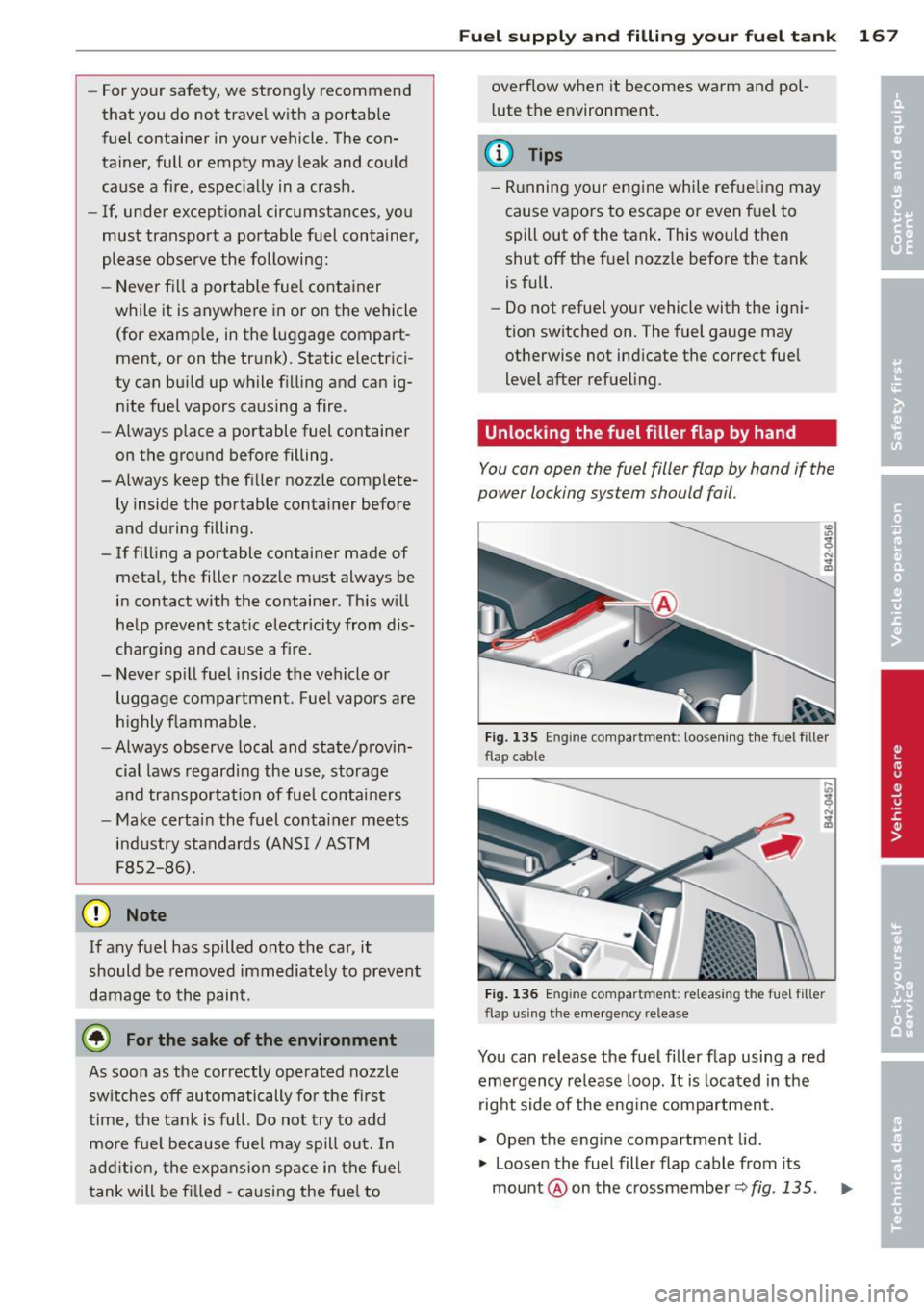
Fig. 135 En gin e compar tment: loo sening the fue l fill er
fl ap cab le
Fig. 136 Engine compar tment: re lea sing the fuel fille r
flap using the emer gen cy re le ase
You can release the fuel filler flap using a red
emergency release loop .
It is located in the
right side of the engine compartment.
.. Open the engine compartment lid.
.. Loosen the fuel filler flap cable from its
mount @ on the crossmember
~ fig. 135 . liJJ,,
Page 170 of 236
168 Fuel supply and filling your fuel tank
• Pull the red loop in the direction of the ar
row until the fuel filler flap opens
¢fig. 136 .
• Once the fue l filler f lap is open, secure the
cable on the crossmember again.
• Close the engine compa rtment lid
¢ page 170 .
Page 171 of 236
Checking and filling Engine compartment
lid
Working in the engine compartment
Be especially careful whenever you work in the engine compartment!
Whenever you must perform any work in the
engine compartment, for example checking
and filling the different fluids, there is a risk
of injury, burns and accidents. To prevent per
sonal injury always observe the following
WARNINGS. The engine compartment of any
vehicle is a ha zardous area!
¢ &. .
_&. WARNING
To help avoid injury, before you check any
thing under the engine compartment lid:
- Switch off the engine.
- Remove the ignition key.
- Apply the parking brake.
- Move selector lever of R tronic to "N"
(Neutral); put manual transmission in
Neutral.
- Always let the engine cool down. Hot
components will burn skin on contact.
- To reduce the risk of being burned, never
open the engine compartment lid if you
see or hear steam or coolant escaping
from the engine compartment. Wait un
til no steam or coolant can be seen or heard before carefully opening the en
gine compartment lid.
- Keep children away from the engine com
partment .
- Never spill fluids on hot engine compo
nents. They can cause a fire.
- Never open the coolant reservoir cap
when the engine is still warm. The cool
ant system is pressurized and hot cool
ant could spray out .
- Protect your face, hands and arm from
steam or hot engine coolant by placing a
thick rag over the cap when you open the
coolant reservoir .
Checking and filling 169
-If work on the fuel system or the electri
cal system is necessary:
- Always disconnect the battery.
- Never smoke or work near heaters or open flames . Fluids in the engine com
partment could start a fire.
- Keep an approved fire extinguisher im
mediately available .
- To avoid electrical shock and personal in
jury while the engine is running or being started, never touch:
- Ignition cables
- Other components of the high voltage
electronic ignition system.
- If you must perform a check or repair
with the engine running:
- First, fully apply the parking brake,
move selector lever of R tronic to "N"
(Neutral); put manual transmission in
Neutral.
- Always use extreme caution to prevent clothing, jewelry, or long hair from get
ting caught in the radiator fan, V-belts
or other moving parts, or from contact
ing hot parts. Tie back hair before
starting, and wear no clothing that will
hang or droop into the engine.
- Minimize exposure to emission and
chemical hazards¢& .
A WARNING
California Proposition 65 Warning:
- Engine exhaust, some of its constituents,
and certain vehicle components contain
or emit chemicals known to the State of
California to cause cancer and birth de
fects and reproductive harm. In addition,
certain fluids contained in vehicles and
certain products of component wear con
tain or emit chemicals known to the State of California to cause cancer and birth defects or other reproductive harm.
- Battery posts, terminals and related ac
cessories contain lead and lead com
pounds, chemicals known to the State of
California to cause cancer and reproduc
tive harms. Wash hands after handling.
•
•
Page 172 of 236
1 7 0 Che cking and filling
(D Note
When adding fluids, a lways make sure that
they are poured into the proper container or filler opening, otherwise serious dam
age to veh icle systems will occur.
@ For the sake of the environment
To detect leaks in time, inspect the vehicle
floor pan from underneath regu larly . If
you see spots from oil or other vehicle flu ids, have your vehicle inspected by an au
thorized Audi dealer.
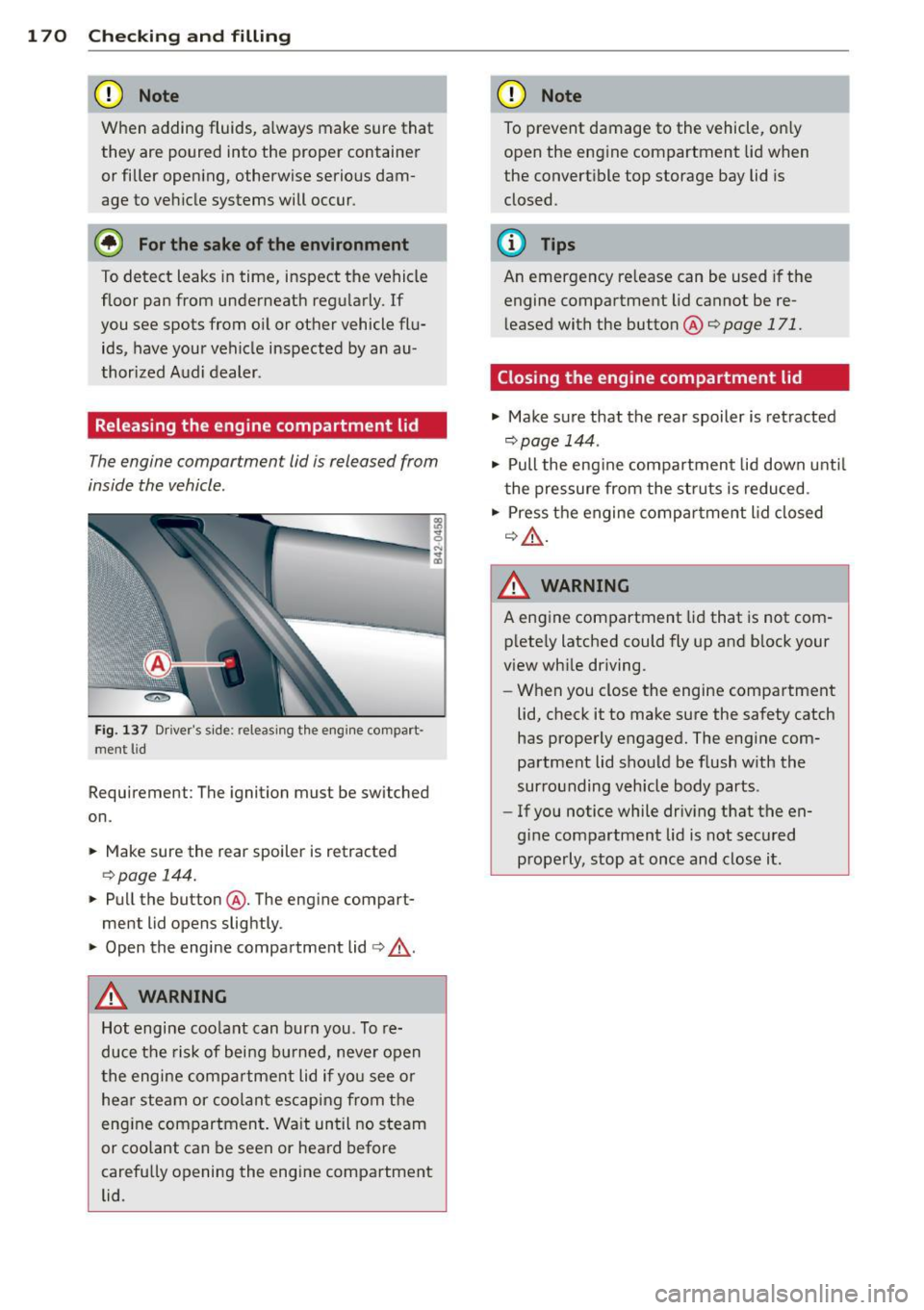
Releasing the engine compartment lid
The engine compartment lid is released from
inside the vehicle .
Fig. 137 Driver's side: releasing t he engine co mpart
ment lid
Requirement : The ignition must be switched
on.
... Make sure the rear spoiler is retracted
¢page 144 .
... Pull the button @. The eng ine compart
ment lid opens slightly .
... Open the engine compartment lid
c> ,& .
A WARNING
-
Hot engine coo lant can burn you . To re
duce the risk of being bu rned, never open
the engine compartment lid if yo u see or
hear steam or coolant escaping from the
eng ine compartment. Wait until no steam
or coolant can be seen or heard before
carefully opening the engine compartment
lid.
(D Note
To prevent damage to the vehicle, on ly
open the engine compartment lid when
the convert ible top storage bay lid is
closed.
(D Tips
An emergency re lease can be used if the
engine compartment lid cannot be re
leased with the button
® ¢ page 171.
Closing the engine compartment lid
... Make sure that the rear spoiler is retracted
Qpage 144.
.,. Pull the eng ine compartment lid down unti l
the pressure from the struts is reduced .
... Press the engine compartment lid closed
Q&. .
A WARNING
A engine compartment lid that is not com
plete ly latched could fly up and b lock your
view wh ile driving.
- When you close the engine compartment
lid, check it to make sure the safety catch
has properly engaged. The engine com
partment lid should be flush with the
surrounding vehicle body parts.
- If you notice while driving that the en
gine compartment lid is not secured
properly, stop at once and close it.
Page 173 of 236
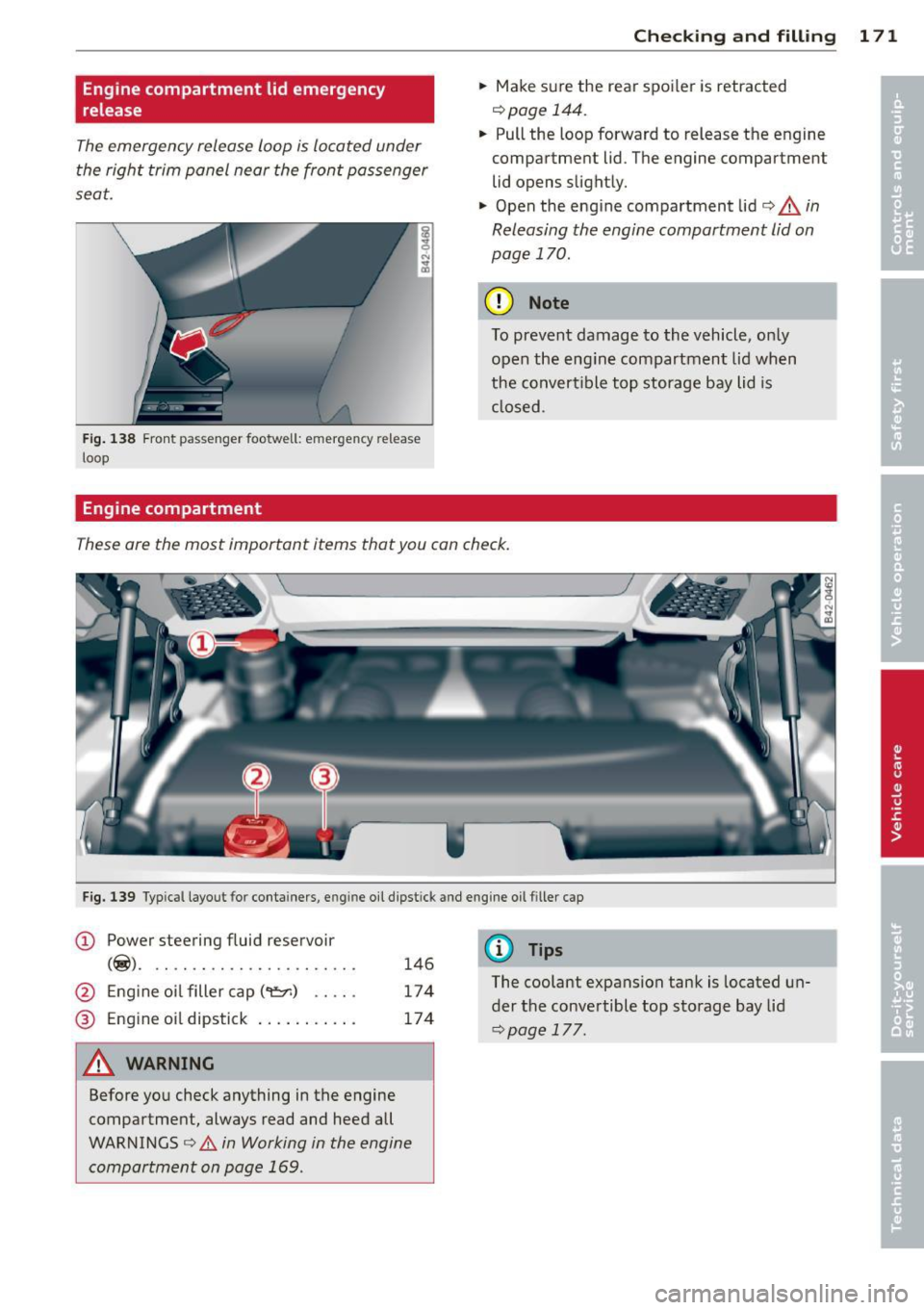
Engine compartment lid emergency
release
The emergency release loop is located under
the right trim panel near the front passenger
seat.
F ig . 138 Front pas se n ge r footwe ll: emer gen cy re lease
l oo p
Engine compartment
Checkin g and fillin g 171
.. Make su re the rear spoiler is retracted
¢ page 144 .
.. Pull the loop forward to release the engine
compartment lid . The engine compartment
lid opens sligh tly.
.. Open the engine compartment lid¢.&.
in
Releasing the engine compartment lid on
page 170.
(D Note
To prevent damage to the vehicle, only
open the eng ine compartment lid when
the convertible top storage bay lid is
closed .
Th es e ar e th e most important it ems that you can ch eck.
Fig. 139 Ty pical layout for containers , en gin e oil dipst ick and eng ine o il filler cap
(D Power steering fluid reservoir
(@) ... .. .... .... ... ...... .
@ Eng ine oi l filler cap ('l=r.) .. ...
® Engin e oi l dipstick
146
174
174
A WARNING
Before you check anything in the engine
compartment, always read and heed all
WARNINGS ¢.&. in Working in the engine
compartment on page 169 .
-
{!) Tips
The coolant expansion tank is located un
der the convertible top storage bay lid
¢ page 177.
Page 174 of 236
172 Checking and filling
Engine oil
Engine oil specifications
The engine oil used in your Audi needs the
right kind of oil.
The engine in your Audi is a sophisticated
powerplant that was built to exacting specifi
cations. This engine needs the right kind of
engine oil that meets specifications regarding
quality and viscosity so that it can run
smoothly and reliably. Choosing the right oil
and changing oil within the time and mileage intervals printed in your vehicle's Warranty
&
Maintenance booklet matters a lot more to
day than it did years ago. Audi has developed
a special quality standard for engine oil that
will help assure that your vehicle's engine will
get the lubrication it needs for proper opera
tion .
Modern engine lubrication has taken a quan
tum leap in the last few years. Many synthetic
oils available today provide better engine lu brication that can outlast traditional petrole
um-based oils, making them a smart choice
for use throughout the life of your Audi .
Whether you use synthetic or petroleum based engine oil, the oil that you use must
conform to Audi's oil quality standard
VW 502 00 to help keep your vehicle's engine running smoothly and help prevent the for
mation of harmful deposits, sometimes called
"sludge," that over time can lead to expensive
repairs.
At the time of printing, engine oils available in
the U.S. and Canada that meet the exacting
specifications of Audi oil standard VW 502 00
are synthetic engine oils. This does not mean,
however, that every synthetic engine oil will
meet Audi oil standard VW 502 00 . So always
be sure that you use an approved oil.
To help prevent the formation of harmful de posits use only oil with the following specifi
cations printed on the oil container :
Audi oil standard VW 502 00
Oil container labels may carry the specifica
tion singly or in combination with other desig nations and oil quality standards.
Viscosity
Engine oils are graded according to their vis
cosity . The proper viscosity grade oil for your
engine depends on climactic or seasonal con
ditions where you drive. You can use oil with a
viscosity grade of SAE SW40 across all tem
perature ranges for normal driving conditions.
However, if engine oil viscosity grade SAE
SW40 is not available, you can also use viscos
ity grade SAE SW-30 or SAE OW-40 as long as
it meets Audi oil quality standard VW 502 00
specifications.
Because engine oil that meets the Audi oil
standard may not be available everywhere
when you need it, we strongly recommend
that you always carry with you an extra quart (liter) of oil that expressly conforms to the
VW 502 00 specification, in case you have to
top off the oil while on the road.
Only if the level of the oil is at or below the
minimum mark on the oil dipstick - and no oil
that expressly conforms to Audi oil standard
VW 502 00 specifications is available -may
you top off with a high quality engine oil, pref
erably synthetic-based, that meets ACEA A3
or API SM specifications, but even then, only
in viscosity grades SAE SW-40, SAE SW-30, or
SAE OW-40. However, during the entire time
between oil change intervals, never top off
with more than a total of 1 qt/liter engine oil
that does not conform to Audi oil specification
vw 502 00.
For more information about engine oil that
has been approved for your vehicle, please
contact either your authorized Audi dealer or
Audi Customer Relations at 1 (800) 822-2834 or visit our web site at www.audiusa.com or
www .audicanada .ca. Here you will also find a
current list of oils (manufacturers, brand
names etc.) that conform to Audi oil standard
vw 502 00.
Changing the engine oil
Page 175 of 236
The engine oil and oil filter must be changed
according to the mi leage (kilometers) and
time interva ls specified in your vehicle's War
ranty
& Maintenance booklet. Do not exceed
t hese intervals -harmful deposits from old
engine o il can reduce engine performance and
can lead to expensive engine repairs .
Changing the o il at the recommended inter
vals is so very important because the lubricat
ing properties of oil decrease gradually during
norma l vehicle use . If you are not sure when
you have your oi l changed, ask your author
i zed A udi Service Advisor.
Under some circumstances the engine o il
should even be changed more frequently .
Change o il more often if you drive mostly
short distances, ope ra te the vehicle in dusty
areas or mostly under s top -and-go traffic con
d itions, or when yo u use your vehicle whe re
temperatures stay below freezing point for
l ong periods.
D etergen t additives i n the o il w il l make fresh
oil look dark after the eng ine has been run
ning for a short time . This is norma l and is not
a reason to change the oi l more often than
recommended.
Damage or malfunction s due t o lack of
m aintenance
It is essen tial that you change your oil at the
r ecommended inte rva ls using only engine o il
that complies with A udi oil standard
VW 502 00 . Your Limited New Vehicle War
ranty does not cover damage or malfunctions
d ue to fai lure to fo llow recommended mainte
nance and use req uirements as set forth in
t he Audi Owner's Manua l and Warranty
&
Ma intenance book let . Your authorized Aud i
deale r will have to deny warranty coverage un
l ess you present to the dealer p roof in the
fo rm of Se rvice o r Repair Orde rs t hat all
sched uled main tenance w as performed in a
time ly manner .
Checkin g and fillin g 173
Engine oil consumption
The engine in your vehicle depends on an ade
quate amount of oil to lubricate and cool all
of its moving parts .
In order to provide effective lubrication and
cooling of interna l eng ine components, all in
te rnal combust io n engines consume a certain
amount of oil. Oil consumpt io n va ries from
engine to engine and may change sig nifican tly
ove r the life of the engine. Typically, engines
with a spec ified break -in pe riod (see
¢
page 150) consume more oil duri ng the
break-in pe riod than they consume afte r oi l
consumption has stabili zed.
U nder normal cond itions , the rate of oi l con
s u mption depends on t he q uality and viscos ity
of the oil, the RP M (revolut ions per minute) at
which the engine is operated, the ambient
temperature and road conditions. Further fac
tors are the amount of oil dilut ion from water
condensa tion or fue l residue a nd the oxida
tion level of the oi l. As any eng ine is subject to
wear as mileage builds up, t he oil co nsump
t ion may incre ase over time until repla cement
of wo rn components may be come necessary.
With a ll these va riab les coming into p lay, no
standard rate of oil consumpt io n can be es
t a bl is h ed o r spe cified . There is no alte rnative
to regular an d frequent chec king of the o il lev
el , see
Note.
If the yellow engine o il level wa rning symbo l
i n the instrument cluster
Ill lights up, yo u
sho uld check the oil leve l as soon as possib le
¢
page 174 . Top off the oil at your ear liest
convenience
¢ page 174.
A WARNING
-Before you check anything in the engine
c o mpartment, always read and heed a ll
WARNINGS¢
& in Working in the engine
compartment on pag e 169 .
(D Note
Driving w ith an insufficient o il level is like-
-
ly to cause severe damage to the engine. Ill>-
•
•
Page 176 of 236
17 4 Che cking and filling
@ Tips
If you have the impression your eng ine
consumes excessive amounts of oil, we
recommend that you cons ult your a uthor
ized Audi deale r to have the cause of yo ur
concer n properly d iagnosed . Keep in m ind
that the accurat e measurement of oil con
sumpt ion re quires great care an d may take
s ome time. Your author ized Audi dealer
h as ins truction s about h ow to mea sure o il
consumption a ccurately .
Checking the engine oil level
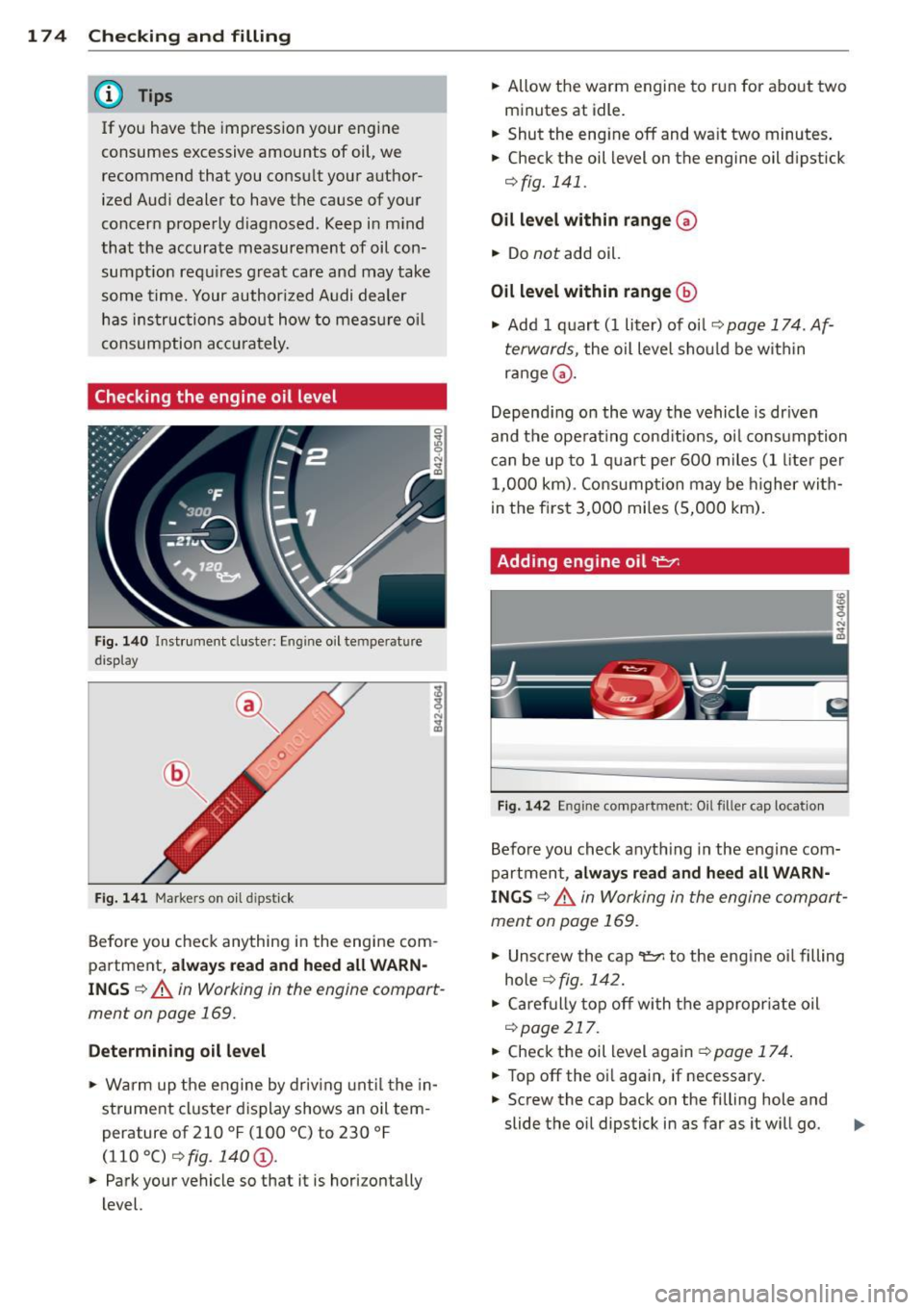
Fig. 140 Ins trume nt clus te r: En gin e o il te mpe rat ure
di sp lay
F ig.
14 1 Marke rs on oil dipstic k
Before you check anything in the eng ine com
pa rtment,
alway s read and heed all WARN
INGS ¢ A in Working in the engin e compart
ment on page 169.
Determining oil lev el
.. Warm up the engine by dr iv ing unt il t he in
strument cl uster d isplay shows an oil tem
perature of 210 °F (100 °C) to 230 °F
(110 °C)
¢ fig . 140 @ .
.. Park your vehicle so that it is hori zo ntally
level. ..
Allow the warm engine to r un for abo ut two
m inutes at idle.
.. Shut the eng ine off and wa it two minutes .
.. Check the oil level on the engine oil d ipstick
¢fig. 141.
Oil level within range (v
.. Do not add oil.
Oil level within range@
"" Add 1 quart (I liter) of oi l i=:> page 174. Af
terwards ,
the oil leve l sho uld be with in
r a nge
G) .
Depend ing on the way the vehicle is dr iven
and the ope ra tin g cond itions, o il consu mption
ca n be up to 1 q uart per 600 miles (1 liter per
1,0 00 km) . Co nsump tion may be higher with
i n the f irst 3,000 mi les (5,00 0 km) .
Adding engine oil~
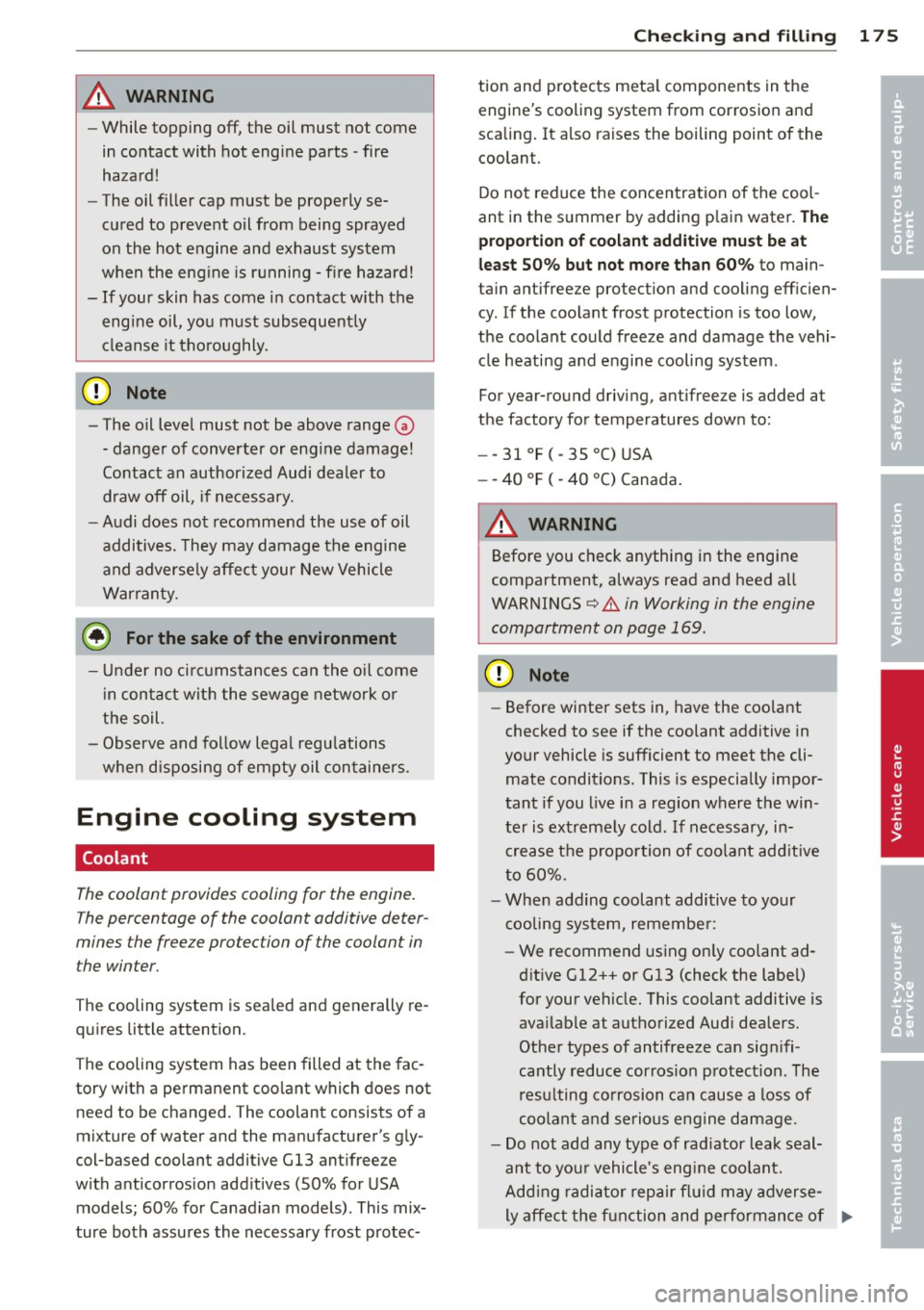
Fig. 14 2 En g in e co mpa rt m ent: O il fil ler cap loca tio n
Befo re you check a nyth ing in the eng in e com
partment,
always read and heed all WARN
INGS ¢.&. in Working in the engine compar t
men t on page 169.
.,. Unsc rew th e cap 't=;,1 to the eng ine o il filling
hole
¢ fig . 14 2.
.,. Care fully top o ff wi th t he a ppropr iate oil
¢ page 217.
.. Check the oil level again ¢ page 174 .
.. Top off the oi l aga in, if necessary .
.,. Sc rew the cap back on the filling hole and
slide the oil dipstick in as far as it w ill go. ..,.
Page 177 of 236
A WARNING
-While top ping off, the oil must not come
in contact with hot engine pa rts -fire
hazard!
- The oil fille r cap must be prope rly se
cured to preve nt o il from being sprayed
on the hot engine and exhaust system
when the eng ine is r unning -fire hazard!
- If your skin has come in contact w ith the
engine oil, yo u must subseque ntly
cl eanse it tho roughly.
(D Note
- The oil level must not be above range G)
- danger of conver ter or eng ine damage!
Co ntact an authorized Audi dea ler to
draw off oil, if necessa ry.
- Audi does not recommend the use of oil
additiv es. They may damage the engine
and adverse ly affec t your New Vehicle
Warr an ty.
@) For the sake of the environment
- Under no ci rcumstances ca n the o il come
i n cont act w it h the sewage network o r
the soil.
- Observe and fo llow lega l regu lations
when d isposing of empty oil con taine rs.
Engine cooling system
Coolant
The coolant provides cooling for the engine.
The percentage of the coolant additive deter
mines the freeze protection of the coolant in the winter.
The cooling system is sea led and generally re
q ui res little attention.
The cooling system has been filled at the fac
tory with a permanent coolant which does not
need to be changed. The coolant consists of a
mixture o f water and the man ufacture r's g ly
col-based coolant additive Gl3 ant ifreeze
w ith a nticorros ion add itives (50% for USA
models; 60% for Canad ian models). This mix
ture bot h assures the n ecessary frost protec-
Checkin g and fillin g 175
tion and protects meta l components in t he
engine's cooling system from corrosio n and
sca ling . It a lso raises the boiling point of the
coolant.
Do not reduce the concen tration of the cool
ant in the s ummer by adding p lai n wate r.
The
proportion of coolant additive must be at
least 50 % but not more than 60 %
to main
ta in antifreeze protect io n and coo ling eff ic ien
cy. If the coo la nt frost protection is too low,
t h e coolant could freeze and damage the vehi
cle heating and engine cooling system .
For year-round driving, antifreeze is added at
the factory fo r temperatures dow n to:
- -31°F( -35°C)USA
- -40 °F ( -40 °C) Canada .
A WARNING ~
Before you chec k anything in the engi ne
compartment, always read and heed a ll
WARNINGS¢
& in Working in the engine
compartment on page 169.
-
(D Note
- Before winter sets in, have the coo lant
checked to see if the coolant additive in
your vehicle is sufficient to meet the cli
mate condit ions. This is especially impor
t ant if you l ive i n a region where the win-
t er is extremely cold. If necessary, in-
cr ea se t he p ropo rtion of coo lant add itive
t o 6 0%.
- Whe n ad ding coolant addi tiv e to yo ur
c oo ling sys te m , reme mbe r:
- We recommend using on ly coo lant ad
d itive Gl2 ++ or Gl3 (check the labe l)
for your vehicle. This coolant additive is ava ilable at authorized Aud i dea lers .
Othe r ty pes of antifreeze ca n sig nifi
ca ntly reduce cor ros io n protec tion . The
r esu lting co rrosion can cause a loss of
coo lant a nd serio us e ng ine da mage.
- Do not add any type of rad iator l eak seal
ant to yo ur vehicle's engi ne coo lant .
A dd ing radia to r r epair f luid m ay adverse-
ly affect the f unction and pe rformance of .,.. •
•