engine AUDI R8 SPYDER 2012 Owner's Manual
[x] Cancel search | Manufacturer: AUDI, Model Year: 2012, Model line: R8 SPYDER, Model: AUDI R8 SPYDER 2012Pages: 236, PDF Size: 59.24 MB
Page 43 of 236
(D Note
To p reve nt damage t o the conve rtible top:
- do no t s tore any objects in the converti
ble top storage bay .
- make sure there is enough space above
the veh icle when opening or closing the
convertible top.
@ Tips
- When the indica to r l amp iii blinks,
there is a system malfunc tion
c> page 15 .
-The one-touch openi ng fun ction is not
ava ilable when the vehicle is traveling
below 4 mph (6 km/h) or above 31 mph
(SO km/h).
If this is the case, a wa rning
tone w ill sound and a message will ap
pear in the instrument cluster
c> page 41.
Error message in the instrument cluster
display
An error message appears if the convertible
top cannot open or close.
Severa l conditions must be met for the con
ve rtible top to open or close automatically .
An error message in the inst rument cluste r
d isp lay ind icates if one of the condit ions is not
met or there is a malfunct ion.
Soft top: Please clo se engine lid!
The engine compa rtment lid must be closed
when opening or closing the convertible top .
T his message appears in the instrument clus
ter d isp lay if the engine compartment lid is
not closed.
Soft top : Cannot be used!
This error message appears if the convertib le
cannot open or close because of safety rea
sons or if there is a malfunction . The follow
ing causes are poss ible:
- The vehicle is t ra veling too fa st: Converti
ble top operation is deactivated for safety
reasons if the vehicle is traveling too fast . A
message w ill appear . Reduce the vehicle
Con vertible top 41
speed and pu ll or press the sw itch again to
open or close the convertible top.
- The battery voltage i s too low: Th e conver
tible top cannot open or close if the battery
voltage is too low. This ens ures there will be
enough battery vo ltage left to start the ve
hicle . The convertible top can be operated
aga in after the engi ne is started.
- Ove rload protect ion is acti ve: Operating the
convert ible top continuously for a long peri
od of time p laces stress on the hydraulic
un it. Over load protect io n is act ivated to p re
vent damage to the system . This protective
fu nction preve nts t he conver tible top from
open ing or close fo r approximate ly 15 to 30
m inu tes.
It will f unct io n a gain a fter tha t
c:::> &..
-Malfun ction : Failure of system components
is one possib le cause fo r malfunction. If this
happens, you can a lso operate the converti
ble top by hand
c:> page 43 .
-The exterior temperature is too low: The
converti ble top will not o pen in tempera
t u res below (S °F) (-15 QC).
Soft top not secure
If the conve rtib le to p is not complet ely open
or closed and the vehi cle is t raveling too fast,
the error message above appears and a warn
ing tone sounds. Reduce the vehicle speed
and pull or press the switch again to open or close t he convertible top.
A WARNING
N eve r drive when the c onvertible top is not
locked correctly . The wind from driving
could cause the co nvertib le top to open.
T his ca n resu lt in i nju ries and damage to
the vehicle.
Page 46 of 236
44 Convertible top
Step 1: Retract the rear window
Fig. 45 Upper storage compa rtme nt: re mov ing the
cover
F ig. 46 Upper sto rage compartment: using the Allen
wrench as a crank to lower the rear win dow
M 0 N ... a,
... ... M 0
The rear window must be retracted in order to
close the convertible top. If the rear window
switch is not functioning¢
page 42, the rear
window can be cranked .
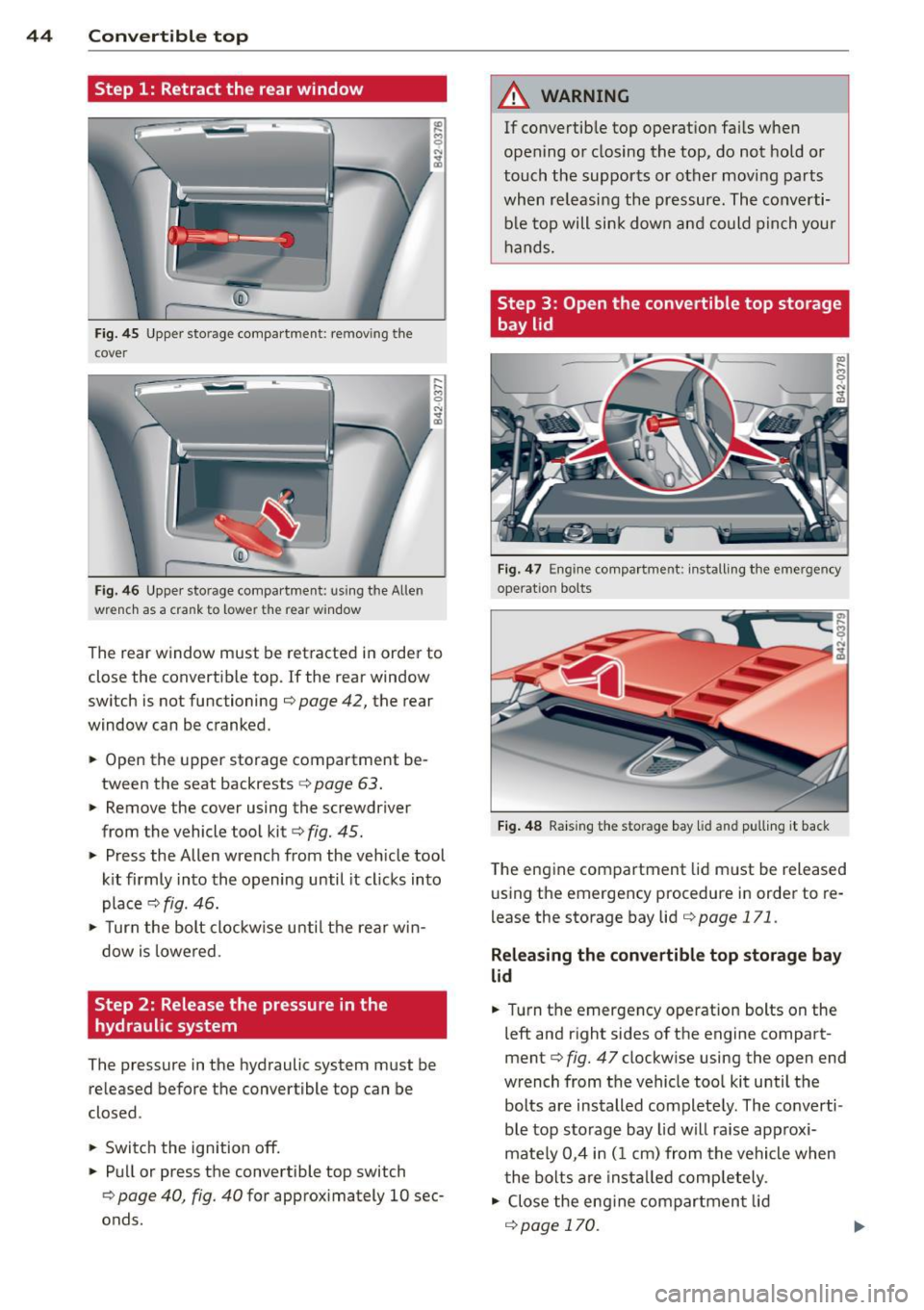
.. Open the upper storage compartment be
tween the seat backrests ¢
page 63 .
.. Remove the cover using the screwdriver
from the vehicle tool kit¢
fig. 45.
• Press the Allen wrench from the veh icle tool
kit firmly into the opening until it clicks into
place ¢
fig. 46.
• Turn the bolt clockwise until the rea r w in
dow is lowered .
Step 2: Release the pressure in the
hydraulic system
The pressure in the hydraulic system must be
re leased before the convertible top can be
closed.
.. Switch the ignition off.
.. Pu ll or press the convertible top switch
¢
page 40, fig. 40 for approximately 10 sec
onds.
A WARNING
-
If convertib le top operat ion fa ils when
opening o r closing the top, do not hold or
touch the supports or other moving parts
when releasing the pressure. The converti
ble top will sink down and could pinch your
hands.
Step 3 : Open the convertible top storage
bay lid
Fig. 47 E ng ine compartme nt: install ing the eme rgency
ope rat io n bolts
Fig. 48 Ra is ing t he sto rage bay lid and pulling it back
The engine compartment lid must be released
using the emergency procedure in order to re
l ease the storage bay lid
¢page 171.
Releasing the convertible top storage bay
lid
.. Tur n the emergency operation bolts on the
left and right sides of the engine compart
ment¢
fig. 47 clockw ise using the open end
wrench from the vehicle too l kit until t he
bolts are installed completely . The co nverti
ble top sto rage bay lid will raise app rox i
mate ly 0,4 in (1 cm) from the vehicle when
t he bolts are install ed comp letely.
• Close the engine compartment lid
r=;, page 170.
Page 47 of 236
Opening the convertible top storage bay
lid
• From th e rear of the vehicle, reach into the
center ventilation slot in the storage bay lid
with both hands and raise the lid approxi
mately 12 in (30 cm).
"' Hold the storage bay lid in this position and
pull it toward you until it stops ¢
fig. 48 .
& WARNING
When working in the engine compart
ment:
- Turn the engine off .
- Act ivate the parking brake.
-
-In veh icles with a manual transm ission,
move the shifter lever into idle. In vehi -
cles with the R tronic transmission, move
the selector lever into the N position.
- Remove the ignit ion key.
- Let the engine cool down.
- Keep children away from the engine com- partment .
(D Note
To prevent damage to the vehicle, only
open the convertible top storage bay lid
when the engine compartment lid is
closed.
Step 4: Remove the covers
Fig. 49 Conve rtib le t op : cove rs ma rk e d
Convertible top 45
Fig . SO Co nver tible top sto rage bay lid: remov ing the
c ov er
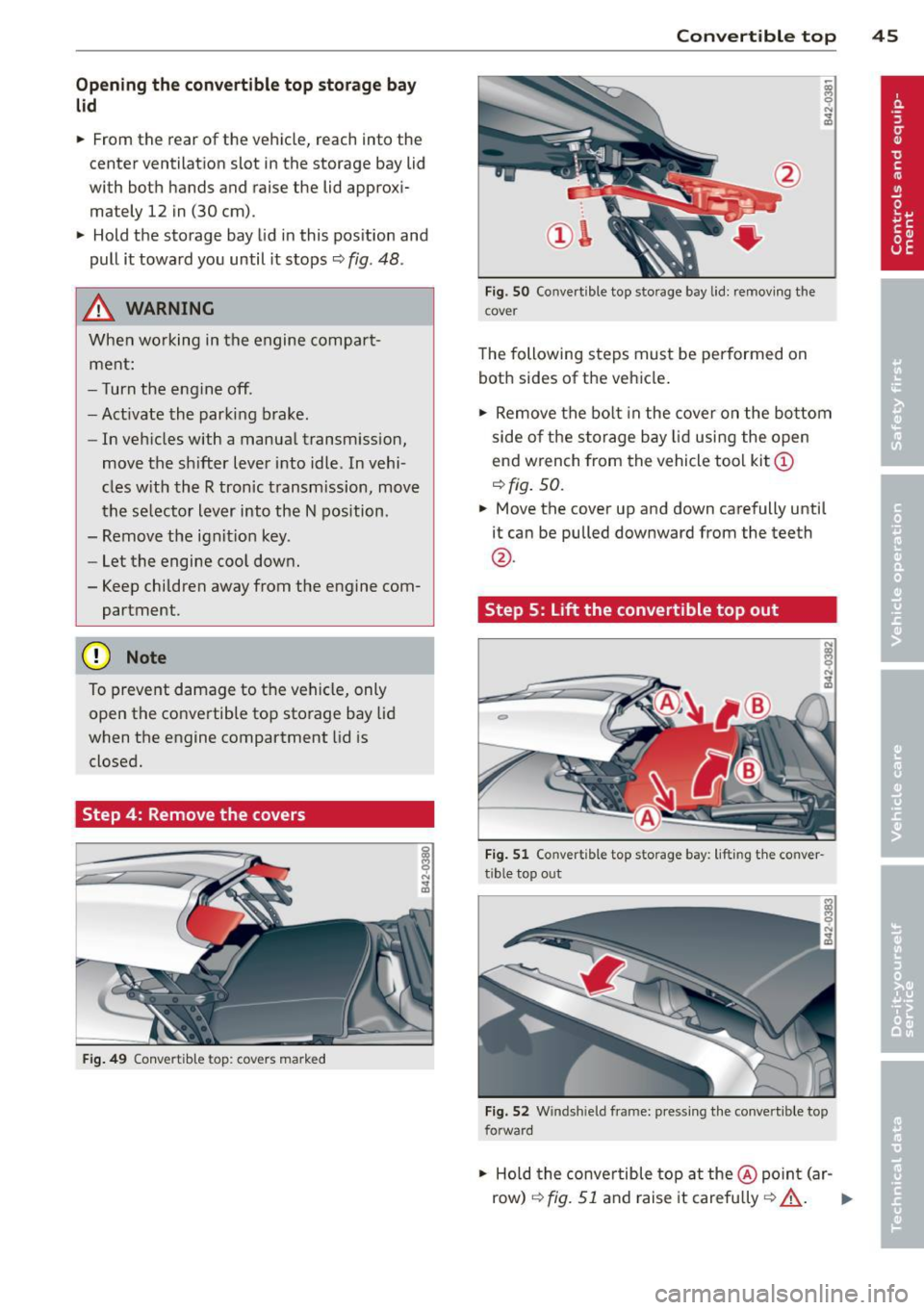
The following steps must be performed on
both sides of the vehicle.
"' Remove the bolt in the cover on the bottom
side of the st orage bay lid using the open
end wrench from the vehicle tool kit@
¢fig. 50.
• Move the cover up and down carefully unt il
it can be pulled downward from the teeth
@ .
Step 5:
Lift the convertible top out
Fig. 51 Co nve rtible top s tora ge bay: liftin g th e co nver
tible top out
Fig. 52 Wind shi eld fra me: press ing the conve rti ble top
fo rward
"' Ho ld the conve rtible top at the@ point (ar-
row)
¢ fig. 51 and raise it carefully ¢_& . II--
Page 67 of 236
Warm and cold Climate controls
Controls
W arm and cold 65
The climate controls automatically maintain the selected temperature in the vehicle interior
throughout each season .
Fig. 79 Climate contro ls
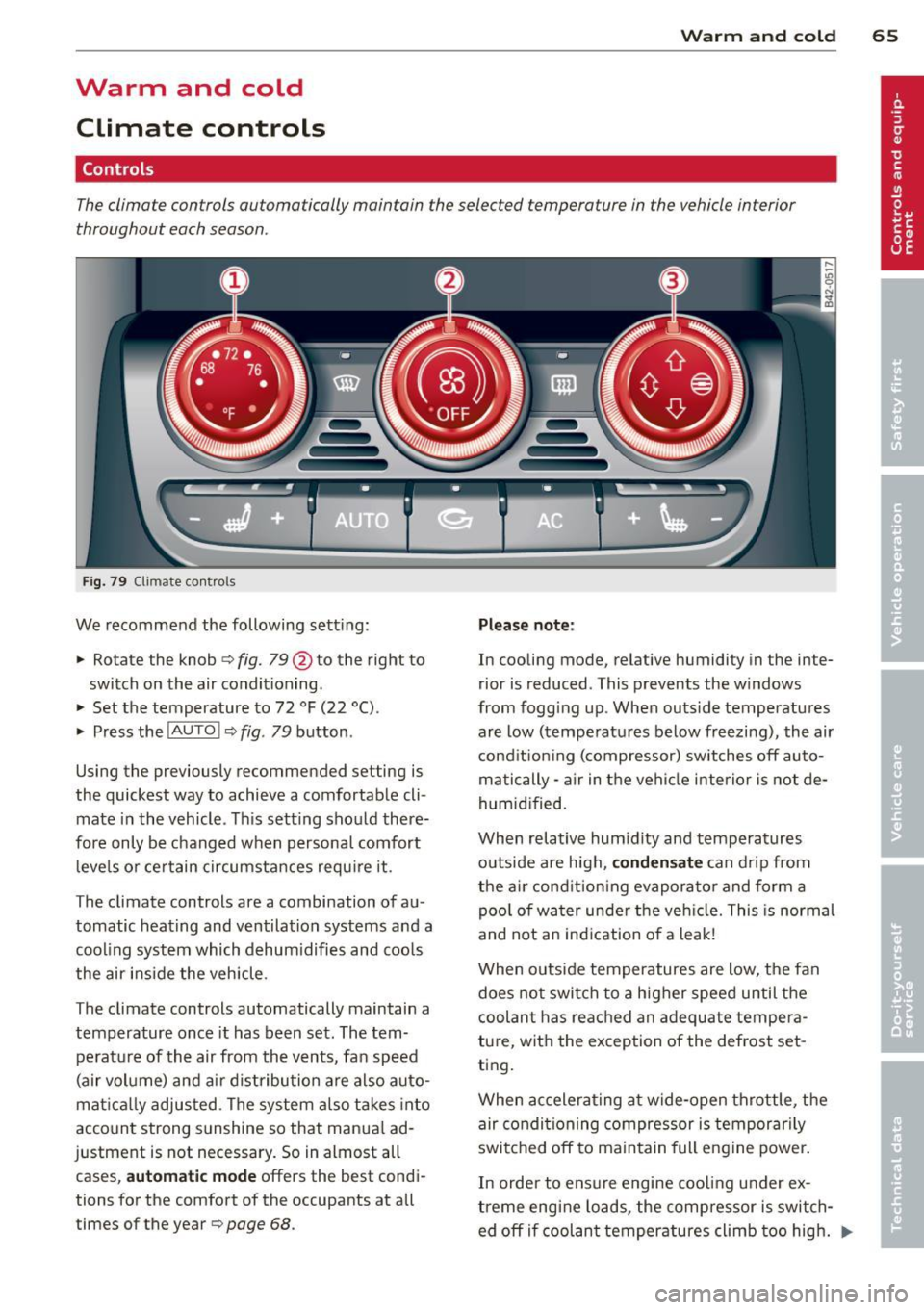
We recommend the following sett ing :
• Rotate the knob¢
fig. 79@ to the right to
switch on the air conditioning .
• Set the temperature to 72
°F (22 °().
• Press the !AUTO !¢ fig . 79 button .
Using the previously recommended setting is
the quickest way to achieve a comfortable cli
mate in the vehicle . Th is setting shou ld there
fore only be changed when persona l comfort
l eve ls o r ce rtain circumstances requ ire it .
The climate controls are a combination of au
tomatic heating and ventilation systems and a
cooling system which dehum idifies and coo ls
the air inside the vehicle .
The climate controls automatically maintain a temperature once it has been set. The tem
pe rat ure of the air from the v ents, fan speed
(air volume) and ai r distribu tion a re also auto
mat ica lly adjus ted . The system a lso takes into
account strong s unshine so that manua l ad
justment is not necessary . So in almost all
cases,
automatic mode offers the best cond i
tions for the comfort of the occupants at all
times of the year ¢
page 68.
Please note:
In cooling mode, relative humidity in the inte
r ior is reduced . This prevents the w indows
from fogg ing up . When outside temperatu res
ar e l ow (temperat ures below freezing), the air
cond it ion ing (compressor) switches off auto
matically - a ir in the vehicle interior is not de
humid ified.
When relative hum idity and tempera tures
outside are high,
c onden sate can drip from
t he a ir cond ition ing evaporator and form a
poo l of w at er unde r the ve hicle. This is normal
and not an ind ication of a leak!
When o uts ide temperatures are low, the fan
does not swi tch to a higher speed until the
coolant has reached an adequa te tempera
tu re, wit h the exception of the defrost set
ting.
When ac celera ting at w ide-open throttle, t he
air condi tioning compressor is temporar ily
swi tched off to ma intain full engine power .
In order to ensure engine coo ling under ex
t reme engine lo ads , the compressor is switch
ed off if coolant temperatures climb too hig h . ..,.
Page 71 of 236
an authorized Audi dealer when there is an
operating prob lem.
Using the climate controls economically
Economical use of the climate controls helps
to save fuel.
When climate con trol is wor king in cool ing
mode, engine performance is red uced and
fuel consumption is affected. To keep the time
the air conditioning is on as short as possib le,
you shou ld do the fo llow ing:
.,. If you wo uld like to save f uel, sw itch the air
conditioning off .
.. If you open the windows whi le driving,
switch the air conditioning off.
.,. If the vehicle is extremely hot due to the
heat of the sun, briefly open doors and win
dows.
@ For the sake of the environment
When you save fuel, you reduce em iss ions
from the vehicle.
Rear window defogger
The rear window defogger clears the rear win
dow of condensation .
.. Press the Iii button <=> page 65, fig. 79 to
turn the rear window defogger on and off.
The rear window defogger wor ks only when
the eng ine is r unning. The indicator light in
the button illuminates when the rear window
defogger is turned on.
The rear window defogger is switched off au
tomatically after approx . 10 minutes .
@ For the sake of the environment
As soon as the rear window is clear, yo u
should switc h the rea r window de fogger
off . The reduced power consumption has a
beneficial effect on f uel consumption.
Warm and c old 69
Heated seats
Applies to vehicles: with heated seats
The seat cushion and the seatback of the
front seats can be heated electrically.
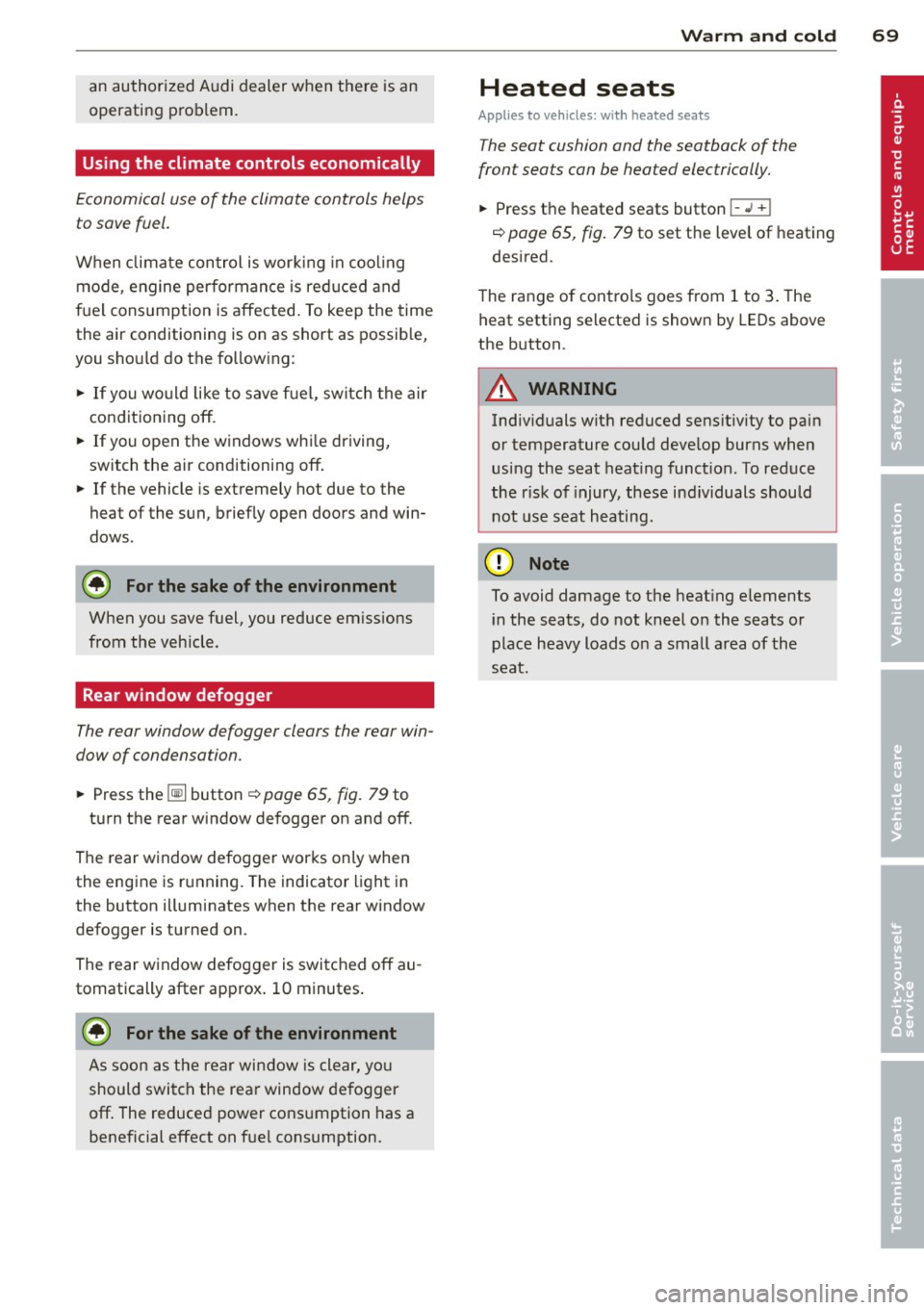
.. Press the heated seats button I-J + I
<=> page 65, fig . 79 to set the leve l of heating
desired.
The range of cont ro ls goes from 1 to 3. The
heat setting selected is shown by LEDs above
the button.
A WARNING
--=
Indiv iduals wit h reduced sens itiv ity to pa in
or temperature could deve lop burns when
using the seat heat ing funct ion. To reduce
the r isk of injury, these ind ividuals should
not use seat heating.
@ Note
To avoid damage to the heat ing e lements
i n the seats, do not kneel on the seats or
place heavy loads o n a small area of the
seat.
Page 72 of 236
70 On the road
On the road
Steering
Adjusting the steering wheel column
The steering wheel position can be continu
ously adjusted in height and distance .
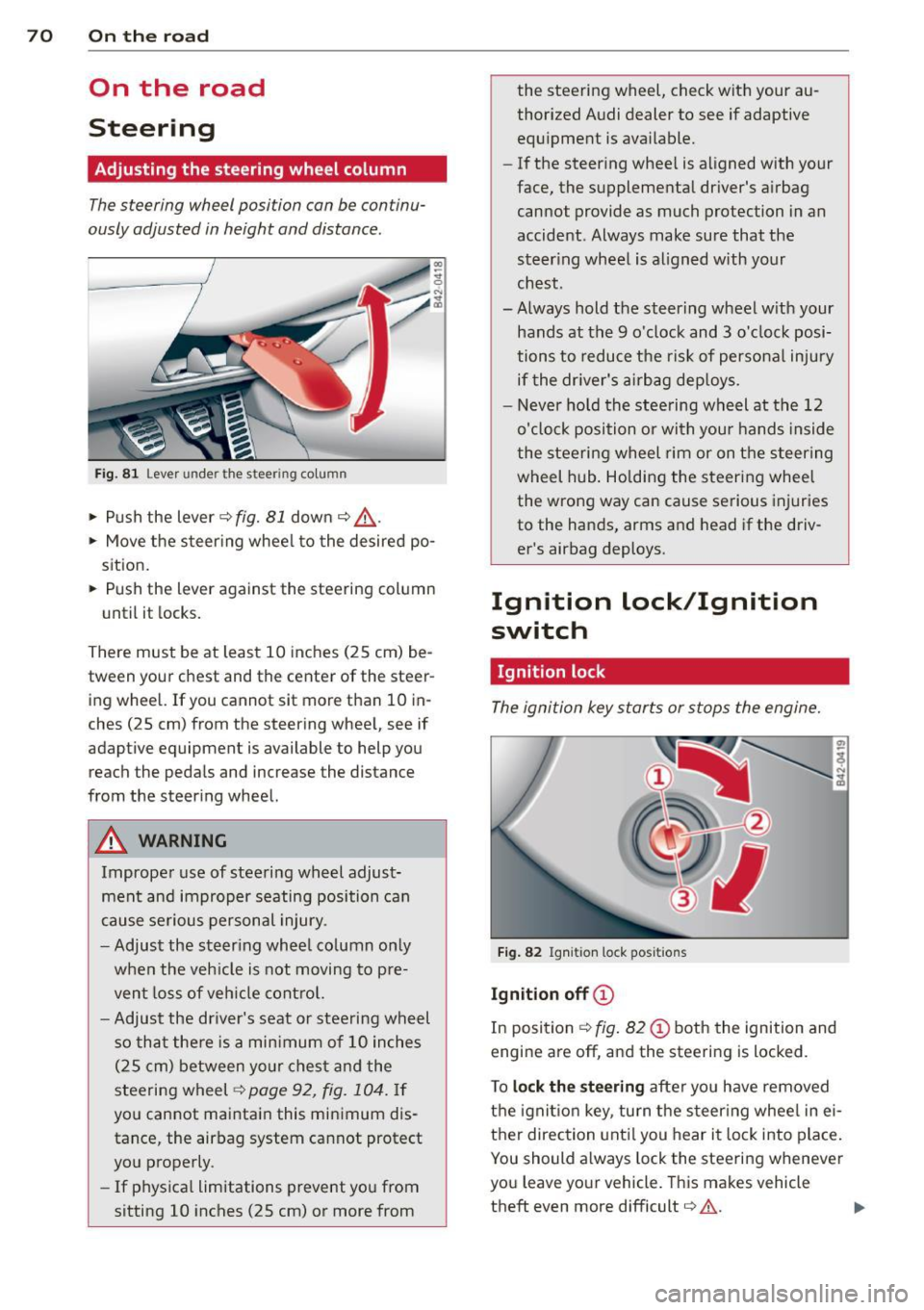
Fig. 81 Lever under the steering column
~ Push the lever¢ fig. 81 down ¢ .&_.
~ Move the s teer ing whee l to the desired po
sition.
~ Push the lever against the steering column
until it locks.
There must be at least 10 inches (25 cm) be
tween your chest and the center of the steer
ing wheel. If you cannot sit more than 10 in
ches (25 cm) from the steering wheel, see if
adaptive equipment is available to help you
reach the pedals and increase the distance
from the steer ing wheel.
A WARNING
Improper use of steering wheel adjust
ment and improper seating position can
cause serious personal injury.
- Adjust the steer ing whee l co lumn only
when the vehicle is not moving to pre
vent loss of veh icle control.
-
- Adjust the dr iver's seat or steering wheel
so that there is a minimum of 10 inches
(25 cm) between your chest and the
steering wheel ¢
page 92, fig. 104. If
you cannot maintain this minimum dis
tance, the airbag system cannot protect
you properly .
- If physical limitations prevent you from
sitting 10 inches (25 cm) or more from the steering wheel, check with your au
thorized Audi dealer to see if adaptive
equipment is
available.
- If the steer ing whee l is aligned with your
face, the supplemental dr iver's a irbag
cannot provide as much protection in an
accident . Always make sure that the
steer ing whee l is al igned with your
chest.
- Always hold the steering wheel w ith your
hands at the 9 o'clock and 3 o'clock posi
tions to reduce the risk of personal injury if the dr iver's airbag dep loys.
- Never hold the steering wheel at the 12
o'clock position or with you r hands inside
the steering wheel rim or on the steering
wheel hub . Ho lding the steering wheel
the wrong way can cause serious injuries
to the hands, arms and head if the driv
er's airbag deploys.
Ignition lock/Ignition
switch
Ignition lock
The ignition key starts or stops the engine.
Fig . 82 Ignit ion lock positions
Ig niti on off ©
In position ¢ fig. 82 (D both the ignition and
engine are
off, and the steering is locked .
T o
loc k t he steerin g after you have removed
the ignition key, turn the steering wheel in ei
ther direction unt il you hear it lock into place.
You should a lways lock the steering whenever
you leave your vehicle. This makes vehicle
theft even more difficult¢&. .
Page 73 of 236
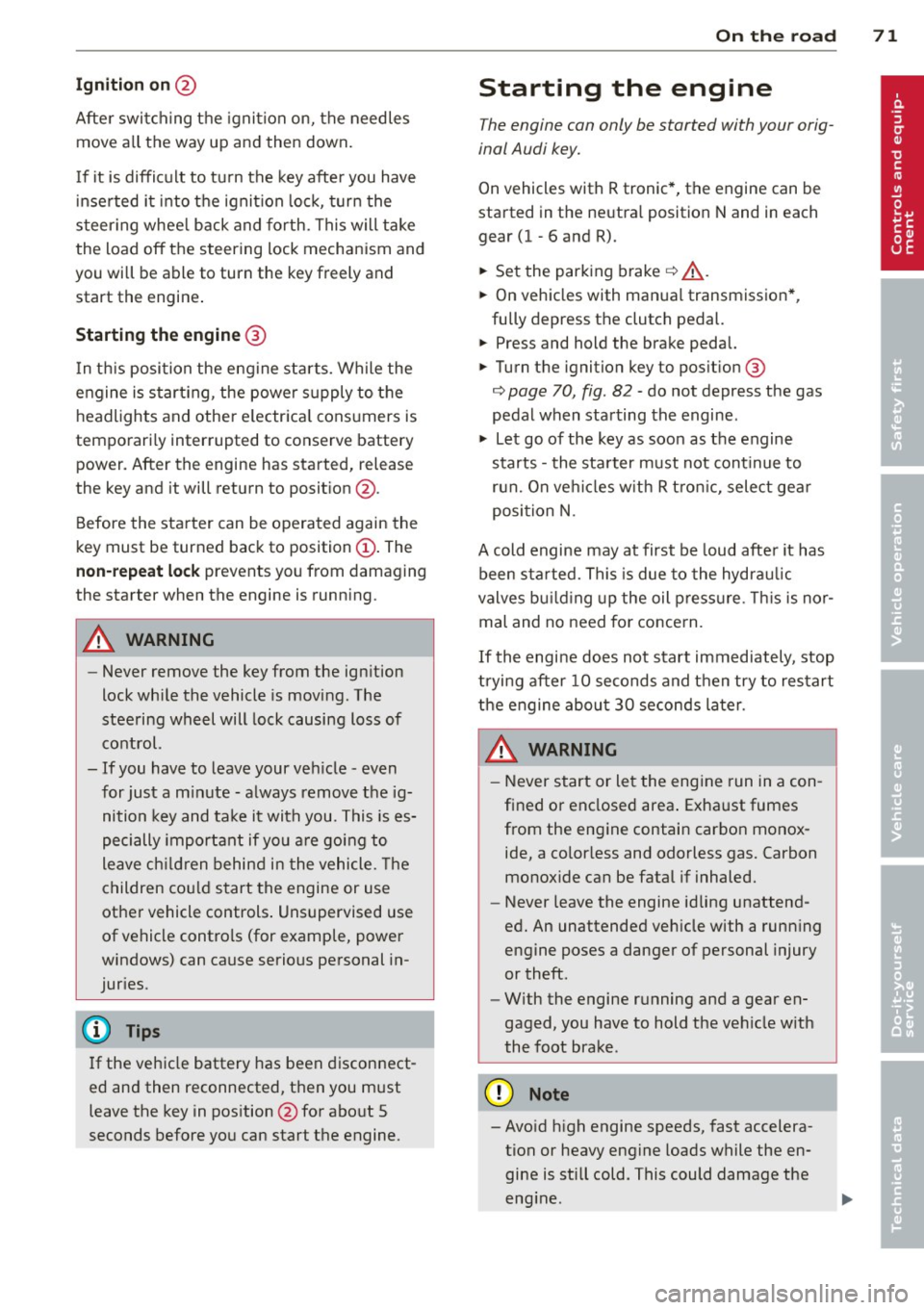
Ignition on @
Afte r switch ing the ignition on, the needles
move all the way up and then down .
I f it is difficult to turn the key afte r you have
i nse rted it into the ignit ion lo ck, tur n the
steer ing whee l back and forth. This will take
the load off the steering lock mechanism and
you will be able to turn the key freely and start the engine .
Starting the engin e@
In th is position the engine starts. While the
engine is start ing, the power s upply to the
headlights and other e lectrica l consumers is
temporari ly interrupted to conserve battery
pow er. Aft er the engine has started, release
the key and it will return to posit ion @.
Before the starter can be operated again the
key must be turned back to position@. The
non -repe at lock prevents you from damaging
the starter when the engine is runn ing .
A WARNING
-Never remove the key from the ign ition
lock whi le the vehicle is moving. The
steering wheel will lock causing loss of control.
- If you have to leave your veh icle -even
for just a m in ute - always remove the ig
nition key and take it with you. This is es
pecially important if you a re going to
leave c hildren behind in the vehicle. The
children co uld start the engine or use
other vehicle controls . Unsupervised use
of vehicle controls (for example, power
windows) can cause serious personal in
jur ies .
If the vehicle battery has been disconnect
ed and then reconnected, then you m ust
leave the key in pos ition @for abo ut 5
seconds before you can start the engine.
On th e ro ad 71
Starting the engine
The engine can only be started with your orig
inal Audi key.
On vehicles with R tronic *, the engine can be
start ed in the ne utra l position N and in each
gea r (1 - 6 and R).
.. Set the park ing brake ¢,&. .
.. On vehicles with man ua l transmission *,
fu lly depress the clutch pedal.
.. Press and hold the brake pedal.
.. Turn the ignition key to pos it ion ®
¢ page 70, fig. 82 - do not depress the gas
pedal when starting the engine .
.. Let go of the key as soon as the engine
starts - the sta rter must not cont inue to
r u n. On ve hicles w ith R t ro ni c, selec t gea r
posi tion N .
A cold engine may at first be loud afte r it has
been sta rted. This is due to the hydraulic
valves bu ild ing up the oil press ure . Thi s is nor
mal and no need for concern.
If the engine does not start immediately, stop
tryi ng after 10 seconds and then try to restart
the engine abou t 30 seconds later.
A WARNING
- Never start or let the eng ine run in a con
fined or enclosed area . Exha ust fumes
from the engine contain carbon monox
ide, a co lor less and odorless gas. Carbon
mo nox ide ca n be fatal if inhaled.
- Never leave the engine idling unattend
ed. An unattended veh icle with a runn ing
engine poses a danger of personal injury
or theft .
- With the engine r unning and a gear en
gaged, you have to hold the veh icle w ith
the foot brake .
(D Note
- Avoid h igh engine speeds, fast accelera
tion or heavy engine loads while the en
gine is still cold. This could damage the
eng ine .
Page 74 of 236
7 2 On the road
-The eng ine cann ot be started by pushing
or towing the vehicle.
@ For the sake of the env ironment
To avo id unnecessary engine wea r and to
red uce exhaust emissions, do not let your
vehicle stand and warm up . Be ready to
drive off immediately after starting your
veh icle.
Stopping the engine
On vehicles with R tronic*, the engine can be
turned off in the neutral position N and in
each gear (1 -6 and R).
.,. Turn the ign ition key to position ©
¢ page 70, fig. 82.
A WARNING
-Never turn off the eng ine unti l the vehi
cle has come to a complete stop.
- The brake booster and servotronic on ly
work when the engine is running. With
the ignition turned off, you have to apply
more force when stee ring or braking.
S ince you cannot steer and stop no rma l
ly, this can lead t o acciden ts and ser io us
injuries.
- If the engine has bee n under heavy load
fo r an ext ended period of time, heat
builds up i n the engi ne compa rtme nt af
ter the eng ine is sw itched off -there is a
risk of damaging the engine . Allow the
engine to continue to run at idle for a
sho rt time or drive until it has cooled
down before you turn it off¢
page 151.
- If the engine has been under heavy load
for an extended pe riod of time, it can be
come extreme ly hot. You should not park
your vehicle over easily combustible ob
j ects o r areas (e.g. g rass or leaves). There
i s a r isk of start ing a f ire.
(D Tips
After the engine has been switched off, the
radiator fan can continue to run for up to
10 minutes -even with the ignition switch
ed off. It can also sw itch on again after
some time if the coolant tempe rature rises
as the result of heat b uild up or if the en
g ine compartment is heated by the sun 's
r ays and the eng ine is hot.
Parking brake
Parking brake
When the parking brake is set, it prevents the
vehicle from rolling away unintentionally .
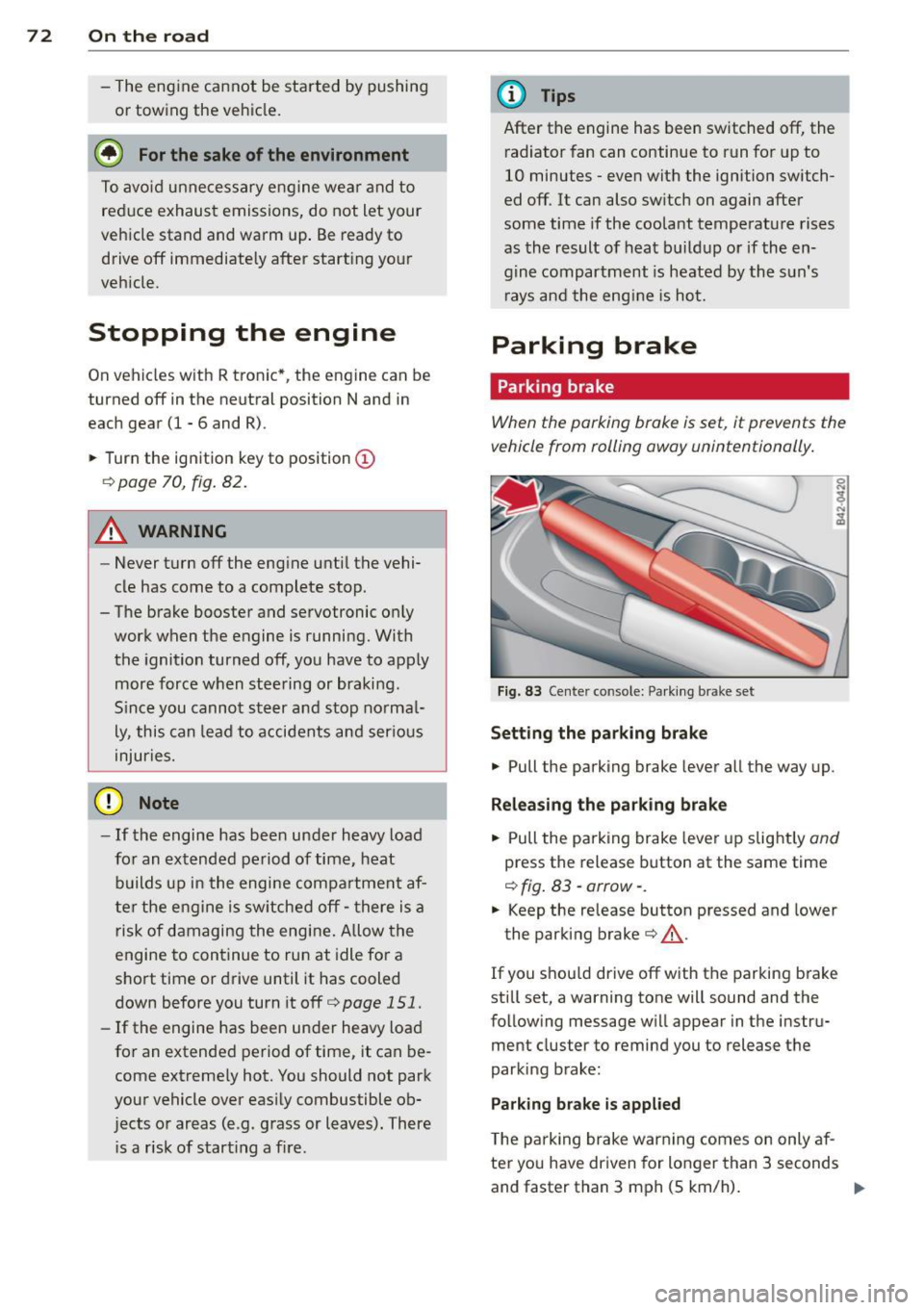
Fig. 83 Center console: Pa rk in g brake set
Setting the parking brake
.,. Pull the parking brake lever a ll the way up.
Releasing the park ing brake
.,. Pull the pa rking brake lever up slight ly and
press the release button at the same time
¢ fig . 83 -arrow- .
.,. Keep the release button pressed and lower
the parking brake¢&_.
If you s hou ld drive off with the parking b rake
st ill set, a warning tone will sound and the
following message wi ll appear in the instru
ment cluster to remind you to release the
parking brake:
Parking brake is applied
T he p arking brake war ning comes on only af
ter yo u have dr iven for longer than 3 seconds
and faster than 3 mph (5 km/h) . .,.
Page 75 of 236
The parking brake warning light_
(USA)/ . (CON) ill uminates when the parking
brake is set and you switch on the ignition .
A WARNING
-
Always release the parking brake com
pletely. A partially engaged brake will
overheat the rear brakes, reduce the ir ef
fectiveness and cause excess ive wear. This
cou ld lead to brake failure and an accident .
(D Note
Only after the ve hicle has come to com
plete stop, should you f irm ly set the park
ing brake and move the gearsh ift lever into
a gear .
Parking
To prevent a parked vehicle from rolling
away, there are a few things you should do.
.,. Stop the vehicle using the brake pedal.
.,. Set the parking brake firmly .
.,. Switc h off the engine .
" Engage a gear
~ &.-
What else you should do when parking
your v ehicle on an incline or decline
T u rn the steering wheel so that if the vehicle
should sta rt to ro ll, it will roll into the curb .
A WARNING
This is how yo u can reduce the risk of in
jury when le aving your veh icle.
- Never par k the vehicle whe re it ca n come
in contac t wi th dry grass, s pilled f uel or
any other flammable mater ials .
- Neve r allow anyone - especially small
ch ildren - to rem ain in the vehicle whe n
it is locked. Locked doors ma ke it mo re
difficult for rescuers to access the pas
senger compartment in the event of an
emergency. Danger to life!
- Never leave c hildren unsupervised in the
vehicle. Children co uld re lease the park
ing brake or move the gea rshift lever out
-
On th e ro ad 73
of gear . The vehicle cou ld sta rt to ro ll
away and cause an acc ident.
- No matte r what the season is, the tem
peratu re in a parked veh icle can reach
dangerous leve ls .
Starting on hills
App lies to vehicles : wit h hill ho ld assist
Hill ho ld assist makes it eas ier to start on
hills .
The system is activated when the brake peda l
is depressed
for a few seconds .
After releasing the brake pedal, the brake
power is held for a
brief moment to prevent
the ve hicle from rolling back when starting .
D uring this t ime, you can easily begin to move
your vehicle.
A WARNING
- If you did not begin moving immed iate ly
after rel easing the brake pedal, the vehi
cle could b eg in to roll bac kward unde r
cer ta in c ircu mstances . Dep ress the brake
pe dal imme diate ly or eng age the p arking
bra ke.
- If the engine sta lls, de pre ss the bra ke
pe dal imme diate ly or engage the pa rking
brake .
- T o prevent the vehicle from ro lling b ack
un intent iona lly when st arting in stop
an d-go tra ffic, keep the brake pedal de
pressed for a few seconds before d riving
off.
(D Tips
You can find o ut if yo ur vehicle is eq uipped
wi th "hi ll hol d assist" at an a uthorized Au
di dealer.
Page 76 of 236
7 4 On the road
Cruise control
Introduction
The cruise control system keeps the speed
constant.
The cruise control system makes it possible to
drive at a constant speed over 20 mph (US
model) or 30 km/h (Canadian model) . This is
true only to the extent that engine power or
engine braking effect allow . Using the system
takes the strain off the "gas pedal foot" - es
pecially on long trips.
In the control mode, the indicator light in the
instrument cluster is lit
aijj(1)~1~ (US model);II
(Canadian model).
The cruise control system automatically
switches itself off immediately under the fol
lowing conditions:
- Pressing the brake pedal.
- Pressing the clutch pedal.
A WARNING
-Always pay attention to traffic even when
the cruise control system is switched on.
You are always responsible for your speed and the distance between your ve
hicle and other vehicles.
- For safety reasons, the cruise control sys
tem should not be used in the city, in
stop-and-go traffic, on twisting roads
and when road conditions are poor (such
as ice, fog, gravel, heavy rain and hydro
planing) -risk of accident.
- Turn off the cruise control system tem
porarily when entering turn lanes, high
way exit lanes or in construction zones.
- Please note that inadvertently "resting"
your foot on the accelerator pedal causes
the cruise control system not to brake.
This is because the cruise control system
is overridden by the driver's acceleration.
(D Note
On manual transmission vehicles: If you
shift into neutral with the cruise control system switched on, always depress the
clutch
pedal! Otherwise the engine will
race and could be damaged as a result.
(D Tips
When driving on steep downward grades,
the cruise control system cannot keep the
speed constant. The vehicle's own weight increases the speed. Shift into a lower gear
in plenty of time or brake the vehicle with
the foot brake.
Saving the speed
The desired speed must be saved.
®-
Fig. 84 Cruise control system cont rols
.,. Drive at the speed you wish to set.
.,. Pull the lever to position@¢
fig. 84 to
switch the system on.
.,. Briefly press button @.
After the button @is released, the current ve
hicle speed is stored and maintained,
i. e. you
are driving in control mode .
Changing speed
The desired speed can be changed.
Faster
.,. Press lever up towards the 0 ¢ page 7 4,
fig . 84 .
.,. Release the lever to store the current speed .
Slower
.. Press lever down towards the O ¢ page 74,
fig . 84.
.,. Release the lever to store the current speed. IJ,,,