transmission AUDI R8 SPYDER 2014 User Guide
[x] Cancel search | Manufacturer: AUDI, Model Year: 2014, Model line: R8 SPYDER, Model: AUDI R8 SPYDER 2014Pages: 244, PDF Size: 61.06 MB
Page 85 of 244
@ Tips
The transmission cannot detect if the parking lock was re leased with the emergency
re lease. An error message appears in the
instrument cluster as soon as the trans
m iss ion requ ires the P posit ion but th is po
sition is not engaged .
Transm iss ion 83
Page 149 of 244
The effectiveness of the brakes can be reduced
when the vehicle is dr iven on a salt -covered
road and the brakes are not used. Likewise,
you clean
off accumulated salt coating from
brake discs and pads with a few ca utious ap
plications of the brake<=>,& .
Co rrosion
There may be a tendency for dirt to build up
on the brake pads and corrosion to form on
the discs if the car is not dr iven regularly or
only for short trips with little use of the
brakes.
If the brakes are not used frequently, or if cor rosion has formed on the discs, it is advisable
to clean
off the pads and discs by brak ing
firmly a few times from a moderately high
speed<=> ,&.
Fa ult s in th e bra ke s yste m
If you should notice a sudden increase in
brake pedal travel, then one of the two brake
circu its may have failed. Drive immed iately to
the nearest qualified workshop to have the
damage repa ired. Drive at reduced speed on
the way there and anticipate longer stopping
d istances and higher peda l pressure¢ _&.
Low brake fluid level
Malfunctions can occur in the brake system if
the brake flu id level is too low . The brake fluid
l eve l is monito red electronically .
Brake po wer ass ist un it
The brake power assist un it increases the
pressure that you generate with the brake
pedal. It works only when the eng ine is run
ning.
Br ake lining w ear statu s
Brake lining wear may be checked by visual in
spection of the condition of the brake pads
through the openings in the wheel. If neces
sary, the wheel may be removed for this in
spection
¢ page 214 .
Int ellig ent technolog y 147
_& WARNING
-You should perform braking maneuvers
for the purpose of cleaning the brake
system only if road conditions permit.
Other road use rs must not be put at risk -
you may ca use an accident!
- Before descend ing a steep grade, reduce
speed and sh ift transmission into a lower
gear o r lower dr iving range. Do not ride
the brakes or hold the pedal down too
long o r too often. Th is could cause the
brakes to get hot and diminish braking
efficiency .
- Do not " ride the brakes" by resting you r
foot on the pedal when you do not intend to brake. This may cause the brakes to
overheat, premature wear and increased
stopping distance.
- Under certain cl imatic and operat ing
conditions such as passing through wa
ter, dr iv ing in heavy rain o r after washing
the vehicle, the effectiveness of the brakes can be reduced. In winte r, ice can
accumu late on the bra ke pads, lin ings,
discs and drum s. Carefully app ly bra ke s
for a test. Brakes w ill dry and ice coa t
ings w ill be cleaned
off after a few care
fu l brake applications.
- Driving for an extended period of time on
salt -cove red roads without using your
brakes can a lso affect braking efficiency .
Clean
off accum ulated salt coating from
brake discs and pads with a few cautious
brake applications.
- I f you damage the front spoiler, or if you
install a different spoiler, be sure the air
f low to the front brakes is not obstruct
ed. Otherw ise the brake system could
overheat reducing the effectiveness of
the entire brake system.
- Failure of one b rake circuit will impai r
the braking capab ility result ing in an in
creased stopping distance. Avoid driving
the vehicle a nd have it towed to the near
est A udi dealer or qualified workshop .
- Never let the veh icle roll to a s top with
the engine shut
off. .,.
•
•
Page 155 of 244
Driving and
environment
Break-in period
A new vehicle must be broken in, and the
break-in period should be 1,500 miles (2,500
km) . Do not use full acceleration for the first
600 m iles (1,000 km) and do not exceed the
maximum engine speed of 6,000 rpm You
must also not use full accelerat ion between
600 and 1,200 mi les (1,000 to 2,000 km).
Fr om 1,200 to 1,500 miles (2,000 to 2,500
km), you can gradua lly increase maximum en
gine speed to 8,250 rpm for brief periods.
During the first hours of operation, there is
greater friction in the engine and the trans
mission than later when all the moving parts
have broken in.
The way you drive during the first 1,500 miles
(2,500 km) affects engine quality. If you drive
at moderate eng ine speeds thereafter, partic
ularly when the engine is cold, you reduce en
gine wear and increase the potential mileage
of the engine.
Do not drive at RPMs that are too
low. Shift
down when the engine is no longer running
"smoothly". Extreme ly high RPMs are gov
erned automatically.
Avoid damaging the
vehicle
When you are driving on poor roads, or over
curbs, steep ramps, etc., make certain that
low-lying parts such as spoilers and exhaus t
system parts do not bottom out and get dam
aged.
This is especially true for vehicles with low
slung chassis (sports chassis) and fully loaded
veh icles.
Driving and environment 153
Driving through water
on roads
Note the following to avoid vehicle damage
when driving through water, for example on
flooded roads:
- The water must not be any higher than the
bottom of the vehicle body.
- Do not drive faster than walking speed .
A WARNING
After driving through water, mud, slush,
etc ., the brakes may be slow to take effect
because of wet brake rotors and pads . Dry
the brakes first by braking carefully to re
store the full braking effect.
(D Note
Vehicle components such as the eng ine,
transmission, suspension or electrical sys
tem can be severe ly damaged by dr iv ing
th rough water.
(D Tips
- Check the depth of the water before d riv
ing through it.
- Do not stop the vehicle, drive in reverse
or switch the engine off when driving
through water.
- Keep in mind that oncoming vehicles
may create waves that ra ise the water
level and make it too deep for your vehi
cle to drive through safely.
- Avo id driving through salt water because
it can cause corrosion.
Catalytic converter
It is very important that your emission con
trol system (catalytic converter) is function
ing properly to ensure that your vehicle is run
ning in on environmentally sound manner .
.,. Always use lead-free gasoline ~ page 167,
Fuel supply .
.,. Never run the tank down all the way to emp-
~. ~
•
•
Page 167 of 244
(D Note
-Never use chemical solvents (e.g . lighter
flu id, turpentine), waxes, shoe polish or
s imilar products on Alcantara ® surfaces.
- To avoid damage, have stubborn stains
removed by a commercia l cleaning spe
cialist.
- Do not use brushes, stiff sponges or sim
ilarly abrasive cleaning aids.
Safety belts
Heavily soiled safety belts may not retract
properly .
~ Keep belts clean.
~ For cleaning, use a mild soap and water sol
ution. Let belts dry thoroughly and away
from direct sunlight.
~ Do not allow inertia reel safety belts to re
tract before they are completely d ry.
~ Check the condition of your safety belts reg
ularly.
A WARNING
Damaged safety belts can break in a crash.
- Any thing tha t might damage you r safety
belts co uld mean that you and your pas
sengers wo uld not be adequately pro
tected in an accident.
- Safety belt performance depends on cor rect installation . Never remove belts
from the vehicle to clean them.
- Do not use chemical cleaning agents,
bleach o r dyes . They have corrosive prop
erties which weaken the webbing.
- When cleaning your safety belts, inspect
them for damage. If you discover dam
age, see your authorized Audi dea ler.
- Always read and heed all WARNINGS and
the informat ion
¢page 156.
1) Use o nly the correct cleaning sol utio ns. Neve r use gas
oline or d iese l fuel.
Cleaning and protec tion
Engine compartment
Be especially careful when cleaning the en
gine compartment.
Corrosion p rotection
The engine compartment and transmission
have been corrosion-protected at the factory.
Good anti-corrosion treatmen t is very impor
tant, partic ularly in the winter.
If the vehicle
is frequently driven on salt treated roads, the
entire engine compartment and plenum panel
shou ld be thoroughly cleaned at the end of
winter and retreated to prevent salt damage .
At the same time, the underside of the veh icle
shou ld be washed as well.
If the engine compartment is cleaned at any
time with grease remov ing solutions
1>, or if
you have the engine washed, the a nti-corro
s ion treatment is almost always removed as
well.
It i s therefo re essentia l to have a long
lasti ng corrosion protection reapplied to all
su rfaces, seams, joints and components in the
engine compa rtment .
A WARNING
--=
Be aware: The eng ine compartment of any
motor veh icle is a potentially hazardous
area.
- Before work ing in the engine compart
ment, be sure to read the information
¢page 172.
-Before reaching into the front p lenum
panel, a lways remove the ignit ion key.
Otherwise, the w indshield wiper system
could u nintentionally be sw itched on,
possibly caus ing persona l injury from the
mov ing wipe r linkage.
- Never reach i nto the area around or
touch the rad iator fan. The aux iliary fan
is tempe ratu re controlled and ca n sw itch
on s uddenly -even when the ignition is
off. .,.
165
•
•
Page 175 of 244
WARNINGS. The engine compartment of any
vehicle is a hazardous area!
c::> &.
A WARNING
To help avoid injury, before you check any
thing under the engine compartment lid:
- Switch off the engine.
- Remove the ignition key.
- Apply the parking brake.
- Move selector lever of S tronic to "N"
(Neutral); put manual transmission in
Neutral.
- Always let the engine cool down. Hot
components will burn skin on contact.
- To reduce the risk of being burned, never
open the engine compartment lid if you
see or hear steam or coolant escaping
from the engine compartment. Wait un
til no steam or coolant can be seen or heard before carefully opening the en
gine compartment lid .
- Keep children away from the engine com
partment .
-Never spill fluids on hot engine compo
nents. They can cause a fire.
- Never open the coolant reservoir cap when the engine is still warm. The coolant system is pressurized and hot cool
ant could spray out.
- Protect your face, hands and arm from
steam or hot engine coolant by placing a
thick rag over the cap when you open the
coolant reservoir .
- Do not remove the engine cover under
any circumstances. This increases the
risk of burns.
- If work on the fuel system or the electri
cal system is necessary:
- Always disconnect the battery.
- Never smoke or work near heaters or
open flames. Fluids in the engine com
partment could start a fire.
- Keep an approved fire extinguisher im
mediately available.
- To avoid electrical shock and personal in
jury while the engine is running or being
started, never touch:
Checking and filling 173
- Ignition cables
- Other components of the high voltage electronic ignition system.
- If you must perform a check or repair
with the engine running:
- First, fully apply the parking brake,
move selector lever of S tronic to "N"
(Neutral); put manual transmission in
Neutral.
- Always use extreme caution to prevent
clothing, jewelry, or long hair from get
ting caught in the radiator fan, V-belts
or other moving parts, or from contact ing hot parts. Tie back hair before
starting, and wear no clothing that will hang or droop into the engine.
- Minimize exposure to emission and chemical hazards
c::> .&. .
A WARNING
California Proposition 65 Warning:
- Engine exhaust, some of its constituents,
and certain vehicle components contain
or emit chemicals known to the State of
California to cause cancer and birth de
fects and reproductive harm. In addition, certain fluids contained in vehicles and
certain products of component wear con
tain or emit chemicals known to the
State of California to cause cancer and birth defects or other reproductive harm.
- Battery posts, terminals and related ac
cessories contain lead and lead com
pounds, chemicals known to the State of
California to cause cancer and reproduc
tive harms. Wash hands after handling.
@ Note
When adding fluids, always make sure that
they are poured into the proper container
or filler opening, otherwise serious dam
age to vehicle systems will occur.
@ For the sake of the environment
To detect leaks in time, inspect the vehicle
floor pan from underneath regularly. If
you see spots from oil or other vehicle
IJI>
•
•
Page 176 of 244
17 4 Che cking and filling
fluids, have your vehicle inspected by an
authorized Audi dealer.
Closing the engine compartment lid
.. Make sure that the rear spo iler is retracted
¢ page 148.
.. Pull the engine compa rtment lid dow n until
the p ress ure from the struts is reduced .
.. Pr ess the eng ine compartment lid closed
¢ &_ .
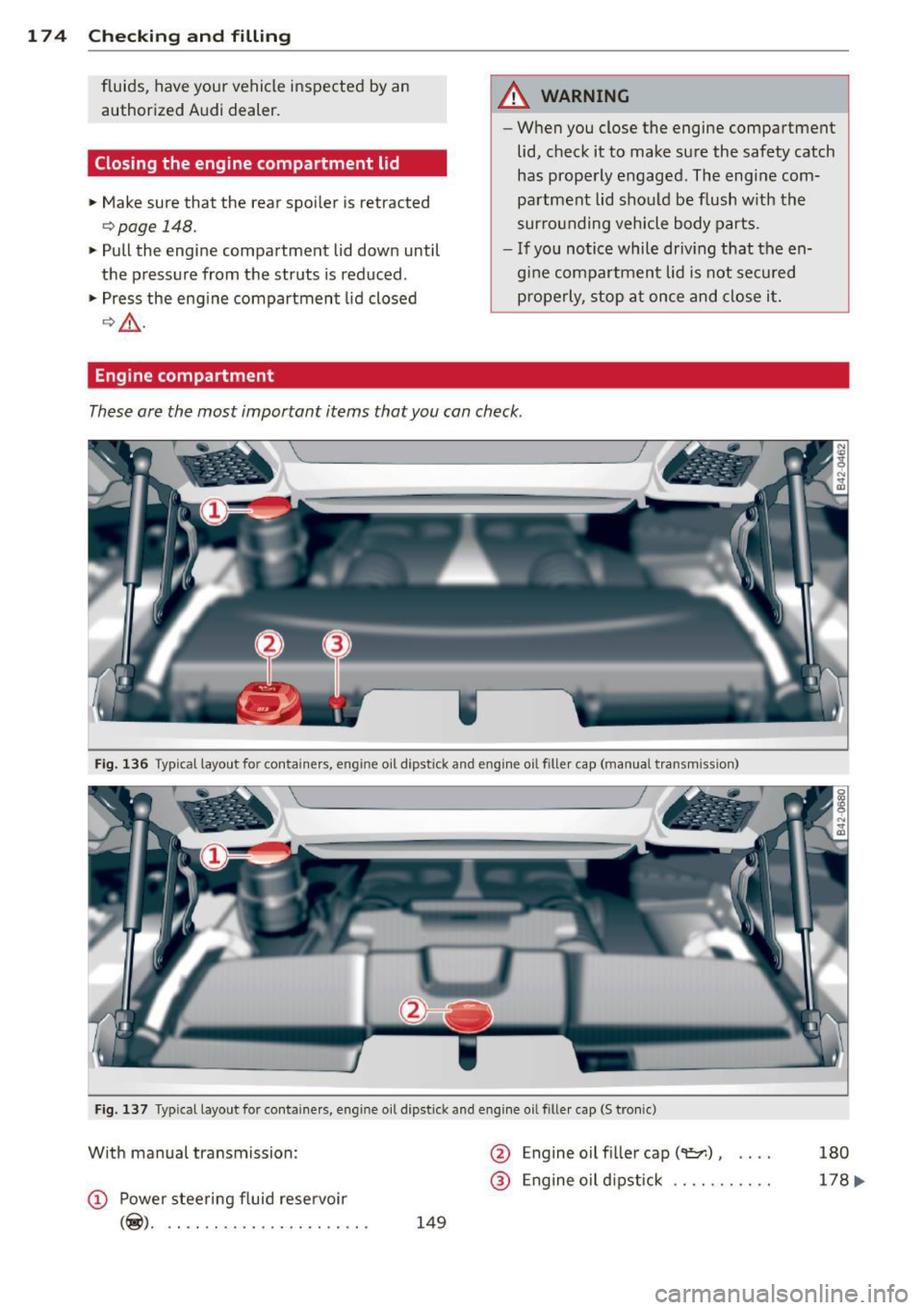
Eng ine compartment
A WARNING
-- W hen you close the engine compartment
lid, chec k it to make su re the safety catch
has prope rly engaged . The engine com
pa rtment lid s ho ul d be flush w ith the
sur ro un ding vehicle body parts .
- If you notice while driv ing t hat the en
g in e compartmen t lid is not secu red
p roperly, sto p at once and cl ose it .
These ore the most important items that you con check .
Fig . 136 Ty pica l layout fo r co ntai ners , e ngin e o il dipst ick and engin e o il fille r cap (man ual t ra n sm iss io n)
F ig . 1 37 Typ ica l layout fo r co ntain ers, e ngin e o il d ipstic k and e ng in e o il fill er cap (S t ro nic )
W ith manual transmission: @ Engine oil f iller cap(~) ,
(D Power steering f luid rese rvoir
@ E ngine o il d ipst ick ...... .... .
(@) ... .... .... ....... .. .. . 14 9
180
178 ....
Page 177 of 244
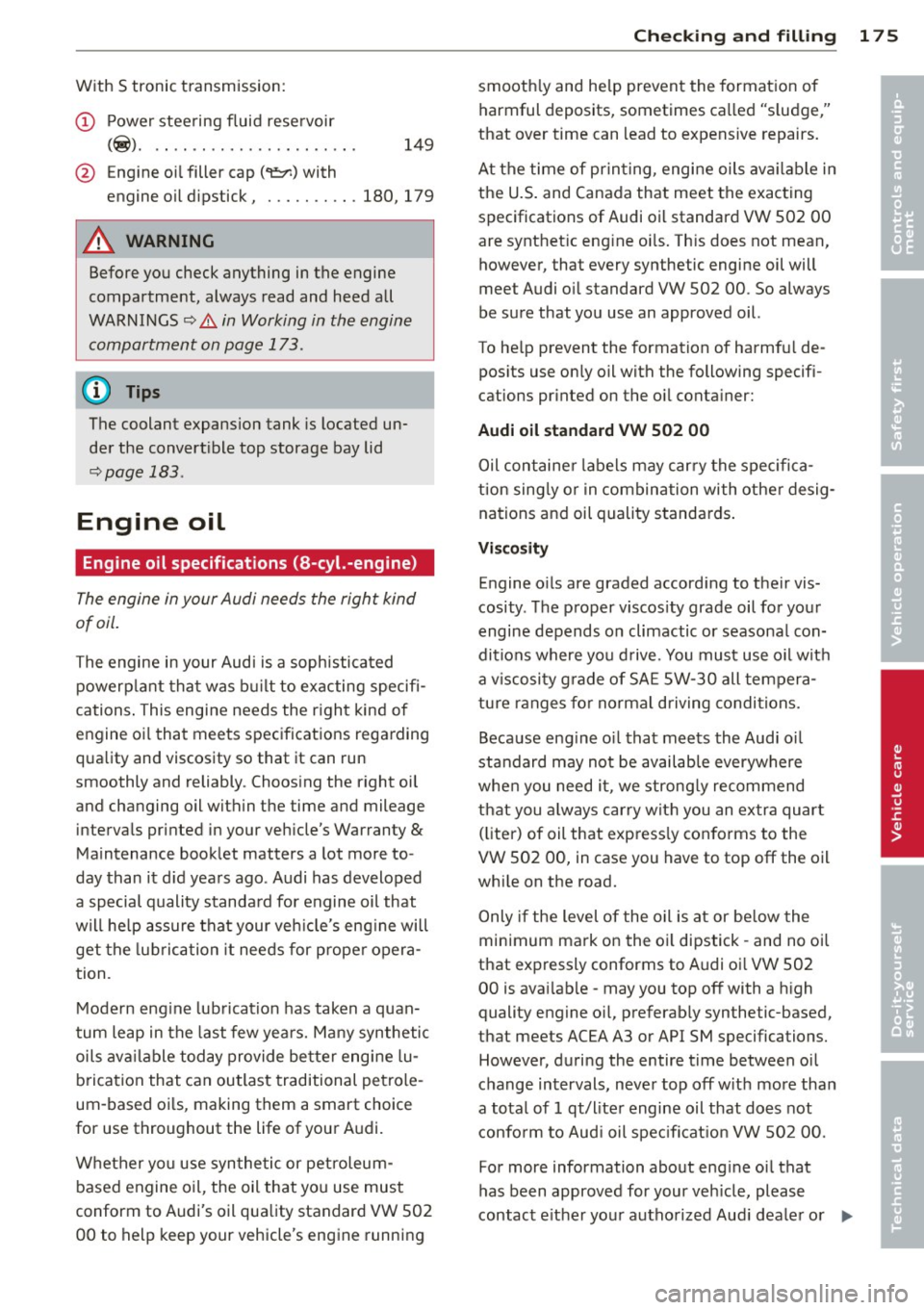
With S tronic transmission:
(!) Powe r steeri ng fluid rese rvoir
(~ ) ... .. ................ . . 149
@ Engine oi l filler cap ("1::r.) with
engine oil dipstick, ........ .. 180, 179
A WARNING
Before you ch eck a nything in the engine
compartment, always read and heed all
WARNINGS
~ A in Working in the engine
compartment on page 173.
@ Tips
The coolant expansion tank is located un
der the convert ible top storage bay lid
~page 183.
Engine oil
Engine oil specifications (8-cyl.-engine )
The engine in your Audi needs the right kind
of oil.
-
The engine in your Audi is a soph istica ted
powerp lant tha t was b uilt to exacting specifi
cations . This engine needs the r ight kind of
engine oi l that meets specifications regarding
qua lity and viscosity so that it can run
smoothly and reliably. Choos ing the right oi l
and changing oil within the time and mileage intervals printed in your veh icle's Warranty
&
Ma intenance book let matters a lot more to
day than it d id yea rs ago. A udi has developed
a special quality standa rd for engine oil that
will he lp assure tha t your veh icle's eng ine will
get the lubrica tion it needs for prope r opera
tion.
M odern eng ine lub rication has taken a quan
t um leap in the last few yea rs. Ma ny synthetic
oils availa ble today provide be tter eng ine lu
b rica tion that can outlast traditional pe trole
um-based o ils, making them a smart choice
for use throughout the life of your A udi.
Whether yo u use syn thetic or petroleum
based engine oil, the oil that yo u use must
conform to Audi's oil qua lity standard VW S02
00 to help keep your vehicle's engine running
Checkin g and fillin g 175
smooth ly and he lp prevent the format ion of
harmful deposits, sometimes ca lled "s ludge,"
that over time can lead to expensive repairs.
At the time of prin ting, engine oils ava ilab le in
t h e U.S . and Canada that meet the exacting
specifications of Audi oi l standard VW 502 00
are synt het ic eng ine oi ls . Th is does not mean,
however, that every synthetic engine oil will
meet Audi o il standard VW 502 00. So always
be sure that you use an approved oil.
To he lp prevent the formation of harmfu l de
pos its use on ly oil with the following specifi
cations pr inted on the o il conta iner:
Audi oil standard VW 502 00
Oil containe r labels m ay car ry the s peci fica
t ion sing ly or in combina tion wi th othe r desig
na tions and oil quality s tanda rds .
Viscosity
Engine o ils are graded accord ing to thei r vis
cosity. The p roper viscos ity grade oil fo r yo ur
engine depends o n climactic or seasona l con
ditions where yo u drive. You must use oil w it h
a v isco sity g rade of SA E 5W-30 all temper a
tu re ranges fo r norma l d riving condi tions.
Because eng ine o il that meets the Audi oil
sta ndard may not be availab le everyw here
whe n you need i t, we strong ly reco mmend
t h at you a lways carry wit h you an ex tra quart
( li ter) of oil that exp ress ly con forms to the
VW 502 00, in case you have to top
off the oil
whi le on the road.
Only if the level of the o il is at or be low the
minimum ma rk on the oi l dipstick -and no oil
that expressly conforms to Audi oi l VW 502
00 is ava ilab le -may you top
off with a h igh
quality eng ine o il, preferab ly synthetic-based,
that meets ACEA A3 or API SM specifications. However, duri ng the entire time between oi l
c h ange in tervals, neve r top
off w ith more tha n
a total of 1 qt/lite r engine oil that does not
confo rm to Aud i oil spec ifi cat ion VW 50 2 00.
For more information abo ut eng ine oi l that
has been approved for your veh icle, please
contact e ither you r autho rized Aud i dea le r o r ..,.
•
•
Page 182 of 244
180 Checking and filling
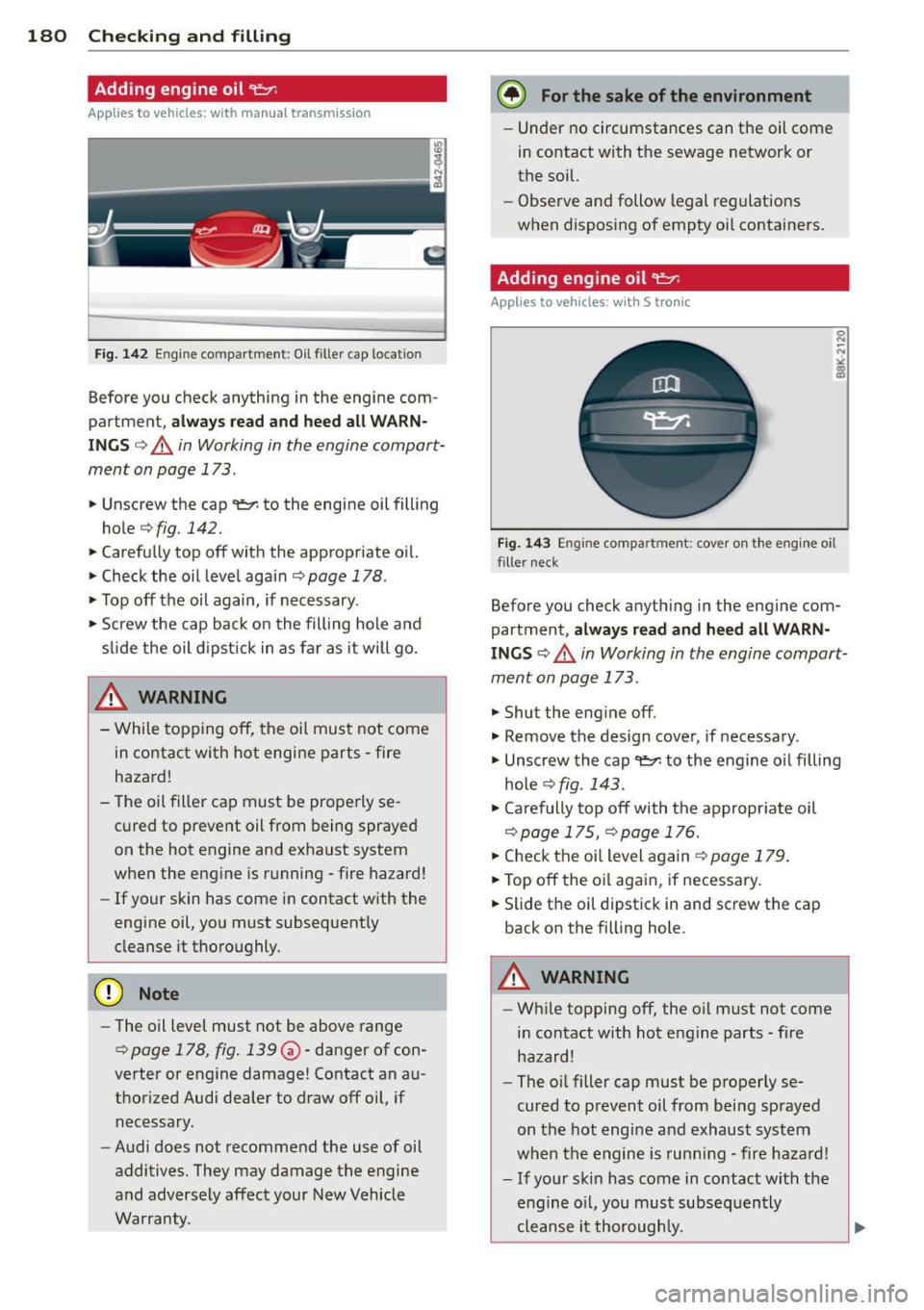
Adding engine oil "1::::1:
Appl ies to vehicles: with manual transmission
Fig. 142 Engine compartment : Oil filler cap locat io n
Before you check anything in the engine com
partment,
al ways r ead and h eed all WARN
INGS ¢ A in Working in the engine compart
ment on page 173 .
.. Unscrew the cap~ to the engine oil filling
hole¢
fig. 142 .
,. Carefully top off with the appropriate oil.
.. Check the oil level aga in ¢
page 178 .
,. Top off t he oil again, if necessary .
,. Screw the cap back on the filling hole and
s li de the oil d ipst ick in as far as it will go .
& WARNING
-While topping off, the oil mus t not come
in contact with hot engine parts -fire
hazard!
- The oil fil ler cap must be prope rly se
c u red to prevent oil from being sprayed
on the hot engine and exhaust system
when the eng ine is running - fire hazard!
- If your skin has come in contact w ith the
engine oil, you must subsequent ly
cleanse it thoro ughly.
(D Note
- The oil level must not be above range
c:> page 178, fig. 139 0 -danger of con
verter or engine damage ! Contact an au
thorized Audi dealer to draw off oil, if
necessa ry.
- Audi does not recommend the use of oil
additives. They may damage the engine
and adversely affect your New Vehicle
Warranty .
@) For the sake of the environment
-Under no circumstances can the oil come
in contact with the sewage network or
the soil.
- Observe and follow legal regulat ions
when disposing of empty oil containers.
Adding engin e oil "1::::1:
Applies to vehicles: with S tronic
Fig . 14 3 En gi ne compartment : cover on t he eng ine oi l
filler neck
Before you check anything in the engine com
partment,
always r ead and heed all WARN
INGS c:> A in Working in the engine compart
ment on page 173 .
,. Shut the eng ine off.
,. Remove the design cover, if necessary .
,. Unscrew the cap
't=7: to the engine o il filling
hole
c:> fig . 143.
,. Carefully top off with the appropr iate oil
c:> page 175, c:> page 176.
,. Check the oi l level aga in c:> page 1 79 .
.. Top off the oil again, if necessary.
.. Slide the oil dipstick in and screw the cap
back on the filling hole.
& WARNING
'-
- W hile topping off, the o il must not come
in contact with hot engine parts - f ire
hazard!
- The oi l filler cap must be p roperly se
cured to prevent oil from bei ng sprayed
on the hot engi ne and exhaust system
when the engine is runn ing - fire haza rd !
- If you r skin has com e in contact with the
engine o il, you must subsequently
cleanse i t thoroughly. ..,.
Page 214 of 244
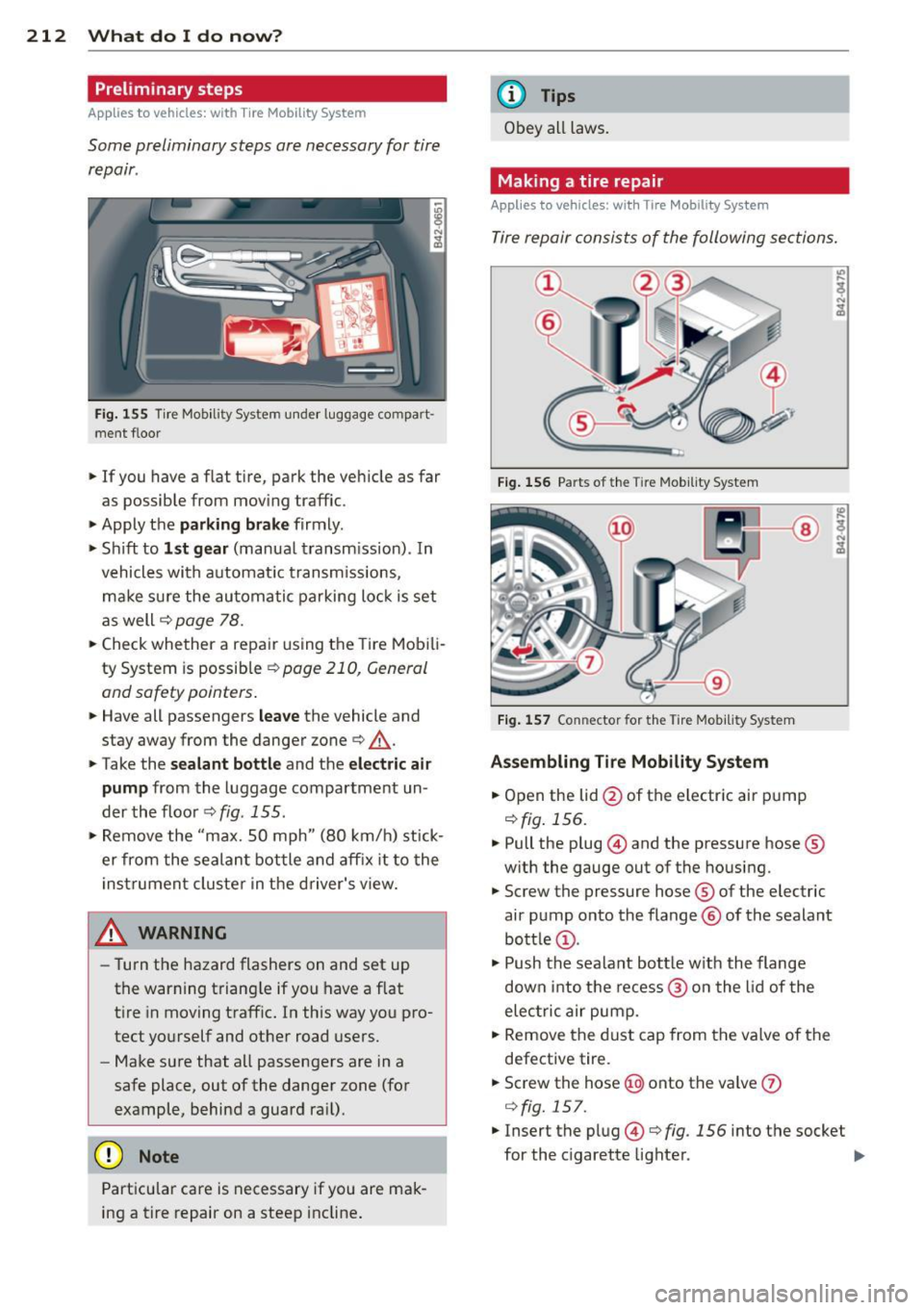
212 What do I do now?
Preliminary steps
Applies to vehicles: with T ire Mobility System
Some preliminary steps are necessary for tire
repair .
Fig. 155 Tire Mobili ty System under luggage co mpart
ment f loor
.,. If you have a flat tire, park the vehicle as far
as possible from mov ing traffic .
.,. Apply the
park ing brake firmly .
.,. Shift to
1st gear (manual transmission) . In
vehicles with a utomat ic transm iss ions,
make sure the automatic parking lock is set
as well
c::> page 78 .
.,. Check whether a repair using the Tire Mobili
ty System is possible
c::> page 210, General
and safety pointers .
.,. Have all passengers leave the vehicle and
stay away from the danger zone
c::> .&, .
.,. Take the sealant bottle and the electric air
pump from the luggage compartment un
der the floor
c::> fig. 155.
.,. Remove the "max. 50 mph" (80 km/h) stick
er from the sealant bottle and affix it to the
instrument cluster in the driver 's view.
A WARNING
- Turn the hazard flashers on and set up
the warning triangle if you have a flat
tire in moving traff ic. In this way you pro
tect you rs elf and other road users.
- Make sure that all passengers are in a
safe place, out of the danger zone (for
example, behind a guard ra il).
(D Note
Particular care is necessary if you are mak
ing a tire repair on a steep incline.
-
(D Tips
Obey all laws.
Making a tire repair
Applies to vehicles: with Tire Mobility System
Tire repair consists of the following sections.
Fig. 156 Parts of the Ti re Mobility System
Fig. 157 Conn ector for the Tire Mob i,lity System
Assembling Tire Mobility System
.,. Open the lid @of the electric air pump
c::> fig. 156 .
.,. Pull the plug© and the pressure hose ®
w ith the gauge out of the housing.
.,. Screw the pressure hose ® of the electric
air pump onto the flange @ of the sealant
bottle @.
.,. Push the sealant bott le w ith the flange
down into the recess @ on the lid of the
electric air pump.
.. Remove the dust cap from the valve of the
defective tire.
.. Screw the hose @onto the valve
(j)
c::>fig. 157.
.,. Insert the plug© c::> fig. 156 into the socket
for the cigarette lighter. .,,_
Page 216 of 244
214 What do I do now ?
@ Tips
After a tire repair, have the sealant bottle
rep laced at a dealership. This restores full
functionality to the Tire Mob ility System.
What should I be
aware of when
changing a tire?
Tires with unidirectional tread design
Tires with unidirectional tread design must be
mounted with their tread pattern pointed the
right direction .
A unidirectiona l tire can be ident ified by ar
row s on the sidewall,
which point in the direc
tion of the rotation. You must follow the
specified direction of rotat ion. This is necessa
ry in order for these t ires to develop the ir op·
timum characteristics regarding grip, road noise, wear, and hydroplani ng.
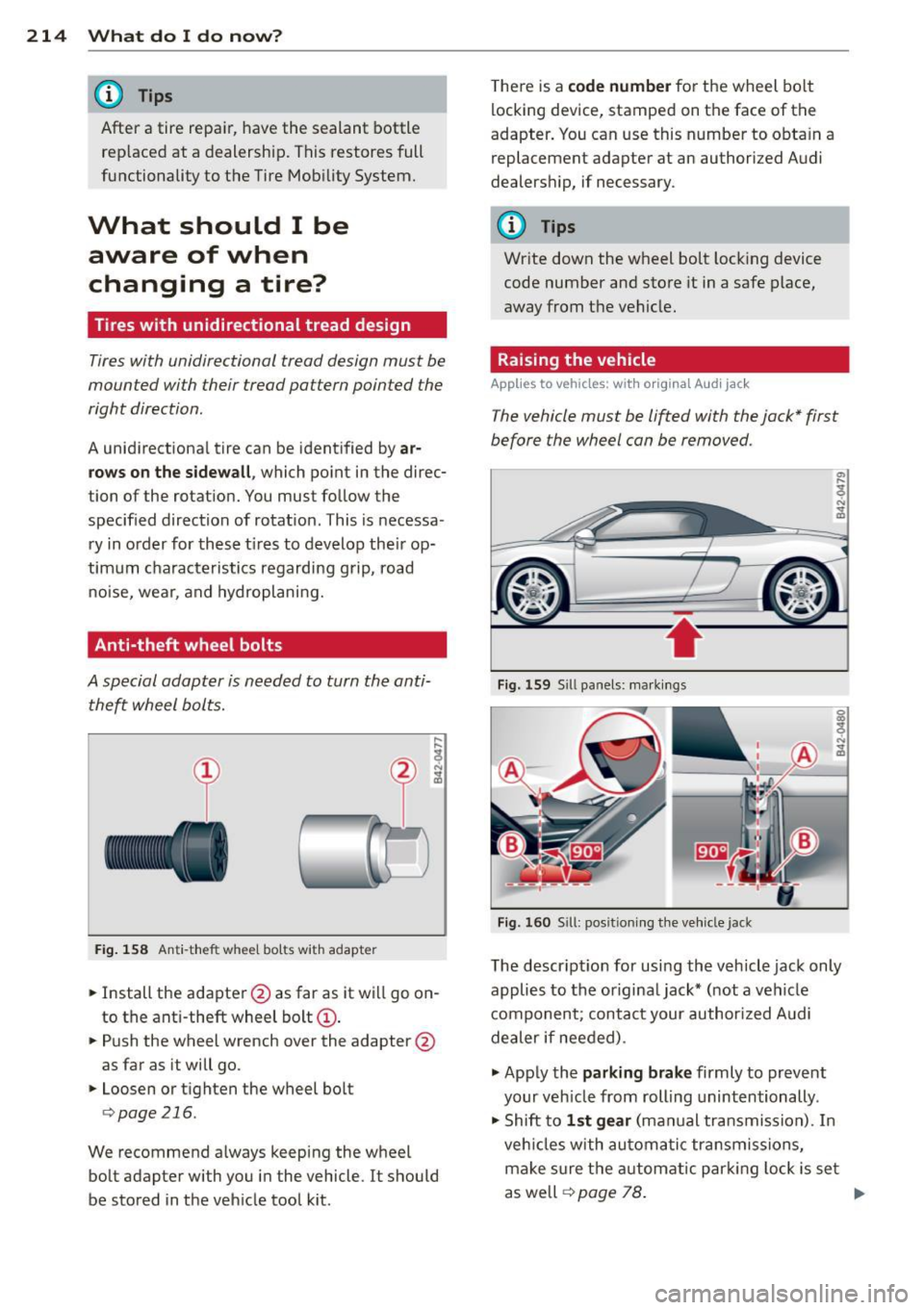
Anti-theft wheel bolts
A special adapter is needed to turn the anti· theft wheel bolts.
Fi g. 1 58 Anti-theft wheel bolts with adapter
., Install the adapter @as far as it wi ll go on
to the ant i-theft wheel bolt(!).
., Push the wheel wrench over the adapter @
as far as it wi ll go.
., Loosen or tighten the wheel bo lt
r=> page 216.
We recommend a lways keeping the wheel
bolt adapter w ith you i n the vehicle. It should
be stored in the veh icle tool k it. T
he re is a
c ode number for the wheel bo lt
locking device , stamped on the face of the
adapter . You can use this n umber to obta in a
replacement adapter at an authorized A udi
dealers hip, if necessary.
(0 Tips
Wr ite down the wheel bolt lock ing device
code number and store it in a safe place,
away from t he vehicle.
Raising the vehicle
Applies to vehicles: with orig inal Audi jack
The vehicle must be lifted with the jack* first
before the wheel can be removed.
•
F ig. 159 Sill panels: ma rk in gs
Fi g. 16 0 Sill: pos it io nin g th e ve hicle jack
The descr ip ti on for using the vehicle jack only
applies to the origina l jack* (not a vehicle
component; contact your author ized A udi
dealer if nee ded) .
., App ly the
parking brake firmly to prevent
your veh icle from rolling unintentionally.
., Shift to
1st gear (manual transmission). In
veh icles with au toma tic tra nsmissions,
make sure t he au tomatic par king lock is se t
as well
r=> page 78 . ..,